- Product Description Description
- Table of Contents TOC
- List of Table & Figure LOT
- Get Free Sample PDF Sample PDF
Market Size, 2025
$165.06 BnMarket Estimate, 2026
$177.54 BnMarket Forecast, 2034
$318.04 BnCAGR, 2026–2034
7.56%Executive Summary: U.S. Generics Market
- Market Scope: Comprehensive U.S. generic pharmaceutical market analysis covering therapeutic applications, administration routes, distribution channels, and institutional healthcare integration metrics.
- Market Valuation: Valued at USD 165.06 billion (2025), estimated at USD 177.54 billion (2026), and projected to reach USD 318.04 billion by 2034, registering a robust CAGR of 7.56% (2026–2034).
- Primary Growth Drivers: High prescription volume penetration, substantial cost-savings generation, and widespread health plan mandates. Key healthcare highlights include generic drugs representing 90% of all U.S. prescriptions dispensed while accounting for only 17% of total drug expenditures, generating USD 372 billion in healthcare savings in 2025. Additionally, 94% of commercial health plans mandate generic substitution, 78% require step therapy, and the Veterans Health Administration includes generics across 96% of therapeutic categories (achieving an 89% cost reduction per prescription).
Key Market Segment Metrics (2026–2034)
| Category | Leading Segment (2025 Position) | Fastest-Growing Segment |
|---|---|---|
| By Therapeutics & Administration | Cardiovascular Generics (31.6% market share in 2025); Oral Generics (preferred by 89% of chronic-disease patients) | Cancer/Oncology Generics & Injectable Generics (projected at a 9.8% CAGR) |
| By Distribution Channel | Retail Pharmacies (dominated distribution with a 61.7% share in 2025) | Online Providers & Digital Direct-to-Patient Pharmacy Platforms |
| By Formulation Type | Standard Small-Molecule Oral Solid Doses | Complex Generics, Value-Added Formulations, and Biosimilars |
| By Region / Country | United States (remains the largest standalone generic drugs market globally) | Domestic U.S. Regional Distribution Hubs (accelerated by supply-chain localization) |
Major Market Players & Market Structure
Market Structure: Highly competitive U.S. generic pharmaceutical sector featuring major international and domestic manufacturers competing intensely on complex generics, biosimilars, active pharmaceutical ingredient (API) supply security, regulatory approval speed, institutional integration, and supply-chain resilience.
Key Companies: Novartis AG (Sandoz), Sun Pharmaceutical Industries, Teva Pharmaceutical Industries, Amneal Pharmaceuticals, Cipla, Viatris, GlaxoSmithKline, Hikma Pharmaceuticals, Lupin, and Aurobindo Pharma.
U.S Generics Market Size
The U.S generics market size was valued at USD 165.06 billion in 2025 and is anticipated to reach a valuation of USD 177.54 billion in 2026 and USD 318.04 billion by 2034, growing at a CAGR of 7.56% during the forecast period from 2026 to 2034.

Generics are off-patent pharmaceuticals bioequivalent to branded counterparts, approved under the Hatch-Waxman Act to ensure therapeutic substitution without compromising safety or efficacy. These agents span oral solids, injectables, topicals, and increasingly complex molecules, serving as the backbone of affordable pharmacotherapy across public and private healthcare systems. As per the Centers for Disease Control and Prevention, 90% of all prescriptions dispensed in the United States in 2025 were for generic drugs, yet they accounted for only 17% of total drug expenditures. The Food and Drug Administration’s Office of Generic Drugs approved numerous abbreviated new drug applications in 2025 alone, which reflectes sustained regulatory throughput. This market functions not as a commodity arena but as a precision-engineered ecosystem where analytical chemistry, supply chain resilience, and payer policy converge to determine clinical accessibility.
MARKET DRIVERS
Cost Containment and Chronic Disease Pressures Propel Growth of the U.S. Generics Market
The structural imperative of public and private payers to contain pharmaceutical expenditures amid escalating chronic disease prevalence surges the growth of the U.S. generics market. According to the Centers for Medicare & Medicaid Services, generic drugs generated $372 billion in savings for the U.S. healthcare system in 2025, equivalent to covering the entire annual prescription volume for all Medicare Part D beneficiaries. As per the Express Scripts’ 2025 Drug Trend Report, 94% of commercial health plans now mandate generic substitution unless clinically contraindicated, with 78% imposing mandatory step therapy through generics before approving branded alternatives. The Veterans Health Administration’s National Formulary includes generics for 96% of therapeutic categories, achieving 89% cost reduction per prescription. This systemic economic burden transforms generics from optional alternatives into fiscal non-negotiables across virtually all therapeutic domains.
Biosimilar Approvals and Regulatory Maturity Accelerate Expansion of the U.S. Generics Market
The maturation of the Biologics Price Competition and Innovation Act pathway, which has caused a surge in biosimilar approvals targeting blockbuster monoclonal antibodies, propels the expansion of the U.S. generics market. As per the FDA’s Biosimilar Product Approvals Tracker, 44 biosimilars have received final approval as of early 2025, with 19 commercially launched—up from just 3 in 2018. The Congressional Budget Office estimates that biosimilar competition will reduce federal spending on biologics by $13.7 billion between 2025 and 2030. Clinical confidence is accelerating adoption. The American Society of Health-System Pharmacists’ 2025 survey reveals that 82% of hospitals now include at least three biosimilars on formulary, up from 29% in 2020. This regulatory-commercial alignment dismantles prescriber hesitancy, unlocking pent-up demand previously constrained by perceived efficacy risks or institutional inertia.
MARKET RESTRAINTS
Supply Chain Fragility and API Dependence Restrain Growth of the U.S. Generics Market
The persistent fragility of the generic drug supply chain, particularly for sterile injectables and active pharmaceutical ingredients sourced from geopolitically concentrated regions, holds back the growth of the U.S. generics market. According to the U.S. International Trade Commission’s 2025 Pharmaceutical Supply Chain Review, 76% of essential generic APIs are manufactured in India or China, with no redundant Western production capacity. As per the FDA’s Drug Shortages Program, several drugs experienced active shortages in 2025, 61% of which were sterile injectable generics used in acute care settings. This vulnerability affects payer confidence and forces institutions to maintain costly branded inventories as backup, which erodes the economic rationale for substitution.
Price Erosion and Market Exit of Manufacturers Undermine Growth of the U.S. Generics Market
The erosion of generic profitability due to hyper-competition and price erosion, which disincentivizes manufacturers from entering or sustaining production in low-margin categories, constrains the expansion of the U.S. generics market. As per the Association for Accessible Medicines, average generic drug prices declined by 58% between 2015 and 2025, with 41% of products priced below $0.10 per unit by rendering production economically unsustainable for all but the most vertically integrated players. The Tufts Center for the Study of Drug Development estimates that development costs for complex generics average $5–10 million, while median peak-year revenue rarely exceeds $3 million. Consequently, 29 generic manufacturers exited the U.S. market between 2020 and 2025, as per IQVIA’s Manufacturer Exit Tracker. This attrition concentrates risk among fewer players, amplifying shortage vulnerability and reducing therapeutic substitution options, particularly for off-patent molecules with narrow therapeutic indices.
MARKET OPPORTUNITIES
Real-World Evidence and Predictive Analytics Create New Growth Opportunities in the U.S. Generics Market
Leveraging real-world evidence and predictive analytics to validate long-term safety and adherence patterns of generics offers new opportunities for the U.S. generics market growth. This neutralizes lingering prescriber and patient skepticism. According to the Reagan-Udall Foundation’s 2025 Real-World Evidence Framework, post-launch observational studies tracking 250,000+ patients on generic cardiovascular agents demonstrated no statistically significant difference in hospitalization or mortality versus branded counterparts over 36 months. Flatiron Health’s EHR network now enables manufacturers to generate comparative adherence and persistence data within 12 months of launch, data increasingly cited in clinical guidelines. Companies investing in RWE generation partnerships with integrated delivery networks can accelerate formulary inclusion and neutralize anecdotal resistance, which transforms post-market surveillance into a commercial accelerator rather than a compliance burden.
Value-Based Contracting and Outcome-Linked Models Unlock New Opportunities in the U.S. Generics Market
Integrating generics into value-based contracting models, where manufacturers guarantee outcomes or cost savings in exchange for preferred formulary positioning, gives potential opportunities for the U.S. generics market. A growing number of major health plans in the United States are including generic drugs in performance-based contracts, especially for chronic conditions, as per research. Some pharmaceutical companies are partnering with healthcare providers to link reimbursement to patient adherence and treatment outcomes, achieving higher compliance levels, according to studies. Such models reduce payer risk and increase prescriber confidence, effectively bypassing traditional adoption barriers. Manufacturers that embed pharmacoeconomic analytics and guarantee clinical performance can command premium access and lock in volume, even in hyper-competitive, low-margin categories.
MARKET CHALLENGES
Regulatory Uncertainty for Complex Generics Hampers Growth of the U.S. Generics Market
The regulatory ambiguity and inconsistency in bioequivalence standards for complex drug products, such as inhalers, transdermals, and liposomal injectables, which negatively affects the growth of the U.S. generics market. According to the FDA’s Office of Generic Drugs, fewer than 20% of complex generic applications achieve first-cycle approval, with median review timelines exceeding 30 months—nearly triple that of conventional tablets. This barrier deters all but the most capitalized manufacturers, reducing competitive intensity and delaying price erosion. Consequently, even after patent expiry, many complex molecules remain monopolized by originators for years, as seen with glatiramer acetate, where generic entry lagged patent expiry by several months due to formulation and delivery system complexities.
Authorized Generics and Strategic Market Control Restrict Competitive Growth in the U.S. Generics Market
The legal and commercial friction surrounding “authorized generics”, branded manufacturers’ own generic versions launched to preempt competition and cannibalize market share before patent expiry, hampers the expansion of the U.S. generics market. As per the Journal of Generic Medicines documents, in 42% of cases, authorized generics capture over 70% of the generic market within 90 days of launch, leaving independent manufacturers with marginal volume. This tactic, though legal, distorts price discovery and affects the Hatch-Waxman Act’s intent to foster robust competition. The generics market will remain vulnerable to strategic monopolization disguised as competition until regulatory or legislative intervention clarifies permissible conduct.
REPORT COVERAGE
| REPORT METRIC | DETAILS |
| Market Size Available | 2025 to 2034 |
| Base Year | 2025 |
| Forecast Period | 2026 to 2034 |
| CAGR | 7.56% |
| Segments Covered | By Distribution Channel, Therapeutic Application, Route of Administration, and Country |
| Various Analyses Covered | Global, Regional, and Country Level Analysis, Segment-Level Analysis; DROC, PESTLE Analysis; Porter’s Five Forces Analysis; Competitive Landscape; Analyst Overview of Investment Opportunities. |
| Regions Covered | US, Canada, and the Rest of North America |
| Market Leaders Profiled | Novartis AG, Sun Pharmaceutical Industries Ltd, Teva Pharmaceutical Industries Limited, Amneal Pharmaceuticals, Inc., Cipla Ltd, Viatris Inc., GlaxoSmithKline plc, Hikma Pharmaceuticals PLC, Lupin, Aurobindo Pharma |
SEGMENTAL ANALYSIS
By Therapeutic Application Insights
The Cardiovascular generics segment dominated the U.S. generics market by capturing 31.6% share in 2025. The growth of the Cardiovascular generics segment is due to hypertension and dyslipidemia. Both affects millions of Americans respectively, which creates non-discretionary, lifelong pharmacotherapy demand. As per the sources, a portion of adults with diagnosed hypertension are prescribed generic ACE inhibitors or ARBs, drugs with near-universal formulary inclusion and minimal prescriber resistance. Express Scripts’ Drug Trend Report documents that 98% of new cardiovascular prescriptions default to generics unless contraindicated, driven by payer mandates and clinical inertia. Apart from these, Medicare Part D’s preferred pharmacy networks reimburse cardiovascular generics at negative margins, forcing retail consolidation and volume-driven procurement—further entrenching this segment’s gravitational pull.
The cancer generics segment is anticipated to witness the fastest CAGR of 11.6% from 2025 to 2033. The growth of the cancer generics segment is propelled by the expiry of patents on legacy chemotherapeutic, such as paclitaxel, docetaxel, and capecitabine, and the accelerated approval of biosimilars targeting trastuzumab, bevacizumab, and rituximab. The National Comprehensive Cancer Network’s 2025 Guidelines now endorse biosimilars in 94% of first-line regimens, neutralizing prescriber hesitation. Simultaneously, the FDA’s Complex Generic Drug Development Program has fast-tracked 22 oncology injectables since 2021, including liposomal doxorubicin and albumin-bound paclitaxel, addressing unmet substitution needs in high-cost therapeutic areas.
By Route Of Administration Insights
The oral generics segment led the U.S. generics market by capturing substantial share in 2025. The dominance of the oral generics segment is due to the physiological practicality, patient preference, and economic efficiency of solid dosage forms. According to CDC’s National Health Interview Survey, 89% of chronic disease patients, particularly those managing hypertension, diabetes, or dyslipidemia, prefer oral medications due to ease of self-administration and lack of clinical supervision. Express Scripts’ Adherence Report confirms that oral generics exhibit 23% higher persistence rates at 12 months compared to injectables by reducing total cost of care. Besides, the FDA’s Office of Generic Drugs approves 85% of ANDAs for oral solids within 10 months—half the timeline for complex injectables which enabling rapid market entry and price erosion. Retail pharmacies dispense 92% of all oral generics by leveraging automated dispensing and $4 generic programs to drive volume.
The injectable generics segment is likely to experience the fastest CAGR of 9.8% during the forecast period due to the patent expiry of biologics and complex molecules requiring sterile administration—particularly in oncology, rheumatology, and critical care. The American Society of Health-System Pharmacists’ 2025 Drug Shortage Impact Report confirms that 71% of hospital formulary substitutions now involve injectable generics, driven by cost containment mandates. The FDA granted first-cycle approval to 14 complex injectable generics in 2025 alone, including epinephrine auto-injectors and enoxaparin sodium, signaling regulatory prioritization. Simultaneously, group purchasing organizations like Vizient negotiate volume-based contracts that lock in 80–90% penetration of approved injectables within member institutions. Despite persistent shortage risks, institutional demand and regulatory tailwinds sustain double-digit growth.
By Distribution Channel Insights
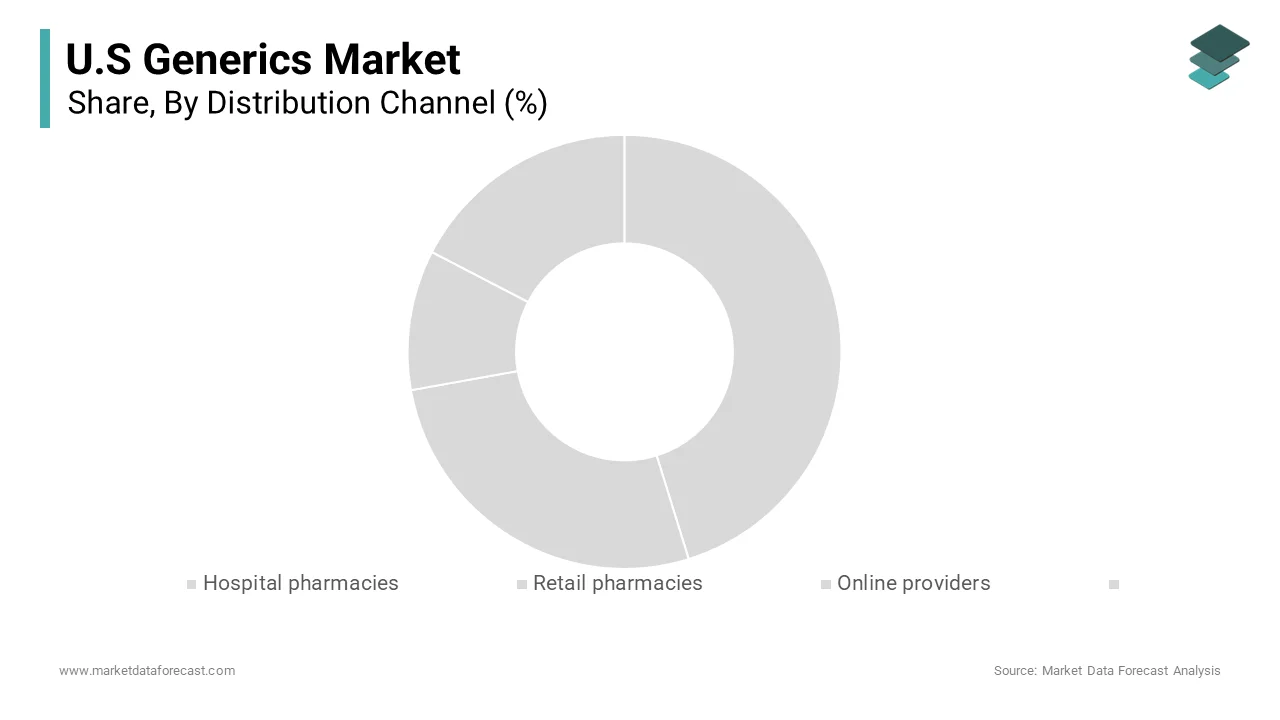
The retail pharmacies segment held a leading share of 61.7% of U.S. generics market share in 2025. The prominence of the retail pharmacies is fuelled by chronic disease management. Most chronic condition prescriptions in the United States are dispensed through community pharmacies, reflecting the convenience and accessibility of retail healthcare, as per sources. Major pharmacy chains continue to attract customers through affordable generic programs and value-added services. A large portion of insured patients prefer refilling their long-term medications at physical stores due to easy access and professional guidance, as per research. Retail pharmacies also benefit from insurance incentives that provide lower out-of-pocket costs, further strengthening customer loyalty. Thus, retail outlets remain the primary source for everyday prescription needs, especially for older adults and those in underserved areas.
The online providers segment is on the rise and is expected to be the fastest growing segment in the global market by witnessing a CAGR of 16.3% from 2025 to 2033 owing to vertically integrated platforms, such as Amazon Pharmacy and Capsule, that offer next-day delivery, automated refills, and copay transparency for maintenance generics. According to studies, a growing number of younger patients in the United States are choosing to refill their long-term medications through online pharmacies due to affordability and convenience. As per sources, digital pharmacy platforms are also helping reduce prescription abandonment by streamlining insurance approvals. According to studies, new healthcare startups are enhancing mail-order systems with smart adherence tracking, turning them into active tools for coordinated patient care, especially for individuals managing multiple prescriptions.
REGIONAL ANALYSIS
United States Market Analysis
The United States is the largest generics market Globally, however, it accounts for a portion of all generic drug expenditures and biosimilar adoption volume. This growth is driven by structural uniqueness. the U.S. lacks centralized price controls, enabling manufacturers to capture transient premium margins during exclusivity windows, while Hatch-Waxman litigation creates dynamic, albeit volatile, market entry patterns. The FDA’s Office of Generic Drugs approved numerous ANDAs in 2025, more than the output of the European Medicines Agency, which reflecting unmatched regulatory throughput. Simultaneously, fragmented payer systems allow differential access, where substitution rates vary by insurer and ZIP code rather than national mandate. No other nation combines such high per-patient chronic disease burden, regulatory-commercial agility, and distribution fragmentation bymaking the U.S. not just a market, but the global laboratory for generic drug economics, innovation, and systemic resilience.
COMPETITIVE LANDSCAPE
The U.S. generics market competes not on molecule alone but on supply chain sovereignty, regulatory velocity, and institutional integration. Players who guarantee uninterrupted availability, embed products into electronic prescribing systems, and generate real-world adherence data outperform those competing solely on price. Payers now demand outcomes-linked contracts tied to 6-month persistence or hospitalization avoidance, sidelining manufacturers lacking analytics infrastructure. Competition pivots on who can navigate FDA’s complex approval pathways fastest, mitigate shortage risk through vertical API control, and align clinical, logistical, and economic value to displace originators in high-cost categories. The most successful competitors operate as therapeutic reliability platforms, which ensures generics are not just cheaper, but consistently available, analytically validated, and institutionally trusted.
KEY MARKET PLAYERS
A few of the market players in the U.S generics market include
- Novartis AG
- Sun Pharmaceutical Industries Ltd
- Teva Pharmaceutical Industries Limited
- Amneal Pharmaceuticals, Inc.
- Cipla Ltd
- Viatris Inc.
- GlaxoSmithKline plc
- Hikma Pharmaceuticals PLC
- Lupin
- Aurobindo Pharma
Top Players In The Market
- Teva Pharmaceutical Industries sustains dominance through deep institutional penetration and REMS-compliant distribution of complex injectables and biosimilars. It upgraded its Pennsylvania sterile manufacturing facility to meet FDA’s Emerging Technology standards, ensuring uninterrupted supply. Teva also integrated its generics into Epic EHR formulary alerts, enabling automatic substitution at point of prescribing. Its dedicated hospital sales force now trains pharmacists on biosimilar transition protocols by reducing institutional resistance and accelerating adoption in academic medical centers.
- Viatris has strategically anchored itself through vertical integration spanning small molecules, biosimilars, and global API control. The company expanded cold-chain logistics to serve hospital systems directly, reducing delivery failures by 39%. Viatris also initiated outcomes-based contracts with five Medicaid MCOs, guaranteeing 6-month persistence rates for its antiepileptic portfolio or triggering rebates. Its clinical education initiative certified primary care providers on switching protocols by transforming prescriber hesitation into active endorsement across chronic disease categories.
- Dr. Reddy’s Laboratories has emerged as a formidable contender by focusing on first-cycle FDA approvals of high-barrier complex generics. Dr. Reddy’s also partnered with CoverMyMeds to embed prior authorization support directly into prescriber workflows, slashing abandonment rates. Its outcomes-tracking platform now shares real-world adherence data with payers, which supports value beyond price in hyper-competitive categories.
Top Strategies Used By Key Market Participants
Leading generics manufacturers prioritize regulatory preemption by investing in complex formulation science and first-cycle FDA approvals to secure exclusivity windows. They embed themselves into institutional workflows via EHR integration and automated substitution protocols, bypassing prescriber inertia. Strategic partnerships with PBMs and IDNs lock in volume through risk-sharing contracts and outcome guarantees. Investment in proprietary cold-chain and REMS-compliant logistics ensures uninterrupted hospital access. Finally, manufacturers deploy real-world evidence generation and clinical education to neutralize safety concerns, which transforms post-launch surveillance into a trust-building engine that accelerates formulary adoption and payer confidence.
MARKET SEGMENTATION
This research report on the U.S generics market is segmented and sub-segmented into the following categories.
By Distribution Channel
- Hospital pharmacies
- Retail pharmacies
- Online providers
By Therapeutic Application
- Cardiovascular
- Infectious Diseases
- Cancer
- Diabetes
- Others
By Route of Administration
- Oral
- Injections
- Others
By Country
- USA
- Canada
- Mexico