- Product Description Description
- Table of Contents TOC
- List of Table & Figure LOT
- Get Free Sample PDF Sample PDF
Market Size, 2025
$5.53 BnMarket Estimate, 2026
$6.17 BnMarket Forecast, 2034
$14.80 BnCAGR, 2026–2034
11.56%U.S. Hearing Aid Market Size, Growth, Trends & Forecast (2026–2034)
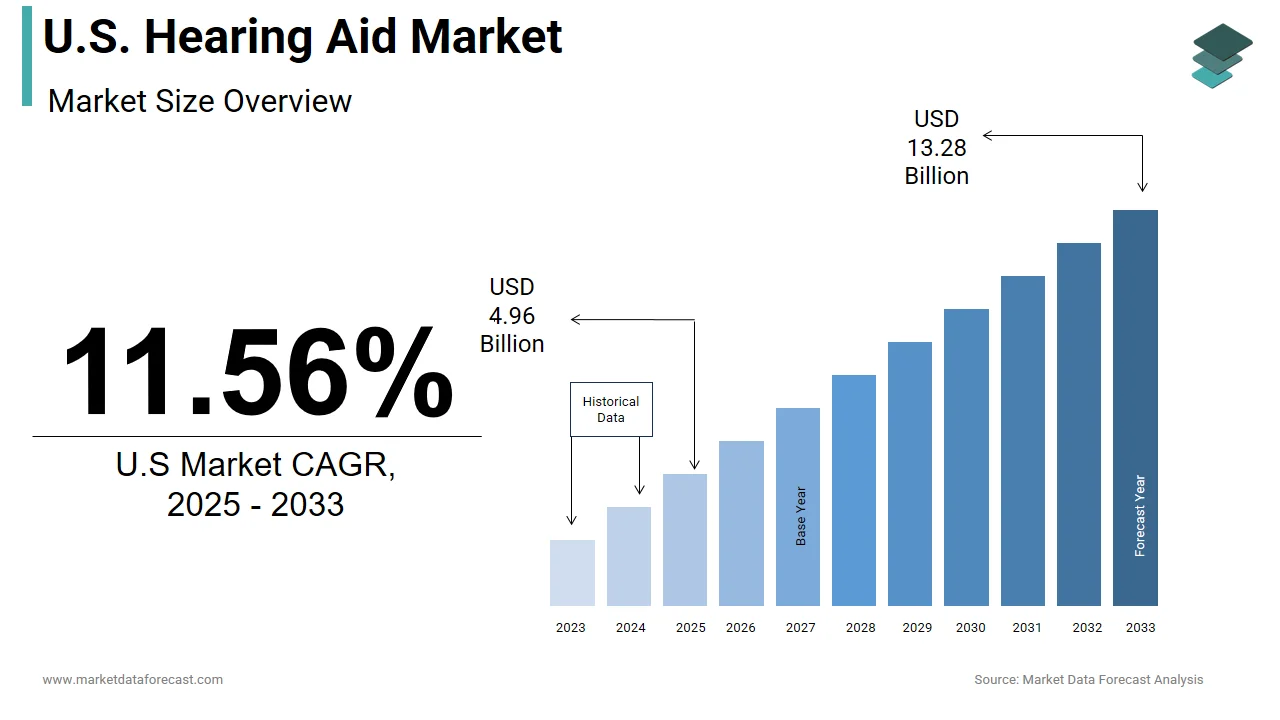
The U.S. hearing aid market size was valued at USD 5.53 billion in 2025, reached USD 6.17 billion in 2026, and is projected to reach USD 14.80 billion by 2034, growing at a compound annual growth rate (CAGR) of 11.56% from 2026 to 2034. Driven by a rapidly aging population, technological integration of AI and Bluetooth features, and regulatory updates like the FDA's Over-the-Counter Hearing Aid Act, the market is experiencing strong medical and lifestyle-driven expansion.
Key Executive Metrics (At-a-Glance)
- 2025 Base Valuation: USD 5.53 Billion
- 2026 Current Valuation: USD 6.17 Billion
- 2034 Forecast Valuation: USD 14.80 Billion
- Compound Annual Growth Rate (CAGR): 11.56% (2026–2034)
- Largest Product Segment: Behind-the-Ear (BTE) hearing aids (accounted for 38.2% of total sales in 2025 due to versatility and durability)
- Fastest-Growing Product Segment: Receiver-in-the-Ear (RITE) hearing aids (projected at a CAGR of 7.2% through 2033)
- Dominant Hearing Loss Type: Sensorineural hearing loss (capturing the largest share due to age-related presbycusis and noise-induced impairments)
- Fastest-Growing Hearing Loss Segment: Conductive hearing loss (expanding at a 6.8% CAGR)
- Largest End-User Segment: Adults (spearheading demand due to high hearing impairment incidence among individuals aged 50 and above)
- Fastest-Growing End-User Segment: Pediatrics (booming at a 6.4% CAGR supported by universal newborn screening mandates)
- Regional Standing: The United States (commanded 39.6% of total revenue in 2025 within the global footprint)
Core Market Drivers & Growth Triggers
- Aging Population: Americans aged 65 and older exceeding 58 million, driving high volumes of age-related hearing loss (presbycusis).
- Technological Innovation: Integration of artificial intelligence, machine learning, Bluetooth connectivity, and rechargeable models.
- Regulatory Shifts: FDA Over-the-Counter (OTC) regulations reducing cost and access barriers.
Primary Market Restraints & Challenges
- High Costs & Limited Insurance: Out-of-pocket financial burden for senior citizens on fixed incomes due to poor private insurance coverage.
- Stigma & Delayed Treatment: Average 5-to-7-year delay by individuals before seeking professional help following symptom onset.
- Competitive Price Pressures: Margin compression from consumer electronics entrants and direct-to-consumer alternatives.
U.S. Hearing Aid Market Segmentation Breakdown
| Segment Category | Key Segment Classifications |
|---|---|
| By Product | In-The-Ear, Canal Hearing Aids, Receiver-In-The-Ear, Behind-The-Ear, Cochlear Implants, and Bone Anchored Systems |
| By Hearing Loss | Sensorineural and Conductive |
| By End User | Adults and Pediatrics |
| By Country | The United States |
Major Industry Players Profiled
Key corporations shaping the U.S. hearing aid market include Sonova (Phonak, Unitron, Hansaton), Demant (Oticon), WS Audiology (Resound, Widex, Rexton), GN Store Nord A/S, Cochlear Limited, MED-EL, SeboTek Hearing Systems, Starkey Hearing Technologies, Inc., William Demant Holding A/S, and Zounds Hearing, Inc.
 Download Free Sample Report
U.S. Hearing Aid Market Size
The U.S. hearing aid market was valued at USD 5.53 billion in 2025, is estimated to reach USD 6.17 billion in 2026, and is projected to reach USD 14.80 billion by 2034, growing at a CAGR of 11.56% from 2026 to 2034.
A hearing aid is a small electronic device designed to amplify sound for individuals experiencing hearing loss, improving their ability to communicate and engage in daily activities. These devices typically consist of a microphone, amplifier, and speaker, and are available in various styles including behind-the-ear (BTE), in-the-ear (ITE), and completely-in-canal (CIC) models. Also, the U.S. hearing aid market has evolved significantly due to technological advancements, increased awareness about auditory health, and an aging population that is more prone to age-related hearing impairments.
According to the National Institute on Deafness and Other Communication Disorders (NIDCD), approximately 15% of American adults report some trouble with hearing, translating to nearly 48 million people nationwide. This high prevalence underlines the growing need for accessible and effective hearing solutions. Moreover, as per the Centers for Disease Control and Prevention (CDC), the proportion of the U.S. population aged 65 and older is expected to reach nearly 21% by 2040, further intensifying demand for hearing aids.
The market is also being shaped by regulatory changes such as the FDA’s Over-the-Counter Hearing Aid Act, which aims to improve accessibility and affordability. Consumer preferences are shifting toward discreet digitally enhanced devices with Bluetooth connectivity and AI-based features and the U.S. hearing aid market continues to expand driven by both medical necessity and lifestyle-oriented adoption.
MARKET DRIVERS
Aging Population and Increasing Prevalence of Hearing Loss
A primary driver of the U.S. hearing aid market is the rapid aging of the population, which correlates with a higher incidence of age-related hearing loss.
According to the U.S. Census Bureau, the number of Americans aged 65 and older exceeded 58 million in 2023, accounting for over 17% of the total population. This demographic shift has significantly increased the pool of potential hearing aid users, as presbycusis (age-related hearing loss) becomes more prevalent with advancing age.
As per the National Institute on Deafness and Other Communication Disorders (NIDCD), nearly one in three individuals between the ages of 65 and 74 experiences some degree of hearing loss, with this figure rising to almost half for those above 75 years. These statistics show the growing healthcare burden associated with untreated hearing impairment and highlight the urgent need for intervention through hearing aids.
Apart from these, public health initiatives and greater awareness campaigns led by organizations such as the Hearing Loss Association of America (HLAA) have contributed to improved recognition of hearing issues among seniors. With increasing life expectancy and a strong emphasis on maintaining quality of life in later years, more elderly individuals are seeking out hearing solutions. This trend is expected to sustain robust growth in the U.S. hearing aid market over the coming decades.
Technological Advancements and Consumer Demand for Discreet Devices
A further key driver fueling the U.S. hearing aid market is the continuous advancement in digital technology, which has led to the development of smaller, more powerful, and feature-rich hearing aids. Modern devices now incorporate artificial intelligence, machine learning algorithms, directional microphones, and wireless connectivity via Bluetooth, allowing seamless integration with smartphones and other smart devices.
These innovations have significantly improved user experience, making hearing aids more appealing to younger and tech-savvy consumers who previously hesitated to adopt such devices due to concerns about visibility and outdated performance.
Moreover, the introduction of rechargeable models has reduced the need for frequent battery replacements, enhancing convenience and environmental sustainability.
MARKET RESTRAINTS
High Cost of Hearing Aids and Limited Insurance Coverage
A significant restraint impeding the growth of the U.S. hearing aid market is the high cost of hearing aids combined with limited insurance coverage. Despite their medical necessity, most private health insurance plans do not cover the full or even partial cost of hearing aids, leaving patients to bear the financial burden. This lack of financial support disproportionately affects senior citizens, many of whom live on fixed incomes and may prioritize other essential expenses over hearing care.
Furthermore, the complexity of purchasing options ranging from audiologist-prescribed devices to direct-to-consumer models can be overwhelming for consumers unfamiliar with the technology. As a result, many individuals delay or forgo treatment altogether, limiting market penetration despite high levels of hearing loss prevalence.
This affordability gap remains a critical barrier to widespread adoption, especially for lower-income populations, and continues to hinder the full realization of the market's potential.
Lack of Awareness and Stigma Associated with Hearing Loss
A different major constraint on the U.S. hearing aid market is the persistent lack of awareness regarding the importance of early diagnosis and treatment of hearing loss, coupled with social stigma surrounding the use of hearing aids. Many individuals underestimate the impact of mild to moderate hearing impairment, often delaying intervention until symptoms become severe.
According to the Hearing Loss Association of America (HLAA), the average person waits five to seven years after noticing hearing difficulties before seeking professional help. This delay is attributed to misconceptions about hearing loss being a normal part of aging, embarrassment about wearing visible devices, and reluctance to acknowledge diminished sensory function.
In addition, research conducted by the National Council on Aging (NCOA) found that untreated hearing loss was linked to increased risks of depression, social isolation, and cognitive decline. However, awareness of these associations remains low among the general public, particularly among middle-aged adults who could benefit from early intervention.
Public education efforts, while growing, have yet to fully penetrate mainstream consciousness. Until societal perceptions shift and hearing health is prioritized similarly to vision or dental care, the market will continue to face resistance from potential users hesitant to take action.
MARKET OPPORTUNITIES
Expansion of Over-the-Counter (OTC) Hearing Aids
A transformative opportunity emerging in the U.S. hearing aid market is the expansion of over-the-counter (OTC) hearing aids, made possible by the FDA’s finalization of regulations under the OTC Hearing Aid Act in August 2022. This legislation allows consumers to purchase certain types of hearing aids directly from retail stores or online without requiring a medical evaluation or prescription, significantly lowering access barriers. This democratization of hearing assistance aligns with broader healthcare trends emphasizing consumer empowerment and self-management.
Furthermore, major retailers and tech companies have begun entering the OTC hearing aid space, offering competitively priced, sleekly designed devices with app-based customization. By expanding access and reducing the perceived complexity of acquiring hearing aids, the OTC model presents a significant avenue for market growth and increased adoption across diverse consumer segments.
Integration of Artificial Intelligence and Smart Technologies
The integration of artificial intelligence (AI) and smart technologies into hearing aids presents a substantial opportunity for innovation and differentiation in the U.S. hearing aid market. Modern hearing aids now leverage AI-driven algorithms to enhance sound clarity, reduce background noise, and personalize listening experiences based on user behavior and environment.
According to the American Speech-Language-Hearing Association (ASHA), AI-enabled hearing aids can adapt in real time to different acoustic environments, offering superior performance compared to traditional models. Some devices utilize machine learning to learn user preferences over time, automatically adjusting settings for optimal comfort and comprehension.
In addition to AI, hearing aids increasingly incorporate Bluetooth connectivity, voice assistants, and compatibility with mobile apps, allowing users to control volume, streaming, and diagnostics through smartphones. As per a report published by McKinsey & Company, nearly 60% of surveyed consumers expressed interest in smart hearing aids that integrate seamlessly with their digital lifestyles.
These advancements are attracting a younger demographic, including working professionals and active retirees, who value discretion, functionality, and connectivity. By embracing smart technologies, hearing aid manufacturers can not only enhance product appeal but also drive long-term market expansion beyond traditional user groups.
MARKET CHALLENGES
Regulatory Complexity and Product Classification
Among the foremost challenges facing the U.S. hearing aid market is the evolving regulatory landscape governing device classification and distribution. While the introduction of over-the-counter (OTC) hearing aids was intended to increase accessibility, it has also introduced complexities related to compliance, labeling, safety standards, and consumer education.
According to the U.S. Food and Drug Administration (FDA), OTC hearing aids must meet strict performance criteria, including maximum amplification limits and frequency response ranges to ensure they are suitable for individuals with mild to moderate hearing loss. Manufacturers must navigate these requirements while balancing affordability and functionality.
Besides, confusion persists among consumers regarding the distinction between personal sound amplification products (PSAPs) and FDA-regulated hearing aids. As per the Hearing Industries Association (HIA), PSAPs are not intended to treat hearing loss and may mislead users into believing they serve the same purpose as medical-grade hearing aids.
Ensuring accurate product categorization, consumer understanding, and adherence to evolving regulations poses a significant challenge for both established players and new entrants in the market. Companies must invest in clear communication strategies and compliance infrastructure to maintain trust and credibility in a rapidly shifting regulatory environment.
Intense Market Competition and Price Pressure
An additional pressing challenge confronting the U.S. hearing aid market is the intensifying competition among manufacturers, leading to downward pressure on pricing and margin compression. Traditional audiological brands are now competing not only with each other but also with new entrants from the consumer electronics and tech sectors, which offer lower-cost alternatives with similar functionalities.
Retail chains and online platforms have further disrupted the ecosystem by offering bundled services and discounted packages, altering consumer expectations around value and affordability.
Moreover, the growing availability of imported and private-label hearing aids has intensified price sensitivity among buyers. As per the Hearing Loss Association of America (HLAA), nearly 40% of respondents indicated willingness to consider non-traditional brands if they offered comparable performance at a lower cost.
Maintaining brand loyalty while adapting to a more competitive and cost-conscious market landscape requires strategic investments in marketing, customer engagement, and product differentiation. For many firms, striking the right balance between accessibility and profitability remains a formidable challenge.
SEGMENTAL ANALYSIS
By Product Insights
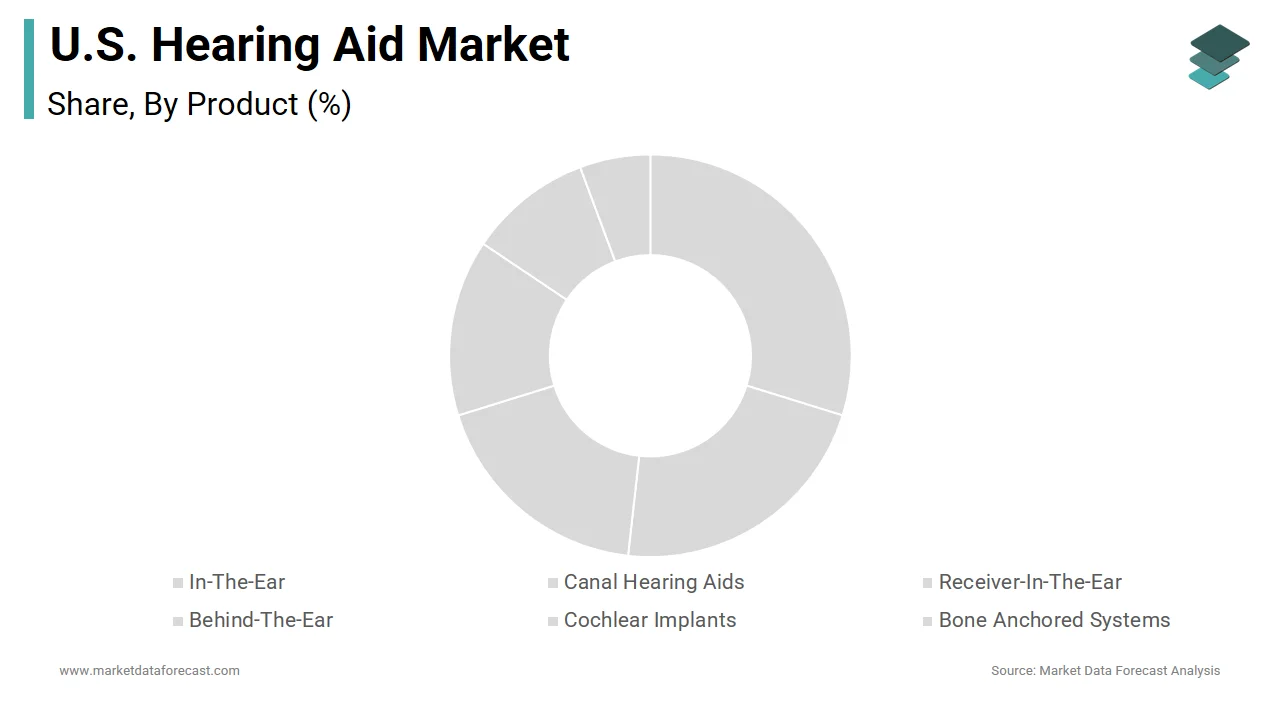
Behind-the-ear (BTE) hearing aids depicted the largest segment in the U.S. hearing aid market in 2025, accounting for 38.2% of total sales. This dominance is attributed to the versatility, durability, and suitability of BTE devices across a wide range of hearing loss severities, from mild to profound.
According to the Hearing Industries Association (HIA), BTE models have remained a preferred choice among audiologists and hearing care professionals due to their robust performance and compatibility with assistive listening devices such as telecoils and Bluetooth accessories. Apart from these, their larger size allows for easier handling, longer battery life, and integration of advanced features like directional microphones and noise reduction algorithms, making them particularly suitable for elderly users.
As per the Centers for Disease Control and Prevention (CDC), age-related hearing loss affects over 40% of Americans aged 65 and older, reinforcing the demand for reliable and feature-rich hearing solutions.
So, ongoing miniaturization efforts and enhanced digital capabilities help BTE hearing aids maintain their lead position in the U.S. market.
Receiver-in-the-ear (RITE) hearing aids are the fastest-growing product segment in the U.S. hearing aid market, projected to expand at a CAGR of 7.2% through 2033. RITE devices combine the benefits of behind-the-ear technology with a sleek, open-fit design that enhances comfort and aesthetics, making them increasingly popular among younger and tech-savvy users.
Unlike traditional BTE models, RITE aids place the receiver directly in the ear canal, reducing occlusion effects and offering a more natural listening experience. Furthermore, these devices are highly compatible with wireless streaming technologies, allowing direct connectivity with smartphones and other smart devices.
The growing adoption of digital health platforms and mobile-based hearing diagnostics has also contributed to increased awareness and acceptance of RITE aids. With continuous advancements in AI-driven personalization and rechargeable options, this segment is poised for sustained growth in the coming years.
By Hearing Loss Type Insights
Sensorineural hearing loss constituted the dominant segment in the U.S. hearing aid market in 2025, capturing substantial share of total demand. This type of hearing impairment results from damage to the inner ear’s hair cells or auditory nerve pathways, commonly caused by aging, prolonged exposure to loud noises, genetic factors, or certain medical conditions.
According to the National Institute on Deafness and Other Communication Disorders (NIDCD), sensorineural hearing loss is the most prevalent form of permanent hearing impairment, affecting millions of adults and children across the United States. Age-related presbycusis alone impacts over 30 million Americans, making it a primary driver of hearing aid adoption.
Moreover, increasing occupational and recreational exposure to high-decibel environments has led to early-onset sensorineural hearing loss among younger populations. As per the American Academy of Audiology (AAA), noise-induced hearing loss affects approximately 15% of Americans between the ages of 20 and 69, further expanding the user base for hearing aids tailored to sensorineural impairments.
Given its irreversible nature and widespread prevalence, this segment remains the dominant force driving the U.S. hearing aid market.
Conductive hearing loss sees the rapid expansion segment within the U.S. hearing aid market, expected to rise at a CAGR of 6.8% over the years. Unlike sensorineural hearing loss, conductive impairments result from issues in the outer or middle ear, such as ear infections, fluid buildup, perforated eardrums, or congenital abnormalities.
Like, according to the American Speech-Language-Hearing Association (ASHA), conductive hearing loss accounts for a significant portion of pediatric hearing impairments, particularly among children with chronic otitis media. Also, as per the CDC, nearly 80% of children experience at least one episode of middle ear infection by the age of three, contributing to temporary or persistent hearing difficulties that often require intervention.
In recent years, there has been an increase in the adoption of bone conduction and bone-anchored hearing systems designed specifically for conductive hearing loss. These devices bypass damaged parts of the ear and transmit sound directly through the skull to the functioning inner ear, offering a non-invasive alternative to surgery.
Additionally, rising awareness about early detection and treatment of childhood hearing impairments has led to greater utilization of hearing aids in school screening programs.
By End User Insights
Adults spearheaded the end-user segment in the U.S. hearing aid market, depicting a significant portion of total demand in 2025. This overwhelming dominance is because of the high incidence of age-related and noise-induced hearing loss among individuals aged 50 and above, who form the core demographic for hearing aid adoption.
According to the Centers for Disease Control and Prevention (CDC), nearly 40% of adults aged 65–74 experience some degree of hearing impairment, with this figure rising to over 50% for those aged 75 and older. As life expectancy continues to rise and the baby boomer generation ages, the pool of potential adult users expands significantly.
Apart from these, workplace-related hearing loss remains a critical concern, particularly in industrial, construction, and military sectors. As per data from the National Institute for Occupational Safety and Health (NIOSH), approximately 22 million workers in the U.S. are exposed to hazardous noise levels annually, leading to preventable but persistent hearing damage.
The American Academy of Audiology (AAA) emphasizes that untreated hearing loss in adults is linked to cognitive decline, depression, and reduced social engagement. Consequently, healthcare providers increasingly recommend early intervention through hearing aids.
Pediatrics is the booming end-user segment in the U.S. hearing aid market, projected to expand at a CAGR of 6.4% in the future. This progress is mainly driven by heightened awareness around early diagnosis and intervention for childhood hearing impairments, supported by mandatory newborn hearing screenings and expanded access to pediatric audiological services.
According to the Centers for Disease Control and Prevention (CDC), nearly every state in the U.S. now mandates universal newborn hearing screening, ensuring early identification of hearing deficits. As per the National Institute on Deafness and Other Communication Disorders (NIDCD), approximately 1.5 out of every 1,000 children born in the U.S. are diagnosed with permanent hearing loss, necessitating prompt fitting of appropriate hearing aids.
Furthermore, advancements in pediatric hearing aid technology including waterproof models, adjustable volume controls, and remote monitoring capabilities have improved usability and parental confidence in long-term use. Schools and educational institutions have also integrated assistive listening systems to support students with hearing impairments, fostering better academic outcomes.
So, with continued emphasis on early detection and government-supported programs, the pediatric segment is set for accelerated growth in the U.S. hearing aid market.
REGIONAL ANALYSIS
The United States commanded the global hearing aid market, accounting for 39.6% of total revenue in 2025. This dominance is driven by a combination of factors including an aging population, high prevalence of hearing disorders, and a strong healthcare infrastructure that supports early diagnosis and treatment.
According to the National Institute on Deafness and Other Communication Disorders (NIDCD), over 48 million Americans report some degree of hearing loss, making it a major public health concern. Besides, as per the projection by the Centers for Disease Control and Prevention (CDC), by 2040, more than 20% of the U.S. population will be aged 65 or older an age group particularly prone to age-related hearing loss.
The regulatory environment has also evolved to improve accessibility, with the FDA’s Over-the-Counter Hearing Aid Act enabling broader consumer access to affordable hearing solutions. As per the Hearing Industries Association (HIA), OTC hearing aid sales grew by 25% in the first year following implementation, signaling a shift in purchasing behavior.
With continuous technological innovation, expanding insurance coverage initiatives, and increasing awareness campaigns, the United States remains at the forefront of the global hearing aid industry.
COMPETITIVE LANDSCAPE
The U.S. hearing aid market is highly competitive, shaped by a combination of established multinational manufacturers, emerging direct-to-consumer brands, and evolving regulatory frameworks. Traditional players continue to dominate due to their technological expertise, extensive distribution networks, and strong relationships with hearing care professionals. However, new entrants particularly those focused on over-the-counter (OTC) models are disrupting the landscape by offering more affordable and accessible alternatives. These companies leverage e-commerce, mobile-based diagnostics, and AI-driven personalization to attract a broader demographic beyond the typical senior user base.
Competition is intensifying not only in terms of pricing but also in product differentiation, with features such as rechargeability, app control, and seamless integration with smartphones becoming standard expectations. Moreover, marketing strategies have shifted toward lifestyle branding, positioning hearing aids as wellness and communication-enhancing devices rather than purely medical necessities. As the market expands, companies must balance innovation with affordability while navigating complex regulatory requirements and evolving consumer preferences. Strategic acquisitions, partnerships with telehealth providers, and investments in consumer education further define the competitive dynamics, ensuring a rapidly transforming industry landscape.
KEY MARKET PLAYERS
Companies playing a leading role in the U.S. hearing aid market covered in this report are GN Store Nord A/S, Cochlear Limited, MED-EL, SeboTek Hearing Systems, Starkey Hearing Technologies, Inc., Widex, William Demant Holding A/S, and Zounds Hearing, Inc. (U.S.).
TOP LEADING PLAYERS IN THE MARKET
- Sonova is a global leader in the hearing aid industry and plays a dominant role in the U.S. market through its well-established brands such as Phonak, Unitron, and Hansaton. The company contributes to the market by consistently introducing innovative hearing solutions that incorporate artificial intelligence, wireless connectivity, and adaptive sound processing. Sonova emphasizes patient-centric design and has been instrumental in advancing pediatric hearing technologies and open-fit devices.
- Demant operates a strong portfolio of hearing aid brands in the U.S., including Oticon, one of the most recognized names in audiological care. Through its diverse brand offerings, Demant caters to a broad spectrum of users, from high-end audiophile models to consumer-focused OTC hearing aids. The company supports research into brain-centric hearing technology and collaborates with healthcare professionals to improve early diagnosis and treatment adherence.
- WS Audiology is a key player in the U.S. hearing aid market, combining innovation and accessibility through its leading brands Resound, Widex, and Rexton. Known for their advanced digital signal processing and seamless integration with smart devices, these brands have helped redefine user experience across both professional and direct-to-consumer channels. WS Audiology also focuses on sustainability and personalized hearing experiences, contributing significantly to the evolution of modern audiological solutions.
TOP STRATEGIES USED BY KEY MARKET PARTICIPANTS
Product Innovation and Digital Integration Leading companies are continuously developing next-generation hearing aids featuring artificial intelligence, Bluetooth connectivity, and real-time speech enhancement. These advancements enhance usability and appeal to younger, tech-savvy consumers while improving outcomes for long-term users.
Expansion into Over-the-Counter (OTC) Hearing Solutions to capture a broader consumer base, major players are launching affordable, self-fitting hearing aids that comply with FDA regulations. This strategy allows them to reach individuals who previously avoided traditional hearing aids due to cost or accessibility barriers.
Strengthening Distribution Networks and Brand Presence Companies are expanding their retail partnerships, enhancing online sales platforms, and increasing collaborations with audiologists and ENT clinics. These efforts ensure wider product availability and reinforce brand credibility among both professionals and end users.
RECENT MARKET DEVELOPMENTS
- In March 2023, Sonova launched a new line of AI-powered hearing aids under the Phonak brand, designed to adapt to individual listening environments automatically, enhancing user comfort and clarity without manual adjustments.
- In July 2023, Demant expanded its presence in the direct-to-consumer segment by introducing an OTC version of Oticon’s popular hearing aid model, targeting budget-conscious users seeking premium performance at a lower cost.
- In November 2023, WS Audiology partnered with a leading telehealth provider to integrate remote fitting and adjustment capabilities into its ReSound app, allowing users to personalize settings from home with professional guidance.
- In February 2024, Sonova acquired a U.S.-based digital health startup specializing in AI-driven hearing diagnostics, aiming to strengthen its position in self-assessment tools and expand access to personalized hearing care.
- In June 2024, Demant introduced a national awareness campaign in collaboration with hearing advocacy groups to promote early detection of hearing loss, reinforcing its commitment to public health initiatives and brand visibility.
MARKET SEGMENTATION
This research report on the U.S. hearing aid market has been segmented & sub-segmented into the following categories.
By Product
- In-The-Ear
- Canal Hearing Aids
- Receiver-In-The-Ear
- Behind-The-Ear
- Cochlear Implants
- Bone Anchored Systems
By Hearing Loss
- Sensorineural
- Conductive
By End User
- Adults
- Pediatrics
By Country
- The United States