- Product Description Description
- Table of Contents TOC
- List of Table & Figure LOT
- Get Free Sample PDF Sample PDF
Market Size, 2025
$36.19 BnMarket Estimate, 2026
$45.17 BnMarket Forecast, 2034
$265.97 BnCAGR, 2026–2034
24.81%Executive Summary: U.S. Herbal Medicine Market
- Market Scope: Comprehensive market analysis of the United States herbal medicine ecosystem, evaluating product types, botanical sources, delivery forms, and consumer self-care dynamics.
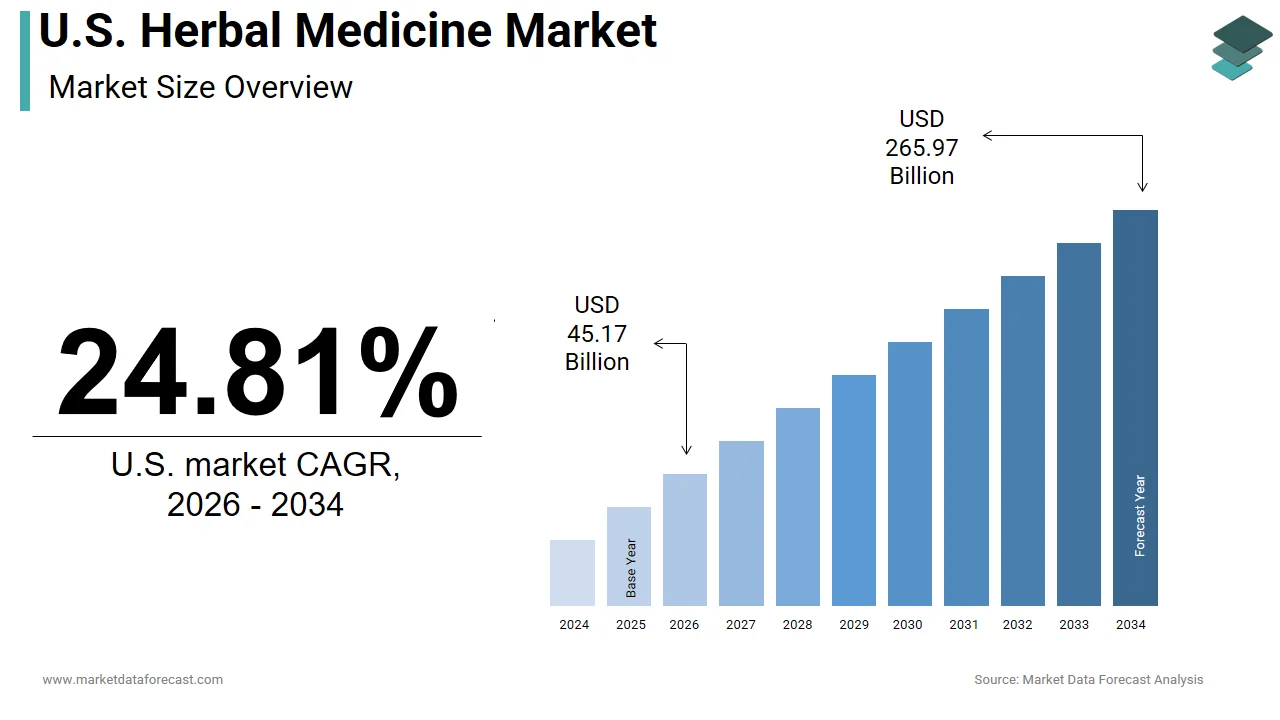
- Market Valuation: Valued at USD 36.19 billion (2025), estimated at USD 45.17 billion (2026), and projected to reach USD 265.97 billion by 2034, registering a high CAGR of 24.81% (2026–2034).
- Primary Growth Drivers: Broadening consumer adoption (~35% of the U.S. population), rising demand for alternative and preventive solutions for chronic conditions, a growing aging demographic favoring botanical alternatives, and active pharmaceutical industry investment in R&D.
Key Market Segment Metrics (2026–2034)
| Category | Leading Segment (2025 Position) | Fastest-Growing Segment (2026–2034) |
|---|---|---|
| By Type | Herbal Dietary Supplements (holds a major share driven by self-medication trends for immunity, weight loss, and memory boost) | Herbal Pharmaceuticals & Functional Foods (expanding rapidly through standardized plant extracts and preventive wellness integration) |
| By Source | Roots, Barks, and Leaves (prominent sources yielding high-concentration active phytochemicals like ginkgo, echinacea, and garlic) | Whole Plants and Fruits (gaining traction as consumer preferences lean toward holistic, clean-label botanical ingredients) |
| By Form | Tablets & Capsules (dominate volume due to dosage accuracy, extended shelf-life, and consumer convenience) | Extracts & Syrups (experiencing high growth driven by enhanced bioavailability and rapid absorption profiles) |
| By Country / Region | The United States (anchors the North American market with widespread consumer integration, advanced R&D infrastructure, and robust retail/online distribution) | U.S. Regional Metros & E-Commerce Channels (propelling high-velocity direct-to-consumer adoption) |
Major Market Players & Market Structure
Market Structure: A highly diversified and competitive marketplace featuring global phytotherapy leaders, specialized botanical enterprises, and pharmaceutical companies expanding into evidence-based natural formulations.
Key Companies: Tsumura & Co., Dr. Willmar Schwabe India Pvt. Ltd., Blackmores Limited, Nature's Answer, Arkopharma, Arizona Natural Products, Bio-Botanica Inc., Herbal Africa, Sidomuncul, and Nature Herbs.
 Download Free Sample Report
U.S. Herbal Medicine Market Size
The U.S. herbal medicine market was valued at USD 36.19 billion in 2025. The market is estimated at USD 45.17 billion in 2026 and is projected to reach USD 265.97 billion by 2034, growing at a CAGR of 24.81% from 2026 to 2034.
The growing awareness regarding the efficacy of herbal medicine in addressing diverse diseases and infections in the United States drives the growth of the U.S. herbal medicine market. The adoption of herbal medicine stands at approximately 35% of the population in the United States. This therapeutic approach offers solutions for a wide spectrum of conditions, including allergies, eczema, asthma, rheumatoid arthritis, and more. Herbal medicine, derived from plant sources, yields pharmaceutical-grade benefits and is notably used in tandem with conventional medication. Prominent herbal supplements in the U.S. encompass echinacea, garlic, ginkgo, valerian, and others, often synergistically combined to enhance efficacy.
The growing aging population and rising support from the pharmaceutical industry in the U.S. further propel the U.S. herbal medicine market growth. Notably, ginkgo and garlic are favored herbal ingredients among the elderly, addressing concerns like bruising and bleeding. Approximately 20% of arthritis-affected older individuals opt for herbal medicine, given its favorable side effect profile versus conventional options. A substantial portion of the adult population contends with sexual issues, which herbal medication can mitigate. These dynamics are inciting pharmaceutical entities to channel their efforts into herbal medicine production, driving the U.S. herbal medicine market growth.
The availability of investments required for R&D activities, a robust presence of industry leaders, progressive manufacturing advancements, and growing acceptance of novel herbal medications collectively fuel the growth of the U.S. herbal medicine market.
The higher cost of certain herbal medicines for chronic conditions majorly hampers the growth of the U.S. herbal medicine market. Factors such as insufficient expertise in herbal medical research, limited drug availability, awareness gaps, and stringent regulations hinder market expansion. Complications arising from interactions between herbal ingredients and other medications, particularly when purchased online or from unregulated sources, also pose challenges to market growth.
KEY MARKET PLAYERS
A few of the promising companies operating in the U.S. herbal medicine market profiled in this report are TSUMURA & CO., Dr. Willmar Schwabe India Pvt. Ltd., Blackmores Limited, NATURE’S ANSWER, Arkopharma, Arizona Natural Products, Bio-Botanica Inc., Herbal Africa, Sidomuncul, and Nature Herbs.
MARKET SEGMENTATION
This research report on the United States herbal medicine market has been segmented & sub-segmented into the following categories.
By Type:
- Herbal Functional Foods
- Herbal Dietary Supplements
- Herbal Beauty Products
- Herbal Pharmaceuticals
By Source:
- Roots and barks
- Fruits
- Whole plants
- Leaves
- Others
By Form:
- Tablets
- Capsules
- Extracts
- Syrups
- Powders
- Others
By Country:
- The United States
The United States holds the largest share in the market growth. In the last two decades, the US population are adopting herbal medicine as an alternative medicine to normal drugs. Self-medication for herbal supplements which are used for weight loss, immunity and memory boost, and physical and mental health also drives the U.S. market growth.