- Product Description Description
- Table of Contents TOC
- List of Table & Figure LOT
- Get Free Sample PDF Sample PDF
Market Size, 2025
$320.38 MnMarket Estimate, 2026
$338.32 MnMarket Forecast, 2034
$523 MnCAGR, 2026–2034
5.6%Executive Summary: U.S. Nebulizer Market
- Market Scope: Comprehensive market assessment of the U.S. nebulizer sector, tracking product lines, delivery modalities, home care versus institutional end-users, and epidemiological trends.
- Market Valuation: Valued at USD 320.38 million in 2025, estimated at USD 338.32 million in 2026, and projected to reach USD 523 million by 2034, registering a steady CAGR of 5.6% from 2026 to 2034.
- Primary Growth Drivers: High rates of chronic respiratory conditions (such as asthma and COPD), rising geriatric demographics, a paradigm shift toward home healthcare settings, and rapid technological innovations like low-noise, highly portable mesh nebulizers.
Key Market Segment Metrics (2026–2034)
| Category | Leading Segment Position | Fastest-Growing / Key Growth Segment |
|---|---|---|
| By Product | Jet Nebulizer (historically captured the largest share due to cost-effectiveness and widespread clinical availability) | Mesh Nebulizer (emerging as the preferred choice due to low residual volumes, fast treatment times, and high target precision) |
| By Modality | Table-top (traditionally anchored in hospitals, clinics, and long-term care facilities backed by DME reimbursement frameworks) | Portable (expanding rapidly as active lifestyle demands and mobile home-care needs push patient preferences) |
| By End-User | Hospitals & Clinics (core hubs for acute respiratory disease management and initial patient diagnosis) | Home Care Settings (surging due to cost containment initiatives, shorter hospital stays, and patient convenience) |
| By Country | United States (exclusive focus market driven by high healthcare spending, environmental emission factors, and rising obesity/lifestyle disorders) | Home-use ambulatory care channels supported by insurer cost-saving incentives |
Major Market Players & Market Structure
Market Structure: Highly competitive medical device landscape defined by ongoing product miniaturization, quiet operation tech integrations, and strategic commercial expansions into direct-to-consumer home healthcare models.
Key Companies: Briggs Healthcare, Besco Medical, Ca-Mi, DeVilbiss Healthcare, Feellife Health, Flyp, Invacare, Omron, Philips Respironics, and Pari Medical.
U.S. Nebulizer Market Size
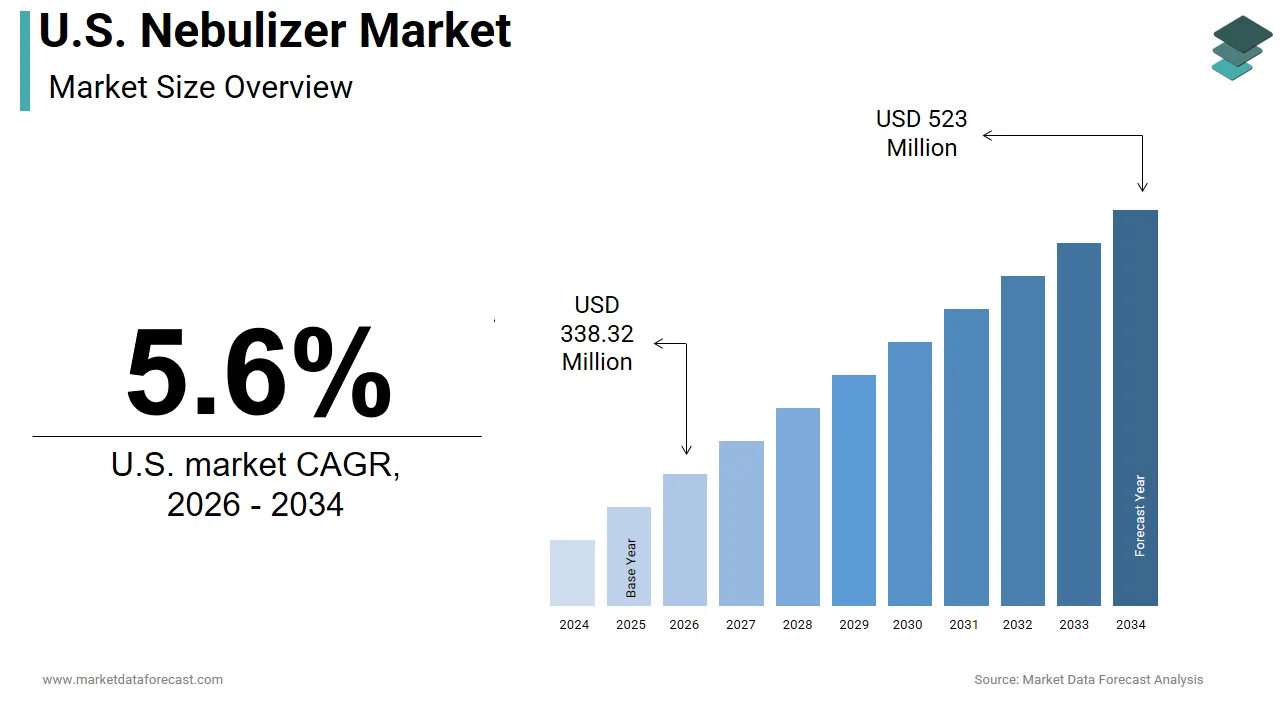
The U.S. nebulizer market was valued at USD 320.38 million in 2025. The market is estimated at USD 338.32 million in 2026 and is projected to reach USD 523 million by 2034, growing at a CAGR of 5.6% from 2026 to 2034.
Factors such as excessive cigarette and alcohol consumption, poor diet, lack of physical activity, and alarming obesity rates are also expected to contribute to a rise in the prevalence of respiratory disorders in the United States, boosting the nebulizer market in the U.S. during the forecast period. Compact nebulizers that are available for home usage and technical advancements in nebulizers that minimize noise and increase functionality are increasing their use in home healthcare. Insurance providers choose such machines because they want to save money while also delivering high-quality healthcare. All these factors contribute to the growth of the U.S. nebulizer industry. Another important factor driving global demand for nebulizers is raising emission levels due to increased adoption of private vehicles and industrial expansion.
Increasing demand for effective inhaled drugs, healthcare costs, and longer hospital stays have resulted in a change in inpatient treatment to home environments, increasing the use of breathable medical devices for home healthcare. Nebulizers are instruments that convert liquid drugs into aerosols for use in the lungs (liquid particles in a gas). The drug is transformed into a mist that can be inhaled immediately by the user. The increasing prevalence of chronic respiratory disorders and rapid technological advancements is driving the use of nebulizers. For new nebulizer pharmaceutical drug production, mesh nebulizers have been the first option. Mesh nebulizers are expected to become more common in the future. Because of their low residual volumes and precise lung delivery, these treatments are portable, convenient, and fast.
The main restriction for the growth of the U.S. nebulizer market is dispersion and wastage of the drug during delivery to the respiratory tract, which is a spraying technique. Over the forecast period, the demand is expected to be hampered by limited reimbursement policies in developed countries and the higher cost of these instruments based on mesh and ultrasonic techniques.
The U.S. Nebulizer Market Research Report has been segmented and sub-segmented into the following categories.
By Product:
- Jet Nebulizer
- Mesh Nebulizer
- Ultrasonic Nebulizer
By Modality:
- Portable
- Table-top
By End-User:
- Hospitals
- Clinics
- Home care settings
By Country:
- United States
Geographically, one of the main factors for the increase in market demand in the United States is the rise in pollution rates and the increasing number of cases related to respiratory problems, including neonatal treatment. The growing geriatric population in the United States, the high prevalence of target diseases, and the need to reduce healthcare costs are all considered to be major driving forces for home healthcare products. Furthermore, post-financial-crisis healthcare cost containment issues in the United States have compelled the government to implement new strategies to reduce hospital stays. This boosted homecare facilities, which in turn built a favorable atmosphere for the nebulizer market to grow. Patients seeking more portable nebulizer devices that can be transferred easily in times of need for patients who have asthma and other airway disorders are searching for more portable nebulizer devices because the population in the region follows a fast-paced lifestyle. The COVID-19 pandemic has sparked a surge in the use of nebulizers in the United States. As a result of increased national health spending, the country will grow.
KEY MARKET PLAYERS:
Some of the major companies operating in the U.S. nebulizer market profiled in this report are Briggs Healthcare, Besco Medical, Ca-Mi, De Vilbiss Healthcare, Feellife Health, Flyp, Invacare, Omron, Philips Respironics, and Pari Medical.