U.S. Paper Cups and Paper Plates Market Size, Share, Trends, and Growth Analysis Report, Segmented By Product Type (Hot Paper Cups, Cold Paper Cups), Wall Type & Region ( New York, Massachusetts, Pennsylvania, Illinois, Ohio, Michigan, Texas, Florida, Georgia, California, Washington, Colorado), Industry Forecast From 2025 to 2033
U.S. Paper Cups and Paper Plates Market Size
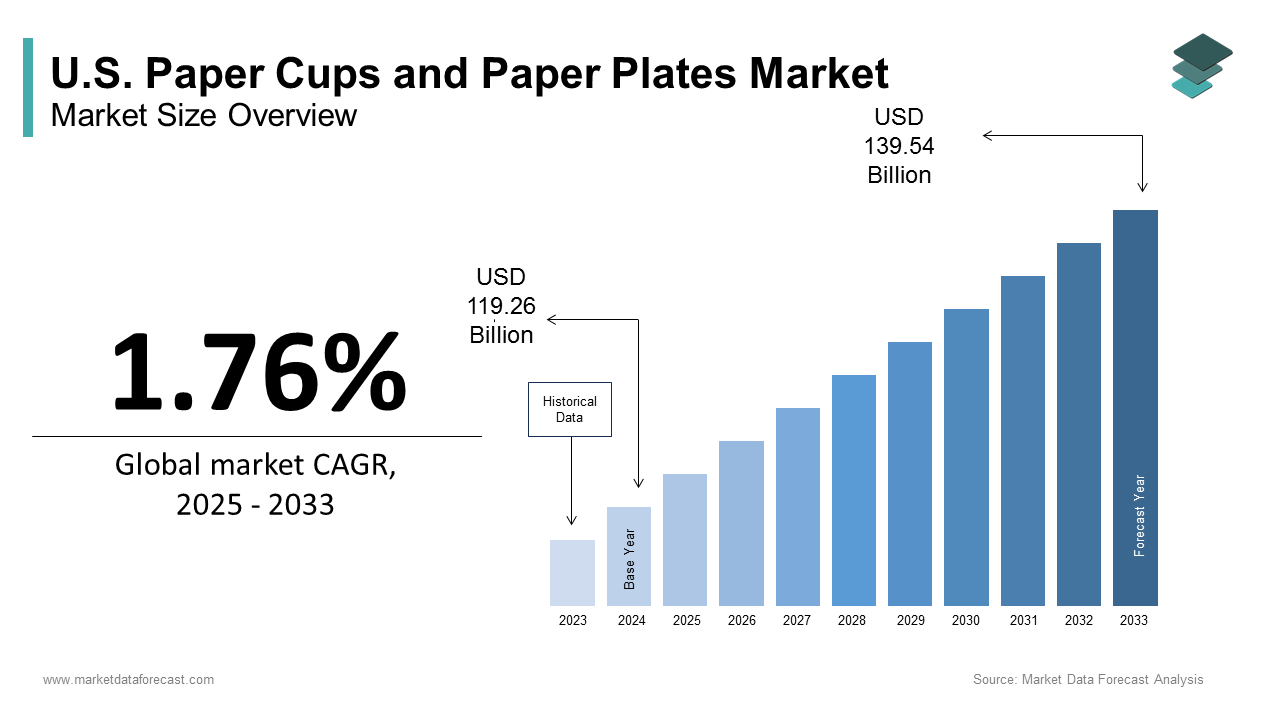
The U.S. Paper Cups and Paper Plates market size was valued at USD 119.26 billion in 2024 and is anticipated to reach USD 121.36 billion in 2025 and USD 139.54 billion by 2033, growing at a CAGR of 1.76% during the forecast period from 2025 to 2033.
The paper cups and paper plates are a disposable foodservice packaging ecosystem, evolving consumer behaviors, regulatory pressures, and infrastructural dependencies.
MARKET DRIVERS
Growing Takeout Culture Driving Demand for Paper Serviceware
The entrenched preference for convenience in fast-casual dining and takeout culture is driving the growth of the U.S. paper cups and paper plates market. According to the National Restaurant Association, 85% of adults in the United States reported purchasing takeout or delivery at least once per month in 2023, with nearly half doing so weekly. Furthermore, as per Datassential, 68% of quick-service restaurants have permanently integrated disposable paper serviceware into their standard operations post-pandemic, citing customer comfort and labor efficiency.
Regulatory Shifts and Corporate Commitments Accelerating Market Growth
The regulatory tailwind favoring fiber-based disposables over plastic alternatives is expected to leverage the growth of the U.S. paper cups and paper plates market. As per the U.S. Plastics Pact, over 12 states and 300 municipalities have enacted bans or fees on polystyrene foam food containers since 2020, compelling foodservice operators to pivot toward paper-based substitutes. The substitution effect is quantifiable: the Biodegradable Products Institute notes that paper cup adoption in coffee chains increased by 41% between 2020 and 2023 in jurisdictions with active plastic restrictions. Additionally, major chains like Starbucks and Dunkin’ have publicly committed to eliminating plastic-lined cups by 2025, accelerating procurement shifts.
MARKET RESTRAINTS
Rising Raw Material Costs Due to Tight Wood Pulp Supply
The tightening supply and escalating cost of virgin wood pulp, which is the primary raw material, are limiting the growth of the U.S. paper cups and paper plates market. As per the Food and Agriculture Organization of the United Nations, U.S. softwood pulpwood prices rose by 28% between 2020 and 2023, driven by logging restrictions in federal forests and increased export demand from Asia. This supply rigidity forces manufacturers into spot-market purchases at premium rates, compressing margins.
Recycling Infrastructure Limitations Hindering Market Growth
The municipal recycling infrastructure's incapacity to process coated paper products is another factor hampering the growth of the U.S. paper cups and paper plates market. According to the Recycling Partnership, less than 16% of U.S. households have access to curbside recycling programs that accept polyethylene-coated paper cups, and even fewer accept food-soiled paper plates. This systemic bottleneck undermines environmental claims associated with paper disposables and invites regulatory scrutiny. Consumer-facing brands, wary of greenwashing accusations, are increasingly hesitant to promote paper products as “recyclable,” thereby dampening marketing-driven demand expansion.
MARKET OPPORTUNITIES
Technological Innovations in Compostable Coatings Driving Market Expansion
The technological advancement of compostable barrier coatings that eliminate polyethylene dependency is attributed to enhancing the growth of the U.S. paper cups and paper plates market. As per the U.S. Composting Council, certified compostable paper cups and plates now constitute 19% of all foodservice disposables procured by institutional buyers such as universities and corporate cafeterias. Innovations from companies like Footprint and Solenis have enabled water-based, PFAS-free coatings that meet ASTM D6400 standards while maintaining functional integrity. The City of San Francisco’s mandatory commercial composting ordinance, which diverts 80% of business waste from landfills, has already catalyzed a 63% uptake in certified compostable tableware among local restaurants, according to the Department of the Environment.
Circular Procurement Policies Accelerating Institutional Demand
The rapid institutionalization of circular procurement policies within public-sector foodservice is also expected to bolster the growth of the U.S. paper cups and paper plates market. The Department of Defense alone operates more than 3,000 dining facilities globally and has mandated 100% transition to compostable serviceware by 2026. Similarly, the National Association of College and University Food Services reports that 71% of member institutions have adopted procurement standards prioritizing certified compostable paper products.
MARKET CHALLENGES
Consumer Perception Gap Undermining Recycling Efficiency
The misalignment between consumer perception of “eco-friendliness” and the actual end-of-life reality of paper tableware is quite challenging for the growth of the U.S. paper cups and paper plates market. As per a 2023 survey by Shelton Group, 69% of U.S. consumers believe paper cups are “fully recyclable,” yet the same study found only 9% could correctly identify whether their local facility accepts them. This perception gap leads to contamination in recycling streams and undermines municipal waste diversion targets. The Ellen MacArthur Foundation’s U.S. Plastics Pact Progress Report notes that paper cup contamination contributes to a 22% increase in processing costs at materials recovery facilities.
Regulatory Fragmentation Increasing Compliance Burden
The intensifying regulatory fragmentation across state and municipal jurisdictions regarding chemical additives in paper food contact materials is additionally to further boost the growth of the U.S. paper cups and paper plates market. As per the Environmental Working Group, 14 states have introduced bills since 2022 restricting PFAS in food packaging, with 8 enacting outright bans. This patchwork forces manufacturers to maintain multiple SKUs and reformulate repeatedly, increasing R&D and compliance costs by an estimated 34%, according to the Flexible Packaging Association’s 2023 operational survey.
REPORT COVERAGE
| REPORT METRIC | DETAILS |
| Market Size Available | 2024 to 2033 |
| Base Year | 2024 |
| Forecast Period | 2025 to 2033 |
| CAGR | 1.76% |
| Segments Covered | By Product Type, Wall Type, and Region |
| Various Analyses Covered | Global, Regional, and Country Level Analysis; Segment-Level Analysis; DROC; PESTLE Analysis; Porter’s Five Forces Analysis; Competitive Landscape; Analyst Overview of Investment Opportunities |
| Regions Covered | New York, Massachusetts, Pennsylvania, Illinois, Ohio, Michigan, Texas, Florida, Georgia, California, Washington, Colorado |
| Market Leaders Profiled | Dart Container Corporation, Huhtamaki North America, Georgia-Pacific LLC, Dixie Consumer Products LLC, Graphic Packaging International, LLC, Eco-Products, Inc., Genpak LLC, WinCup Inc., Sabert Corporation, Pactiv LLC, Solo Cup Company, BioPak, Bunzl Distribution USA, LLC |
SEGMENTAL ANALYSIS
By Product Type Insights
The hot paper cups segment held 58.3% the U.S. paper cups and paper plates market share in 2024, with the structural entrenchment of hot beverage culture across American daily routines. As per the National Coffee Association, 66% of U.S. adults consume coffee every day, which translates to over 146 billion hot beverage servings annually, nearly all served in disposable paper cups.

The cold paper cups segment is expected to grow with an expected CAGR of 7.8% during the forecast period, with the meteoric rise of cold specialty beverages, particularly iced coffee, protein shakes, and premium smoothies. Cold beverage chains such as Jamba and Smoothie King, which grew their store count by 12% year-over-year in 2023, exclusively utilize double-ridged, moisture-resistant cold cups engineered for condensation control.
By Wall Type Insights
The single-wall segment held a dominant share of the U.S. paper cups and paper plates market in 2024, with cost-efficiency and supply chain scalability. Single-wall products consume 30% less raw material than double-wall alternatives, enabling manufacturers to price them 22% lower on average, an advantage for budget-sensitive foodservice operators. Furthermore, single-wall units occupy 40% less warehouse space per thousand units, a logistical benefit emphasized by Sysco’s distribution efficiency metrics, which show a 19% reduction in transport emissions per case when single-wall dominates the load configuration.
The double-wall segment is likely to grow with an expected CAGR of 9.2% throughout the forecast period, driven by the premiumization trends and regulatory nudges toward user safety and insulation performance. The U.S. Consumer Product Safety Commission recorded over 4,200 burn-related incidents linked to single-wall hot beverage containers in 2022. As per Aramark’s 2023 sustainability procurement directive, 65% of its 500+ campus and healthcare facility contracts now require double-wall cups for temperatures exceeding 160°F.
REGIONAL ANALYSIS
The United States held 89.3% of the North American paper cups and paper plates market in 2024. Unlike Canada, where municipal composting mandates and deposit-return schemes constrain volume growth, the U.S. lacks federal uniformity by enabling 7.2 million foodservice points of sale to operate without standardized reuse or recycling obligations, according to the Bureau of Labor Statistics’ business establishment count.
KEY MARKET PLAYERS
A few of the dominating players in the U.S. paper cups and paper plates market include
- Dart Container Corporation
- Huhtamaki North America
- Georgia-Pacific LLC
- Dixie Consumer Products LLC
- Graphic Packaging International, LLC
- Eco-Products, Inc.
- Genpak LLC
- WinCup Inc.
- Sabert Corporation
- Pactiv LLC
- Solo Cup Company
- BioPak
- Bunzl Distribution USA, LLC
MARKET SEGMENTATION
This research report on the U.S. paper cups and paper plates market is segmented and sub-segmented into the following categories.
By Product Type
- Hot Paper Cups
- Cold Paper Cups
By Wall Type Insights
- Single Wall
- Double Wall
By Region
- New York
- Massachusetts
- Pennsylvania
- Illinois
- Ohio
- Michigan
- Texas
- Florida
- Georgia
- California
- Washington
- Colorado
Frequently Asked Questions
1. What factors are driving the growth of this market?
Key drivers include the rise in takeout and fast-casual dining culture, regulatory bans on plastic food containers, consumer preference for sustainable products, and technological advancements in compostable coatings.
2. What are the major challenges faced by the market?
Major challenges include high raw material costs, recycling infrastructure limitations, consumer perception gaps, and regulatory fragmentation regarding PFAS and other additives.
3. How big is the U.S. paper cups and paper plates market?
The market is valued in the billions of dollars, with steady growth driven by sustainability trends, increasing foodservice demand, and shifting corporate procurement standards.
4. Which regions in the U.S. have the highest market demand?
High demand is concentrated in the Northeast, Midwest, South, and West regions, with states like California, New York, and Texas showing strong consumption due to urbanization and regulatory measures.
5. What materials are commonly used to manufacture paper cups and plates?
The primary raw material is virgin wood pulp, along with barrier coatings such as polyethylene or new compostable water-based coatings to enhance durability and functionality.
6. How are regulations impacting the market?
Regulations banning single-use plastics and PFAS chemicals in packaging are accelerating the shift toward sustainable paper alternatives and driving product innovation.
7. What role does recycling infrastructure play in market growth?
Limited recycling infrastructure for coated paper products is a significant barrier, as most facilities cannot process these materials, which affects adoption and environmental claims.
8. What are the latest trends shaping the market?
Trends include the use of compostable coatings, corporate sustainability commitments, circular procurement policies, and smart packaging technologies.
9. What opportunities exist for market expansion?
Opportunities lie in eco-friendly innovations, expansion of composting and recycling infrastructure, and public-sector procurement mandates supporting sustainable packaging.
10. What is the market outlook for the coming years?
The outlook is positive, with continued growth expected due to sustainability trends, increasing consumer awareness, and stronger regulatory frameworks encouraging paper-based alternatives.
Related Reports
Access the study in MULTIPLE FORMATS
Purchase options starting from
$ 1200
Didn’t find what you’re looking for?
TALK TO OUR ANALYST TEAM
Need something within your budget?
NO WORRIES! WE GOT YOU COVERED!
Call us on: +1 888 702 9696 (U.S Toll Free)
Write to us: sales@marketdataforecast.com