U.S. Scrap Metal Market Size, Share, Trends & Growth Forecast Report Segmented By Type, Application, and Region (New York, Massachusetts, Pennsylvania, Illinois, Ohio, Michigan, Texas, Florida, Georgia, California, Washington, Colorado), Industry Forecast From 2025 to 2033
Market Size, 2025
$10.95 BnMarket Estimate, 2026
$11.57 BnMarket Forecast, 2034
$17.92 BnCAGR, 2026–2034
5.62%U.S. Scrap Metal Market Size
The U.S. scrap metal market size was valued at USD 10.95 billion in 2025, and the market size is expected to be worth USD 17.92 billion by 2034 from USD 11.57 billion by 2026. The market is growing at a CAGR of 5.62% during the forecast period.
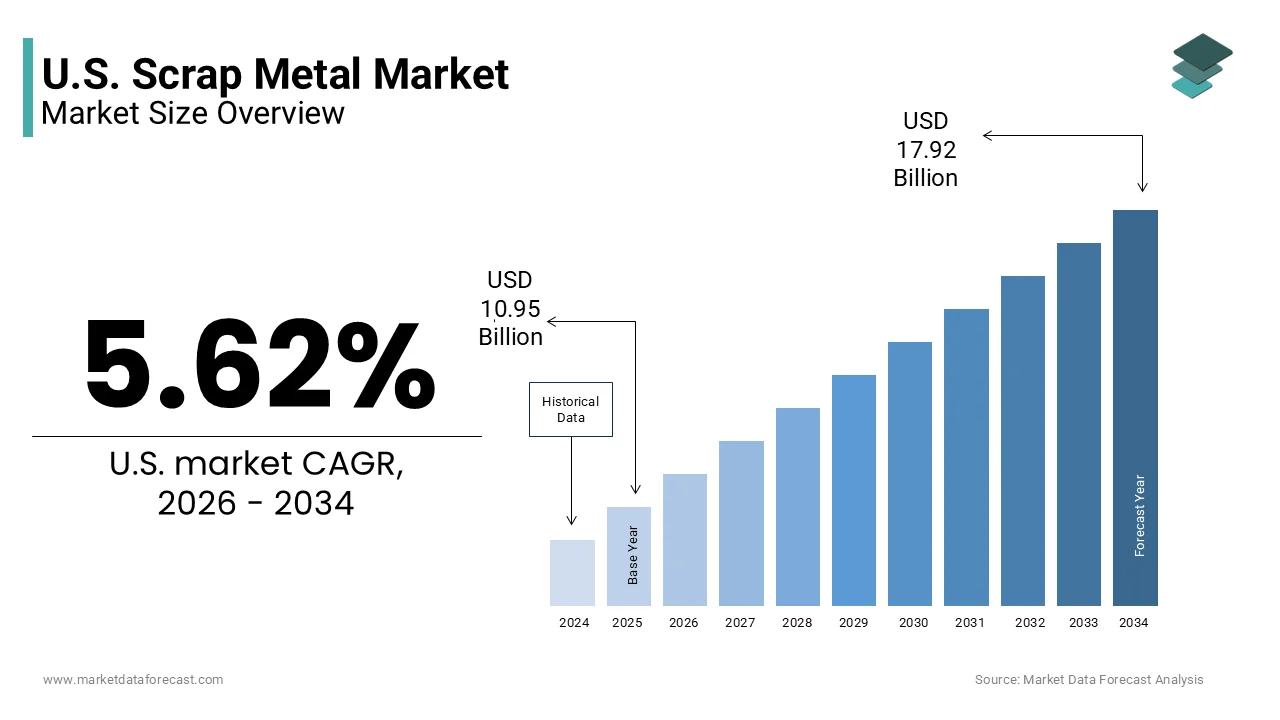
The scrap metal is a foundational pillar of industrial resource circulation with the recovery, processing, and redistribution of discarded metals from obsolete vehicles and demolished infrastructure to end-of-life electronics and manufacturing offcuts. According to the Institute of Scrap Recycling Industries, over 136 million metric tons of scrap were processed domestically in 2022, with ferrous scrap accounting for nearly 80% by volume.
MARKET DRIVERS
Infrastructure Modernization Under the Bipartisan Infrastructure Law
The bipartisan infrastructure law with modern infrastructure is major factor accelerating the growth of U.S. scrap metal market. As per the American Society of Civil Engineers, over 45,000 bridges in the U.S. are classified as structurally deficient, necessitating large-scale reconstruction using recycled steel, which is a material now preferred for its cost-efficiency and lower carbon footprint compared to virgin production.
Automotive Sector Electrification and Battery Metal Recovery
The rapid shift toward electric vehicles (EVs) has reshaped scrap metal composition by elevating demand for lithium, cobalt, nickel, and copper materials embedded in EV batteries and motor windings is also steadily enhancing the growth of U.S. scrap metal market. As per the International Energy Agency, the U.S. sold 1.1 million EVs in 2023, representing 8.3% of total vehicle sales, up from just 4.6% in 2021. Each EV contains approximately 83 kilograms of copper, nearly triple the amount in a conventional internal combustion engine vehicle.
MARKET RESTRAINTS
Supply Chain Fragmentation and Logistics Inefficiencies
The systemic logistical disparities caused by decentralized collection networks and aging transportation infrastructure is restraining the growth of U.S. scrap metal market. As per the Bureau of Transportation Statistics, the average distance traveled by scrap haulers increased by 34% between 2018 and 2023, due to the closure of over 1,200 regional scrapyards since 2015, consolidating operations into fewer, larger hubs. As per the Federal Highway Administration, 43% of U.S. bridges used for heavy haul transport are rated in fair or poor condition, delaying delivery windows by an average of 4.7 days per shipment.
Regulatory Uncertainty Around Export Restrictions and Tariff Fluctuations
The uncertainties around the export restrictions and tariff fluctaion from one country to other is one of the factors that is degrading the growth of U.S. scrap metal market. China’s “National Sword” policy, though initiated in 2018, continues to reverberate through global markets by limiting impurity thresholds in imported scrap, forcing U.S. exporters to invest in advanced sorting technologies.
MARKET OPPORTUNITIES
Urban Mining from E-Waste and Consumer Electronics
The proliferation of consumer electronics has created a latent reservoir of high-value metals buried in discarded devices with an emerging frontier termed “urban mining.” According to the United Nations Global E-waste Monitor, the U.S. generated 6.9 million metric tons of e-waste in 2022, yet only 15% was formally recycled, leaving over 5.8 million tons unprocessed. Companies like iFixit and Sims Lifecycle Services have pioneered modular disassembly techniques that extract circuit boards and connectors with 92% purity by enabling direct feedstock for semiconductor manufacturers.
Decarbonization Incentives and Carbon Credit Integration
The scrap-based steel production is gaining recognition as a low-carbon alternative to blast furnace methods, which is additionally to enhance the growth of US scrap metal market. According to the World Steel Association, producing steel from scrap consumes 75% less energy than virgin ore processing. In 2023, the Environmental Protection Agency began piloting a voluntary carbon accounting framework for recycling facilities under its Greenhouse Gas Reporting Program by allowing eligible scrap processors to generate verified emission reductions tradable via the Chicago Climate Exchange.
MARKET CHALLENGES
Labor Shortages and Workforce Aging in Manual Sorting Operations
The heavily reliant on manual labor for material identification, separation, and handling with a vulnerability exposed by demographic shifts and declining workforce participation is a primary challenging factor for the growth of US scrap metal market. According to the U.S. Bureau of Labor Statistics, the median age of workers in scrap and salvage yards is 52.7 years, with 41% of employees expected to retire within the next decade. This gap forces operators to pay overtime premiums averaging 38% above standard wages, increasing operating costs by $1.8 billion annually, according to ISRI’s Operational Cost Index.
Contamination and Quality Degradation from Mixed Waste Streams
The integration of household and municipal waste into scrap collection channels has introduced persistent contamination issues in non-ferrous streams, which is also to limit the growth of US scrap metal market.
REPORT COVERAGE
| REPORT METRIC | DETAILS |
| Market Size Available | 2025 to 2034 |
| Base Year | 2025 |
| Forecast Period | 2026 to 2034 |
| CAGR | 5.62% |
| Segments Covered | By Type, Application, and Region |
| Various Analyses Covered | Global, Regional, and Country Level Analysis; Segment-Level Analysis; DROC; PESTLE Analysis; Porter’s Five Forces Analysis; Competitive Landscape; Analyst Overview of Investment Opportunities |
| Regions Covered | New York, Massachusetts, Pennsylvania, Illinois, Ohio, Michigan, Texas, Florida, Georgia, California, Washington, Colorado |
| Market Leaders Profiled | Nucor Corporation, Schnitzer Steel Industries, OmniSource Corporation, Commercial Metals Company (CMC), SA Recycling, American Pulverizer Company, Metal Management Inc., Tube City Inc., Hugo Neu Corporation, Alter Trading Corporation, Ferrous Processing & Trading Company (FPT), and PSC Metals |
SEGMENTAL ANALYSIS
By Type Insights
The ferrous metals segment was accounted in holding a significant share of the US scrap metal market in 2025 with the sheer scale of steel consumption across infrastructure and industrial sectors. As per the American Iron and Steel Institute, domestic steel production relied on scrap as the primary feedstock in 74% of electric arc furnace operations, which is consuming 91 million metric tons of ferrous scrap annually.
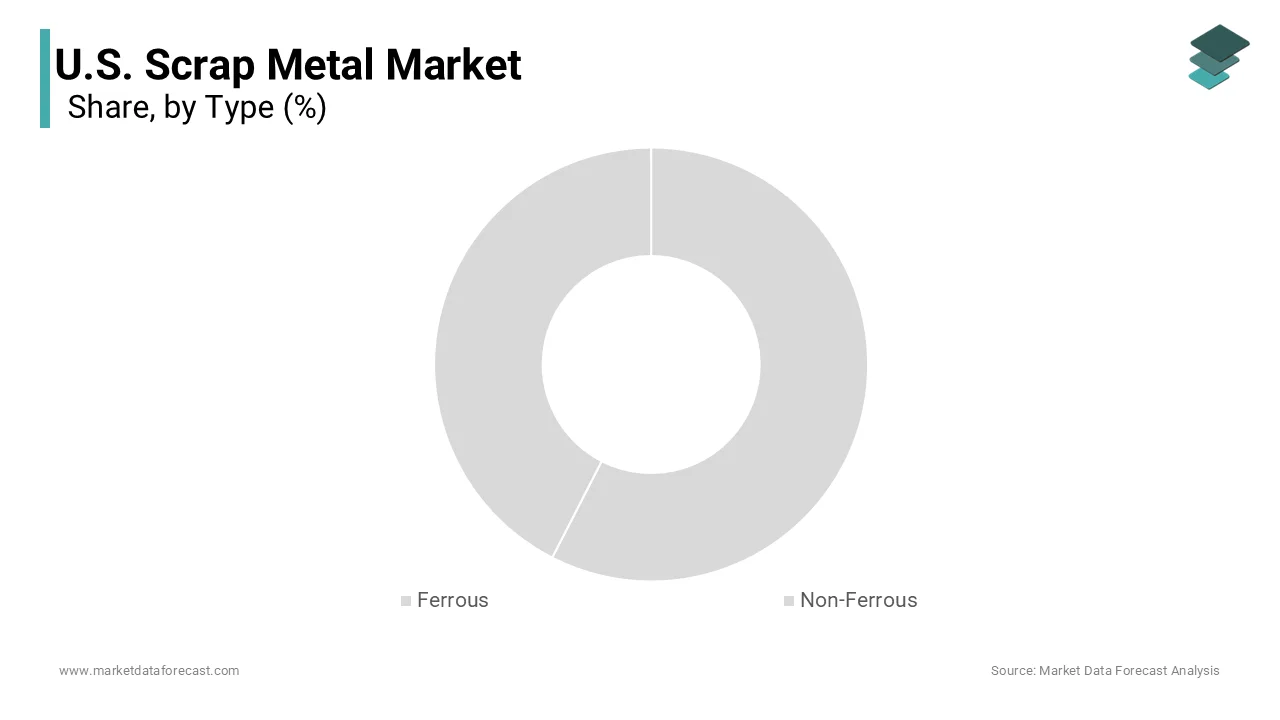
The non-ferrous copper segment is projected to expand at a CAGR of 6.8% during the forecast period. Simultaneously, the Department of Energy’s Grid Modernization Initiative has allocated $14 billion to upgrade transmission lines, with copper wiring accounting for 70% of conductor material in new projects. Recovery rates for end-of-life copper from decommissioned data centers and HVAC systems have surged by 29% since 2020, as documented by the Copper Development Association, transforming urban waste streams into strategic reserves.
By Application Insights
The Building & Construction segment held 47.5% of the US scrap metal market share in 2025 with the nation’s persistent infrastructure renewal cycle, fueled not by new construction alone but by the dismantling of obsolete structures. The Department of Housing and Urban Development allocated $4.5 billion in 2023 specifically for rehabilitating public housing, mandating reuse of structural steel and aluminum framing under green procurement guidelines. Meanwhile, the National Association of Home Builders notes that 78% of new residential projects now incorporate recycled content in steel beams and copper piping to meet LEED certification thresholds.
The consumer appliances segment is likely to grow with an expected CAGR of 8.3% during the forecast period with the accelerating appliance turnover cycles and regulatory shifts toward circular design. The average lifespan of refrigerators and washing machines has dropped from 13 years in 2005 to under 9 years today, as tracked by the Appliance Manufacturers Association, due to planned obsolescence and rising repair costs. Companies like Best Buy and Home Depot now operate mandatory take-back programs tied to warranty extensions, recovering 91% of eligible units, according to their 2023 sustainability disclosures.
REGIONAL ANALYSIS
Texas was the top performer in the United States scrap metal market by accounting for 18.3% of share in 2025 with the epicenter of industrial scrap stems from a unique confluence of energy infrastructure, manufacturing density, and logistics advantage. Houston’s port complex handles nearly 40% of U.S. scrap exports, with shipments primarily bound for Southeast Asia, as noted by the Port of Houston Authority.
California scrap metal market was accounted in holding 14.3% of share in 2025. The state’s stringent Extended Producer Responsibility laws require manufacturers of electronics and appliances to fund collection and recycling, generating 1.9 million metric tons of e-waste-derived metal annually more than any other state.
COMPETITIVE LANDSCAPE
KEY MARKET PLAYERS
A few of the dominating players in the U.S. scrap metal market include
- Nucor Corporation
- Schnitzer Steel Industries
- OmniSource Corporation
- Commercial Metals Company (CMC)
- SA Recycling
- American Pulverizer Company
- Metal Management Inc.
- Tube City Inc.
- Hugo Neu Corporation
- Alter Trading Corporation
- Ferrous Processing & Trading Company (FPT)
- PSC Metals
MARKET SEGMENTATION
This research report on the U.S. scrap metal market is segmented and sub-segmented into the following categories.
By Type
- Ferrous
- Non-Ferrous
- Aluminum
- Copper
- Others
By Application
- Building & Construction
- Automotive
- Equipment Manufacturing
- Packaging
- Consumer Appliances
- Others
By Region
- New York
- Massachusetts
- Pennsylvania
- Illinois
- Ohio
- Michigan
- Texas
- Florida
- Georgia
- California
- Washington
- Colorado
Frequently Asked Questions
1. What is the U.S. Scrap Metal Market?
The U.S. Scrap Metal Market involves the collection, processing, recycling, and resale of metal waste from industrial, commercial.
2. What types of metals are recycled in the U.S. scrap industry?
The market primarily deals with ferrous metals (iron, steel) and non-ferrous metals (aluminum, copper, brass, zinc, lead, and nickel).
3. Which sectors use recycled scrap metal the most?
Key end-use sectors include construction, automotive, electronics, packaging, and manufacturing industries.
4. Which regions dominate the U.S. Scrap Metal Market?
The Midwest and Southern regions lead due to their strong industrial base and proximity to steel manufacturing facilities. Coastal states also play a major role due to export activities.
5. How does government regulation affect the scrap metal industry?
Strict environmental regulations on metal waste management and recycling standards encourage sustainable operations but can increase compliance costs for recyclers.
6. How is technology transforming the scrap metal market?
Technologies like AI-powered sorting systems, shredding automation, real-time material tracking, and data analytics are improving efficiency and recovery rates.
7. What is the future outlook of the U.S. Scrap Metal Market?
The market is expected to see steady growth driven by the green manufacturing movement, increasing recycling rates, and strong domestic steel demand, making the U.S. one of the leading recyclers globally.
Related Reports
Access the study in MULTIPLE FORMATS
Purchase options starting from
$ 1200
Didn’t find what you’re looking for?
TALK TO OUR ANALYST TEAM
Need something within your budget?
NO WORRIES! WE GOT YOU COVERED!
Call us on: +1 888 702 9696 (U.S Toll Free)
Write to us: sales@marketdataforecast.com