U.S Semiconductor Market Size, Share, Trends And Growth Forecasts Research Report, Segmented Compound, Product, Application & Country - Industry Analysis (2026 to 2034)
Market Size, 2025
$9.96 BnMarket Estimate, 2026
$10.69 BnMarket Forecast, 2034
$18.87 BnCAGR, 2026–2034
7.36%U.S. Semiconductor Market Report Summary
The U.S. semiconductor market was valued at USD 9.96 billion in 2025, is anticipated to reach USD 10.69 billion in 2026, and is projected to reach USD 18.87 billion by 2034, growing at a CAGR of 7.36% during the forecast period from 2026 to 2034. The growth of the U.S. semiconductor market is primarily driven by the increasing demand for high-performance computing devices, rapid expansion of the electric vehicle (EV) and renewable energy sectors, and rising investments in domestic semiconductor manufacturing under national initiatives such as the CHIPS and Science Act. The market also benefits from the growing integration of AI, IoT, and 5G technologies across industries, accelerating the need for advanced semiconductor solutions.
Key Market Trends
- Growing adoption of silicon carbide (SiC) and gallium nitride (GaN) semiconductors for high-efficiency power and automotive applications.
- Increased emphasis on reshoring semiconductor manufacturin to strengthen domestic supply chains and reduce dependence on imports.
- Rising integration of AI and machine learning accelerators in data centers and consumer electronics.
- Expanding use of power semiconductors in electric vehicles, industrial automation, and renewable energy systems.
- Strong collaboration between semiconductor companies and federal programs to promote innovation and fabrication infrastructure in the U.S.
Segmental Insights
- Based on compound, the silicon carbide (SiC) segment accounted for 42.3% of the U.S. semiconductor market share in 2025, owing to its superior thermal conductivity, voltage resistance, and efficiency in power electronics. SiC semiconductors are increasingly used in EV powertrains, industrial drives, and grid energy systems.
- Based on product, the power electronics segment dominated the U.S. semiconductor market in 2025, holding 38.2% of the total market share. The segment’s growth is supported by the rising use of power semiconductors in EVs, consumer appliances, and data center power management systems.
Competitive Landscape
The U.S. semiconductor market is highly competitive and innovation-driven, characterized by continuous R&D, mergers, and technological collaborations. Market leaders are investing heavily in advanced chip architectures, material innovation, and domestic fab capacity expansion. Major players in the U.S. semiconductor market include Samsung Semiconductor, Inc., Qorvo, Inc., Skyworks Solutions, Inc., Intel Corporation, Texas Instruments Incorporated, Broadcom Inc., Wolfspeed, Inc., Analog Devices, Inc., Microchip Technology Inc., MACOM Technology Solutions Holdings, Inc., GlobalFoundries Inc., GPD Optoelectronics Corp., and NTE Electronics, Inc.
U.S Semiconductor Market Size
The U.S semiconductor market size was valued at USD 9.96 billion in 2025 and is anticipated to reach a valuation of USD 10.69 billion in 2026 and USD 18.87 billion by 2034, growing at a CAGR of 7.36% from 2026 to 2034.
The semiconductor is the domestic ecosystem of design, fabrication, packaging, and distribution of integrated circuits that serve as foundational components in virtually all modern digital systems. Geopolitical recalibrations and supply chain vulnerabilities have intensified national focus on semiconductor sovereignty, which is reshaping investment and policy trajectories beyond mere commercial metrics.
MARKET DRIVERS
AI and cloud-driven high-performance computing demand are propelling the U.S. semiconductor market growth.
The surging demand for high-performance computing architectures fueled by artificial intelligence and cloud infrastructure expansion is propelling the growth of the U.S. semiconductor market. NVIDIA’s data center revenue, which climbed to $47.5 billion in fiscal year 2024 as per its annual financial disclosures, reflects the scale of enterprise and government procurement for AI training clusters.
Defense and aerospace modernization mandates are boosting the U.S. semiconductor market growth.
The embedded proliferation of semiconductors in defense and aerospace systems underwritten by federal modernization mandates is accelerating the growth of the U.S. semiconductor market. This institutionalized procurement, coupled with classified programs like the Rapid Assured Microelectronics Prototypes initiative that ensures sustained, non-cyclical demand insulated from consumer electronics volatility, anchoring long-term capacity planning for U.S.-based specialty foundries.
MARKET RESTRAINTS
Shortages of specialized EUV equipment are limiting U.S. semiconductor market growth.
The acute shortages in specialized semiconductor manufacturing equipment, particularly extreme ultraviolet lithography systems, are restraining the growth othe f the U.S. semiconductor market. As per the U.S. International Trade Commission, lead times for new EUV tools exceeding 18 months are delaying domestic capacity ramp-ups mandated under the CHIPS Act.
Domestic advanced packaging shortages are restraining U.S. semiconductor growth.h
The persistent deficit in domestic semiconductor packaging and advanced assembly capabilities, particularly for heterogeneous integration and 3D stacking, is degrading the growth of the U.S. semiconductor market. As per the U.S. National Institute of Standards and Technology, fewer than five U.S. sites possess the metrology and process control infrastructure necessary for sub-10-micron bump pitch assembly.
MARKET OPPORTUNITIES
The reindustrialization of semiconductor materials supply chains for ultra-pure precursors and specialty gases is creating new opportunities for the growth of the U.S. semiconductor market.
The integration of quantum computing hardware development and cryogenic CMOS innovation is additionally to level up the growth of the U.S. semiconductor market.
MARKET CHALLENGES
Workforce skill gaps are limiting the rapid expansion of U.S. semiconductor fabs.
The misalignment between workforce skill development and the technical requirements of next-generation fabs is ascribed to bolster the growth of the U.S. semiconductor market. Intel’s Arizona training academy, as disclosed in their 2023 workforce report, requires 12 weeks of intensive cleanroom protocol and tool diagnostics training before new hires can operate independently, with a timeline incompatible with rapid capacity scaling. Fragmented discharge rules slow U.S. semiconductor fab growth.
The regulatory fragmentation governing water and chemical discharge permits for new semiconductor manufacturing sites is challenging for the growth of the U.S. semiconductor market. According to the U.S. Army Corps of Engineers, 60% of proposed fab sites require wetland mitigation studies, adding cost and complexity.
REPORT COVERAGE
| REPORT METRIC | DETAILS |
| Market Size Available | 2025 to 2034 |
| Base Year | 2025 |
| Forecast Period | 2026 to 2034 |
| CAGR | 7.36% |
| Segments Covered | By Compound, Product, Application, and Country |
| Various Analyses Covered | Global, Regional, and Country Level Analysis, Segment-Level Analysis; DROC, PESTLE Analysis; Porter’s Five Forces Analysis; Competitive Landscape; Analyst Overview of Investment Opportunities. |
| Regions Covered | US, Canada, and the Rest of North America |
| Market Leaders Profiled | Samsung Semiconductor, Inc., Qorvo, Inc., Skyworks Solutions, Inc., Intel Corporation, Texas Instruments Incorporated, Broadcom Inc., WOLFSPEED, INC., Analog Devices, Inc., Microchip Technology Inc., MACOM Technology Solutions Holdings, Inc., GlobalFoundries Inc., GPD Optoelectronics Corp., NTE Electronics, Inc. |
SEGMENT ANALYSIS
By Compound Insights
The silicon carbide (SiC) segment accounted in holding 42.3% of the U.S. semiconductor market share in 2025, with SiC’s irreplaceable role in high-efficiency power conversion systems deployed across electric vehicles and industrial infrastructure. General Motors, as stated in its 2025 investor briefing, confirmed adoption of SiC power modules across all its Ultium-based EV platforms, projecting a 70% reduction in switching losses compared to silicon IGBTs.
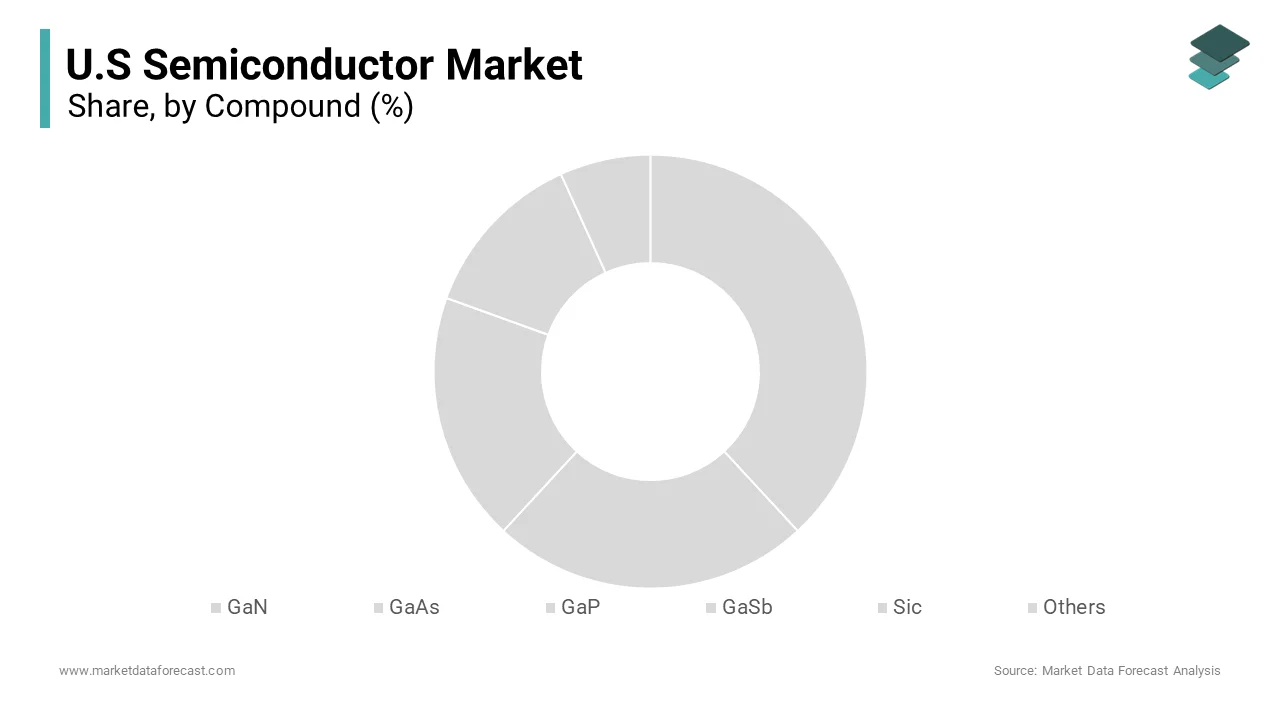
The Gallium nitride (GaN) segment is anticipated to grow with a CAGR of 51% from 2025 to 2033, with GaN’s unmatched power density and switching frequency, enabling miniaturization in consumer fast-chargers and defense-grade RF amplifiers.
By Product Insights
The power electronics segment was the largest and held 38.2% of the U.S. semiconductor market share in 2025, with the irreversible electrification of mobility and renewable energy infrastructure.
The optoelectronics segment is projected to register a CAGR of 29.3% during the forecast period, with hyperscale data center optical interconnect demand and LiDAR proliferation in autonomous systems. The National Highway Traffic Safety Administration’s 2024 proposed rulemaking on automated driving systems mandates sensor redundancy, effectively institutionalizing optoelectronics as non-discretionary automotive content.
COMPETITIVE LANDSCAPE
KEY MARKET PLAYERS
A few of the market players in the U.S semiconductor market include
- Samsung Semiconductor, Inc.
- Qorvo, Inc.
- Skyworks Solutions, Inc.
- Intel Corporation
- Texas Instruments Incorporated
- Broadcom Inc.
- WOLFSPEED, INC.
- Analog Devices, Inc.
- Microchip Technology Inc.
- MACOM Technology Solutions Holdings, Inc.
- GlobalFoundries Inc.
- GPD Optoelectronics Corp.
- NTE Electronics, Inc.
Top Players In The Market
- Intel Corporation anchors U.S. semiconductor leadership through advanced logic manufacturing and defense-grade secure processing. The company broke ground on two new Ohio fabs, backed by CHIPS Act funding, to restore U.S. process leadership. Intel’s IDM 2.0 strategy integrates design, packaging, and global foundry services, positioning it as a full-stack solution provider critical to national tech sovereignty and next-gen AI infrastructure deployment.
- NVIDIA dominates accelerated computing through its GPU and AI platform ecosystem. Its 2025 release of the H100 Tensor Core GPU and Grace Hopper Superchip redefined data center AI training efficiency. The company expanded CUDA’s reach into robotics and digital twins via Omniverse and Isaac platforms. Strategic partnerships with cloud titans and sovereign AI initiatives globally cement its architectural lock-in. NVIDIA’s acquisition of AI infrastructure software firms and in-house CPU development signal vertical integration to control the full AI stack from silicon to software.
- Applied Materials fortifies U.S. fabrication capacity through materials engineering and process control systems. In 2025, it unveiled the Centura Sculpta patterning system, enabling sub-2nm feature definition without EUV dependency. The company established a Materials Engineering Technology Accelerator in Albany, NY, co-funded by NewYork State and IBM, to co-develop next-gen deposition and etch technologies.
Top Strategies Used by Key Market Participants
Key players deploy vertical integration, co-innovation with national labs, and geopolitical supply chain de-risking. They anchor R&D in federally funded hubs, acquire niche IP for architectural dominance, and align fab expansions with CHIPS Act disbursements. Talent pipeline development via university partnerships and technician academies ensures workforce readiness. Foundry service diversification attracts fabless clients seeking U.S.-based production. Equipment vendors embed AI-driven predictive maintenance to reduce downtime.
MARKET SEGMENTATION
This research report on the U.S semiconductor market is segmented and sub-segmented into the following categories.
By Compound
- GaN
- GaAs
- GaP
- GaSb
- Sic
- Others
By Product
- LED
- Optoelectronics
- RF Devices
- Power Electronics
- Others
By Application
- Electronics & Consumer Goods
- Aerospace & Defense
- Telecommunication
- Others
By Country
- USA
- Canada
- Mexico
Frequently Asked Questions
Why is the U.S. pushing so hard to reshore chip manufacturing?
National security and supply chain resilience—after pandemic-era shortages disrupted autos, defense, and medical devices, the U.S. aims to produce 30% of global advanced chips domestically by 2030.
Is the CHIPS Act actually working?
Yes—over $30 billion in grants and loans have been awarded (e.g., to Intel, TSMC, Samsung), with new fabs under construction in Arizona, Ohio, and Texas. But full-scale output won’t ramp until 2026–2027.
Are U.S. companies still dependent on Asia for chips?
Heavily—over 70% of global semiconductor production is in Asia. While design leadership remains strong (NVIDIA, AMD, Qualcomm), the U.S. makes only ~12% of the world’s chips today.
What’s driving demand for semiconductors in 2025?
AI data centers (requiring H100/B100 GPUs), electric vehicles (power electronics), defense systems, and industrial automation—not just consumer electronics.
Is there a shortage of skilled semiconductor workers?
Yes—engineers, process technicians, and equipment specialists are in short supply. Companies are partnering with community colleges and offering $100K+ starting salaries to fill cleanroom roles.
How are export controls affecting the market?
U.S. restrictions on advanced chip sales to China are reshaping global supply chains—boosting domestic R&D but pressuring firms like NVIDIA to design “China-compliant” chips with lower performance.
Are older-node chips still important?
Critically—mature nodes (28nm and above) power cars, appliances, and industrial gear. The U.S. is also investing in these (e.g., GlobalFoundries expansion) to reduce reliance on legacy fabs in Southeast Asia.
What role does packaging play now?
Advanced packaging (like chiplets and 3D stacking) is becoming as crucial as fabrication—enabling performance gains without shrinking transistors further. U.S. firms lead in design and integration.
Is sustainability a concern in chipmaking?
Yes—fabs use massive water and energy. New U.S. plants are incorporating on-site water recycling and renewable power to meet ESG goals and local permitting requirements.
What’s the biggest risk to the U.S. semiconductor comeback?
Delays in talent development, permitting bottlenecks, and global overcapacity in mature nodes could undermine ROI—especially if demand from China or consumer electronics softens longer than expected.
Related Reports
Access the study in MULTIPLE FORMATS
Purchase options starting from
$ 2000
Didn’t find what you’re looking for?
TALK TO OUR ANALYST TEAM
Need something within your budget?
NO WORRIES! WE GOT YOU COVERED!
Call us on: +1 888 702 9696 (U.S Toll Free)
Write to us: sales@marketdataforecast.com