- Product Description Description
- Table of Contents TOC
- List of Table & Figure LOT
- Get Free Sample PDF Sample PDF
Market Size, 2025
$120.27 BnMarket Estimate, 2026
$132.74 BnMarket Forecast, 2034
$292.29 BnCAGR, 2026–2034
10.37%Executive Summary: Global Vehicle Electrification Market
- Market Scope: Comprehensive global vehicle electrification analysis covering vehicle categories, propulsion technologies, battery systems, components, power ratings, application sectors, and regional leadership frameworks.
- Market Valuation: Valued at USD 120.27 billion (2025), estimated at USD 132.74 billion (2026), and projected to reach USD 292.29 billion by 2034, registering a robust CAGR of 10.37% (2026–2034).
- Primary Growth Drivers: Substantial technological shift from hydrocarbon energy to electricity, rising demand for fuel-efficient and low-emission vehicles, reduction of operational expenses by eliminating traditional lubricants and coolants, and aggressive OEM investments in clean power integration.
Key Market Segment Metrics (2026–2034)
| Category | Leading Segment (2025 Position) | Fastest-Growing Segment |
|---|---|---|
| By Product / Component | Electric power steering (EPS) (maintaining high interest as a compact, energy-efficient computer-controlled motor solution) | Electric pumps (predicted to witness an enormous CAGR of 10.7% driven by functional mechanical integration and even oil distribution) |
| By Propulsion Type | Hybrid Electric Vehicles (HEV) and Battery Electric Vehicles (BEV) (capturing major volume based on established manufacturing and environmental compliance) | Plug-in Hybrid Electric Vehicles (PHEV) (expanding at a higher CAGR of 15.6% due to optimal fuel efficiency and low maintenance costs) |
| By Vehicle Type | Passenger cars (leading initial commercial adoption and volume scaling) | Commercial vehicles and two-wheelers/three-wheelers (experiencing rapid electrification across urban fleets) |
| By Region / Country | Asia-Pacific (established as a massive market due to rapid urban population growth and high private transport demand in countries like China and India) | North America (fastest-growing marketplace propelled by expanding charging infrastructure and aggressive OEM investments) |
Major Market Players & Market Structure
Market Structure: Highly competitive global automotive landscape featuring major traditional tier-1 suppliers and multinational automotive manufacturers transitioning rapidly into electric powertrains, advanced thermal management, power electronics, and scalable hybrid architectures.
Key Companies: Robert Bosch GmbH, Continental AG, Denso Corporation, Delphi Automotive PLC, Johnson Electric Holdings Ltd., Volkswagen, Toyota Motor Corporation, Honda Motor Co. Ltd, Mitsubishi Electric Corporation, TRW Automotive Holdings Corp., and Others.
 Download Free Sample Report
Global Vehicle Electrification Market Size
The global vehicle electrification market size was valued at USD 120.27 billion in 2025 and is anticipated to reach USD 132.74 billion in 2026 and USD 292.29 billion by 2034, growing at a CAGR of 10.37% during the forecast period from 2026 to 2034.
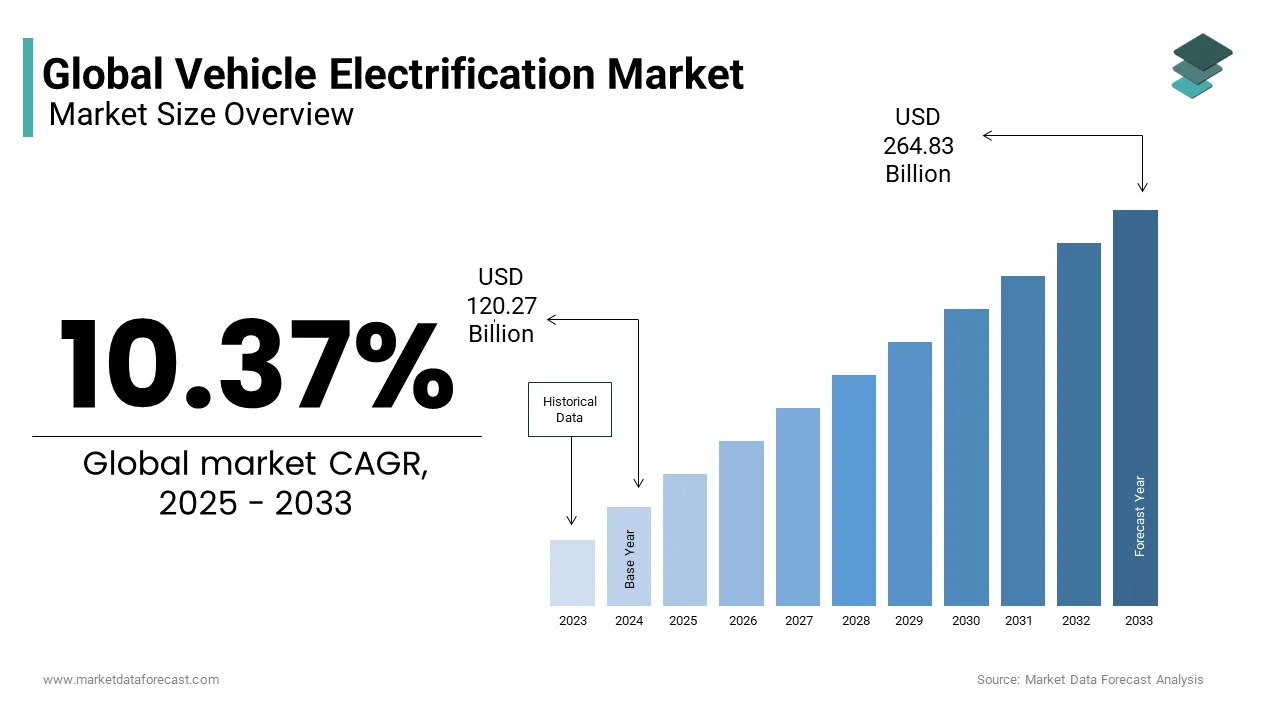
Electric vehicles are designed to work on electricity, and the consumption of fossil fuels is decreased. Electric cars are also likely to assist in reducing carbon emissions from vehicles. OEMs across the planet are making efforts to develop and introduce electric vehicles on the roads as soon as possible.
Adoption of unpolluted power generation sources in such vehicles significantly impacts the environment, with reduced harmful emissions from the tailpipes, also because of the power system. Additionally, the electrification process incurs less operating expense and requires low maintenance because it eliminates the utilization of lubricant or coolant within the vehicle. The mechanical integration through electrification improves the general working and efficiency, which is anticipated to spice up the market over the foreseeable period.
MARKET DRIVERS
The global vehicle electrification market has seen a severe rate of growth due to the considerable shifting of automotive technology from hydrocarbon energy to electricity. The need for sunshine-weighted automobiles to enhance fuel efficiency and reduce carbon emissions drives the expansion of this market. However, the efforts put in by the varied vital players of this marketplace for the development of this technology result in the exponential growth of the market.
MARKET RESTRAINTS
However, it's hard to replace an energy source like gasoline from the oil & gas sector with electricity, thanks to the high power generation capacity of the former, which limits the market growth.
REPORT COVERAGE
| REPORT METRIC | DETAILS |
| Market Size Available | 2025 to 2034 |
| Base Year | 2025 |
| Forecast Period | 2026 to 2034 |
| CAGR | 10.37% |
| Segments Covered | By Vehicle, Propulsion, Battery, Component, Vehicle Power Rating, Application, and Region. |
| Various Analyses Covered | Global, Regional & Country Level Analysis, Segment-Level Analysis, DROC, PESTLE Analysis, Porter’s Five Forces Analysis, Competitive Landscape, Analyst Overview of Investment Opportunities |
| Regions Covered | North America, Europe, APAC, Latin America, Middle East & Africa |
| Market Leaders Profiled | Robert Bosch GmbH, Continental AG, Denso Corporation, Delphi Automotive PLC, Johnson Electric Holdings Ltd., Volkswagen, Toyota Motor Corporation, Honda Motor Co. Ltd, Mitsubishi Electric Corporation, TRW Automotive Holdings Corp., and Others. |
SEGMENT ANALYSIS
By Product Insights
The electric power steering witnessed high interest in 2016 and is anticipated to grow at a CAGR of 6.3% over the foreseen period. Electric power steering (EPS) offers benefits that include advanced technology, such as displacing the hydraulic guide with a computer-controlled motor within the vehicle. EPS is smaller and lighter than HPS because it eliminates various conventional components and, thus, results in an energy-efficient solution for automobiles. The lack of reliability in hydraulic power steering further supports the growth of EPS in this market. However, the electric pump in the merchandise type segment is predicted to witness an enormous CAGR of 10.7% over the foreseen period. Useful mechanical integration fuels electrical pump applications in the automotive industry. This results in oil lubrication being equally distributed amongst the required area of the engine, also because of the different parts of the auto.
By Degree of Hybridization Insights
Plug-in hybrid Electric Vehicle (PHEV) is anticipated to expand at a comparatively higher CAGR of 15.6 % than other hybridization types over the foreseeable period. The current technology and mechanical integration prospects within automobiles deliver the consumer with an optimum solution for efficiency. The rising demand for PHEVs is attributed to growing consumer preference for the benefits of fuel efficiency and low operational and maintenance costs of the vehicle.
Battery Electric Vehicle (BEV) is predicted to grow at a healthy CAGR of 14.2% over the foreseen period. The expansion within the segment is owed to changing environmental standards across all nations' governments. The aim to attenuate the impact of worldwide carbon footprints is further anticipated to fuel the demand for the market within the industry.
REGIONAL ANALYSIS
North America Market Analysis
North America is predicted to be the fastest-growing marketplace for vehicle electrification. The expansion in this region is propelled by growing charging infrastructure and significant investments by OEMs in the development of auto electrification. The US is about to dominate the North American market, holding the very best market share in the future. Thus, North America is predicted to be the fastest-growing market during the foreseeable period.
Europe Market Analysis
Europe is projected to account for the second-largest marketplace for vehicle electrification. The government within the region is concentrated on practicing sustainable development within infrastructure growth, which has led the OEM of auto electrification to expand its business in major countries like Germany, France, Italy, and the U.K.
Asia Pacific Market Analysis
The Asia Pacific market was estimated at USD 31.71 billion in 2016. The rising automotive industry in countries like India and China, due to the demand for vehicles, supplements the expansion of the industry. However, the mixture of rising population in countries and increasing per capita income stimulates the demand for private transport automobiles, which is supportive of a sustainable environment.
KEY MARKET PLAYERS
A few of the market players in the global vehicle verification market include
- Robert Bosch GmbH
- Continental AG
- Denso Corporation
- Delphi Automotive PLC
- Johnson Electric Holdings Ltd.
- Volkswagen
- Toyota Motor Corporation
- Honda Motor Co. Ltd
- Mitsubishi Electric Corporation
- TRW Automotive Holdings Corp
MARKET SEGMENTATION
This research report on the vehicle electrification market is segmented and sub-segmented into the following categories.
By Vehicle Type
- Passenger Cars
- Commercial Vehicles (Buses, Trucks)
- Two-wheelers & Three-wheelers
By Propulsion Type:
- Hybrid Electric Vehicle (HEV)
- Plug-in Hybrid Electric Vehicle (PHEV)
- Battery Electric Vehicle (BEV)
- Fuel Cell Electric Vehicle (FCEV)
By Battery Type:
- Lithium-ion Battery
- Lead Acid Battery
- Nickel-Metal Hydride Battery
By Components:
- Battery Pack
- Electric Motor
- Power Electronics
- Onboard Charger
By Vehicle Power Rating:
- <30 kW
- 30–80 kW
- 80 kW
By Application:
- Personal
- Commercial
By Region
- North America
- Europe
- Asia Pacific
- Latin America
- Middle East and Africa