- Product Description Description
- Table of Contents TOC
- List of Table & Figure LOT
- Get Free Sample PDF Sample PDF
Market Size, 2025
$72.40 BnMarket Estimate, 2026
$82.61 BnMarket Forecast, 2034
$237.31 BnCAGR, 2026–2034
14.1%Global Vehicle Tracking System Market Size, Growth, Trends & Forecast (2026–2034)
The global vehicle tracking system market size was valued at USD 72.40 billion in 2025, reached USD 82.61 billion in 2026, and is projected to scale up to USD 237.31 billion by 2034, registering a compound annual growth rate (CAGR) of 14.1% during the forecast period from 2026 to 2034. Driven by mandatory regulatory compliance for commercial fleets, escalating vehicle theft rates, and expanding integration of predictive maintenance with telematics analytics, the market continues to expand significantly across the globe.
Key Executive Metrics (At-a-Glance)
- 2025 Base Valuation: USD 72.40 Billion
- 2026 Current Valuation: USD 82.61 Billion
- 2034 Forecast Valuation: USD 237.31 Billion
- Compound Annual Growth Rate (CAGR): 14.1% (2026–2034)
- Leading Regional Market: North America (Dominating globally with 36.3% share)
- Fastest-Growing Regional Market: Asia Pacific
Core Market Drivers
- Regulatory Mandates: Government requirements for real-time commercial fleet monitoring, electronic logs, and automatic collision response.
- Security Needs: Rising vehicle theft rates globally, driving urgent adoption of real-time geolocation and remote immobilization.
Primary Market Restraints & Challenges
- Privacy & Cybersecurity: Growing data privacy concerns, potential data breaches, and vulnerabilities in connected tracking devices.
Global Vehicle Tracking System Market Segmentation Highlights
| Segment Category | Largest Segment | Fastest-Growing Segment |
|---|---|---|
| By Vehicle Type | Heavy Commercial Vehicles | Light Commercial Vehicles |
| By Technology | GPS/Satellite | Dual Mode |
| By Type | Not specified | Not specified |
| By Component | Not specified | Not specified |
| By End Use | Transportation & Logistics | Government & Defence |
| By Region | North America | Asia Pacific |
Major Industry Players Profiled
Key technology developers and market leaders shaping the global vehicle tracking system sector include Geotab Inc., Inseego Corp., Robert Bosch GmbH, Trimble Inc., MiX Telematics International, Verizon Communications Inc., Spireon, Inc., US Fleet Tracking, TRACK GROUP (US), Continental AG, and AT&T Inc.
Global Vehicle Tracking System Market Size
The global vehicle tracking system market size was valued at USD 72.40 billion in 2025 and is anticipated to reach a valuation of USD 82.61 billion in 2026, and USD 237.31 billion by 2034, growing at a CAGR of 14.1% during the forecast period from 2026 to 2034.
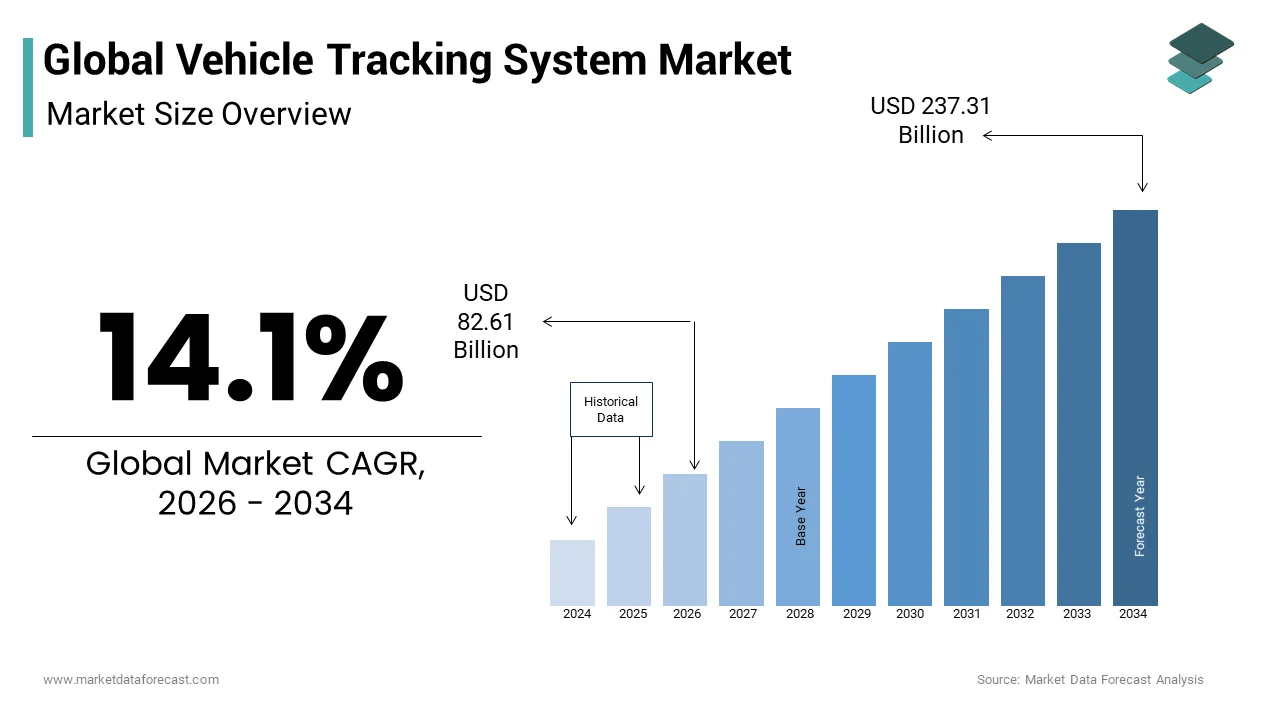
A vehicle tracking system refers to the hardware and software solutions that monitor and manage vehicle location, movement, speed, and operational status in real time using satellite and cellular networks. These systems integrate Global Navigation Satellite System receivers, cellular mode, ms, and onboard diagnostics to deliver data for fleet management, theft recovery, driver behavior analy, sis and compliance reporting. New commercial vehicles frequently come with factory-installed tracking devices as a standard feature. Regulations require all new vehicles to automatically transmit precise location data to emergency services during collisions. Mandates exist for electronic logging devices with GPS functionality for commercial carriers to monitor location and hours of service. Government agencies have made GPS tracking compulsory for all public transport and commercial freight vehicles. These regulatory and safety imperatives have transformed vehicle tracking from a discretionary tool into a foundational component of intelligent transportation and asset security infrastructure.
MARKET DRIVERS
Mandatory Regulatory Compliance for Commercial Fleets
Government mandates requiring real-time vehicle monitoring have become a primary enabler for tracking system adoption across commercial transport sectors, which drives the expansion of the vehicle tracking system market. Regulatory frameworks globally enforce the use of digital monitoring devices in commercial vehicles to manage driver activity. Authorities require the integration of GPS and related technologies to ensure compliance with driving and rest regulations, as well as for real-time tracking of vehicle location and operations. Policies are designed to reduce incidents related to driver fatigue by mandating electronic records of hours of service. Tamper-proof systems are used to maintain the integrity of recorded data. Enforcement measures also target the reduction of unauthorized route deviations and aim to improve overall road safety. Mandates for real-time tracking for certain public and goods carriers are implemented to improve safety standards following various safety reforms. These regulations create non-discretionary demand as non-compliance results in fines, operational suspension,n or license revocation, making tracking systems essential infrastructure rather than optional technology.
Rising Vehicle Theft and Demand for Real-Time Recovery Solutions
Escalating vehicle theft rates globally are driving urgent adoption of tracking systems with real-time geolocation and remote immobilization capabilities, which further propels the expansion of the vehicle tracking system market. Vehicle thefts have seen a significant increase. Recovery rates for stolen vehicles are substantially higher when a tracking system is used compared to those without. The use of GPS-enabled tracking technology has directly assisted law enforcement in recovering stolen vehicles. Vehicles equipped with active tracking systems are recovered much faster on average than those without such systems. Automakers have responded to the trend by embedding vehicle tracking as a standard feature in their vehicles. Specific automotive brands offer integrated stolen vehicle assistance and automatic alert services. Insurance companies are actively encouraging the use of tracking systems by offering premium discounts as an incentive. This convergence of crime trends, law enforcement collaboration, and financial incentives establishes real-time tracking as a critical layer of modern vehicle security.
MARKET RESTRAINTS
Data Privacy and Surveillance Concerns Among End Users
Growing awareness of data privacy risks associated with continuous vehicle monitoring is restraining widespread adoption, particularly among private vehicle owners and gig economy drivers, which restricts the growth of the vehicle tracking system market. Many fleet tracking agreements lack clear provisions on data retention and usage, a situation that often leads to employee distrust. A significant portion of consumers would avoid purchasing a new vehicle if it included non-removable tracking hardware. Legal challenges are increasing, and courts are ruling that employers must disable GPS tracking outside working hours unless a specific risk justifies its continuous use. Concerns are amplified by high-profile data breaches where hackers have accessed commercial fleet tracking platforms to identify information like high-value cargo routes. Consumer and workforce pushback will hinder market adoption until robust data governance frameworks and privacy settings controlled by users become the norm.
Interoperability and Fragmentation Across Tracking Platforms
The absence of universal communication standards and proprietary data formats across tracking system providers creates significant integration barriers for multi-vendor fleets and public safety agencies. This impedes the expansion of the vehicle tracking system market. Fleet operators managing vehicles from multiple manufacturers often require separate software dashboards and subscription services, increasing operational complexity and cost. Law enforcement agencies face similar challenges. In emerging markets, the problem is exacerbated by low-cost aftermarket devices that use non-standardized GSM frequencies and lack secure APIs. The full benefits of vehicle tracking for coordinated safety and logistics optimization cannot be achieved until open architecture and common data schemas are universally adopted across the industry.
MARKET OPPORTUNITIES
Integration with Predictive Maintenance and Telematics Analytics
These systems are evolving beyond location monitoring to deliver predictive maintenance insights through integration with onboard diagnostics and machine learning algorithms, which provides new opportunities for the growth of the vehicle tracking system market. Modern tracking units collect real-time data on engine performance, fuel consumption,n tire pressure, and driving behavior, enabling proactive service scheduling. Companies offer analytics platforms that correlate GPS data with engine fault codes to forecast component failures before they cause breakdowns. This convergence transforms tracking from a passive monitoring tool into an active operational intelligence layer that enhances asset utilization, reduces lifecycle costs, and supports sustainability goals through optimized vehicle performance.
Expansion of Tracking in Last Mile and Micromobility Segments
The explosive growth of e-commerce and shared mobility is creating new demand for compact, affordable tracking solutions in last-mile delivery and micromobility applications, which is setting up fresh prospects for the expansion of the vehicle tracking system market. Companies mandate GPS tracking on all last-mile assets to ensure route efficiency and package security. Startups such as Trackimo and Invoxia have developed credit card-sized trackers with multi-year battery life specifically for light electric vehicles. This shift toward hyperlocal urban logistics and shared transport models is opening a high-volume market for miniaturized energy-efficient tracking devices that operate reliably in dense urban environments.
MARKET CHALLENGES
Cybersecurity Vulnerabilities in Connected Tracking Devices
The increasing connectivity of these systems introduces significant cybersecurity risks that can compromise vehicle control and personal data, thereby challenging the growth of the vehicle tracking system market. Vulnerabilities found in specific cellular tracking modules enable attackers to remotely disable engine immobilizers or manipulate location data. Numerous commercial tracking platforms are susceptible to man-in-the-middle attacks due to a lack of end-to-end encryption. In one incident, thieves successfully used GPS spoofing to mislead fleet managers regarding vehicle locations during high-value heists. Many new tracking systems do not support secure over-the-air updates, resulting in known exploits remaining unpatched for extended periods. These weaknesses are particularly concerning as tracking data often includes sensitive information such as home address, etc., frequent routes, and driver behavior patterns. Tracking systems may introduce new security risks—acting as potential attack vectors rather than the intended security assets—until robust security by design principles and mandatory certification standards (such as ISO 21434) are universally adopted.
Dependence on Cellular and Satellite Network Coverage
The reliability of vehicle tracking systems remains heavily contingent on the availability and quality of cellular and satellite communication infrastructure, particularly in remote and rural areas, which further holds back the expansion of the vehicle tracking system market. Even in developed nations, tunnels, mountain regions, and underground parking structures disrupt signals. While dual-mode systems using both GNSS and low-earth orbit satellites exist, they remain cost-prohibitive for mass adoption. Until ubiquitous low-latency connectivity is achieved, tracking systems will continue to face operational limitations that reduce their effectiveness in critical scenarios.
REPORT COVERAGE
| REPORT METRIC | DETAILS |
| Market Size Available | 2025 to 2034 |
| Base Year | 2025 |
| Forecast Period | 2026 to 2034 |
| CAGR | 14.1% |
| Segments Covered | By Vehicle Type, Technology, Type, Component, End Use, and Region. |
| Various Analyses Covered | Global, Regional, and Country-Level Analysis, Segment-Level Analysis, DROC, PESTLE Analysis, Porter’s Five Forces Analysis, Competitive Landscape, Analyst Overview of Investment Opportunities |
| Regions Covered | North America, Europe, APAC, Latin America, Middle East & Africa |
| Market Leaders Profiled | Geotab Inc., Inseego Corp., Robert Bosch GmbH, Verizon Communications Inc., Spireon, Inc., US Fleet Tracking, TRACK GROUP (US), Continental AG, Robert Bosch GmbH, Verizon Communications Inc., AT&T Inc., Cartrack Holdings Limited, Spireon, Inc., and Others. |
SEGMENTAL ANALYSIS
By Vehicle Insights
The heavy commercial vehicles segment dominated the vehicle tracking system market and accounted for a 28.3% share in 2025. The dominance of the heavy commercial vehicles segment is propelled by the stringent regulatory mandates, high asset value, and operational complexity that necessitate continuous monitoring. Regulatory requirements are driving the adoption of sophisticated vehicle monitoring technology, leading to widespread use of location-tracking devices in commercial vehicles. Compliance efforts are resulting in a high rate of equipment installation across the heavy goods transport sector, where the significant investment represented by commercial vehicles makes asset monitoring for theft prevention and efficiency a strong economic necessity. No external sources were provided for this summary. Fleet operators also leverage tracking data to monitor fuel consumption, driver behavior, and maintenance schedules, directly impacting profitability. These combined regulatory, financial, and operational factors cement heavy commercial vehicles as the cornerstone of the tracking system market.
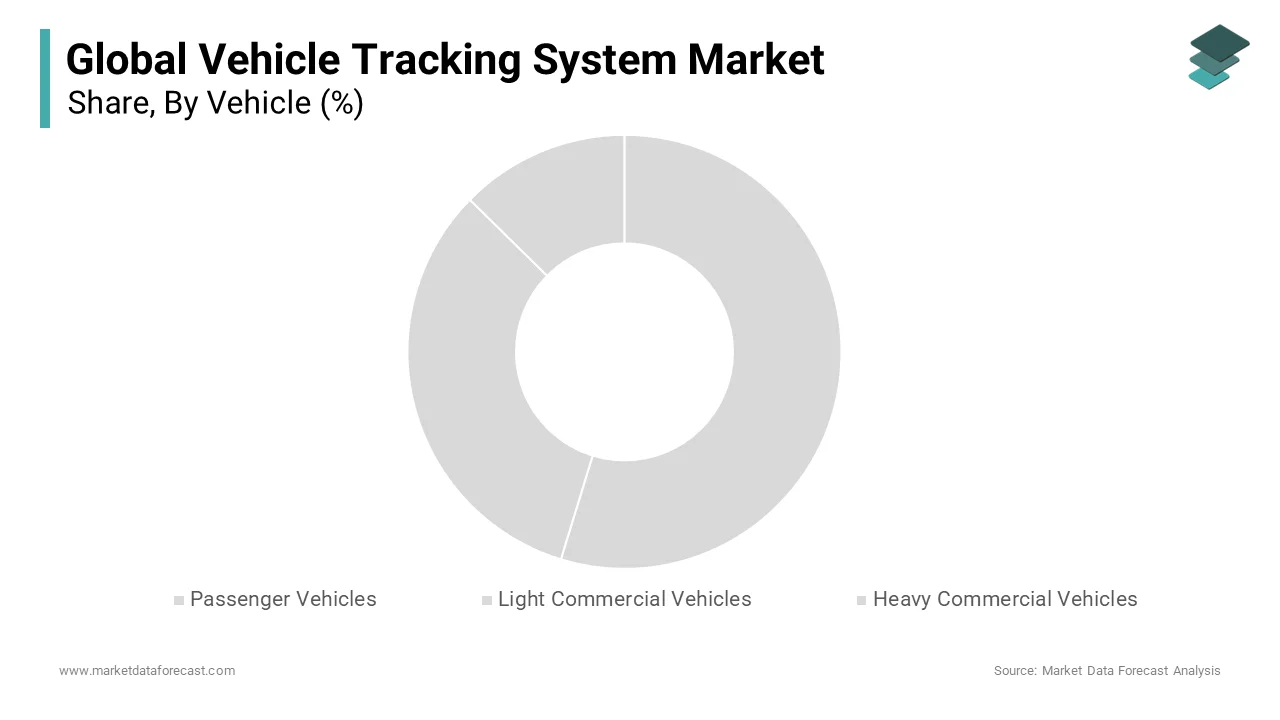
The light commercial vehicle segment is expected to exhibit a noteworthy CAGR of 18.6% from 2025 to 2033 due to the exponential expansion of e-commerce, last-mile delivery, and urban logistics networks. Parcel volume is substantial and growing, necessitating efficient delivery operations. Every delivery van or cargo van requires real-time tracking to ensure efficient routes, secure packages, and provide proof of delivery. Major logistics companies now mandate GPS tracking on all last-mile assets as a standard operating procedure. Regulatory bodies have established compulsory vehicle tracking for specific goods carriers to combat cargo theft. Government frameworks encourage the use of light commercial vehicle data within traffic management systems to help reduce overall congestion. Delivery fleets currently average multiple stops per route, making the use of dynamic rerouting and geofencing essential for effective operations. The rise in urban delivery volumes, coupled with consumer expectations for real-time tracking, is making LCVs the primary source of data in city transport, thus accelerating the adoption of sophisticated tracking solutions.
By Technology Insights
The GPS and satellite-based tracking segment led the vehicle tracking system market by capturing a 62.6% share in 2025. The supremacy of this segment is driven by global coverage, high positional accuracy, and independence from terrestrial infrastructure. GPS enables real-time location monitoring with sub-meter precision in open environments, making it indispensable for long-haul freight maritime logistics and cross-border transport. In maritime and remote land applications where cellular networks are absent, satellite-based systems like Iridium and Globalstar provide critical backup. Automakers also embed GPS as standard. The maturity of multi-constellation support, combining GPS, Galileo, GLONASS, SS, and BeiDou, further enhances reliability in urban canyons and mountainous terrain, ensuring GPS remains the foundational layer of global vehicle tracking infrastructure.
The dual-mode tracking systems segment is predicted to witness the highest CAGR of 22.4% over the forecast period. This hybrid approach addresses the critical limitations of standalone GPS by enabling data transmission even in signal-degraded environments such as tunnels, underground parking, and dense urban cores. Companies like Geotab and Samsara now deploy dual-mode trackers that switch seamlessly between GNSS and cellular triangulation or Wi Fi positioning to maintain continuous visibility. The European Union’s 5G Action Plan further accelerates adoption by enabling ultra-reliable low-latency communication for real-time tracking in smart city corridors. In emerging markets, dual-mode devices leverage affordable 2G/4G networks for data backhaul while using GPS for primary positioning—offering cost-effective resilience. "The increase in urban vehicle use, coupled with higher demands for connectivity, means that dual-mode architecture is shifting from a luxury feature to a standard necessity for dependable mission-critical tracking.
By End Use Insights
The transportation and logistics segment was the largest segment in the vehicle tracking system market and occupied a 57.7% share in 2025. This prominence is fuelled by the sector’s dependence on real-time visibility for operational efficiency, regulatory compliance, and asset security. Regulatory requirements are being implemented to mandate continuous location and hours of service monitoring for commercial vehicles. International customs and border systems are integrating location data to facilitate faster cross-border cargo movement. Logistics firms are adopting integrated tracking platforms that enable dynamic route optimization and predictive arrival times. Tracking platforms are used by companies to monitor vehicles and aid in theft recovery efforts. Tracked shipments demonstrate a reduced rate of incidents concerning cargo security issues. The sector’s scale, regulatory exposure, and economic sensitivity to asset visibility ensure its continued dominance in tracking system deployment.
The government and defense segment is estimated to register the fastest CAGR of 20.8% from 2025 to 2033 due to national security imperatives, fleet modernization programs, and smart city initiatives that require secure real-time vehicle monitoring. Military forces globally are equipping tactical and support vehicles with encrypted dual-mode trackers resistant to jamming and spoofing. Civilian agencies are also expanding deployment. The European Union’s Horizon Europe program funds projects like SECURVET, which integrates vehicle tracking with critical infrastructure protection. Additionally, smart city frameworks in Dubai, Singapore, nd Seoul require municipal fleets—including waste management and public transit- to share location data with central traffic management centers. Government vehicle fleets are now considered a key strategic asset for tracking, driven by governmental goals for transparency, security, and efficiency in urban environments.
REGIONAL ANALYSIS
North America Market Analysis
North America outperformed other regions in the global vehicle tracking system market by accounting for a 36.3% share in 2025. The United States drives this leadership through comprehensive regulatory mandates, robust logistics infrastructure, and high adoption of telematics in both commercial and private fleets. Regulatory requirements have led to the widespread adoption of active vehicle tracking units among interstate carriers. Mandates ensure new vehicles include embedded GPS as a standard component of automatic crash notification systems. A complementary framework connects various transport authorities to a unified vehicle monitoring platform. The high recovery rate of tracked vehicles after theft is driving extensive consumer acceptance of the technology. The market for vehicle tracking technology is currently the most developed and data-intensive globally, supported by a large number of registered vehicles and a significant contribution to the economy.
Europe Market Analysis
Europe was the second-largest region in the vehicle tracking system market and captured a share of 31.7% share in 2025. The region’s strength lies in harmonized regulations across-border interoperability, nd strong public sector adoption. The EU’s Mobility Package mandates digital tachographs with GPS for all heavy goods vehicles,s, while the eCall regulation requires automatic location transmission during collisions in all new cars. Additionally, the European GNSS Agency promotes Galileo-enabled trackers that offer higher accuracy and authentication features. Europe’s institutional cohesion and emphasis on data-driven transport policy create a uniquely integrated environment for large-scale tracking deployment.
Asia Pacific Market Analysis
Asia Pacific is an attractive player in the vehicle tracking system market. India and China are the primary growth engines due to massive vehicle fleets, evolving regulations, and booming commerce logistics. Regulatory bodies are mandating vehicle tracking for public and commercial transport. Government systems require heavy freight vehicles to transmit real-time location data to a central monitoring system. Automobile manufacturers are integrating advanced dual-mode trackers into new vehicle models for enhanced safety and recovery. Aftermarket adoption of tracking technology is increasing in developing economies. Initiatives are promoting the integration of cross-border tracking systems across neighboring states. The region’s combination of regulatory enforcement ital infrastructure investment, and urban delivery expansion positions it as the fastest-growing ecosystem outside the West.
Latin America Market Analysis
Latin America is growing steadily in the global market. Brazil dominates regional activity with over ove250,00000 commercial vehicles tracked under the National Land Transport Agency’s mandatory monitoring program for intercity buses and freight carriers. Mexico’s Secretariat of Communications and Transportation requires real-time GPS for all federal highway concessionaires to manage toll compliance and incident response. Aftermarket adoption is strong due to high vehicle theft rates. Chile and Colombia have launched smart city initiatives integrating municipal fleet data into traffic management centers to reduce congestion. Despite infrastructure gaps, the region’s focus on public safety, cargo security, ty and urban mobility is driving steady growth in both OEM and aftermarket tracking solutions across diverse vehicle segments.
Middle East and Africa Market Analysis
The Middle East and Africa are likely to expand over the forecast period. The United Arab Emirates leads regional efforts through Dubai’s Smart City initiative, which mandates real-time tracking for all taxis, police vehicles, nd municipal fleet,,s achieving a notable stolen vehicle recovery rate. There is an increasing implementation of national mandates for vehicle tracking, linking all new vehicles to essential emergency and security services. Although market share remains modest, the strategic investments in urban security, national logistics, CS, cs and defense mobility signal growing recognition of vehicle tracking as critical infrastructure for economic and public safety resilience.
COMPETITIVE LANDSCAPE
The vehicle tracking system market features intense competition among global technology providers, regional specialists, and automotive original equipment manufacturers. Established players like Geotab and Trimble dominate through scalable cloud platforms, advanced analytics, and deep integration with enterprise workflows. HoHoweverhey face growing pressure from agile startups offering niche solutions such as AI-powered driver coaching or low-cost trackers for micromobility. Competition is increasingly defined by data intelligence rather than hardware, with value shifting toward predictive insights and interoperability. Geographic dynamics further shape rivalry as Western firms lead in software sophistication, while Asian and African companies excel in cost-effective customized devices for formal transport sectors. The absence of universal data standards allows for innovation but also fragments ecosystem compatibility. As tracking evolves from location monitoring to holistic operational intelligence, companies that combine regulatory compliance, real-time analytics, and user-centric design are best positioned to lead in this rapidly maturing market.
KEY MARKET PLAYERS
Companies playing a key role in the global vehicle tracking system market include Geotab Inc.
- Inseego Corp.
- Robert Bosch GmbH
- Geotab Inc
- MiX Telematics International
- Trimble Inc
- Verizon Communications Inc.
- Spireon, Inc.
- US Fleet Tracking
- TRACK GROUP (US)
- Continental AG
- Robert Bosch GmbH
- Verizon Communications Inc.
- AT&T Inc.
- Cartrack Holdings Limited
- Spireon, Inc.
Top Players In The Market
- Geotab Inc. is a global leader in IoT and telematics solutions, offering cloud-based vehicle tracking systems used by over 50,000 fleets across countries. The company specializes in open platform architecture that enables integration with third-party applications for maintenance routing and safety analytics. Geotab’s GO devices collect billions of data points daily from commercial vehicles, supporting real-time decision-makingRecently, the company enhanced its platform with AI-driven predictive maintenance alerts and expanded its MyGeotab software to include electric vehicle-specific metrics such as battery health and charging efficiency. Geotab also collaborates with municipal governments to integrate fleet data into smart city traffic management systems, reinforcing its role in sustainable urban mobility and public sector innovation.
- Trimble Inc. provides advanced vehicle tracking and fleet management solutions with a strong focus on transportation logistics and construction sectors. Its Connected Site and Transportation platforms combine GPS tracking with workflow automation to optimize asset utilization and compliance. Trimble’s systems are widely adopted by long-haul carriers and heavy equipment operators for real-time visibility and regulatory reporting. In recent years, the company has integrated its tracking technology with enterprise resource planning and dispatch software to create end-to-end operational intelligence. Trimble also partners with original equipment manufacturers to embed its tracking modules directly into vehicle control units, ensuring seamless data flow and reduced installation complexity across global commercial fleets.
- MiX Telematics International delivers cloud-based fleet management and vehicle tracking solutions with a significant presence in emerging markets across Africa, Latin America, and Asia. The company offers both hardware and software tailored for high-risk environments, including anti-theft recoveryiver behavior monitoring, and fuel management. Recently, the company launched MiX Visi,n a driver-facing AI camera system that detects fatigue and distraction in real time. MiX also collaborates with insurers to provide verified driving data for usage-based policies, strengthening its position in safety-centric tracking services for diverse commercial vehicle segments.
Top Strategies Used By The Key Market Participants
Key players in the vehicle tracking system market focus on developing open platform architectures to enable seamless integration with third-party logistics and enterprise software. They invest heavily in artificial intelligence and machine learning to deliver predictive maintenance and driver risk scoring capabilities. Companies expand their offerings to include electric vehicle-specific tracking features, such as aa state-of-charge monitoring and mapping. Strategic partnerships with original equipment manufacturers ensure factory-embedded tracking modules that enhance data accuracy and reduce aftermarket installation costs. Additionally, firms tailor solutions for regional regulatory compliance and safety standards to strengthen adoption in emerging markets within the vehicle tracking system market.
MARKET SEGMENTATION
This research report on the global vehicle tracking system market has been segmented and sub-segmented based on vehicle type, technology, type, component, end-user, and region.
By Vehicle Type
- Passenger Vehicles
- Light Commercial Vehicles
- Heavy Commercial Vehicles
By Technology
- GPS/Satellite
- GPRS/Cellular Network
- Dual Mode
By Type
- Active
- Passive
By Component
- Hardware
- Software
By End Use
- Transportation & Logistics
- Construction & Manufacturing
- Aviation
- Retail
- Government & Defence
- Others
By Region
- North America
- Europe
- APAC
- Latin America
- Middle East and Africa