- Product Description Description
- Table of Contents TOC
- List of Table & Figure LOT
- Get Free Sample PDF Sample PDF
Market Size, 2025
$17.76 BnMarket Estimate, 2026
$22.27 BnMarket Forecast, 2034
$136.18 BnCAGR, 2026–2034
25.4%Executive Summary: Global Virtual Mirror Market
- Market Scope: Comprehensive global virtual mirror market analysis covering hardware/software components, 3D/AR technologies, retail and automotive industry verticals, distribution networks, and immersive consumer engagement metrics.
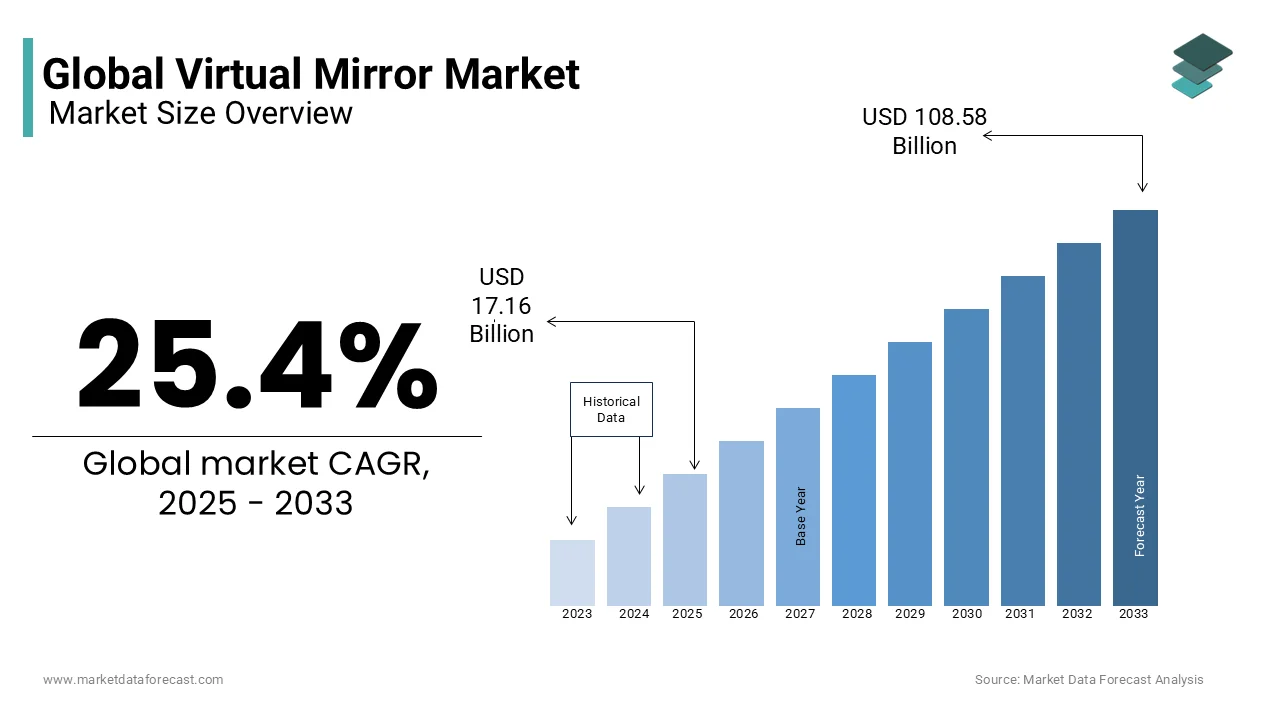
- Market Valuation: Valued at USD 17.76 billion (2025), estimated at USD 22.27 billion (2026), and projected to reach USD 136.18 billion by 2034, registering a strong CAGR of 25.4% (2026–2034).
- Primary Growth Drivers: Enhanced customer convenience in testing apparel and cosmetics via virtual storefronts, increased hygiene expectations in retail environments, rising integration of multi-sensor body scanners, and the rapid expansion of e-commerce platforms leveraging AR, VR, and AI.
Key Market Segment Metrics (2026–2034)
| Category | Leading Segment (2025 Position) | Fastest-Growing Segment |
|---|---|---|
| By Component | Software Solutions (dominated market value by powering interactive visual interfaces, algorithms, and rendering engines) | Hardware Infrastructure (expanding rapidly alongside advanced kiosks, smart mirrors, and high-resolution sensor upgrades) |
| By Technology | 3D Augmented Reality (AR) & Virtual Reality (held the highest share through immersive real-time overlays) | 3D Body Scanning & Photo Accurate VFR (accelerating due to demand for precise digital tailoring and virtual fitting rooms) |
| By Industry | Retail (anchored the market across brick-and-mortar memory mirrors and digital e-commerce web portals) | Automotive & Hospitality (surging via digital side mirrors, virtual windscreens, and interactive hotel display screens) |
| By Region | North America (market leader driven by a high density of major retail brands, luxury chains, and tech innovators) | Asia-Pacific (fastest-growing regional market fueled by booming e-commerce adoption in China, Japan, and India) |
Major Market Players & Market Structure
Market Structure: Dynamic and highly competitive technology landscape featuring specialized start-ups and global tech corporations competing on AI precision, AR/VR integration, omnichannel compatibility, and end-to-end virtual try-on solutions.
Key Companies: Astrafit, DigitalDM, Fitnect Interactive, International Business Machines Corporation (IBM), Metail Limited, MemoMi Labs Inc., SenseMi, Virtual, Zugara Inc., and 3D-A-porter.
Global Virtual Mirror Market Size
The global virtual mirror market was valued at USD 17.76 billion in 2025. The market is estimated at USD 22.27 billion in 2026 and is projected to reach USD 136.18 billion by 2034, growing at a CAGR of 25.4% from 2026 to 2034.
Current Scenario of the Global Virtual Mirror Market
The virtual mirror market growth is projected to emphasize factors such as ease of testing clothing in a virtual business environment, increased hygiene for cosmetic products and other retail products, and virtual product testing in the e-commerce platform before purchasing. In addition, the introduction of multi-sensor body scanners has revolutionized the shopping experience with online platforms. The growth of e-commerce is expected to provide virtual mirror solution providers with great potential to grow.
In the automotive industry, a digital exterior mirror is commonly used since it provides a practical view of the wide-angle camera and the LCD in the vehicle. Their adoption and deployment are projected to be further increased, reassuring the industry about its benefits. The use of an external digital mirror in cars helps automakers reach seasoned buyers while at the same time raising vehicle costs. The use of interactive mirrors with LCD screens in the hotel sector is becoming more common because they integrate text on the monitor and video content to engage and entertain customers in the hospitality sector, providing a practical solution for customer engagement.
MARKET DRIVERS
Digital mirror manufacturers offer a wide range of products to retailers in brick & mortar shops and e-commerce sites. The market is mainly comprised of start-up firms investing in technology for increasing reality (AR) and virtual reality (VR) and for artificial intelligence (AI). These start-ups have received substantial financial support, instilling confidence in the market's stability and potential for growth. To develop and market their products, companies offering cost-efficient and creative digital mirror solutions have been bolstered by this support. As mentioned, automotive providers joined the virtual space with solutions like a digital side/outside mirror and a virtual windscreen.
Customers can check clothes and accessories, share photos, and compare different objects digitally via a photo scope or body 3D using kiosks and web portals with AR, VR, AI, facial recognition, and 3D body scanning technology. The better use of a virtual mirror is mainly attributable to the need to determine customer preferences and test clothes without wearing clothes. Hardware components, including cameras, sensors, and display systems, are integral to a virtual mirror in a brick-and-mortar shop fitting room.
Research Methodology
Market research involves studying market trends and growth patterns and understanding the influence of macro and microeconomic conditions, geopolitical conditions, and demographic conditions on market value and market dynamics.
The research methodology used to calculate and forecast the Virtual Mirror market began by collecting information on the market key players' sales using multiple sources via secondary research. Supplier offers have been considered to identify market segmentation.
REPORT COVERAGE
| REPORT METRIC | DETAILS |
| Market Size Available | 2025 to 2034 |
| Base Year | 2025 |
| Forecast Period | 2026 to 2034 |
| CAGR | 25.4% |
| Segments Covered | By Component, Technology, Industry, And Region |
|
Various Analyses Covered | Global, Regional & Country Level Analysis, Segment-Level Analysis, DROC, PESTLE Analysis, Porter’s Five Forces Analysis, Competitive Landscape, Analyst Overview on Investment Opportunities |
| Regions Covered | North America, Europe, APAC, Latin America, Middle East & Africa |
|
Market Leaders Profiled | Astrafit, DigitalDM, Fitnect Interactive, International Business Machine Corporation, Metail Limited, MemoMi Labs Inc., SenseMi, Virtual, Zugara, Inc., 3D-A-porter, and others. |
SEGMENTAL ANALYSIS
By Component Insights
By Technology Insights
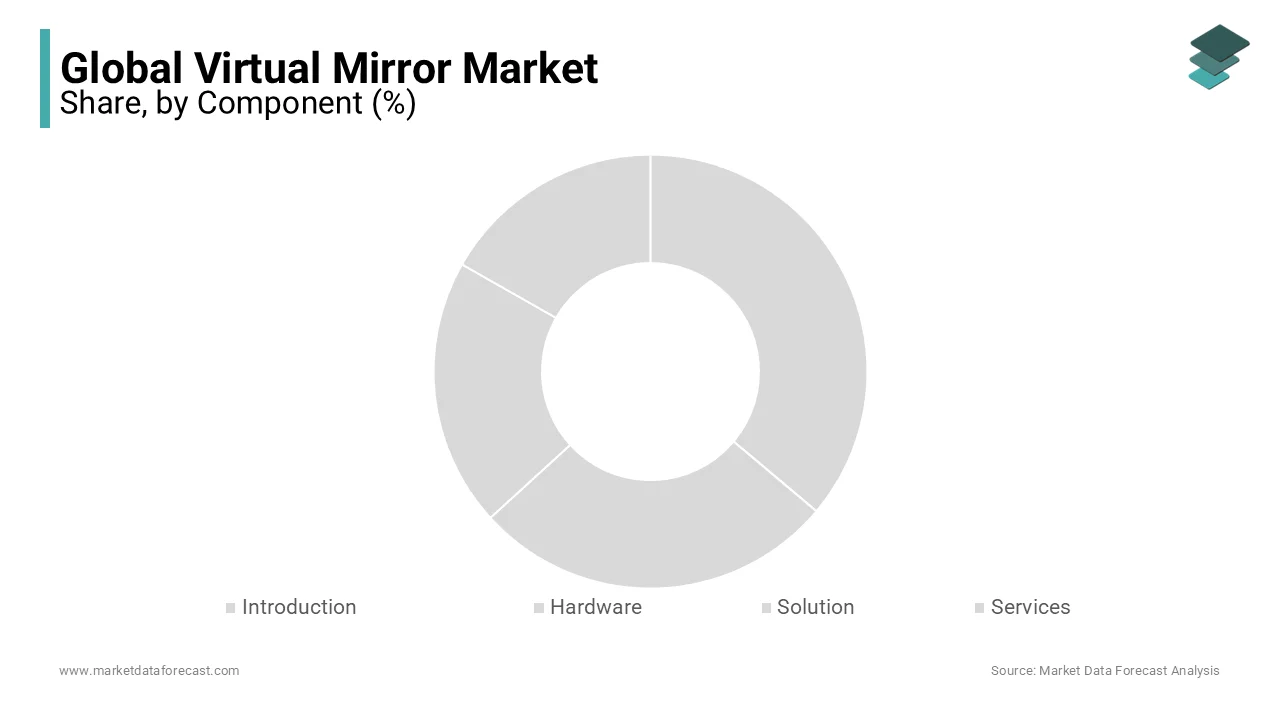
The global market is divided into software, hardware, and services based on the components. The market share of the technology category over the forecast period shall be the highest. The need for interactive visual interfaces on dedicated hardware systems such as kiosks and mirrors can be attributed to the demand for software. The software ensures a compatible display of clothing and accessories in a virtual world on applications and websites. For example, L'Oreal deployed an AR virtual mirror that can provide the effect and feel of the actual product with the help of a virtual makeup attempt.
By Industry Insights
The virtual mirror market is divided into consumer and other demands based on industry. The retail sector is further divided into e-commerce and brick-and-mortar based on the type of distribution channel. In retail, a digital mirror is typically called a memory mirror or an intelligent reflector. Such mirrors boost the consumers' experience in in-store and online shopping. For instance, Nike has an in-store customer, allowing consumers to digitally model a pair of sneakers. In 2018, there was a significant market share in the retail segment, and the projected period is expected to show high growth.
REGIONAL ANALYSIS
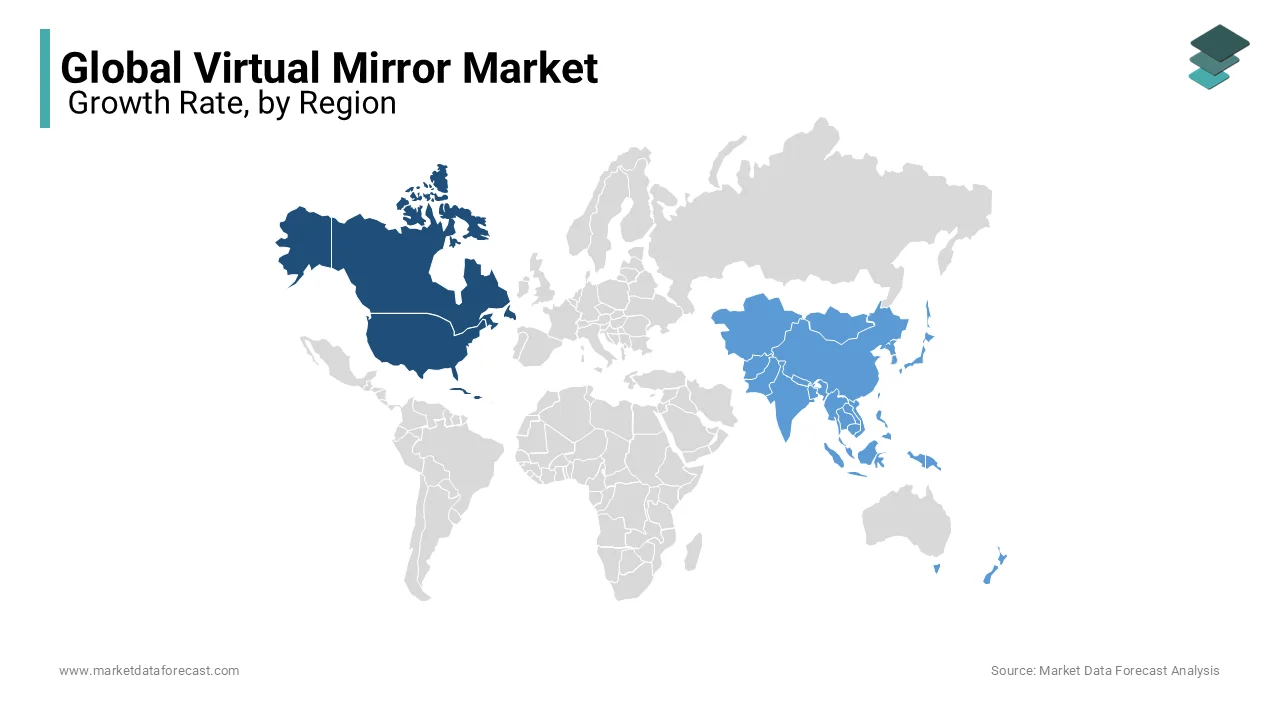
The highest percentage of sales over the forecast period is expected in North America. The USA is a focal point of the largest retail brands and hotel chains, boosting demand in the country for virtual mirrors. However, the US Government has categorized virtual side mirrors under the mirrorless section as an obstruction in the automotive industry. In the Asia Pacific area, the development of online shopping is projected to be the highest in the next six years. Countries like China, Japan, and India are major car and retail hub countries that currently experience rising demand for digital mirrors.
KEY PLAYERS IN THE MARKET
Astrafit, DigitalDM, Fitnect Interactive, International Business Machine Corporation, Metail Limited, MemoMi Labs Inc., SenseMi, Virtual, Zugara, Inc., and 3D-A-porter are leading companies providing virtual mirror solutions with core expertise in AR / VR-based solutions. These companies offer various virtual mirror services supported by advanced technologies to support different stages of the product life cycle and offer a product solution end-to-end. The businesses opt for alliances and conferences to present their goods.
RECENT HAPPENINGS IN THE MARKET
- With Cisco's Innovation & Experience Centre (IXC), SenseMi partnered in May 2018 to demonstrate their digital mirror solutions.
- Metail Limited joined Princess Polly in 2017 to enter the Australian market to satisfy online shoppers' needs.
Key highlights of the research report
- This report provides a detailed quantitative analysis of the current market and estimates for 2024-2029, which help identify the prevailing market opportunities.
- Important changes in market dynamics.
- Report and evaluation of recent developments in the industry.
- Competitive intelligence helps to understand the competitive scenario in geographical regions.
- This report describes the key players in the market in detail and analyzes their strategies in depth to better understand the market's competitive advantage.
MARKET SEGMENTATION
This research report on the global virtual mirror market has been segmented and sub-segmented based on the component, technology, industry, and region.
By Component
- Introduction
- Hardware
- Solution
- Services
By Technology
- Introduction
- 3D Body Scanning
- Photo Accurate VFR
- 3D Augmented Reality
- Virtual Reality
By Industry
- Introduction
- Retail
By Region
- North America
- Europe
- Asia Pacific
- Latin America
- Middle East and Africa