- Product Description Description
- Table of Contents TOC
- List of Table & Figure LOT
- Get Free Sample PDF Sample PDF
Market Size, 2025
$37.33 BnMarket Estimate, 2026
$43.45 BnMarket Forecast, 2034
$146.43 BnCAGR, 2026–2034
16.4%Executive Summary: Virtualization Software Market
- Market Scope: Comprehensive global virtualization software industry analysis covering server and application virtualization types, hybrid cloud deployment frameworks, regional leadership metrics, strategic corporate developments, and competitive landscapes.
- Market Valuation: Valued at USD 37.33 billion (2025), estimated at USD 43.45 billion (2026), and projected to reach USD 146.43 billion by 2034, registering a robust CAGR of 16.4% (2026–2034).
- Primary Growth Drivers: Need for IT operational efficiency, data center modernization, cloud migration strategies, hardware consolidation (reducing energy consumption by up to 80%), and remote work/digital transformation initiatives pushing VDI and software-defined networking adoption. Restraints include licensing complexity and high initial implementation costs.
Key Market Segment Metrics (2026–2034)
| Category | Leading Segment / Region (Position) | Fastest-Growing Segment |
|---|---|---|
| By Technology / Type | Server virtualization (dominant technology segment maximizing utilization and reducing physical infrastructure costs) | Application virtualization (experiencing significant adoption growth as organizations modernize legacy apps) |
| By End-User Industry | BFSI sector (represents the largest end-user vertical due to stringent security and regulatory compliance needs) | Distributed retail, healthcare, and manufacturing verticals deploying hybrid infrastructure |
| By Region | North America (maintains substantial market presence owing to early tech adoption and mature cloud infrastructure) | Asia-Pacific (expected to exhibit the highest growth rate driven by rapid digital transformation and cloud adoption) |
Major Market Players & Market Structure
Market Structure: Highly competitive global infrastructure software ecosystem focused on hybrid cloud integration (such as Nutanix clusters on AWS), hyper-converged infrastructure deployments, converged memory architectures, and simplified enterprise workload migration.
Key Companies: VMware Inc., Citrix Systems Inc., Oracle Corporation, Microsoft Corporation, Red Hat Inc., Amazon.com Inc., Google LLC, NIMBOXX Inc., Corel Corporation, Huawei Technologies Co. Ltd., Nutanix Inc., and Scale Computing.
Global Virtualization Software Market Size
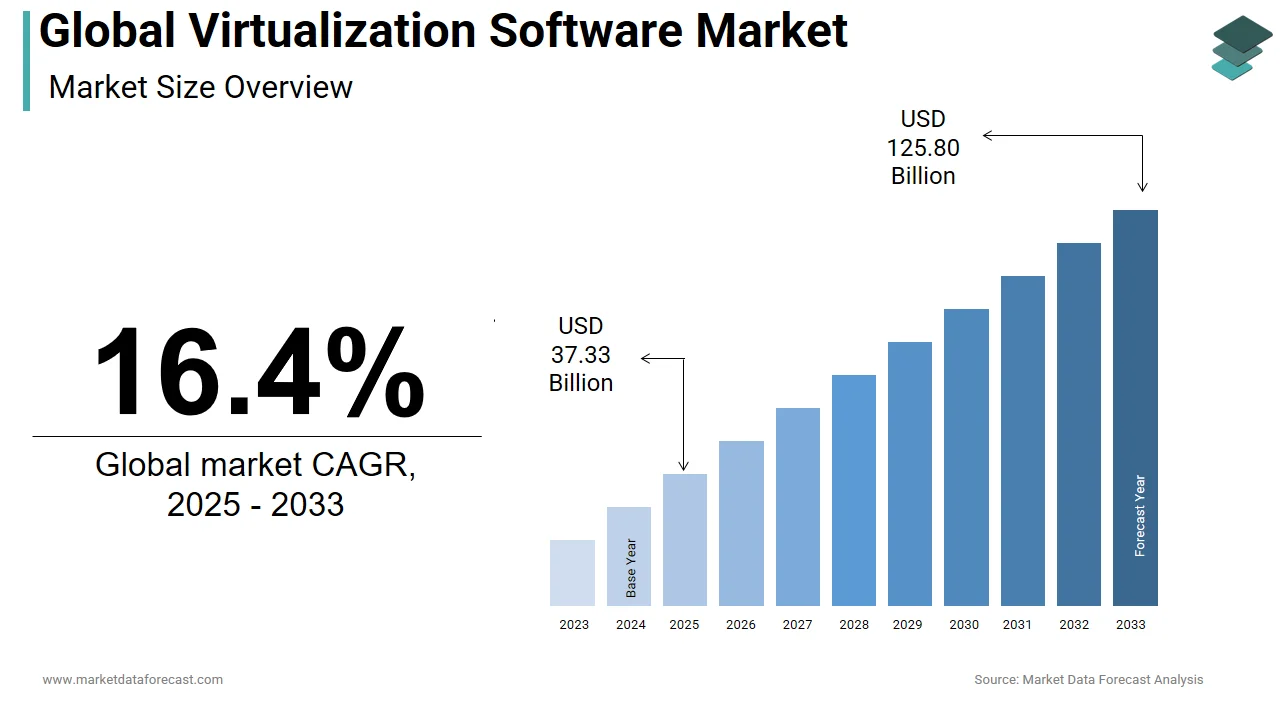
The global virtualization software market was worth USD 37.33 billion in 2025. The global market is predicted to be USD 43.45 billion in 2026 and USD 146.43 billion by 2034, growing at a CAGR of 16.4% from 2026 to 2034.
Virtualization is a technology that uses software to create a simulated, or virtual, version of a physical computer system, server, storage device, or network. It lets you run multiple virtual computers, called virtual machines, on just one real physical computer at the same time. This technology serves as the foundational substrate for modern cloud computing, allowing organizations to maximize server utilization rates. According to the International Energy Agency, global data center electricity consumption could reach 945 terawatt-hours by 2026, driven directly by the scaling of cloud infrastructure, enterprise migration, and expanding AI workloads. As per the European Commission, a core objective of the 2030 Digital Compass framework targets that 75% of European enterprises adopt cloud computing services, big data, and artificial intelligence within their operational infrastructure. According to Eurostat, paid cloud computing service adoption among European Union enterprises rose to 52.7% as corporate operations shifted steadily toward cloud-hosted models. Furthermore, as per the United Nations Institute for Training and Research, annual global electronic waste generation reached an unprecedented 62 million metric tons, intensifying environmental pressure on municipal waste systems. The market definition has expanded beyond traditional server consolidation. It now encompasses network function virtualization, storage abstraction, and desktop delivery models that collectively redefine how computational capacity is provisioned, consumed, and governed across hybrid multicloud architectures spanning diverse regulatory jurisdictions and performance requirements throughout Europe and beyond.
MARKET DRIVERS
Cloud Native Application Modernization Accelerating Container Adoption
The widespread migration toward microservices architectures and cloud native development practices is accelerating the growth of the Virtualization Software Market. This factor is fundamentally reshaping virtualization demand away from traditional hypervisors toward lightweight container orchestration platforms optimized for distributed systems. According to the Cloud Native Computing Foundation, 96% of organizations surveyed in recent annual tracking assessments reported utilizing or evaluating Kubernetes. As per the European Telecommunications Standards Institute, network operators utilize containerized network functions within a standardized service-based architecture to establish agile orchestration across 5G core network environments. According to Red Hat, modern cloud services enable global enterprises to streamline hybrid cloud operations, accelerate time to value, and enhance development agility. This architectural shift creates sustained demand for virtualization software that enables immutable infrastructure patterns, declarative configuration management, and automated scaling behaviors essential for DevOps maturity. Unlike legacy virtualization driven primarily by cost reduction through consolidation, container adoption stems from developer productivity imperatives and business agility requirements that make virtualization inseparable from application delivery workflows rather than an optional infrastructure optimization layer operating independently of software development lifecycle considerations.
Legacy System Continuity Amid Hardware Obsolescence Pressures
Organizations face mounting pressure to keep mission-critical applications running on deprecated operating systems and unsupported hardware architectures, which further fuels the expansion of the Virtualization Software Market. This creates non-discretionary demand for virtualization as a preservation mechanism independent of cloud migration timelines. According to the European Central Bank framework, financial institutions driving open banking ecosystems navigate evolving regulatory infrastructure while integrating newer microservices with legacy core banking platforms. As per Germany's Federal Office for Information Security, the convergence of corporate IT vulnerabilities and operational technology environments exposes industrial control systems to complex spear-phishing and network manipulation vectors. According to the UK Government, public sector healthcare entities implement multi-year digital transformation blueprints to replace fragmented clinical legacy systems with consolidated infrastructure. This continuity driver operates countercyclically to innovation trends, sustaining virtualization demand even as organizations pursue cloud native transformations because decommissioning timelines stretch across decades rather than fiscal quarters. Regulatory retention requirements and certification complexities further entrench these dependencies, ensuring virtualization remains essential infrastructure glue holding together fragmented technology estates where wholesale replacement remains economically or operationally infeasible despite strategic preferences for modernization.
MARKET RESTRAINTS
Performance Overhead in Latency Sensitive Real Time Applications
Virtualization still faces measurable latency and throughput penalties despite continuous optimization advances, which constrains the growth of the Virtualization Software Market. This performance loss makes certain workloads unsuitable for virtualized environments and limits the addressable market scope. According to the Technical University of Munich, researchers analyze software-defined networking infrastructures to maximize flexibility metrics across core virtualized data center architectures. As per the European Automobile Manufacturers Association, automotive developers integrate embedded hypervisor platforms to consolidate critical electronic control units while managing real-time system performance. According to CERN, high-performance server clusters running large-scale experiments rely on specialized high-performance fabrics to deliver exceptionally low latency and massive bandwidth for real-time physics data processing. These hard technical boundaries persist despite decades of optimization because fundamental physics of context switching and memory indirection impose irreducible overhead. The performance ceiling ensures certain segments remain permanently outside virtualization scope regardless of cost pressures or management convenience arguments favoring abstraction.
Licensing Complexity and Vendor Lock-In Creating Financial Friction
Opaque licensing and aggressive audits from top virtualization vendors create major cost uncertainty, which hampers the expansion of the Virtualization Software Market. This uncertainty deters adoption and drives migration toward open-source alternatives despite feature gaps. According to sources, worldwide public cloud end-user spending continues to expand as enterprises seek to optimize their software portfolios and manage infrastructure deployment variables. As per the European Commission, antitrust regulators monitor competitive practices in software licensing to evaluate bundling conditions and market consolidation impacts across cloud computing sectors. Open source alternatives like Proxmox and KVM gain traction not due to superior capabilities but because predictable zero marginal cost eliminates audit anxiety and vendor negotiation friction. This friction converts what should be pure technology decisions into protracted legal and financial negotiations that delay deployments and fragment ecosystems along vendor loyalty lines rather than technical merit criteria.
MARKET OPPORTUNITIES
Edge Computing Proliferation Creating Distributed Virtualization Demand
The expansion of compute capacity toward network edges creates a massive greenfield opportunity for the Virtualization Software Market. This growth supports IoT processing, content delivery, and low-latency services through lightweight platforms optimized for constrained environments, unlike centralized cloud deployments. According to the European Telecommunications Standards Institute, standardized MEC architectural frameworks enable multi-tenant application deployments across federated edge and cloud networks. As per a study, European organizations scale edge computing investments across distributed retail and operational environments to process localized datasets and mitigate core cloud bandwidth constraints. This distributed paradigm favors virtualization software with minimal resource footprints, offline operation capabilities, and automated remote management features absent from traditional enterprise platforms designed for staffed data centers. According to the European Commission, the Horizon Europe research program funds collaborative consortium projects to pioneer open-source edge computing paradigms and enhance digital autonomy. This geographic dispersion transforms virtualization from a centralized efficiency tool to a ubiquitous enabler of decentralized intelligence, expanding the addressable market by orders of magnitude as compute migrates from a few large facilities to millions of small nodes.
AI Infrastructure Abstraction Enabling Heterogeneous Accelerator Management
The explosive growth in AI workloads utilizing diverse hardware, including GPUs, TPUs, and custom ASICs, creates an urgent demand for virtualization layers, which is likely to drive the expansion of the global Virtualization Software Market. These layers abstract specialized silicon to enable resource sharing, scheduling, and multi-tenancy, which were previously impossible with dedicated attachment models. According to NVIDIA, enterprise AI infrastructure platforms employ hardware-level multi-instance GPU technologies to partition massive accelerators into isolated, independent compute segments. As per the European High Performance Computing Joint Undertaking, European supercomputing infrastructures deploy advanced AI Gigafactories to scale exascale computing power for concurrent multi-tenant public research initiatives. The opportunity positions virtualization as essential middleware unlocking ROI on expensive AI infrastructure investments that would otherwise remain chronically underutilized. It creates demand elasticity tied directly to AI adoption curves rather than traditional IT refresh cycles. This expands market relevance into emerging technology domains where virtualization previously had minimal presence.
MARKET CHALLENGES
Security Vulnerabilities in Shared Kernel Architectures Exposing Multi-Tenant Risks
The fundamental architectural assumptions underlying virtualization create persistent attack surfaces, which limit the growth of the global Virtualization Software Market. As a result, hypervisor or kernel exploits can compromise all co-resident workloads simultaneously, undermining the technology’s core isolation guarantees. According to the European Union Agency for Cybersecurity, cross-border digital service providers scale systemic risk management frameworks to address emerging zero-day vulnerabilities across multi-tenant cloud ecosystems. As per the German Federal Office for Information Security, enterprise network operators implement comprehensive patch management cycles and hardware-level isolation metrics to defend critical data infrastructure against side-channel execution threats. These persistent vulnerabilities force operators into impossible trade-offs between security hardening that degrades performance and accepting residual risk that violates compliance frameworks. This creates friction that slows adoption in regulated sectors where breach consequences outweigh efficiency benefits and constrains market expansion despite clear operational advantages.
Skills Shortage Impeding Migration from Legacy Platforms to Modern Alternatives
Severe talent deficits in both legacy virtualization administration and modern container orchestration create implementation barriers that obstruct the expansion of the Virtualization Software Market. These barriers delay transformations and inflate project costs beyond initial projections across organizations. According to the European Centre for the Development of Vocational Training, advanced technical industries across the region expand specialized vocational education and training frameworks to bridge emerging ICT software engineering shortfalls. As per UK Government immigration tracking assessments, global tech visa pathways attract specialized engineering talent to enhance domestic tech sector innovation and digital service delivery. This human capital constraint means technology availability no longer determines adoption velocity; organizational learning capacity becomes a binding limitation that favors incumbents with established teams over disruptive alternatives requiring new skill sets, slowing market evolution regardless of technical superiority or economic rationale for platform transitions.
REPORT COVERAGE
| REPORT METRIC | DETAILS |
| Market Size Available | 2025 to 2034 |
| Base Year | 2025 |
| Forecast Period | 2026 to 2034 |
| Segments Covered | By Type, Platform, End-Use Industry, and Region. |
| Various Analyses Covered | Global, Regional, and Country-Level Analysis, Segment-Level Analysis, Drivers, Restraints, Opportunities, Challenges; PESTLE Analysis; Porter’s Five Forces Analysis, Competitive Landscape, Analyst Overview of Investment Opportunities |
| Regions Covered |
|
| Market Leaders Profiled | VMware, Inc., Citrix Systems, Inc., Oracle Corporation, Microsoft Corporation, Red Hat, Inc., Amazon.com, Inc., Google LLC, NIMBOXX, Inc., Corel Corporation, Huawei Technologies Co., Ltd., and others. |
SEGMENTAL ANALYSIS
By Platform Insights
The PC virtualization segment remained the largest in 2025 and occupied a commanding share of the virtualization software Market. This prominence of the segment was credited to its foundational role in enterprise desktop management, legacy application compatibility, and secure remote workforce enablement across global organizations. Revenue peaks in this segment due to the widespread adoption of desktop abstraction technologies, which are foundational across diverse knowledge worker setups.

Large-scale PC virtualization deployments remain essential for centralized endpoint management where security compliance mandates outweigh user preference for native hardware experiences. According to the European Union Agency for Cybersecurity, European public bodies deploy unified operational frameworks to strengthen cross-border information assurance metrics and enhance multi-tenant cloud data security controls. As per the UK National Health Service, public health systems scale standardized endpoint device management configurations across clinical environments to safeguard digital patient record connectivity parameters. According to Germany's Federal Office for Information Security, payment card processing networks implement rigid data security standards and isolated endpoint session controls to mitigate malware persistent threat execution vectors. In addition, the regulatory-driven demand creates a stable revenue base independent of consumer technology cycles, as compliance deadlines and audit requirements force continued investment regardless of economic conditions or alternative technology emergence. The sheer volume of managed endpoints in banking, healthcare, and public administration ensures PC virtualization retains structural dominance even as mobile platforms grow in absolute terms.
Decades of accumulated Windows application dependencies create non-discretionary demand for PC virtualization as organizations modernize underlying operating systems while preserving access to mission-critical software incompatible with current platforms. According to Microsoft, modern enterprise endpoint migrations utilize proactive desktop analytics and integrated cloud compatibility profiles to manage legacy application delivery dependencies. As per the European Central Bank framework, significant supervised entities implement secure operational resilience metrics to update deprecated legacy banking web access components and safeguard digital financial transactions. According to the UK Government, public sector institutions enforce structured IT life-cycle blueprints to accelerate legacy application transition roadmaps toward modern web-based databases. The technical debt accumulation ensures sustained PC virtualization demand as each new OS release introduces fresh incompatibilities requiring abstraction solutions, creating a perpetual renewal cycle tied to Microsoft’s support lifecycle rather than voluntary innovation adoption.
The mobile virtualization segment is estimated to register the fastest CAGR of 24.6% over the forecast period, as bring-your-own-device policies, mobile-first workforce strategies, and secure containerization requirements converge to drive adoption beyond niche use cases into mainstream enterprise mobility management.
The proliferation of personal devices in corporate environments creates urgent demand for virtualization layers that separate business data and applications from personal content without requiring users to carry multiple phones or sacrifice device functionality. According to the European Data Protection Board, cross-border corporate entities utilize sandboxed enterprise workspaces on private endpoints to enforce clean separation guidelines under existing personal data protection statutes. As per research, global corporate mobile security solution spending scales upwards as remote workforce paradigms drive enterprise device deployment complexity. According to the German Federal Commissioner for Data Protection, enterprise entities handling personal datasets must implement strict technical and organizational measures under General Data Protection Regulation conditions to isolate unmanaged peripheral endpoints. The security imperative transforms mobile virtualization from an optional enhancement to a compliance necessity as regulators interpret data protection obligations more strictly regarding personal device usage, creating demand drivers independent of productivity benefits or user experience improvements.
Remote work normalization has expanded attack surfaces beyond corporate perimeters, making mobile virtualization essential for providing secure application access without exposing backend systems to potentially compromised client devices connecting from home networks or public Wi Fi. According to Zscaler, sophisticated mobile phishing campaigns expand across multi-channel attack surfaces to harvest high-value identity infrastructure access credentials. As per the European Banking Authority, standard technical guidelines enforce strong customer authentication to lower active online fraud thresholds during retail remote payment processing interactions. According to the Norwegian National Security Authority, high-assurance security evaluation parameters govern mobile hardware and software components handling national classified communication parameters. The threat landscape evolution makes virtualization defensive infrastructure rather than a convenience feature, sustaining growth as attack sophistication outpaces native OS security capabilities.
By Type Insights
The hardware virtualization segment led the Virtualization Software Market and accounted for a substantial share in 2025. This leading position of the segment was attributed to its status as a foundational infrastructure layer upon which all other virtualization forms depend, capturing value through hypervisor licensing, management platforms, and ecosystem integration that creates high switching costs and recurring revenue streams. Public and private cloud platforms universally rely on hardware virtualization to achieve the resource pooling, isolation, and elasticity characteristics defining cloud computing economics, creating a massive installed base that sustains market leadership. According to the Cloud Native Computing Foundation, organizations optimize hybrid and multi-cloud container orchestration frameworks to manage workload resilience and scale enterprise development velocity. As per Amazon Web Services, cloud infrastructure modernization initiatives scale computational capacity across geographic regions to satisfy diverse enterprise workload requirements. The ubiquity means hardware virtualization benefits from network effects where tooling, training, and integration ecosystems develop around dominant platforms, creating self-reinforcing dominance that newer virtualization types must overcome through superior value propositions rather than mere technical parity.
Hardware virtualization enables efficient replication, snapshotting, and failover capabilities that make comprehensive disaster recovery economically feasible for mid-market organizations previously priced out of dedicated standby infrastructure. According to the Uptime Institute, data center infrastructure designs implement robust electrical and mechanical redundancies to mitigate unexpected downtime risks and satisfy high-availability criteria. As per Veeam, global enterprise backup deployment architectures focus on hybrid-cloud immutability features and automated ransomware recovery plans to safeguard critical digital workloads. The resilience value proposition creates sticky demand less sensitive to economic cycles than performance-driven purchases, as insurance requirements and regulatory mandates maintain DR budgets even during downturns when optimization projects face deferral.
The network virtualization segment is anticipated to witness the fastest CAGR of 27.3% from 2026 to 2034. Software-defined networking, micro-segmentation, and zero-trust architectures turn static physical networks into programmable security fabrics for cloud-native applications.
Traditional perimeter-based security models prove inadequate for hybrid multicloud environments where identity and workload context replace network location as primary trust determinants, driving rapid adoption of network virtualization, enabling policy enforcement at granular levels impossible with physical appliances. According to the European Union Agency for Cybersecurity, the enforcement of the NIS2 Directive drives standardized cybersecurity risk-management measures and operational reporting criteria across critical entities. As per Cisco, enterprise network infrastructure architectures integrate software-defined paradigms to establish secure micro-segmentation models and prevent unverified network communications. The security transformation reframes networking from a connectivity utility to a security enforcement plane, expanding the addressable market beyond traditional network teams to include security architects and compliance officers who control budget allocation for risk mitigation investments.
Organizations operating across multiple cloud providers and on-premises environments require network virtualization to abstract underlying infrastructure differences and enforce consistent security policies regardless of deployment location, creating demand driven by architectural complexity rather than single-vendor lock-in avoidance. According to Flexera, multi-cloud strategy adoption expands among global enterprises to distribute core platform reliance across public and private infrastructure environments. As per HashiCorp, technology managers adopt standardized infrastructure-as-code orchestration workflows to streamline cross-cloud infrastructure deployments and minimize workflow configurations. The operational efficiency driver complements security motivations, creating dual value propositions that sustain growth even when one rationale faces budget scrutiny.
By End Use Industry Insights
In 2025, the Banking, Financial Services and Insurance (BFSI) segment held the majority share in the Virtualization Software Market. This supremacy was propelled by strict regulatory compliance, legacy system preservation, and high-value transaction processing. Financial regulators across Europe mandate specific technical controls that virtualization uniquely satisfies through centralized logging, immutable snapshots, and auditable configuration management capabilities embedded in hypervisor platforms. According to the European Banking Authority, financial institutions update their baseline ICT risk management structures to conform with comprehensive regional security directives and mitigate digital operational vulnerabilities. As per the Bank of England, financial entities design robust operational resilience programs to ensure critical business services withstand systemic technical failures and remain within impact tolerances. The regulatory entrenchment creates demand inelasticity where license renewals continue regardless of economic conditions because non-compliance carries existential penalties including license revocation and executive liability, distinguishing BFSI from discretionary spending sectors.
Core banking, trading, and payment systems generate sufficient revenue per virtualized instance to absorb premium licensing costs while benefiting from consolidation efficiencies that would be uneconomical for lower-value workloads in other industries. According to the European Central Bank, euro area non-cash payment statistics demonstrate a continuous volume expansion for standardized electronic credit transfers and card transaction types. As per SWIFT, global banking network institutions establish rigid cybersecurity controls to protect internal message processing environments from peripheral boundary compromises. The economic scale means BFSI virtualization decisions involve eight-figure budgets where vendor negotiations focus on enterprise agreements rather than per-unit pricing, creating revenue concentration that sustains market leadership despite slower growth rates than emerging verticals.
The public security segment is on the rise and is expected to be the fastest-growing segment in the market with a CAGR of 29.8% during the forecast period. This growth is fueled by digital transformation, cross-agency interoperability, and secure information-sharing mandates that force historically conservative government security apparatuses to adopt virtualization. Fragmented legacy systems across police, intelligence, and emergency response organizations create an urgent need for virtualization-based integration platforms enabling secure data exchange without full system replacement that would take decades and billions to complete. According to Europol, cross-border investigative operations benefit from enhanced multi-jurisdictional cooperation and integrated communication frameworks to dismantle transnational criminal networks. As per the UK Home Office, modern police tech strategies expand unified information networks across domestic forces to streamline criminal database access configurations. The operational efficiency driver combines with national security imperatives to create funding streams insulated from general government austerity measures, as counterterrorism and organized crime budgets maintain political priority even during fiscal constraints affecting other public services.
Modern policing and emergency response require secure mobile access to sensitive databases from patrol vehicles and incident scenes, driving virtualization adoption to extend classified system access beyond secure facilities without compromising data protection standards. According to the European Union Agency for Cybersecurity, public security bodies coordinate regional security standards to fortify dynamic endpoint configurations against sophisticated network intrusions. As per the French Ministry of the Interior, national security units integrate secure, enterprise-grade peripheral tablets to accelerate real-time remote communication and facilitate field agent deployment profiles. The operational transformation converts virtualization from a back-office efficiency tool to a frontline capability enabler, expanding the addressable user base from administrative staff to sworn officers and creating demand multiples beyond traditional government IT deployments.
REGIONAL ANALYSIS
Asia Pacific Virtualization Software Market Analysis
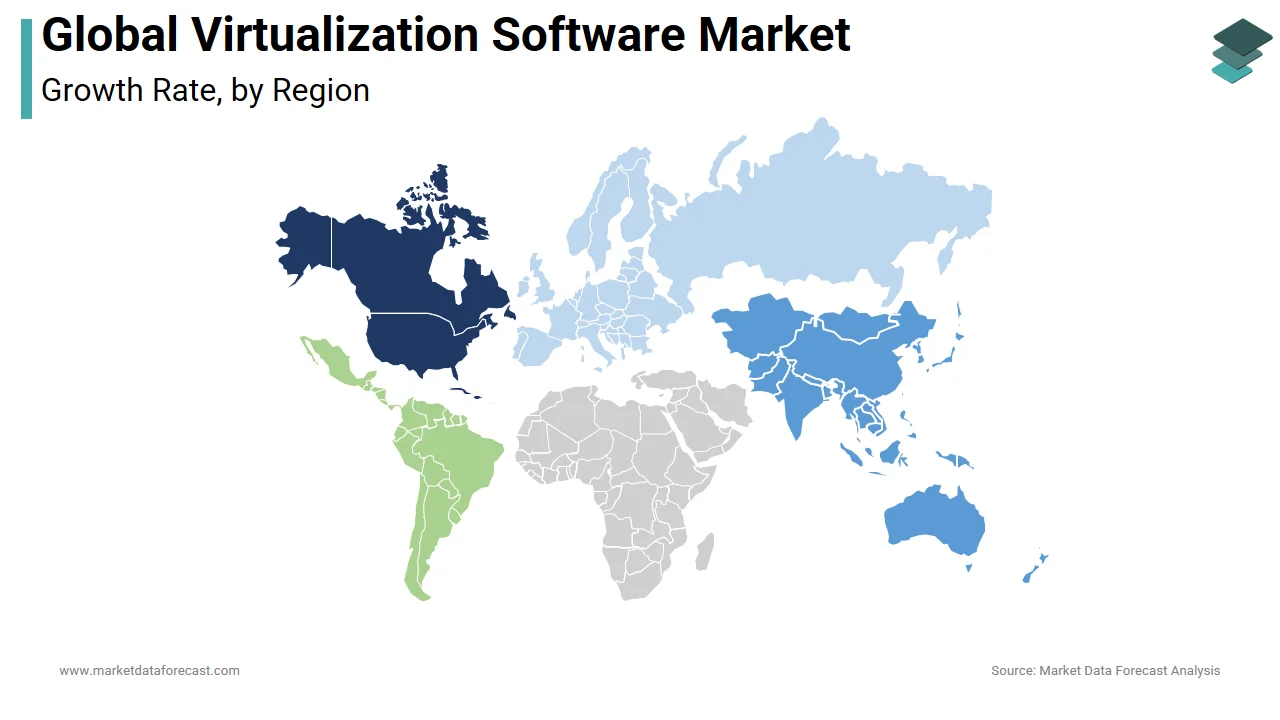
Asia Pacific was the fastest-growing region in the global Virtualization Software Market and captured a 31.8% share in 2025. This leading position of the APAC market was attributed to hyperscale cloud buildouts, government digital sovereignty initiatives, and manufacturing sector automation concentrated in China, Japan, India, and Southeast Asian tiger economies. According to the Ministry of Industry and Information Technology, China scales up its domestic digital infrastructure frameworks to promote software supply chain security and enhance industrial cloud data management practices across regional development zones. As per Japan's Ministry of Economy, Trade and Industry, digital modernization programs provide financial incentives to small and medium enterprises to integrate cloud computing architectures and boost operational manufacturing productivity. According to India's Ministry of Education, digital learning platforms deploy virtual lab models to provide equitable access to science and technology simulations for school students nationwide. Regional diversity creates multiple concurrent growth vectors spanning import substitution, educational inclusion, and industrial modernization that collectively sustain expansion rates exceeding global averages despite varying national maturity levels and geopolitical alignments influencing vendor selection criteria.
Europe Virtualization Software Market Analysis
Europe was positioned second and secured 27.4% of the global Virtualization Software Market share in 2025. The European market is known for regulatory leadership, digital sovereignty frameworks, and sustainability integration, creating unique value propositions unavailable in other regions. According to the European Commission, the Gaia-X ecosystem develops open architectural parameters for data exchange to strengthen multi-cloud interoperability and regional digital governance mechanisms. As per Germany's Federal Ministry for Economic Affairs and Climate Action, public IT frameworks prioritize open-source software strategies within administrative bodies to establish competitive vendor-neutral procurement systems. According to CSC – IT Center for Science, high-performance computing centers deploy sustainable direct liquid-cooling technologies to capture waste heat and achieve low power usage effectiveness scores. As per the National Cybersecurity Agency of France, the SecNumCloud qualification standard sets strict technical sovereignty and cryptographic requirements for cloud providers managing sensitive enterprise and state data. Regional fragmentation creates both coordination challenges and specialization opportunities where national sovereignty requirements, linguistic localization needs, and regulatory compliance variations sustain a diverse vendor ecosystem rather than winner-take-all consolidation seen in less regulated markets.
Middle East and Africa Virtualization Software Market Analysis
The Middle East and Africa region is another key player in the global Virtualization Software Market. However, the region exhibits bifurcated dynamics, with Gulf states pursuing futuristic smart cities and African nations focusing on foundational digital access. According to the Public Investment Fund, Saudi Arabia's comprehensive data center strategy deploys multi-billion-dollar investments to establish advanced digital real estate infrastructure and accelerate nationwide computing ecosystems. As per the Telecommunications and Digital Government Regulatory Authority, the official United Arab Emirates government platform accelerates national digital transformation milestones by integrating unified cross-entity digital services for millions of active users. According to the Just Energy Transition Investment Plan framework, South Africa mobilises multilateral funding parameters to decarbonise its core grid infrastructure while transitioning heavy industries toward sustainable power configurations. The region’s growth stems from both top-down sovereign wealth investment and bottom-up development finance, creating a heterogeneous market structure where luxury deployments coexist with basic access initiatives under a common regional umbrella shaped by oil revenue diversification imperatives and leapfrogging aspirations distinct from mature market upgrade cycles.
North America Virtualization Software Market Analysis
North America maintains a significant share of the global Virtualization Software Market. It is led by United States technological innovation, Canadian privacy-compliant cloud infrastructure, and Mexican nearshoring trends that create binational virtualization corridors serving integrated supply chains. According to the Department of the Treasury, clean energy tax provisions incentivize corporate infrastructure upgrades to curb industrial greenhouse gas emissions and enhance long-term commercial energy efficiency. Northern Virginia remains the world’s largest virtualization cluster but faces power constraints, prompting migration to secondary markets. As per sources, multi-gigawatt utility power requests from large-scale data center operators drive major structural capital adjustments to expand high-voltage transmission networks. Canada leverages Quebec and British Columbia hydroelectric resources. According to Natural Resources Canada, data facility infrastructure operations account for approximately one percent of total national electricity demand while driving adoption of higher efficiency standard hardware guidelines. Mexico’s nearshoring boom drives virtualization demand in Querétaro and Monterrey. Regional growth combines federal stimulus, provincial resource advantages, and trade agreement-induced demand, creating a multi-jurisdictional expansion pattern distinct from single-country dominance models seen elsewhere.
Latin America Virtualization Software Market Analysis
Latin America witnesses a moderate growth in the global Virtualization Software Market. Targeted deployments addressing specific socioeconomic objectives, rather than comprehensive coverage ambitions, drove this position of the Latin American market. Fiscal limitations constrained growth, but multilateral development bank financing and regional integration initiatives accelerated it. According to the Ministry of Communications of Brazil, digital expansion programs fund telecommunications infrastructure connectivity deployments across the northern region to improve rural public internet accessibility. As per the National Energy Commission of Chile, expanding utility-scale renewable generation grids lowers regional marginal costs and attracts multinational industrial power buyers to clean energy corridors. According to the Ministry of Information Technologies and Communications of Colombia, national connectivity projects deploy localized technological access centres to expand digital literacy, distance education, and basic telemedicine tools. Costa Rica positions itself as a regional virtualization hub. Growth remains volatile due to currency fluctuations and political transitions but maintains an upward trajectory through externally funded anchor projects demonstrating viability for subsequent domestic replication and private capital attraction despite macroeconomic headwinds affecting discretionary enterprise spending.
COMPETITIVE LANDSCAPE
Competition in the Virtualization Software Market exhibits stratified dynamics where established incumbents defend installed bases through ecosystem integration while open source alternatives and cloud native specialists capture greenfield opportunities and modernization projects. VMware retains technological leadership but faces pricing backlash and licensing uncertainty following the Broadcom acquisition, creating openings for competitors emphasizing cost predictability and vendor neutrality. Microsoft leverages Azure and Windows Server bundling to commoditize basic virtualization while differentiating through hybrid management and AI integration, pressuring standalone vendors lacking comparable platform breadth. Red Hat and SUSE compete on open source credibility and Kubernetes native integration, appealing to organizations avoiding proprietary lock-in during cloud native transitions. Nutanix and Cisco differentiate through hyperconverged infrastructure integration, simplifying deployment for mid-market customers lacking large virtualization teams. Cloud providers AWS and Azure offer native virtualization at marginal cost to drive platform consumption, making independent licensing increasingly difficult to justify for cloud-first organizations. Innovation competition centers on AI workload optimization, confidential computing, and edge deployment rather than core hypervisor features, which have largely commoditized. Consolidation accelerates as acquirers seek adjacent capabilities in security, observability, and automation to expand the addressable market beyond the saturated virtualization layer, preserving a diverse competitive landscape even as individual segments mature, and growth shifts toward integrated platform plays rather than point solutions.
KEY MARKET PLAYERS
The leading companies operating in the global virtualization software market include:
- VMware, Inc.
- Citrix Systems, Inc.
- Oracle Corporation
- Microsoft Corporation
- Red Hat, Inc.
- com, Inc.
- Google LLC
- NIMBOXX, Inc.
- Corel Corporation
- Huawei Technologies Co., Ltd.
TOP PLAYERS IN THE MARKET
- VMware maintains foundational involvement in the Virtualization Software Market through its vSphere and Cloud Foundation platforms that established industry standards for enterprise hypervisor deployment and management globally. The company contributes extensively by enabling hybrid multicloud architectures spanning on-premises data centers and public cloud environments with consistent operational models. VMware also expanded the Aria automation suite with AI-driven operations capabilities, reducing manual administration overhead for complex virtualized environments. These initiatives reinforce ecosystem stickiness among existing customers navigating modernization while extending relevance into container orchestration domains where pure-play Kubernetes vendors previously held an advantage, ensuring continued platform centrality despite ownership transitions and licensing model changes affecting customer sentiment across the global installed base.
- Microsoft participates significantly in the Virtualization Software Market through Azure Stack HCI and Hyper-V technologies integrated deeply with Windows Server and Azure cloud services, creating seamless hybrid experiences for enterprise customers. The company contributes globally by offering virtualization as an embedded platform capability rather than a standalone product, reducing friction for organizations already invested in the Microsoft ecosystem. Microsoft also enhanced AKS integration with Arc, enabling unified Kubernetes governance across virtualized and bare-metal environments. These moves leverage existing Windows Server and Office 365 relationships to drive virtualization adoption through bundling and integration advantages unavailable to independent vendors, particularly among mid-market organizations prioritizing vendor consolidation and simplified licensing over specialized virtualization features or multi-vendor flexibility.
- Red Hat serves the Virtualization Software Market through OpenShift Virtualization and KVM-based RHEV platforms, emphasizing open-source foundations and Kubernetes native integration for organizations pursuing cloud native transformation without abandoning existing VM workloads. The company contributes globally by bridging traditional virtualization and container ecosystems through a unified platform, allowing gradual migration rather than disruptive rip-and-replace approaches. Red Hat also introduced Ansible Automation Platform integration, enabling infrastructure-as-code management across virtualized and containerized environments with consistent policy enforcement. These initiatives position Red Hat as a preferred partner for organizations seeking vendor neutrality and avoiding proprietary lock-in while maintaining enterprise support and certification requirements that pure community distributions cannot satisfy, particularly in regulated industries and public sector deployments across European and Asia Pacific markets valuing sovereignty and transparency.
TOP STRATEGIES USED BY KEY MARKET PARTICIPANTS
Key players employ platform integration strategies combining virtualization with container orchestration, automation, and security tools to create comprehensive stacks, increasing switching costs and capturing broader wallet share beyond hypervisor licensing alone. Companies pursue hybrid multicloud positioning, enabling consistent operations across on-premises and public cloud environments to retain relevance as customers adopt distributed architectures rather than choosing a single deployment model. Strategic acquisitions target complementary technologies like network virtualization, storage abstraction, and AI operations to fill portfolio gaps and accelerate innovation timelines versus organic development in a rapidly evolving landscape. Open source community engagement builds developer mindshare and ecosystem contributions that sustain long-term platform viability, while commercial offerings monetize enterprise support and certification requirements. Vertical specialization focuses on industry-specific compliance frameworks and pre-validated reference architectures, reducing customer risk and shortening sales cycles in regulated sectors like financial services and healthcare. Subscription licensing transitions convert perpetual revenue streams to predictable recurring models, improving valuation multiples while aligning vendor incentives with continuous value delivery rather than one-time transactions, fundamentally reshaping competitive dynamics around customer success metrics and retention rates rather than new logo acquisition alone.
MARKET SEGMENTATION
This research report on the global virtualization software market has been segmented and sub-segmented based on the type, platform, end-use industry, and region.
By Type
-
Application Virtualization
-
Network Virtualization
-
Hardware Virtualization
By Platform
-
PC Virtualization
-
Mobile Virtualization
By End-Use Industry
-
Instructive, Measurable, and Public Security
-
IT and Media
-
BFSI
By Region
-
North America
-
The United States
-
Canada
-
Rest of North America
-
-
Europe
-
The United Kingdom
-
Spain
-
Germany
-
Italy
-
France
-
Rest of Europe
-
-
The Asia Pacific
-
India
-
Japan
-
China
-
Australia
-
Singapore
-
Malaysia
-
South Korea
-
New Zealand
-
Southeast Asia
-
-
Latin America
-
Brazil
-
Argentina
-
Mexico
-
Rest of LATAM
-
-
The Middle East and Africa
-
Saudi Arabia
-
UAE
-
Lebanon
-
Jordan
-
Cyprus
-