- Product Description Description
- Table of Contents TOC
- List of Table & Figure LOT
- Get Free Sample PDF Sample PDF
Market Size, 2025
$4.51 BnMarket Estimate, 2026
$5.24 BnMarket Forecast, 2034
$17.42 BnCAGR, 2026–2034
16.2%Executive Summary: Global Warehouse Management Systems Market
- Market Scope: Comprehensive global warehouse management systems (WMS) market analysis covering component types, cloud/on-premise deployment frameworks, industry applications, regional leadership dynamics, and supply chain automation trends.
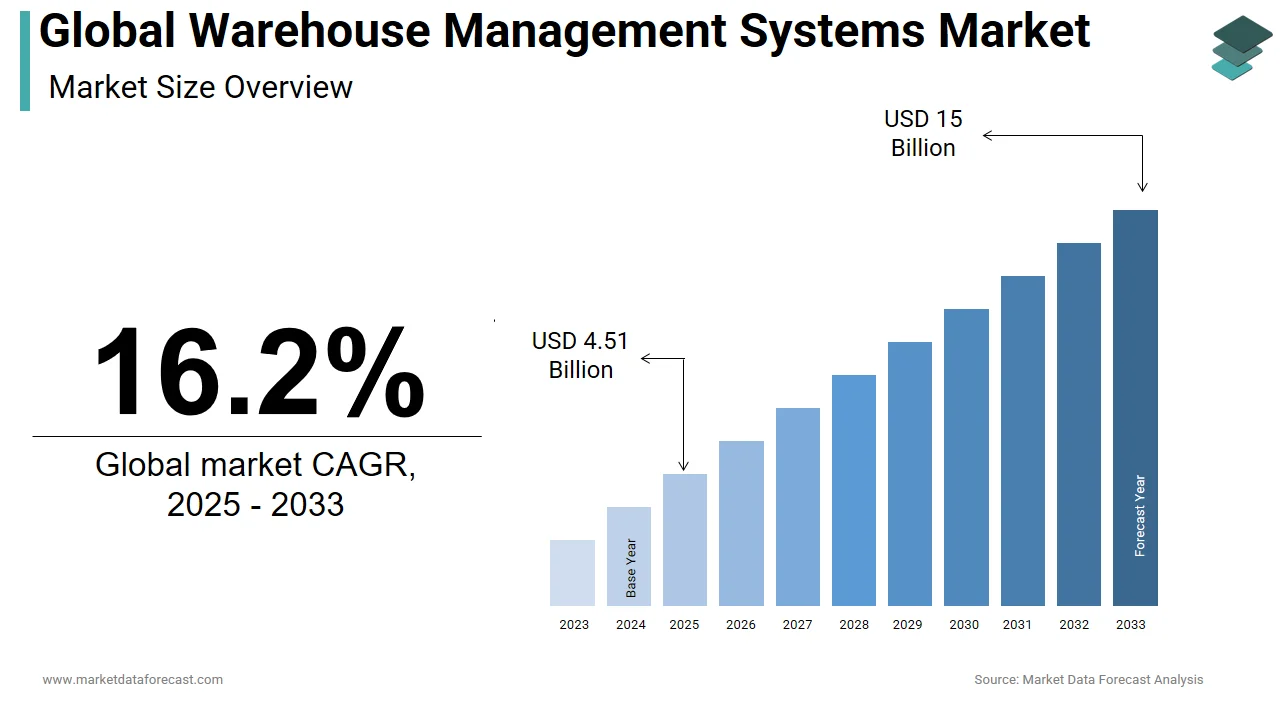
- Market Valuation: Valued at USD 4.51 billion (2025), estimated at USD 5.24 billion (2026), and projected to reach USD 17.42 billion by 2034, registering a strong CAGR of 16.2% (2026–2034).
- Primary Growth Drivers: Warehouse automation, rapid digital transformation, expanding e-commerce operations, and increasing demand for integrated supply chain management solutions. Key catalysts include cloud-based WMS adoption, real-time inventory visibility, omnichannel fulfillment, and industrial/healthcare sector expansion.
Key Market Segment Metrics (2026–2034)
| Category | Leading Segment (Base Year Position) | Fastest-Growing Segment |
|---|---|---|
| By Component | Software and core system licenses (comprehensive workflow optimization) | Cloud-based software-as-a-service (SaaS) and deployment services |
| By Deployment | On-premise and hybrid enterprise solutions | Cloud-based WMS platforms (expanding due to remote accessibility and real-time tracking) |
| By Application | E-commerce and omnichannel fulfillment operations | Healthcare, industrial, and specialized cold-chain logistics |
| By Region | Europe (held the major share and expected to dominate globally, supported by healthcare and industrial sectors) | Asia-Pacific (projected to experience rapid growth driven by technology investments in China, India, and Japan) |
Major Market Players & Market Structure
Market Structure: Highly competitive global landscape comprising established software providers focused on warehouse automation, cloud deployment, inventory optimization, and integrated supply chain execution tools.
Key Companies: HighJump Software, Infor Inc., LogFire Inc., Tecsys, Inc., Manhattan Associates Inc., Made4net LLC, Oracle Corporation, SAP SE, Reply, Softeon, Inc., JDA Software Group, Inc., Synergy Logistics Ltd., Indigo Software, Produmex, SmartTurn, Justransform, Swisslog WMS, SNS, Provia Software, EXE Technologies, Royal 4 Systems, Snapfulfil, and Synergy Ltd.
 Download Free Sample Report
Global Warehouse Management Systems Market Size
The global warehouse management systems market was valued at USD 4.51 billion in 2025. The global market is forecast to reach USD 5.24 billion in 2026 and USD 17.42 billion by 2034, growing at a CAGR of 16.2% from 2026 to 2034.
The warehouse management system (WMS) is an essential part of the supply chain strategy, as it controls the movement of goods and storage materials in the warehouse. This includes the processes associated with transactions, such as receiving, sending, recording, and collecting. Warehouse management systems also direct and make the most of the stored inventory based on the actual situation of warehouse operations. Thus, warehouse automation is the complete cycle of warehouse management from the moment the goods are received in the warehouse to the delivery of customer orders.
The rising advancements in digitization have supported the rapid adoption of warehouse management systems (WMS) in numerous applications. The growth of e-commerce and omnichannel compliance requirements, WMS add-on sales, work efficiency, cost of ownership benefits, and supply chain platform integration are the main drivers that complement market growth. Expensive deployment of WMS solutions and the dominance of ERP vendors have slowed this market growth.
MARKET TRENDS
The demand for cloud-based warehouse management systems is increasing as these systems facilitate communication between a supplier and a buyer, help improve customer service, and reduce inventory costs.
Warehouse management systems in the cloud have the ability to manage inbound and outbound freight and cross-docking. Cloud-based warehouse management systems are compatible with other supply chain systems, including transportation management systems, business analysis, yard management, and space management. Cloud-based warehouse management system solutions can be accessed from any location through web portals. These systems have many advantages over local systems, which are important. Cloud-based warehouse management systems extend supply chains with modern purchasing methods and offer real-time visibility into a full inventory that can be accessed through smartphones and web browsers.
MARKET DRIVERS
The need for manufacturers to automate warehouse management processes and reduce costs globally is one of the major trends driving the growth of the market.
The main factors driving the growth of warehouse management systems are the increase in technology investment in economically developing regions such as Asia-Pacific and the emergence of electronic commerce. Also, strong demand from the industrial and healthcare sectors in developing countries is fueling the growth of the warehouse management systems market. Technological progressions like cloud deployment are supporting the call for a warehouse management systems market. However, the costly deployment of a warehouse management system solution is holding back the growth of the warehouse management systems market.
MARKET RESTRAINTS
The inherent challenges associated with implementing distribution software, such as lack of standardization of processes in distribution, less business-savvy users, high rate of concurrent active transactions, material handling interface requirements, and other factors, lead to monopolization of resources, cost overruns, and the risk of operational disruption. Small installations with a small staff find WMS solutions too expensive to deploy. Many of these companies rely on memory-based processes, outdated systems, and paper-based warehouse operations. The impact of this factor was significant; however, due to advancements in technology, this impact is expected to decrease over the forecast period.
REPORT COVERAGE
| REPORT METRIC | DETAILS |
| Market Size Available | 2025 to 2034 |
| Base Year | 2025 |
| Forecast Period | 2026 to 2034 |
| CAGR | 16.2% |
| Segments Covered | By Component, Deployment, Application, and Region |
|
Various Analyses Covered | Global, Regional & Country Level Analysis, Segment-Level Analysis, DROC, PESTLE Analysis, Porter’s Five Forces Analysis, Competitive Landscape, Analyst Overview on Investment Opportunities |
| Regions Covered | North America, Europe, APAC, Latin America, Middle East & Africa |
|
Market Leaders Profiled | HighJump Software, Infor Inc., LogFire Inc., Tecsys, Inc., Manhattan Associates Inc., Made4net LLC, Oracle Corporation, SAP SE, Reply, Softeon, Inc., JDA Software Group, Inc. and Synergy Logistics Ltd.Indigo Software, Produmex, SmartTurn, Justransform, Swisslog WMS, SNS, Provia Software, EXE Technologies, Infor / SSA Global, Royal 4 Systems' Warehouse Information System, Snapfulfil, Synergy Ltd., ERCIM, Yobel SCM, NUO Consulting, and GCM Business Consulting & Technology and Others. |
REGIONAL ANALYSIS
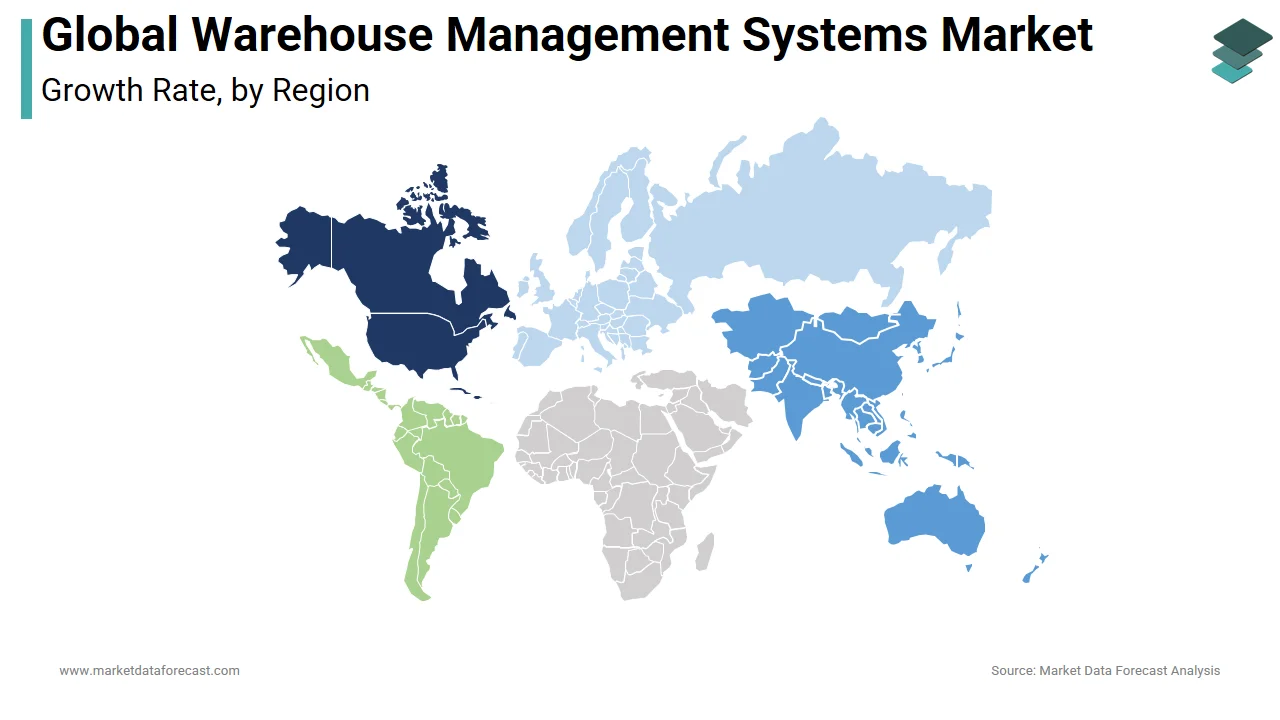
Europe is expected to dominate the WMS market; however, Asia-Pacific is expected to experience rapid growth.
Europe leads the warehouse management systems market due to its strong penetration in healthcare and industry. Europe is closely followed by North America. The warehouse management system is expanding its footprint in North America due to increasing demand from various industries such as food manufacturing, agriculture, beverage, cosmetics, logistics, and medical devices. China, India, and Japan in the Asia-Pacific region dominate the warehouse management system market due to high investment in technology. The adoption of barcode and RFID chip technology is accelerating the growth of the warehouse management systems market in Asia-Pacific.
KEY MARKET PLAYERS
The major players in the global warehouse management systems market are HighJump Software, Infor Inc., LogFire Inc., Tecsys, Inc., Manhattan Associates Inc., Made4net LLC, Oracle Corporation, SAP SE, Reply, Softeon, Inc., JDA Software Group, Inc., and Synergy Logistics Ltd.
In addition, Indigo Software, Produmex, SmartTurn, Justransform, Swisslog WMS, SNS, Provia Software, EXE Technologies, Infor / SSA Global, Royal 4 Systems' Warehouse Information System, Snapfulfil, Synergy Ltd., ERCIM, Yobel SCM, NUO Consulting, and GCM Business Consulting & Technology are other players in the warehouse management systems market.
RECENT MARKET HAPPENINGS
-
In April 2020, Softeon Company participated in MODEX 2020, held in Atlanta, to showcase its warehouse management and fulfillment system capabilities. Through this participation, the company aims to improve its global customer base in the market.
MARKET SEGMENTATION
The global warehouse management systems market is segmented on the basis of components, deployment, applications, and region.
By Component
- Software
- Services
By Application
- Pharmaceutical
- Retail
- Food & Beverage
- Electronics
By Deployment
- On-Premise
- Cloud
By Region
- North America
- Europe
- Asia-Pacific
- Latin America
- The Middle East and Africa