- Product Description Description
- Table of Contents TOC
- List of Table & Figure LOT
- Get Free Sample PDF Sample PDF
Market Size, 2025
$3.9 BnMarket Estimate, 2026
$4.42 BnMarket Forecast, 2034
$12 BnCAGR, 2026–2034
13.3%Executive Summary: Wealth Management Platform Market
- Market Scope: Comprehensive global wealth management platform industry analysis covering advisory segments, regional leadership frameworks, strategic corporate developments, and competitive landscapes.
- Market Valuation: Valued at USD 3.9 billion (2025), estimated at USD 4.42 billion (2026), and projected to reach USD 12 billion by 2034, registering a strong CAGR of 13.3% (2026–2034).
- Primary Growth Drivers: Increasing digitization, business process automation adoption, rising high-net-worth individuals (HNWIs), AI-driven predictive analytics, personalized investment strategies, and hybrid advisory model expansion. Restraints include regulatory compliance complexity and technical expertise gaps.
Key Market Segment Metrics (2026–2034)
| Category | Leading Segment / Region | Fastest-Growing Segment |
|---|---|---|
| By Advisory / Service Segment | Traditional and hybrid human-digital wealth advisory solutions | Robo-advisor segment (estimated to show the highest growth rates due to low-cost fee structures) |
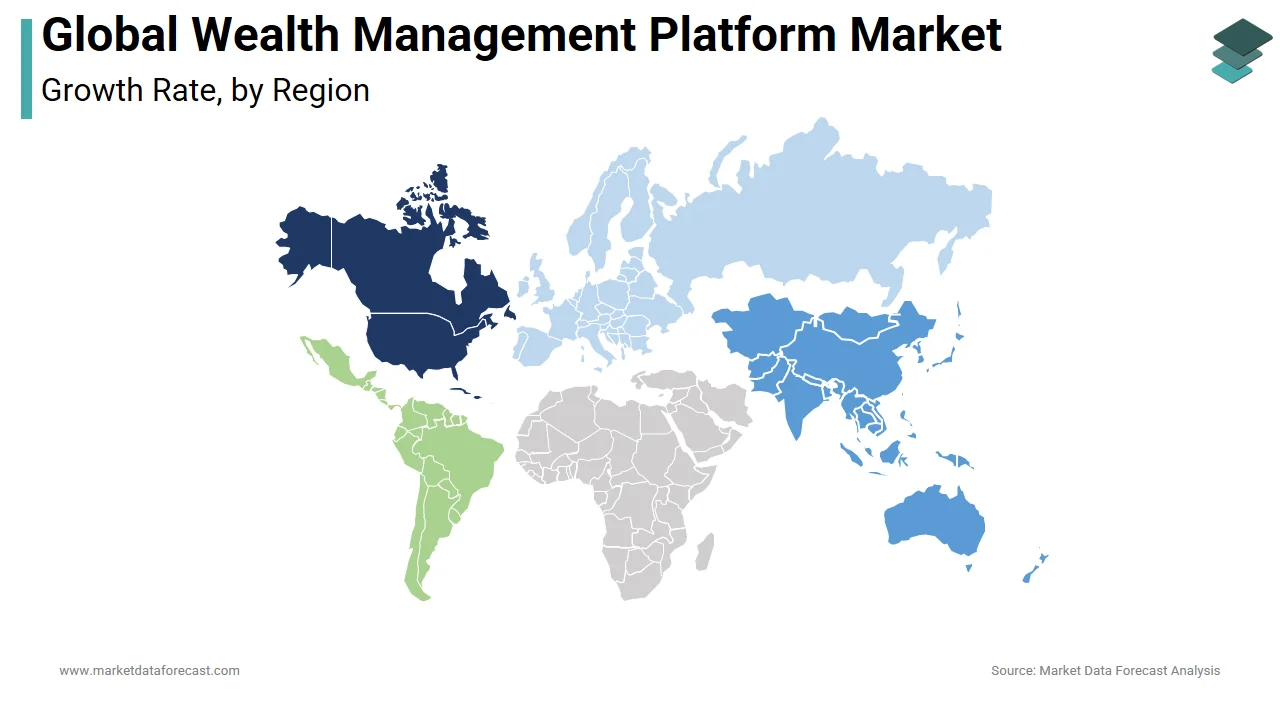
| By Region / Geography | North America (represents the largest revenue share in the worldwide marketplace) | Europe (estimated to register the fastest revenue growth as digital platform adoption increases) |
Major Market Players & Market Structure
Market Structure: Highly competitive global wealth tech and financial software ecosystem driven by automated advisory models, international operational hub expansions, and strategic technology partnerships tailored for HNWI-centric services.
Key Companies: Dorsum Ltd., Comarch SA, Finantix SpA, Objectway SpA, Fiserv, Inc., Profile Software, Fidelity National Information Services, Inc., SS&C Technologies Holdings Inc., SEI Investments Company, and Temenos Headquarters SA.
 Download Free Sample Report
Global Wealth Management Platform Market Size
The global wealth management platform market was worth USD 3.9 billion in 2025. The global market is predicted to reach USD 4.42 billion in 2026 and USD 12 billion by 2034, growing at a CAGR of 13.3% from 2026 to 2034.
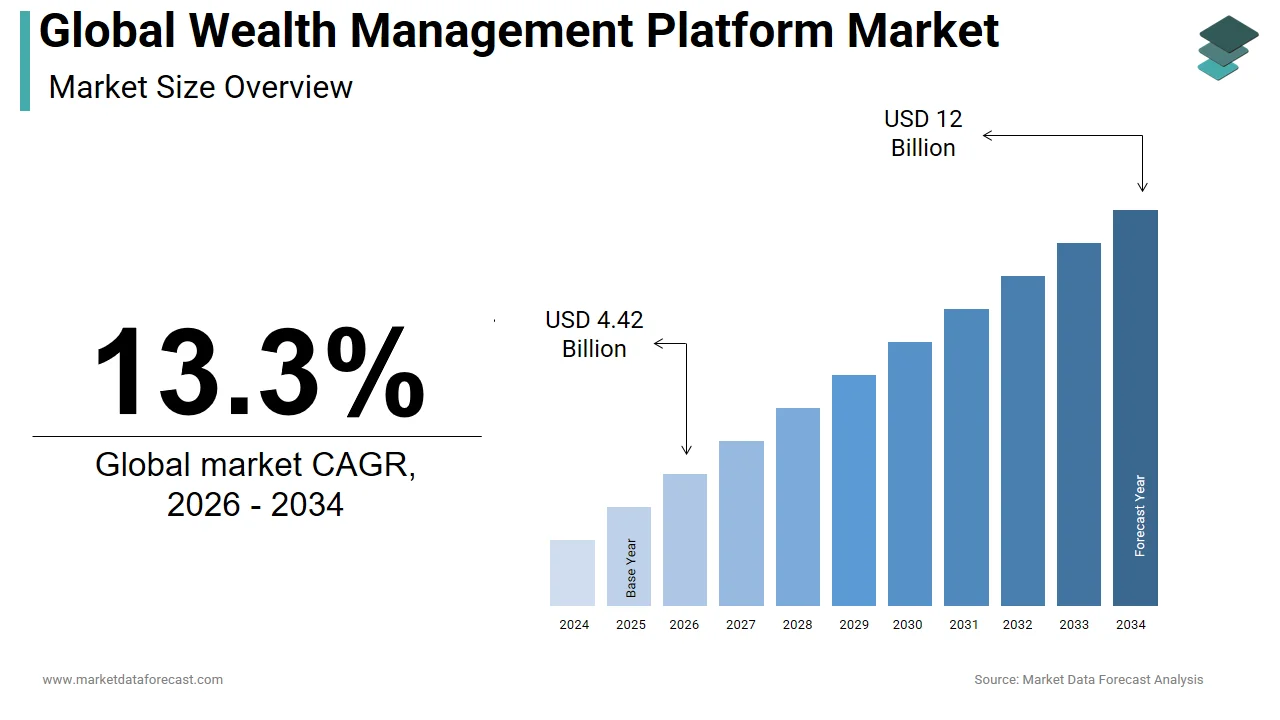
The wealth management platforms are integrated technological ecosystems that unify portfolio management client relationship tools regulatory compliance and investment research into singular digital environments enabling financial advisors and institutions to deliver personalized fiduciary services at scale. These systems transcend traditional brokerage interfaces by embedding behavioral analytics tax optimization algorithms and estate planning modules directly within advisor workflows facilitating holistic wealth stewardship rather than transactional execution alone. As per survey, nearly 61% of European households now access financial planning services through digital channels reflecting fundamental shift in service delivery expectations across generational cohorts. Furthermore, advisors using unified platforms managed 42% more client relationships per full time equivalent, while maintaining higher satisfaction scores, as per the study.
MARKET DRIVERS
Regulatory Harmonization Mandates Integrated Compliance Infrastructure
The regulatory frameworks increasingly require wealth managers to demonstrate systematic adherence to suitability appropriateness and sustainability disclosure obligations creating non-discretionary demand for platforms embedding compliance logic within advisory workflows. The regulatory harmonization mandates integrated compliance infrastructure is bolstering the growth of the wealth management platform market. According to the report 2025, national competent authorities conducted over 480 targeted inspections focusing specifically on MiFID II cost disclosure and sustainability preference assessments resulting in enforcement actions against 67 firms lacking adequate technological support for regulatory documentation. This supervisory intensity transforms wealth platforms from optional productivity tools to mandatory compliance infrastructure for over 12000 investment firms operating within the European Economic Area. The Consumer Duty framework in the United Kingdom and similar good outcome requirements across EU member states mandate continuous monitoring of client value necessitating real time analytics capabilities only modern platforms provide. Organizations recognize that robust platform architecture simultaneously satisfies multiple regulatory obligations reducing audit preparation costs and enforcement exposure while enabling advisors to focus on client relationships rather than administrative burden.
Intergenerational Wealth Transfer Accelerates Digital Service Expectations
The unprecedented transfer of assets from baby boomers to younger generations fundamentally reshapes service delivery expectations driving urgent adoption of platforms capable of meeting digital native preferences, while retaining older clientele accustomed to traditional advisory relationships. The intergenerational wealth transfer accelerates digital service expectations, which is also propelling the growth of the wealth management platform market. According to report, European households will pass approximately 14 trillion euros to heirs over the next two decades with 68% of beneficiaries indicating they would change providers if digital capabilities failed to meet their standards for transparency accessibility and self-service functionality. As per survey, clients under age 45 expect real time portfolio visibility mobile first communication and collaborative goal setting features ranking these capabilities above fee levels when selecting wealth managers. Traditional paper based reporting and quarterly review cadences no longer satisfy younger investors who consume financial information continuously through integrated dashboards and push notifications. This demographic imperative forces firms to invest in platforms supporting multi generational engagement strategies where same system serves diverse user personas without compromising experience quality.
MARKET RESTRAINTS
Legacy System Integration Complexity Delays Modernization Timelines
Many established European wealth managers operate heterogeneous IT landscapes with decades old core banking and custody systems lacking modern APIs or event streaming capabilities required for seamless platform integration. The legacy systems integration complexity delays modernization timelines are restricting the growth of the wealth management platform market. Integrating modern advisory tools with these systems requires custom middleware development extensive testing and prolonged change management cycles averaging 11 months per integration point significantly delaying time to value realization. Core custody platforms often lack granular position level metadata necessary for accurate performance attribution tax lot accounting and ESG scoring forcing organizations to implement costly data enrichment layers or accept reduced analytical fidelity. Vendor support for legacy protocols including proprietary message formats and batch file transfers is declining as focus shifts to RESTful APIs and real time messaging standards creating compatibility gaps for firms unable to modernize core systems quickly.
Data Privacy Regulations Constrain Cross Border Platform Standardization
The stringent European data protection frameworks limit ability to deploy standardized wealth platforms across multiple jurisdictions creating fragmentation that increases costs and reduces economies of scale for multinational firms. Data privacy regulations constrain cross border platform standardization is also declining the growth of the wealth management platform market. According to the study, updated January 2026 personal financial data processing must comply with member state specific interpretations of GDPR adequacy decisions and supplementary measures making centralized cloud platform deployments legally complex for firms serving clients across borders. The multinational private banks reported maintaining separate platform instances or data residency configurations for each major jurisdiction increasing infrastructure costs by 34% compared to unified global deployments. National competent authorities, including BaFin CNMV and CSSF issued divergent guidance on cloud outsourcing third party risk assessments and data localization creating compliance mosaic that resists standardization. Organizations must navigate conflicting requirements where regulators demand consistent client outcomes while simultaneously restricting underlying data flows needed for unified analytics and reporting.
MARKET OPPORTUNITIES
Embedded Sustainability Analytics Unlocks Differentiated Advisory Value
The integration of granular environmental social and governance data directly within wealth platforms to differentiate advisory services through personalized sustainability aligned portfolio construction addressing both regulatory mandates and genuine client values. The embedded sustainability analytics unlocks differentiated advisory value is solely to boost the growth of the wealth management platform market. According to the survey, 73% of European retail investors expressed willingness to pay premium fees for portfolios demonstrating measurable positive impact beyond financial returns yet only 28% felt current advisors provided adequate sustainability guidance. As per the study, funds classified as Article 8 or 9 attracted net inflows of 41 billion euros while conventional funds experienced outflows of 18 billion euros demonstrating clear capital allocation preference toward sustainable strategies. Wealth platforms embedding real time ESG scoring carbon footprint calculation and taxonomy alignment verification enable advisors to translate abstract sustainability preferences into concrete portfolio recommendations with auditable evidence trails satisfying SFDR disclosure requirements. The EU Green Bond Standard and Corporate Sustainability Reporting Directive create expanding universe of verifiable sustainable instruments requiring sophisticated analytics to assess credibility and avoid greenwashing accusations. This convergence of client demand regulatory clarity and data availability creates powerful growth vector transforming sustainability from compliance burden to revenue generating differentiator for platforms enabling authentic values-based advice.
Hybrid Advisory Models Expand Addressable Client Segments
The platforms enabling seamless integration of algorithmic portfolio management with human advisor oversight unlock opportunity to serve mass affluent clients profitably, while preserving premium positioning for high net-worth relationships. The hybrid advisory models expand addressable client that is also to foster the expansion of the wealth management platform market. The mass affluent investors prefer hybrid model combining digital efficiency with periodic human consultation for complex decisions like retirement planning inheritance structuring and tax optimization. This efficiency gain makes previously unprofitable segments economically viable expanding total addressable market without cannibalizing premium offerings. Firms deploying successful hybrid models achieved 3.1 times faster asset growth in mass affluent segment versus peers offering binary choice between expensive human advice or impersonal algorithms.
MARKET CHALLENGES
Advisor Adoption Resistance Undermines Technology ROI
Despite substantial platform investments, many European wealth firms fail to realize expected value due to persistent advisor resistance rooted in cultural inertia perceived loss of autonomy and inadequate change management. The advisor adoption resistance undermines technology ROI is likely to decline the growth of the wealth management platform market. According to study, only 38% of advisors consistently utilize advanced platform features beyond basic CRM and portfolio viewing with usage dropping precipitously after initial training period despite demonstrated productivity benefits. Compensation structures emphasizing sales volume over process adherence create misaligned incentives where advisors bypass platform workflows to maximize short term revenue at expense of long-term client outcomes and regulatory compliance. Training programs averaging 12 hours annually prove insufficient for mastering complex integrated systems requiring continuous learning curves that compete with client facing time. According to report, firms experiencing low platform adoption saw 23% higher advisor attrition as frustrated top performers departed for competitors with better technology fit or greater autonomy.
Algorithmic Transparency Requirements Conflict With Proprietary Protection
The regulatory demands for explainable AI and transparent recommendation logic create fundamental tension with vendors’ intellectual property protection and competitive differentiation strategies limiting platform sophistication and innovation velocity. The algorithmic transparency requirements conflict with proprietary protection is additional factor to impede the growth of the wealth management platform market. Vendors resist disclosing proprietary algorithms fearing reverse engineering and competitive imitation yet regulators insist on sufficient transparency to validate fairness accuracy and suitability. This impasse forces firms to either accept black box solutions risking regulatory challenge or demand white box access increasing vendor costs and reducing available innovation. Wealth firms delayed AI enhanced platform features awaiting clearer guidance on acceptable explanation standards creating innovation lag versus less regulated jurisdictions. Balancing legitimate commercial confidentiality with democratic accountability for automated financial advice remains unresolved challenge constraining platform evolution toward more sophisticated adaptive intelligence that could better serve complex client needs across European markets.
REPORT COVERAGE
| REPORT METRIC | DETAILS |
| Market Size Available | 2025 to 2034 |
| Base Year | 2025 |
| Forecast Period | 2026 to 2034 |
| Segments Covered | By Advisory Model, Deployment Model, Company Size, Business Function, End User and Region. |
| Various Analyses Covered | Global, Regional, and Country-Level Analysis, Segment-Level Analysis, Drivers, Restraints, Opportunities, Challenges; PESTLE Analysis; Porter’s Five Forces Analysis, Competitive Landscape, Analyst Overview of Investment Opportunities |
| Countries Covered |
|
| Market Leaders Profiled | Dorsum Ltd., Comarch SA, Finantix SpA, Objectway SpA, Fiserv, Inc., Profile Software, Fidelity National Information Services, Inc., BlackRock Aladdin, Addepar Inc, SS & C Technologies Holdings Inc., Envestnet Inc, SEI Investments Company and Temenos Headquarters SA. |
SEGMENTAL ANALYSIS
By Advisory Model Insights
The human advisory segment was accounted in holding a prominent share of the European Wealth Management Platform market in 2025 due to the irreplaceable role of trusted advisors in managing complex high net worth relationships involving estate planning tax optimization and cross border asset structuring. According to study, with over 1 million euros in investible assets allocated 89% of their wealth through human advised channels despite widespread availability of digital alternatives reflecting preference for personalized fiduciary guidance on non-standardized decisions. Regulatory frameworks including MiFID II suitability requirements and Consumer Duty obligations mandate documented evidence of personalized recommendations that algorithmic systems struggle to provide for bespoke situations involving family governance business succession or philanthropic objectives. Organizations recognize that platforms supporting rather than replacing human advisors achieve better outcomes for complex clients justifying continued investment in advisor enablement tools. This combination of relationship economics regulatory nuance and client preference for trusted counsel solidifies human advisory dominance ensuring sustained platform demand centered on advisor productivity enhancement rather than displacement across European wealth management sector.
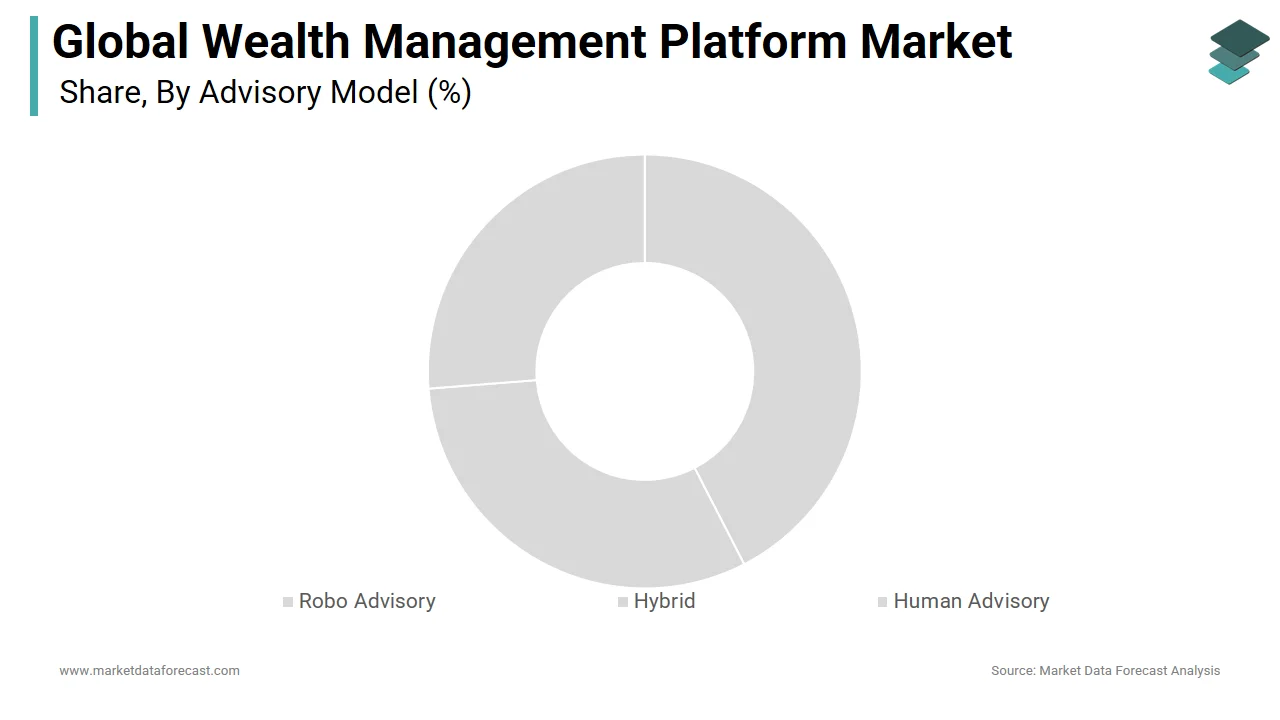
The hybrid advisory segment is projected to register a fastest CAGR of 26.2% throughout the forecast period with the unique ability to serve the underserved mass affluent segment profitably, while preserving premium positioning for high net worth relationships. According to study, approximately 42 million European households possess 100000 to 500000 euros in investible assets representing segment where traditional human advisory economics fail, yet pure robo solutions lack trust and personalization desired for meaningful financial planning. The affluent investors prefer hybrid model combining digital efficiency with periodic human consultation for complex decisions like retirement planning inheritance structuring and tax optimization. This efficiency gain makes previously unprofitable segments economically viable expanding total addressable market without cannibalizing premium offerings. Firms deploying successful hybrid models achieved 3.1 times faster asset growth in mass affluent segment versus peers offering binary choice between expensive human advice or impersonal algorithms.
By Enterprise Size Insights
The large enterprises segment was the largest by accounting for a dominant share of the European Wealth Management Platform market in 2025 due to sufficient scale to justify comprehensive platform investments and heightened regulatory exposure mandating sophisticated technological infrastructure. The large wealth firms have dedicated technology budgets exceeding 5 million euros annually with formal governance structures versus 34% of SMEs, indicating maturity gap in strategic planning and execution capabilities. Multinational banks and asset managers face cross border compliance requirements including MiFID II SFDR DORA and national conduct rules that compel integrated platform architectures capable of consistent policy enforcement across jurisdictions. Large organizations operate sufficient advisor headcounts and client volumes to achieve favorable unit economics on platform deployments that would be prohibitive at smaller scale.
The small and medium enterprises segment is swiftly emerging at a fastest CAGR of 24.4% during the forecast period with the SaaS platform democratization and regulatory requirements that apply equally regardless of firm size creating non-discretionary demand previously deferred due to cost barriers. As per survey, 67% of SMEs now prefer operational expenditure models for wealth platforms versus 29% in 2023 reflecting shift from capital constrained purchasing to flexible consumption aligned with cash flow patterns and scalability needs. Regulatory frameworks, including MiFID II suitability documentation SFDR disclosure and DORA operational resilience apply uniformly to all investment firms regardless of size eliminating exemptions that historically allowed SMEs to defer technology modernization. Industry associations and supervisory sandboxes facilitate collective purchasing and shared compliance resources enabling SMEs to access volume discounts and implementation support previously reserved for large enterprises.
By Application Insights
The risk and compliance management segment was accounted in holding 43.2% of the Europe Wealth Management Platform market share in 2025 due to pervasive regulatory requirements that mandate systematic controls documentation and monitoring capabilities independent of business cycle conditions or voluntary investment appetites. The wealth firms ranked compliance functionality as top selection criterion for platform vendors surpassing performance analytics client reporting or trading capabilities reflecting primacy of regulatory risk mitigation in procurement decisions. MiFID II suitability appropriateness and cost disclosure requirements SFDR sustainability classification DORA operational resilience and AML transaction monitoring collectively create overlapping compliance obligations that only integrated platforms can address efficiently without duplicative data entry or reconciliation gaps. The mandate three lines of defense model with technology enabled second line oversight requiring real time risk dashboards and automated breach detection capabilities. This combination of supervisory intensity penalty avoidance and operational efficiency solidifies risk and compliance as anchor application justifying initial platform investments that subsequently enable advanced advisory and analytics capabilities across European wealth sector.
The financial advice management segment is deemed to grow at a fastest CAGR of 29.4% from 2026 to 2034 with the intensifying regulatory requirements for documented suitability assessments and personalized recommendation justification that exceed capabilities of legacy CRM and portfolio systems. Firms must maintain granular records demonstrating how each recommendation aligns with client financial situation knowledge experience objectives risk tolerance and sustainability preferences, creating documentation burden that manual processes cannot sustain at scale. The UK Consumer Duty and EU Retail Investment Strategy proposals introduce additional requirements for fair value assessments and customer understanding validations that extend beyond traditional suitability into ongoing outcome monitoring necessitating specialized advice lifecycle management tools. This emergence of regulatory expansion productivity gains and client experience improvement creates powerful structural demand ensuring advice management maintains exceptional growth trajectory as it transitions from back office compliance tool to front office advisory enabler across European wealth markets.
REGIONAL ANALYSIS
North America Wealth Management Platform Market Analysis
North America wealth management platform market was the outperformer of the 38.3% of share in 2025 from early technology adoption mature RIA ecosystem concentrated fintech innovation hubs and deep capital supporting continuous platform evolution. According to the study, US private sector wealth technology investment grew 22% year over year outpacing overall IT expenditure growth driven by RIA consolidation intergenerational transfer preparation and alternative asset democratization. Canadian organizations leverage platforms for cross border US Canada advisory services and indigenous wealth management programs reflecting regional specialization. The region hosts major platform vendors, including Envestnet Addepar and Orion whose proximity enables faster innovation cycles and customized solutions for local regulatory and tax requirements. Mature advisor ecosystems and open API standards accelerate third party integration and solution diversity. This combination of regulatory uniformity capital availability and innovation density solidifies North America as undisputed global leader serving as benchmark for other regions aspiring to similar platform maturity and commercial scale.
Europe Wealth Management Platform Market Analysis
Europe wealth management platform market was ranked second by holding 29.3% of share in 2025. Regional growth is distinctly shaped by stringent regulatory frameworks, including MiFID II SFDR DORA and national conduct rules that mandate specific platform capabilities creating non-discretionary demand independent of market cycles. European platforms prioritize sustainability integration cross border compliance and multi-language support distinguishing them from North American counterparts focused primarily on tax optimization and alternative assets. This unique combination of regulatory compulsion public funding and cross border complexity positions Europe as sophisticated differentiated market with growth dynamics emphasizing compliance and sustainability alongside commercial objectives creating distinct vendor requirements and competitive dynamics.
Asia Pacific Wealth Management Platform Market Analysis
Asia Pacific Wealth Management Platform market was ranked second by holding 21.4% of share in 2025 but exhibits highest growth rates driven by rising affluence digital native investor demographics and government led financial inclusion initiatives. China, Japan, Australia, Singapore, India, and Hong Kong represent diverse submarkets with distinct characteristics yet share common momentum toward platform enabled wealth democratization. Japanese organizations focus on aging population wealth decumulation and NISA tax free account expansion through simplified digital platforms. Australian superannuation reform and comprehensive advice reforms drive platform modernization for retirement income planning. Southeast Asian nations accelerate platform adoption through ASEAN fintegration and rising middle class wealth accumulation. Unlike Western markets constrained by legacy infrastructure Asia Pacific organizations frequently implement cloud native mobile first platforms avoiding technical debt. This combination of demographic dividends policy support and greenfield advantage positions Asia Pacific as future growth engine reshaping global wealth platform geography through speed scale and digital innovation.
Middle East and Africa Wealth Management Platform Market Analysis
Middle East and Africa wealth management platform market growth is likely to grow with the sovereign wealth fund spillover economic diversification agendas and expatriate wealth accumulation. Gulf Cooperation Council nations particularly Saudi Arabia United Arab Emirates and Qatar invest heavily in wealth platform infrastructure as cornerstone of Vision 2030 and similar national transformation programs developing domestic wealth management capabilities beyond oil revenues. UAE government mandates digital wealth infrastructure for all licensed financial free zones creating baseline demand with Islamic finance compliance and Arabic localization features. South Africa serves as regional hub for pension fund and retail wealth platforms leveraging relatively mature regulatory framework and skilled workforce. Development finance institutions fund financial inclusion platform capacity building creating foundational demand.
Latin America Wealth Management Platform Market Analysis
Latin America Wealth Management Platform market growth is significantly growing with the economic volatility yet accelerated by pension system reforms and fintech expansion. Brazil, Mexico, Chile, Colombia, and Argentina represent primary countries with Brazil accounting for 52% of regional platform spending reflecting its economic size and sophisticated financial sector. Brazilian organizations deploy platforms extensively for private pension portability open finance integration and high inflation hedging strategies creating concentrated demand. Mexican companies leverage platforms for AFORE pension system modernization and cross border remittance wealth services creating dual demand drivers. Colombian fintech ecosystem expansion creates demand for inclusive wealth platforms serving unbanked populations through alternative data credit scoring. Regional trade agreements and Pacific Alliance financial integration promote cross border platform interoperability reducing fragmentation. Currency fluctuations and political instability create headwinds yet also increase demand for inflation protection and offshore diversification analytics.
COMPETITIVE LANDSCAPE
Competition in the Wealth Management Platform market exhibits intense multidimensional rivalry among established financial technology incumbents asset manager affiliated platforms and emerging fintech disruptors each pursuing distinct value propositions and target segments. Incumbents leverage decades of custodian integrations regulatory expertise and installed base to defend positions while innovators disrupt through superior user experience modern architecture and specialized vertical solutions attracting next generation advisors and digital native clients. Competitive differentiation increasingly centers on data breadth integration ecosystem and regulatory alignment rather than core feature parity as baseline portfolio management and reporting capabilities achieve commodity status across major vendors. Geographic expansion particularly in Asia Pacific and Middle East creates new battlegrounds where local players challenge global vendors through localization regulatory alignment and cultural adaptation. Talent acquisition wars for wealth technologists compliance experts and data engineers constrain innovation velocity and increase operational costs across all competitors.
KEY MARKET PLAYERS
The leading companies operating in the global wealth management platform market include:
- Dorsum Ltd.
- Comarch SA
- Finantix SpA
- Objectway SpA
- Fiserv, Inc.
- Profile Software
- Fidelity National Information Services, Inc.
- BlackRock Aladdin
- Addepar Inc.
- SS&C Technologies Holdings Inc.
- Envestnet Inc.
- SEI Investments Company
- Temenos Headquarters SA
TOP PLAYERS IN THE MARKET
- Addepar Inc significantly influences the global Wealth Management Platform landscape through its data aggregation and performance analytics engine designed specifically for complex multi asset portfolios held by ultra-high net worth families and institutional investors. The company strengthens its position by continuously expanding direct custodian integrations and alternative asset data feeds enabling comprehensive consolidated reporting across fragmented holdings. Recent initiatives focus on enhancing ESG attribution capabilities and private market valuation tools addressing growing demand for sustainability aligned investment oversight and illiquid asset transparency. Addepar invests heavily in API ecosystem development allowing seamless connectivity with CRM compliance and trading systems creating sticky integrated workflows.
- Envestnet Inc advances the Wealth Management Platform market through its unified TAMP and analytics ecosystem connecting advisors asset managers and custodians within single integrated environment serving over one hundred thousand financial professionals globally. The company recently enhanced its enterprise data and analytics platform with AI driven insights and behavioral intelligence capabilities enabling personalized client engagement at scale, while maintaining regulatory compliance documentation. Envestnet focuses on expanding managed account solutions and model marketplace breadth providing advisors turnkey investment offerings that reduce operational complexity and accelerate practice scalability. Strategic partnerships with major custodians and recordkeepers ensure seamless data flow and straight through processing reducing reconciliation burdens. By positioning platform as neutral infrastructure layer rather than proprietary product manufacturer Envestnet attracts diverse participant base creating network effects where value increases with each additional user and integration.
- BlackRock Aladdin contributes substantially to the global Wealth Management Platform ecosystem through its end to end investment management technology combining risk analytics portfolio construction trading execution and compliance monitoring within single cloud native platform serving both institutional and wealth segments. The company recently strengthened its market position by launching Aladdin Accounting for Wealth and expanding ESG data integration capabilities enabling unified front to back office operations for large private banks and RIAs managing complex multi entity structures. BlackRock leverages its asset management expertise to embed proprietary risk models and factor analytics directly within platform creating differentiated intellectual property unavailable from pure technology vendors. Recent enhancements focus on democratizing institutional grade tools for wealth advisors through simplified interfaces and prebuilt model portfolios.
TOP STRATEGIES USED BY KEY MARKET PARTICIPANTS
Key players in the Wealth Management Platform market prioritize ecosystem expansion through open API architectures and third party integration marketplaces enabling clients to assemble customized technology stacks while maintaining core platform stickiness through data gravity and workflow centrality. Strategic acquisitions of niche technology providers enable rapid capability expansion in areas like alternative data aggregation behavioral analytics and document automation while eliminating competitive threats and consolidating specialized talent pools essential for domain expertise. Data network effects creation through custodian integrations transaction feeds and benchmark libraries builds defensible moats where platform value increases with each additional connection making switching costs prohibitive for established clients. Managed services and outsourced operations offerings expand revenue streams beyond software licensing, while deepening client relationships through operational dependency and shared accountability for outcomes. Geographic expansion through local data centers sovereign cloud options and regional compliance teams addresses data residency requirements, particularly in European and Asian markets where regulatory alignment determines purchasing decisions.
MARKET SEGMENTATION
This research report on the global wealth management platform market has been segmented and sub-segmented based on the advisory model, depending on the deployment model, company size, business function, end-user, and region.
By Advisory Model
- Robo Advisory
- Hybrid
- Human Advisory
By Deployment Model
- Cloud
- On-Premises
By Company Size
- Large Companies
- Small and Medium-Sized Enterprises (SMEs)
By Business Function
- Performance Management
- Reporting
- Risk and Compliance Management
- Financial Advisory Management
- Accounting
- Portfolio
- Transaction Management, etc.
By End-User
- Securities Companies
- Banks
- Exchange and Trade Companies
- Investment Management Companies
By Region
- North America
- The United States
- Canada
- Rest of North America
- Europe
- The United Kingdom
- Spain
- Germany
- Italy
- France
- Rest of Europe
- The Asia Pacific
- India
- Japan
- China
- Australia
- Singapore
- Malaysia
- South Korea
- New Zealand
- Southeast Asia
- Latin America
- Brazil
- Argentina
- Mexico
- Rest of LATAM
- The Middle East and Africa
- Saudi Arabia
- UAE
- Lebanon
- Jordan
- Cyprus