- Product Description Description
- Table of Contents TOC
- List of Table & Figure LOT
- Get Free Sample PDF Sample PDF
Market Size, 2025
$3.71 BnMarket Estimate, 2026
$3.84 BnMarket Forecast, 2034
$5.08 BnCAGR, 2026–2034
3.56%Global Wheels Aftermarket Market Summary
The global wheels aftermarket market size was valued at USD 3.71 billion in 2025, is anticipated to reach USD 3.84 billion in 2026, and is projected to reach USD 5.08 billion by 2034, growing at a CAGR of 3.56% from 2026 to 2034. The growth of the global wheels aftermarket market is driven by rising consumer demand for aesthetic vehicle customization, replacement of damaged wheels, and the increasing popularity of alloy wheels for performance and fuel efficiency improvements. Expanding automotive production, urban mobility trends, and premium aftermarket services further strengthen market momentum.
Key Market Trends
- Strong demand for lightweight alloy and forged wheels for performance and fuel efficiency.
- Growing aftermarket customization and personalization across passenger cars and SUVs.
- Rising preference for larger rim sizes (16–18 inches and above) in both premium and mid-range vehicles.
- Increasing adoption of e-commerce channels for aftermarket wheels.
- Steady growth in commercial vehicle fleet replacements in emerging markets.
Segmental Insights
- Based on aftermarket type, the new wheel replacement segment dominated the global wheels aftermarket in 2025, supported by high replacement frequency and customization trends.
- Based on vehicle type, the passenger car (PC) segment held the largest share in 2025, driven by increasing vehicle ownership and consumer interest in aesthetics.
- Based on rim size, the 16–18 inch rim segment led the wheels aftermarket with 52.8% share in 2025, favored by its balance of performance, durability, and affordability.
Regional Insights
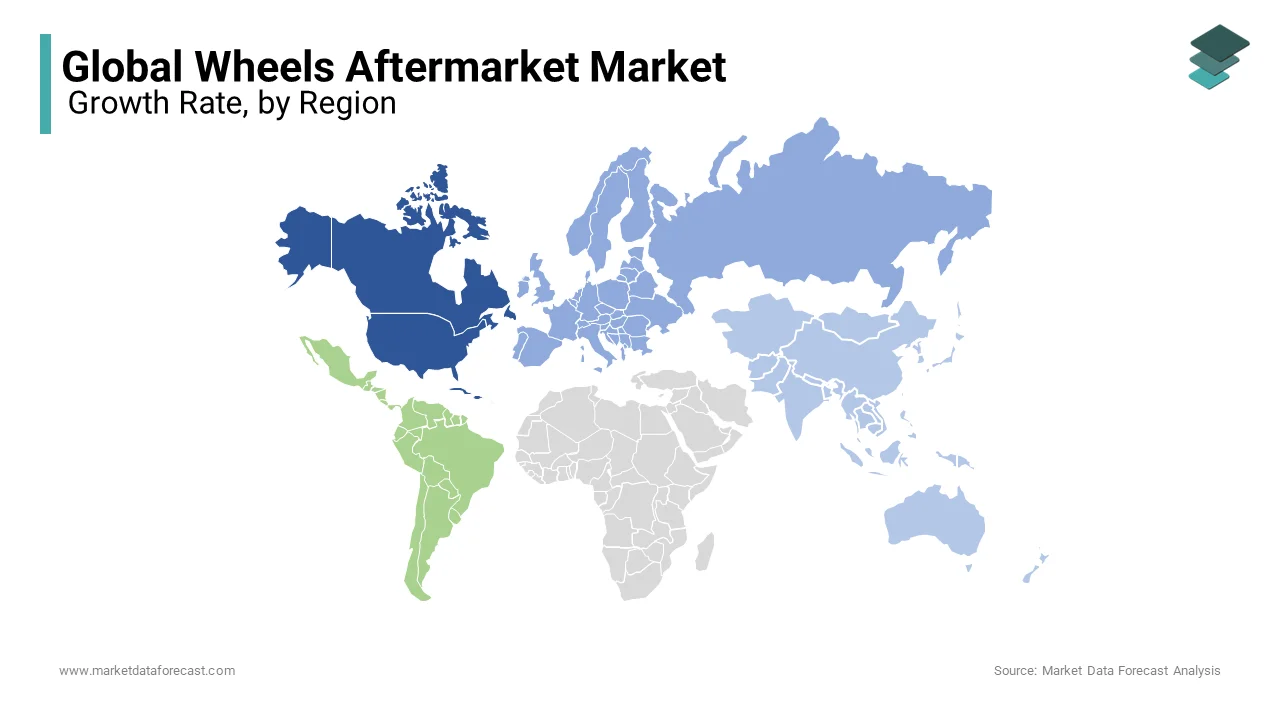
- North America was the top performer in the global wheels aftermarket, accounting for 34.1% share in 2025, driven by a large vehicle parc and strong aftermarket demand.
- Europe maintained a significant market share due to premium vehicle penetration and strict safety replacement standards.
- Asia-Pacific is anticipated to be the fastest-growing region, fueled by rising automotive sales in China and India.
- Latin America and the Middle East & Africa are emerging regions with steady adoption of aftermarket wheel upgrades.
Competitive Landscape
The global wheels aftermarket market is moderately consolidated, with leading players focusing on innovation, lightweight materials, and distribution expansion. Key players dominating the market include Maxion Wheels, Ronal Group, Borbet GmbH, Enkei Corporation, Superior Industries, Howmet Aerospace, The Carlstar Group, CM Wheels, Central Motor Wheel of America, and Accuride Corporation.
Global Wheels Aftermarket Market Size
The global wheels aftermarket market size was valued at USD 3.71 billion in 2025 and is anticipated to reach a valuation of USD 3.84 billion in 2026 and USD 5.08 billion by 2034, growing at a CAGR of 3.56% from 2026 to 2034.
Wheels aftermarket are replacement and performance-oriented wheels for passenger vehicles, light trucks, and specialty automobiles, which are distinct from original equipment manufacturer (OEM) fittings. It is supported by consumer preferences for vehicle personalization, enhanced aesthetics, and improved driving dynamics. As per the Specialty Equipment Market Association (SEMA), one-third of U.S. vehicle owners modify at least one component of their automobiles, with wheels and tires ranking among the top three categories for modification. Furthermore, as per the study, the average age of light-duty vehicles on American roads has reached several years, fostering increased demand for replacement and upgraded components.
MARKET DRIVERS
Rising Consumer Emphasis on Vehicle Customization and Aesthetic Enhancement
The growing consumer inclination toward vehicle personalization in the n developed automotive industry is driving the growth of the wheels aftermarket. The number of American drivers has invested in at least one aesthetic or performance upgrade in the last three years, with wheel replacements being the most prevalent modification. The appeal of larger diameters, unique finishes such as matte black or machine-faced alloys, and brand-specific designs from manufacturers like BBS or HRE has transformed wheels into a signature element of vehicle identity. Social media platforms have amplified this trend, where modified vehicles garner significant engagement, further normalizing aesthetic upgrades. This psychological and cultural momentum sustains robust demand for visually distinctive wheels among millennials and Gen Z vehicle owners who prioritize self-expression through their automobiles.
Expansion of the High-Performance and Electric Vehicle Enthusiast Segment
The proliferation of high-performance and electric vehicles (EVs) also drives the growth of the wheels aftermarket. These wheels are engineered to accommodate higher torque loads and reduce unsprung mass. As per the International Energy Agency, global electric car registrations surpassed 10 million units in 2022, a figure that rose to over 14 million in 2023. These vehicles, including models from Tesla, Porsche, and Lucid, often come with heavy battery packs, which increase overall vehicle weight and place greater stress on wheel integrity. Aftermarket solutions featuring lightweight forged aluminum or carbon-composite rims, such as those offered by Rotiform or ADV.1, provide enhanced load capacity and improved energy efficiency.
MARKET RESTRAINTS
Stringent Vehicle Safety and Compliance Regulations in Key Markets
The growing stringency of vehicle safety and compliance standards in Europe and North America is restraining the growth of the wheels aftermarket. The improperly fitted or non-compliant wheels were implicated in several crash incidents, prompting stricter enforcement of fitment regulations. In the European Union, replacement wheels intended for passenger cars must meet specific technical requirements for load, durability, and dimensions. One common way to prove compliance is through certification under the UNECE Regulation 124 (ECE R124), but this is not the only permissible standard. Automakers such as BMW and Mercedes-Benz have also intensified warnings against using non-approved wheels by citing potential voiding of warranties and liability concerns. These regulatory and manufacturer-imposed barriers deter casual consumers and complicate distribution channels.
Volatility in Raw Material Supply Chains and Production Costs
The global supply chain instabilities and the high cost of manufacturing aftermarket wheels are restraining the growth of the aftermarket wheels. This affects the price and availability of raw materials like aluminum, magnesium, and specialized alloys. According to the study, aluminum prices fluctuated due to energy crises in Europe and export restrictions in key producing nations like China and Jamaica. These cost volatilities directly impact the profit margins of mid-tier wheel fabricators, many of whom lack the hedging capabilities of larger OEMs. Apart from these, the European Commission pointed out in 2023 that carbon border adjustment mechanisms will impose additional costs on imported aluminum products, further pressuring manufacturers reliant on offshore production.
MARKET OPPORTUNITIES
Integration of Smart Wheel Technologies and IoT-Enabled Components
The convergence of wheel systems with smart technologies, including tire pressure monitoring systems (TPMS), load sensors, and connectivity modules, is a key factor providing opportunity for the expansion of the wheel aftermarket. As per the study, by 2030, the number of high-end aftermarket wheels is expected to incorporate embedded sensors for real-time performance tracking. Companies like Pirelli and Yokohama have already introduced smart rims compatible with vehicle telematics, enabling predictive maintenance and dynamic load adjustment. Furthermore, data from the Institute of Electrical and Electronics Engineers (IEEE) suggests that sensor-integrated wheels can reduce tire-related failures by providing early warnings for imbalance or structural stress.
Growth of Online Direct-to-Consumer Sales and Virtual Fitment Platforms
The digital transformation of automotive retail e-commerce and augmented reality (AR)-based customization tools is also expected to enhance the growth of the wheels aftermarket. A portion of consumers research wheel upgrades online before purchasing, with some completing transactions digitally. Moreover, AR integration on mobile apps, as demonstrated by brands, enables 3D previews of wheel designs on actual vehicles, which reduces return rates and enhances consumer confidence.
MARKET CHALLENGES
Proliferation of Counterfeit and Substandard Wheel Products in Global Markets
The widespread circulation of counterfeit and structurally deficient products in regions with lax regulatory oversight is challenging the growth of the aftermarket. The number of fake automotive components, including wheels and hubs, was seized across many countries, with Asia and Eastern Europe identified as primary hubs for illicit production. These counterfeit wheels often fail to meet ISO 9001 or SAE J2530 standards, posing severe safety risks. The reputational damage from accidents involving substandard wheels affects legitimate manufacturers and erodes consumer trust.
Balancing Lightweight Design with Structural Integrity Under Evolving Performance Demands
Manufacturers face the complex engineering challenge of minimizing weight without compromising strength or fatigue resistance, which is hampering the growth of the wheel aftermarket. Modern performance sedans and EVs, such as the Tesla Model S Plaid or the Porsche Taycan, exert peak torque levels exceeding 1,000 Nm, placing unprecedented stress on wheel hubs and spokes. According to SAE International, wheels must endure over 500,000 load cycles in radial fatigue testing to meet safety benchmarks, yet demand for ultra-light designs under 20 pounds for 21-inch rims pushes material limits.
REPORT COVERAGE
| REPORT METRIC | DETAILS |
| Market Size Available | 2025 to 2034 |
| Base Year | 2025 |
| Forecast Period | 2026 to 2034 |
| CAGR | 7.26% |
| Segments Covered | By Vehicle, Aftermarket, Type, Material, Coating, Product, Distribution Channel, Rim size, and Region |
| Various Analyses Covered | Global, Regional & Country Level Analysis, Segment-Level Analysis, DROC, PESTLE Analysis, Porter’s Five Forces Analysis, Competitive Landscape, Analyst Overview on Investment Opportunities |
| Regions Covered | North America, Europe, APAC, Latin America, Middle East & Africa |
| Market Leaders Profiled | Maxion Wheels, Ronal Group, Borbet Gmbh, Enkei Corporation, Superior Industries, Howmet Aerospace, The Carlstar Group, CM Wheels, Central Motor Wheel Of America, Accuride Corporation. |
SEGMENTAL ANALYSIS
By Aftermarket Insights
The new wheel replacement segment dominated the global wheel aftermarket by capturing a substantial share in 2025. The growth of the new wheel replacement segment is primarily driven by rising vehicle ownership and the increasing frequency of wheel damage due to harsh road conditions and curb impacts. In the United States, it is reported that the number of pothole-related vehicle damages was reported, with wheel deformation or cracking accounting for a portion of claims, according to a study. Consumers increasingly opt for complete replacements rather than repairs to maintain structural integrity and aesthetic consistency, especially when alloy wheels are involved. Furthermore, insurance coverage for wheel damage has expanded, with research indicating that a portion of comprehensive policies includes rim replacement, reducing out-of-pocket costs and accelerating replacement cycles.
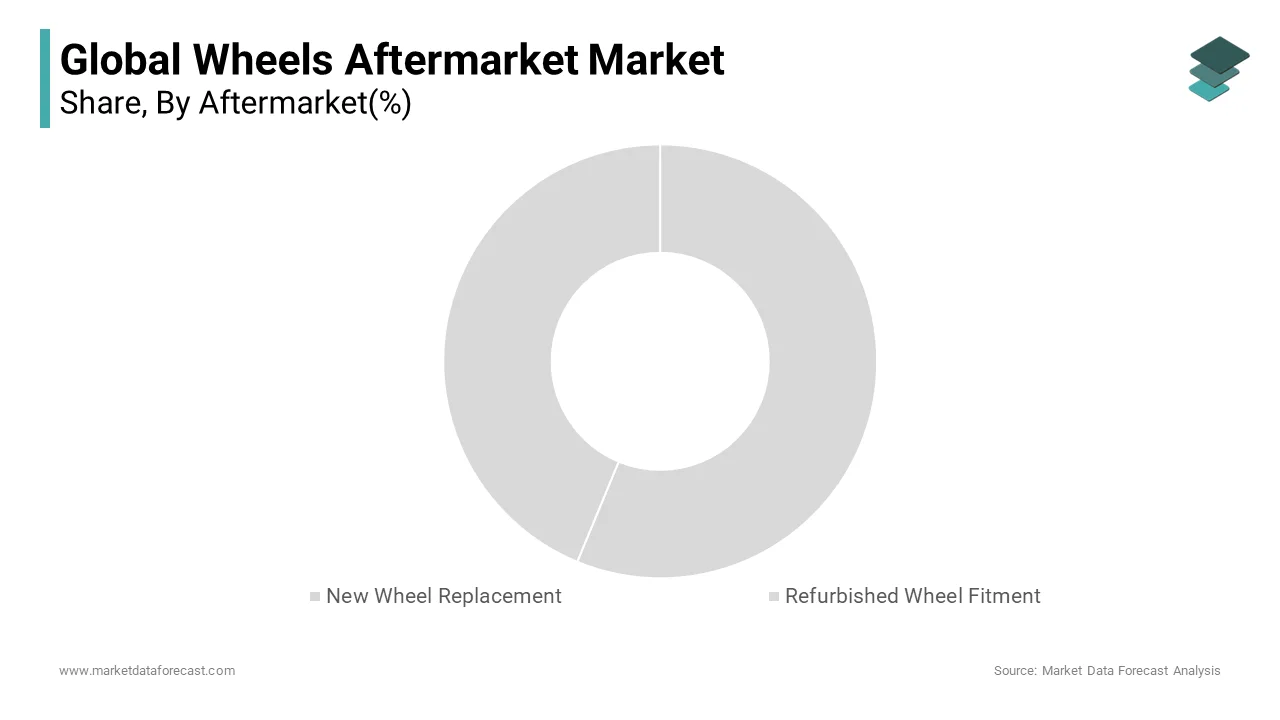
The refurbished wheel fitment segment is predicted to witness the highest CAGR of 9.4% from 2025 to 2033 due to the escalating cost-consciousness among consumers and a growing emphasis on sustainability in automotive maintenance. Refurbishing a wheel consumes less energy than manufacturing a new one, aligning with tightening environmental regulations across the EU. Apart from these, technological advancements in precision machining and powder coating have elevated the quality and durability of refurbished wheels, making them nearly indistinguishable from new units.
By Vehicle (PC, CV) Insights
The passenger car (PC) segment was the largest by accounting for a substantial share in 2025. The growth of the passenger car (PC) segment is attributed to the sheer volume of passenger vehicles in circulation and the strong cultural affinity for personalization in this category. As per the U.S. Department of Transportation, there were a number of registered light-duty vehicles in the United States, each representing a potential candidate for wheel upgrades or replacements. Moreover, the integration of larger, stylized wheels in new vehicle designs has created a cascading effect in the aftermarket, where owners of older models seek to emulate contemporary aesthetics.
The commercial vehicle (CV) segment is estimated to register a CAGR of 24.1% over the forecast period, owing to the expansion of e-commerce logistics and last-mile delivery networks, which have dramatically increased fleet utilization and wear rates. According to the research, global parcel delivery volumes surged, necessitating a larger and more intensively operated fleet of light and medium-duty commercial vans. These vehicles endure significantly higher mileage and road stress, leading to accelerated wheel degradation. As per a study, the average delivery van in urban environments sustains wheel damage at a rate higher than passenger vehicles due to constant stop-start driving and kerb impacts.
By Rim Size Insights
The 16-18 inch rim size segment led the wheels aftermarket by accounting for 52.8% share in 2025. The growth of the 16-18 inch rim size segment is driven by its broad compatibility with the majority of modern passenger vehicles, particularly compact SUVs, sedans, and crossover utility vehicles. As per research, a portion of new vehicles produced were equipped with 17- or 18-inch wheels as standard fitment, establishing this range as the industry baseline. The widespread adoption of this size ensures ample availability of replacement options and reduces fitment complexity for consumers and installers alike. Apart from these, the balance between performance, ride comfort, and cost makes this segment highly attractive.
The 19-21 inch rim size segment is anticipated to witness the fastest CAGR of 10.3% from 2025 to 2033. The growth of the 19-21 inch rim size segment can be attributed to the premiumization of mainstream vehicle segments and the rising popularity of performance SUVs and electric vehicles. Moreover, social media and automotive influencer culture have amplified the visual appeal of large-diameter wheels, with Instagram posts featuring 20-inch rims generating more engagement than those with smaller sizes, according to a study. Aftermarket manufacturers like Forgestar and Vossen have capitalized on this trend by offering flow-formed and forged options that maintain structural integrity at larger diameters, which enables safe and stylish upgrades.
REGIONAL ANALYSIS
North America Wheels Aftermarket Market Analysis
North America was the top performer in the global wheels aftermarket in 2025 and accounted for 34.1% of the global market share in 2025. The domination of North America in the global market is driven by a deeply ingrained car culture that prioritizes personalization, performance, and aesthetic distinction. According to the study, American consumers spent a notable amount on vehicle customization, with wheels and tires constituting a portion of total expenditure. The high average vehicle age fuels replacement demand, while the popularity of truck and SUV modifications drives premium wheel adoption. States like California and Texas host the highest concentration of specialty wheel retailers. The integration of e-commerce platforms with VIN-specific configurators has further streamlined access, which strengthens North America’s position in the global wheels aftermarket.
Europe Wheels Aftermarket Market Analysis
The growth of the European market is likely to be driven by its emphasis on engineering precision, regulatory compliance, and sustainability. The region’s stringent safety standards, particularly under EU Regulation 2018/858, have elevated consumer expectations for certified, high-performance wheels. Germany, the UK, and Italy lead in both demand and manufacturing, with German engineering firms like BBS and Schroeder dominating the premium forged wheel segment. According to the research, a portion of vehicle owners in Western Europe have upgraded their wheels within five years of purchase, driven by the popularity of sport-tuned suspensions and staggered fitments. Additionally, the EU’s Circular Economy Action Plan has spurred interest in refurbished and recyclable wheel systems.
Asia-Pacific Wheels Aftermarket Market Analysis
Asia Pacific is expected to pose steady growth opportunities in the Asia Pacific cocktail market during the forecast period due to its vast economic and cultural diversity. Japan and South Korea lead in technological innovation, with companies like Rays Engineering setting global benchmarks for forged magnesium wheels. Meanwhile, India and Indonesia are witnessing rapid growth in entry-level alloy wheel adoption, fueled by rising middle-class vehicle ownership. In India, passenger vehicle registrations increased, with a portion of new buyers opting for alloy wheels as factory extras. This trend is mirrored in the aftermarket, where affordable Chinese-manufactured wheels dominate price-sensitive markets.
Latin America Wheels Aftermarket Market Analysis
Latin America's aftermarket growth is likely to grow with its resilient, informal distribution network and strong regional preferences for aesthetic upgrades. Brazil and Mexico are the primary hubs, where vehicle modification is a cultural staple, especially in urban centers like São Paulo and Mexico City. As per the study, the number of vehicles in the country is over ten years old, creating consistent demand for replacement and styling components. The popularity of rebaixados (lowered vehicles with large wheels) has driven demand for 18- and 19-inch rims, often imported from Asia. However, economic volatility and import tariffs constrain growth.
MEA Wheels Aftermarket Market Analysis
Middle East & Africa wheels aftermarket growth is likely to grow with the extreme climate conditions, and a preference for large SUVs and luxury sedans shapes consumer behavior. Sand and high temperatures accelerate tire and wheel wear, which increases replacement frequency. In South Africa, the demand is more utilitarian.
KEY MARKET PLAYERS
A few of the major players in the global wheels aftermarket market include
- Maxion Wheels
- Ronal Group
- Borbet Gmbh
- Enkei Corporation
- Superior Industries
- Howmet Aerospace
- The Carlstar Group
- CM Wheels
- Central Motor Wheel Of America
- Accuride Corporation
Top Players in the Market
Enkei Corporation
Enkei Corporation, headquartered in Japan, is a globally recognized innovator in lightweight alloy wheel technology and a pivotal player in the Asia Pacific aftermarket landscape. The company leverages its proprietary MAT (Multi-Stage Air Transfer) forging process to produce high-strength, fuel-efficient wheels widely adopted in performance and OEM-replacement segments. In recent years, Enkei has intensified its collaboration with Japanese and Korean tuning brands to expand its presence in the enthusiast market. Enkei also strengthened distribution partnerships in India and Australia, while sponsoring motorsport events such as the D1 Grand Prix to reinforce brand visibility. Its focus on R&D and regional customization has strengthened its reputation as a technology-forward brand trusted by performance drivers and OEMs alike.
Rays Engineering Co., Ltd.
Rays Engineering, a Japanese high-performance wheel manufacturer, holds a prestigious position in the premium segment of the Asia Pacific aftermarket, renowned for its forged alloy wheels used in motorsports and high-end vehicle builds. The company’s flagship brands, Volk Racing and TE37, are considered benchmarks for strength-to-weight ratio and design innovation. The company also deepened its collaboration with tuning houses like Liberty Walk and Nismo, aligning its product releases with popular vehicle modification trends.
Alcoa Wheel and Transportation Products (Howmet Aerospace Inc.)
Alcoa, now operating under Howmet Aerospace Inc., is a leading provider of forged aluminum wheels in the commercial and premium passenger vehicle segments across the Asia Pacific. Known for their durability and weight efficiency, Alcoa wheels are increasingly adopted in fleet operations and luxury SUV modifications in Australia, India, and the Middle East. The company has focused on expanding its service network in emerging markets, launching certified wheel care centers in Sydney, Mumbai, and Dubai to support maintenance and warranty services. Apart from these, the company has partnered with logistics firms in Singapore and South Korea to promote fuel-efficient wheel solutions for commercial fleets, which supports its value proposition in both durability and operational economy.
Top Strategies Used By Key Market Participants
Key players in the wheels aftermarket deploy a range of strategic initiatives to consolidate their market presence and respond to evolving consumer and technological demands. Product differentiation through advanced materials such as forged aluminum and flow-formed alloys is a dominant strategy, enabling brands to target performance and luxury segments. Companies are increasingly investing in regional customization and designing fitments tailored to popular local vehicle models in markets like India, Thailand, and Australia. Strategic partnerships with tuning shops, motorsports teams, and automotive influencers enhance brand credibility and visibility.
COMPETITION OVERVIEW
The competition in the wheels aftermarket is marked by a blend of technological innovation, brand prestige, and regional adaptability. While global manufacturers dominate the premium and performance segments, regional players and low-cost producers exert significant pressure in price-sensitive markets, particularly in South Asia and Latin America. Differentiation is achieved through material engineering, design exclusivity, and motorsport associations, with brands like Rays and BBS leveraging racing heritage to command loyalty. The rise of electric and high-torque vehicles has intensified R&D competition, pushing companies to develop lighter, stronger wheels capable of withstanding new performance demands. E-commerce platforms and direct-to-consumer models are reshaping distribution, enabling niche brands to compete with established names. Regulatory compliance, counterfeit challenges, and supply chain resilience further define competitive dynamics that require continuous investment in quality assurance and customer trust.
MARKET SEGMENTATION
This research report on the global automotive wheels market is segmented and sub-segmented into the following categories.
By Vehicle Type
- Passenger Cars
- Commercial Vehicles
By Aftermarket Type
- New Wheel Replacement
- Refurbished Wheel Fitment
By Material Type
- Alloy
- Steel
- Others (Carbon Fiber, Nickel)
By Coating Type
- Liquid Coating
- Powdered Coating
By Product Type
- Regular Wheels
- High-Performance Wheels
By Distribution Channel
- Retail
- Wholesalers and Distributors
By Rim Size
- 13”–15” inch
- 16”–18” inch
- 19”–21” inch
- Above 21” inch
By Region
- North America
- Europe
- Asia Pacific
- Latin America
- Middle East and Africa