- Product Description Description
- Table of Contents TOC
- List of Table & Figure LOT
- Get Free Sample PDF Sample PDF
Market Size, 2025
$1.40 BnMarket Estimate, 2026
$1.52 BnMarket Forecast, 2034
$2.87 BnCAGR, 2026–2034
8.29%Middle East and Africa Forage Seed Market Size, Growth, Trends & Forecast (2026–2034)
The Middle East and African forage seed market size was valued at USD 1.40 billion in 2025, stands at USD 1.52 billion in 2026, and is anticipated to reach USD 2.87 billion by 2034, registering a compound annual growth rate (CAGR) of 8.29% during the forecast period from 2026 to 2034. The market expansion is primarily driven by rapid urbanization, increasing per capita incomes, surging consumption of dairy and meat products, and a critical shift toward intensive animal husbandry amidst shrinking grazing lands.
Key Executive Metrics (At-a-Glance)
- 2025 Base Valuation: USD 1.40 Billion
- 2026 Current Valuation: USD 1.52 Billion
- 2034 Forecast Valuation: USD 2.87 Billion
- Compound Annual Growth Rate (CAGR): 8.29% (2026–2034)
- Dominant Livestock Segment: Poultry (holding the largest share driven by soaring regional demand for poultry meat and eggs)
- Fastest-Growing Livestock Segment: Cattle & Aquaculture (scaling rapidly via commercial feedlot expansions and structured dairy initiatives)
- Dominant Plant Type Segment: Alfalfa (capturing a major share due to high nutritional yields and nitrogen-fixing traits)
- Fastest-Growing Plant Type Segment: Ryegrass & Alternative Grasses (expanding quickly for climate resilience and fast biomass accumulation)
- Dominant Country Market: Kingdom of Saudi Arabia (KSA) & South Africa (leading regional revenue contributions)
- Fastest-Growing Country Market: UAE & Ethiopia (supported by government agricultural investments and intensive feed programs)
Core Market Drivers
- Livestock Sector Transformation: Surging demand for animal protein pushing commercial producers to adopt high-performance forage crops to optimize livestock productivity.
- Resource Scarcity Pressures: Shrinking traditional grazing areas and water scarcity problems shifting focus toward managed, high-yield forage cultivation and crop rotation.
Primary Market Restraints & Challenges
- High Seed Costs: Premium prices associated with quality-certified imported forage seeds limiting rapid adoption among smallholder farmers.
- Knowledge Gaps & Logistics: Limited local distribution networks and technical awareness regarding specialized forage management systems.
Middle East and Africa Forage Seed Market Segmentation Breakdown
| Segment Category | Largest (Dominant) Sub-Segment | Fastest-Growing Sub-Segment |
|---|---|---|
| By Livestock | Poultry | Cattle & Aquaculture |
| By Plant Type | Alfalfa | Ryegrass |
| By Country | KSA & South Africa | UAE & Ethiopia |
Major Industry Players Profiled
Key agricultural corporations and seed suppliers dominating the Middle East and Africa market include Hancock Farm & Seed Co., Golden Acre Seeds, Dynamic Seeds Ltd., Northstar Seed Ltd., Brett Young, Moore Seed Processors, Foster’s Seed and Feed, Allied Seed, LLC, BASF SE, and Dow AgroSciences LLC.
Middle East and Africa Forage Seed Market Size
The Middle East and African forage seed market was valued at USD 1.40 billion in 2025 and is anticipated to reach USD 1.52 billion in 2026 to reach USD 2.87 billion by 2034, growing at a CAGR of 8.29% from 2026 to 2034.
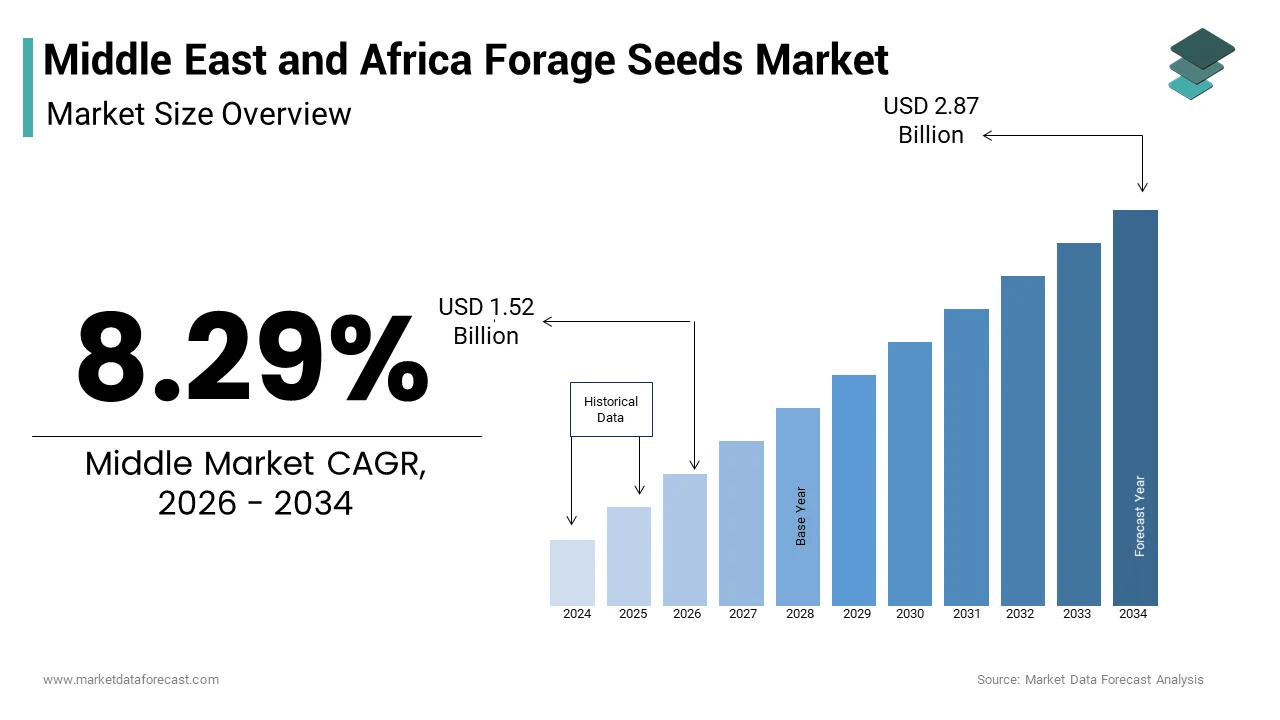
Forage seeds are used for feeding livestock, including poultry, cattle, swine, and aquaculture animals. Farmers prefer to use forage seeds for feeding purposes as cultivation of these seeds generates some economic benefits, such as crop rotation, risk diversification, improved soil structure, and prevention of soil erosion.
The major drivers for the market are a steady increase in population, emerging per capita income, increased demand for dairy and animal products, low productivity of cattle, increased demand for cattle feed, government subsidies, and the shrinkage of land for grazing animals. The livestock sector in the Middle East and Africa is undergoing a major transformation. Rapidly increasing populations, increases in per capita income, and, especially, increases in urbanization are driving the forage seed market. Although the quality potential of the forage seed is quite high, the cost is higher, which restricts the market growth.
REPORT COVERAGE
| REPORT METRIC | DETAILS |
| Market Size Available | 2025 to 2034 |
| Base Year | 2025 |
| Forecast Period | 2026 to 2034 |
| CAGR | 8.29% |
| Segments Covered | By livestock, Plant Type, Region. |
| Various Analyses Covered | Global, Regional & Country Level Analysis, Segment-Level Analysis, DROC, PESTLE Analysis, Porter’s Five Forces Analysis, Competitive Landscape, Analyst Overview on Investment Opportunities |
| Regions Covered | KSA, UAE, Israel, South Africa, Ethiopia, Kenya, Egypt, Sudan, Rest of GCC Countries, and Rest of MEA |
| Market Leaders Profiled | Hancock Farm & Seed Co., Golden Acre Seeds, Dynamic Seeds Ltd., Northstar Seed Ltd., Brett Young, Moore Seed Processors, Foster’s Seed and Feed, Allied Seed, LLC, BASF SE, and Dow AgroSciences LLC. |
SEGMENT ANALYSIS
By Livestock Insights
The poultry segment holds the largest share in the market, and poultry farms are concentrating on quality seeds for better productivity as the demand for meat and eggs is increasing.
KEY MARKET PLAYERS
Some of the dominating Players in the Middle East and African market are
- Hancock Farm & Seed Co.
- Golden Acre Seeds
- Dynamic Seeds Ltd.
- Northstar Seed Ltd.
- Brett Young
- Moore Seed Processors
- Foster’s Seed and Feed
- Allied Seed
- LLC
- BASF SE
- Dow AgroSciences LLC.
MARKET SEGMENTATION
This research report on the Middle East and Africa forage seed market is segmented and sub-segmented into the following categories.
By Livestock
- Namely
- Cattle
- Swine/Pork
- Poultry
- Others (Including Aquaculture, etc.)
By Plant Type
- Chicory
- Ryegrass
- Clover
- Alfalfa
- Others (Including Lablab, fescue, etc.)
By Country
- KSA
- UAE
- Israel
- rest of the GCC countries
- South Africa
- Ethiopia
- Kenya
- Egypt
- Sudan
- rest of MEA