- Product Description Description
- Table of Contents TOC
- List of Table & Figure LOT
- Get Free Sample PDF Sample PDF
Market Size, 2025
$701.74 MnMarket Estimate, 2026
$748.76 MnMarket Forecast, 2034
$1257 MnCAGR, 2026–2034
6.7%Executive Summary: Global Agricultural Chelates Market
- Market Scope: Comprehensive global agricultural chelates market analysis covering agent types, application methods, crop types, regional leadership frameworks, and emerging growth drivers.
- Market Valuation: Valued at USD 701.74 million (2025), estimated at USD 748.76 million (2026), and projected to reach USD 1257.93 million by 2034, registering a robust CAGR of 6.7% (2026–2034).
- Primary Growth Drivers: Soil degradation, modern farming practices, and rising demand for chelated iron micronutrients and high-yielding, quality crops. Additional drivers include increasing biofuel (bioethanol and biodiesel) interest prompting food grain production, alongside R&D efforts focused on organic, biodegradable chelates and hydroponics technology adoption.
Key Market Segment Metrics (2026–2034)
| Category | Leading Segment (2025 Position) | Fastest-Growing Segment |
|---|---|---|
| By Type | EDTA (widely used chelating agent, prized for cost efficiency, availability, and heavy metal detoxification) | Organic and biodegradable chelates (driven by environmental concerns and sustainable R&D) |
| By Application | Soil application (expanding steadily as essential soil nutrition to counteract iron and micronutrient deficiencies) | Hydroponics and controlled-environment application methods |
| By Crop Type | Cereals and grains (representing the highest absolute growth and market scale, supported by biofuel demand) | Fruits and vegetables (following cereals with high absolute growth opportunities and horticulture expansion) |
| By Region | Asia-Pacific (largest user and consumer of agricultural chelates globally) | Latin America (with Mexico expected to experience the highest growth driven by the horticulture industry) |
Major Market Players & Market Structure
Market Structure: Highly competitive agrochemical and micronutrient landscape driven by product development of biodegradable formulas, balancing high chelating agent costs with increasing demand for sustainable high-yield agricultural practices.
Key Companies: BASF SE, Haifa Chemicals, Syngenta AG, AkzoNobel N.V., Nufarm Ltd., Deretil Agronutritional, Shandong IRO Chelating Chemicals Co. Ltd., Protex International, Iagro SPA, and Van Iperen International.
Global Agricultural Chelates Market Size
The global agricultural chelates market size was valued at USD 701.74 million in 2025 and is anticipated to reach USD 748.76 million in 2026 to reach USD 1257.93 million by 2034, growing at a CAGR of 6.7% during the forecast period from 2026 to 2034.
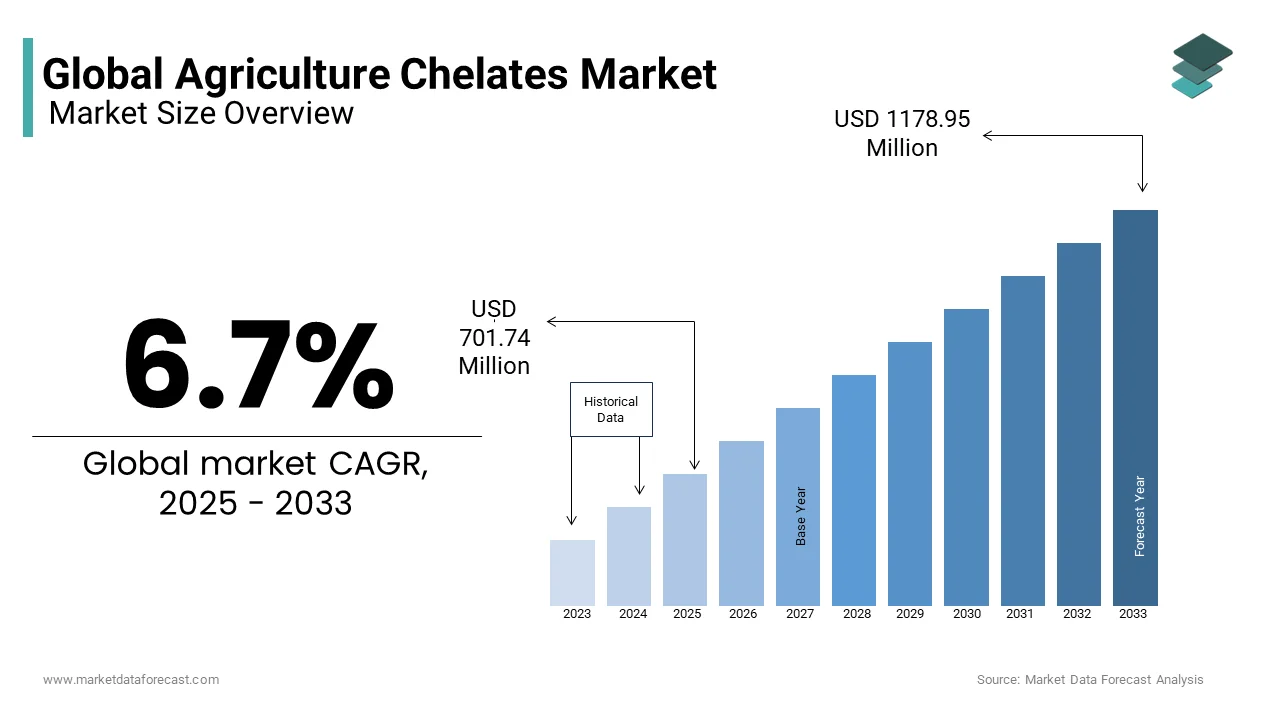
Degradation of soil increased modern farming practices, and demand for chelated iron micronutrients is are key factor driving the market. The high growth potential in emerging markets and untapped regions provides market players with new growth opportunities.
Micronutrients are essential in agriculture to increase yield and enhance the quality of agricultural produce. Though required in very small quantities, these essential elements are consumed by plants to carry out important bodily functions. They are effectively supplied by complexes containing chelated compounds, which are more stable than their non-chelated compounds. The most commonly used chelates are EDTA, DPTA, and EDDHA. Micronutrients such as iron, zinc, copper, manganese, calcium, and magnesium can be chelated easily, while the other nutrients cannot be readily chelated.
MARKET DRIVERS
The driving factor of the market is the increasing demand for high-yielding, quality crops. These chelate compounds also help in removing toxicity due to excess micronutrients and play an important role in helping plants overcome micronutrient deficiency, thereby increasing profits by overcoming agricultural economies. Increasing demand for biofuels is further expected to aid market growth. Rapid depletion of crude oil deposits and rising environmental concerns regarding the harmful effects of petroleum products on the environment are further aiding the research to find a sustainable alternative.
Bioethanol and biodiesel are considered sustainable alternatives. Both of these products are derived from biofuels such as waste vegetable and waste vegetable oils, Therefore, an enlarged interest in biofuels has prompted interest in food grains and crops, which will fuel the demand for agricultural micronutrients. Factors such as the high cost associated with chelating agents and increasing environmental concern over non-biodegradable chelates are major constraints limiting the market growth. However, with the increasing emphasis on research and product development by companies to produce organic and biodegradable chelates, the advantages associated with the increasing adoption of hydroponics technology are boosting the growth of the agricultural chelate market.
REPORT COVERAGE
| REPORT METRIC | DETAILS |
| Market Size Available | 2025 to 2034 |
| Base Year | 2025 |
| Forecast Period | 2026 to 2034 |
| CAGR | 6.7% |
| Segments Covered | By Type, Application, Crop Type, and Region |
| Various Analyses Covered | Global, Regional & Country Level Analysis, Segment-Level Analysis, DROC, PESTLE Analysis, Porter’s Five Forces Analysis, Competitive Landscape, Analyst Overview on Investment Opportunities |
| Regions Covered | North America, Europe, APAC, Latin America, Middle East & Africa |
| Market Leaders Profiled | BASF SE, Haifa Chemicals, Syngenta AG, AkzoNobel N.V., and Nufarm Ltd. |
SEGMENTAL ANALYSIS
By Crop Type Insights
EDTA chelates metal ions, such as calcium ions and ferrous ions, and forms weak bonds with metal nutrients, such as zinc, iron, and copper. EDTA chelates, being comparatively less expensive and easily available, also help to treat harmful lead poisoning in the soil by removing toxins, such as lead, cadmium, and mercury. These factors have further helped the demand for EDTA chelates.
Soil application in the agricultural chelates market is growing as soil nutrition is necessary to increase the productivity of crops. Crops witness a usual deficiency of iron, and therefore, chelated iron micronutrients are applied in the soil to provide the required amount of nutrition for enhanced crop production. Bioethanol and biodiesel are considered the most sustainable alternatives to conventional fuel. Bioethanol is sourced from wheat, soybean, corn, rapeseed, and sugarcane, whereas biodiesel is sourced from Jatropha, sunflower, soybean, mustard, rapeseed, flax, canola, palm oil, hemp, and waste vegetable oils. The absolute growth opportunity is expected to be highest in the cereals segment, followed by fruits and vegetables.
REGIONAL ANALYSIS
Asia-Pacific is the largest user of agricultural chelates. EDTA is the most widely used chelating agent, while organic chelates are gaining increasing importance in the North American agricultural chelates market. With agricultural chelates being widely used in the horticulture industry, the growth of agricultural chelates is expected to be the highest in Mexico.
KEY MARKET PLAYERS
A few of dominating players that are in the global animal agricultural chelates market are
- BASF SE
- Haifa Chemicals,
- Syngenta AG
- AkzoNobel N.V.
- Nufarm Ltd.
- Deretil Agronutritional
- Shandong IRO Chelating Chemicals Co. Ltd.
- Protex International
- lagro SPA
- Van Iperen International
MARKET SEGMENTATION
This research report on the global animal agricultural chelates market is segmented and sub-segmented into the following categories.
By Type
- EDTA
- EDDHA
- DTPA
- IDHA.
By Application
- Soil
- Seed Dressing
- Foliar Sprays
- Hydroponics
By Crop Type
- cereals and grains
- oilseeds and pulses
- fruits and vegetables
By Region
- North America
- Europe
- Asia Pacific
- Latin America
- Middle East and Africa