- Product Description Description
- Table of Contents TOC
- List of Table & Figure LOT
- Get Free Sample PDF Sample PDF
Market Size, 2025
$739.09 MnMarket Estimate, 2026
$788 MnMarket Forecast, 2034
$1,314 MnCAGR, 2026–2034
6.60%Global Anal Cancer Market Size
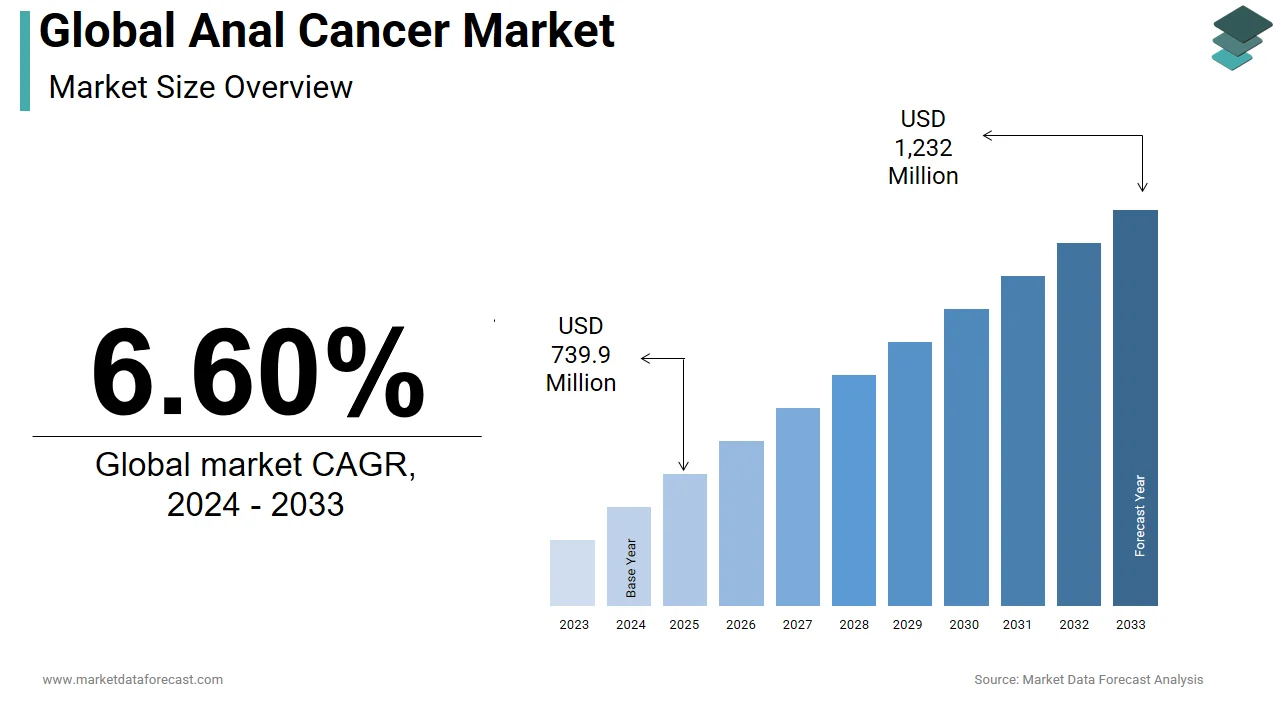
The global anal cancer market was valued at USD 739.09 million in 2025, is estimated to reach USD 788 million in 2026, and is projected to reach USD 1,314 million by 2034, growing at a CAGR of 6.60% from 2026 to 2034.
MARKET DRIVERS
The growing research and development activities are one of the major factors propelling the anal cancer market growth. There are 50,000 cases of anal cancer globally worldwide. The growing R&D efforts help scientists and healthcare professionals to identify underlying causes and mechanisms of anal cancer. This leads to more targeted approaches to prevention, early detection and treatment. These activities contribute to developing improved screening methods and diagnostic tools for anal cancer, allowing for earlier detection and intervention that can lead to better patient outcomes. Therapeutic advancement in anal cancer treatment potentially increases survival rates and improves patients’ quality of life.
The growing incidences of sexually transmitted diseases further fuel the growth rate of the anal cancer market. HPV is the most significant risk factor for developing anal cancer. The majority of the population is at a higher risk of acquiring HPV infection and vaccination against HPV is highly effective in preventing infection with the most common high-risk strain of the virus. The rising incidence of sexually transmitted diseases leads to anal cancer that needs proper treatment and medication and drives the anal cancer market growth.
The growing availability of funds by several public and private sectors propels the market growth. As more funding allows for expanded research initiatives focused on anal cancer, these research efforts explore the disease’s biology and risk factors leading to discoveries and innovation. Funding helps to conduct clinical trials, which are crucial for evaluating the safety and efficiency of new treatments and therapies for anal cancer. Adequate funds can be allocated to develop and implement advanced screening methods and diagnostic tools for early detection of anal cancer; early diagnosis can lead to more successful treatment outcomes, which leads to driving the market growth during the forecast period.
Factors such as the growing number of advancements in therapeutics, clinical trials and rapid advancements in the healthcare and medical sector, growing cases of anal cancer, and rising demand for targeted therapies contribute to the growth rate of the anal cancer market.
MARKET RESTRAINTS
The resistance from patients to expensive treatment primarily hampers the anal cancer market growth. In middle and low-income countries, patients with limited financial resources may face barriers to accessing expensive treatment due to their high costs. This lack of access can result in delayed diagnosis and suboptimal treatment outcomes. Financial concerns lead to some patients discontinuing treatment, potentially reducing survival rate, which hampers the market's growth. Clinical trial failure rate, a high proportion of adverse effects related to treatment and poor awareness in developing nations further restrains the market growth.
REPORT COVERAGE
| REPORT METRIC | DETAILS |
| Market Size Available | 2025 to 2034 |
| Base Year | 2025 |
| Forecast Period | 2026 to 2034 |
| Segments Covered | By Treatment, End-user, and Region. |
| Various Analyses Covered | Global, Regional, and Country-Level Analysis, Segment-Level Analysis, Drivers, Restraints, Opportunities, Challenges; PESTLE Analysis; Porter’s Five Forces Analysis, Competitive Landscape, Analyst Overview of Investment Opportunities |
| Regions Covered | North America, Europe, Asia Pacific, Latin America, Middle East & Africa |
| Market Leaders Profiled | Novartis AG, Sanofi, AstraZeneca Plc, Johnson & Johnson Services, Inc., GlaxoSmithKline Plc, Pfizer Inc., Advaxis Inc., Spectrum Pharmaceuticals, Inc., Merck & Co., Inc. Bayer AG, AbbVie Inc. Hoffmann-La Roche Ltd. CELGENE CORPORATION, Johnson & Johnson Private Limited, Eli Lilly and Company, Atara Biotherapeutics Inc. and Amgen Inc. |
SEGMENT ANALYSIS
By Treatment Type Insights
Based on treatment type, the chemotherapy segment is expected to account for the leading share of the global market during the forecast period. The broad systemic effect of chemotherapy to target cancer cells throughout the body and the growing use of combination chemotherapy regimens to enhance effectiveness majorly drive the growth of the chemotherapy segment. Neoadjuvant chemotherapy to downsize tumors for better surgical outcomes, the growing number of applications of chemotherapy in advanced or metastatic anal cancer cases and the increasing adoption of chemotherapy in palliative care to manage symptoms and enhance quality of life further fuels the growth rate of the segment in the global market.

The immunotherapy segment is another promising segment and is estimated to hold a considerable share of the global market in the coming years. Immunotherapy works by harnessing the body’s immune system to recognize and attack cancer cells, offering a targeted and potentially less toxic approach than radiation therapy. Immunotherapy has demonstrated high efficacy leading to durable responses and long-term survival for patients with certain types of cancer. The potential of immunotherapy for durable responses and long-term survival in some patients, growing usage of immunotherapy in cases with limited response to other treatments, ongoing research and clinical trials exploring new immunotherapeutic agents and shift towards personalized medicine and precision therapies drive the growth of the immunotherapy segment in the global market.
By End-User Insights
Based on end-users, the hospital and clinic segment is anticipated to account for the major share of the global market during the forecast period. Hospitals and clinics have the proper infrastructure and equipment for chemotherapy and immunotherapy. Furthermore, they have the ease of getting all facilities under one roof. The availability of advanced diagnostic tools and treatment modalities, multidisciplinary approach for comprehensive patient care and centralization of specialized medical expertise for optimal management primarily propel the growth of the hospitals and clinics segment worldwide.
The pharmacies segment is anticipated to account for a substantial global market share during the forecast period. Due to emerging digital tools and technology, online pharmacies are booming faster. These pharmacies are responsible for dispensing medication for anal cancer treatment, ensuring patients can access the prescribed drugs for their therapy. Pharmacists also provide crucial information and knowledge to patients about their medication, including potential side effects, drug interactions, and proper administration, helping patients adhere to their treatment plans and boosting the market growth during the forecast period.
REGIONAL ANALYSIS
North America was the biggest regional segment in the global market in 2024 and is expected to hold the major share of the global market during the forecast period. The growing number of R&D activities around anal cancer in the North American region primarily drives the North American market growth. According to the National Cancer Institute, approximately 77,820 people were diagnosed with anal cancer in the U.S. in 2022. The growing number of product launches, notable market participants, high disposable income, well-developed healthcare infrastructure, favorable reimbursement policies and increasing healthcare spending further propel the North American market growth.

Europe is a prominent regional market and is expected to occupy a considerable share of the worldwide market during the forecast period. The growing prevalence of cancer and increasing aging population driving the demand for cancer therapeutics in clinics, and hospitals, which is one of the major factors driving the European market growth.
The APAC region is expected to register the fastest CAGR during the forecast period. Factors such as the growing prevalence of anal cancer among the younger generations, larger patient population with STDs, increasing number of product launches, emerging support from the governments of APAC countries and an increasing number of improvements in healthcare infrastructure drive the APAC market growth.
The Latin American region is predicted to witness a healthy CAGR in the coming years owing to the growing awareness and early detection, technological advancements and increasing initiatives from the governments of Latin American countries to propel the growth of the Latin American market. The Middle East and Africa market is predicted to showcase a moderate CAGR during the forecast period.
KEY MARKET PLAYERS
Some of the companies that are playing a dominating role in the global anal cancer market include
- Novartis AG
- Sanofi
- AstraZeneca Plc
- Johnson & Johnson Services, Inc.
- GlaxoSmithKline Plc
- Pfizer Inc.
- Advaxis Inc.
- Spectrum Pharmaceuticals, Inc.
- Merck & Co., Inc.
- Bayer AG
- AbbVie Inc.
- F. Hoffmann-La Roche Ltd.
- Celgene Corporation
- Johnson & Johnson Private Limited
- Eli Lilly and Company
- Atara Biotherapeutics Inc.
- Amgen Inc.
GLOBAL ANAL CANCER MARKET NEWS
- In January 2022, Merck Sharp and Dohme raised funding for Pembrolizumab monotherapy. This is a possible treatment option with a favorable benefit–risk ratio for patients with previously treated advanced anal squamous cell carcinoma who have no alternative satisfactory treatment options.
- In November 2021, Pfizer acquired Trillium Therapeutics for approximately USD 2.22 billion to boost its oncology portfolio by adding next-generation immune therapies.
- In June 2021, Bristol Myers Squibb received European Commission approval for Opdivo plus Yervoy to treat patients of cancer and it has received marketing authorizes across the European regions.
MARKET SEGMENTATION
This research report on the global anal cancer market has been segmented and sub-segmented based on the treatment, end-user, and region.
By Treatment Type
- Radiation Therapy
- Surgery
- Chemotherapy
- Immunotherapy
By End-User
- Research & Academic Institutes
- Long-term Care Centers
- Hospitals & Clinics
- Pharmacies
By Region
- North America
- Europe
- Asia-Pacific
- Latin America
- Middle East and Africa