- Product Description Description
- Table of Contents TOC
- List of Table & Figure LOT
- Get Free Sample PDF Sample PDF
Market Size, 2025
$5.61 BnMarket Estimate, 2026
$5.96 BnMarket Forecast, 2034
$9.72 BnCAGR, 2026–2034
6.30%Global Anti-Microbial Additives Market Size, Growth, Trends & Forecast (2026–2034)
The Global Anti-Microbial Additives Market was valued at USD 5.61 billion in 2025, is anticipated to reach USD 5.96 billion in 2026, and is projected to expand up to USD 9.72 billion by 2034, registering a compound annual growth rate (CAGR) of 6.30% during the forecast period from 2026 to 2034. Market growth is primarily driven by expanding healthcare infrastructure, rising urbanization, and surging demand for protected materials in the packaging and building sectors.
Key Executive Metrics (At-a-Glance)
- 2025 Base Valuation: USD 5.61 Billion
- 2026 Current Valuation: USD 5.96 Billion
- 2034 Forecast Valuation: USD 9.72 Billion
- Compound Annual Growth Rate (CAGR): 6.30% (2026–2034)
- Dominant End-User/Type Segment: Silver-based / Inorganic Additives (accounting for the highest market revenue and ongoing deployment)
- Dominant Region: Asia-Pacific (holding over 30% of the total global market share)
Core Market Drivers
- Healthcare & Packaging Growth: Escalating demand across China, India, Japan, and South Korea fueled by aging populations and lifestyle disease management.
- Favorable Material Traits: Exceptional non-toxicity, high thermal stability, and eco-friendliness characteristic of silver-based antimicrobial solutions.
Primary Market Restraints & Challenges
- High Raw Material Costs: Premium pricing models for silver, copper, and zinc inputs restricting rapid integration in emerging regions.
- Regulatory Constraints: Strict safety and environmental evaluations limiting swift commercialization.
Global Anti-Microbial Additives Market Segmentation Breakdown
| Segment Category | Key Sub-Segments & Highlights |
|---|---|
| By Application | Plastics, Paint and Coating, Pulp and Paper |
| By End-User | Healthcare, Packaging, Food and Beverages, Construction |
| By Region | North America, Europe, Asia-Pacific (Dominant), Latin America, Middle East and Africa |
Major Industry Players Profiled
Key corporations steering the global anti-microbial additives market include BASF SE, The Dow Chemical Company, Clariant AG, A. Schulman, Inc., PolyOne Corporation, Sanitized AG, Microban International, BioCote Limited, King Plastic Corporation, and Steritouch Ltd.
 Download Free Sample Report
Global Anti Microbial Additives Market Size
The global anti-microbial additives market size was valued at USD 5.61 billion in 2025 and is anticipated to reach USD 5.96 billion in 2026 to reach USD 9.72 billion by 2034, growing at a CAGR of 6.30% during the forecast period from 2026 to 2034.
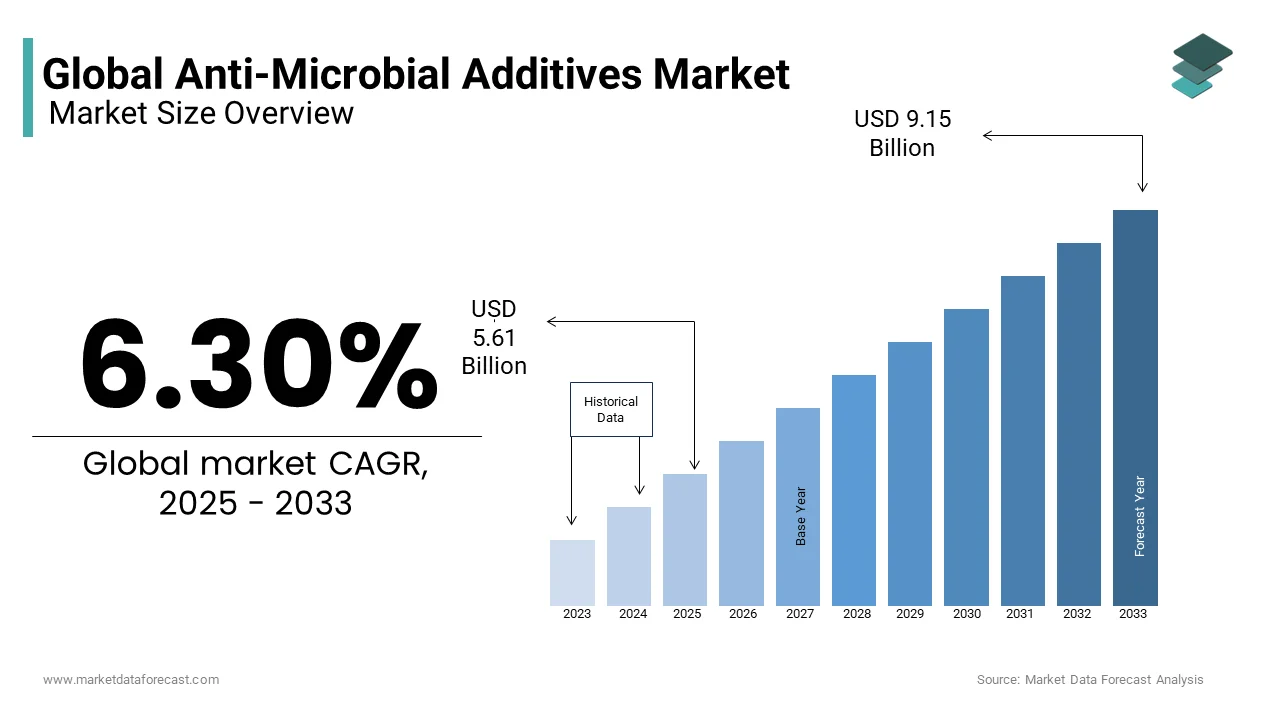
The market is showcasing evident potential in the mentioned forecasting period. Antimicrobial additives control microbes via many different means and are extremely diverse. When used in the manufacturing of products they create surfaces and materials inhospitable to microbes such as bacteria and mold. The properties of silver are non-toxicity, high thermal stability, and environmental friendliness which boost the global anti-microbial additives market. Antimicrobial additives are chemical ingredients that prevent bacterial, fungal, and algal growth in materials that are exposed to high levels of ultraviolet radiation, moisture, and unsanitary conditions. These additives are primarily used in applications such as plastics, papers, paints & coatings, textiles, inks, rubber, and fabric care to inhibit the growth of unwanted microorganisms and increase the longevity of the substrate.
MARKET DRIVERS AND RESTRAINTS
The antimicrobial additives market is driven by the rapid growth of the healthcare and packaging industries in the Asia-Pacific region. In recent times, China, India, Japan, and South Korea have observed a high demand for antimicrobial additives, mainly due to the growing urbanization, aging population, and increasing lifestyle diseases. This is fuelling the growth of the antimicrobial additives market in this region. Properties like non-toxicity, environmental friendliness, flammability, sustainability, and high thermal stability of silver antimicrobial additives contribute to the growth of the antimicrobial additives market.
The major factor restraining the growth of the antimicrobial additives market is the high cost o0f raw materials and stringent regulations. The basic raw materials used in the manufacturing of antimicrobial additives products are silver, copper, and zinc. The high price of silver antimicrobials restricts their use in various products, particularly in the developing regions of Asia-Pacific and South America. These issues restrain the growth of the Anti-Microbial Additives Market. The Anti-Microbial additives market is broadly categorized into the Inorganic Anti-Microbial additives market (Silver, Copper, and Zinc) and the organic Anti-Microbial Additives Market (OBPA, DCOIT).
REPORT COVERAGE
| REPORT METRIC | DETAILS |
| Market Size Available | 2025 to 2034 |
| Base Year | 2025 |
| Forecast Period | 2026 to 2034 |
| CAGR | 6.30% |
| Segments Covered | By Application, End-User, And Region |
| Various Analyses Covered | Global, Regional & Country Level Analysis, Segment-Level Analysis, DROC, PESTLE Analysis, Porter’s Five Forces Analysis, Competitive Landscape, Analyst Overview on Investment Opportunities |
| Regions Covered | North America, Europe, APAC, Latin America, Middle East & Africa |
| Market Leaders Profiled | BASF SE, The Dow Chemical Company, Clariant AG, A. Schulman, Inc., Polyone Corporation, Sanitized AG, Microban International, Biocote Limited, King Plastic Corporation, and Steritouch Ltd. |
SEGMENT ANALYSIS
By End-User Insights
Silver-based antimicrobial additives accounted for the highest revenue of the overall market and are projected to witness a high growth rate during the forecast period.
REGIONAL ANALYSIS
The anti-microbial additives market was dominated by Asia-Pacific, with an overall market share of over 30% globally. Asia-Pacific was followed by North America and Europe. Asia Pacific is predicted to grow at a rapid pace in the coming few years.
KEY MARKET PLAYERS
Some of the major companies dominating the Anti-Microbial Additives Market by their products and services, include
- BASF SE
- The Dow Chemical Company
- Clariant AG
- A. Schulman, Inc.
- PolyOne Corporation
- Sanitized AG
- Microban International
- Biocote Limited
- King Plastic Corporation
- Steritouch Ltd.
MARKET SEGMENTATION
This research report on the global anti-microbial additives market is segmented and sub-segmented into the following categories.
By Application
- Plastics
- Paint and Coating
- Pulp and Paper
By End-User
- Healthcare
- Packaging
- Food and Beverages
- Construction
By Region
- North America
- Europe
- Asia-Pacific
- Latin America
- Middle East And Africa