- Product Description Description
- Table of Contents TOC
- List of Table & Figure LOT
- Get Free Sample PDF Sample PDF
Market Size, 2025
$3.60 BnMarket Estimate, 2026
$3.95 BnMarket Forecast, 2034
$8.34 BnCAGR, 2026–2034
9.78%Executive Summary: Asia Pacific Molecular Diagnostics Market
- Market Scope: Comprehensive market analysis of the Asia Pacific (APAC) molecular diagnostics ecosystem, evaluating product and service segments, technology platforms, laboratory end-user types, and country-level growth dynamics.
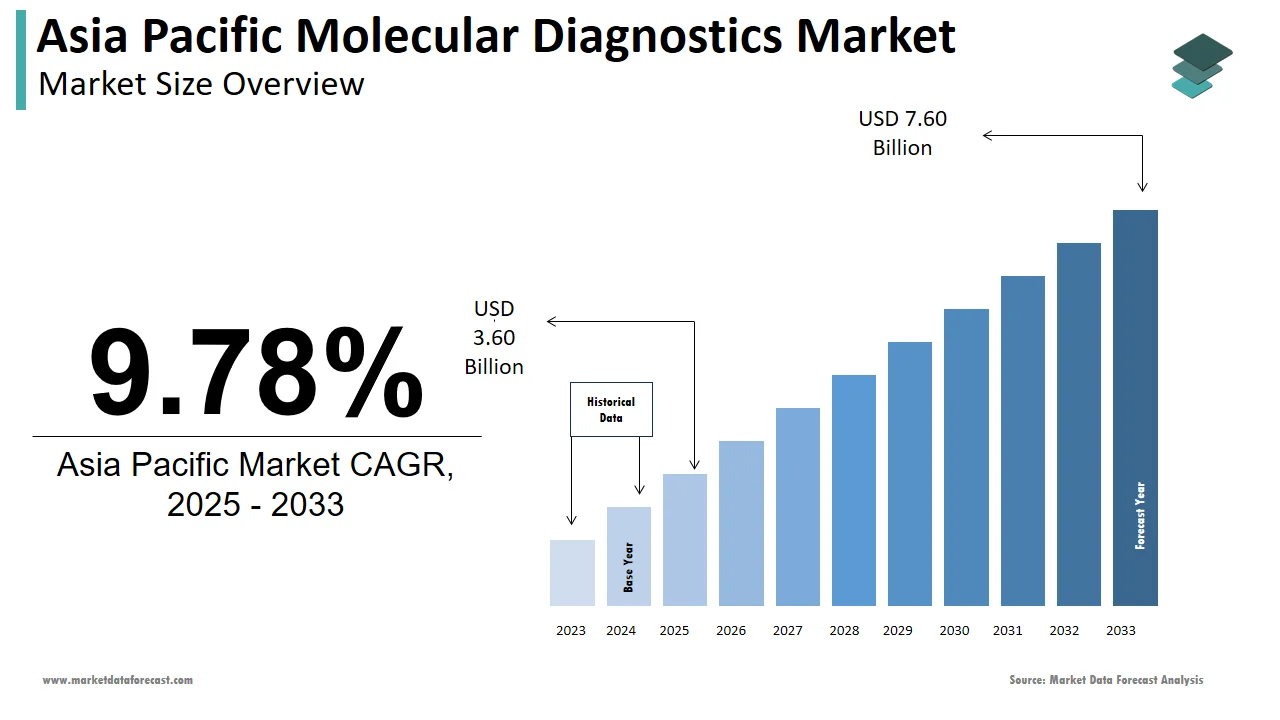
- Market Valuation: Valued at USD 3.60 billion (2025), estimated at USD 3.95 billion (2026), and projected to reach USD 8.34 billion by 2034, registering a strong CAGR of 9.78% (2026–2034).
- Primary Growth Drivers: Escalating prevalence of cancers and chronic diseases (diabetes, cardiovascular conditions), a rapidly expanding aging demographic across APAC, growth in biomarker identification, and rising adoption of personalized medicine and companion diagnostics.
Key Market Segment Metrics (2026–2034)
| Category | Leading Segment (2025 Position) | Fastest-Growing Segment (2026–2034) |
|---|---|---|
| By Products and Services | Reagents and Kits (dominate annual market consumption due to high-frequency usage in testing workflows) | Software and Services (growing rapidly alongside digital pathology, data analytics, and automated lab integration) |
| By Technology | Polymerase Chain Reaction (PCR) (holds the largest market share backed by gold-standard infectious disease and oncology testing) | DNA Sequencing and Next-Generation Sequencing (NGS) (expanding exponentially through precision oncology and genetic profiling) |
| By End-User | Hospital and Academic Laboratories (command the largest volume of clinical molecular diagnostic procedures) | Reference Laboratories (experiencing high growth driven by centralized high-throughput testing capabilities) |
| By Country / Region | China (accounted for the largest regional share driven by a massive aging population, tech innovation, and government support) | India (projecting significant growth spikes through rising government health initiatives and increasing molecular procedure adoption) |
Major Market Players & Market Structure
Market Structure: A highly competitive and innovation-driven global biotechnology and in-vitro diagnostics (IVD) marketplace featuring leading multinational corporations scaling advanced molecular testing portfolios across Asian healthcare systems.
Key Companies: Abbott Laboratories, Agilent Technologies, Becton, Dickinson and Company (BD), bioMérieux SA, Danaher Corporation, DiaSorin, Grifols, Hologic, Illumina, Qiagen, Roche Diagnostics, Siemens Healthineers, and Thermo Fisher Scientific.
 Download Free Sample Report
Asia Pacific Molecular Diagnostics Market Size
The size of the Asia Pacific molecular diagnostics market was valued at USD 3.60 billion in 2025. This market is expected to grow at a CAGR of 9.78% from 2026 to 2034 and be worth USD 8.34 billion by 2034 from USD 3.95 billion in 2026.
Molecular diagnostics is a dynamic field of medical testing that analyses biomarkers in an individual's genetic code (DNA and RNA) or proteins to detect, diagnose, and monitor diseases. Unlike traditional laboratory medicine that identifies symptoms or changes at the cellular or tissue level, molecular diagnostics uncovers the specific underlying molecular causes of a condition. According to the World Health Organisation (WHO), the South-East Asia Region faces a heavy burden of infectious diseases like tuberculosis, prompting a regional commitment to expand the use of WHO-recommended rapid diagnostics, including molecular diagnostics, to ensure early and complete detection. As per studies, noncommunicable diseases and infectious outbreaks impose a major health burden in South-East Asia, driving regional roadmaps to improve access to essential medical devices and in vitro diagnostics. This epidemiological shift has catalysed extensive government funding toward precision medicine frameworks and genomic surveillance infrastructure. Consequently, regional clinical laboratories are aggressively upgrading from conventional immunoassay techniques to high-throughput polymerase chain reaction and next-generation sequencing platforms.
MARKET DRIVERS
Surging Prevalence of Infectious and Chronic Pathogens
The escalating regional burden of infectious outbreaks and chronic oncological disorders is driving unprecedented clinical demand for high-sensitivity nucleic acid testing technologies, which fuels the growth of the Asia Pacific molecular diagnostics market. According to the International Agency for Research on Cancer, new cancer diagnoses across Asia are projected to reach 15.1 million cases per year until 2040, creating an intense medical necessity for molecular biomarker profiling to guide targeted therapies. This epidemiological pressure is compounded by persistent vulnerability to respiratory and viral pathogens across densely populated sub-regions. According to sources, infectious diseases continue to pose a significant public health burden as a primary cause of outpatient morbidity and clinical visits in developing Asia Pacific countries, highlighting the widespread necessity for rapid diagnostic tools to curb community transmission. These clinical realities compel regional hospitals and specialized reference laboratories to routinely deploy automated polymerase chain reaction assays and genomic kits, directly accelerating commercial adoption rates and sustaining robust market expansion trajectories.
Expansion of Precision Medicine and Genomic Initiatives
Aggressive government-backed healthcare modernization programs and precision medicine frameworks are fundamentally transforming clinical diagnostic protocols across emerging economies, which in turn propels the Asia Pacific molecular diagnostics market. As per PeerJ, precision medicine and large-scale national genomic projects feature planned public and mixed funding investments reaching up to 9.2 billion dollars to establish comprehensive genomic databases and personalized medicine frameworks. This institutional backing directly facilitates the validation and clinical integration of advanced companion diagnostics and tailored therapeutic regimens. According to research, expanding administrative approvals for novel in vitro diagnostic assays and companion diagnostics have significantly streamlined the commercialization pathway for targeted oncology tests. These favorable regulatory environments and strategic funding injections encourage domestic and international medical device manufacturers to deploy cutting-edge sequencing infrastructure throughout major metropolitan research centers and teaching hospitals.
MARKET RESTRAINTS
Stringent and Complex Regulatory Approval Frameworks
Lengthy administrative evaluation procedures and rigorous evidentiary demands are imposed by national health authorities, which restrict the growth of the Asia Pacific molecular diagnostics market. These factors create severe time-to-market barriers for innovative diagnostic assays. According to sources, securing commercial authorization for novel molecular diagnostic systems in various countries frequently requires localized clinical evaluations, resulting in multi-month operational delays before the equipment can be legally distributed. This procedural friction restricts the agility of smaller biotech entrants attempting to scale operations across diverse national borders. As per the Asian Harmonization Working Party, varying statutory classifications for in vitro diagnostic products among regional countries prevent manufacturers from leveraging unified cross-border approval strategies. Consequently, diagnostic companies must allocate disproportionate capital resources toward localized compliance documentation and regulatory navigation, which ultimately dampens the commercial release velocity of next-generation testing kits.
High Capital Costs and Infrastructure Deficits
Prohibitive instrumentation expenses and inadequate laboratory infrastructure in secondary cities restrict the widespread clinical deployment of advanced molecular technologies, and thereby slow down the expansion of the Asia Pacific molecular diagnostics market. As per research, developing healthcare networks encounter intense budget and infrastructure constraints that can restrict public facilities from freely acquiring high-throughput laboratory equipment. This financial hurdle is further exacerbated by acute shortages of specialized laboratory technicians capable of operating complex molecular machinery. According to studies, clinical laboratories in developing healthcare systems often face significant human resource deficits due to a lack of specialized pathology personnel trained in advanced diagnostic platforms. These severe equipment and talent deficits concentrate advanced diagnostic capabilities within major metropolitan centres, leaving vast rural patient populations underserved and constraining addressable market growth.
MARKET OPPORTUNITIES
Proliferation of Decentralised Point-of-Care Testing
The rapid technological transition toward portable, cartridge-based diagnostic platforms unlocks vast expansion opportunities across remote and resource-limited clinical settings within the Asia Pacific molecular diagnostics market. According to sources, point-of-care molecular diagnostics are essential in the Asia Pacific region to decentralize infectious disease surveillance and improve patient outcomes where access to centralized laboratory facilities is constrained. This decentralised testing paradigm allows frontline healthcare providers to deliver rapid molecular results outside traditional central laboratories. As per research published by the National Institutes of Health (NIH), deploying point-of-care loop-mediated isothermal amplification (LAMP) and recombinase polymerase amplification (RPA) devices significantly reduces diagnostic processing time, generating actionable results within 10 to 45 minutes in remote or resource-limited settings. This technological decentralization enables immediate therapeutic decision-making for infectious outbreaks, opening lucrative commercial avenues for manufacturers targeting community clinics and ambulatory care centers.
Integration of Artificial Intelligence in Genomic Sequencing
The convergence of artificial intelligence and machine learning algorithms with high-throughput genomic platforms creates transformative avenues for predictive diagnostics and automated variant interpretation, and is anticipated to drive the expansion of the Asia Pacific molecular diagnostics market. According to the National Institutes of Health (NIH), artificial intelligence frameworks integrated into next-generation sequencing pipelines assist oncology laboratories by screening somatic variants, decreasing human analytical errors, and automating tasks to resolve expert curation bottlenecks. These computational tools empower pathologists to decode complex multi-gene panels and liquid biopsy profiles with unprecedented speed and accuracy. As per studies, automated software integration significantly optimizes genomics workflows, enhances tracking traceability, and minimizes human variability or manual errors during large-scale genetic screenings. Thus, software-driven diagnostic solutions represent a high-margin growth vector that attracts substantial venture capital and strategic research partnerships throughout the regional ecosystem.
MARKET CHALLENGES
Reimbursement Deficits for Advanced Genetic Tests
Patients bear a heavy financial burden due to inadequate public health insurance coverage and limited reimbursement frameworks for specialized genomic assays, thereby holding back the growth of the Asia Pacific molecular diagnostics market. As a result, the routine adoption of these diagnostic tests is significantly suppressed. According to a Korean Society of Medical Oncology (KSMO) survey published in Cancer Research and Treatment, public reimbursement for oncology next-generation sequencing (NGS) varies widely in the Asia Pacific region, with full government coverage being uncommon and completely absent in developing lower- and upper-middle–income nations like the Philippines, Indonesia, and India. Consequently, patients must cover the entire cost of complex molecular tests out of pocket, which severely deters utilization among middle- and lower-income demographics. As per research, a substantial percentage of oncology patients recommended for advanced genetic and molecular diagnostics frequently defer or decline testing due to high out-of-pocket costs and a lack of universal insurance or public reimbursement coverage. This systemic reimbursement gap forces diagnostic laboratories to absorb high operational costs or operate at reduced test volumes, discouraging private facilities from adopting state-of-the-art molecular platforms.
Supply Chain Vulnerabilities and Reagent Dependencies
Heavy reliance on imported raw materials, specialised enzymes, and proprietary chemical reagents creates severe operational fragility for domestic molecular diagnostic manufacturers in the Asia Pacific market. Consequently, these supply chain dependencies jeopardize the stability of domestic production. According to studies, regional diagnostic kit producers extensively source critical raw components, including high-purity enzymes and synthetic oligonucleotides, from major international bio-manufacturing suppliers situated across North America and Europe. This overreliance exposes local manufacturing supply lines to sudden geopolitical disruptions, international shipping bottlenecks, and severe currency fluctuation risks. As per sources, global logistical delays and procurement bottlenecks elevate secondary acquisition expenses for essential clinical reagents, occasionally creating operational challenges that disrupt specialized testing menus. This persistent supply chain instability undermines market predictability and compresses operating profit margins for domestic diagnostic enterprises attempting to scale production.
REPORT COVERAGE
| REPORT METRIC | DETAILS |
| Market Size Available | 2025 to 2034 |
| Base Year | 2025 |
| Forecast Period | 2026 to 2034 |
| Segments Covered | By Products and Service, Technology, End-User, and Country. |
| Various Analyses Covered | Global, Regional, and Country-Level Analysis, Segment-Level Analysis, Drivers, Restraints, Opportunities, Challenges; PESTLE Analysis; Porter’s Five Forces Analysis, Competitive Landscape, Analyst Overview of Investment Opportunities |
| Countries Covered | India, China, Japan, South Korea, Australia, New Zealand, Thailand, Malaysia, Vietnam, Philippines, Indonesia, Singapore and Rest of APAC. |
| Market Leaders Profiled | Abbott Laboratories, Agilent Technologies, F. Hoffmann-La Roche Ltd, Becton, Dickinson and Company, Biomérieux SA, Danaher Corporation, Diasorin, Grifols, Hologic, Illumina, Qiagen, Siemens Healthineers, and Thermo Fisher Scientific |
SEGMENTAL ANALYSIS
By Product and Service Insights
The reagents and kits dominated the Asia Pacific molecular diagnostics market and accounted for a 58.3% share in 2025. This dominance of the segment was driven by the continuous and indispensable requirement for these consumables in daily diagnostic workflows. According to the Centers for Disease Control and Prevention (CDC), the ongoing implementation of routine molecular testing and high-throughput screening initiatives relies heavily on a continuous supply of chemical primers, probes, and specialized assay kits to maintain uninterrupted diagnostic capacities. As per the National Institutes of Health (NIH), an escalation of infectious disease testing across public health facilities directly requires frequent inventory management and strategic replenishment cycles for diagnostic kits. This continuous consumption pattern ensures sustained, high-volume revenue generation for manufacturers, effectively cementing the category as the financial cornerstone of the regional market. Furthermore, strict procedural validation protocols mandate the use of proprietary brand-specific reagents, securing long-term customer retention for major life science corporations operating throughout developing and developed Asian economies.
The reagents and kits segment is also likely to experience the fastest CAGR of 13.4% over the forecast period. According to the World Health Organization (WHO), accelerated expansion of laboratory capacity stems from escalating test volumes in both oncology and virology diagnostics across integrated medical networks. As per research, the massive scale-up of decentralized screening programs across densely populated regional territories necessitates constant bulk procurement of standardized testing kits. This insatiable clinical demand for ready-to-use assay consumables enables agile suppliers to capture high-margin recurring revenues, rapidly outpacing the capital equipment and software sectors in overall financial growth velocity.
By Technology Insights
The polymerase chain reaction segment led the Asia Pacific molecular diagnostics market and captured a significant share in 2025. This leading position of the segment was attributed to its gold-standard status in pathogen detection and clinical gene expression analysis. According to sources, quantitative real-time polymerase chain reaction (qRT-PCR) platforms remain the predominant nucleic acid amplification methodology due to their exceptional analytical sensitivity and rapid diagnostic turnaround times. As per the Asian Pacific Society of Respirology, the heavy regional burden of viral and respiratory infections mandates the widespread deployment of automated thermal cyclers in hospital laboratories. This ubiquitous clinical reliance ensures that polymerase chain reaction systems remain the most widely utilized diagnostic mechanism across both primary care facilities and advanced tertiary research centers.
The DNA sequencing and next-generation sequencing segment is expected to exhibit a noteworthy CAGR of 8.4% from 2026 to 2034. According to the National Institutes of Health (NIH), the rapid acceleration of next-generation sequencing infrastructure is driven by falling sequencing costs and the aggressive expansion of precision oncology programs across global medical hubs. According to The Lancet Oncology, next-generation sequencing allows pathologists to decode multi-gene panels simultaneously, enabling personalized therapeutic selection for complex cancer patients. This technological superiority heavily attracts venture capital and government research grants, driving rapid adoption across advanced clinical laboratories in East Asia and Oceania.
By End-User Insights
In 2025, the hospital and academic laboratories segment held the majority share of the Asia Pacific molecular diagnostics market. This supremacy of the segment was supported by its central role in managing high-volume patient diagnostics and complex clinical research. According to the Centers for Disease Control and Prevention (CDC), hospital and independent reference laboratories together perform the largest portion of total diagnostic test volumes due to centralized high-complexity infrastructure and immediate patient care requirements. As per studies by the World Bank, continuous public investments and public-private partnerships in hospital upgrading projects across developing nations support the acquisition of modern laboratory equipment and pathology infrastructure to expand regional diagnostic capacity. This institutional dominance is further reinforced by academic medical centres conducting large-scale genomic studies, which generate consistent demand for advanced molecular testing reagents and instrumentation.
The reference laboratories segment is predicted to witness the highest CAGR of 7.3% during the forecast period. As per research, the clinical practice of outsourcing specialized genetic testing and complex diagnostic assays is utilized by clinical networks to manage cost pressures, overcome technical complexity limits, and access expert interpretation. According to sources, centralized reference laboratories achieve enhanced data consistency, lower analytic variability, and cost efficiencies by consolidating specialized molecular workflows across multi-site networks. This economic advantage fuels rapid corporate expansion, enabling reference networks to penetrate secondary and tertiary healthcare tiers effectively.
COUNTRY-LEVEL ANALYSIS
China Molecular Diagnostics Market Analysis
China was the top performer in the Asia Pacific molecular diagnostics market and accounted for a 42.5% share in 2025. This prominence of the country’s market was driven by massive public healthcare investments and advanced domestic biotechnology manufacturing. According to the National Health Commission of China, expanding national basic medical insurance coverage has significantly increased patient access to advanced medical treatments and reimbursed oncology drugs, thereby promoting health equity across the general population. As per sources, government-led laboratory networks, such as the Chinese Pathogen Identification Net (China PIN), have integrated standardised diagnostic protocols and surveillance frameworks across multiple provincial, prefecture, and county-level network laboratories to monitor infectious disease burdens.
India Molecular Diagnostics Market Analysis
India is rapidly expanding in the Asia Pacific molecular diagnostics market. This growth of the Indian market is propelled by accelerating urbanization, rising incomes, and the rapid expansion of private diagnostic lab networks. As per studies, rising private sector and public equity investments in diagnostic infrastructure are expanding healthcare networks and medical laboratory capacities across both urban and regional tiers. According to research, the National Vector Borne Disease Control Programme has significantly expanded healthcare infrastructure and surveillance frameworks to improve the early detection, tracking, and management of major viral and vector-borne illnesses.
Japan Molecular Diagnostics Market Analysis
Japan continues to be a mature player in the Asia Pacific molecular diagnostics market. This position is secured by an exceptionally advanced senior population alongside the mature clinical implementation of genomic treatments. The market’s momentum is fuelled by advanced automated laboratory systems paired with the rapid clinical rollout of tailored cancer therapies using pharmacogenomics. According to the Statistics Bureau of Japan, individuals aged 65 and older account for over 29% of the total national population, creating sustained domestic demand for companion diagnostics and age-related genetic screening. As per the Japanese Ministry of Health, Labour and Welfare, streamlined regulatory pathways for innovative in-vitro diagnostics have accelerated the clinical uptake of advanced oncology panels in university hospitals.
South Korea Molecular Diagnostics Market Analysis
South Korea contributes significantly to the Asia Pacific molecular diagnostics market. It functions as a high-value regional hub for innovation, maintaining a vital strategic position in the market. This leadership is underpinned by extensive public investment in biotechnology research alongside pioneering genomic enterprises. According to the Ministry of Science and ICT of South Korea, national research and development spending on biotechnology, clinical informatics, and precision medicine frameworks remains a key strategic driver within institutional budgeting guidelines. As per studies, rapid emergency-use authorization frameworks established during recent public health crises have permanently strengthened domestic manufacturing capabilities for export-grade diagnostic kits.
Australia Molecular Diagnostics Market Analysis
Australia is a crucial player in the Asia Pacific molecular diagnostics market, supported by stringent therapeutic goods regulations and high public health literacy. According to the Department of Health and Aged Care of Australia, public health funding through the Medicare Benefits Schedule (MBS) subsidises genetic and genomic services, enabling structured patient access to next-generation sequencing platforms across metropolitan and regional pathology laboratories. As per the Royal College of Pathologists of Australasia, standardized national screening guidelines ensure high utilization rates for molecular tests in prenatal care and hereditary cancer management.
New Zealand Molecular Diagnostics Market Analysis
New Zealand is also a key player in the Asia Pacific molecular diagnostics market. The pharmaceutical and diagnostic landscape in the country is defined by its niche, quality-oriented framework. As a result, local healthcare providers consistently select molecular diagnostic systems that possess robust international validation and proven clinical efficacy. Under the New Zealand health system, national laboratory guidelines ensure that medical tests are accurate, clinically useful, and fairly accessible to all people across the country. According to research, regional laboratories and district-level health networks establish localised workflows to offer specific pharmacogenetic tests based on distinct clinical demand and localised research requirements.
Thailand Molecular Diagnostics Market Analysis
Thailand is steadily expanding its footprint within the Asia Pacific molecular diagnostics market. It holds a pivotal status as a major medical tourism and healthcare manufacturing hub within the Association of Southeast Asian Nations bloc, balancing routine infectious screening with expanding oncology care. According to sources, government implementation of the Medical Investment Hub policy actively builds public-private partnerships, pulling local suppliers into global research, medical services, and pharmaceutical manufacturing ecosystems. As per research, national disease eradication campaigns continue to drive high-volume procurement of polymerase chain reaction reagents for public reference hospitals.
Malaysia Molecular Diagnostics Market Analysis
Malaysia is a developing player in the Asia Pacific molecular diagnostics market. It is a strategically important Southeast Asian landscape where proactive government digital health strategies and streamlined medical device regulations accelerate diagnostic technology adoption. According to studies, household out-of-pocket healthcare expenditure combined with expanding private clinical facilities is increasing general healthcare utilisation, helping modernise patient services across metropolitan networks. As per sources, compliance with national accreditation policies and international quality standards, such as ISO 15189, ensures that participating clinical pathology labs maintain high precision, accuracy, and external quality evaluations.
Vietnam Molecular Diagnostics Market Analysis
Vietnam is quickly emerging within the Asia Pacific molecular diagnostics market. This growth is driven by rapid hospital modernisation and increasing disease surveillance needs. As per research, sustained capital investments and infrastructure upgrades across the national health database and public diagnostic systems have expanded medical capacity and centralized surveillance networks to track diseases. According to sources, expanding health insurance reimbursement schemes for first-line therapies and clinical guidelines is managed under strict national criteria to optimize therapeutic efficacy and enhance basic care delivery.
COMPETITIVE LANDSCAPE
Competition within the Asia Pacific molecular diagnostics market is remarkably intense, shaped by the aggressive coexistence of established global multinational corporations and rapidly expanding domestic manufacturing enterprises. Major industry leaders continuously leverage their substantial financial resources, advanced research capabilities, and extensive distribution networks to introduce high-margin, automated molecular testing platforms into urban healthcare hubs. At the same time, regional competitors challenge incumbent players by offering cost-effective testing alternatives and customized assays specifically designed to address localized infectious disease profiles and price-sensitive healthcare environments. The rapid proliferation of decentralized point-of-care testing and digital health integration has further accelerated competitive pressures, compelling companies to innovate constantly and streamline laboratory workflows. Strategic pricing models, targeted local acquisitions, and rigorous compliance with varying national regulatory frameworks remain essential tactics for maintaining viability. Consequently, market participants must constantly refine their commercial strategies, emphasizing diagnostic accuracy, rapid turnaround times, and robust customer support to secure sustainable growth and market differentiation across diverse regional economies.
KEY MARKET PLAYERS
The leading companies operating in the Asia Pacific molecular diagnostics market include:
- Abbott Laboratories
- Agilent Technologies
- Hoffmann-La Roche Ltd
- Becton, Dickinson and Company
- Biomérieux SA
- Danaher Corporation
- Diasorin
- Grifols
- Hologic
- Illumina
- Qiagen
- Siemens Healthineers
- Thermo Fisher Scientific
TOP PLAYERS IN THE MARKET
- Hoffmann La Roche contributes extensively to the regional molecular diagnostics market by providing high-throughput polymerase chain reaction platforms, automated workflow systems, and comprehensive oncology testing menus to clinical laboratories throughout Asia. The organization plays a vital role in advancing precision medicine by equipping major hospitals with standardized diagnostic instruments that ensure rapid pathogen detection and personalized cancer profiling. To strengthen its competitive standing, the enterprise focuses on expanding regional manufacturing capabilities, forging strategic distribution partnerships with local healthcare providers, and accelerating regulatory approvals for novel in-vitro diagnostic assays across emerging economies.
- Danaher contributes significantly to the regional molecular diagnostics landscape through its prominent operating companies like Cepheid and Beckman Coulter, which specialize in automated nucleic acid amplification and near-patient testing solutions. The corporate entity drives market efficiency by delivering scalable laboratory systems that streamline high-volume testing workflows and reduce diagnostic turnaround times in resource-limited clinical settings. To enhance its market position, the corporation invests heavily in next-generation assay development, optimizes regional supply chain networks, and introduces advanced point-of-care molecular cartridges designed to meet the growing decentralized testing demands of healthcare providers across developing Asian nations.
- Abbott Laboratories plays a crucial role in the regional market by offering versatile molecular testing platforms and rapid point-of-care diagnostic solutions that facilitate decentralized clinical decision-making. The enterprise contributes heavily to public health surveillance by supplying reliable infectious disease screening tools to remote and urban medical facilities alike across multiple Asian sub-regions. To reinforce its market position, the firm prioritizes continuous research and development to update its assay menus, leverages direct-to-consumer digital health initiatives, and establishes collaborative programs with regional medical institutions to expand clinical test adoption and improve overall patient management outcomes.
TOP STRATEGIES USED BY KEY MARKET PARTICIPANTS
Key market participants operating within the Asia Pacific molecular diagnostics industry deploy a diverse array of strategic initiatives to secure competitive advantages and expand their regional footprints. Leading corporations heavily emphasize continuous research and development investments to introduce advanced high-throughput instruments and multiplex assay kits tailored for oncology and infectious disease testing. Strategic collaborations, joint ventures, and distribution agreements with regional healthcare networks and local biotech firms represent another primary approach utilized to accelerate regulatory approvals and penetrate emerging country markets. Furthermore, key players frequently pursue mergers and acquisitions to integrate cutting-edge genomic sequencing technologies and digital software solutions into their existing product portfolios. Companies also focus on expanding localized manufacturing infrastructure and customer training support to reduce supply chain vulnerabilities and foster long-term loyalty among hospital laboratories and independent reference testing facilities.
MARKET SEGMENTATION
This Asia Pacific molecular diagnostics market research report is segmented and sub-segmented into the following categories.
By Products and Services
- Reagents and kits
- Instruments
- Software and service
By Technology
- Polymerase Chain Reaction (PCR)
- Isothermal Nucleic Acid Amplification Technology (INAAT)3.
- DNA Sequencing and NGS
- DNA Microarrays
- In Situ Hybridization
- Other Technologies
By End-User
- Hospital and Academic Laboratories
- Reference Laboratories
- Other End-Users
By Country
- India
- China
- Japan
- South Korea
- Australia
- New Zealand
- Thailand
- Malaysia
- Vietnam
- Philippines
- Indonesia
- Singapore
- Rest Of APAC