- Product Description Description
- Table of Contents TOC
- List of Table & Figure LOT
- Get Free Sample PDF Sample PDF
Market Size, 2025
$38.51 BnMarket Estimate, 2026
$42.42 BnMarket Forecast, 2034
$92 BnCAGR, 2026–2034
10.16%Executive Summary: Asia-Pacific Personal Protective Equipment (PPE) Market
- Market Scope: Comprehensive regional market evaluation of personal protective equipment (PPE) covering diverse product categories, material variations, end-use industrial sectors, and country-level distribution across Asia-Pacific.
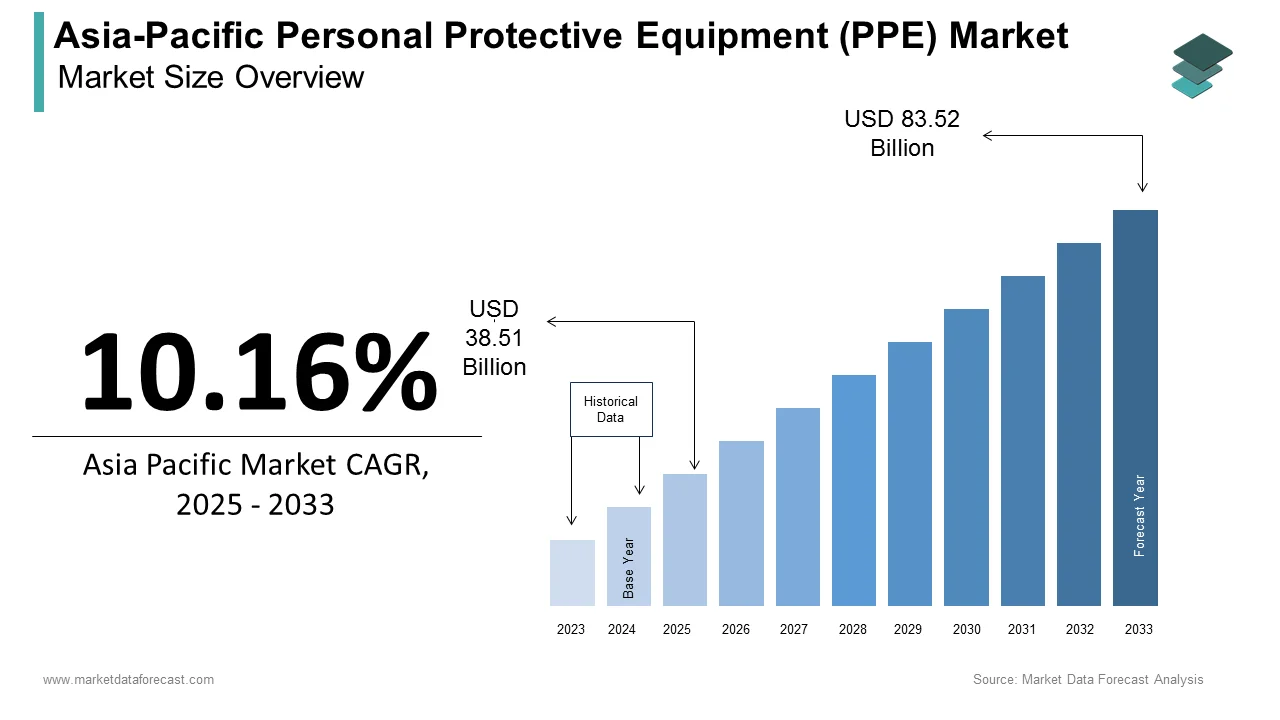
- Market Valuation: Valued at USD 38.51 billion (2025), estimated at USD 42.42 billion (2026), and projected to reach USD 92.00 billion by 2034, registering a strong CAGR of 10.16% (2026–2034).
- Primary Growth Drivers: High incidence of workplace accidents and injuries (with the NSC noting worker injuries occurring frequently), tightening regulatory mandates enforcing certified safety protocols, and robust infrastructure/construction investments. Key structural factors include the expanding oil & gas and manufacturing sectors across emerging economies like China, India, Indonesia, and Vietnam.
Key Market Segment Metrics (2026–2034)
| Category | Leading Segment (2025 Position) | Fastest-Growing Segment |
|---|---|---|
| By Product | Hand Protection & Protective Clothing (historically commanding major regional volume across heavy industries) | Respiratory Protection & Specialized Protective Gear (driven by industrial hygiene and healthcare safety) |
| By End-User | Manufacturing & Construction (dominant consumers due to rapid infrastructure development and large labor forces) | Healthcare & Pharmaceuticals (experiencing high surge due to infection control protocols and health mandates) |
| By Country | China & India (accounted for the largest regional market share backed by massive industrial and manufacturing hubs) | India (projected to grow with the highest growth rate driven by expanding healthcare and construction sectors) |
Major Market Players & Market Structure
Market Structure: Highly competitive regional landscape featuring global safety conglomerates and domestic manufacturers competing on product comfort, technological integration (smart PPE), regulatory compliance adherence, and cost-effective raw material sourcing.
Key Companies: 3M, Honeywell International, Inc., DuPont, Cardinal Health, Medline Industries, Inc., Kimberly-Clark Corporation, Ansell Ltd., MSA Safety Inc., and O&M Halyard, Inc.
 Download Free Sample Report
Asia-Pacific Personal Protective Equipment (PPE) Market Size
The Asia-Pacific personal protective equipment (PPE) market size was valued at USD 38.51 billion in 2025. The regional market is estimated at USD 42.42 billion in 2026 and is projected to reach USD 92 billion by 2034, growing at a CAGR of 10.16% from 2026 to 2034.
Personal Protective Equipment (PPE) is designed to shield workers from occupational hazards across industrial, construction, healthcare, and chemical sectors. According to the International Labour Organization, approximately 2.78 million work-related deaths occur globally each year, with a significant portion attributed to inadequate safety measures in developing economies within the region. This stark reality underscores the urgent necessity for robust PPE adoption to mitigate workplace injuries and fatalities. Healthcare-associated infections affect millions of patients annually, driving the mandatory use of disposable gloves, masks, and gowns in medical facilities throughout Asia Pacific. Manufacturers focus on developing ergonomic and breathable materials to enhance user comfort and adherence to safety protocols. Regulatory frameworks in countries like China, India, and Japan continue to tighten enforcement mechanisms, ensuring consistent demand for high-quality protective solutions.
MARKET DRIVERS
Stringent Occupational Safety Regulations
The strict enforcement of occupational safety regulations is mandating comprehensive protective measures across high-risk industries, driving the growth of the Asia Pacific personal protective equipment(PPE) market. Governments in the region are increasingly aligning their labor laws with international standards to reduce workplace accidents and improve overall worker welfare. According to the International Labour Organization, the global workforce is employed in the Asia Pacific region, where rapid industrialization has historically led to higher accident rates, necessitating rigorous safety interventions. This regulatory push compels manufacturing, mining, and construction firms to invest heavily in compliant PPE to avoid legal penalties and operational shutdowns. These large-scale projects drive substantial volume demand for durable and certified safety gear. Companies must regularly update their inventory to meet evolving certification requirements such as ISO and ANSI standards. The shift toward formalizing informal labor sectors further amplifies this driver by bringing previously unregulated workers under safety mandates.
Rising Industrialization and Manufacturing Activities
The rapid industrialization and expanding manufacturing activities increase the number of workers exposed to hazardous environments, which is another factor amplifying the growth of the Asia Pacific personal protective equipment (PPE) market. The region serves as the global factory hub for electronics, automotive textiles, and chemicals requiring extensive use of specialized protective gear. Industrial employment in Southeast Asia has risen over the last decade, exposing a larger workforce to potential occupational hazards such as toxic fumes and heavy machinery risks. Factories implementing lean manufacturing and automation still require human oversight in dangerous zones, maintaining steady PPE demand. The rise of small and medium enterprises in emerging economies further contributes to this driver as they adopt basic safety standards to compete globally. Supply chain resilience strategies post-pandemic have led to nearshoring of production facilities, boosting local PPE consumption. Government initiatives promoting domestic manufacturing capabilities also support this trend by encouraging safety compliance.
MARKET RESTRAINTS
High Cost of Advanced PPE Solutions
The high cost of advanced personal protective equipment is limiting the growth of the Asia Pacific personal protective equipment (PPE) market. Premium PPE featuring smart technology, superior comfort, and enhanced durability commands a price point that many budget-constrained organizations find prohibitive. This financial barrier forces many smaller operators to rely on cheaper substandard alternatives that offer minimal protection and frequent replacement needs. When companies prioritize short-term savings over long-term safety, they expose workers to higher risks and potential liability costs. The lack of financing options for safety equipment upgrades further exacerbates this restraint. Price-sensitive markets often view PPE as a regulatory burden rather than a value-adding investment. This perception hinders the adoption of innovative products that could significantly improve worker safety and efficiency.
Prevalence of Counterfeit and Substandard Products
The widespread availability of counterfeit and substandard is also degrading the growth of the Asia Pacific personal protective equipment (PPE) market. Unregulated areas in several developing countries are flooded with fake certifications and low-quality materials that fail to meet international safety standards. The counterfeit goods constitute a significant portion of trade in some Asian markets, causing billions in losses and posing severe health risks to users. These inferior products often tear easily or fail to filter hazardous particles, leading to false security and increased injury rates. The presence of such products distorts pricing dynamics, making it difficult for legitimate manufacturers to compete on value rather than just price. Workers in informal sectors are particularly vulnerable as they lack the knowledge to distinguish between genuine and fake certifications. Regulatory enforcement remains inconsistent across borders, allowing counterfeiters to operate with impunity. This issue erodes brand reputation for established players and slows down the adoption of standardized safety practices.
MARKET OPPORTUNITIES
Integration of Smart and IoT-Enabled PPE
The integration of Internet of Things (IoT) and smart technologies are enhancing worker safety through real-time monitoring and data analytics that is substantially to create new opportunities for the growth of the Asia Pacific personal protective equipment (PPE) market. Smart helmets, vests, and glasses equipped with sensors can detect hazardous gas levels, extreme temperatures, and worker fatigue, providing immediate alerts to prevent accidents. This technological adoption enables companies to move from reactive safety measures to proactive risk management strategies. Industries such as oil and gas, mining, and construction are early adopters seeking to improve operational efficiency and comply with strict safety audits. The data collected from these devices helps in analyzing trends and optimizing workflow processes. Manufacturers can differentiate their offerings by providing integrated software platforms that visualize safety metrics. Partnerships with tech firms accelerate the development of lightweight and energy-efficient smart gear.
Expansion in Healthcare and Pharmaceutical Sectors
The expanding healthcare and pharmaceutical sectors require specialized disposable and reusable protective gear, which is additionally to surge the growth of the Asia Pacific personal protective equipment (PPE) market. The ongoing focus on infection control, hospital hygiene, and pandemic preparedness ensures consistent procurement of gloves, masks, gowns, and face shields. The Asia Pacific region faces a growing burden of infectious diseases requiring robust containment protocols in medical facilities. This public health imperative supports steady demand for high-quality medical-grade PPE that meets stringent sterilization standards. This growth translates into higher volumes of PPE usage in hospitals, clinics, and laboratories. The rise of biotechnology and pharmaceutical manufacturing also creates demand for cleanroom suits and respiratory protection to maintain sterile environments. Government investments in healthcare infrastructure further boost this opportunity by upgrading facilities with modern safety equipment. Innovation in antimicrobial fabrics and sustainable disposable materials appeals to environmentally conscious healthcare providers.
MARKET CHALLENGES
Lack of Awareness and Training in Informal Sectors
The lack of safety awareness and adequate training in informal sectors is a major challenge for the growth of the Asia Pacific personal protective equipment (PPE) market. A significant portion of the workforce in agriculture, construction, and small-scale manufacturing operates without formal safety education or supervision. Limited literacy and language barriers hinder the effective communication of safety instructions and proper fitting techniques for protective gear. Workers often perceive PPE as uncomfortable or unnecessary due to a lack of understanding regarding long-term health risks. Employers in these sectors may not prioritize training due to cost constraints or high employee turnover. This cultural and educational barrier makes it difficult for manufacturers to promote advanced safety solutions.
Supply Chain Disruptions and Raw Material Volatility
Supply chain disruptions and volatility in raw material prices also limit the growth of the Asia Pacific personal protective equipment (PPE) market. The manufacturing of PPE relies heavily on commodities such as polypropylene, nitrile rubber, and specialized fabrics, which are subject to global market fluctuations. The instability forces producers to hold higher inventory levels, tying up capital and increasing storage costs. Dependence on imports for certain specialized materials exposes companies to geopolitical tensions and trade restrictions. Natural disasters in the region further disrupt logistics networks, affecting distribution to remote areas. Manufacturers struggle to maintain stable pricing for customers while absorbing sudden cost spikes. This uncertainty discourages long-term contracts and investment in capacity expansion.
REPORT COVERAGE
| REPORT METRIC | DETAILS |
| Market Size Available | 2025 to 2034 |
| Base Year | 2025 |
| Forecast Period | 2026 to 2034 |
| Segments Covered | By Product, End User, and Country. |
| Various Analyses Covered | Global, Regional, and Country-Level Analysis, Segment-Level Analysis, Drivers, Restraints, Opportunities, Challenges; PESTLE Analysis; Porter’s Five Forces Analysis, Competitive Landscape, Analyst Overview of Investment Opportunities |
| Countries Covered | India, China, Japan, South Korea, Australia, New Zealand, Thailand, Malaysia, Vietnam, Philippines, Indonesia, Singapore and Rest of Asia-Pacific |
| Market Leaders Profiled | 3M, Honeywell International, Inc., DuPont, Cardinal Health, Medline Industries, Inc., Kimberly-Clark Corporation, Ansell Ltd., MSA Safety Inc., and O&M Halyard, Inc. |
SEGMENTAL ANALYSIS
By Product Insights
The head, eye, and face protection segment was the largest, holding 46.2% of the Asia Pacific Personal Protective Equipment (PPE) Market share in 2025 due to its mandatory usage across construction, manufacturing, and industrial sectors. The sheer volume of infrastructure projects and factory operations ensures consistent demand for these essential items. Safety helmets protect against falling objects, while goggles and face shields guard against chemical splashes and debris. Regulatory bodies enforce strict standards for impact resistance and optical clarity, ensuring high-quality procurement. Manufacturers focus on lightweight materials and ventilation systems to improve worker comfort during long shifts. The integration of visors with helmets provides comprehensive protection, enhancing market’s growth.
The protective clothing segment is emerging at the fastest CAGR of 12.3% during the forecast period, with the rising awareness of chemical, biological, and thermal hazards. This category includes coveralls, aprons, and specialized suits designed to shield the entire body from harmful substances and extreme conditions. According to the World Health Organization, exposure to hazardous chemicals in industrial settings affects over 100 million workers globally, with a significant concentration in Asian manufacturing hubs. This health risk drives industries to adopt full-body protection solutions to comply with occupational health standards. The expansion of the pharmaceutical and healthcare sectors further boosts demand for sterile gowns and disposable coveralls to maintain hygiene. Innovations in breathable yet protective materials enhance user acceptance and reduce heat stress. Government mandates for personal hygiene in food processing plants also contribute to this growth. The rise of biotechnology and laboratory research creates niche demand for high-end protective suits. Manufacturers invest in sustainable materials to meet environmental regulations.
By End User Insights
The construction sector segment was the largest, accounting for 33.2% of the Asia Pacific Personal Protective Equipment (PPE) Market share in 2025 due to the massive scale of infrastructure development and urbanization projects. This industry involves high-risk activities such as working at heights, handling heavy machinery, and exposure to falling debris, which necessitates comprehensive protective gear. This extensive activity drives substantial demand for helmets, safety boots, high-visibility vests, and harnesses. Governments in countries like China, India, and Indonesia enforce strict safety codes mandating the use of certified equipment on all major projects. The informal nature of labor in some areas poses challenges, but formalization efforts are increasing compliance. Large contracting firms prefer bulk procurement from reputable brands to ensure liability protection. Seasonal peaks in construction activity create fluctuating but consistently high demand.
The healthcare sector is likely to grow at the fastest CAGR of 12.1% from 2026 to 2034 with the heightened infection control measures and expanding medical infrastructure. The pandemic legacy has permanently altered safety protocols in hospitals, clinics, and laboratories, driving sustained demand for disposable gloves, masks, gowns, and face shields. Healthcare-associated infections affect millions of patients annually in the Asia Pacific region, prompting stringent hygiene standards and mandatory PPE usage. This public health imperative ensures consistent procurement cycles for medical-grade protective items. The rise of outpatient care centers and diagnostic labs further expands the user base. Regulatory agencies enforce strict sterilization and disposal guidelines, influencing product design and material selection. Innovation in antimicrobial fabrics and sustainable disposable materials appeals to environmentally conscious institutions. Training programs for medical staff emphasize proper donning and doffing techniques, reducing waste. Strategic partnerships between manufacturers and hospital groups facilitate customized supply solutions.
COUNTRY-LEVEL ANALYSIS
China Personal Protective Equipment (PPE) Market Analysis
China was the top performer in the Asia Pacific Personal Protective Equipment (PPE) Market by capturing 58.1% of the share in 2025 owing to its status as the global manufacturing hub and extensive industrial base. China has strengthened workplace safety regulations following several high-profile industrial accidents, leading to stricter enforcement of PPE usage mandates. The government initiative to upgrade manufacturing capabilities through Industry 4.0 integrates smart PPE technologies for real-time monitoring. Local manufacturers benefit from established supply chains and raw material availability, reducing production costs. Export opportunities remain strong as Chinese brands gain recognition for quality and affordability. Environmental regulations influence the shift toward sustainable materials in PPE production.

India Personal Protective Equipment (PPE) Market Analysis
India Personal Protective Equipment (PPE) market was ranked second, with 23.1% of the share in 2025 with the government initiatives to boost manufacturing and infrastructure development. The Make in India campaign has attracted foreign investment and stimulated domestic production, creating a larger industrial workforce requiring safety gear. The workplace safety audits have become mandatory for large enterprises, encouraging systematic procurement of certified protective equipment. The construction boom in urban centers further amplifies demand for fall protection and high-visibility clothing. Local manufacturers are upgrading technology to meet international quality standards, enabling exports to neighboring countries. Awareness campaigns by trade unions educate workers on the importance of PPE, reducing resistance to usage. Price sensitivity remains a factor, but quality consciousness is rising among corporate buyers. Government tenders for infrastructure projects often specify PPE requirements, ensuring compliance.
Japan Personal Protective Equipment (PPE) Market Analysis
Japan Personal Protective Equipment (PPE) Market growth is likely to have prominent opportunities in the coming years with high-quality innovation and strict regulatory compliance. The country leads in the development of smart PPE integrated with sensors for health monitoring and hazard detection, catering to its aging workforce and high-tech industries. This culture of safety ensures consistent demand for premium PPE products that offer superior comfort and protection. The aging population necessitates ergonomic PPE designs that reduce physical strain on older workers, maintaining productivity. Japanese manufacturers focus on lightweight, breathable materials and customizable fits to enhance user adherence. The automotive and electronics sectors drive demand for specialized anti-static and chemical-resistant clothing. Regulatory standards are among the strictest globally, requiring continuous product innovation. Collaboration between research institutions and industry accelerates the commercialization of new technologies.
South Korea Personal Protective Equipment (PPE) Market Analysis
South Korea Personal Protective Equipment (PPE) Market growth is likely to grow with its advanced manufacturing sector and strong emphasis on occupational health. The country is a hub for semiconductor, shipbuilding, and automotive industries, which require specialized high-performance protective gear. The strict penalties for safety violations encourage companies to procure certified, high-quality PPE from reputable suppliers. The rise of smart factories integrates IoT-enabled safety devices for real-time hazard monitoring. Korean consumers value innovative features such as cooling technologies in protective clothing for hot environments. Local manufacturers collaborate with global tech firms to develop smart helmets and vests. Government subsidies for safety equipment upgrades in small and medium enterprises broaden market access.
Australia Personal Protective Equipment (PPE) Market Analysis
Australia's Personal Protective Equipment (PPE) market is expected to grow with the stringent safety laws and high per capita spending on worker protection. The mining, construction, and healthcare sectors are primary drivers demanding durable and certified protective gear. This regulatory environment ensures consistent demand for high-quality products that meet Australian Standards. The focus on mental health and well-being extends to physical safety, promoting ergonomic PPE designs. Australian buyers prioritize sustainability, leading to increased demand for eco-friendly and recyclable PPE materials. Import dependence for certain specialized items creates opportunities for international suppliers with strong compliance records.
COMPETITIVE LANDSCAPE
The competitive landscape of the Asia Pacific Personal Protective Equipment (PPE) Market features a mix of multinational corporations and regional specialists striving to capture growing demand across diverse industries. Major players differentiate themselves through product innovation, sustainability initiatives, and strong distribution networks that ensure reliable supply to end users. Competition intensifies as companies invest in research and development to create novel protective materials that offer superior comfort and durability in challenging environments. Local manufacturers gain traction by offering cost-effective alternatives and leveraging proximity to raw material sources like rubber and textiles. Strategic collaborations between ingredient suppliers and safety equipment producers accelerate the development of customized solutions tailored to regional regulatory requirements. Price volatility of raw materials prompts firms to adopt hedging strategies and vertical integration to stabilize costs. The shift toward smart PPE and digital safety solutions drives competition in the premium segment where technology integration is paramount. Companies also compete on technical service quality, providing formulators with expert guidance to optimize safety protocols. Digital transformation enhances customer engagement through online platforms that offer training resources and procurement tools.
KEY MARKET PLAYERS
The leading companies operating in the Asia-Pacific personal protective equipment (PPE) market include:
- 3M
- Honeywell International, Inc.
- DuPont
- Cardinal Health
- Medline Industries, Inc.
- Kimberly-Clark Corporation
- Ansell Ltd.
- MSA Safety Inc.
- O&M Halyard, Inc.
TOP PLAYERS IN THE MARKET
- Honeywell International Inc. maintains a robust presence in the Asia Pacific Personal Protective Equipment (PPE) Market through its comprehensive portfolio of safety solutions spanning respiratory protection, hearing conservation, and headgear. The company leverages its global research capabilities to develop advanced materials that offer superior comfort and durability for industrial workers. Recent initiatives focus on expanding manufacturing facilities in India and China to enhance local supply chain resilience and reduce delivery times. Honeywell actively collaborates with regional safety regulators to ensure its products meet stringent compliance standards across diverse markets. Their commitment to innovation drives the development of smart PPE integrated with sensors for real-time hazard monitoring. The company provides extensive training programs, helping organizations implement effective safety protocols and maximize equipment utility. Strategic partnerships with local distributors ensure widespread market penetration in emerging economies. Honeywell emphasizes sustainability by introducing eco-friendly materials in their product lines. This approach strengthens brand loyalty among environmentally conscious clients.
- 3M Company serves as a pivotal contributor to the Asia Pacific Personal Protective Equipment (PPE) Market by offering high-performance protective solutions, including respirators, eye protection, and protective clothing. The company focuses on delivering scientifically backed products that address specific occupational hazards in manufacturing, healthcare, and construction sectors. Recent expansions include upgrading production sites in Southeast Asia to increase capacity for disposable masks and filters. 3M prioritizes sustainability by implementing waste reduction technologies and renewable energy sources in its manufacturing processes. The firm actively engages with healthcare institutions to provide specialized infection control products, ensuring high purity and reliability. Their technical teams work closely with customers to develop customized solutions for complex industrial environments.
- Ansell Limited plays a significant role in the Asia Pacific Personal Protective Equipment (PPE) Market by specializing in high-quality gloves and protective clothing for healthcare and industrial applications. The company integrates its deep expertise in polymer science with advanced manufacturing technologies to deliver consistent and reliable barrier protection. Recent actions involve strengthening partnerships with hospitals and factories in Australia and Japan to secure long-term supply contracts for protective items. Ansell emphasizes innovation through its application centers where experts help customers select optimal glove materials for chemical and biological risks. The firm is committed to reducing its environmental footprint by optimizing water usage and adopting circular economy principles in production. Ansell actively participates in industry forums to share knowledge on best practices for hand safety and hygiene. Their focus on ergonomics drives the development of gloves that reduce hand fatigue during prolonged use. The company also invests in digital tools that provide real-time data on product performance and inventory levels.
TOP STRATEGIES USED BY THE KEY MARKET PARTICIPANTS
Top strategies employed by key market participants include vertical integration to secure raw material supplies and reduce dependency on volatile commodity markets. Companies invest heavily in research and development to innovate new protective fabrics and filtration technologies with enhanced functional properties such as improved breathability or chemical resistance. Expansion into emerging economies through joint ventures and local manufacturing facilities helps firms overcome logistical barriers and cater to regional preferences effectively. Strategic acquisitions of niche safety providers allow larger corporations to broaden their product portfolios and access specialized technologies quickly. Sustainability initiatives form a core part of corporate strategies, with firms focusing on responsible sourcing, waste reduction, and carbon footprint minimization to appeal to environmentally conscious buyers.
MARKET SEGMENTATION
This research report on the Asia-Pacific PPE market has been segmented and sub-segmented into the following categories:
By Product
- Head, Eye & Face Protection
- Hearing Protection
- Protective Clothing
- Heat & Flame Protection
- Chemical Defending
- Cleanroom Clothing
- Mechanical Protective Clothing
- Limited General Use
- Others
- Respiratory Protection
- Air-purifying Respirators
- Supplied Air Respirators
- Protective Footwear
- Leather
- Rubber
- PVC
- Polyurethane
- Others
- Fall Protection
- Hand Protection
- Disposable Gloves
- By Type
- General Purpose
- Chemical Handling
- Sterile Gloves
- Surgical
- Others
- By Material
- Natural Rubber
- Nitrile
- Neoprene
- Vinyl
- Others
- By Type
- Durable Gloves
- Mechanical Gloves
- Chemical Handling
- Thermal/Flame Retardant
- Others
- Disposable Gloves
- Others
By End-User
- Construction
- Manufacturing
- Oil & Gas
- Chemicals
- Food
- Pharmaceuticals
- Healthcare
- Transportation
- Mining
- Others
By Country
- India
- China
- Japan
- South Korea
- Australia
- New Zealand
- Thailand
- Malaysia
- Vietnam
- Philippines
- Indonesia
- Singapore
- Rest of APAC