- Product Description Description
- Table of Contents TOC
- List of Table & Figure LOT
- Get Free Sample PDF Sample PDF
Market Size, 2025
$1.63 BnMarket Estimate, 2026
$1.79 BnMarket Forecast, 2034
$3.88 BnCAGR, 2026–2034
10.12%Executive Summary: Asia Pacific Sterilization Services Market
- Market Scope: Regional market analysis covering sterilization methods, service types, end-user settings, country-level adoption, and healthcare infrastructure drivers.
- Market Valuation: Valued at USD 1.63 billion (2025), estimated at USD 1.79 billion (2026), and projected to reach USD 3.88 billion by 2034, registering a CAGR of 10.12% (2026–2034).
- Primary Growth Drivers: Rising prevalence of healthcare-associated infections (HAIs), increasing surgical volumes due to chronic diseases and an aging population, rapid expansion of the pharmaceutical and biotechnology sectors, and growing outsourcing trends by sterile processing departments.
Key Market Segment Metrics (2026–2034)
| Category | Leading Segment (2025 Position) | Fastest-Growing Segment |
|---|---|---|
| By Method | Ethylene Oxide (dominated due to broad material compatibility and large sterilizing volume) | Advanced validation and alternative eco-friendly sterilization methods |
| By Type | Contract Sterilization Services (driven by medical device firms outsourcing to third-party vendors) | Specialized outsourced validation services |
| By End User | Hospitals and Clinics (supported by high surgical rates and infection control protocols) | Pharmaceutical and Medical Device Companies |
| By Country | China (held the largest market share, followed closely by India) | Asia-Pacific emerging economies expanding medical tourism |
Major Market Players & Market Structure
Market Structure: Highly competitive landscape featuring major multinational sterilization technology providers and specialized healthcare service vendors competing on advanced processing capabilities, regulatory compliance, and extensive regional networks.
Key Companies: STERIS Corporation, Getinge Group, Advanced Sterilization Products, 3M Company, Belimed AG, Cantel Medical Corporation, Anderson Products Inc., Matachana Group, MMM Group, and Sterigenics International Inc.
Asia Pacific Sterilization Services Market Size
The Asia Pacific sterilization services market was worth USD 1.63 billion in 2025. The Asia Pacific market is anticipated to grow at a CAGR of 10.12% from 2026 to 2034, reaching USD 3.88 billion by 2034, up from USD 1.79 billion in 2026.
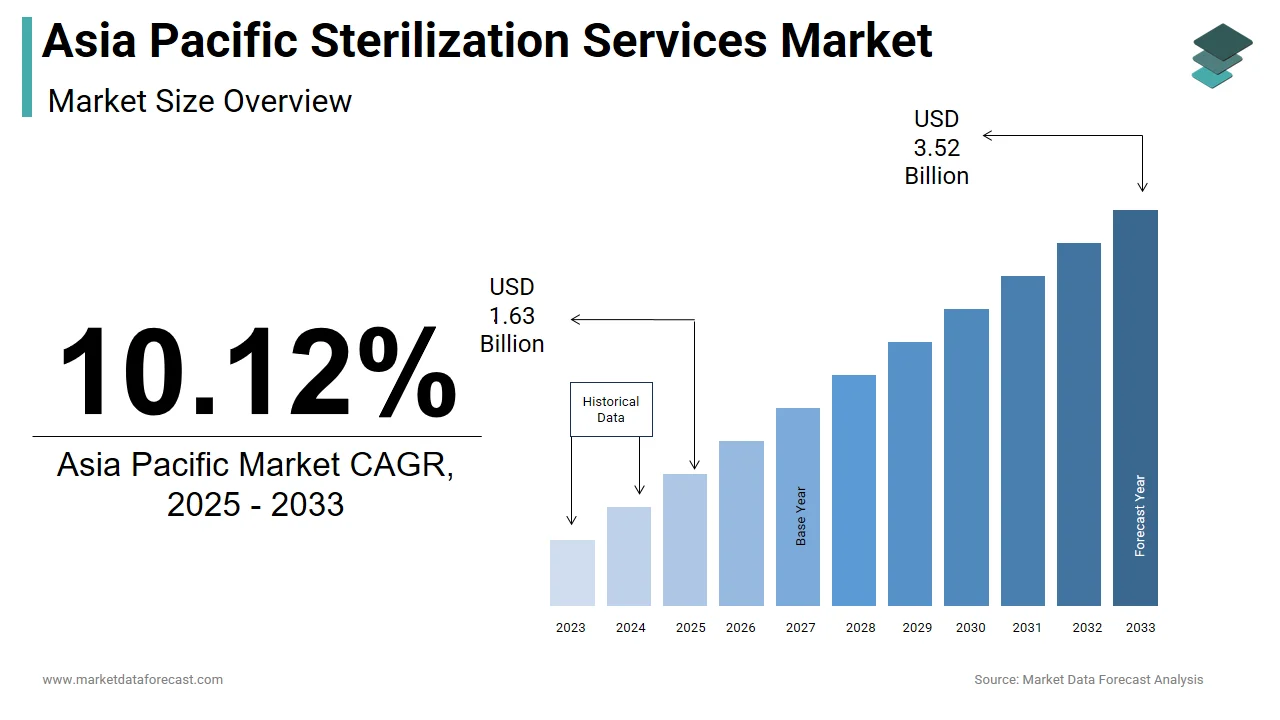
Sterilization is any process that completely removes or kills all living microorganisms, including bacteria, viruses, fungi, and highly resistant spores. It differs from disinfection because disinfection reduces germ numbers but may leave spores behind, whereas a sterilized object is entirely free of all life. This market is fundamentally anchored in patient safety protocols and regulatory compliance rather than discretionary spending, as it serves as the non-negotiable backbone of modern healthcare delivery and biopharmaceutical manufacturing. According to the World Health Organisation, surgical site infections are the most frequent healthcare-associated infection in low- and middle-income countries, affecting between 8% and 30% of surgical patients, which drives the adoption of rigorous infection prevention protocols across regional medical facilities. As per the Asian Development Bank, regional infrastructure commitments prioritise integrated healthcare governance, technical upgrades, and clinical training pathways within base and district hospitals to ensure safe medical care outcomes. According to the United Nations Economic and Social Commission for Asia and the Pacific, the region attracts substantial cross-border healthcare and biopharmaceutical investments, expanding local manufacturing capacities for critical medical goods and vaccines to improve supply-chain resilience. Consequently, this market is defined by the convergence of public health mandates, industrial capacity expansion and evolving regulatory harmonisation efforts spanning advanced economies like Japan and emerging manufacturing hubs such as India and Vietnam, requiring distinct technological approaches.
MARKET DRIVERS
Expansion of Regional Biopharmaceutical Manufacturing Capacity
The unprecedented scaling of biopharmaceutical and vaccine production facilities across the region is a primary structural driver for advanced sterilization technology adoption, which propels the growth of the Asia Pacific sterilization services market. This trend is particularly visible in aseptic processing and terminal sterilization validation. According to the International Federation of Pharmaceutical Manufacturers and Associations Globalisation Report, the rapid globalisation of the pharmaceutical industry relies on massive chemical synthesis networks and expanded supply hubs to ensure continuous compliance with Good Manufacturing Practice (GMP) quality standards. As per the International Vaccine Institute Capacity Program, intensive regional training and technical capacity-building programs are expanding biomanufacturing infrastructure within low- and middle-income nations to scale local vaccine production capabilities. According to Australia’s Therapeutic Goods Administration, Australia enforces structured manufacturing and quality guidelines for biological therapeutic goods, requiring rigorous cell or tissue processing compliance and technical validations to maintain safety frameworks. The manufacturing renaissance transforms sterilization from an ancillary support function into a critical process determinant where equipment reliability directly impacts product release timelines and regulatory compliance. Unlike hospital settings where sterilization serves procedural throughput, pharmaceutical applications demand validated cycle reproducibility and data integrity, making this segment less sensitive to economic cycles and more responsive to capacity expansion and quality system upgrades across the region.
Surgical Volume Growth and Infection Control Mandates
Rising surgical procedure volumes combined with stringent hospital accreditation requirements fuel sustained demand for sterilization equipment and consumables across the regional healthcare systems, which contributes to the expansion of the Asia Pacific sterilization services market. According to the Organisation for Economic Co-operation and Development, expanding surgical procedures such as hip and knee replacements reflect the healthcare system demands of ageing national demographics and evolving clinical intervention models. According to research on the Global Volume of Surgery Registry, tracking surgical operations based on per capita total health expenditures allows member states to map system capacities and implement necessary safety protocols to control clinical outcomes. As per the Japan Health Policy NOW Cost Control Registry, the Ministry of Health, Labour and Welfare enforces specific conditions for hospital billing and reimbursement revisions to exercise strict quality control over institutional equipment utilisation and medical services. These policy interventions convert infection prevention from a cost centre into a revenue enabler, accelerating technology refresh cycles. Furthermore, urbanisation and rising middle-class populations in Indonesia and the Philippines increase elective surgery demand while simultaneously raising patient expectations for safety standards previously associated only with developed markets, creating dual pressure on hospitals to upgrade sterilisation capabilities beyond minimum regulatory thresholds.
MARKET RESTRAINTS
High Capital Intensity and Budgetary Constraints in Public Facilities
High upfront costs and ongoing maintenance expenses severely limit the adoption of validated sterilisation equipment, which constrains the growth of the Asia Pacific sterilization services market. Public healthcare facilities across developing nations in the region face this barrier despite a clear clinical need. According to the World Bank, domestic general government health expenditure per capita in several lower-middle-income regional nations remains highly constrained, which restricts independent public procurement budgets for high-end medical infrastructure and advanced autoclave sterilisation systems. As per the Asian Development Bank, infrastructure modernisation and technology investments in rural district hospitals are limited by capital inefficiencies and long-term installation and maintenance gaps across developing Southeast Asian territories. The financial barrier creates a two-tiered sterilization landscape where private and urban facilities operate advanced systems while public rural counterparts depend on inadequate alternatives, increasing infection risks for vulnerable populations. Capital intensity will continue suppressing market penetration in segments representing the majority of patient volume across lower-income Asia Pacific territories. This will happen until innovative financing models like lease-to-own or pooled regional procurement become widespread.
Workforce Competency Gaps and Validation Expertise Shortages
A critical shortage of trained sterilization technicians and validation specialists further hinders the expansion of the Asia Pacific sterilization services market. This fundamentally constrains effective deployment and utilization of advanced sterilisation technologies regardless of equipment availability across the region. According to the Healthcare Sterile Processing Association Professional Registry, institutional workforce regulations increasingly mandate structured certification and formal examination pathways to achieve strict process monitoring compliance within central sterile supply departments. According to the World Health Organisation Infection Prevention and Control Repository, global health frameworks prioritise comprehensive workforce education, proper sanitation protocols, and localised training to eliminate technical errors and ensure safe instrument processing standards. The competency gap means sophisticated low-temperature or vaporised hydrogen peroxide systems often remain underutilised or misconfigured, negating their intended safety benefits. Manufacturers face higher total cost of ownership as they must provide extensive on-site training and remote support, eroding margins. Workforce limitations will suppress effective market growth. This happens even when capital constraints are resolved through external funding or favourable procurement terms, because standardised vocational education pathways and professional recognition still need to expand and improve.
MARKET OPPORTUNITIES
Adoption of Low Temperature Technologies for Heat Sensitive Devices
Proliferation of complex, heat-sensitive medical devices, including endoscopes, robotic instruments, and single-use electronics, creates substantial opportunity for low-temperature sterilisation technologies across the regional healthcare systems, which is anticipated to fuel the growth of the Asia-Pacific sterilization market. According to the Gastroenterological Society of Australia Endoscopy Infection Prevention Guidelines, Australian clinical practices require strict, documented decontamination and high-level disinfection protocols for flexible endoscopes to minimise transmission risks. As per Singapore General Hospital Clinical, the transformation of the sterile supply unit integrates advanced IT barcode-based management systems to effectively track, streamline, and optimise surgical instrument inventory turnaround workflows. The technological shift reflects fundamental change in device composition where polymers, optics and embedded sensors dominate modern instrument design, rendering steam obsolete for a growing proportion of inventory. Early movers offering validated low-temperature platforms with rapid cycle times capture a disproportionate share as hospitals recognise that protecting expensive capital equipment investments justifies premium sterilisation method costs through extended device lifespan and increased procedural throughput.
Digital Traceability and Regulatory Compliance Integration
Integration of digital traceability systems with sterilisation equipment paves the way for the expansion of the Asia Pacific sterilization services market. This helps to address documentation burdens and enhance regulatory compliance across increasingly scrutinised Asia Pacific healthcare environments. According to the China National Medical Products Administration, updated regulations significantly strengthen national alignment with international safety frameworks by introducing chapters specifically dedicated to quality assurance and validation. As per the Therapeutic Goods Administration Australia Guidelines, domestic medical device oversight frameworks enforce rigorous data traceability and international parametric release parameters for moist heat terminally sterilized therapeutic goods. The digital transformation converts sterilization from an isolated operational function into an integrated quality system component generating actionable analytics for continuous improvement. Vendors offering interoperable platforms compatible with national health information exchanges gain preferential procurement status as regulators prioritise data integrity and traceability over standalone equipment specifications, creating sustainable differentiation beyond hardware performance alone.
MARKET CHALLENGES
Regulatory Fragmentation and Harmonisation Delays
Extreme regulatory divergence across jurisdictions in the region creates prohibitive compliance burdens on the Asia Pacific sterilization services market. This prevents efficient scaling of sterilization products and delays technology access despite regional harmonisation initiatives. According to the Pharmaceuticals and Medical Devices Agency Review Standards, Japan maintains regulatory biological indicator oversight and technical parameters for therapeutic validation that parallel international ISO 11138 series specifications. The fragmentation prevents economies of scale, keeping prices artificially high and limiting product variety available to end users. Unlike the European Union centralised CE marking system, Asia Pacific lacks a unified conformity assessment framework, perpetuating market silos. Until genuine regulatory convergence occurs through strengthened ASEAN coordination or bilateral agreements, each country remains an isolated fragment. These fragments sustain inefficiencies that ultimately compromise patient safety through delayed access to validated sterilization technologies.
Environmental Compliance Pressures on Traditional Sterilants
Increasing environmental regulations targeting hazardous sterilants like ethylene oxide and glutaraldehyde create operational and financial challenges for facilities dependent on legacy technologies across the region, which holds back the expansion of the Asia Pacific sterilization services market. According to the United Nations Environment Programme Environmental Assessment, global environmental panels evaluate the atmospheric half-life and biodegradation rates of volatile industrial processing compounds to guide structural chemical management frameworks. As per the Australian Commission on Safety and Quality in Health Care Systems, hospital facilities conform to unified AS/NZS 4187 standards for low-temperature processing and ethylene oxide chemical handling to guarantee clinical sterilisation safety. The regulatory tightening transforms environmental compliance from a peripheral concern into existential operational risk, particularly for older facilities lacking capital reserves for retrofitting. While newer technologies offer safer profiles, transition costs and revalidation requirements create significant barriers, especially in price-sensitive public sector markets where budget cycles cannot accommodate unplanned environmental upgrades. Balancing worker safety, environmental protection, and affordable sterilisation access remains an unresolved tension shaping technology adoption trajectories across diverse regulatory landscapes.
REPORT COVERAGE
| REPORT METRIC | DETAILS |
| Market Size Available | 2025 to 2034 |
| Base Year | 2025 |
| Forecast Period | 2026 to 2034 |
| Segments Covered | By Method, Type, End-User, and Region. |
| Various Analyses Covered | Global, Regional and Country-Level Analysis, Segment-Level Analysis, Drivers, Restraints, Opportunities, Challenges; PESTLE Analysis; Porter’s Five Forces Analysis, Competitive Landscape, Analyst Overview of Investment Opportunities |
| Countries Covered | India, China, Japan, South Korea, Australia, New Zealand, Thailand, Malaysia, Vietnam, Philippines, Indonesia, Singapore, Rest of APAC |
| Market Leaders Profiled | STERIS Corporation, Getinge Group, Advanced Sterilization Products, 3M Company, Belimed AG, Cantel Medical Corporation, Anderson Products Inc., Shinva Medical Instrument, Matachana Group, MMM Group, and Sterigenics International Inc. |
SEGMENTAL ANALYSIS
By Method Insights
In 2025, the steam sterilization segment held the majority share in the Asia Pacific sterilization services market because of its superior cost efficiency and operational simplicity, making it the default choice for high-volume reprocessing across diverse healthcare settings. According to the World Health Organisation, hospitals prioritise steam autoclaving as the primary method for thermal instrument reprocessing due to its extensive clinical efficacy and long-term operational cost-effectiveness. As per the Asian Development Bank Health Sector Evaluation Guidelines, infrastructure modernisation and technical upgrades in regional hospitals prioritize standard medical equipment lines to reliably expand healthcare delivery capacities. The economic and logistical advantage creates self-reinforcing dominance where workforce training, supply chains, and regulatory familiarity all centre on steam technology. Even as advanced methods emerge for heat-sensitive devices, steam remains a foundational backbone supporting the majority of surgical and procedural volumes across price-sensitive Asia Pacific markets where total cost of ownership determines adoption more than technological sophistication.
Steam sterilisation retains market leadership through universal regulatory acceptance and harmonised validation standards that reduce compliance burden compared to emerging alternative methods across fragmented Asia Pacific jurisdictions. According to the International Organisation for Standardisation, ISO 17665 establishes explicit requirements for the development, validation, and routine control of a moist heat sterilisation process for medical devices. According to the Therapeutic Goods Administration Real-Time Release Testing Rules, Australia adopts international scientific frameworks to evaluate the parametric release parameters of moist heat terminally sterilised therapeutic goods. The regulatory asymmetry means steam enjoys grandfathered status with established compliance infrastructure while newer methods face evidentiary hurdles. Consequently, facilities default to steam not merely due to technical suitability but because it represents the path of least resistance through complex regional regulatory landscapes where validation certainty outweighs marginal performance benefits of specialised technologies.
The gamma and electron beam sterilization segment is likely to experience the fastest CAGR of 11.8% between 2026 and 2034, owing to explosive growth in single-use medical device manufacturing requiring terminal processing at an industrial scale. According to the United Nations Economic and Social Commission for Asia and the Pacific, the region experiences rapid structural expansions in health technology sectors, attracting extensive cross-border investments to scale domestic medical manufacturing outputs. According to the International Atomic Energy Agency, irradiation processing networks utilize specialized radiation technologies to provide high-level microbial reduction for single-use medical devices and healthcare supplies. The structural shift from reusable to disposable paradigms transforms sterilisation from a hospital-based service into industrial manufacturing input. Growth reflects fundamental change in product architecture where polymer-based single-use devices dominate new product development, creating sustained demand for penetration-capable sterilisation methods compatible with sealed packaging and high-throughput production lines serving global supply chains.
The fast development of this segment, heightened by pharmaceutical aseptic processing expansion across the Asia Pacific, requires validated terminal sterilization for container closures and drug delivery systems incompatible with heat-based methods. As per the International Vaccine Institute Capacity Program, regional technical education initiatives expand specialised biomanufacturing capabilities to reliably secure vaccine production systems within developing markets. According to the Future Market Insights E-beam Sterilisation Industry Tracker, pharmaceutical and healthcare sectors scale up their deployment of electron beam processing lines to satisfy strict contamination control standards for packaging components. The regulatory and quality preference converts radiation sterilization from an optional alternative into a preferred platform for next-generation pharmaceutical manufacturing. Growth stems from alignment with industry trends toward faster cycle times, reduced chemical exposure, and enhanced data integrity, making irradiation strategically positioned to capture a disproportionate share of expanding biopharmaceutical capacity investments across the region.
By Type Insights
The contract sterilization services segment was the largest in the Asia Pacific market in 2025 because outsourcing enables medical device and pharmaceutical manufacturers to avoid substantial capital expenditure while maintaining flexibility to scale operations in response to volatile demand patterns. According to the Future Market Insights Healthcare Sterilisation Equipment Industry Tracker, medical device manufacturing companies increasingly outsource complex processing tasks to contract sterilisers to control initial capital expenditures and convert rigid infrastructure investments into scalable operational expenses. As per regional market reports on the Asia-Pacific Contract Sterilisation Services Sector, the rising demand for single-use medical devices and surgical equipment drives small and medium-sized manufacturers to deploy contract sterilization networks to overcome localised technical constraints. The preference intensifies during economic uncertainty when preserving cash flow takes precedence over long-term asset ownership. Contract providers achieve economies of scale serving multiple clients, enabling lower unit costs than captive facilities could achieve at similar utilisation rates. Consequently, even large multinational corporations increasingly adopt hybrid models, outsourcing peak demand and specialised methods while retaining only core steam sterilisation internally, optimising both cost structure and operational resilience across the dynamic Asia Pacific manufacturing landscape.
Contract sterilisation maintains type segment leadership through specialised regulatory expertise that reduces compliance risk for manufacturers navigating fragmented Asia Pacific approval requirements. According to the International Organisation for Standardisation, keeping industrial processes aligned with global ISO 11135 ethylene oxide guidelines and ISO 11137 radiation standards requires structured corporate quality management systems and precise technical lifecycle protocols. As per the Singapore Economic Development Board Biomedical Report, Singapore provides specialised manufacturing ecosystems, training grants, and technical networks to help biomedical corporations scale regional production and establish compliant supply chains. The regulatory arbitrage makes outsourcing strategically advantageous beyond mere cost considerations. Manufacturers recognise that specialised providers maintain deeper relationships with regulators, stay current with evolving standards and absorb compliance update costs across the client base. In regions where regulatory fragmentation creates persistent uncertainty, transferring sterilisation responsibility to experts with proven track records de-risks market access strategies, making contract services an indispensable enabler of regional expansion.
The validation services segment is expected to exhibit a noteworthy CAGR of 13.4% from 2026 to 2034 due to digital transformation mandates creating new compliance requirements for electronic records and automated system validation. According to U.S. Food and Drug Administration Regulatory Records, official pharmaceutical warning letters frequently cite data integrity deficiencies and inadequate computer system validation under 21 CFR Part 11 mandates, requiring broad process remediation. According to the Pharmaceutical Inspection Co-operation Scheme Annex 11 Draft Framework, the modernised guidance updates global expectations by placing an increased emphasis on system lifecycle risk management, quality culture, and data integrity controls for computerised systems. The regulatory-driven demand differs fundamentally from traditional equipment qualification because it addresses intangible software and data governance aspects where internal competency gaps are most acute. Growth reflects industry recognition that digital compliance cannot be achieved through capital investment alone, requiring specialised knowledge transfer and independent verification services. As more Asia Pacific regulators adopt data integrity expectations aligned with global standards, validation services will continue accelerating as an essential enabler of digital transformation rather than discretionary consulting expense.
The swift expansion of this segment gains further momentum from severe workforce competency gaps across the Asia Pacific, making external expertise essential for meeting increasingly sophisticated validation expectations. According to the International Society for Pharmaceutical Engineering Knowledge Base, pharmaceutical validation engineering practices rely on systematic installation, operational, and performance qualification steps to preserve therapeutic safety. According to the World Health Organisation Prequalification Team Guidelines, vaccine manufacturing sites must submit structured validation protocols, data integrity audits, and contamination control assessments to satisfy global health procurement criteria. The human capital shortage means companies cannot build validation capacity organically fast enough to meet regulatory deadlines, forcing reliance on consultants who bring proven methodologies and benchmark data from multiple engagements. Growth accelerates as complexity increases because each new technology or regulation widens the gap between internal capabilities and external expectations. Until vocational education systems produce sufficient qualified professionals, validation services will remain a growth segment supported by structural talent deficit rather than cyclical demand fluctuations.
By End User Insights
The hospitals and clinics segment dominated the Asia Pacific sterilization services market and accounted for a substantial share in 2025. This dominance of the segment was driven by massive surgical volumes and intensive instrument reprocessing requirements that generate continuous consumable and equipment demand. According to the Organisation for Economic Co-operation and Development Data Explorer, expanding ambulatory surgery patterns and same-day medical treatments across high-income countries dictate strict, continuous disinfection metrics to manage high surgical patient throughput safely. As per the World Health Organisation Integrated Health Services Guidelines, localised healthcare licensing policies and national infection prevention frameworks mandate fully functional central sterile supply departments to safely support essential patient procedures. The institutional embeddedness makes the healthcare sector resilient to economic cycles because sterilisation is a non-deferrable safety requirement rather than a discretionary operational expense. Even during budget constraints, hospitals prioritize sterilization consumables and maintenance over elective capital projects because infection outbreaks carry far greater financial and reputational consequences. Consequently, this segment maintains a stable dominant position through regulatory compulsion and clinical necessity, creating a predictable demand foundation upon which manufacturers build long-term business strategies independent of industrial sector volatility.
Hospitals and clinics maintain end-user leadership through infection prevention accreditation programs that mandate technology upgrades beyond minimum regulatory thresholds, creating sustained replacement demand. According to the Joint Commission International Facility Registry, certified medical institutions globally earn the Gold Seal of Approval by deploying structured process monitoring, strict load release metrics, and validated infection control protocols. As per the Australian Commission on Safety and Quality in Health Care Systems, health facilities execute mandatory national reprocessing frameworks for reusable medical devices to guarantee standardised clinical security across surgical networks. The accreditation frameworks function as de facto technology mandates because compliance requires specific capabilities rather than outcome achievement alone. Unlike industrial users who optimise for cost efficiency, healthcare facilities prioritise audit readiness and liability reduction, justifying premium investments in traceability automation and safety-engineered devices. This dynamic ensures continuous technology refresh cycles independent of equipment functional lifespan, sustaining market growth through compliance-driven obsolescence.
The pharmaceuticals segment is predicted to witness the highest CAGR of 12.6% during the forecast period. This swift expansion of the segment is fuelled by unprecedented biologics and vaccine manufacturing capacity expansion requiring specialised aseptic processing and terminal sterilisation infrastructure. According to the International Vaccine Institute Capacity Program, intensive cross-border partnerships scale up regional biomanufacturing capabilities, bringing advanced aseptic fill-finish operations and sterile validation services to emerging vaccine supply networks. As per the Department of Pharmaceuticals Annual Report, India’s Production Linked Incentive (PLI) initiatives for bulk drugs and medical devices accelerate complex technological enhancements to fulfil international regulatory compliance mandates. This capacity build-out differs fundamentally from hospital demand because pharmaceutical sterilisation involves higher-value equipment, longer validation cycles and stricter regulatory oversight, creating larger transaction values and extended service engagements. Growth reflects strategic industrial policy prioritising domestic medicine security and export competitiveness, making the pharmaceutical segment less sensitive to healthcare budget constraints and more responsive to sovereign investment priorities and global supply chain diversification trends.
Multiple factors accelerate this growth, including regulatory harmonisation initiatives that enable export-oriented manufacturing capacity that requires sterilisation systems compliant with multiple international standards simultaneously. According to the Pharmaceutical Inspection Co-operation Scheme Framework, participating regulatory bodies utilise structured mutual reliance mechanisms on Good Manufacturing Practice (GMP) inspections to eliminate duplicative auditing overhead for global pharmaceutical exporters. As per the Health Sciences Authority of Singapore, member states integrate the current PIC/S Guide to Good Manufacturing Practice for Medicinal Products into their frameworks to synchronise global cross-border sterile assurance definitions. The regulatory convergence transforms sterilisation from a local compliance cost into a strategic export enabler, justifying premium technology investments that would be uneconomic serving the domestic market alone. Growth accelerates as more countries achieve recognition status because each new agreement expands the addressable market for compliant manufacturers, creating a positive feedback loop between regulatory progress and sterilisation capacity investment across the export-oriented Asia Pacific pharmaceutical sector.
COUNTRY LEVEL ANALYSIS
China Sterilization Services Market Analysis
China led the Asia Pacific sterilization services market and captured a 32.9% share in 2025. This leading position of the Chinese market was attributed to the world’s largest medical device manufacturing base and aggressive pharmaceutical capacity expansion under national self-sufficiency strategies. According to the State Council of the People's Republic of China, the domestic medical equipment market size expanded rapidly to reach 1.35 trillion yuan, driving sustained regional infrastructure integration and broad-based demand for industrial production services. As per the World Economic Forum Industrial Transformation, China enters an AI-augmented and self-reliance-oriented manufacturing expansion phase, prompting life science and biopharmaceutical enterprises to invest in modernised sterile production lines to align with evolving regulatory frameworks. However, regulatory enforcement variability across provinces creates compliance inconsistency where coastal regions enforce stringent standards while inland facilities operate with greater latitude, fragmenting market expectations. China’s dominance stems from manufacturing scale and state-directed investment creating a self-reinforcing ecosystem, though sustainability depends on a successful transition from volume leadership to quality parity with international benchmarks as export markets demand higher validation rigour.
Japan Sterilization Services Market Analysis
Japan followed closely behind in the Asia Pacific sterilization services market and captured a 21.4% share in 2025. Factors such as mature healthcare infrastructure, a stringent regulatory environment, and an advanced ageing society driving sustained sterilisation demand through high procedural volumes and quality expectations contributed to the growth of the Japanese market. According to the Japan Health Policy NOW Cost Control Registry, the Ministry of Health, Labour and Welfare enforces specific conditions for hospital billing and reimbursement revisions to exercise strict quality control over institutional equipment utilisation and medical services. As per the Pharmaceuticals and Medical Devices Agency Medical Standards, the regulatory framework mandates structured pre-market technical reviews and post-market safety assessments for all medical equipment categories to confirm clinical efficacy and strict quality assurance compliance. However, demographic decline and fiscal pressure constrain public sector capital spending, limiting growth to replacement cycles and private sector innovation rather than capacity expansion. Japan’s market exemplifies maturity where value derives from quality compliance and service excellence rather than volume growth, requiring vendors to compete on total lifecycle support and regulatory expertise rather than price or specifications alone.
India Sterilization Services Market Analysis
India occupies a significant position in the Asia-Pacific sterilisation market due to a dual role as the world’s largest generic pharmaceutical manufacturer and a rapidly expanding domestic healthcare system, which creates divergent demand profiles across industrial and clinical segments. According to the Department of Pharmaceuticals, the Production Linked Incentive (PLI) schemes for bulk drugs and medical devices continue to expand domestic production capabilities, strengthening local manufacturing infrastructure to serve critical healthcare sectors and export markets. As per the National Health Mission Operational Standards, the program provides comprehensive structural funding to upgrade primary health centres with standardised medical equipment, bridging rural healthcare access gaps through state-level decentralised implementation. However, price sensitivity in the domestic healthcare segment limits adoption of advanced technologies, with a notable portion of public hospitals still using gravity displacement autoclaves despite availability of pre-vacuum systems. India’s market reflects extreme segmentation where world-class pharmaceutical sterilisation coexists with basic clinical infrastructure requiring bifurcated commercial strategies addressing both premium export-oriented and frugal domestic segments simultaneously.
South Korea Sterilization Services Market Analysis
South Korea grew steadily in the Asia-Pacific sterilisation market, owing to its status as an advanced biopharmaceutical manufacturing hub and a highly consolidated hospital system that drove demand for sophisticated sterilisation technologies and validation services. According to the Ministry of Food and Drug Safety Bio-Regulatory Network, South Korea enforces rigorous cGMP medical device and biologic production validation standards to align domestic facilities with major international healthcare certification frameworks. As per the Korean Hospital Association Operations Index, group purchasing organisations and hospital networks evaluate central sterile supply departments based on acute care safety metrics and strict infection prevention criteria to control healthcare-associated infections. However, a chaebol-dominated manufacturing structure limits supplier diversity, with preferred vendor relationships creating entry barriers for new entrants despite market attractiveness. South Korea’s market demonstrates how regulatory diplomacy and industrial consolidation create a premium segment where technology sophistication and compliance capability matter more than price positioning, with vendors as strategic partners rather than commodity suppliers.
Australia Sterilization Services Market Analysis
Australia is also a key player in the Asia-Pacific sterilisation market because of stringent regulatory oversight, a mature contract sterilisation sector, and leadership in digital health integration, driving demand for validated, compliant systems. According to the Therapeutic Goods Administration Real-Time Release Testing Rules, Australia adopts updated international scientific guidelines for real-time release testing and parametric release of moist heat terminally sterilised therapeutic goods. As per the Australian Commission on Safety and Quality in Health Care National Standards, healthcare facilities are mandated to follow unified national criteria for the reprocessing of reusable medical and surgical instruments to guarantee uniform clinical safety outcomes. However, a small domestic population limits absolute market size despite high per capita spending, making Australia strategically important as a regulatory benchmark and reference site rather than a volume driver. Market dynamics reflect a quality-over-quantity paradigm where compliance excellence and data integrity command premium pricing, enabling sustainable business models despite limited scale.
COMPETITIVE LANDSCAPE
Competition in the Asia Pacific sterilization services market occurs across multiple tiers reflecting extreme economic and infrastructural heterogeneity across the region. Multinational innovators compete primarily in advanced economies and pharmaceutical segments where premium pricing is viable and regulatory pathways are established. Regional manufacturers from China, India, and South Korea dominate public sector tenders and emerging industrial markets through cost leadership and localized product adaptation meeting specific national standards. Contract sterilization providers compete on regulatory expertise, geographic coverage, and turnaround times rather than equipment specifications alone, creating service-based differentiation. Competition increasingly centers on access enablers including validation support, workforce training, and digital integration rather than hardware performance since most core technologies are mature and commoditized. Humanitarian organizations function as both competitors and customers, creating complex dynamics where commercial and aid objectives intersect unpredictably. Regulatory fragmentation prevents pan-regional strategies, forcing participants to maintain country-specific approaches, increasing operational complexity. Success requires balancing scale efficiencies with local responsiveness, making this market uniquely challenging compared to homogeneous regions where standardized approaches suffice. Winners demonstrate the ability to navigate regulatory diversity, build local partnerships, and adapt business models to varying payment capacities rather than competing solely on technology or price.
KEY MARKET PLAYERS
The leading companies operating in the Asia Pacific sterilization services market include:
- STERIS Corporation
- Getinge Group
- Advanced Sterilization Products
- 3M Company
- Belimed AG
- Cantel Medical Corporation
- Anderson Products Inc.
- Shinva Medical Instrument
- Matachana Group
- MMM Group
- Sterigenics International Inc.
TOP PLAYERS IN THE MARKET
- STERIS plc maintains significant involvement in the Asia Pacific sterilization services market through a comprehensive portfolio spanning steam, low-temperature, and contract sterilization services tailored to diverse regional needs. The company operates manufacturing facilities in India and Singapore, ensuring localized supply resilience against import disruptions and currency volatility affecting neighboring markets. Its initiatives demonstrate commitment to adapting global technologies for local regulatory and infrastructure contexts while strengthening service capabilities across fragmented Asia Pacific healthcare landscapes requiring contextually appropriate solutions rather than standardized offerings.
- Getinge AB contributes specialized sterilization expertise to Asia Pacific through a focus on pharmaceutical aseptic processing and advanced hospital reprocessing systems aligned with regional quality standards. Getinge collaborated with Singapore’s Economic Development Board to develop training programs for sterile manufacturing personnel addressing workforce competency gaps limiting technology adoption. Recent partnerships with Indian vaccine producers enabled deployment of high-capacity steam sterilizers meeting WHO prequalification standards supporting pandemic preparedness initiatives. These actions reflect strategy prioritizing knowledge transfer and regulatory alignment alongside equipment supply, recognizing that sustainable market development requires building clinical and industrial ecosystems rather than merely distributing devices across resource-constrained environments where human capital deficits limit utilization regardless of availability.
- Shinva Medical Instrument strengthens Asia Pacific sterilization services market through affordable steam sterilizer portfolios and innovative access models tailored to price-sensitive public sector procurement across developing nations. Shinva recently collaborated with Indonesia’s Ministry of Health to establish a local assembly facility, reducing import dependence and creating skilled manufacturing jobs aligned with national industrialization goals. Its initiatives demonstrate commitment to frugal innovation and public health partnership, positioning Shinva as an essential infrastructure provider rather than a conventional commercial vendor in humanitarian and development contexts where affordability determines actual therapeutic reach more than technological sophistication alone.
TOP STRATEGIES USED BY KEY MARKET PARTICIPANTS
Key players in the Asia Pacific sterilization services market prioritize local manufacturing partnerships or facility acquisitions, reducing currency exposure and import clearance delays that frequently cause stockouts in import-dependent markets. Companies increasingly pursue tiered pricing strategies offering differentiated price points across income segments, enabling public sector access while maintaining private sector profitability through cross-subsidization models. Strategic focus on workforce education addresses competency gaps, creating sustainable demand through improved utilization rather than promotional activities alone. Manufacturers actively engage with international procurement agencies and donor-funded programs, securing volume commitments justifying market entry despite uncertain domestic reimbursement. Regulatory engagement emphasizes alignment with national health plans, positioning companies as implementation partners rather than external vendors. Supply chain diversification through multiple sourcing and regional buffer stocks mitigates geopolitical and logistical disruptions endemic to fragile states. Digital health integration enables remote monitoring and traceability, extending value beyond hardware sales. Product portfolio adaptation includes ruggedized and energy-efficient designs for infrastructure-constrained settings. These multifaceted approaches recognize success requires balancing commercial viability with developmental imperatives across extraordinarily diverse operating environments where pure profit maximization fails systematically without contextual adaptation and long-term ecosystem investment.
MARKET SEGMENTATION
This Asia Pacific sterilization services market research report is segmented and sub-segmented into the following categories.
By Method
- Steam Sterilization
- Gamma and E-Beam Sterilization
- Ethylene Oxide
- E-beam
By Type
- Contract Sterilization Services
- Validation Services
By End User
- Hospitals and Clinics
- Food and Beverage
- Pharmaceuticals
By Country
- India
- China
- Japan
- South Korea
- Australia
- New Zealand
- Thailand
- Malaysia
- Vietnam
- Philippines
- Indonesia
- Singapore
- Rest Of APAC