- Product Description Description
- Table of Contents TOC
- List of Table & Figure LOT
- Get Free Sample PDF Sample PDF
Market Size, 2025
$1,899.72 BnMarket Estimate, 2026
$2,046.00 BnMarket Forecast, 2034
$3,703.66 BnCAGR, 2026–2034
7.7%Global Pharmaceuticals Market Report: Size, Share, Trends & Forecast (2026–2034)
- Market Scope: Comprehensive industry assessment encompassing conventional small molecule drugs, biologics and biosimilars, vaccines, multi-channel distribution networks, and regional market performance across North America, Europe, Asia-Pacific, Latin America, and the Middle East & Africa.
- Market Valuation: Valued at USD 1,899.72 billion in 2025, estimated at USD 2,046 billion in 2026, and projected to reach USD 3,703.66 billion by 2034, registering a compound annual growth rate (CAGR) of 7.7% from 2026 to 2034.
- Primary Growth Drivers: Accelerated global aging, expanding prevalence of chronic and non-communicable diseases (such as cardiovascular conditions, oncology, and diabetes), massive R&D investments, and strategic shifts toward personalized medicine and advanced biotherapeutics.
Global Pharmaceuticals Market Segment Metrics (2026–2034)
| Category | Leading Segment / Position | Fastest-Growing Segment |
|---|---|---|
| By Type | Drugs Segment (captures dominant market share globally, spanning critical areas like oncology, diabetes, and cardiology) | Biologics & Biosimilars (experiencing high growth due to rising demand for precision, targeted therapies) |
| By Distribution Channel | Hospital Pharmacies (accounted for the largest share at 54.6% in 2024, driven by acute care and high patient footfall) | Retail & Online Pharmacies (expanding swiftly through chronic disease management and omni-channel convenience) |
| By Region | North America (reigns as the dominant regional market with a 41.9% share, backed by heavy R&D and strong health infrastructure) | Asia-Pacific (the fastest-growing regional powerhouse fueled by scaling manufacturing, clinical capabilities in India, and demand in China) |
Major Global Pharmaceuticals Market Players & Industry Structure
Market Structure: A highly competitive global landscape characterized by large-scale strategic consolidations, cross-border technology-driven partnerships, and an increased reliance on Contract Development and Manufacturing Organizations (CDMOs) to optimize operational efficiency and supply chain resilience.
Key Companies: Pfizer Inc., Johnson & Johnson Services Inc., GSK plc, Novartis AG, Merck & Co., Inc., Sanofi, F. Hoffmann-La Roche Ltd, AstraZeneca, Novo Nordisk A/S, Takeda, Aurobindo Pharma, and Samsung Biologics.
Global Pharmaceuticals Market Size
The global pharmaceuticals market reached USD 1,899.72 billion in 2025, is expected to grow to USD 2046 billion in 2026, and is anticipated to touch USD 3703.66 billion by 2034, at a CAGR of 7.7% from 2026 to 2034.

Pharmaceuticals are medicinal drugs from small molecular entities to advanced biologics and generics. This sector underpins modern healthcare by advancing therapeutic innovations, safeguarding public health, and responding to evolving disease burdens. The National Institutes of Health (NIH) allocated around USD 47 billion in 2023 for biomedical research. Simultaneously, India continues to serve as the "pharmacy of the world," manufacturing more than half of global vaccines and supplying 40 percent of generic pharmaceuticals to the U.S., according to data reported by Indian industry authorities. This dual emphasis on innovation and production identifies the pharmaceuticals market as both a frontier of medical advancement and a linchpin in global drug accessibility.
MARKET DRIVERS
Accelerated Aging and Chronic Disease Burden
An aging population worldwide is fueling an unprecedented surge in demand for pharmaceuticals tailored to chronic conditions. Non-communicable diseases, such as cardiovascular ailments, diabetes, and cancer, now account for roughly 71 percent of global fatalities, totaling approximately 41 million deaths annually, as per the World Health Organization. This demographic and epidemiological shift propels pharmaceutical development and utilization, catalyzing investment in long-term treatments and specialized drug therapies. The continued rise of chronic disease prevalence thereby directly intensifies demand for novel and sustained pharmaceutical interventions, reinforcing the market’s expansion.
Investment in R&D and Innovation
Deepening investment in pharmaceutical R&D is a powerful catalyst for downstream market activity. The trajectory toward more sophisticated treatments has been enabled by investment, signaling substantial backing for innovation. Moreover, the high cost of bringing a new drug to market reflects the financial muscle propelling drug pipelines. The readiness to commit such resources underscores the sector’s capacity to deliver novel therapies and scalable advancements, establishing R&D as both a driver of value creation and expansion.
MARKET RESTRAINTS
Intensifying R&D Costs and Development Timelines
The skyrocketing cost associated with drug development presents a formidable brake on pharmaceutical advancement. Furthermore, regulatory timelines alone can span 10–15 years from initial discovery to market launch. These factors significantly heighten project risk and limit entrants with constrained capital, deterring innovation and inhibiting the pace of new drug introductions.
Clinical Trial Complexity and Patient Recruitment Hurdles
Clinical trials are increasingly complex, both in design and execution, creating operational bottlenecks that suppress market agility. These obstacles elevate costs, slow timelines, and inflate failure risk, especially for treatments targeting rare or demographically diverse populations, thereby constraining pharmaceutical pipelines and strategic growth.
MARKET OPPORTUNITIES
Expanding Role of Contract Development and Manufacturing Organizations (CDMO)
The rise of CDMOs offers pharmaceutical firms a cost-efficient and flexible manufacturing alternative amid increasing pressure on margins and COGS. For firms, this pivot enables the outsourcing of production, accelerates time-to-market, and mitigates capital expenditure, thereby strengthening supply chain resilience and operational efficiency.
Surveillance and Big Data for Personalized Medicine
The explosion of big data and real-world evidence is enabling unprecedented personalization in drug development. This data surge empowers companies to refine drug discovery, target treatments precisely, and tailor therapies to individual patients, ushering in an era of precision medicine with both clinical and commercial upside.
MARKET CHALLENGES
Cost Pressures from Manufacturing and Outsourcing Shifts
Pharmaceutical firms are grappling with rising manufacturing costs and evolving outsourcing strategies that impact profitability. Consequently, many companies are relocating production to Asia to reduce costs, although variable regulatory standards in those regions may pose quality and compliance risks. This dual pressure on margins and operations represents a substantial strategic challenge.
Regulatory Hurdles and Market Entry Barriers
Rigorous regulatory frameworks remain a long-standing barrier for new entrants and novel therapies. The drug approval process can stretch up to 12 years, with investment per drug reaching billions of dollars, an onerous commitment that often deters smaller players. Established companies typically benefit from entrenched distribution networks, patent portfolios, and economies of scale. As such, these structural barriers solidify the dominance of established players and limit disruptive competition, challenging the market’s openness and adaptability.
REPORT COVERAGE
| REPORT METRIC | DETAILS |
| Market Size Available | 2025 to 2034 |
| Base Year | 2025 |
| Forecast Period | 2026 to 2034 |
| Segments Covered | By Type, Distribution Channel, and Region. |
| Various Analyses Covered | Global, Regional and Country-Level Analysis, Segment-Level Analysis, Drivers, Restraints, Opportunities, Challenges; PESTLE Analysis; Porter’s Five Forces Analysis, Competitive Landscape, Analyst Overview of Investment Opportunities |
| Regions Covered | North America, Europe, Asia-Pacific, Latin America, the Middle East, and Africa |
| Market Leaders Profiled | Pfizer Inc. (U.S.) Johnson & Johnson Services Inc. (U.S.) GSK plc. (U.K.) Novartis AG (Switzerland) Merck & Co., Inc. (U.S.) Sanofi (France) F. Hoffmann-La Roche Ltd. (Switzerland) AstraZeneca (U.K.) Novo Nordisk A/S (Denmark). |
SEGMENTAL ANALYSIS
By Type Insights
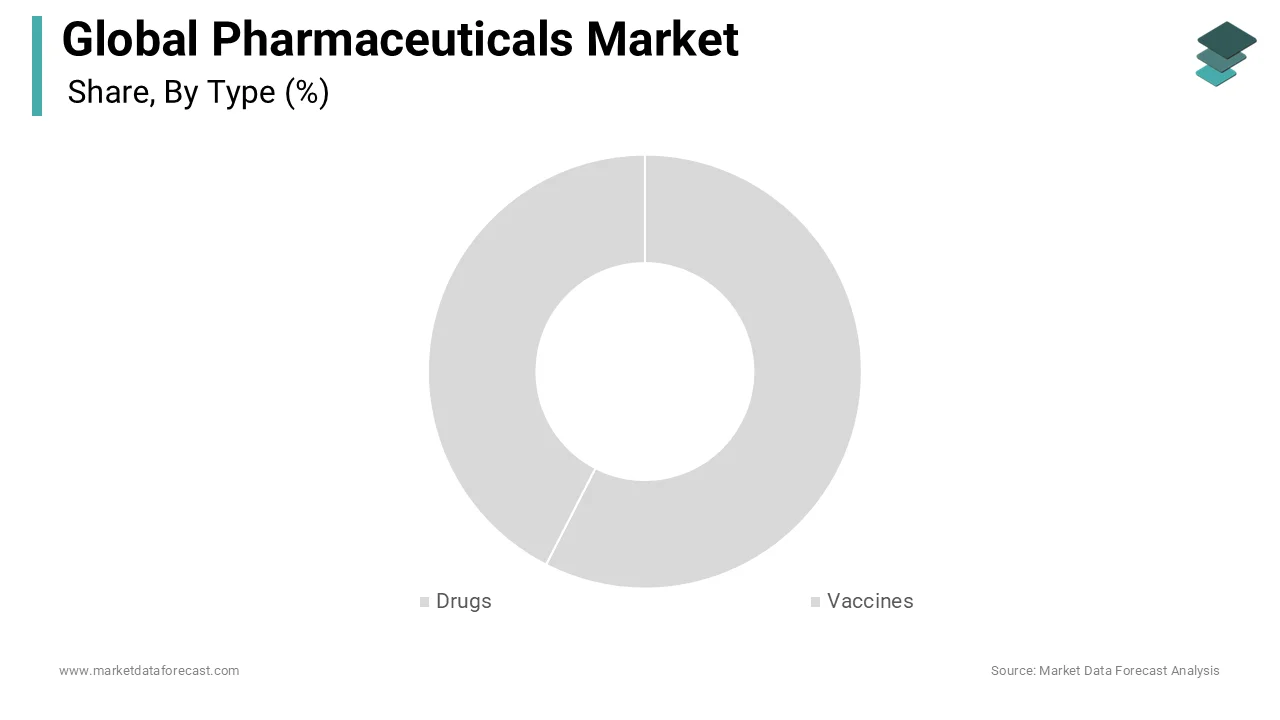
The drugs segment captured the dominant share of the pharmaceuticals market in 2024. It encompasses therapeutic areas like oncology, diabetes, infectious diseases, cardiology, neurology, respiratory, hypertension, and others. This dominance is due to heightened prevalence and public awareness of chronic illnesses such as cancer and diabetes, together driving sustained demand for both generics and specialty prescription drugs. The unrelenting rise in chronic diseases, including burgeoning cancer and diabetes cases, is injecting continuous momentum into drug consumption globally, especially in prescription and generic formats. The flexibility and breadth of the “drugs” category, spanning multiple therapeutic classes, foster widespread demand and quicker replenishment vs. vaccines, which are typically episodic and preventive in nature.
The biologics and biosimilars segment represents the fastest-growing subset in terms of revenue trajectory. The complexity of these therapies aligns with rising needs for personalized and targeted treatments, especially in oncology and autoimmune disorders, pushing uptake rapidly upward. Scientific and manufacturing capabilities have matured, enabling faster approvals and production scaling. Their elevated clinical value justifies premium pricing and accelerates growth despite their higher cost of development.
By Distribution Channel Insights
The hospital pharmacies segment accounted for the highest share at 54.6% of pharmaceutical distribution globally in 2024. Their dominance is because of the hospital setting’s high patient footfall, acute care demands (especially for time-sensitive medications), and policy-backed procurement systems. Also, hospitals serve as primary sites for treating severe or complex conditions requiring specialized meds; they integrate drug dispensing within overall care pathways. Strategic health system funding and institutional formularies channel drug spend through hospital pharmacies more consistently than retail venues.
The retail pharmacies segment is expanding briskly and is outpacing hospital distribution in its growth trajectory. It is driven by evolving patient behavior and service evolution. Expansion of chronic disease management at the point-of-care, with retail chains offering supplementary clinical services and convenience. Rising adoption of omni-channel models, merging physical retail with e-pharmacy capabilities, supported by digital investments in chains, and rising consumer comfort with online drug fulfilment.
REGIONAL ANALYSIS
North America Pharmaceuticals Market Insights

North America reigned in supremacy and held 41.9%of the global pharmaceutical market in 2025–2033, making it the dominant region worldwide. Its commanding presence stems from robust R&D ecosystems, fast regulatory approval cycles, heavy investment in biologics and specialty medications, a high chronically ill patient base, and well-funded health infrastructure. These dynamics ensure North America remains the market’s locomotive.
Europe Pharmaceuticals Market Insights
Europe has a stable strength in the global pharmaceuticals industry. Mature healthcare systems, progressive biosimilar uptake, and strong biopharmaceutical research pipelines (especially in Germany, France, UK) are key pillars of its market resilience.
Asia-Pacific Pharmaceuticals Market Insights
Asia-Pacific is the fastest-growing regional market and is a momentum powerhouse. Evolving healthcare infrastructure, rising middle-class demand, and industrial scaling in China and India are fueling a steep regional ascent.
Latin America Pharmaceuticals Market Insights
Latin America’s share is modest yet rising. Brazil leads regional growth, propelled by increased healthcare funding and government-led access initiatives. Hospital channels continue to dominate distribution, supported by partial retail expansion.
Middle East & Africa Pharmaceuticals Market Insights
This region is nascent but expanding as healthcare systems modernize and governments invest in biopharma capacity. Saudi Arabia, in particular, is enhancing access to pharmaceuticals, again led by hospital channels, yet gradually diversifying through retail.l
KEY MARKET PLAYERS
Some of the noteworthy companies in the global pharmaceuticals market profiled in this report are Pfizer Inc. (U.S.) Johnson & Johnson Services Inc. (U.S.) GSK plc. (U.K.) Novartis AG (Switzerland) Merck & Co., Inc. (U.S.) Sanofi (France) F. Hoffmann-La Roche Ltd. (Switzerland) AstraZeneca (U.K.) Novo Nordisk A/S (Denmark)
TOP LEADING PLAYERS IN THE MARKET
Takeda
Takeda has deepened its engagement across the Asia Pacific by integrating India’s clinical infrastructure into its global development efforts. The company is evaluating conducting global drug trials in India to accelerate innovation deployment and access to advanced oncology, neuroscience, gastrointestinal, and inflammatory treatments, according to recent insights from its India leadership at Takeda. Furthermore, it has launched an innovation center in Bengaluru, expanding its workforce focused on AI, data science, and engineering, underscoring its commitment to regional and global digital transformation.
Aurobindo Pharma
India-based Aurobindo Pharma is pursuing deeper roots in the Asia Pacific through strategic moves in biologics and generics. In May 2024, its subsidiary TheraNym Biologics signed an agreement with Merck & Co. to expand biologics manufacturing capacity and evaluate contract manufacturing operations for complex molecules, a forward-looking step toward high-value production in the region. In addition, Aurobindo is leading negotiations for a potential US$5.5 billion acquisition of Zentiva, a major European generic drugmaker, signaling its ambitions to diversify reach and strengthen supply across Asia and beyond.
Samsung Biologics
Samsung Biologics asserts its role as a powerhouse in Asia-based biopharma manufacturing. It has forged partnerships with 16 of the top 20 global biopharmaceutical companies, offering contract manufacturing services from high-impact deals with GSK through to recent multi-hundred-million-dollar engagements with Pfizer for biosimilars production. It also supported pandemic-era responses by providing fill-finish and packaging for mRNA vaccines and antibody therapies. These moves position Samsung Biologics as a cornerstone of biologics supply in the region.
TOP STRATEGIES USED BY KEY MARKET PARTICIPANTS
Companies like Takeda are embedding Asia Pacific into their clinical and innovation pipelines through local centers and trial operations in India, enhancing regional agility and access. Samsung Biologics partners with global pharma firms to secure large-scale biologics manufacturing contracts, reinforcing its role as a vital production hub. Aurobindo Pharma seeks scale and diversification through biologics deals such as its agreement with Merck and the proposed acquisition of Zentiva, extending its manufacturing footprint and technological capabilities.
COMPETITION OVERVIEW
Competition in the pharmaceuticals market today unfolds as a dynamic interplay between innovation, regional expansion, and efficiency. Traditional giants and agile regional players are vying to capture Asia Pacific’s rising significance not through market-share megaphones, but through strategic depth. Takeda leverages India’s trial ecosystem and talent pools to fast-track novel therapies. Samsung Biologics enhances supply reliability by delivering large-scale, high-quality manufacturing for global biologics, attracting top-tier partners. Aurobindo strengthens its bid through vertical expansion, growing advanced biologics capability, and pursuing the acquisition of European generics platforms. Collectively, these strategies reflect a competitive landscape reshaped by regional integration, technology-led partnerships, and a shift from mere sales volume to innovation architecture and ecosystem presence.
RECENT MARKET DEVELOPMENTS
- In March 2025, Sun Pharma announced the acquisition of Checkpoint Therapeutics, a US-based immunotherapy and targeted oncology company, for US$355 million. This market move elevates Sun Pharma’s presence in advanced oncology therapeutics and strengthens its Asia-Pacific footprint by integrating cutting-edge immuno-oncology capabilities into its portfolio. This acquisition aligns with Sun Pharma’s strategic intent to access high-value biologics and broaden its technological depth across international markets.
- In May 2024, TheraNym Biologics, a subsidiary of Aurobindo Pharma, entered into a partnership with Merck & Co. to enhance biologics manufacturing capacity and explore contract manufacturing operations. This pharmaceutical market collaboration strengthens Aurobindo’s technical capabilities in biologics production and positions the company to deliver complex therapies across the Asia Pacific, marking a pivotal step into advanced biologics manufacturing.
- In March 2025, AstraZeneca pledged a US$2.5 billion investment in research and manufacturing facilities in Beijing over the next five years. This pharmaceutical market investment, conducted in partnership with local biotech firms and the Beijing Cancer Hospital, includes creating an AI-powered data science lab. It is designed to accelerate early-stage research, clinical development, and regional production, reinforcing AstraZeneca’s Asia-focused innovation infrastructure.
MARKET SEGMENTATION
This research report on the global pharmaceuticals market has been segmented and sub-segmented based on type, distribution channel, and region.
By Type
- Drugs
- Oncology
- Diabetes
- Infectious Diseases
- Cardiology
- Neurology
- Respiratory
- Hypertension
- Others
- Vaccines
- Viral Diseases
- Bacterial Diseases
By Distribution Channel
- Hospital Pharmacies
- Retail Pharmacies
- Online Pharmacies
By Region
- North America
- Europe
- Asia-Pacific
- Middle East Africa
- Latin America