- Product Description Description
- Table of Contents TOC
- List of Table & Figure LOT
- Get Free Sample PDF Sample PDF
Market Size, 2025
$2.28 BnMarket Estimate, 2026
$2.47 BnMarket Forecast, 2034
$4.65 BnCAGR, 2026–2034
8.23%Asia Pacific Compressed Air Treatment Equipment Market Size
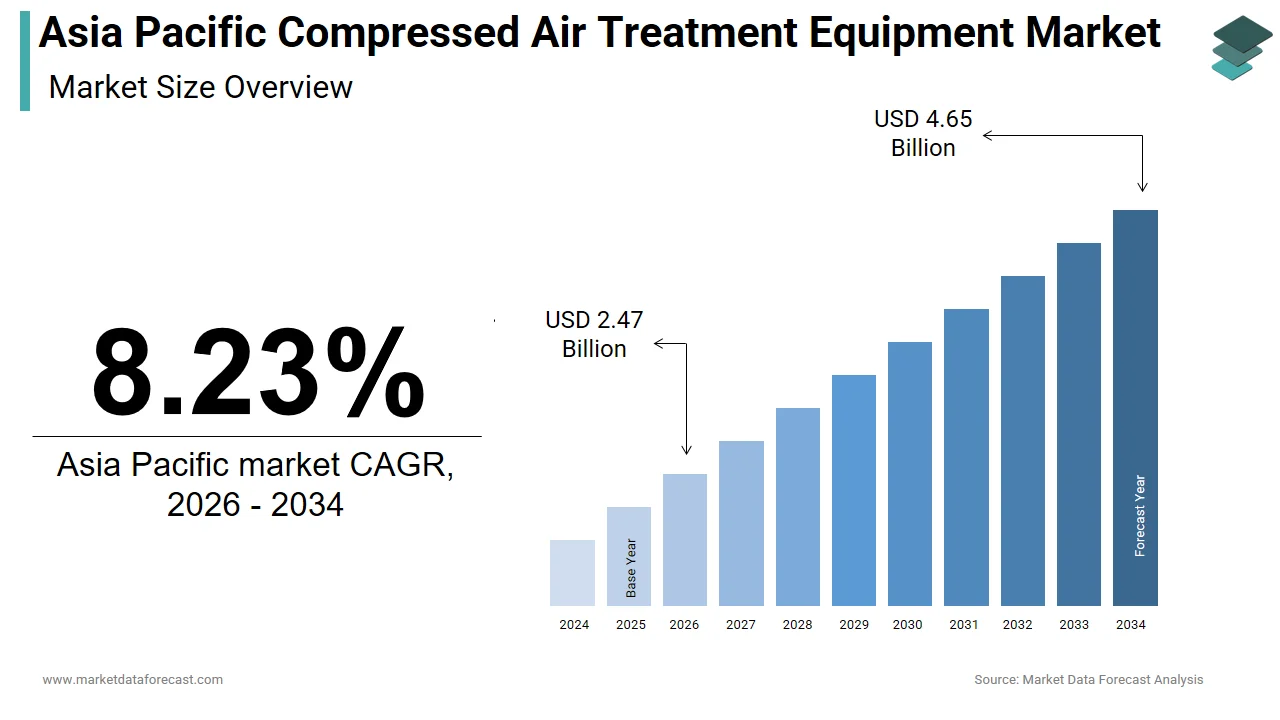
The size of the Asia Pacific compressed air treatment equipment market was valued at USD 2.28 billion in 2025. This market is expected to grow at a CAGR of 8.23% from 2026 to 2034 and be worth USD 4.65 billion by 2034 from USD 2.47 billion in 2026.
Compressed air treatment equipment is a range of systems designed to purify compressed air by removing contaminants such as moisture, oil, and particulate matter. These systems are essential for ensuring the efficiency, longevity, and safety of industrial operations that rely on clean and dry compressed air. The Asia Pacific compressed air treatment equipment market encompasses products like filters, dryers, aftercoolers, and condensate management units, all of which play a critical role in sectors including manufacturing, pharmaceuticals, food & beverage, chemicals, and energy.
As industries across the region adopt more advanced automation and precision-based production methods, the demand for high-quality compressed air has surged. In addition, regulatory bodies such as the Ministry of Environment in Japan and the Central Pollution Control Board in India have mandated stricter air quality standards, compelling manufacturers to invest in superior air purification systems.
The growth of semiconductor fabrication in South Korea and Taiwan, where even trace amounts of contamination can lead to costly production failures, further underscores the strategic importance of compressed air treatment technologies. This trend is driving innovation and investment in ultra-clean air solutions, reinforcing the market’s significance within the broader industrial landscape.
MARKET DRIVERS
Surge in Industrial Automation and Smart Manufacturing
The rapid adoption of industrial automation and smart manufacturing practices across the Asia Pacific is a key driver for the compressed air treatment equipment market. Automated production lines, robotic assembly systems, and precision control mechanisms increasingly depend on clean, dry, and contaminant-free compressed air to ensure operational reliability and product integrity.
According to the International Federation of Robotics (IFR), approximately 70% of global industrial robot installations in 2023 were concentrated in the Asia Pacific region, with China alone deploying over 200,000 units. These robots are often used in applications such as welding, painting, and material handling, where even minor air impurities can cause system malfunctions or defective outputs. In response, manufacturers are investing heavily in high-efficiency filtration and drying systems to maintain optimal air quality.
In India, the government's "Production-Linked Incentive (PLI) Scheme" has spurred domestic manufacturing in electronics and automotive components, both of which rely extensively on compressed air. Moreover, the expansion of semiconductor and electronics manufacturing in countries like South Korea and Malaysia has intensified the need for Class 0-rated compressed air systems. These developments are fueling sustained demand for high-performance compressed air treatment equipment across the Asia Pacific.
Expansion of Food & Beverage Processing Infrastructure
The growing scale and sophistication of food and beverage processing infrastructure in the Asia Pacific region is another major driver for the compressed air treatment equipment market. With rising disposable incomes, urbanization, and changing dietary habits, there has been a surge in packaged food consumption, necessitating stringent hygiene and safety measures throughout the production chain.
According to the Food and Agriculture Organization (FAO), the Asia Pacific accounts for over 40% of global food production, with countries like Thailand, Indonesia, and Vietnam emerging as key exporters of processed foods. In Thailand, packaged food exports grew in recent years, driven largely by investments in modern bottling, filling, and packaging lines that rely on compressed air for operation. Ensuring the purity of this air supply is critical to preventing microbial contamination and maintaining product shelf life.
In addition, the rise of centralized dairy and beverage processing hubs in Australia and New Zealand has further boosted demand for reliable air purification solutions. These trends are playing a pivotal role in driving the regional compressed air treatment equipment market.
MARKET RESTRAINTS
High Cost of Advanced Air Treatment Systems
The high cost associated with advanced treatment systems is one of the primary restraints affecting the Asia Pacific compressed air treatment equipment market. High-efficiency filters, desiccant dryers, and condensate separators often require significant upfront investment, which can be prohibitive for small and medium-sized enterprises (SMEs) operating on tight budgets. According to the Asian Development Bank (ADB), SMEs account for over 95% of all businesses in the Asia Pacific, yet few invest in premium-grade compressed air treatment solutions due to financial constraints.
Furthermore, the integration of these systems into existing compressed air networks often requires extensive engineering modifications, increasing overall project costs. In addition, maintenance expenses for high-performance systems such as periodic filter replacements and desiccant regeneration add to the long-term financial burden. These financial challenges continue to limit the adoption of high-end compressed air treatment technologies.
Regulatory Compliance Complexity and Environmental Restrictions
Stringent regulatory requirements and environmental compliance standards pose a significant challenge for the compressed air treatment equipment market in the Asia Pacific. Governments across the region are enforcing tighter norms on emissions, air quality, and energy efficiency, compelling manufacturers to adopt cleaner and more sustainable technologies. Compliance with such regulations often necessitates the deployment of high-efficiency particulate and oil removal filters, which can add up to the total system cost.
In India, the National Clean Air Programme (NCAP) has imposed stricter limits on particulate emissions from industrial sources, impacting over 100 industrial clusters. Moreover, refrigerant-based dryers are facing scrutiny due to their greenhouse gas emissions. According to the United Nations Environment Programme (UNEP), hydrofluorocarbons (HFCs) used in such equipment contribute significantly to global warming potential. Several countries in the region, including Japan and South Korea, are phasing out older models, pushing manufacturers toward more expensive but eco-friendly alternatives like membrane or regenerative dryers.
These compliance demands are slowing down market growth in some areas and posing a considerable restraint on industry expansion.
MARKET OPPORTUNITIES
Growth in Renewable Energy Infrastructure
The rapid development of renewable energy infrastructure presents a substantial opportunity for the Asia Pacific compressed air treatment equipment market. Wind farms, solar power plants, and hydrogen production facilities increasingly rely on compressed air for turbine control, panel cleaning, and process automation, necessitating efficient air purification systems.
According to the International Renewable Energy Agency (IRENA), the Asia Pacific accounted for over 60% of global renewable energy capacity additions in 2023. China and India led this expansion, with combined solar and wind installations exceeding 900 gigawatts. These energy facilities use compressed air in various applications, including pitch control systems in wind turbines and robotic cleaning mechanisms in photovoltaic farms, where air purity directly impacts performance and longevity. In Japan, the Ministry of Economy, Trade and Industry (METI) has set a target of 3 million tons of annual hydrogen production by 2030, requiring extensive use of ultra-clean compressed air systems.
Increasing Demand from the Pharmaceutical Sector
The pharmaceutical industry in the Asia Pacific is experiencing robust growth, driven by rising healthcare spending, expanding biotech research, and increasing demand for generic drugs. This sector relies heavily on compressed air for tablet coating, powder handling, and sterile packaging, making air purity a critical factor in ensuring product safety and regulatory compliance. Japan remains a global leader in biopharmaceutical innovation, with companies investing heavily in state-of-the-art manufacturing facilities. This regulatory scrutiny intensifying and pharmaceutical production expanding is offering strong opportunities for market players across the Asia Pacific.
MARKET CHALLENGES
Complexity in System Integration and Technical Expertise Gaps
The complexity involved in integrating advanced treatment systems with existing compressed air infrastructure is one of the foremost challenges confronting the Asia Pacific compressed air treatment equipment market. Many industrial facilities, particularly in developing economies, operate legacy systems not designed to accommodate modern, high-efficiency treatment units. Retrofitting these systems requires specialized engineering knowledge, custom modifications, and extended downtime, all of which can deter adoption. This skill gap results in reliance on external consultants or OEM services, escalating project costs and timelines. Moreover, discrepancies in international and local standards complicate equipment compatibility assessments. Also, the shortage of trained service personnel to handle advanced diagnostics and preventive maintenance further exacerbates the issue. These challenges hinder the seamless deployment of high-performance air treatment equipment.
Supply Chain Disruptions and Component Shortages
Supply chain disruptions and shortages of critical components have emerged as a persistent challenge for the compressed air treatment equipment market in the Asia Pacific. The region, which serves as both a manufacturing hub and a major consumer market, has faced logistical bottlenecks, raw material scarcity, and fluctuating freight costs, all of which impact production timelines and equipment availability.
Countries like Vietnam and Malaysia, which rely heavily on imported components for compressor and dryer manufacturing, experienced lead times extending beyond six months for key parts such as refrigeration compressors and desiccant materials. Moreover, the semiconductor shortage, though primarily associated with the automotive and electronics sectors, has indirectly impacted the compressed air industry by delaying the supply of programmable logic controllers (PLCs) and digital monitoring systems used in smart dryers and filters. As per the Semiconductor Industry Association (SIA), global chip deliveries remained below pre-pandemic levels in early 2023. Currency fluctuations have further compounded the problem, making imported components more expensive. These supply-side pressures are posing a significant challenge to market expansion in the region.
REPORT COVERAGE
| REPORT METRIC | DETAILS |
| Market Size Available | 2025 to 2034 |
| Base Year | 2025 |
| Forecast Period | 2026 to 2033 |
| Segments Covered | By Product, Application, End-user, and Region. |
| Various Analyses Covered | Global, Regional and Country-Level Analysis, Segment-Level Analysis, Drivers, Restraints, Opportunities, Challenges; PESTLE Analysis; Porter’s Five Forces Analysis, Competitive Landscape, Analyst Overview of Investment Opportunities |
| Countries Covered | India, China, Japan, South Korea, Australia, New Zealand, Thailand, Malaysia, Vietnam, Philippines, Indonesia, Singapore, Rest of APAC |
| Market Leaders Profiled | Atlas Copco AB, Airfilter Engineering, Beko Technologies, BOGE, Chicago Pneumatic, Sanmina Corporation, Ingersoll-Rand, and Mann+Hummel. |
SEGMENTAL ANALYSIS
By Product Insights
The filters segment held the commanding position by accounting for 34.6% in 2024. The increasing adoption of high-purity compressed air in sectors like pharmaceuticals, food & beverages, and semiconductor manufacturing is one of the key drivers behind the growth of filters segment. This dominance is primarily attributed to their indispensable role in removing contaminants such as oil, water, and particulate matter from compressed air systems across a wide range of industrial applications. Besides, aging infrastructure in Japan and South Korea has led to a surge in retrofitting projects, where outdated filtration systems are replaced with high-efficiency variants.
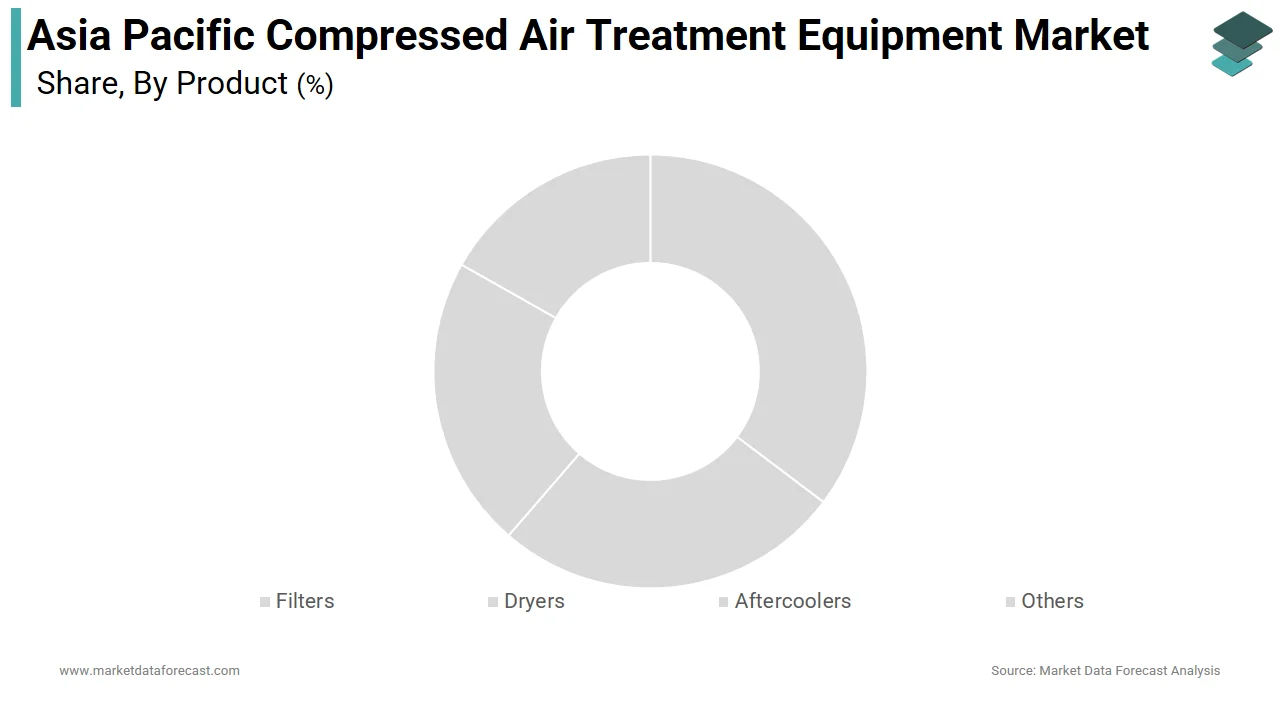
The dryers segment is projected to grow at the fastest CAGR of 6.9% during the forecast period in the Asia Pacific compressed air treatment equipment market. The expansion of energy-intensive industries such as petrochemicals and natural gas processing, where moisture-laden air can cause severe operational disruptions, is a major contributing factor for the growth of dryers segment. This rapid progress is driven by rising industrialization and the need for moisture-free compressed air in precision-dependent manufacturing processes. Also, natural gas consumption in the region increased in 2024, particularly in China, leading to heightened demand for desiccant and refrigerated dryers to prevent pipeline corrosion and equipment failure. Moreover, advancements in energy-efficient dryer technologies are gaining traction among environmentally conscious manufacturers. These trends are positioning dryers as the fastest-growing segment in the Asia Pacific compressed air treatment equipment market.
By End Use Insights
The chemical industry was the prevailing end-use segment in the Asia Pacific compressed air treatment equipment market by representing 23.6% in 2024. The rapid industrialization and expansion of chemical manufacturing hubs in countries like China, India, and South Korea is one of the primary drivers of the growth of the chemical industry. This dominance is credited to the sector’s reliance on clean, contaminant-free compressed air for critical processes such as chemical synthesis, reactor control, and packaging operations. Furthermore, stringent safety regulations imposed by bodies such as the Occupational Safety and Health Administration (OSHA) in Australia have mandated the use of certified compressed air treatment equipment in chemical handling facilities. These factors strengthen the segment's position as the dominant consumer of compressed air treatment solutions in the Asia Pacific region.
The food & beverages industry is emerging as the fastest-growing end-use segment and is likely to register a CAGR of 7.4% in the Asia Pacific compressed air treatment equipment market. This growth of the food & beverages industry is fueled by rising consumer demand for packaged and processed foods, coupled with tightening hygiene regulations across the supply chain. The surge in investment in automated food processing facilities, particularly in Southeast Asian economies, is another significant growth catalyst for the food & beverages industry. In addition, regulatory authorities such as the Singapore Food Agency (SFA) and Japan’s Ministry of Health, Labour and Welfare have emphasized food safety and contamination control. This has led to widespread adoption of high-efficiency coalescing and sterilizing filters, boosting equipment demand. In India, the government approved the Scheme for Mega Food Parks, which facilitated the establishment of over 40 integrated processing zones, each requiring advanced air purification systems. These developments highlight the strong momentum driving the food & beverage segment’s rapid expansion in the region.
By Application Insights
The plant/shop air segment remained the top-performing application in the Asia Pacific compressed air treatment equipment market by capturing 34.5% of total volume in 2024. The extensive usage of compressed air in automotive, metalworking, and textile industries, which form the backbone of manufacturing in countries like China, India, and Indonesia, is one of the primary reasons for the growth of the plant/shop air segment. Moreover, the increasing adoption of Industry 4.0 technologies, including automated pneumatic tools and robotics, has intensified the demand for reliable and clean plant air. These factors ensure that Plant/Shop Air remains the most substantial application segment in the Asia Pacific compressed air treatment equipment market.
The breathing air application segment is anticipated to witness the highest growth rate and is expanding at a CAGR of 8.1% from 2025 to 2033 in the Asia Pacific compressed air treatment equipment market. This quick expansion of the breathing air application segment is primarily driven by increasing occupational health and safety concerns across industrial, construction, and healthcare settings. The rising emphasis on worker safety in hazardous environments such as mining, offshore drilling, and chemical processing is One of the key growth enablers is another key growth enabler for the breathing air application segment. According to the International Labour Organization (ILO), over 1.2 million workplace fatalities occur annually worldwide, with respiratory hazards being a leading cause. In response, governments across the Asia Pacific are strengthening safety protocols, particularly in Australia and New Zealand, where occupational health and safety regulators mandate the use of Grade D or higher certified breathing air systems in high-risk industries. Besides, the healthcare sector is witnessing a surge in demand for medical-grade breathing air systems, especially post-pandemic. Furthermore, the construction boom in Southeast Asia, which is driven by urbanization and infrastructure development, has increased demand for portable breathing air compressors. This makes breathing air one of the most rapidly evolving application areas in the region’s compressed air treatment equipment market.
COUNTRY LEVEL ANALYSIS
China Compressed Air Treatment Equipment Market Insights
China held the largest market share and accounted for 32.1% of the regional compressed air treatment equipment market in 2024. As the world’s leading manufacturing hub, China’s industrial base heavily relies on compressed air systems for automotive, electronics, and chemical production. A key growth driver is the government’s push toward smart manufacturing and energy efficiency under the "Made in China 2025" initiative. This policy encourages the adoption of high-efficiency compressed air treatment technologies to reduce energy consumption and emissions. A further contributing factor is the expansion of renewable energy and semiconductor manufacturing. These developments solidify China’s leading position in the Asia Pacific compressed air treatment equipment market.
India Compressed Air Treatment Equipment Market Insights
India remains a significant player in the Asia Pacific compressed air treatment equipment market. The country’s rapid industrialization, bolstered by government-led initiatives such as "Make in India" and "Atmanirbhar Bharat," has spurred demand for high-quality compressed air systems across sectors like automotive, pharmaceuticals, and food processing. This expansion has been accompanied by a surge in capital investments in modern industrial infrastructure. An additional major growth driver is the implementation of stringent regulatory standards by agencies such as the Food Safety and Standards Authority of India (FSSAI) and the Central Pollution Control Board (CPCB). Also, the expansion of micro, small, and medium enterprises (MSMEs) has contributed significantly to market growth. These factors show India’s strong market position and sustained growth potential in the compressed air treatment equipment sector.
Japan Compressed Air Treatment Equipment Market Insights
Japan occupies a notable position in the Asia Pacific compressed air treatment equipment market. Known for its advanced industrial ecosystem, Japan extensively utilizes high-performance compressed air systems in the automotive, electronics, and precision manufacturing sectors. A key driver of market growth is the country’s focus on automation and energy efficiency. Moreover, Japan’s aging industrial infrastructure has prompted widespread retrofitting and upgrading of compressed air systems. This trend is further reinforced by stringent regulatory standards set by the Ministry of Health, Labour and Welfare. Also, the country’s commitment to hydrogen and fuel cell technology is creating new demand avenues. These factors collectively sustain Japan’s strong presence in the regional market.
South Korea Compressed Air Treatment Equipment Market Insights
South Korea holds a notable position in the Asia Pacific compressed air treatment equipment market. As a global leader in semiconductor manufacturing, automotive production, and electronics, South Korea's industrial landscape is highly dependent on clean, high-purity compressed air systems. A primary growth driver is the continued expansion of the semiconductor industry. These facilities require ultra-clean compressed air to prevent contamination in wafer processing and lithography equipment. In addition, the automotive sector remains a strong contributor to market growth. The adoption of electric vehicles (EVs) has further amplified demand for precision air systems in battery manufacturing and coating applications. Moreover, South Korea’s commitment to green manufacturing and energy efficiency has led to increased investments in low-energy dryers and high-efficiency particulate filters. These developments strengthen South Korea’s prominent market position in the Asia Pacific region.
Rest of Asia Pacific
Australia & New Zealand region stands out for its high adoption of premium and energy-efficient air treatment systems. It is driven by strict industrial safety regulations and a mature manufacturing ecosystem. Among the key growth factors is the robust presence of heavy industries such as mining, oil & gas, and food processing. In addition, to ensure operational reliability and worker safety, the Safe Work Australia (SWA) agency mandates the use of Grade D breathing air systems in underground mining operations. Besides, the food and beverage industry is another major consumer of compressed air treatment equipment.
New Zealand, though smaller in scale, is also witnessing growth due to rising investments in dairy processing and biotechnology. These regulatory and industrial dynamics position Australia & New Zealand as important contributors to the Asia Pacific compressed air treatment equipment market.
COMPETITIVE LANDSCAPE
The competition in the Asia Pacific compressed air treatment equipment market is intense, marked by the presence of both global leaders and regional specialists vying for dominance across diverse industrial landscapes. As industries increasingly prioritize operational efficiency, product quality, and regulatory compliance, demand for high-performance air treatment solutions has surged, prompting manufacturers to innovate and expand their offerings. Leading players distinguish themselves through continuous product development, integration of smart technologies, and enhanced after-sales services that cater to the unique requirements of different sectors. Additionally, the growing emphasis on energy conservation and environmental sustainability has further intensified rivalry, with companies striving to introduce eco-friendly, low-maintenance systems. While multinational corporations leverage established brand reputations and extensive distribution networks, regional players are capitalizing on cost advantages and localized expertise to capture market share. This dynamic environment fosters constant evolution, with companies adopting agile strategies to adapt to shifting economic conditions, regulatory frameworks, and technological advancements across the Asia Pacific region.
KEY MARKET PLAYERS
Some of the noteworthy companies in the Asia Pacific compressed air treatment equipment market profiled in this report are
- Atlas Copco AB
- Airfilter Engineering
- Beko Technologies
- BOGE
- Chicago Pneumatic
- Sanmina Corporation
- Ingersoll-Rand
- Mann+Hummel
TOP LEADING PLAYERS IN THE MARKET
One of the leading global players in the compressed air treatment equipment market is Atlas Copco. With a strong presence across the Asia Pacific, the company offers a comprehensive range of filters, dryers, and condensate management systems tailored for industrial applications. Atlas Copco’s focus on energy efficiency, innovation, and after-sales service has positioned it as a preferred supplier in sectors such as automotive, manufacturing, and pharmaceuticals. Its strategic partnerships and localized service centers across major APAC countries have significantly enhanced its regional footprint.
Another key player is Ingersoll Rand, known for its high-performance compressed air solutions under the Gardner Denver brand. The company provides advanced air treatment technologies that cater to diverse industries, including oil & gas, food & beverage, and electronics. In the Asia Pacific region, Ingersoll Rand has been instrumental in promoting sustainable operations through low-energy dryers and smart filtration systems. Its investment in R&D and customer-centric offerings has helped maintain a competitive edge in the market.
Donaldson Company Inc. is a major contributor to the compressed air treatment equipment sector, particularly in filtration. The firm specializes in high-efficiency particulate and coalescing filters used in critical applications across chemical processing, healthcare, and power generation. In the Asia Pacific region, Donaldson has built a robust distribution network and technical support system. Its commitment to product innovation and environmental compliance has made it a trusted name among industrial end-users seeking clean and safe compressed air solutions.
TOP STRATEGIES USED BY KEY MARKET PARTICIPANTS
Key players in the Asia Pacific compressed air treatment equipment market are leveraging product innovation and technological advancements to differentiate themselves in a competitive landscape. Companies are investing heavily in R&D to develop energy-efficient, compact, and smart air treatment systems that align with industry sustainability goals and digital transformation trends.
Another major strategy is strategic partnerships and collaborations, where manufacturers team up with local distributors, engineering firms, and automation solution providers to enhance market penetration and after-sales support. These alliances help companies better understand regional requirements and offer customized solutions tailored to specific industrial needs.
Lastly, expansion through mergers and acquisitions is being actively pursued to consolidate market position and strengthen regional presence. By acquiring smaller regional players or complementary technology providers, leading firms are enhancing their product portfolios and service capabilities, ensuring long-term competitiveness in the evolving APAC market.
RECENT MARKET DEVELOPMENTS
- In February 2024, Atlas Copco launched a new line of smart refrigerated dryers equipped with IoT-enabled monitoring features, specifically designed for high-humidity environments common in Southeast Asia. This move was aimed at improving system efficiency and reducing downtime for industrial users.
- In May 2024, Donaldson Company Inc. expanded its manufacturing facility in Shanghai, China, to increase production capacity for high-efficiency coalescing filters. The expansion supports the company’s strategy to meet rising demand from the pharmaceutical and food processing sectors in the region.
- In July 2024, Ingersoll Rand entered into a strategic partnership with a Japanese automation solutions provider to integrate compressed air treatment systems into smart factory setups across Japan and South Korea, enhancing performance monitoring and predictive maintenance capabilities.
- In September 2024, Hitachi Industrial Equipment Systems introduced an energy-saving membrane dryer series tailored for semiconductor and electronics manufacturing plants in Taiwan and South Korea, aligning with the region’s push for ultra-clean air standards.
- In November 2024, Kobe Steel Compressor Solutions announced the establishment of a regional service hub in Thailand to provide rapid maintenance and technical support for large-scale industrial clients, strengthening its presence in the ASEAN market.
MARKET SEGMENTATION
This Asia Pacific compressed air treatment equipment market research report is segmented and sub-segmented into the following categories.
By Product
- Filters
- Particulate filter/pre-filter
- Coalescing filter/oil removal
- Activated Carbon Filter
- Filtered Centrifugal Separator
- Others
- Dryers
- Refrigerated dryers
- Desiccant air dryers
- Membrane dryers
- Others
- Aftercoolers
- Others
By Application
- Plant/Shop Air
- Instrument Air
- Process Air
- Breathing Air
By End use
- Chemical
- Food & Beverages
- Automotive
- Pulp and Paper
- Pharmaceutical
- Others
By Country
- India
- China
- Japan
- South Korea
- Australia
- New Zealand
- Thailand
- Malaysia
- Vietnam
- Philippines
- Indonesia
- Singapore
- Rest Of APAC