- Product Description Description
- Table of Contents TOC
- List of Table & Figure LOT
- Get Free Sample PDF Sample PDF
Market Size, 2025
$17.35 BnMarket Estimate, 2026
$20.33 BnMarket Forecast, 2034
$72.17 BnCAGR, 2026–2034
17.15%Asia Pacific Concentrated Solar Power Market Size
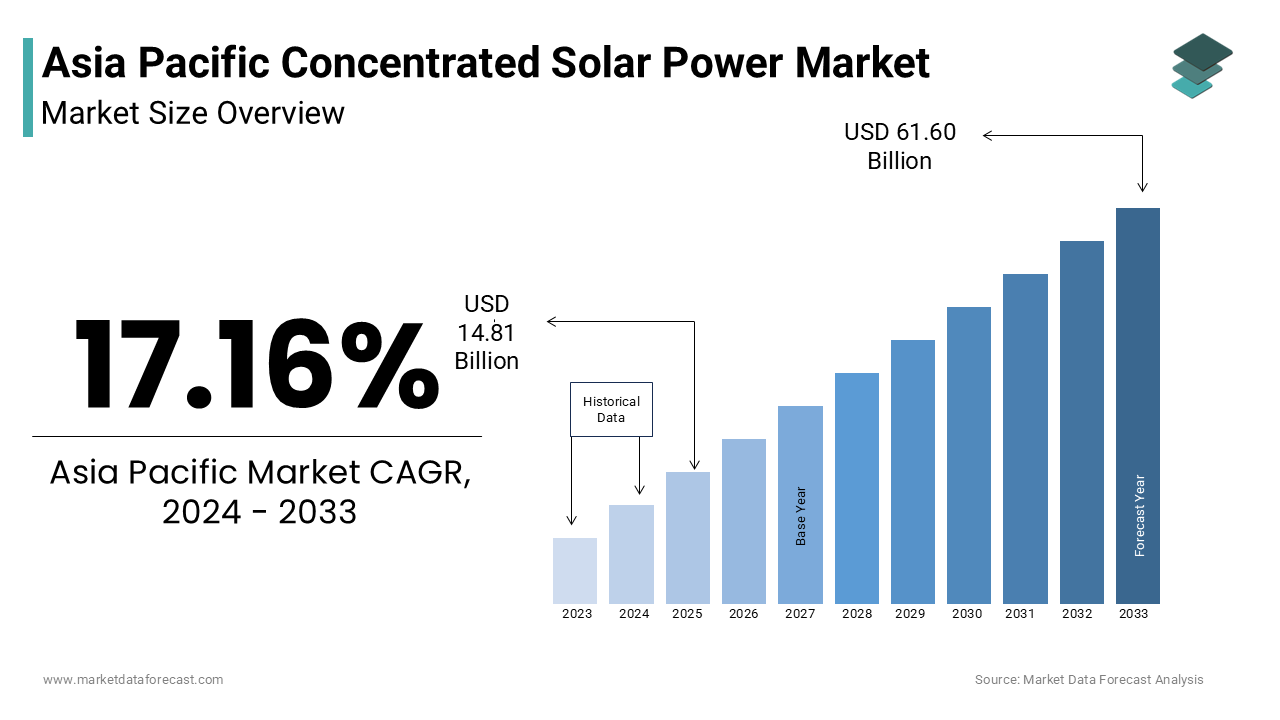
The Asia Pacific concentrated solar power market size was valued at USD 17.35 billion in 2025 and is anticipated to reach USD 20.33 billion in 2026 from USD 72.17 billion by 2034, growing at a CAGR of 17.16% during the forecast period from 2026 to 2034.
Concentrated Solar Power (CSP) is a renewable energy technology that utilizes mirrors or lenses to focus sunlight onto a small area, generating heat that drives a turbine or engine to produce electricity. Unlike photovoltaic systems that convert sunlight directly into electricity, CSP systems generate thermal energy that can be stored for later use, making them particularly suitable for baseload power applications. The Asia Pacific concentrated solar power market encompasses utility-scale CSP projects, research and development initiatives, and supporting infrastructure aimed at harnessing solar thermal energy across the region.
Despite the dominance of photovoltaic (PV) solar in the region, CSP is gaining attention for its ability to provide dispatchable renewable energy, especially in countries with high direct normal irradiation (DNI). Australia, China, and India are emerging as key markets due to their vast solar potential and government commitments to decarbonization.
Apart from these, as per the Asian Development Bank, CSP with thermal storage can play a strategic role in diversifying the energy mix and reducing reliance on fossil fuels. These factors, combined with rising corporate and government interest in long-duration clean energy solutions, are shaping the trajectory of the Asia Pacific concentrated solar power market.
MARKET DRIVERS
Government Incentives and Renewable Energy Targets
The growing number of government-backed incentives and national renewable energy targets is among the primary drivers of the Asia Pacific concentrated solar power market. Several countries in the region have introduced policy frameworks aimed at promoting clean energy development, including feed-in tariffs, tax incentives, and grants specifically designed for concentrated solar power projects.
China has been particularly proactive in this regard, with the National Development and Reform Commission (NDRC) launching a series of pilot CSP projects under its 13th and 14th Five-Year Plans. As part of these initiatives, the Chinese government provided preferential financing and guaranteed off-take agreements for CSP developers.
Similarly, India’s Ministry of New and Renewable Energy (MNRE) introduced a Viability Gap Funding (VGF) scheme to support CSP deployment in high-solar-potential regions such as Rajasthan and Gujarat. Such policy interventions have significantly improved investor confidence in the region’s CSP sector.
Rising Demand for Dispatchable Renewable Energy
The increasing demand for dispatchable renewable energy sources that can provide stable and continuous power supply beyond intermittent photovoltaic systems is also a key driver of the Asia Pacific concentrated solar power market. As countries strive to integrate higher shares of renewables into their grids, the ability of CSP systems to store thermal energy and generate electricity on demand is becoming a significant advantage.
Australia, with its high solar irradiation and growing energy demand, has recognized CSP with thermal storage as a viable solution for grid stability. The Australian Renewable Energy Agency (ARENA) has supported feasibility studies for hybrid CSP-PV projects in the Sunraysia and Kimberley regions, emphasizing the importance of dispatchable solar technologies.
MARKET RESTRAINTS
High Capital and Development Costs
The high initial capital investment required for CSP projects is one of the most significant restraints facing the Asia Pacific concentrated solar power market. Compared to photovoltaic solar systems, concentrated solar power plants involve complex thermal engineering, extensive mirror arrays, and integrated thermal storage systems, all of which contribute to elevated construction and deployment costs.
Also, the cost differential has led many investors and governments to prioritize photovoltaic solar, which offers quicker returns and lower risk.
In India, despite government incentives, CSP developers have struggled to secure financing due to concerns over project viability and payback periods exceeding 10–15 years.
Similarly, in China, although pilot CSP plants have been successfully commissioned, the high upfront costs have limited large-scale deployment beyond government-backed initiatives. As long as CSP remains more expensive than alternative renewables, its expansion in the Asia Pacific market will continue to face financial and investment-related barriers.
Land and Water Resource Constraints
The requirement for large tracts of land and significant water resources, which can pose logistical and environmental challenges, is another critical constraint affecting the Asia Pacific concentrated solar power market. CSP plants, particularly those using parabolic trough or tower-based technologies, require vast open spaces with high solar irradiation, often in arid or semi-arid regions where land use conflicts and ecological concerns are prevalent.
In Australia, despite abundant solar potential, CSP project developers have encountered difficulties in securing land rights due to competing agricultural and conservation interests. Several proposed CSP sites faced opposition from environmental groups citing habitat disruption concerns.
Water consumption is another pressing issue, particularly for wet-cooled CSP plants that rely on water-intensive processes for steam generation and heat dissipation. In China’s Gansu province, water scarcity has become a limiting factor for CSP expansion, prompting regulators to encourage the adoption of dry cooling technologies. However, these alternatives often reduce plant efficiency and increase operational costs.
MARKET OPPORTUNITIES
Integration with Thermal Storage and Hybrid Power Systems
The integration of CSP with thermal storage and hybrid power systems, which enhances the technology’s ability to provide continuous and reliable electricity generation, is a major opportunity for the Asia Pacific concentrated solar power market. Unlike photovoltaic systems, CSP with molten salt thermal storage can store excess heat and generate electricity even after sunset, making it a valuable asset for grid stability.
China has been at the forefront of this development, with several CSP plants in the Qinghai and Gansu provinces incorporating thermal storage systems capable of delivering power for up to 14 hours. These projects have demonstrated the ability to operate as semi-baseload power sources, reducing reliance on fossil fuels.
Australia is also exploring hybrid CSP-PV configurations to optimize solar resource utilization. The Australian Renewable Energy Agency (ARENA) has funded feasibility studies for integrated solar facilities in the Northern Territory and Western Australia, where CSP can provide dispatchable power while PV contributes to daytime generation.
Expansion of CSP in Industrial Process Heat Applications
Its growing application in industrial process heat (IPH) sectors, where high-temperature thermal energy is required for manufacturing, food processing, and chemical production, is another promising opportunity for the Asia Pacific concentrated solar power market. Unlike utility-scale power generation, IPH applications can benefit from smaller-scale CSP systems that directly supply heat for industrial use, offering a cost-effective and sustainable alternative to fossil fuel-based boilers.
India has been actively promoting CSP-based industrial heating solutions, particularly in textile, dairy, and agro-processing industries located in high-solar-potential regions such as Gujarat and Rajasthan.
China is also advancing in this domain, with the National Development and Reform Commission (NDRC) encouraging the adoption of solar thermal energy in medium-temperature industrial applications.
MARKET CHALLENGES
Competition from Low-Cost Photovoltaic Solar Technologies
The intense competition from low-cost photovoltaic (PV) solar technologies is one of the foremost challenges confronting the Asia Pacific concentrated solar power market. Over the past decade, PV systems have experienced significant cost reductions, making them the preferred choice for utility-scale and distributed solar energy projects across the region.
Also, the price advantage has led governments and private investors to prioritize PV over CSP, particularly in markets where dispatchable power is not an immediate requirement.
In India, for instance, the rapid expansion of PV capacity—driven by aggressive government targets and competitive bidding—has overshadowed CSP development. As per the Central Electricity Authority (CEA), PV installations accounted for over 95% of new solar capacity additions in 2023, leaving limited room for CSP projects.
Similarly, in China, while CSP pilot projects have demonstrated technical feasibility, the dominance of PV in the renewable energy mix has constrained large-scale CSP deployment.
Limited Technical Expertise and Supply Chain Constraints
The limited availability of technical expertise and well-developed supply chains for CSP components and systems is a critical challenge affecting the Asia Pacific concentrated solar power market. Unlike photovoltaic solar, which has a mature and widely accessible supply chain, CSP technology requires specialized engineering, precision manufacturing, and skilled labor for installation and operation.
In countries such as India and Indonesia, the lack of trained professionals in CSP-specific thermal engineering and plant operations has slowed project development.
China, despite its leadership in renewable energy, still imports several key CSP components, including high-precision mirrors and receiver tubes, due to limited domestic manufacturing capabilities. As per the China Renewable Energy Engineering Institute, supply chain bottlenecks contributed to delays in several CSP pilot projects.
Furthermore, the absence of standardized CSP equipment manufacturing across the region complicates procurement and increases costs.
SEGMENTAL ANALYSIS
By Technology Insights
The parabolic trough technology segment dominated the Asia Pacific concentrated solar power market by accounting for 60% of total installed capacity in 2024. Its maturity, proven performance, and widespread adoption in early-stage CSP projects across the region is largely attributed to the dominance of parabolic trough technology segment. China has been a major adopter of parabolic trough systems, particularly under its national pilot programs launched during the 13th Five-Year Plan. India has also favored this technology due to its compatibility with local manufacturing capabilities and ease of integration with conventional power cycles.
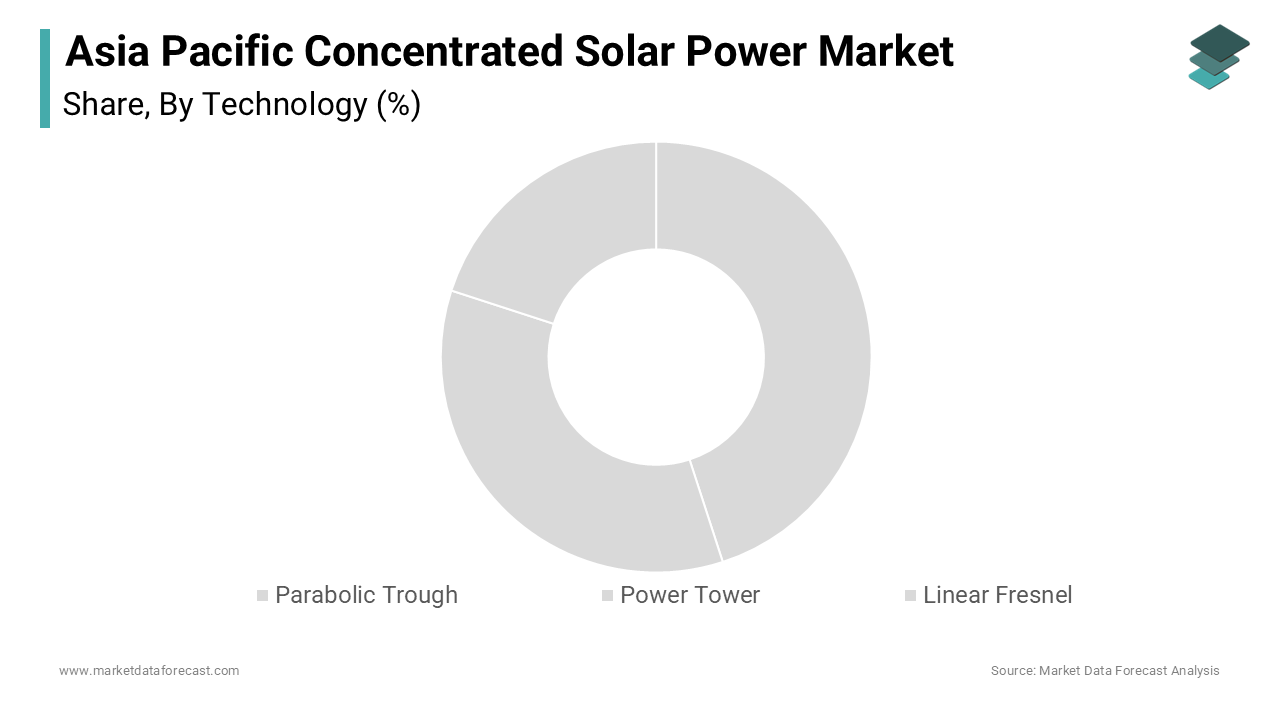
The power tower segment is emerging as the fastest-growing technology in the Asia Pacific concentrated solar power market and is projected to expand at a CAGR of 12.4% between 2025 and 2033. Its superior efficiency, scalability, and integration potential with thermal storage systems is propelling the rapid ascent of power tower segment. China leads this transition, with several large-scale power tower projects incorporating molten salt storage to enable continuous electricity generation beyond sunset. Australia is also exploring power tower configurations for hybrid renewable energy parks, particularly in regions with high direct normal irradiation (DNI). As per the Australian Renewable Energy Agency (ARENA) there is growing interest in this technology for utility-scale applications requiring dispatchable power.
By Application Insights
The utility application segment led the Asia Pacific concentrated solar power market by contributing a substantial share of total installed capacity in 2024. The nature of CSP technology, which is best suited for large-scale power generation rather than decentralized or residential use. China has been the primary driver of utility-scale CSP development, with state-backed projects aimed at diversifying the country’s energy mix and reducing reliance on coal-fired generation. Australia is also advancing utility-level CSP initiatives, particularly in remote areas where hybrid CSP-PV systems can provide stable power supply.
The non-residential application segment is experiencing the highest growth in the Asia Pacific concentrated solar power market and is likely expanding at a CAGR of 10.2% during the forecast period. Increasing adoption of CSP systems for industrial process heat and commercial operations, particularly in sectors requiring high-temperature thermal energy is fuelling the growth of non-residential application segment. India has emerged as a key market for non-residential CSP deployments, with textile mills, dairy processing units, and food manufacturers adopting solar thermal systems to reduce fuel costs. China is also promoting non-residential applications through subsidies and tax incentives targeting industrial consumers. CSP-based process heat installations increased, particularly in chemical and pharmaceutical industries.
REGIONAL ANALYSIS
China Concentrated Solar Power Market Insights
China led the Asia Pacific concentrated solar power market by capturing a 45.6% of total regional capacity in 2024. As part of its broader renewable energy strategy, the country has actively supported CSP development through targeted pilot projects and financial incentives. Under the 13th and 14th Five-Year Plans, the National Development and Reform Commission (NDRC) launched a series of CSP demonstrations in Gansu, Qinghai, and Inner Mongolia, aiming to test different technologies and assess their economic viability. Government-backed feed-in tariffs and guaranteed off-take agreements initially drove investor confidence, though recent reforms have shifted toward competitive bidding frameworks. Despite challenges related to cost competitiveness against photovoltaic solar, China continues to explore hybrid CSP-PV models and thermal storage integration to enhance grid stability.
India Concentrated Solar Power Market Insights
India is a significant player of the Asia Pacific concentrated solar power market. The country's CSP development has been guided by the National Solar Mission, which initially included dedicated provisions for concentrated solar power to complement photovoltaic solar expansion. The Ministry of New and Renewable Energy (MNRE) implemented a Viability Gap Funding (VGF) scheme to encourage private sector participation in CSP projects, particularly in Rajasthan and Gujarat. Despite slower-than-expected progress due to cost challenges and competition from PV solar, India continues to explore CSP for industrial process heat applications and hybrid renewable energy systems. State-run entities like NTPC and SECI are piloting projects that integrate CSP with thermal storage to enhance dispatchability.
Australia Concentrated Solar Power Market Insights
Australia holds a notable position in the Asia Pacific concentrated solar power market. The country’s high solar irradiation levels and growing need for dispatchable renewable energy have positioned CSP as a viable option for long-duration power generation. Besides, Western Australia and the Northern Territory have shown interest in CSP for remote mining and industrial applications, where reliable off-grid power solutions are required.
Japan Concentrated Solar Power Market Insights
Japan occupies a modest but growing presence in the Asia Pacific concentrated solar power market. Although the country is better known for its leadership in photovoltaic solar, there is increasing interest in CSP as a means to diversify renewable energy sources and enhance energy security. Following the Fukushima nuclear disaster, Japan has been actively seeking alternatives to fossil fuels and nuclear power. While CSP adoption remains limited, research institutions such as the National Institute of Advanced Industrial Science and Technology (AIST) are evaluating small-scale CSP applications for industrial heat and hybrid power generation. The Ministry of Economy, Trade and Industry (METI) is also assessing regulatory adjustments that could facilitate CSP integration into the national energy mix.
South Korea Concentrated Solar Power Market Insights
South Korea holds key position in the Asia Pacific concentrated solar power market. The country’s renewable energy strategy has traditionally focused on wind and photovoltaic solar, but recent developments suggest growing interest in CSP for specialized applications. The Korea Institute of Energy Research (KIER) has been leading research into CSP integration with thermal storage and hydrogen production, aligning with the government’s Green Hydrogen Roadmap. The Ministry of Trade, Industry and Energy (MOTIE) has also introduced pilot funding programs to evaluate CSP’s feasibility in combination with other renewables. Although large-scale CSP deployment remains unlikely due to land constraints and moderate solar irradiation, the country is exploring compact CSP modules for localized heat and power applications.
COMPETITVE LANDSCAPE
The competition in the Asia Pacific concentrated solar power market is shaped by a mix of international technology providers, domestic engineering firms, and state-backed utilities striving to capture opportunities in clean energy generation. While the market remains relatively niche compared to photovoltaic solar, growing interest in dispatchable renewables has attracted new entrants and expanded the scope for technological differentiation. Established players bring global expertise in CSP design and implementation, but success in the region increasingly depends on understanding local policy frameworks, resource conditions, and financial mechanisms. Domestic firms are leveraging their familiarity with regional markets to offer cost-effective alternatives, often in collaboration with foreign partners. At the same time, government-led initiatives and public-private partnerships are playing a critical role in shaping the competitive dynamics. As CSP evolves from pilot deployments to more commercial-scale applications, the ability to integrate with storage, reduce costs, and demonstrate reliability will determine leadership positions in the Asia Pacific market.
KEY MARKET PLAYERS
The key market players in the Asia Pacific Concentrated Solar Power Market include
- ACWA Power (Saudi Arabia)
- Abengoa Solar S.A. (Spain)
- BrightSource Energy, Inc. (U.S.)
- Siemens Energy AG (Germany)
- Acciona S.A. (Spain)
- Aalborg CSP A/S (Denmark)
- INITEC Energía S.A.U. (Spain)
- Enel Green Power S.p.A. (Italy)
- Torresol Energy Investments, S.A. (Spain)
- TSK Flagsol Engineering GmbH (Germany)
Top Players in the Asia Pacific Concentrated Solar Power Market
BrightSource Energy
BrightSource Energy is a leading global developer of concentrated solar power technology with a strong presence in the Asia Pacific region. The company specializes in power tower systems that utilize advanced heliostat and receiver technologies to generate large-scale, dispatchable renewable energy. BrightSource has played a pivotal role in advancing CSP innovation by collaborating with local governments and energy agencies in countries like China and Australia. Its expertise in thermal energy storage and grid integration has positioned it as a key contributor to the development of next-generation CSP plants in the region.
ACWA Power
ACWA Power has emerged as a major player in the Asia Pacific concentrated solar power market through strategic investments and project development partnerships. Known for its experience in utility-scale renewable energy projects, ACWA Power has been actively exploring joint ventures and consortium-based models to deploy CSP solutions in high-solar-potential regions. The company's emphasis on hybrid power systems integrating CSP with PV and storage aligns with regional energy diversification goals. ACWA Power’s involvement brings international best practices in financing, execution, and sustainability to the evolving CSP landscape in the Asia Pacific.
SENER Group
SENER Group is a globally recognized engineering firm that has made significant contributions to the growth of concentrated solar power in the Asia Pacific region. As a pioneer in parabolic trough and power tower technologies, SENER provides turnkey solutions including plant design, equipment supply, and technical advisory services. In collaboration with local developers and government agencies, SENER has supported the deployment of CSP plants in India and China, contributing to the expansion of clean baseload power capacity. The company’s commitment to innovation and long-term project support has reinforced its reputation as a trusted partner in the CSP sector across the Asia Pacific.
Top Strategies Used by Key Market Participants
One of the primary strategies employed by key players in the Asia Pacific concentrated solar power market is technology localization and adaptation. Companies are tailoring their CSP solutions to suit regional climatic conditions, land availability, and grid requirements, ensuring better performance and cost efficiency.
Another widely adopted approach is strategic partnerships and joint ventures with local firms, research institutions, and government entities. These collaborations help navigate regulatory landscapes, secure funding, and accelerate project execution while leveraging indigenous knowledge and infrastructure.
Lastly, integration with thermal storage and hybrid systems is gaining traction as a competitive strategy. By combining CSP with molten salt storage or photovoltaic solar, companies enhance dispatchability and economic viability, making concentrated solar power more attractive in markets transitioning toward flexible renewable energy portfolios.
RECENT MARKET DEVELOPMENTS
- In March 2024, BrightSource Energy announced a partnership with a leading Australian engineering firm to develop a utility-scale power tower CSP plant equipped with thermal storage, aiming to support continuous clean energy supply in remote mining regions.
- In February 2024, ACWA Power entered into a memorandum of understanding with a Chinese state-owned energy enterprise to co-develop hybrid CSP-PV projects in western China, combining both technologies to optimize solar utilization and grid stability.
- In January 2024, SENER Group launched an R&D initiative in collaboration with an Indian Institute of Technology to improve heliostat alignment precision in power tower systems, enhancing overall plant efficiency and reducing maintenance costs.
- In December 2023, Masdar, a global renewable energy company, initiated a feasibility study in Indonesia to assess the potential of CSP technology for industrial process heat applications, particularly in sugar and textile manufacturing sectors.
- In November 2023, KEPCO Engineering & Construction Co. signed an agreement with a Spanish CSP technology provider to evaluate the deployment of modular CSP units in South Korean islands, supporting off-grid decarbonization efforts.
MARKET SEGMENTATION
This research report on the Asia Pacific Concentrated Solar Power Market has been segmented and sub-segmented into the following categories.
By Technology
- Parabolic Trough
- Power Tower
- Linear Fresnel
By Application
- Residential
- Non-residential
- Utility
By Country
- India
- China
- Japan
- South Korea
- Australia
- New Zealand
- Thailand
- Malaysia
- Vietnam
- Philippines
- Indonesia
- Singapore
- Rest of APAC