- Product Description Description
- Table of Contents TOC
- List of Table & Figure LOT
- Get Free Sample PDF Sample PDF
Market Size, 2025
$13.02 BnMarket Estimate, 2026
$14.05 BnMarket Forecast, 2034
$24.24 BnCAGR, 2026–2034
7.06%Asia Pacific Crane Rental Market Summary
The Asia Pacific crane rental market was valued at USD 13.02 billion in 2025 and is anticipated to reach USD 14.05 billion in 2026 to reach USD 24.24 billion by 2034, growing at a CAGR of 7.06% during the forecast period from 2026 to 2034.
Key Market Trends & Insights
- China stood as the undisputed leader in the Asia Pacific Market in 2025.
- India is emerging as the most dynamic growth engine in the regional market in 2025.
- Japan maintains a strong position in the regional market in 2025.
- Based on Type, the mobile crane segment dominated the Asia Pacific market in 2025.
- Based on End-User, the building and construction sector commanded the largest share in 2025.
- Based on Weightlifting Capacity, the heavy-lift segment (80–300 tons) led the Asia Pacific market in 2025.
Market Size & Forecast
2025 Market Size: USD 14.05 Billion
2034 projected Market Size: USD 24.24 Billion
CAGR (2026 to 2034): 7.06%
China: Largest Market in 2025
India: Strongest Growth Region
Asia Pacific Crane Rental Market Size
The Asia Pacific crane rental market size was valued at USD 13.02 billion in 2025 and is anticipated to reach USD 14.05 billion in 2026 to reach USD 24.24 billion by 2034, growing at a CAGR of 7.06% during the forecast period from 2026 to 2034.
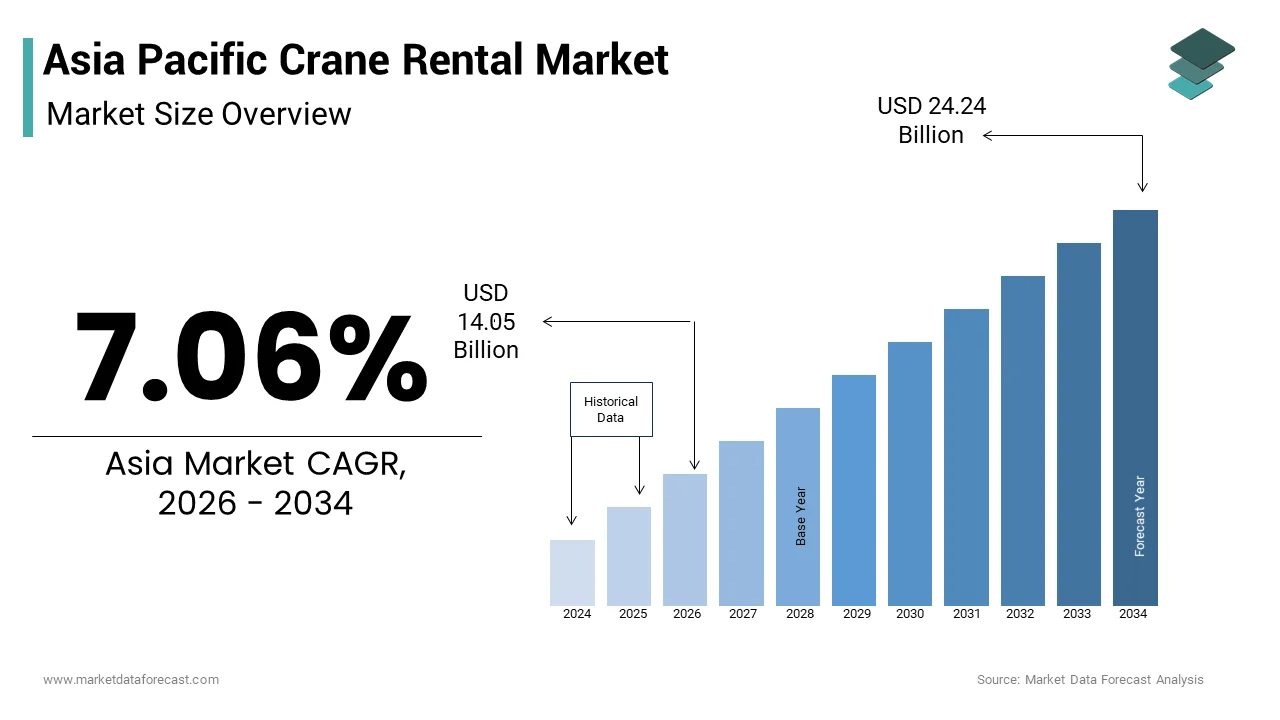
Crane rental refers to the temporary provisioning of lifting equipment, ranging from tower, mobile, and crawler cranes to specialized variants, across construction, infrastructure, energy, and industrial sectors throughout the region. Unlike direct procurement, crane rental allows project-based access to high-capacity machinery, minimizing capital expenditure while enabling scalability and operational agility. This model has gained prominence due to the region’s fragmented construction landscape, where short-to-medium-term projects dominate and demand fluctuating equipment needs. The market is intricately tied to urbanization trajectories, regulatory frameworks governing construction safety, and advancements in crane technology, including telematics and remote monitoring systems. Regulatory emphasis on worksite safety further reinforces reliance on professionally maintained rental fleets. These dynamics collectively shape a service-driven ecosystem where flexibility, compliance, and technological integration define competitive advantage.
MARKET DRIVERS
Expansion of Urban Infrastructure and High-Rise Construction
The proliferation of vertical urban development across the Asia Pacific is a pivotal force accelerating crane rental adoption. Rapid urbanization has triggered a surge in high-rise construction, particularly in densely populated cities where land scarcity necessitates upward expansion. This architectural shift demands tower cranes and advanced lifting systems that are cost-prohibitive for one-off projects, making rental models economically rational. The projects typically span 2–5 years, aligning perfectly with medium-term rental agreements. Furthermore, the complexity of urban sites, constrained spaces, traffic logistics, and safety mandates favors rental providers who offer engineered lifting plans and certified operators. As per the McKinsey Global Institute, labor productivity in Asian construction remains 30–40% below global benchmarks, prompting contractors to adopt mechanized solutions to offset inefficiencies. The integration of rental cranes thus addresses both technical and economic constraints, positioning the model as indispensable in modern urban development.
Rising Emphasis on Operational Safety and Regulatory Compliance
Stringent safety regulations across The Asia Pacific are compelling contractors to source cranes from professional rental firms equipped with certified, well-maintained fleets. This regulatory tightening discourages the use of outdated or privately owned equipment, which often lacks compliance documentation. Rental providers, by contrast, maintain digital service histories and employ trained technicians, ensuring adherence to national codes. Additionally, insurance premiums for construction projects are lower when certified rental equipment is used. These factors collectively incentivize general contractors to outsource lifting operations, transforming safety compliance from a cost center into a strategic advantage through rental partnerships.
MARKET RESTRAINT
High Dependency on Skilled Crane Operators and Technicians
The acute shortage of certified crane operators and maintenance technicians, which impedes fleet utilization and service delivery, is a critical bottleneck in the Asia Pacific crane rental market. Training programs remain underdeveloped. This human capital deficit forces rental companies to limit fleet deployment or incur higher costs to import skilled labor. Moreover, complex crane types such as luffing jibs and self-erecting towers require specialized expertise, further narrowing the talent pool. Without scalable training infrastructure and standardized regional certification frameworks, the mismatch between equipment supply and operational capability will persist, undermining the efficiency and scalability of crane rental services.
Fragmented Regulatory Frameworks Across Jurisdictions
The lack of harmonized safety and operational standards across Asia Pacific nations complicates cross-border crane rental operations and increases compliance burdens for multinational providers. Each country enforces distinct certification, inspection, and operator licensing requirements, creating logistical and financial inefficiencies. The fragmentation escalates downtime; Additionally, variations in load testing protocols, ranging from 110% to 125% of rated capacity, create operational ambiguities. Rental firms operating in multiple countries must maintain separate compliance teams, increasing overheads. The absence of a unified regulatory body analogous to the European Union’s Machinery Directive further entrenches these inefficiencies. Until regional standardization progresses, crane rental companies will face constrained scalability and heightened operational risk, particularly in cross-border infrastructure projects.
MARKET OPPORTUNITY
Integration of Digital Monitoring and Predictive Maintenance Systems
The adoption of telematics, IoT-enabled sensors, and predictive analytics presents a transformative opportunity for crane rental operators to enhance equipment reliability and customer trust. Modern rental fleets are increasingly embedded with real-time monitoring systems that track load cycles, structural stress, hydraulic performance, and operator behaviour. These systems utilize machine learning to forecast component failures, such as wire rope fatigue or gearbox wear, based on historical and real-time data, enabling proactive servicing. The Industrial Internet of Things landscape in the Asia Pacific is accelerating this trend. Furthermore, digital twin technology allows remote simulation of crane performance under specific site conditions, improving lift planning accuracy. As per McKinsey, predictive maintenance can extend crane lifespan, directly improving fleet ROI. By offering data-driven service packages, rental providers can differentiate themselves, command premium pricing, and reduce liability risks, positioning digital integration as a cornerstone of future competitiveness.
Growth of Renewable Energy Infrastructure Projects
The regional push toward decarbonization is catalyzing large-scale renewable energy developments that require specialized crane rental solutions for wind, solar, and hydropower installations. In China, a vast amount of GW of wind and solar capacity was added between 2021 and 2023, necessitating heavy-lift cranes for turbine assembly and panel deployment. Offshore wind projects, particularly in Taiwan and South Korea, demand crawler and floating cranes capable of lifting components exceeding 100 tons in challenging marine environments. Rental companies like Mammoet and Sarens have expanded their Asia Pacific presence to serve this niche, deploying high-capacity lattice boom cranes tailored for nacelle and blade lifting. These projects often operate under tight timelines and complex logistics, favoring rental providers with engineered lift solutions and rapid mobilization.
MARKET CHALLENGE
Volatility in Fuel and Transportation Costs
Operational profitability in the Asia Pacific crane rental market is increasingly vulnerable to fluctuations in fuel prices and interregional transport expenses, which constitute a significant portion of service delivery costs. In India, transportation costs account for a notable share of total rental pricing for mobile cranes, with long-haul movements from depots to remote project sites amplifying exposure. In Indonesia, where inter-island logistics dominate, shipping cranes via barge increases costs compared to mainland transfers. Additionally, carbon taxation policies in countries like Japan and New Zealand are prompting rental firms to invest in fuel-efficient or hybrid cranes, though upfront costs remain prohibitive. These cost uncertainties complicate long-term pricing strategies and erode margins, especially for small and mid-sized rental operators lacking hedging mechanisms or fleet optimization tools.
Increasing Competition from Informal and Unregulated Rental Operators
The Asia Pacific crane rental market faces growing pressure from unlicensed operators who offer lower rates by circumventing safety regulations, maintenance protocols, and tax obligations. In countries like Thailand, Bangladesh, and Pakistan, a notable share of crane rentals occurs through informal channels. These operators often use aging or second-hand cranes without certified inspections, posing safety risks while undercutting market prices. The shadow segment distorts market pricing and erodes client confidence in professional rental services. Moreover, formal operators face higher operational costs due to compliance, such as mandatory third-party inspections and operator training, limiting their ability to compete on price. Until regulatory oversight strengthens and procurement policies prioritize certified providers, the persistence of this parallel market will constrain the growth and professionalization of the legitimate crane rental sector.
REPORT COVERAGE
| REPORT METRIC | DETAILS |
| Market Size Available | 2025 to 2034 |
| Base Year | 2025 |
| Forecast Period | 2026 to 2034 |
| CAGR | 7.06% |
| Segments Covered | By Type, End-User, Weightlifting Capacity, Country |
| Various Analyses Covered | Global, Regional, and Country Level Analysis; Segment-Level Analysis; DROC; PESTLE Analysis; Porter’s Five Forces Analysis; Competitive Landscape; Analyst Overview of Investment Opportunities |
| Regions Covered | India, China, Japan, South Korea, Australia, New Zealand, Thailand, Malaysia, Vietnam, Philippines, Indonesia, Singapore, and the Rest of APAC |
| Market Leaders Profiled | United Rentals Inc., Liebherr, Palfinger Ag, Furukawa Unic Corporation, Sarens Nv, Mammoet, The Manitowoc Company Inc., Maxim Crane Works, Action Construction Equipment Ltd., Manitex International Inc |
SEGMENTAL ANALYSIS
By Type Insights
The mobile crane segment dominated the Asia Pacific crane rental market by capturing an estimated 65.2% of total revenue in 2025. This preeminence stems from the inherent versatility and logistical adaptability of mobile cranes across diverse terrains and project types. Unlike fixed cranes, which require extensive foundation work and long setup times, mobile units, ranging from all-terrain and rough-terrain to truck-mounted variants, can be rapidly deployed and repositioned, aligning with the transient nature of construction cycles. Their compatibility with urban retrofitting, roadworks, and pipeline installations further amplifies demand. Additionally, the rise of modular construction, where prefabricated components are lifted into place at multiple locations, has increased the need for mobility. With contractors prioritizing fleet agility and cost efficiency, the mobile segment’s dominance is reinforced by its operational responsiveness and broad applicability.
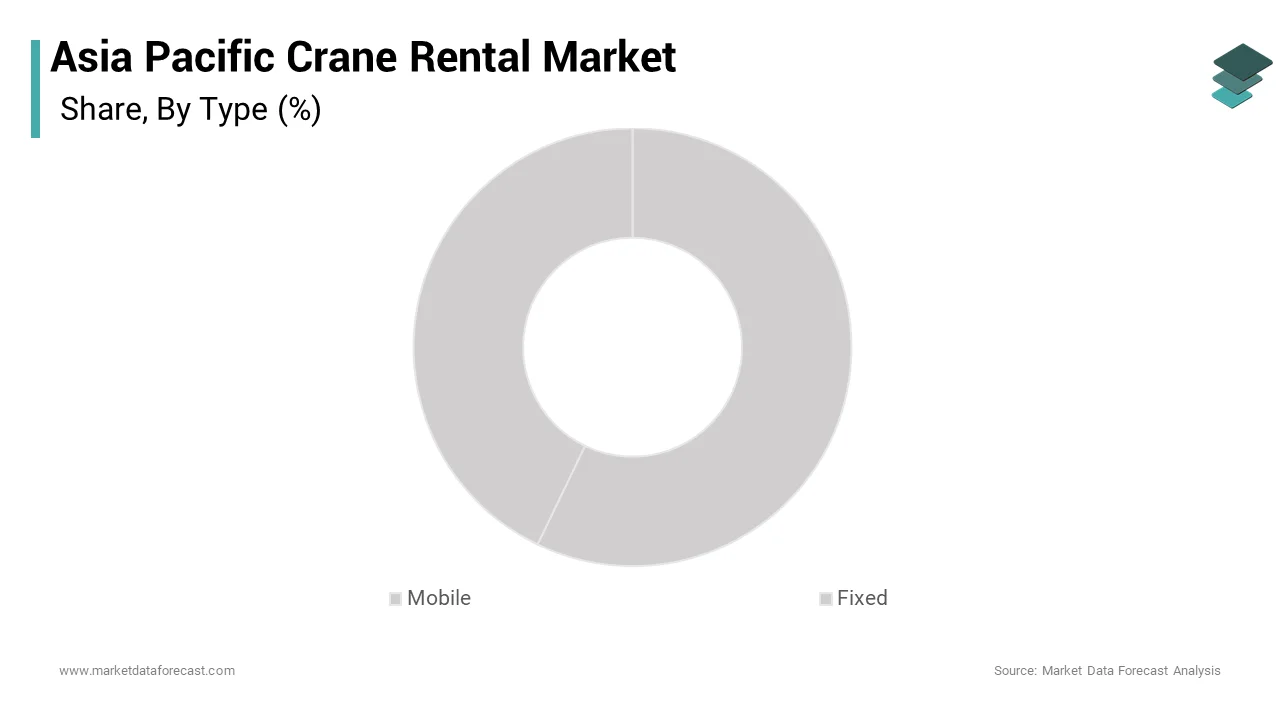
The fixed crane segment is projected to register the highest CAGR of 9.4% from 2025 to 2033. This accelerated growth is driven by the region’s intensifying high-rise construction boom, especially in megacities where vertical density is the only viable urban expansion strategy. Tower cranes, being integral to such developments, offer unmatched lifting precision and sustained operational capacity over long durations. Furthermore, government-backed urban renewal programs, such as Japan’s “Compact City” initiative, are revitalizing central districts with mixed-use skyscrapers, necessitating fixed crane deployment. Besides, advancements in climbing and self-lifting tower cranes reduce installation time and labor dependency, enhancing rental attractiveness. Thus, the fixed crane segment is poised for sustained expansion.
By End-Use Industry Insights
The building and construction sector commanded the largest share of the Asia Pacific crane rental market with 55.2% of total demand in 2024. This dominance is due to the region’s unprecedented urban transformation, where mass housing, commercial complexes, and public infrastructure projects drive consistent demand for lifting equipment. Moreover, the proliferation of smart cities and transit-oriented developments in countries like Malaysia and Thailand has intensified construction activity. The sector’s reliance on rental models is further reinforced by project temporality and capital efficiency; contractors avoid ownership costs while accessing modern, compliant equipment. Hence, the building and construction sector will remain the cornerstone of crane rental demand.
The marine and offshore segment is emerging as the fastest-growing end-use industry and is projected to expand at a CAGR of 10.2% from 2025 to 2033. This surge is primarily fueled by the rapid development of offshore energy infrastructure, particularly in wind and gas extraction. In Australia, the Scarborough LNG project, operated by Woodside Energy, involves the deployment of semi-submersible cranes for subsea module installation, with rental agreements spanning multiple years. Additionally, port modernization initiatives, such as the expansion of the Port of Colombo and Incheon Port, are driving demand for gantry and floating cranes. With governments prioritizing energy security and maritime logistics, the marine and offshore segment is set for prolonged expansion.
By Weightlifting Capacity Insights
The heavy-lift segment (80–300 tons) led the Asia Pacific crane rental market by contributing 44.6% of total revenue in 2025. This lead position is driven by the increasing complexity of industrial and energy projects that require robust lifting capabilities beyond the scope of light or medium equipment. In the power sector, the installation of turbines, transformers, and reactor vessels in thermal and nuclear plants demands cranes with lifting capacities between 150 and 250 tons. The segment also benefits from the growth of large-scale manufacturing facilities, such as semiconductor fabs and automotive plants, where rooftop HVAC units and production lines weigh over 100 tons. Additionally, the rise of precast concrete construction in Japan and Australia has increased demand for cranes capable of lifting prefabricated modules weighing up to 280 tons. With industrialization and energy infrastructure expansion continuing across the region, the heavy-lift segment remains indispensable.
The extreme heavy-lift segment (above 300 tons) is experiencing the fastest growth and is projected to grow at a CAGR of 11.3% in the coming years. This acceleration is driven by the execution of mega-projects in energy, petrochemicals, and offshore construction that require lifting capacities beyond conventional equipment. Also, high-capacity lifts are economically unfeasible for ownership, making rental the only viable option. The segment is further propelled by the rise of offshore wind farms, where nacelles and towers for 15 MW+ turbines can exceed 1,000 tons. Additionally, the scarcity of such equipment, with fewer than 50 cranes above 1,000 tons operating in the Asia Pacific, creates a seller’s market, enabling rental firms to command premium rates.
COUNTRY ANALYSIS
China Crane Rental Market Analysis
China stood as the undisputed leader in the Asia Pacific crane rental market by commanding an estimated 34.5% share in 2025. The country’s dominance is due to its colossal infrastructure and urban development agenda, which continues to drive demand despite economic headwinds. This scale necessitates thousands of crane rentals annually, particularly tower and mobile variants. Additionally, the Belt and Road Initiative has spurred port and rail projects domestically, further boosting demand. Moreover, stringent safety regulations introduced in 2021 mandate third-party crane inspections, favoring professional rental firms over private owners. Hence, the market is both vast and increasingly institutionalized, ensuring China’s leadership remains unchallenged in the near term.
India Crane Rental Market Analysis
India is emerging as the most dynamic growth engine in the region. The country’s construction sector is undergoing a structural transformation, driven by government-led infrastructure spending. Additionally, the rapid expansion of metro systems in cities like Ahmedabad, Lucknow, and Surat has increased demand for tower cranes. Rental penetration is rising due to the fragmented contractor base; over 90% of firms are small or medium-sized and lack capital for equipment ownership. With urbanization accelerating and project execution improving, India’s market share is poised to expand further.
Japan Crane Rental Market Analysis
Japan maintains a strong position in the regional crane rental market. The country’s market is characterized by high technological sophistication and a focus on safety and precision. Urban redevelopment in Tokyo, Osaka, and Yokohama is driving demand for advanced tower cranes, particularly luffing jibs that operate in confined spaces. Japan’s aging infrastructure is also prompting large-scale bridge and tunnel rehabilitation projects. Rental adoption is nearly universal among contractors due to strict safety laws enforced by the Japan Crane Manufacturers Association, which mandates biannual inspections and operator certification.
Australia Crane Rental Market Analysis
Australia is distinguished by its mature, safety-driven rental ecosystem. The country’s vast geography and resource-intensive economy create demand across urban construction and industrial sectors. In Sydney and Melbourne, over 180 high-rise projects were underway in 2023, necessitating extensive tower crane use. The mining and energy sectors further amplify demand; BHP and Rio Tinto rely on rented heavy-lift cranes for plant maintenance and expansion. Regulatory rigor plays a critical role. Additionally, Australia’s cyclone-prone northern regions require rapid deployment of mobile cranes for disaster recovery, creating recurring rental demand. Hence, the market remains resilient and highly regulated.
South Korea Crane Rental Market Analysis
South Korea is defined by its focus on high-tech industrial and urban projects. The country’s semiconductor and shipbuilding industries are major crane users. In shipbuilding, Hyundai Heavy Industries utilizes rented gantry and floating cranes for hull assembly. Urban redevelopment in Seoul, including the Yongsan International Business District, is also fueling tower crane usage. Moreover, Korea’s emphasis on smart construction, using IoT-enabled cranes with real-time monitoring, is accelerating rental adoption among tech-forward contractors. With government support for green and digital infrastructure, South Korea’s crane rental market is evolving into a high-value, specialized segment.
COMPETITIVE LANDSCAPE
The competitive landscape of the Asia Pacific crane rental market is characterized by a mix of global engineering firms, regional specialists, and local operators vying for dominance across fragmented and rapidly evolving markets. While multinational players like Mammoet and Sarens lead in high-end, engineered lifting solutions, regional companies are gaining ground by offering cost-effective, localized services tailored to specific infrastructure needs. The market is highly project-driven, with competition centered on technical capability, fleet availability, and speed of mobilization rather than price alone. Differentiation is achieved through advanced technology integration, such as real-time crane monitoring and digital lift planning, which enhance safety and efficiency. Regulatory compliance and operator certification also serve as competitive barriers, favoring established firms with robust maintenance and training systems. In countries like India and Indonesia, informal rental operators pose a challenge by undercutting prices, but large contractors increasingly prefer certified providers to mitigate risk. Strategic investments in fleet expansion, service infrastructure, and digital tools are enabling leading companies to strengthen client relationships and secure long-term contracts. As infrastructure and energy projects grow in complexity, the competitive advantage is shifting toward firms that combine technical expertise with operational agility and innovation, shaping a dynamic and increasingly specialized market environment.
KEY MARKET PLAYERS
A few of the market players that are dominating the crane rental market are
- United Rentals Inc.
- Liebherr
- Palfinger AG
- Furukawa Unic Corporation
- Sarens NV
- Mammoet
- The Manitowoc Company Inc.
- Maxim Crane Works
- Action Construction Equipment Ltd.
- Manitex International Inc
Top Players In The Market
- Mammoet operates as a global leader in engineered heavy lifting and transport, with deep integration across Asia Pacific’s most complex industrial and energy projects. The company specializes in extreme heavy-lift crane rentals, deploying specialized equipment such as the PTC 200 DS and SKK 4000 for projects in oil & gas, offshore wind, and petrochemical sectors. In recent years, Mammoet has expanded its regional fleet by investing in high-capacity crawler cranes and modular hydraulic platforms tailored for remote and challenging terrains. It executed critical lifts for the Ichthys LNG project in Australia and supported offshore wind installations in Taiwan, reinforcing its technical leadership. The company has also established local engineering hubs in Singapore and Perth to enhance project planning and responsiveness. By focusing on integrated lifting solutions and safety-driven execution, Mammoet has solidified its reputation as a preferred partner for high-stakes infrastructure developments, differentiating itself through innovation and operational excellence in the Asia Pacific crane rental landscape.
- Sarens has significantly strengthened its footprint in the Asia Pacific by deploying advanced crane fleets and establishing strategic joint ventures to support large-scale energy and construction initiatives. The company has introduced high-capacity lattice boom cranes and ring cranes across India, Australia, and Southeast Asia, catering to the rising demand for heavy and extreme heavy-lift capabilities. In 2023, Sarens launched a new service center in Chennai to support India’s growing infrastructure and renewable energy projects, including solar park installations and metro rail expansions. It also collaborated with local engineering firms in Indonesia to provide turnkey lifting solutions for power plants. Sarens integrates digital monitoring systems into its cranes, enhancing operational transparency and safety compliance. Its focus on engineered lifting plans, rapid mobilization, and environmental sustainability, through hybrid crane deployments, has positioned it as a forward-thinking player. By investing in localized infrastructure and technology integration, Sarens continues to expand its influence in high-growth markets across the region.
- Hyundai Engineering & Construction (Hyundai E&C), while primarily a construction giant, operates a substantial in-house crane rental and management division that supports its vast project portfolio across the Asia Pacific. The company utilizes a vertically integrated model, deploying its crane fleets for high-rise construction, industrial plants, and infrastructure developments in South Korea, Vietnam, and the Middle East. Hyundai E&C has invested in smart crane technologies, including IoT-enabled monitoring and automated load control systems, to improve safety and efficiency on sites such as the Songdo International Business District and major desalination plants in Saudi Arabia. It has also partnered with crane manufacturers to co-develop customized lifting equipment for complex urban environments. By maintaining a technologically advanced and well-maintained fleet, the company ensures project continuity and reduces reliance on third-party rentals. Its strategic focus on digitalization and sustainability in lifting operations has enhanced operational reliability, setting a benchmark for integrated crane use in large-scale construction across the region.
Top Strategies Used By The Key Market Participants
Key players in the Asia Pacific crane rental market are deploying a range of strategic initiatives to consolidate their positions and respond to evolving project demands. Fleet modernization is a primary focus, with companies investing in high-capacity, fuel-efficient, and digitally enabled cranes to meet safety and performance standards. Geographic expansion is another critical strategy, as firms establish new service centers and depots in high-growth regions such as India, Vietnam, and Indonesia to reduce mobilization time and improve responsiveness. Strategic partnerships and joint ventures with local contractors and engineering firms are being leveraged to gain market access and deliver integrated lifting solutions. Additionally, companies are adopting digital transformation by integrating IoT, telematics, and predictive maintenance systems into their fleets to enhance operational transparency and reduce downtime. Service differentiation through engineered lift planning, 24/7 technical support, and operator training programs has become a key competitive advantage. Sustainability initiatives, including the deployment of hybrid and electric cranes, are also emerging as strategic differentiators, particularly in environmentally sensitive projects. These multi-pronged strategies enable leading firms to maintain technological leadership, improve customer retention, and capture value in a highly project-driven and competitive market landscape.
RECENT MARKET NEWS
- In March 2023, Sarens inaugurated a new crane service and maintenance facility in Chennai, India, to support growing infrastructure and renewable energy projects across South Asia, enhancing its regional mobilization capabilities and technical responsiveness.
- In August 2023, Mammoet deployed its SKK 4000 super heavy-lift crane for a refinery expansion project in Malaysia, marking the first use of the equipment in Southeast Asia and reinforcing its leadership in extreme heavy-lift engineering solutions.
- In January 2024, Coates Hire launched a fleet of 15 new Liebherr mobile cranes in Australia, equipped with telematics and remote diagnostics, to improve operational efficiency and meet rising demand in urban construction and transport sectors.
- In June 2023, Hyundai E&C partnered with Kobelco Construction Machinery to co-develop smart tower cranes with automated load control for high-rise projects in Vietnam and South Korea, integrating digital safety features and real-time monitoring.
- In November 2023, Action Construction Equipment expanded its crane rental operations into Indonesia through a joint venture with a local engineering firm, aiming to capture market share in the country’s growing industrial and infrastructure sector.
MARKET SEGMENTATION
This research report on the Asia Pacific crane rental market is segmented and sub-segmented into the following categories.
By Type
- Mobile
- Fixed
By End-Use Industry
- Building & Construction
- Oil & Gas
- Marine & Offshore
- Mining & Excavation
- Transportation
By Weightlifting Capacity
- Low
- Low-Medium
- Heavy
- Extreme Heavy
By Country
- India
- China
- Japan
- South Korea
- Australia
- New Zealand
- Thailand
- Malaysia
- Vietnam
- Philippines
- Indonesia
- Singapore
- Rest of APAC