- Product Description Description
- Table of Contents TOC
- List of Table & Figure LOT
- Get Free Sample PDF Sample PDF
Market Size, 2025
$10.72 BnMarket Estimate, 2026
$11.46 BnMarket Forecast, 2034
$19.51 BnCAGR, 2026–2034
6.88%Asia Pacific Food Additives Market Size
The size of the Asia-Pacific food additives market was calculated to be USD 10.72 billion in 2025 and is anticipated to be worth USD 19.51 billion by 2034, from USD 11.46 billion in 2026, growing at a CAGR of 6.88% during the forecast period.
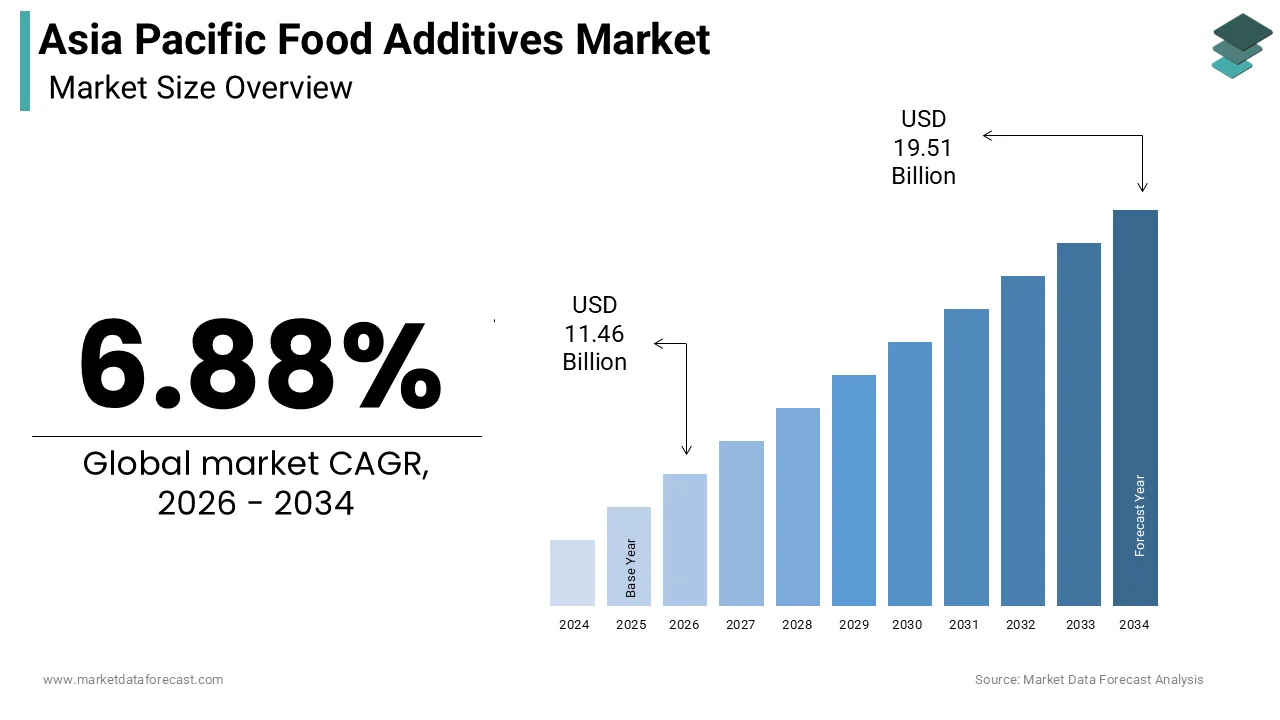
Food additives are natural or man-made substances added to foods during production, processing, or packaging. They improve safety, keep food fresh longer, boost taste, or fix color and texture. This market operates within a uniquely complex environment defined by extreme climatic variability, rapid urbanization, and heterogeneous regulatory frameworks spanning advanced economies like Japan and emerging manufacturing hubs such as Vietnam. According to the Food and Agriculture Organization, significant volumetric post-harvest food losses across developing Asian supply chains are accelerating the commercial application of targeted agricultural storage, cooling networks, and chemical preservation technologies. As per the World Economic Forum, the aggregate Asian middle-class population is projected to expand to approximately 3.5 billion individuals by 2030, driving intense consumer market shifts toward highly processed and stable packaged food products. According to the World Health Organization, persistent regional vitamin and mineral deficiencies are accelerating the roll-out of public-sector food fortification frameworks and mandatory industrial enrichment mandates for staple food matrices. Consequently, this market functions at the intersection of industrial food engineering, tropical logistics resilience, and nutritional policy implementation, distinct from Western markets driven primarily by consumer preference trends.
MARKET DRIVERS
Tropical Climate Logistics Necessitating Advanced Preservation Systems
The pervasive challenge of maintaining food integrity across tropical supply chains with limited cold chain coverage is a key factor boosting the growth of the Asia Pacific food additives market. Consequently, preservative and antioxidant additive utilization remains high throughout developing nations in the region. According to the Asian Development Bank, targeted commercial investments in decentralized retail networks and logistical hubs are expanding operational cold chain infrastructure to improve regional food distribution efficiency. As per the Food and Agriculture Organization, post-harvest supply chain losses and domestic food waste volume metrics vary widely by region, prompting structural value chain transformations to manage microbiological spoilage vulnerabilities. According to the Ministry of Public Health of Thailand, national food safety standards and chemical additive frameworks regulate the specific maximum permissible quantities of targeted antimicrobials and commercial preservatives across retail food matrices. This infrastructural deficit transforms food additives from optional quality enhancers into essential risk mitigation tools, enabling commercial food distribution across geographies where refrigeration remains economically or logistically unfeasible. Demand is consequently anchored in supply chain physics rather than consumer preference, creating inelastic baseline utilization resistant to clean-label trends that might otherwise reduce synthetic preservative adoption in better-resourced markets.
Government Mandated Fortification Programs Addressing Public Health Gaps
National nutrition intervention policies across the region create guaranteed institutional demand for nutritional additives independent of consumer discretionary spending or premium functional food trends, which in turn fuels the expansion of the Asia Pacific food additives market. As per the Global Alliance for Improved Nutrition, national public-sector bodies are accelerating large-scale food fortification mandates across high-volume staple vehicle matrices to eliminate severe population micronutrient deficiencies. According to the World Food Programme, targeted institutional nutrition initiatives and domestic safety-net mechanisms expand access to nutrient-enriched foods among vulnerable population demographics. As per the Food Safety and Standards Authority of India, the national regulatory framework establishes specific quality guidelines for five primary food categories comprising wheat flour, rice, milk, edible oil, and double fortified salt. These policy frameworks convert nutritional additives into compliance necessities for manufacturers participating in subsidized markets representing the majority of staple consumption in developing economies. Unlike voluntary functional foods where demand fluctuates with economic cycles, fortification-driven additive utilization remains recession-resistant because participation in public procurement and regulated retail channels requires adherence regardless of margin pressure or consumer willingness to pay premiums.
MARKET RESTRAINTS
Regulatory Fragmentation Creating Compliance Complexity and Trade Barriers
Extreme divergence in food additive approval standards, maximum usage limits, and labeling requirements across jurisdictions in the region creates prohibitive compliance burdens in the Asia Pacific market. This prevents efficient regional scaling and innovation diffusion. According to the ASEAN Secretariat, member nations cooperate under unified principles and guidelines to establish maximum use limits and streamline ingredient listings for food additives across regional trade boundaries. As per the National Health Commission of China, domestic food compound approvals, additive usage specifications, and positive lists undergo systematic multi-agency safety reviews before product commercialization. According to Food Standards Australia New Zealand, Schedule 18 dictates the mandatory compliance, handling parameters, and permissible concentration benchmarks for manufacturing processing aids used within industrial food production. This fragmentation prevents manufacturers from achieving economies of scale through standardized regional portfolios, instead multiplying R&D testing costs and regulatory submission expenses. Small and medium enterprises are disproportionately affected as they lack resources to navigate multiple approval pathways simultaneously, effectively excluding them from cross-border trade and concentrating market power among multinationals with dedicated regulatory affairs teams capable of managing jurisdictional complexity.
Consumer Skepticism and Clean Label Pressure Reducing Synthetic Adoption
Consumer distrust of chemical-sounding ingredients and preferences for clean labels increasingly constrain the use of synthetic additives and ultimately hinder the expansion of the Asia Pacific food additives market. However, these ingredients have proven safety and functional necessity across price-sensitive mass markets. As per sources, accelerating consumer preference for ingredient transparency is driving the expansion of clean label assertions, organic options, and free-from product formulations across Asia-Pacific retail markets. According to the Indonesian Food and Drug Authority, national labeling frameworks require pre-market distribution permits and precise product composition indexing to regulate safety across commercial food additive matrices. As per the Ministry of Science and Technology of Vietnam, domestic organic production lines, ecological agriculture practices, and certified value chains operate in compliance with national standard TCVN 11041 to verify systemic chemical restrictions. This sentiment-driven restraint creates formulation dilemmas where replacing synthetics with natural alternatives increases costs while often delivering inferior functionality and shorter shelf life. Manufacturers face impossible trade-offs between maintaining technical performance and meeting label expectations, particularly in developing markets where consumers demand both clean labels and affordable prices despite inherent incompatibility between these objectives given current technology cost structures.
MARKET OPPORTUNITIES
Plant-Based Protein Expansion Creating Novel Functional Ingredient Demand
Plant-based meat and dairy alternatives are growing rapidly across urban areas in the region, which is likely to accelerate the growth of the Asia Pacific food additives market. This growth generates substantial opportunity for specialized additives that fix sensory and textural limits in alternative proteins. According to the Good Food Institute Asia Pacific, accelerating alternative protein distribution across the region is driving ingredient manufacturers to innovate advanced texturizers, binding systems, and complex flavor profiles to overcome inherent structural limitations. As per the Singapore Food Agency, a rigorous safety assessment framework evaluates all novel food ingredients and pre-market dossiers prior to granting commercial distribution approvals within the territory. According to the Malaysian Palm Oil Board, expanding industrial applications for specialty palm derivatives are driving the development of customized functional lipids and stable fat replacement matrices across regional processed food chains. This application vector differs fundamentally from traditional additive markets because it addresses core product architecture challenges rather than optional enhancement, making additive selection integral to category viability. Early movers developing protein-specific functional systems capture disproportionate value as the category matures beyond early adopters into mainstream protein substitution, creating sustained demand tied to structural dietary transition megatrends rather than transient wellness fads.
Upcycled and Circular Economy Ingredient Valorization
There is a growing emphasis on circular economy principles and agricultural waste valorization, which is predicted to drive the expansion of the Asia Pacific food additives market. These trends provide a clear path for upcycled food additives from processing byproducts, aligning sustainability goals with a cost-competitive functional ingredient supply. As per the Food and Agriculture Organization, vast volumes of regional agricultural processing byproducts provide scalable opportunities for extracting valuable food additives, natural antioxidants, and functional fibers via targeted circular technologies. According to the Ministry of Industry of Thailand, industrial development initiatives and biomass monetization frameworks support regional agro-industrial upgrades and waste valorization production lines. As per the Ministry of Food Processing Industries, targeted financial incentives under infrastructure development schemes are expanding the domestic processing capacity of value-added agricultural derivatives and specialty oil fractions. This feedstock advantage transforms waste streams into strategic assets for manufacturers seeking both sustainability credentials and supply chain resilience amid recurring raw material volatility. Growth opportunity lies in developing extraction and purification technologies that convert low-value byproducts into high-functionality additives meeting international quality standards while supporting national food sovereignty and rural development objectives simultaneously.
MARKET CHALLENGES
Raw Material Price Volatility and Supply Chain Concentration Risks
Dependence on concentrated global supply sources for critical additive feedstocks creates persistent cost uncertainty and availability vulnerability, which obstructs the growth of the Asia Pacific food additives market. This threatens formulation stability across the region’s food manufacturing. According to the Food and Agriculture Organization, severe regional supply chain shocks and geographic distribution bottlenecks are causing substantial international market disruptions and price volatility for specialty plant-based raw materials. As per the United Nations Environment Programme, upscaling sustainable seaweed aquaculture provides significant environmental and economic development opportunities to support food security across regional biomass supply networks. According to the Ministry of Commerce of China, long-term global trade patterns and commercial distribution systems govern high-volume cross-border exports of strategic industrial food texturants and preservation compounds. This dual pressure of geopolitical disruption and environmental constraint transforms raw material sourcing from routine procurement into a strategic risk management challenge. Manufacturers lacking diversified supplier bases, forward contracting mechanisms, or alternative formulation capabilities face existential vulnerability to commodity shocks that could abruptly eliminate margin viability or force unplanned reformulation cycles disrupting production schedules and customer relationships.
Technical Capability Gaps Among Small and Medium Enterprise Manufacturers
Small and medium-sized food processors face a widespread lack of formulation expertise, analytical testing capacity, and regulatory knowledge, which inhibits the expansion of the Asia Pacific food additives market. This impediment prevents them from effectively using additives, even though the regional manufacturing landscape offers clear functional benefits. As per the United Nations Industrial Development Organization, collaborative multi-stakeholder technical forums are driving regulatory convergence and technology adoption to overcome operational processing gaps among regional small and medium food enterprises. According to the ASEAN Secretariat, coordinated capacity development efforts and structural skills programs aim to expand professional technical expertise within domestic agribusiness sectors. As per the Small and Medium Enterprise Foundation of Bangladesh, expanded decentralization initiatives and regional infrastructure networks assist local manufacturing businesses in accessing commercial testing facilities and production logistics. The capability deficit means additive innovation remains accessible primarily to multinational corporations and large domestic players with dedicated technical teams, while SME-dominated segments supplying the majority of domestic markets continue using suboptimal legacy formulations. Without development of shared technical infrastructure, vocational training programs, and localized extension services, additive benefits cannot diffuse through the ecosystem. This limitation restricts overall market potential and perpetuates quality gaps between formal and informal food sectors.
REPORT COVERAGE
| REPORT METRIC | DETAILS |
| Market Size Available | 2025 to 2034 |
| Base Year | 2025 |
| Forecast Period | 2026 to 2034 |
| CAGR | 6.88% |
| Segments Covered | By Product, Source, Application, And Region |
| Various Analyses Covered | Global, Regional and Country Level Analysis; Segment-Level Analysis; DROC; PESTLE Analysis; Porter’s Five Forces Analysis; Competitive Landscape; Analyst Overview of Investment Opportunities |
| Regions Covered | India, China, Japan, South Korea, Australia, New Zealand, Thailand, Malaysia, Vietnam, Philippines, Indonesia, Singapore And Rest of Asia-Pacific |
| Market Leaders Profiled | E.I. DuPont, Archer Daniels Midland Company, Cargill, Incorporated, CHR. Hansen Holding A/S, Kerry Group Plc, BASF SE |
SEGMENTAL ANALYSIS
By Product Insights
The flavors and enhancers segment remained the largest in 2025 and occupied a commanding share of the Asia Pacific food additives market. This supremacy was supported by its indispensable role in maintaining sensory consistency across mass-produced processed foods, where raw material variability would otherwise compromise consumer acceptance. According to the ASEAN Food Federation, the organization focuses on facilitating the exchange of technical information and harmonizing food standards among member states to streamline regional trade and regulatory compliance. As per India’s Ministry of Food Processing Industries, the Pradhan Mantri Formalisation of Micro Food Processing Enterprises (PMFME) scheme provides financial, technical, and business support to upgrade existing micro-enterprises and support the creation of common infrastructure. This segment’s dominance stems from its function as a quality insurance mechanism where even minor sensory deviation triggers consumer rejection and brand damage. Unlike preservatives or nutritional additives tied to specific functional outcomes, flavors are required in virtually every processed category, creating a broad-based volume foundation resilient to category-specific downturns or regulatory restrictions affecting narrower additive types.
Fueling this segment's ongoing lead is extreme regional taste preference diversity necessitating localized formulation intensity that multiplies SKU complexity and additive utilization versus standardized global flavor platforms. According to research, successful innovation in the packaged food industry increasingly relies on leveraging classic flavor profiles with proven staying power to reduce the risk of product failure in a competitive market. The cultural fragmentation transforms flavor development from a centralized R&D function into a distributed innovation ecosystem where local knowledge and ingredient access determine competitive advantage. Manufacturers cannot achieve economies of scale through global standardization, instead maintaining extensive regional portfolios that sustain higher aggregate additive volumes than homogeneous markets where single flavor platforms serve multiple countries.
The fat replacers segment is on the rise and is expected to be the fastest-growing segment in the market, witnessing a CAGR of 12.4% between 2026 and 2034. This swift growth of the segment is fuelled by plant-based protein formulation challenges requiring specialized lipid mimetics to achieve sensory parity with animal-derived products. According to Good Food Institute Asia Pacific, the alternative protein sector focuses on overcoming sensory challenges such as taste and texture to bridge the gap between plant-based products and conventional animal meat for mainstream consumer adoption. The Singapore Food Agency administers a specific regulatory framework for novel foods, requiring companies to submit safety assessments for ingredients that do not have a history of significant consumption, such as cultured meat, before they can be sold. The application vector differs fundamentally from traditional fat reduction because it addresses core product architecture rather than calorie reduction, making demand proportional to plant-based category volume growth rather than diet trend cycles. Growth accelerates as formulators recognize that fat replacement solves fundamental viability challenges rather than optional health positioning, creating structural demand tied to dietary transition megatrends.
Multiple factors accelerate this growth, including clean-label reformulation pressure, which drives the substitution of synthetic emulsifiers and hydrogenated fats with natural lipid-based alternatives perceived as cleaner despite equivalent functionality. According to sources, clean label attributes such as "natural" and "free-from" continue to be significant drivers in the food and drink market, reflecting consumer demand for transparency and recognizable ingredients. Indonesia’s BPOM mandates strict food labeling regulations, including the truthful declaration of ingredients, nutrition facts, and Halal status, to ensure consumer protection and food safety. As per Vietnam’s Ministry of Science and Technology, national standards such as TCVN 11041 regulate organic agriculture practices to align with international requirements for the production and processing of certified organic products. The regulatory and consumer preference convergence transforms fat replacers from a technical specialty into a mainstream formulation choice for premium segments where label perception drives purchasing decisions more than cost optimization. Growth reflects a fundamental shift in formulator priorities from pure functionality to holistic product positioning where fat system selection impacts marketing claims and target demographic alignment.
By Application Insights
In 2025, the beverages segment held the majority share in the Asia Pacific food additives market because of dual drivers of functional drink innovation and mandatory fortification programs, creating sustained additive utilization across both premium and staple categories. According to sources, expanding health awareness among regional consumers is accelerating the manufacturing volume of functional beverage formulations and specialized dietary ingredients. As per the Global Alliance for Improved Nutrition, national public-sector bodies are accelerating large-scale food fortification programs across staple distribution matrices to eliminate widespread micronutrient deficiencies. According to the Joint FAO/WHO Food Standards Programme, international safety frameworks dictate the permissible usage parameters, stability standards, and compliance evaluation guidelines for complex nutritional ingredients across retail product formats. The dual demand structure ensures beverage additive utilization remains resilient during economic downturns when premium functional categories may contract but fortified staple beverages maintain volume through public procurement. Unlike solid foods where additive use is often category-specific, beverages require multiple additive types simultaneously, including sweeteners, stabilizers, preservatives, and nutrients, creating higher per-unit additive intensity and broader supplier engagement.
The foremost factor securing this segment's leading position is urban hydration habits and convenience culture that make ready-to-drink formats primary liquid nutrition delivery vehicles across Asia Pacific’s time-constrained populations. As per the United Nations Economic and Social Commission for Asia and the Pacific, ongoing municipal infrastructure transitions and rising urbanization rates are reshaping regional consumer lifestyle preferences and commercial consumption structures. According to the Ministry of Agriculture, Forestry and Fisheries of Japan, the widespread domestic popularity of bottled ready-to-drink tea varieties continues to shape industrial beverage manufacturing methods and agricultural raw material processing. As per the Ministry of Food Processing Industries of India, national funding packages and infrastructure upgrade programs are modernizing localized agribusiness facilities to standardize commercial beverage production lines. The demographic and lifestyle transformation creates structural demand where beverages serve as primary vehicle for both hydration and functional ingredient delivery, ensuring sustained additive utilization aligned with irreversible urbanization trajectories rather than transient category trends.
The meat, poultry, and seafood products segment is likely to experience the fastest CAGR of 11.8% over the forecast period due to protein transition and value-added processing trends requiring advanced functional systems for texture, safety, and yield optimization. According to the Food and Agriculture Organization, structural post-harvest supply chain gaps and processing variations across developing regions require targeted shelf-life extension and value-retention technologies. As per the United Nations Industrial Development Organization, regional food manufacturers are upgrading technical processing standards and safety controls to resolve compliance friction in international seafood export corridors. This processing intensification transforms meat additives from commodity inputs into value-enabling technologies where functional performance directly determines export competitiveness and retail margin. Growth reflects structural dietary evolution toward convenient protein formats rather than cyclical demand fluctuations.
The swift expansion of this segment gains further momentum from food safety regulations and cold chain infrastructure gaps, which drive the use of mandatory preservation additives to prevent microbial hazards during tropical distribution. As per the Asian Food Journal, significant logistics infrastructure vulnerabilities and logistical transit bottlenecks lead to substantial volumetric product losses across developing perishable food supply chains. According to the Food and Drug Administration of Thailand, mandatory industrial manufacturing licenses and pre-market registration rules strictly regulate commercial facilities processing meat and seafood products for public distribution. This infrastructure constraint transforms meat additives from quality optimization into supply chain risk mitigation valued by exporters, retailers, and public health programs seeking to extend protein access beyond urban cold chain enclaves. Growth remains anchored in practical necessity rather than premium positioning, ensuring sustained relevance during economic downturns.
By Source Insights
The synthetic segment dominated the Asia Pacific food additives market and accounted for a substantial share in 2025. This dominance of the segment was driven by superior cost efficiency and functional reliability that make them irreplaceable for mass-market processed foods serving price-sensitive consumers across developing economies. According to the Asian Development Bank, high regional inflation and volatile food prices are reshaping household consumption habits across developing Asian economies, making lower-cost processed food matrices essential for general urban affordability. As per the National Health Commission of China, the implementation of the comprehensive food safety standard GB 2760 dictates strict threshold guidelines and maximum use parameters for certified food additive substances across domestic industrial lines. According to the Ministry of Consumer Affairs, Food and Public Distribution of India, the central government distributes fortified rice through the Targeted Public Distribution System and institutional safety-net schemes to mitigate widespread micronutrient deficiencies across the population. This economic reality creates structural lock-in where synthetic additives remain the default choice for manufacturers serving majority population segments unable to absorb clean-label premiums. Unlike premium markets where consumer sentiment drives formulation choices, developing Asia Pacific prioritizes caloric accessibility and food safety over ingredient provenance, ensuring synthetic dominance through socioeconomic necessity rather than technical superiority alone.
Synthetic additives maintain source leadership through decades of regulatory familiarity and established safety dossiers that reduce approval risk and time-to-market versus novel natural alternatives facing uncertain evaluation pathways. According to the Ministry of Health, Labour and Welfare of Japan, pre-market authorization protocols for chemical or natural food additives necessitate structured evaluations of scientific data and safety profiles to protect consumer wellness. The regulatory asymmetry creates powerful path dependency where formulators default to synthetics not merely for cost but because they represent the lowest-risk, fastest route to market option across fragmented jurisdictions. Manufacturers consequently invest disproportionately in synthetic optimization, reinforcing dominance through continuous incremental improvement while natural alternatives face persistent approval barriers limiting commercial viability despite consumer preference signals.
The natural additives segment is expected to exhibit a noteworthy CAGR of 13.2% from 2026 to 2034 owing to clean label consumer willingness to pay premiums that enable cost absorption in middle-class and premium product segments. According to studies, rising global demand for additive transparency and clean label clarity is compelling regional food and beverage manufacturers to expand their portfolios of clean, plant-based formulations. As per Enterprise Singapore's Enterprise Development Grant guidelines, strategic cash funding and development grants co-fund eligible corporate research expenditures to enhance regional technological infrastructure and business capability building. According to the Halal Development Corporation of Malaysia, commercial market demand for verified Shariah-compliant ingredients is accelerating, driving local manufacturers to produce plant-derived oil fractions and functional alternative emulsifiers. This willingness-to-pay dynamic transforms natural additives from niche luxury into a viable mainstream choice for segments where label perception drives purchasing decisions more than absolute cost minimization. Growth reflects the emergence of an affluent consumer base large enough to support parallel premium supply chains alongside mass-market synthetic dominance.
The fast development of this segment is heightened by government incentives for domestic agricultural valorization, which create policy-driven demand for plant-derived additives aligned with rural development and import substitution objectives. As per the Food and Agriculture Organization, vast volumes of raw agricultural processing byproducts across Asia provide scalable industrial channels for extracting essential dietary fibers, functional compounds, and natural extracts via circular technology schemes. According to the Ministry of Industry of Thailand, agricultural manufacturing modernization plans and resource conversion frameworks support the structural expansion of localized biomass value chains and byproduct monetization. The policy alignment transforms natural additives from a market-driven choice into a strategic industrial priority, receiving subsidies, tax incentives, and procurement preferences unavailable to synthetic alternatives. Growth accelerates as governments recognize natural additive production as a vehicle for achieving multiple policy objectives simultaneously, including rural employment, import reduction, and sustainability credentials.
REGIONAL ANALYSIS
China Food Additives Market Analysis
China led the Asia Pacific food additives market and captured a 36.1% share in 2025. This leading position of the segment was attributed to its world’s largest food processing sector, comprehensive domestic additive manufacturing capacity, and aggressive fortification mandates covering 1.4 billion consumers. According to the National Health Commission of China, the implementation of the updated national food safety standard GB 2760-2024 revises maximum permitted thresholds and systematically regulates the usage categories of commercial food additives across domestic production chains. As per the National Health Commission of China, newly filed pre-market registration protocols, nutritional fortification dossiers, and specialized enzyme updates must undergo safety optimization reviews before receiving official regulatory authorization. According to the China National Health Commission, accelerating consumer demand for calorie-reduced matrices and health-conscious formulations is driving localized industrial innovation in natural sweeteners and functional colorant technologies. However, provincial enforcement variation creates compliance inconsistency, where coastal regions implement stricter monitoring than inland areas, fragmenting market standards. China’s dominance stems from unmatched scale and state-directed industrial policy, though sustainability depends on successful quality upgrading to meet international export standards.
India Food Additives Market Analysis
India followed closely behind in the regional market and secured a share of 17.8% in 2025. This growth of the Indian market was propelled by the world's largest public food distribution system, driving institutional additive demand alongside a rapidly expanding private functional food sector serving the emerging middle class. According to the Ministry of Education of India, the central government's PM Poshan initiative distributes cooked hot meals daily to over 120 million eligible children across registered government-funded and primary schools. As per the Food Safety and Standards Authority of India, official draft regulatory updates outline specific standard parameters for industrial sweeteners, culinary paste material limits, and domestic flour compositions. According to ASSOCHAM, the promotion of fortified foods and strategic nutraceutical policy alignment aims to bridge nutritional deficits and enhance regional food security frameworks. However, significant interstate variation in enforcement capacity creates compliance inconsistency, where southern and western states implement regulations rigorously while northeastern states lag due to infrastructure deficits. Price sensitivity remains acute, with a notable portion of consumers unwilling to pay a premium for natural additives, limiting premium segment penetration despite growing awareness. India’s market reflects dual-track development where public sector anchors volume through social welfare programs while private sector drives innovation and margin expansion.
Japan Food Additives Market Analysis
Japan contributes significantly to the regional market because of a mature functional food ecosystem, stringent regulatory standards, and an aging society driving specialized additive applications targeting elderly nutrition and chronic disease management. According to the Consumer Affairs Agency, food products in Japan can be labeled as having health benefits under designated certification channels if manufacturers submit specific scientific validation and food safety criteria to the government prior to sale. The country’s Ministry of Health, Labour and Welfare maintains some of the s most rigorous additive safety assessment protocols in the region, creating high entry barriers that protect domestic manufacturers like Ajinomoto, San-Ei Gen FFI, and Taiyo Kagaku while limiting foreign competition in regulated segments. As per the National Institutes of Health, texture modifications in processed foods suitable for dysphagic patients are expanding across industrial lines as the proportion of elderly citizens increases. However, a shrinking domestic population and deflationary pressure constrain overall volume growth, limiting expansion to replacement cycles and premium innovation rather than capacity expansion. Japanese consumers demonstrate the highest willingness to pay for validated functional benefits but demand exhaustive scientific substantiation, making market entry costly and time-intensive. Japan’s market exemplifies maturity where value derives from regulatory compliance and demographic targeting rather than volume growth.
South Korea Food Additives Market Analysis
South Korea grew steadily in the Asia Pacific food additives market due to K-food global export ambitions, advanced biotechnology integration, and beauty-from-within functional food convergence, creating unique additive demand drivers. According to the Ministry of Agriculture, Food and Rural Affairs, South Korea's aggregate agricultural and food exports reached a fresh record high, exceeding 13 billion USD to expand the global footprint of local culinary offerings. As per the Ministry of Food and Drug Safety of South Korea, updated administrative amendments simplify administrative requirements and accept phased testing data to reduce redundant documentation for new food additive approvals. According to ChemLinked, domestic food additive criteria separate substances into designated chemically synthesized compounds, natural substances, and blended functional preparations to monitor target markets. However, the chaebol-dominated food industry structure limits supplier diversity. Domestic focus on export-oriented innovation means some domestic applications lag behind international offerings as companies prioritize global market requirements. South Korea’s market demonstrates how cultural specificity and export orientation create differentiated demand patterns.
Australia Food Additives Market Analysis
Australia is another key player in the regional market owing to stringent regulatory oversight, a mature contract additive services sector, and leadership in clean-label and sustainable ingredient innovation driving premium positioning. According to Food Standards Australia New Zealand, pre-market statutory safety assessments must evaluate non-traditional and novel food ingredients before their legal addition to the commercial retail supply. As per the Advanced Manufacturing Growth Centre, targeted industry co-investments back specialized manufacturing projects to expand local industrial competitiveness and accelerate high-value commercialization. According to the Australian Food and Grocery Council, the domestic food and grocery manufacturing sector delivers more than 32% of all manufacturing activity to accelerate regional economic growth. Strict biosecurity and import restrictions create a protected domestic market but also limit access to global ingredient diversity, increasing costs. Australia’s market functions as a premium innovation hub where regulatory credibility and sustainability leadership enable technology validation for broader regional export.
COMPETITION OVERVIEW
Competition in the Asia Pacific food additives market occurs across multiple tiers, reflecting extreme heterogeneity in technological sophistication,n regulatory maturity, and end-use applications across the region. Multinational ingredient companies like Ajinomoto, Ingredion,n and Kerry compete through integrated R&D, manufacturing, and regulatory capabilities serving multinational food manufacturers and large domestic players requiring validated global-standard solutions with local adaptation. Regional specialists from Thailand, Malaysia, and India leverage local feedstock advantages, cultural knowledge, and government relationships to capture mid-tier and public sector markets where cost, supply security, and halal or indigenous certification outweigh premium technical specifications. Domestic starch and oil processors in China, Indonesia, and Vietnam compete primarily on price and proximity, serving SMEs and commodity fortification programs with basic additive capabilities sufficient for undemanding applications. Competition increasingly centers on supply chain resilience, feedstock security and regulatory navigation rather than pure technical performance as climate volatility and trade fragmentation elevate operational risk above functional differentiation. Public procurement programs create winner-take-all dynamics in fortification segments where single tender awards determine multi-year volume allocation. Success requires balancing global scale with local responsiveness, technological sophistication with cost accessibility, and commercial objectives with public health alignment, making this market uniquely challenging compared to homogeneous regions where standardized approaches suffice without constant contextual adaptation.
KEY MARKET PLAYERS
Major key players in the APAC Food Additives Market include
- E.I. DuPont
- Archer Daniels Midland Company
- Cargill
- Incorporated
- CHR. Hansen Holding A/S
- Kerry Group Plc
- BASF SE
Top Strategies Used by Key Market Participants
Key players in Asia Pacific food additives market prioritize localization of R&D and manufacturing, establishing regional innovation centers and production facilities aligned with local feedstock availability, regulatory frameworks, and cultural taste preferences rather than importing standardized global solutions. Companies increasingly integrate upstream into agricultural supply chains, securing starch, oilseed, fruit, and marine hydrocolloid sources through direct farming partnerships or processing investments to mitigate raw material volatility and support national food sovereignty priorities. Strategic focus on clean-label and sustainable additives addresses intensifying consumer and regulatory pressure for recognizable ingredients and circular economy alignment, differentiating offerings in premium segments while future-proofing against synthetic additive restrictions. Manufacturers actively collaborate with government fortification programs and public health agencies, embedding additive technologies into social welfare infrastructure, creating stable institutional demand independent of discretionary spending cycles. Regulatory engagement emphasizes harmonization advocacy and novel food pathway navigation, helping shape favorable standards while accelerating client product launches across fragmented jurisdictions. Technology differentiation focuses on application-specific performance, including tropical-climate stability, controlled release profiles, and sensory masking tailored to regional food matrices rather than generic functionality. Digitalization and data analytics enable predictive formulation modeling, reducing development timelines and validation costs for clients navigating complex regulatory and climatic conditions across diverse Asia Pacific markets.
Leading Players in the Asia Pacific Food Additives Market
- Ajinomoto Co Inc maintains significant involvement in the Asia Pacific food additives market through comprehensive umami enhancer amino acid and specialty seasoning portfolios serving diverse regional taste preferences across 22 countries. The company operates several manufacturing facilities throughout Southeast Asia and East Asia, ensuring localized production aligned with domestic agricultural feedstocks and cultural flavor profiles distinct from Western templates. Recent expansion of halal-certified additive lines in Indonesia and Malaysia addresses growing Muslim consumer demand for compliant ingredients without compromising sensory performance. These initiatives demonstrate commitment to cultural localization and supply chain integration rather than standardized global offerings, positioning Ajinomoto as an enabler of regional food sovereignty and taste authenticity across diverse Asia Pacific markets requiring contextually appropriate additive solutions.
- Ingredion Incorporated contributes specialized starch-based additive expertise to Asia Pacific through extensive texturizer, sweetener, and functional carbohydrate portfolios derived from regional tapioca rice and corn feedstocks. The company operates innovation centers in Singapore, Shanghai, and Mumbai, enabling rapid prototyping of clean-label texture modifiers and fat replacers aligned with local regulatory frameworks and consumer preferences. The recent launch of upcycled rice bran antioxidants addresses circular economy priorities and supply chain resilience concerns amid recurring gum arabic shortages. These actions reflect a strategy prioritizing feedstock security and sustainability, recognizing that Asia Pacific additive success depends on aligning technical functionality with local resource availability and policy objectives rather than importing standardized global solutions disconnected from regional agricultural realities.
- Kerry Group plc strengthens Asia Pacific food additives market presence through integrated taste-nutrition platforms and application-specific functional systems tailored to regional processing conditions and regulatory requirements. Recent investment in Malaysia palm-based emulsifier production enables halal-compliant fat replacement systems leveraging local comparative advantage in tropical oilseed processing. These initiatives demonstrate a vertical integration strategy connecting regional feedstock access to finished additive solutions, ensuring supply reliability, regulatory compliance, and cultural relevance across diverse Asia-Pacific operating environments where generic global formulations fail to address local infrastructure and consumer constraints.
MARKET SEGMENTATION
This research report on the Asia-Pacific food additives market has been segmented and sub-segmented into the following categories.
By Type
- Acidulants
- Anti-caking agents
- Colors
- Emulsifiers
- Enzymes
- Flavors
- Hydrocolloids
- Preservatives
- Sweeteners
By Source
- Natural
- Synthetic
By Application
- Bakery & Confectionery
- Beverages
- Convenience Foods
- Dairy & Frozen Desserts
- Spices & Condiments
- Sauces & Dressings
By Region
- India
- China
- Japan
- South Korea
- Australia
- New Zealand
- Thailand
- Malaysia
- Vietnam
- Philippines
- Indonesia
- Singapore
- Rest Of Asia-Pacific