- Product Description Description
- Table of Contents TOC
- List of Table & Figure LOT
- Get Free Sample PDF Sample PDF
Market Size, 2025
$5.42 BnMarket Estimate, 2026
$5.90 BnMarket Forecast, 2034
$11.57 BnCAGR, 2026–2034
8.78%Executive Summary: Asia Pacific Frozen Bakery Products Market
- Market Scope: Asia-Pacific frozen bakery products market analysis covering product categories, distribution channels, regional leadership frameworks, and adoption metrics.
- Market Valuation: Valued at USD 5.42 billion (2025), estimated at USD 5.90 billion (2026), and projected to reach USD 11.57 billion by 2034, growing at a robust CAGR of 8.78% (2026–2034).
- Primary Growth Drivers: Urbanization, rising convenience-food demand, organized retail expansion, and digital distribution growth (with Asia-Pacific's urban population exceeding 2.8 billion, representing nearly 48% of the regional population versus 37% in 2010). Key operational factors include surging wheat consumption (up >50% between 2010–2023) offset by raw-material cost pressures (wheat prices surging >40% in 2022), alongside strong digital access (China's online food-delivery transactions reaching RMB 1.1 trillion in 2023).
Key Market Segment Metrics (2026–2034)
| Category | Leading Segment (2025 Position) | Fastest-Growing Segment |
|---|---|---|
| By Product | Bread (dominated the product segment with 34.2% market share in 2025) | Morning goods (projected to grow at a CAGR of over 11% from 2026 to 2034 driven by urban breakfast trends) |
| By Distribution Channel | Supermarkets and hypermarkets (led distribution with 38.1% share in 2025) | Online retail stores (forecast to expand at a rapid 16.5% CAGR supported by digital grocery and delivery integration) |
| By Region | China (led the regional market with a 28.4% share, with urban consumers averaging 18 kg of bread per person annually, up from 12 kg in 2015), followed by other major regional markets like Japan (where premium bread sales increased 9% YoY in 2023) | China (identified as the fastest-growing national market driven by rapid modern retail expansion and changing dietary habits) |
Major Market Players & Market Structure
Market Structure: Highly competitive Asia-Pacific frozen bakery products landscape featuring 10 major market leaders competing on product diversification, healthier formulations, e-commerce integration, localized offerings, strategic acquisitions, and robust regional distribution partnerships.
Key Companies: Dawn Food Products, General Mills, Bridgford Foods, Lantmannen, T. Marzetti Company, Aryzta AG, Associated British Foods, Flower Foods, Grupo Bimbo, and Europastry.
Asia Pacific Frozen Bakery Products Market Size
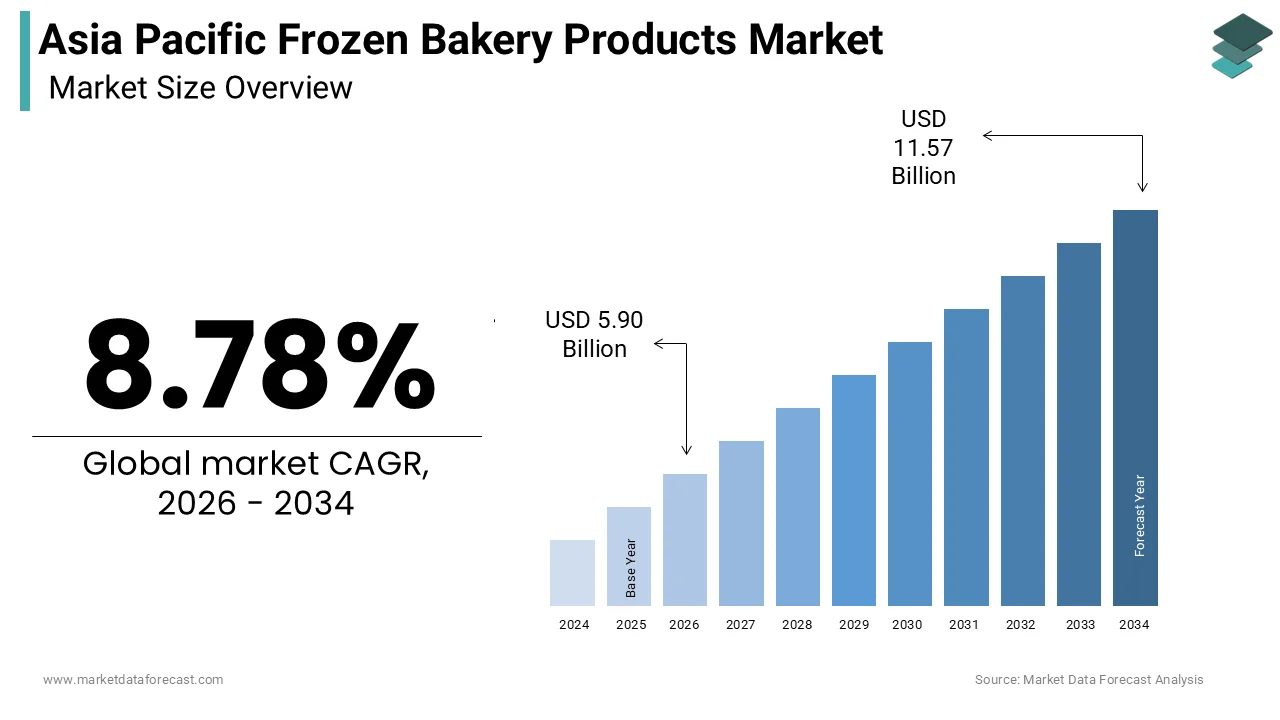
The Asia Pacific Frozen Bakery Products Market size was calculated to be USD 5.42 billion in 2025 and is anticipated to be worth USD 11.57 billion by 2034, from USD 5.90 billion in 2026, growing at a CAGR of 8.78% during the forecast period.
The bakery products are an array of baked goods, including bread, cakes, pastries, biscuits, cookies, and savory snacks. These products are consumed across both household and commercial settings, with increasing integration into daily diets due to changing lifestyle patterns and rising urbanization. The market has evolved significantly over the past decade, driven by the expansion of organized retail, growth of foodservice chains, and rising disposable incomes.
Like, according to the Food and Agriculture Organization (FAO), wheat consumption in the Asia Pacific increased by more than 50% between 2010 and 2023, primarily driven by China and India, where per capita intake nearly doubled during this period. In Japan, bakery items have become a staple part of school lunches and convenience store offerings. Similarly, Southeast Asian countries such as Thailand and Vietnam have witnessed growing demand for Western-style pastries and confectionery. As per the Asian Development Bank, rapid urbanization and a shift toward ready-to-eat food formats have fueled the proliferation of modern bakeries and café chains. This transformation is particularly evident in metropolitan cities like Shanghai, Mumbai, Jakarta, and Sydney.
MARKET DRIVERS
Urbanization and Changing Lifestyles Driving Demand for Convenience Foods
The rapid pace of urbanization and the corresponding shift in consumer lifestyles toward convenience-oriented eating habits is a major factor behind the growth of the Asia Pacific bakery products market. As per the United Nations Department of Economic and Social Affairs, the urban population in the Asia Pacific reached over 2.8 billion in 2023, accounting for nearly 48% of the total regional population, compared to just 37% in 2010. This demographic shift has led to a surge in dual-income households and time-constrained consumers who increasingly rely on ready-to-eat and easy-to-prepare food options. Bakery products such as pre-packaged bread, muffins, croissants, and snack bars fit seamlessly into these fast-paced routines. In South Korea, for example, the number of convenience stores surpassed 46,000 in 2023, many of which feature fresh-baked goods as core offerings, according to the Korea Retail Industry Association.
Moreover, the rise of café culture especially in India, Indonesia, and the Philippines has further expanded the reach of bakery items beyond traditional meal times. These evolving consumption behaviors continue to fuel sustained demand for bakery products across the region.
Expansion of Organized Retail and Modern Distribution Channels
The rapid expansion of organized retail and modern distribution channels is another critical factor propelling the Asia Pacific bakery products market. Traditional wet markets and small neighborhood stores are being gradually replaced by supermarkets, hypermarkets, and online grocery platforms that offer greater variety, improved shelf life, and enhanced consumer experiences. Like, in China, e-commerce giant Alibaba’s Freshippo (Hema) and JD.com have integrated fresh bakery sections into their omnichannel retail models, allowing consumers to order baked goods through mobile apps for same-day delivery. Similarly, in Australia, Woolworths and Coles have expanded their in-store bakeries and frozen bakery lines, catering to diverse consumer preferences.
Apart from these, multinational quick-service restaurant (QSR) chains such as Starbucks, McDonald's, and Domino’s have incorporated bakery-based menu items like muffins, sandwiches, and dessert tarts into their offerings across the region. These developments are boosting visibility as well as driving regular consumption that is reinforcing the role of organized retail as a key growth enabler in the Asia Pacific bakery sector.
MARKET RESTRAINTS
Rising Health Consciousness and Shift Toward Low-Carb and Gluten-Free Diets
The growth of the Asia Pacific bakery products market is hindered by the rising health consciousness among consumers which is leading to a shift away from high-carbohydrate and gluten-containing foods. Awareness about obesity, diabetes, and dietary sensitivities increases and consumers are seeking healthier alternatives, which limits the growth potential of conventional bakery items. In addition, according to the International Diabetes Federation, more than 300 million adults in the Asia Pacific suffer from diabetes or prediabetes, with China and India together accounting for nearly half of this burden. In response, many consumers are reducing their intake of refined flour-based products, including white bread, cakes, and pastries.
Furthermore, regulatory bodies in several APAC countries have introduced labeling mandates and sugar taxes to curb excessive consumption of processed foods. For instance, Thailand’s Ministry of Public Health implemented front-of-pack warning labels for high-sugar and high-fat products in early 2023, influencing purchasing decisions. This moderation in the consumption of traditional bakery products is posing a challenge to market expansion.
Volatility in Raw Material Prices and Supply Chain Disruptions
Volatility in raw material prices, particularly for wheat, sugar, and edible oils, poses a persistent challenge to the Asia Pacific bakery products market. Fluctuations in global commodity markets, exacerbated by geopolitical tensions and climate-related disruptions, directly affect production costs and pricing strategies for bakery manufacturers. For example, wheat prices surged by over 40% in 2022 following supply chain disruptions caused by the Russia-Ukraine conflict, according to the Food and Agriculture Organization (FAO). Countries like Indonesia and the Philippines, which import a significant portion of their wheat from international markets, faced cost pressures that were passed on to consumers, dampening demand for non-essential bakery items.
Besides, extreme weather events such as floods in Pakistan and droughts in parts of Australia have disrupted agricultural output, further straining ingredient availability. These economic uncertainties force manufacturers to either absorb higher costs or raise retail prices, both of which can negatively affect consumer purchasing behavior. This volatility remains a critical constraint on the profitability and scalability of the bakery products industry across the Asia Pacific.
MARKET OPPORTUNITIES
Growing Demand for Premium and Specialty Bakery Items
The increasing consumer interest in premium and specialty bakery products presents a substantial opportunity for market expansion in the Asia Pacific. Consumers, particularly in urban centers, are showing a strong preference for artisanal, organic, and gourmet bakery items that offer superior taste, quality, and perceived health benefits. For Example, in Japan, luxury patisseries and French-style pastry shops have gained immense popularity, especially among younger demographics and affluent consumers. High-end brands such as Beard Papa’s and Le Croissant have successfully capitalized on this trend by offering exclusive flavors and limited-edition products.
Similarly, in Australia, the demand for sourdough bread, plant-based pastries, and gluten-free desserts has surged. With rising disposable incomes and exposure to global food trends, countries like South Korea, Singapore, and Malaysia are witnessing a similar shift. This movement toward premiumization is unlocking new revenue streams within the regional bakery market.
Expansion of E-commerce and Direct-to-Consumer Bakery Platforms
The digital transformation of the bakery industry, particularly through the growth of e-commerce and direct-to-consumer (D2C) platforms which represents a major opportunity for market players in the Asia Pacific. Online ordering, doorstep delivery, and subscription-based models are reshaping how consumers access bakery products, enabling businesses to reach wider audiences beyond physical store locations. In India, startups have leveraged social media and app-based services to connect home bakers with customers, bypassing traditional retail intermediaries.
Meanwhile, in China, Tmall and Meituan have integrated fresh bakery sections into their platforms, allowing local bakeries to fulfill same-day orders. As per the China Internet Network Information Center, online food delivery transactions exceeded RMB 1 trillion in 2023 , with bakery and dessert categories experiencing strong traction.
Australia and New Zealand have also seen an uptick in D2C bakery ventures, with independent bakeries using Shopify and Instagram-based storefronts to expand their customer base. This digital-first approach is fostering deeper consumer engagement and brand differentiation.
MARKET CHALLENGES
Regulatory Pressure and Nutritional Labeling Requirements
The tightening regulatory environment, particularly concerning nutritional labeling, advertising restrictions, and reformulation mandates is one of the major challenges for the Asia Pacific bakery products market. Governments across the region are increasingly implementing policies aimed at curbing excessive sugar, salt, and fat content in processed foods, which directly impacts bakery manufacturers.
In addition, Australia and New Zealand have strengthened their Health Star Rating system, compelling brands to display nutritional scores prominently on packaging. These regulatory pressures are adding complexity to business operations and limiting short-term profitability for many players in the Asia Pacific bakery market.
Intensifying Competition and Fragmented Market Structure
Intense competition between large multinational corporations, regional players, and local artisanal bakeries is greatly affecting the Asia Pacific bakery products market. It is highly fragmented. This saturation makes it increasingly difficult for companies to achieve differentiation and sustain long-term market share without aggressive branding or innovation.
For instance, in India, the market is flooded with micro-bakeries and cloud kitchens that offer customized, niche products at lower overhead costs, challenging established brands.
Moreover, in Southeast Asia, the influx of Japanese and Korean bakery concepts into markets like Vietnam and the Philippines has further diversified consumer choices. This crowded landscape is making sustained profitability a complex endeavor in the Asia Pacific bakery sector.
REPORT COVERAGE
| REPORT METRIC | DETAILS |
| Market Size Available | 2025 to 2034 |
| Base Year | 2025 |
| Forecast Period | 2026 to 2034 |
| CAGR | 8.78% |
| Segments Covered | By Product Type, Distribution Channel, and Region |
| Various Analyses Covered | Global, Regional & Country Level Analysis; Segment-Level Analysis; DROC, PESTLE Analysis; Porter’s Five Forces Analysis; Competitive Landscape; Analyst Overview of Investment Opportunities |
| Regions Covered | India, China, Japan, South Korea, Australia, New Zealand, Thailand, Malaysia, Vietnam, Philippines, Indonesia, Singapore and Rest of APAC |
| Market Leaders Profiled | Dawn Food Products, Inc., General Mills, Inc., Bridgford Foods Corporation, Lantmannen, T. Marzetti Company, Aryzta AG, Associated British Foods Plc, Flower Foods Inc., Grupo Bimbo S.A.B, and Europastry S.A |
SEGMENTAL ANALYSIS
By Product Type Insights
The bread segment was the largest category in the Asia Pacific bakery products market by accounting for a 34.2% in 2025. This dominance of the bread segment is primarily attributed to its widespread consumption across both urban and rural populations as a staple food item is the. In China, per capita bread consumption has steadily increased over the past decade, with the National Bureau of Statistics reporting that urban consumers consumed an average of 18 kilograms of bread per person annually by 2023, up from 12 kilograms in 2015. Apart from these, Japan has seen a surge in demand for Western-style bread formats such as sourdough and brioche, particularly among younger consumers. As per the Japan Bakery Association, sales of premium bread products grew by 9% year-on-year in 2023 , indicating strong consumer interest beyond basic staples.
The morning goods segment represent the fastest-growing segment in the Asia Pacific bakery products market, projected to expand at a CAGR of over 11% between 2026 and 2034. This growth is fueled by changing breakfast habits and the rising influence of café culture across major metropolitan areas.
In South Korea, morning goods have become a daily staple, especially among working professionals and students. According to the Korean Food Industry Association, sales of grab-and-go bakery items sold through convenience stores surged by more than 17% in 2023, reflecting their integration into fast-paced urban lifestyles.
In Southeast Asia, countries have witnessed a proliferation of French-inspired patisseries and artisanal bakeries offering high-quality morning snacks. So, this category is expected to maintain its rapid ascent across the region.
By Distribution Channel Insights
The supermarkets and hypermarkets segment remained the top performing distribution channel in the Asia Pacific bakery products market by capturing a 38.1% in 2025. This superiority of the segment is credited to the broad availability of bakery products in these outlets, combined with consumer preference for one-stop shopping experiences.
In China, large retail chains such as Walmart China and RT-Mart have expanded their fresh bakery sections, incorporating in-store ovens and refrigerated displays to enhance product freshness. Also, modern trade retailers in India including Reliance Retail and Big Bazaar have introduced private-label bakery lines that cater to price-sensitive consumers without compromising on quality. These factors reinforce the stronghold of supermarkets and hypermarkets in distributing bakery products across the Asia Pacific region.
The online retail stores segment is risking as the fastest-growing distribution channel in the Asia Pacific bakery products market, expanding at a CAGR 16.5% during the forecast period. The rise of digital platforms has transformed how consumers access bakery goods, particularly in densely populated urban centers where convenience and delivery speed are paramount.
In India, startups such as BakeMe, Zomato Gold, and Dunzo have integrated bakery-specific fulfillment models, enabling same-day delivery of fresh pastries and cakes. Meanwhile, in China, Meituan and Alibaba’s Freshippo have pioneered cold-chain logistics solutions that preserve the texture and freshness of baked goods during transit. As per the China Internet Network Information Center, online food delivery transactions reached RMB 1.1 trillion in 2023, with bakery and dessert categories experiencing some of the highest order volumes. Hence, online retail continues to reshape the bakery landscape, making it the most dynamic channel in the region.
REGIONAL ANALYSIS
China Bakery Products Market Insights
China held the top position in the Asia Pacific bakery products market, contributing a 28.4% share in 2023. The country with the highest population and a rapidly expanding middle class and it's bakery sector benefits from strong domestic consumption and modernization of retail infrastructure. Also, the proliferation of Western-style bakeries such as BreadTalk and Paris Baguette has introduced new product varieties to Chinese consumers, particularly in Tier 1 and Tier 2 cities. E-commerce platforms like Freshippo and JD.com have also played a crucial role in expanding bakery accessibility. These developments underscore China’s dominant position and sustained growth trajectory in the regional bakery market.
India Bakery Products Market Insights
India is rapidly growing in the Asia Pacific bakery products market. It’s sector is undergoing rapid transformation due to increasing urbanization, changing eating habits, and greater affordability among the expanding middle class. This expansion is supported by the proliferation of organized retail, modern bakeries, and café chains catering to young, aspirational consumers. Moreover, the rise of cloud kitchens and direct-to-consumer (D2C) platforms has enabled home-based bakers to reach a wider audience. Moreover, the Indian government’s push for food safety standardization under FSSAI regulations has further boosted consumer confidence in packaged bakery goods. So, India remains a key growth engine in the Asia Pacific bakery market.
Japan Bakery Products Market Insights
Japan is positioning it as key contributor to the regional market. It is distinguished by its emphasis on quality, innovation, and integration into daily life through convenience stores and specialty cafes. Premium bakery brands have capitalized on consumer demand for unique flavors and limited-time offers, contributing to a thriving artisanal segment. Also, Japan’s aging population has spurred demand for soft-textured and easily digestible bakery alternatives, prompting manufacturers to reformulate products accordingly.
South Korea Bakery Products Market Insights
South Korea captures a notable share of the Asia Pacific bakery products market which is supported by its vibrant café culture and increasing preference for Western-style baked goods. The country’s youthful demographic and tech-savvy consumers have embraced bakery items as part of daily routines, particularly during breakfast and afternoon snack hours. Major brands have expanded their footprint, operating hundreds of outlets nationwide. Moreover, convenience stores like CU and GS25 have incorporated fresh-baked goods into their daily inventory. The integration of digital marketing and social media trends has also influenced bakery consumption, with limited-edition flavors and Instagram-worthy packaging attracting younger audiences.
Australia Bakery Products Market Insights
Australia holds descent portion of the Asia Pacific bakery products market and is driven by a strong focus on health-conscious consumption and premium bakery offerings. Consumers in Australia exhibit a strong preference for organic, gluten-free, and plant-based bakery items, aligning with broader wellness trends. In addition, artisanal bakeries focusing on sourdough, rye, and ancient grains have gained popularity in urban centers such as Sydney and Melbourne. The café industry plays a pivotal role in driving bakery consumption, with a notable number of independent coffee shops operating nationwide, many of which serve freshly baked goods daily.
LEADING PLAYERS IN THE ASIA PACIFIC BAKERY PRODUCTS MARKET
Grupo Bimbo S.A.B. de C.V.
Grupo Bimbo, a global leader in baked goods, has established a strong presence in the Asia Pacific through strategic acquisitions and localized product development. The company operates under various brand names across the region, offering a diverse range of bread, snacks, and sweet bakery products. Its commitment to innovation, sustainability, and supply chain efficiency has enabled it to cater to evolving consumer preferences while maintaining high-quality standards.
Yamazaki Baking Co., Ltd.
Yamazaki Baking is one of Japan’s most influential bakery companies and a major player in the broader Asia Pacific market. Known for its premium quality bread and pastries, the company has expanded beyond Japan into South Korea, Taiwan, and Indonesia. Yamazaki emphasizes product freshness, convenience, and cultural adaptation, making it a preferred choice among consumers seeking both traditional and modern bakery items.
Britannia Industries Limited
Britannia is a leading Indian bakery and dairy products manufacturer with a dominant footprint in South Asia. The company's success stems from its deep-rooted brand equity, wide distribution network, and ability to blend local flavors with international baking techniques. Britannia’s focus on health-oriented bakery products, including fiber-enriched biscuits and diabetic-friendly options, aligns with growing wellness trends.
TOP STRATEGIES USED BY KEY MARKET PARTICIPANTS
One of the primary strategies employed by leading players in the Asia Pacific bakery products market is product diversification and innovation , aimed at catering to evolving consumer preferences. Companies are continuously introducing new flavors, healthier variants, and functional ingredients to capture a broader customer base and differentiate themselves in a competitive environment.
Another key approach is expanding digital engagement and e-commerce integration , which allows brands to reach younger, tech-savvy consumers who prefer online shopping and home delivery. Many bakery firms have developed direct-to-consumer platforms or partnered with food delivery apps to enhance accessibility and convenience.
Lastly, strategic acquisitions and regional partnerships play a crucial role in strengthening market presence. Major players are acquiring local bakeries or forming alliances with regional distributors to gain insights into consumer behavior, streamline logistics, and establish a stronger foothold in emerging markets across Southeast Asia and Oceania.
KEY MARKET PLAYERS AND COMPETITIVE OVERVIEW
Major Players of the Asia Pacific Bakery Products Market include Dawn Food Products, Inc., General Mills, Inc., Bridgford Foods Corporation, Lantmannen, T. Marzetti Company, Aryzta AG, Associated British Foods Plc, Flower Foods Inc., Grupo Bimbo S.A.B, and Europastry S.A
The Asia Pacific bakery products market is characterized by intense competition driven by a mix of multinational corporations, regional powerhouses, and a large number of small-scale, independent bakeries. This highly fragmented structure results in constant pressure on pricing, product differentiation, and branding strategies. Established global players leverage their scale, R&D capabilities, and extensive distribution networks to maintain dominance, particularly in urban centers and organized retail channels. However, regional and local manufacturers often outperform them in niche segments by offering culturally relevant products and superior customer engagement.
Consumer expectations around product quality, freshness, and ingredient transparency further intensify the rivalry among market participants. Innovation cycles are becoming shorter, with frequent launches of limited-edition items and specialty products designed to capture attention on social media and in-store displays. Also, the rise of health-conscious consumers has led to increased competition in developing low-calorie, gluten-free, and organic bakery offerings.
RECENT HAPPENINGS IN THE MARKET
- In February 2025, Yamazaki Baking expanded its operations into Vietnam by launching a new production facility in Ho Chi Minh City, aiming to meet rising demand for Japanese-style bread and convenience bakery items in Southeast Asia.
- In May 2025, Britannia Industries introduced a line of plant-based and high-protein biscuits in India, targeting health-conscious consumers and expanding its presence in the premium bakery segment across South Asia.
- In August 2025, Grupo Bimbo entered into a joint venture with an Indonesian bakery chain to strengthen its foothold in the archipelago, focusing on fresh bread and snack products tailored to local taste preferences.
- In October 2025, a leading Australian artisanal bakery brand launched a nationwide delivery service via its own mobile app, enhancing customer access and reinforcing its position in the premium bakery space.
- In December 2025, a major Korean bakery franchise partnered with a popular coffee chain to co-develop exclusive bakery items, integrating its products into daily café menus and boosting brand visibility across the country.
MARKET SEGMENTATION
This research report on the Asia Pacific Bakery Products Market has been segmented and sub-segmented based on product type, distribution channel, and region.
By Product Type
- Bread
- Morning Goods
By Distribution Channel
- Supermarkets & Hypermarkets
- Online Retail Stores
By Region
- India
- China
- Japan
- South Korea
- Australia
- New Zealand
- Thailand
- Malaysia
- Vietnam
- Philippines
- Indonesia
- Singapore
- Rest of APAC