Global Frozen Bakery Products Market Size, Share, Trends, & Growth Forecast Report Segmented By Product (Bread, Pizza Crust, Cakes & Pastries, Waffles, Donuts, And Cookies), Source, End-Use, Distribution Channel, And Region (North America, Europe, APAC, Latin America, Middle East And Africa) – Industry Analysis From 2026 To 2034
Market Size, 2025
$22.87 BnMarket Estimate, 2026
$24.7 BnMarket Forecast, 2034
$45.72 BnCAGR, 2026–2034
8%Global Frozen Bakery Products Market Size
The global frozen bakery products market size was calculated to be USD 22.87 billion in 2025 and is anticipated to be worth USD 45.72 billion by 2034 from USD 24.70 billion In 2026, growing at a CAGR of 8% during the forecast period.
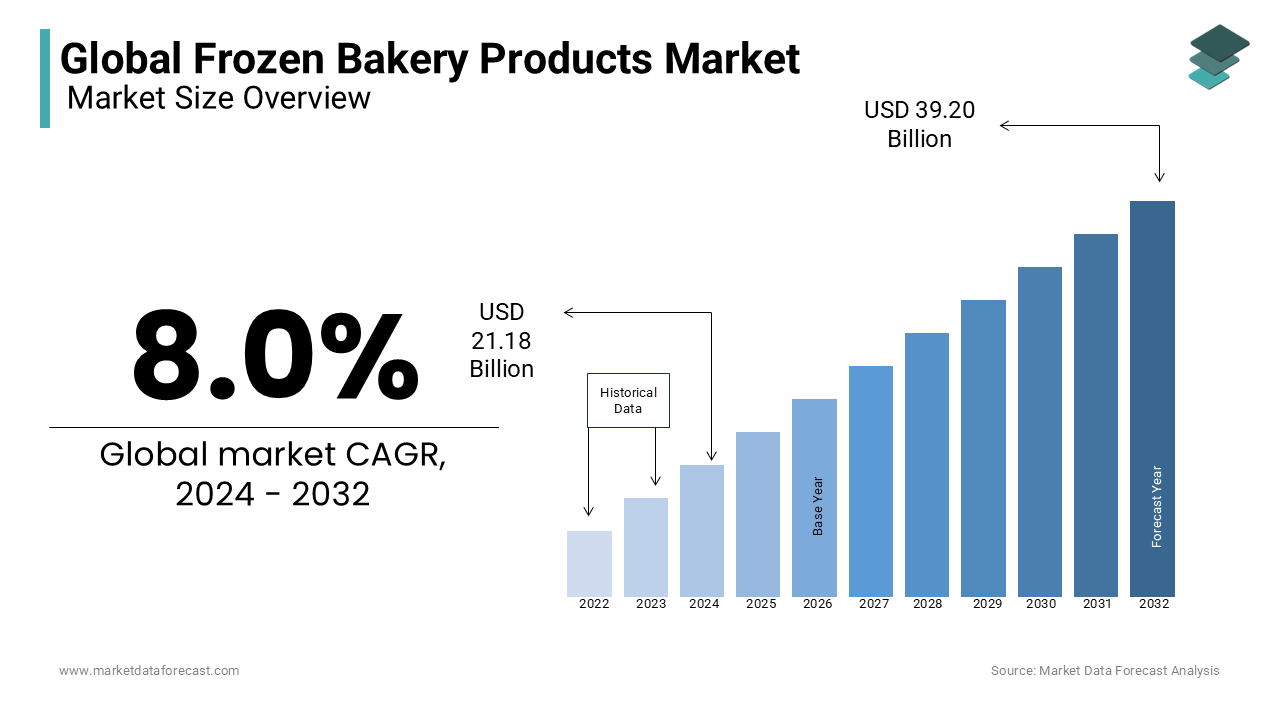
Frozen Bakery Products are pre-baked or unbaked dough-based goods, such as breads, pastries, cakes, and pizzas, designed for long-term storage at sub-zero temperatures while retaining sensory and structural integrity upon thawing and final baking. These products bridge the gap between artisanal quality and operational efficiency, enabling bakeries, restaurants, and households to deliver fresh-baked items with minimal labor and time investment. According to the Food and Agriculture Organization, global wheat production reached 780 million metric tons in 2023, providing a stable raw material base for industrial and specialty bakery applications.
MARKET DRIVERS
The rapid expansion of quick-service restaurants (QSRs) and café chains that prioritize consistency and speed in product delivery is a principal driver of the Frozen Bakery Products Market. This model ensures uniform taste and texture across thousands of outlets, irrespective of geographic location. The scalability offered by frozen bakery solutions enables rapid franchise expansion without the need for skilled in-house bakers, reinforcing their indispensability in modern foodservice ecosystems.
The evolving lifestyle of urban consumers, particularly dual-income households and younger demographics with limited time for meal preparation is another significant driver. As per the United Nations Department of Economic and Social Affairs, over 56% of the world’s population now resides in urban areas, a figure projected to rise to 60% by 2030, intensifying demand for convenient, ready-to-bake food options.
MARKET RESTRAINTS
Consumer skepticism regarding the nutritional quality and ingredient transparency of frozen formulations is one major restraint in the Frozen Bakery Products Market. Despite technological advances, a perception persists that frozen products contain preservatives, artificial additives, or compromised freshness. This cultural preference for artisanal, non-frozen goods limits market penetration in regions where culinary authenticity is highly valued, constraining growth despite logistical advantages.
The high capital and energy intensity of cold-chain logistics, particularly in tropical and developing economies, is another critical restraint. Maintaining a consistent temperature below -18°C throughout storage and distribution is essential to prevent ice crystallization and microbial degradation, which can alter texture and shelf life. As per the World Bank, only 25% of perishable food transport in Sub-Saharan Africa occurs under refrigerated conditions, severely limiting frozen bakery distribution. These systemic inefficiencies increase operational costs and reduce profitability, discouraging investment in frozen bakery expansion in high-growth but logistically fragile markets.
MARKET OPPORTUNITIES
The development of clean-label, organic, and allergen-free frozen bakery products tailored to health-conscious consumers is a pivotal opportunity. Companies like Nestlé and Dr. Oetker have introduced frozen croissants and pizza bases free from artificial emulsifiers and hydrogenated fats, responding to regulatory and consumer demand. This shift enables premium pricing and brand differentiation, positioning frozen bakery goods as compatible with wellness-oriented lifestyles rather than mere convenience items.
The integration of frozen bakery products into e-grocery and direct-to-consumer (DTC) platforms, which have expanded significantly post-pandemic, is another emerging opportunity. In South Korea, where e-commerce penetration in food retail exceeds 30%, companies like CJ CheilJedang have launched subscription-based frozen pastry boxes delivered weekly.
MARKET CHALLENGES
Maintaining product quality during repeated freeze-thaw cycles, which can lead to moisture loss, staling, and textural degradation, is a primary challenge facing the Frozen Bakery Products Market. Even minor temperature fluctuations during transport or retail storage can compromise the crumb structure and volume of breads and pastries. This quality inconsistency undermines brand trust and limits repeat purchases, especially in markets lacking standardized cold storage protocols.
The rising cost and volatility of key ingredients, particularly specialty flours, butter, and eggs, which are sensitive to climatic and geopolitical disruptions, is another significant challenge. According to the Food and Agriculture Organization’s Food Price Index, global dairy prices fluctuated by over 22% in 2022 due to supply constraints in New Zealand and the European Union, directly impacting the production cost of butter-rich items like croissants and danishes. Similarly, egg prices in the U.S. surged by 60% in early 2023 due to avian influenza outbreaks, as per the U.S. Bureau of Labor Statistics. These input cost instabilities compress margins for frozen bakery manufacturers, many of whom operate on thin profitability, and complicate long-term pricing strategies in a highly competitive, price-sensitive consumer environment.
REPORT COVERAGE
| REPORT METRIC | DETAILS |
| Market Size Available | 2025 to 2034 |
| Base Year | 2025 |
| Forecast Period | 2026 to 2034 |
| CAGR | 8% |
| Segments Covered | By Product, End Use, Distribution Channel, And Region |
| Various Analyses Covered | Global, Regional and Country Level Analysis; Segment-Level Analysis; DROC; PESTLE Analysis; Porter’s Five Forces Analysis; Competitive Landscape; Analyst Overview of Investment Opportunities |
| Regions Covered | North America, Europe, APAC, Latin America, Middle East & Africa |
| Market Leaders Profiled | Dawn Food Products, Inc., General Mills, Inc., Bridgford Foods Corporation, Lantmannen, T. Marzetti Company, Aryzta AG, Associated British Foods Plc, Flower Foods Inc., Grupo Bimbo S.A.B, and Europastry S.A |
SEGMENTAL ANALYSIS
By Product Insights
The Bread segment dominated the global frozen bakery products market by capturing a 34.6% of total value in 2025. This growth is due to bread’s universal role as a dietary staple and its widespread integration into both household and commercial food operations. The scalability, shelf-life extension, and labor-saving advantages of frozen bread make it indispensable across diverse culinary traditions.

The Cakes & Pastries segment is projected to grow at the fastest CAGR of 12.8% from 2026 to 2034. This surge is fueled by rising demand for indulgent, ready-to-serve desserts in both retail and hospitality sectors. Innovations such as individually portioned, oven-ready tiramisu and chocolate soufflés from companies like Dr. Oetker have expanded consumer appeal. The growing popularity of home celebrations and gifting further amplifies demand for premium, visually appealing frozen desserts.
By Source Insights
The wheat segment was the dominant raw material in the frozen bakery sector by accounting for a substantial share of total input usage in 2025. Its prevalence is rooted in gluten’s unique viscoelastic properties, which are essential for dough structure, gas retention, and final product volume in breads, croissants, and pizza crusts. Global wheat production reached 780 million metric tons in 2023, with over 70% directed toward food applications, according to the International Grains Council. In Europe, where frozen artisanal breads are a retail staple, over 90% of formulations rely on high-protein wheat varieties to achieve crust crispness and crumb softness. Even in regions with rising interest in alternative grains, wheat remains irreplaceable in frozen formats due to its proven performance under freezing and thawing stress.
The Corn-based segment is expanding at the highest CAGR of 11.3%. It is driven by growing demand for gluten-free and specialty bakery items. As per the Celiac Disease Foundation, an estimated 3 million Americans follow a gluten-free diet, creating a robust market for corn-based frozen muffins, waffles, and tortillas. In Latin America, where corn is a cultural staple, frozen arepas and empanadas made from pre-gelatinized maize flour are gaining commercial traction. Additionally, corn’s lower cost and higher thermal stability during freezing make it ideal for industrial-scale production, particularly in emerging markets where affordability and shelf life are critical.
By End-Use Insights
The Food Service Industry led the frozen bakery market by commanding 48.4% of total consumption in 2025. This dominance is attributable to the operational demands of restaurants, hotels, and café chains that require consistent product quality with minimal labor input. In China, the rapid expansion of Western-style coffee shops like Luckin Coffee, over 9,000 outlets in 2023, relies heavily on frozen viennoiserie to maintain uniformity. The ability to scale production without hiring skilled bakers makes frozen bakery products a strategic asset for franchise-based foodservice models globally.
The Retail segment is projected to grow at the fastest CAGR of 12.1% through 2030. It is driven by shifting consumer shopping behaviors and the expansion of modern grocery infrastructure. E-commerce platforms like Amazon Fresh and BigBasket have further accelerated access, offering frozen bakery bundles with cold-chain delivery. Consumers increasingly view frozen bakery goods not as compromises but as convenient, high-quality alternatives to daily baking.
By Distribution Channel Insights
The Retail channel remained the largest distribution pathway by accounting for 44.7% of total market volume in 2025. This dominance is underpinned by the widespread availability of frozen bakery items in supermarkets, hypermarkets, and convenience stores across developed and emerging economies. In Germany, frozen bread is widely used, due to its freshness-on-demand appeal. In Japan, retailers like Aeon and Ito-Yokado stock a wide array of frozen anpan and melon pan, catering to aging populations seeking convenience. The integration of frozen bakery into private-label offerings by major chains such as Tesco and Carrefour has further strengthened its presence, making it a staple in weekly household shopping baskets.
The Online Channel is experiencing the most rapid growth, with a projected CAGR of 15.6% from 2026 to 2034. This acceleration is driven by the maturation of cold-chain e-commerce logistics and changing consumer preferences for home delivery. Platforms like Walmart+, Instacart, and Blinkit now offer same-day frozen deliveries with temperature-controlled packaging, reducing spoilage risks. Direct-to-consumer models also enable brands to collect data, personalize offerings, and build loyalty beyond traditional retail shelf space.
REGIONAL ANALYSIS
North America Frozen Bakery Products Market Insights
North America held the largest regional share at 33.5% of the global frozen bakery market in 2025. The region’s position is anchored in its highly developed foodservice infrastructure and consumer familiarity with frozen convenience foods. Canada’s aging population and urbanization have further boosted demand for ready-to-bake items. Major players like General Mills and Aryzta operate large-scale frozen dough facilities, ensuring nationwide distribution. The integration of frozen bakery into school meal programs and hospital catering underscores its role in institutional food systems.
Europe Frozen Bakery Products Market Insights
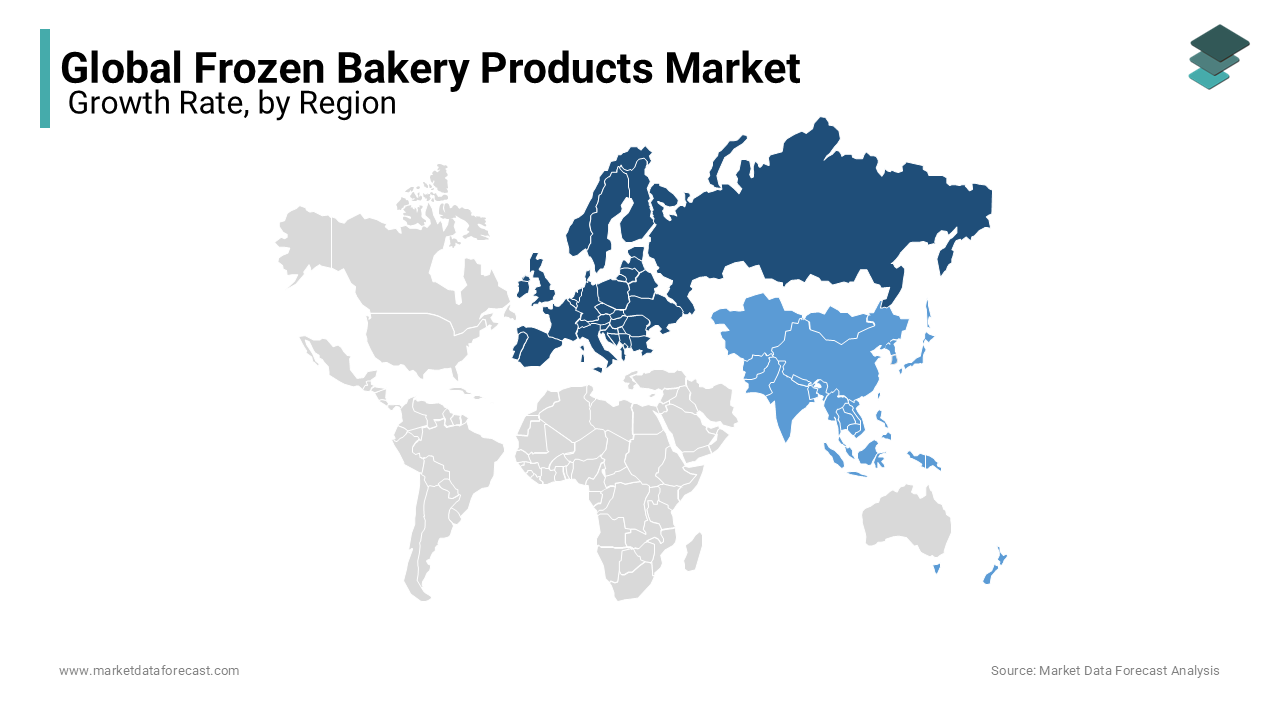
Europe is distinguished by its strong tradition of artisanal baking and regulatory emphasis on food quality. Countries like France, Germany, and Italy have successfully adapted frozen par-baked baguettes and sourdough loaves to retain sensory authenticity. The European Union’s Farm to Fork Strategy supports sustainable food models, encouraging the use of energy-efficient frozen formats over daily baking.
Asia Pacific Frozen Bakery Products Market Insights
Asia Pacific accounts for a notable share of the market, with rapid urbanization and Western dietary influences fueling growth. In India, the organized retail sector’s adoption of frozen naan and kulchas has transformed traditional meal preparation. Japan’s aging workforce has led to increased reliance on frozen shokupan and sweet buns, with convenience stores like 7-Eleven stocking a wide variety. Government investments in cold-chain infrastructure, particularly in India and Indonesia, are removing historical barriers to market expansion.
Latin America Frozen Bakery Products Market Insights
Latin America holds a notble share, with Brazil and Mexico leading adoption. Brazilian consumers increasingly purchase frozen French bread (pão francês) and cheese rolls (pão de queijo), with retail sales rising. In Mexico, frozen corn-based tortillas and pastries are integral to both household and restaurant use. The rise of café chains like OXXO Café and Starbucks has increased demand for standardized frozen pastries.
Middle East and Africa Frozen Bakery Products Market Insights
Middle East and Africa collectively represent small share of the market, but exhibit high growth potential. In the UAE, luxury hotels and airline caterers rely on imported frozen croissants and cakes to meet international standards. South Africa’s formal retail sector stocks frozen bread and rolls due to electricity instability affecting daily baking. Rising disposable incomes and exposure to global cuisines are gradually reshaping consumer expectations in the region.
KEY MARKET PLAYERS AND COMPETITIVE LANDSCAPE
Major Key Players in the Global Frozen Bakery Products Market are Dawn Food Products, Inc., General Mills, Inc., Bridgford Foods Corporation, Lantmannen, T. Marzetti Company, Aryzta AG, Associated British Foods Plc, Flower Foods Inc., Grupo Bimbo S.A.B, and Europastry S.A
The competition in the frozen bakery products market is characterized by a blend of multinational corporations and regional specialists vying for dominance through innovation and operational agility. Established players leverage global supply chains and brand equity, while niche manufacturers differentiate through artisanal quality and dietary-specific offerings such as gluten-free or organic lines. In the Asia Pacific, local adaptation is critical, with companies tailoring textures, flavors, and portion sizes to match regional preferences. The rise of foodtech startups introducing novel freezing techniques and sustainable packaging adds further complexity. Competitive advantage increasingly hinges on consistency, cold-chain reliability, and the ability to deliver fresh-baked experiences without on-site expertise. As consumer expectations rise, companies that combine technological precision with culinary authenticity are gaining sustainable traction in this dynamic landscape.
TOP PLAYERS IN THE MARKET
Aryzta AG
Aryzta AG has established a significant footprint in the Asia Pacific by supplying premium frozen bakery solutions to hotels, airlines, and retail chains across Australia, Japan, and South Korea. The company leverages its expertise in artisan-style par-baked breads and gourmet pastries, tailored to meet the region’s evolving taste preferences. It also launched plant-based frozen muffins in partnership with Australian foodservice distributors to align with clean-label trends. Through its innovation center in Singapore, Aryzta continuously develops region-specific formulations that balance shelf stability with sensory authenticity, reinforcing its reputation as a high-end supplier in institutional and hospitality segments.
Grupo Bimbo
Grupo Bimbo has strategically intensified its presence in the Asia Pacific through localized production and strategic acquisitions, particularly in China, India, and Southeast Asia. The company introduced frozen pan de sal variants for the Philippine market and expanded its frozen sandwich bread lines for institutional clients in Thailand. It also partnered with Indian quick-service chains to supply customized frozen buns and burger rolls, capitalizing on the fast-growing burger economy. By integrating sustainability into its logistics—such as energy-efficient freezing and recyclable packaging—Bimbo is positioning itself as a modern, responsible player in the region’s rapidly expanding frozen bakery landscape.
Finsbury Food Group
Finsbury Food Group has carved a niche in the Asia Pacific by focusing on premium frozen cakes and desserts for upscale retailers and catering services. The company’s UK-developed sponge and cheesecake bases are now being adapted for markets like Singapore and Hong Kong, where demand for Western-style desserts remains strong. It also introduced smaller portioned, individually packaged frozen desserts to cater to urban single-person households. By emphasizing texture retention after thawing and clean-label ingredients, Finsbury is differentiating its offerings in a segment increasingly sensitive to quality and convenience, establishing a foothold in the premium frozen pastry space.
TOP STRATEGIES USED BY THE KEY MARKET PLAYERS
Key players in the frozen bakery products market employ a range of strategic initiatives to consolidate their competitive edge. Major strategies include product innovation focused on clean-label, allergen-free, and plant-based formulations to meet evolving consumer health demands. Companies are investing in regional R&D centers to develop culturally adapted products that align with local palates and culinary traditions. Strategic partnerships with foodservice chains and airlines ensure consistent volume demand and brand visibility. Expansion of cold-chain logistics and temperature-controlled distribution networks enhances product integrity and market reach, especially in tropical climates. Additionally, acquisitions and joint ventures are leveraged to enter new geographies and scale production capacity. Digital engagement through e-commerce platforms and direct-to-consumer models further strengthens customer loyalty and enables data-driven product development.
RECENT HAPPENINGS IN THE MARKET
- In March 2022, Aryzta launched a new line of plant-based frozen croissants in Japan, developed in collaboration with local chefs to meet the growing demand for vegan breakfast options in urban cafes and hotels.
- In July 2022, Grupo Bimbo inaugurated a frozen bakery production facility in Penang, Malaysia, equipped with advanced cryogenic freezing technology to supply par-baked breads to retail and foodservice clients across Southeast Asia.
- In January 2023, Finsbury Food Group entered a strategic distribution partnership with City’super, a premium grocery chain in Hong Kong, to introduce its range of gourmet frozen desserts in upscale urban retail outlets.
- In October 2023, Nestlé Philippines introduced frozen ensaymada and monay dough for household use, tapping into traditional Filipino bread culture while offering convenience for time-constrained consumers.
- In February 2025, McCain Foods, expanding beyond frozen potatoes, launched a pilot range of frozen bakery items including garlic bread and stuffed rolls in Australia, distributed through major supermarket chains Coles and Woolworths.
MARKET SEGMENTATION
This research report on the global frozen bakery products market is segmented and sub-segmented into the following categories.
By Product
- Pizza Crusts
- Bread
- Waffles
- Donuts
- Pies
- Cakes
- Cookies
By Source
- Wheat
- Barley
- Corn
- Rye
By End-use
- Foodservice industry
- Retail
- Food processing industry
By Distribution channel
- Retail
- Specialty stores
- Supermarkets
- Hypermarkets
- Catering
- Bakery and Confectionery
- Online Channel
- Netherlands
- Turkey
- Czech Republic
- Rest Of Europe
By Region
- North America
- Europe
- Asia Pacific
- Latin America
- Middle East and Africa
Frequently Asked Questions
1. What factors are driving the Frozen Bakery Products Market growth?
Urban lifestyles, growing preference for frozen food, and rising quick-service restaurants are driving the Frozen Bakery Products Market.
2. Which regions dominate the Frozen Bakery Products Market?
Europe leads the Frozen Bakery Products Market, while Asia Pacific shows the fastest growth due to increasing bakery consumption.
3. What are the main product categories in the Frozen Bakery Products Market?
Bread, cakes, pastries, pizza crusts, and croissants are major product categories in the Frozen Bakery Products Market.
4. How does convenience influence the Frozen Bakery Products Market?
Convenience and long shelf life are key factors boosting demand in the Frozen Bakery Products Market among busy consumers.
5. Who are the leading players in the Frozen Bakery Products Market?
Key players include Grupo Bimbo, Aryzta, General Mills, Associated British Foods, and Lantmännen Unibake.
6. What challenges affect the Frozen Bakery Products Market?
Challenges include cold chain logistics, fluctuating raw material costs, and consumer perception of frozen foods.
7. What are the key trends in the Frozen Bakery Products Market?
Trends include demand for clean-label, organic frozen bakery products and innovations in frozen dough technology.
8. What opportunities exist in the Frozen Bakery Products Market?
Emerging markets, online food delivery, and plant-based frozen bakery items present strong opportunities for growth.
Related Reports
Access the study in MULTIPLE FORMATS
Purchase options starting from
$ 2500
Didn’t find what you’re looking for?
TALK TO OUR ANALYST TEAM
Need something within your budget?
NO WORRIES! WE GOT YOU COVERED!
Call us on: +1 888 702 9696 (U.S Toll Free)
Write to us: sales@marketdataforecast.com