- Product Description Description
- Table of Contents TOC
- List of Table & Figure LOT
- Get Free Sample PDF Sample PDF
Market Size, 2025
$5,848 MnMarket Estimate, 2026
$7,111 MnMarket Forecast, 2034
$33,995 MnCAGR, 2026–2034
21.6%Executive Summary: Asia-Pacific Healthcare Cybersecurity Market
- Market Scope: Comprehensive regional market analysis covering security offerings, threat types, security architectures, end-user settings, deployment modes, and country-level adoption frameworks across the Asia-Pacific region.
- Market Valuation: Valued at USD 5,848 million (2025), estimated at USD 7,111 million (2026), and projected to reach USD 33,995 million by 2034, registering a robust CAGR of 21.6% (2026–2034).
- Primary Growth Drivers: Escalating cyber threats and high-profile security incidents across regional networks, rapid digital transformation and internet penetration, and stringent government initiatives enforcing data security laws and compliance standards.
Key Market Segment Metrics (2026–2034)
| Category | Leading Segment (2025 Position) | Fastest-Growing Segment |
|---|---|---|
| By Offering | Solutions (led the market via comprehensive IAM, SIEM, and encryption frameworks) | Managed and Professional Services (expanding rapidly to bridge cybersecurity talent and resource gaps) |
| By Threat Type | Ransomware and Malware (accounted for the highest share of reported healthcare breaches) | Advanced Persistent Threats (APT) and Phishing (surging due to expanded digital connectivity) |
| By Security Type | Network Security (dominated market share to protect hospital infrastructure and data flows) | Endpoint and IoT Security (accelerating alongside connected medical device implementations) |
| By End User | Hospitals and Healthcare Facilities (held the largest market share owing to vast patient databases) | Telehealth and Digital Health Providers (scaling quickly with remote care adoption) |
| By Country | China (presently leading the Asia-Pacific market due to large patient datasets and advanced digital health adoption) | India (showcasing healthy, rapid growth driven by expanding digital infrastructure and healthcare investments) |
Major Market Players & Market Structure
Market Structure: Highly competitive regional cybersecurity landscape featuring global tech giants and specialized defense vendors competing on advanced threat detection, compliance readiness, cloud security scalability, and risk management solutions.
Key Companies: McAfee LLC, FireEye, Atos SE, Palo Alto Networks Inc, Cisco Systems Inc, Fortified Health Security, Lockheed Martin Corporation, Booz Allen Hamilton Inc, and IBM Corporation.
Asia Pacific Healthcare Cybersecurity Market Size
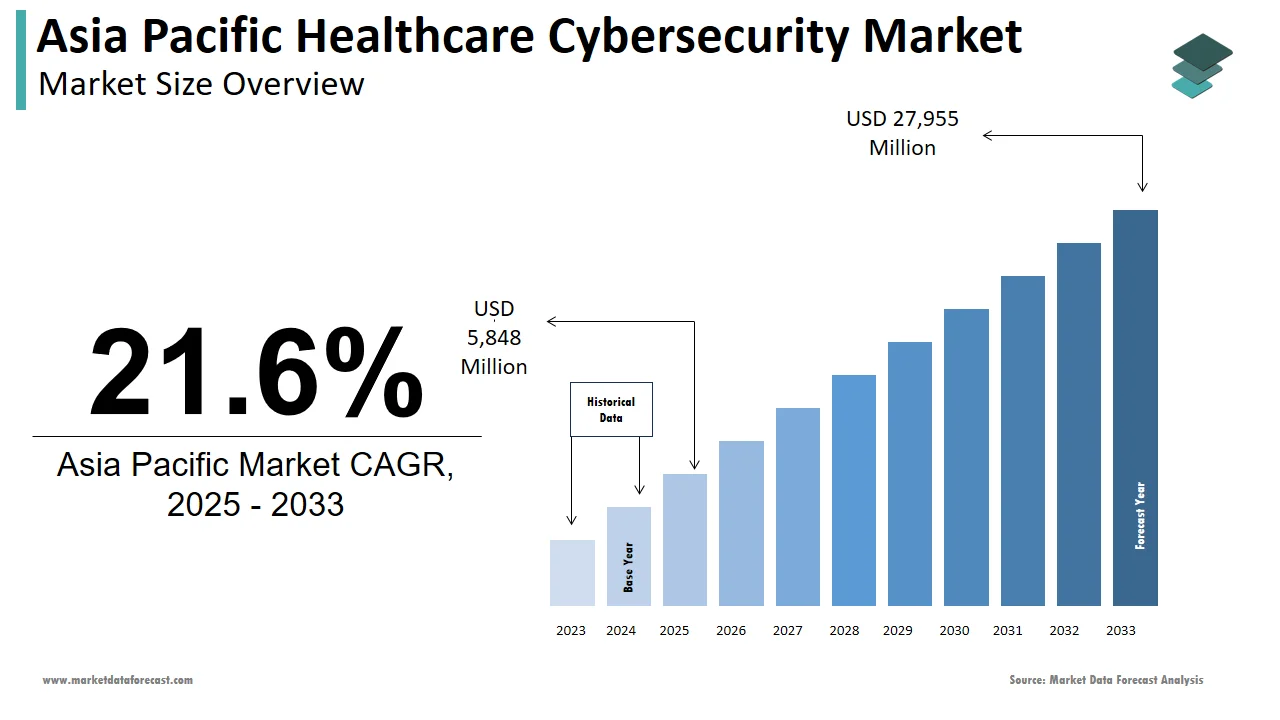
The Asia-Pacific healthcare cybersecurity market was valued at USD 5,848 million in 2025. The market is estimated at USD 7,111 million in 2026 and is projected to reach USD 33,995 million by 2034, growing at a CAGR of 21.6% from 2026 to 2034.
MARKET DRIVERS
Cybersecurity has seen tremendous growth with the Internet, social media, and mobile users in the region. The intensification of these attacks is likely to accelerate the growth of the healthcare cybersecurity market in the Asia-Pacific. In 2016, about 80 million USD was stolen from a bank in Bangladesh by a cyberattack. In the same year, it was reported that the Philippine government places were frequently hacked. The growing number of such incidents pushes the demand for cybersecurity in the Asia Pacific region. More than 75% of the Asian population has no education about cybersecurity. Lack of awareness and lack of appropriate infrastructure in at least networked countries such as Myanmar and Cambodia are driving the growth of the cybersecurity market in the Asia Pacific region.
The growing cyber risk in healthcare and the need to reduce cyber threats are significant factors propelling the demand of the market in the Asia-Pacific region. The adoption of cyber-security solutions is anticipated to grow with growing perforation of the internet among developed and developing countries is expected to boost the Asia Pacific market.
Increasing digital transformation and connectivity in the Asia Pacific area is threatening cyber threats. Besides, the government initiative towards cyber laws and data security is the key factor driving the growth of the market. As the frequency of sophisticated attacks on the company increases, the cybersecurity market is expected to gain traction in the next five years. With the exponential growth and complexity of cyberattacks over the past several years, strict compliance and security packages are demanding to protect the confidential data in the hospitals and other institutes.
MARKET RESTRAINTS
Lack of education and awareness on cybersecurity is hindering the growth of the cybersecurity market in the region. Therefore, stringent government actions taken to enforce regulatory compliance around the world are pushing organizations to implement cybersecurity solutions for data privacy.
COUNTRY LEVEL ANALYSIS

Developing countries like India, China and Japan in the Asia Pacific region produce large amounts of patient data each year. Chinese healthcare cybersecurity market is presently leading the Asia Pacific market. Rising demand to protect data integrity, healthcare professionals have begun to adopt upgraded cybersecurity software that enhances regional market growth. The Department of Defense Information Assurance Certification and Accreditation Process (DICA), the Health Insurance Portability and Accountability Act (HIPPA) and the Payment Card Industry Data Security Standard (PCI-DSS) provide essential guidelines to the companies which helps them to have data security. The stringent policies of the development of cybersecurity solutions are inspiring the increase of the cybersecurity business in the region.
Japan is a lucrative region in the Asia pacific market and it has commanded uniform principles towards government organizations to control and manage illegal access and activity. Government has taken proposals and increasing awareness steps in people in enhancing the cyber rate of the country. Quick development in the technology, existence of huge opportunities for the enhancement of the market is projected to escalate the market during the review period.
The Indian and Chinese markets are expected to showcase a healthy rate during the forecast period.
KEY MARKET PLAYERS
Noteworthy companies dominating the Asia pacific healthcare cybersecurity market profiled in this report are McAfee, LLC, FireEye, Atos SE, Palo Alto Networks, Inc., Cisco Systems, Inc., Fortified Health Security, Lockheed Martin Corporation, Palo Alto Networks, Inc., Booz Allen Hamilton, Inc. and IBM Corporation.
MARKET SEGMENTATION
This Asia Pacific healthcare cybersecurity market research report is segmented and sub-segmented into the following categories.
By Offering
-
Solutions
-
Identity and Access Management (IAM)
-
Risk and Compliance Management
-
Antivirus and Antimalware
-
DDoS Mitigation
-
Security Information and Event Management (SIEM)
-
Intrusion Detection/Prevention Systems (IDS/IPS)
-
Encryption and Tokenization
-
Patch Management
-
Other Solutions (e.g., data backup and recovery, asset identification)
-
-
Services
-
Professional Services
-
Managed Services
-
By Threat Type
- Malware
- Ransomware
- Phishing
- Distributed Denial of Service (DDoS)
- Advanced Persistent Threats (APT)
- Spyware
- Lost or Stolen Devices
- Other Threats (e.g., unauthorized access, code injection)
By Security Type
- Network Security
- Cloud Security
- Application Security
- Endpoint and IoT Security
- Content Security
By End User
- Hospitals and Healthcare Facilities
- Medical Device Manufacturers
- Pharmaceuticals and Biotechnology Companies
- Health Insurance Providers and Payers
- Telehealth and Digital Health Providers
- Government Healthcare Agencies
-
Others
By Deployment Mode
-
On-Premises
-
Cloud-Based
By Country
- India
- China
- Japan
- South Korea
- Australia
- New Zealand
- Thailand
- Malaysia
- Vietnam
- Philippines
- Indonesia
- Singapore
- Rest Of APAC