- Product Description Description
- Table of Contents TOC
- List of Table & Figure LOT
- Get Free Sample PDF Sample PDF
Market Size, 2025
$6.97 BnMarket Estimate, 2026
$7.68 BnMarket Forecast, 2034
$16.75 BnCAGR, 2026–2034
10.24%Asia Pacific Heat Pump Compressors Market Size
The Asia Pacific Heat Pump Compressors Market size was valued at USD 6.97 billion in 2025 and is anticipated to reach USD 7.68 billion in 2026 from USD 16.75 billion by 2034, growing at a CAGR of 10.24% during the forecast period from 2026 to 2034.
The heat pump compressors are specialized thermal regulation technology specially designed to facilitate efficient heating, cooling, and hot water generation across residential, commercial, and industrial applications. These compressors serve as the core mechanical component in heat pump systems, enabling the transfer of thermal energy by compressing and circulating refrigerants through vapor-compression cycles. As of 2023, over 1.8 billion square meters of floor space in China and India alone were equipped with energy-efficient HVAC systems, which is reflecting a structural shift toward electrified thermal solutions as noted by the International Energy Agency. F
MARKET DRIVERS
Expansion of Urban Housing and Green Building Initiatives
The rapid proliferation of urban housing infrastructure in emerging economies such as Vietnam, Indonesia, and India, which is significantly amplifying the growth Asia Pacific heat pump compressor market. This regulatory push has catalyzed the adoption of heat pump systems, which rely on high-efficiency compressors to achieve coefficient of performance (COP) values exceeding 3.5 under standard operating conditions. Similarly, in China, the Ministry of Housing and Urban-Rural Development reported that over 600 million square meters of green buildings were constructed in 2022 alone, many integrating heat pump technology for space and water heating. These systems predominantly utilize scroll and variable-speed compressors, capable of modulating output based on thermal load, thereby reducing energy consumption by up to 50% compared to electric resistance heating.
Government-Led Electrification of Heating Systems
A transformative shift toward the electrification of heating infrastructure is accelerating the growth of the Asia Pacific heat pump compressors market. Countries are increasingly phasing out fossil fuel-based heating systems in favor of electric heat pumps as part of broader energy transition strategies. Japan’s Green Growth Strategy explicitly targets the replacement of 50 million gas-fired water heaters with heat pump-based systems by 2030, a move expected to reduce CO₂ emissions by 55 million tons annually, as stated by the Agency for Natural Resources and Energy. This initiative has already spurred a surge in demand for high-efficiency compressors capable of operating in cold-climate conditions, with manufacturers like Mitsubishi Electric and Daikin reporting over 20% year-on-year growth in compressor shipments for residential heat pumps.
MARKET RESTRAINTS
High Initial Cost and Economic Sensitivity in Emerging Markets
The high upfront cost of equipment, particularly advanced compressors that enable superior efficiency and cold-climate operation is solely restricting the growth of the Asia Pacific heat pump compressors market. This cost disparity is largely attributable to the sophisticated compressor technology required, including hermetic scroll and inverter-driven models, which constitute up to 40% of the total system cost. Moreover, in rural and semi-urban areas, access to financing mechanisms for energy-efficient appliances remains limited, where only 12% of households in Indonesia’s rural provinces have access to green consumer loans, according to the Indonesia Financial Services Authority.
Supply Chain Vulnerability for Compressor Components
The production of advanced heat pump compressors in Asia Pacific is heavily dependent on a tightly coupled supply chain for precision components such as motor laminations, electronic expansion valves, and rare-earth-based permanent magnets used in inverter-driven compressors. Geopolitical disruptions and concentration of manufacturing in specific territories have exposed this supply chain to significant volatility. In 2022, a temporary restriction on rare earth exports led to a 30% increase in magnet prices, directly impacting compressor manufacturing costs for Japanese and South Korean OEMs, as confirmed by the Japan External Trade Organization. Additionally, semiconductor shortages during 2021–2023 disrupted the production of compressor control units, with Taiwan Semiconductor Manufacturing Company reporting a 19% decline in microcontroller supply for HVAC applications. These disruptions delayed heat pump compressor deliveries by up to 14 weeks for major suppliers like Hitachi and LG, according to the Global Supply Chain Institute. These systemic vulnerabilities impede consistent production scalability and price stability, which is limiting market responsiveness to rising demand.
MARKET OPPORTUNITIES
Integration with Renewable Energy Microgrids in Off-Grid Communities
The expansion of decentralized renewable energy systems in remote and off-grid areas is posing new opportunities for the growth of the Asia Pacific heat pump compressors market. These compressors, often utilizing transcritical CO₂ cycles, maintain efficiency at -15°C, making them ideal for cold, high-altitude environments. In the Pacific Island nations, where electricity generation is increasingly solar-dependent, the Secretariat of the Pacific Community reports that 45% of new public infrastructure now includes solar-integrated heat pumps for water heating, reducing strain on limited grid capacity. The off-grid solar expansion and efficient compressor technology with over 120 million people in the region still lacking reliable heating access is enhancing the growth of the Asia Pacific heat pump compressor market.
Adoption of Next-Generation Refrigerants with Advanced Compressor Compatibility
The regional shift toward low-global-warming-potential (GWP) refrigerants is additionally to propel the growth of the Asia Pacific heat pump compressor market. This regulatory transition is accelerating the adoption of refrigerants such as R-32 and R-290, which require compressors with enhanced material compatibility, higher pressure tolerance, and improved oil management. In Japan, over 90% of new residential heat pumps now use R-32, a refrigerant that operates at 20% higher pressure than R-410A, necessitating reinforced compressor casings and precision valve systems, as documented by the Japan Refrigeration and Air Conditioning Manufacturers Association. India’s Department of Scientific and Industrial Research has approved R-290 for use in small-capacity heat pumps, prompting compressor manufacturers like Godrej and Blue Star to develop hermetically sealed units capable of handling flammable refrigerants safely.
MARKET CHALLENGES
Technical Incompatibility with Existing HVAC Infrastructure
The adoption of technical incompatibility with legacy heating and cooling infrastructure, particularly in older urban buildings and industrial facilities is likely to pose challenge for the growth of the Asia Pacific heat pump compressor market. Many existing HVAC systems were designed for boiler-based hydronic heating or single-speed refrigerant cycles, making retrofitting with modern variable-speed heat pump compressors complex and costly. In cities like Bangkok, Jakarta, and Manila, over 60% of commercial buildings constructed before 2000 lack the electrical load capacity and piping configurations required for heat pump integration, as reported by the ASEAN Centre for Energy.
Skilled Labor Shortage in Heat Pump System Installation and Maintenance
The effective operation and longevity of heat pump compressors are highly dependent on precise installation, commissioning, and maintenance tasks that require specialized technical expertise currently in short supply across much of Asia Pacific. As per the International Labour Organization, there is a deficit of over 1.2 million qualified HVAC technicians in Southeast Asia and South Asia, with only 18% of existing technicians trained in heat pump-specific diagnostics and refrigerant handling. This skills gap is particularly acute in rural and semi-urban areas, where training infrastructure remains underdeveloped. In India, for example, the National Skill Development Corporation reports that fewer than 30,000 technicians have been certified in advanced heat pump technologies since 2020, despite a projected need for over 200,000 by 2027. In Vietnam, a 2023 assessment by the Ministry of Labour, Invalids and Social Affairs revealed that 65% of service technicians lacked certification in handling R-32, a widely adopted refrigerant requiring specific safety protocols.
REPORT COVERAGE
| REPORT METRIC | DETAILS |
| Market Size Available | 2025 to 2034 |
| Base Year | 2025 |
| Forecast Period | 2026 to 2034 |
| CAGR | 10.24% |
| Segments Covered | By Product, Type and Country |
| Various Analyses Covered | Regional & Country Level Analysis, Segment-Level Analysis, DROC, PESTLE Analysis, Porter’s Five Forces Analysis, Competitive Landscape, Analyst Overview on Investment Opportunities |
| Countries Covered | India, China, Japan, South Korea, Australia, New Zealand, Thailand, Malaysia, Vietnam, the Philippines, Indonesia, Singapore, and the rest of APAC. |
| Market Leaders Profiled | BITZER, Bock GmbH, Carrier, Copeland LP, Daikin Industries Ltd., Danfoss, Emerson Electric Co., GEA Group Aktiengesellschaft, Gree Electric Appliances Inc., LG Electronics, Mayekawa Mfg. Co. Ltd., Midea Group, Panasonic Corporation, Rechi Precision Co. Ltd., Secop GmbH, Siam Compressor Industry Co. Ltd., and Tecumseh Products Company LLC. |
SEGMENTAL ANALYSIS
By Product Insights
The air source segment was the largest and held a dominant share of the Asia Pacific heat pump compressor market in 2024. Unlike ground source and water source systems, which require extensive site-specific geothermal or hydrological assessments, air source systems can be deployed in high-density urban environments with minimal space and installation complexity. In China, over 22 million air source heat pump units were installed in 2022 alone, primarily in northern provinces under the "Coal-to-Electricity" initiative, according to the China National Renewable Energy Centre. This large-scale deployment has created a self-reinforcing ecosystem of manufacturing, distribution, and service networks focused on air source compressor technology. Additionally, advancements in cold-climate performance have expanded their viability; modern compressors now operate efficiently at temperatures as low as -25°C, with COP values exceeding 2.8 in winter conditions, as validated by the Japan Refrigeration and Air Conditioning Industry Association.
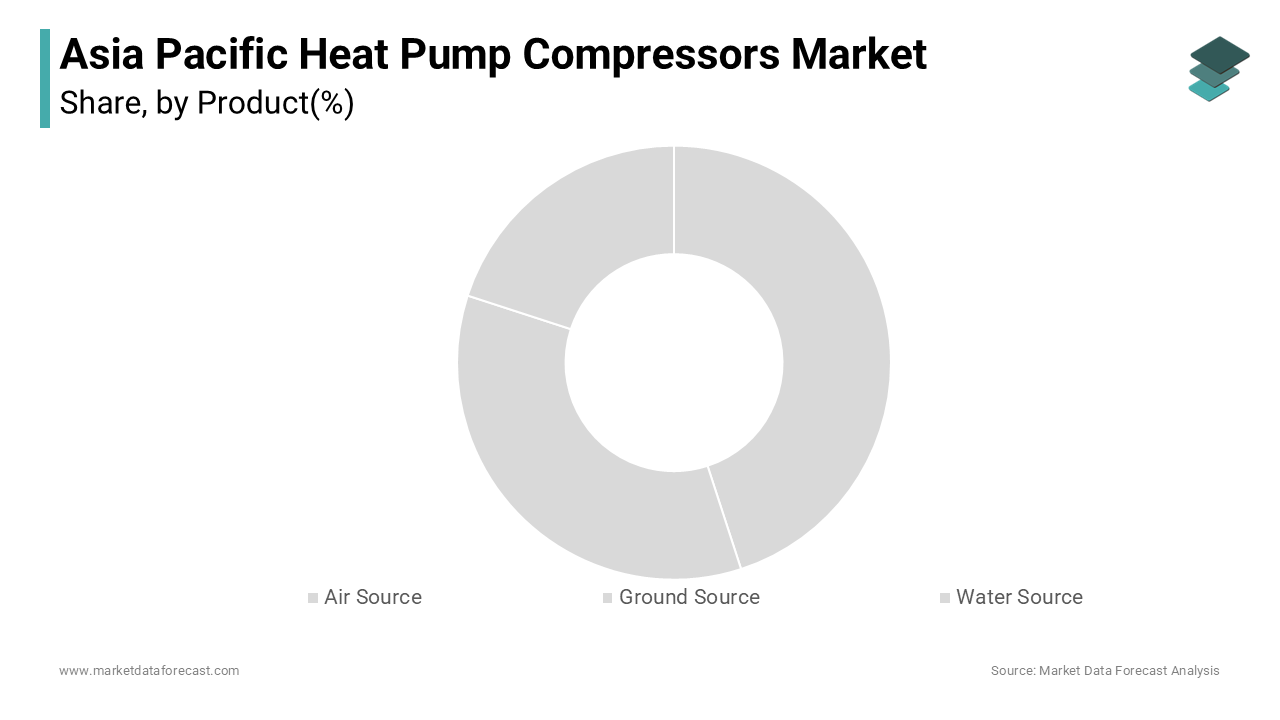
The water source heat pump compressor segment is anticipated to witness a CAGR of 14.3% from 2025 to 2033 owing to the integration of water source systems into large-scale district heating and cooling networks, particularly in coastal and riverine urban developments. The system’s energy efficiency is 25% higher than conventional HVAC networks, largely due to the stable thermal profile of seawater, which allows compressors to operate at optimal discharge pressures with minimal cycling. In Singapore, the government’s Super Low Energy (SLE) building program mandates the use of water source heat pumps in all new high-rise developments exceeding 20,000 square meters, contributing to a 40% reduction in building energy intensity since 2015, as reported by the Building and Construction Authority.
By Type Insights
The scroll compressor segment was accounted in holding 52.3% of the Asia Pacific heat pump compressors market share in 2024. The adoption of these compressors are evident in China, where leading manufacturers such as Gree and Midea have standardized scroll compressors in over 80% of their air-source heat pump lines, producing more than 15 million units annually. Additionally, scroll compressors exhibit a 10–15% higher seasonal coefficient of performance (SCOP) compared to rotary types, particularly in partial-load conditions, which constitute over 70% of real-world operating time, according to field performance data from the China Academy of Building Research.
The screw compressor segment is expected to witness a CAGR of 12.7% from 2025 to 2033 owing to the rising demand for high-capacity heat pump systems in industrial process heating and large-scale commercial applications. In Australia, the dairy industry has increasingly adopted screw compressor-based heat pumps to generate 80°C process heat for pasteurization, reducing natural gas consumption by up to 60%, according to the Australian Dairy Industry Council. Furthermore, advancements in digital twin technology now allow real-time monitoring and predictive maintenance of screw compressors, reducing downtime by 35%, according to a 2023 study by the Singapore Institute of Manufacturing Technology.
REGIONAL ANALYSIS
China was the top performer of the Asia Pacific heat pump compressors market with 45.3% of share in 2024 with a confluence of aggressive policy mandates, domestic manufacturing scale, and rapid urban electrification. The "Coal-to-Electricity" heating reform, initiated in 2017, has driven the installation of over 20 million air-source heat pump units in northern provinces, directly stimulating demand for compressors capable of cold-climate operation. As of 2023, China produces more than 70% of the world’s heat pump compressors, with firms like Hanbell, GMCC, and Huitong dominating both domestic and export supply chains. The government’s 14th Five-Year Plan explicitly targets a 50% reduction in building energy intensity by 2025, further incentivizing the shift from gas boilers to electric heat pumps. Additionally, China’s leadership in rare earth processing and precision machining enables cost-competitive production of high-efficiency inverter compressors, which now account for over 60% of new units, as reported by the Ministry of Industry and Information Technology.
India was positioned second by holding 18.2% of the Asia Pacific heat pump compressors market share in 2024. Positioned as a high-potential frontier, India’s market is transitioning from niche adoption to mainstream integration, driven by rising urbanization, energy security concerns, and federal climate commitments. The Ministry of New and Renewable Energy has set a target of deploying 10 million square meters of solar-assisted heat pump systems by 2026, with pilot projects already operational in 18 states.
Japan heat pump compressors market is likely to grow with prominent CAGR in the next coming years. Renowned for its innovation in high-efficiency and low-emission systems, Japan has long been a pioneer in heat pump adoption, with over 40% of households utilizing heat pump-based heating, particularly in colder regions like Hokkaido and Tohoku. The country’s leadership is anchored in its stringent energy efficiency standards; the Top Runner Program mandates that new heat pump compressors must exceed the efficiency of the best-performing model on the market, driving continuous R&D investment. As of 2023, over 90% of residential heat pumps in Japan use R-32 refrigerant, which requires compressors designed for higher operating pressures and improved oil return mechanisms, according to the Japan Society of Refrigeration and Air Conditioning. Leading firms such as Daikin, Mitsubishi Electric, and Panasonic have developed proprietary inverter and dual-rotary compressor technologies that achieve COP values above 4.0 in mild winter conditions. Additionally, Japan’s aging population is accelerating demand for whole-home heating systems that integrate seamlessly with existing infrastructure, favoring compact, low-noise compressors.
South Korea is gearing up to showcase new opportunities in the next coming years. The country’s market is characterized by high residential density and a strong policy push toward energy independence, with heat pumps playing a central role in reducing reliance on imported fossil fuels. Over 60% of new multi-family housing units in Seoul and Incheon are now equipped with centralized heat pump systems, according to the Korea Housing and Urban Research Institute, driving demand for compact, high-efficiency compressors. The government’s 2023 Building Energy Efficiency Rating System mandates that all new public buildings achieve a Grade 1 or 2 rating, which typically requires the installation of heat pumps with SCOP values above 3.5, a standard met primarily by inverter-driven scroll and rotary compressors. Moreover, South Korea’s leadership in semiconductor and electronics manufacturing enables advanced control systems for compressors, including AI-based load forecasting and adaptive defrost cycles, enhancing reliability and efficiency.
Australia heat pump compressors market is likely to grow with rising electricity costs and net-zero commitments. The National Construction Code now requires all new homes to meet a 7-star energy rating, prompting builders to integrate heat pump systems for space and water heating, particularly in temperate and southern regions. Additionally, Australia’s Renewable Energy Target has spurred investment in hybrid solar-heat pump systems, particularly in off-grid and regional communities.
COMPETITIVE LANDSCAPE
The competitive landscape of the Asia Pacific heat pump compressors market is characterized by a dynamic interplay between established multinational corporations, regional manufacturing powerhouses, and emerging local innovators. Dominant players such as Daikin, Mitsubishi Electric, and Gree leverage proprietary technologies, extensive distribution networks, and economies of scale to maintain strong market influence. However, increasing demand for cost-effective, energy-efficient solutions has opened opportunities for mid-tier manufacturers in India, Thailand, and Indonesia to capture niche segments through localized production and tailored product designs. Competition is intensifying around technological differentiation, particularly in cold-climate performance, low-GWP refrigerant compatibility, and digital integration. Companies are investing in R&D to enhance compressor efficiency, durability, and noise reduction, while also aligning with government decarbonization targets. Strategic collaborations with HVAC OEMs, real estate developers, and utility providers are becoming for market penetration.
KEY MARKET PLAYERS
Some of the companies that are playing a dominating role in the Asia Pacific Heat Pump Compressors Market include
- BITZER
- Bock GmbH
- Carrier
- Copeland LP
- Daikin Industries Ltd.
- Danfoss
- Emerson Electric Co.
- GEA Group Aktiengesellschaft
- Gree Electric Appliances Inc.
- LG Electronics
- Mayekawa Mfg. Co. Ltd.
- Midea Group
- Panasonic Corporation
- Rechi Precision Co. Ltd.
- Secop GmbH
- Siam Compressor Industry Co. Ltd.
- Tecumseh Products Company LLC
Top Players in the Asia Pacific Heat Pump Compressors Market
Daikin Industries, Ltd.
Daikin has established itself as a technological leader in the Asia Pacific heat pump compressors market through continuous innovation and deep integration of in-house compressor design with system-level optimization. The company’s proprietary rotary and scroll compressor technologies are engineered for high efficiency, low noise, and cold-climate performance, enabling reliable operation in regions such as northern China and Japan. Daikin has intensified its focus on R-32 refrigerant compatibility, launching compressors with enhanced thermal stability and reduced global warming potential. In 2023, the company expanded its production capacity in Suzhou, China, to meet rising demand for variable-speed compressors, while also investing in AI-driven predictive maintenance systems for commercial heat pump units.
Mitsubishi Electric Corporation
Mitsubishi Electric plays a pivotal role in advancing high-performance heat pump compressor technology, particularly in the premium residential and commercial sectors. The company’s Hyper Heat Pump systems, powered by twin-rotary compressors, deliver consistent heating at outdoor temperatures as low as -25°C, making them ideal for colder climates in Japan and the Himalayan regions of India. In 2023, Mitsubishi Electric launched its next-generation inverter-driven compressors with improved oil return mechanisms and reduced refrigerant charge, enhancing reliability and environmental performance. The company has also strengthened partnerships with building developers in Singapore and Australia to integrate its compressors into smart, energy-efficient HVAC networks. Furthermore, Mitsubishi Electric has invested in digital twin technology to simulate compressor performance under real-world conditions, accelerating R&D cycles. Its focus on durability, precision engineering, and seamless integration with renewable energy sources positions the company as a key enabler of electrified thermal solutions across urban and off-grid applications in the Asia Pacific market.
Gree Electric Appliances, Inc.
Gree is a dominant force in the Asia Pacific heat pump compressors market, leveraging its vertically integrated manufacturing model to produce high-volume, cost-effective compressor solutions. The company designs and produces its own rotary and scroll compressors, allowing tight control over efficiency, noise, and compatibility with low-GWP refrigerants such as R-32. In 2023, Gree expanded its R&D center in Zhuhai to focus on variable-speed inverter compressors optimized for partial-load conditions common in tropical and subtropical climates. The company also launched a new line of heat pump water heaters with integrated compressors for the Indian and Southeast Asian markets, emphasizing affordability and reliability. Gree’s strategic collaborations with local governments in China and Vietnam have facilitated large-scale deployment in public housing and rural electrification programs.
Top Strategies Used by Key Market Participants
Key players in the Asia Pacific heat pump compressors market are deploying a combination of vertical integration, technological innovation, regional expansion, strategic partnerships, and sustainability-driven product development to strengthen their competitive positioning. Companies are investing heavily in in-house compressor design to ensure compatibility with proprietary heat pump systems, enhancing efficiency and reliability. There is a pronounced shift toward developing compressors compatible with low-global-warming-potential refrigerants such as R-32 and R-290, aligning with the Kigali Amendment and national phase-down schedules. Manufacturers are expanding production facilities in high-growth markets like India and Vietnam to reduce logistics costs and respond swiftly to local demand. Collaborations with governments and utilities are being leveraged to promote heat pump adoption through subsidy programs and building code integration. Additionally, firms are incorporating digital technologies such as IoT-enabled monitoring, AI-based load optimization, and predictive maintenance to differentiate their offerings. Capacity expansion, particularly for variable-speed and high-temperature compressors, is a common strategy to meet rising industrial and commercial demand. These multi-pronged approaches enable market leaders to maintain technological leadership while scaling operations across diverse regulatory and climatic landscapes.
RECENT MARKET DEVELOPMENTS
- In June 2023, Daikin Industries expanded its compressor manufacturing facility in Suzhou, China, to increase production capacity for inverter-driven scroll compressors by enabling faster supply to meet rising demand in residential and commercial heat pump applications across Asia Pacific.
- In September 2023, Mitsubishi Electric launched its next-generation twin-rotary compressor with enhanced cold-climate performance, capable of delivering heating at -25°C with its leadership in high-efficiency heat pump systems for colder regions such as northern Japan and the Himalayan belt.
- In February 2024, Gree Electric inaugurated a new R&D center in Zhuhai dedicated to variable-speed compressor technology by focusing on optimizing energy efficiency and refrigerant compatibility for tropical and subtropical climates across Southeast Asia.
- In November 2023, Hitachi Global Life Solutions introduced a smart heat pump system integrated with IoT-enabled compressors in Singapore, allowing real-time performance monitoring and adaptive control by enhancing reliability and user experience in smart building environments.
- In April 2024, Johnson Controls partnered with a local HVAC manufacturer in India to co-develop R-32-compatible rotary compressors, which is aiming to expand its footprint in the rapidly growing residential heat pump market while aligning with India’s green building standards.
MARKET SEGMENTATION
This research report on the Asia Pacific Heat Pump Compressors Market is segmented and sub-segmented into the following categories.
By Product
- Air Source
- Ground Source
- Water Source
By Type
- Reciprocating
- Scroll
- Rotary
- Screw
- Centrifugal
By Country
- India
- China
- Japan
- South Korea
- Australia
- New Zealand
- Thailand
- Malaysia
- Vietnam
- Philippines
- Indonesia
- Singapore
- Rest of APAC