- Product Description Description
- Table of Contents TOC
- List of Table & Figure LOT
- Get Free Sample PDF Sample PDF
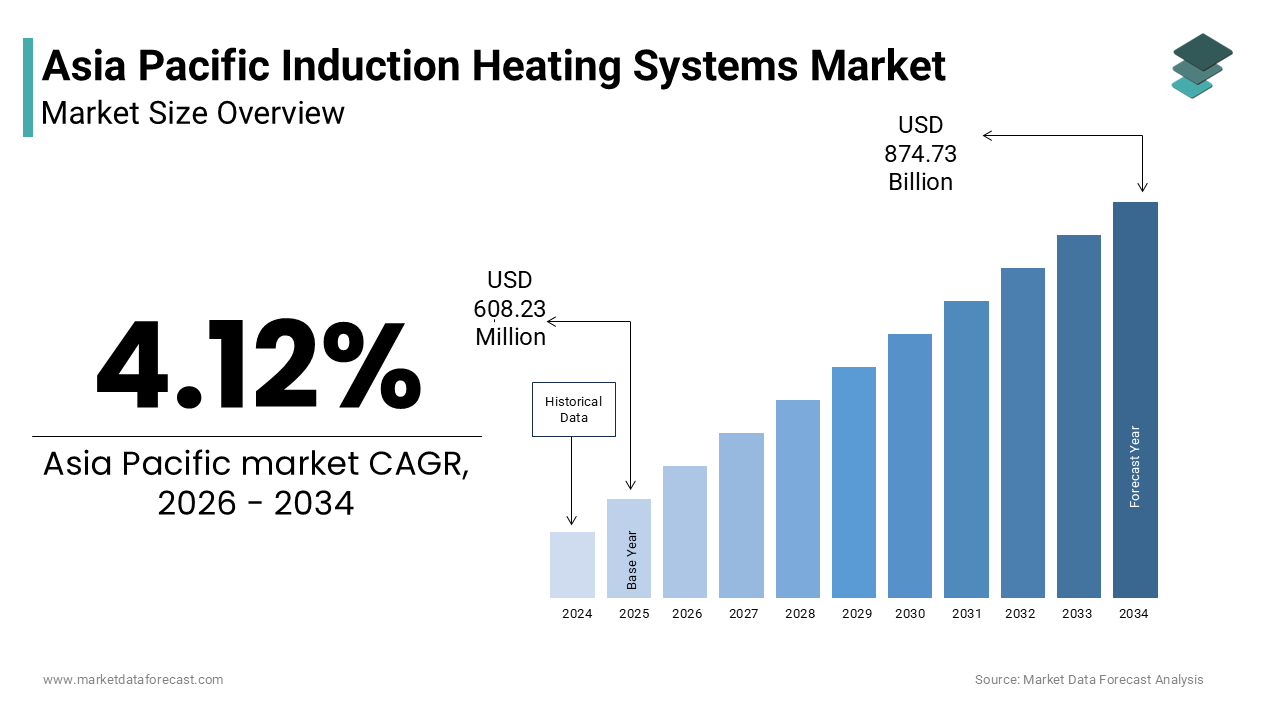
Market Size, 2025
$608.23 MnMarket Estimate, 2026
$633.29 MnMarket Forecast, 2034
$874.73 MnCAGR, 2026–2034
4.12%Asia Pacific Induction Heating Systems Market Size
The Asia Pacific Induction Heating Systems Market size was valued at USD 608.23 million in 2025 and is anticipated to reach USD 633.29 million in 2026 from USD 874.73 million by 2034, growing at a CAGR of 4.12% during the forecast period from 2026 to 2034.
The induction heating systems are integrated with the electromagnetic technologies that generate heat within conductive materials through alternating magnetic fields, enabling precise, contactless, and energy-efficient thermal processing in industrial applications. These systems are widely deployed in metal hardening, brazing, forging, melting, and annealing processes across sectors such as automotive, aerospace, heavy machinery, and electronics manufacturing.
MARKET DRIVERS
Expansion of Automotive and Electric Vehicle Manufacturing
The surge in automotive and electric vehicle (EV) production across the Asia Pacific is escalating the growth of the Asia Pacific induction heating systems market. China produced over 30 million vehicles in 2023, including 9.5 million EVs, which is accounting for 60% of global output, according to the China Association of Automobile Manufacturers. Induction hardening is widely used to enhance the durability of transmission shafts and crankshafts, offering localized heating with minimal distortion. South Korea’s Hyundai Motor Company invested $8.9 billion in EV production capacity by 2025, as stated by the Korea Automobile Manufacturers Association, driving demand for automated induction systems in motor core assembly and welding. India’s EV production grew by 130% in 2023, with Tata Motors and Ola Electric expanding manufacturing facilities in Gujarat and Tamil Nadu, as reported by the Society of Manufacturers of Electric Vehicles.
Government Initiatives Promoting Energy-Efficient Industrial Technologies
National policies aimed at improving industrial energy efficiency are accelerating the adoption of induction heating systems for traditional gas-fired and resistance-based furnaces is also another factor accelerating the growth of the Asia Pacific induction heating systems market. As per the China Energy Conservation Association, induction furnaces achieve 65–75% energy efficiency, compared to 30–45% for coke-fired cupolas by making them a strategic choice for foundries transitioning to cleaner operations. India’s Bureau of Energy Efficiency has identified induction heating as a National Mission on Enhanced Energy Efficiency (NMEEE) priority, offering incentives under the Perform, Achieve, and Trade (PAT) scheme. Over 1,200 industrial units have retrofitted induction systems in forging and heat treatment applications since 2020, reducing specific energy consumption by 20–30%, according to the Confederation of Indian Industry. As per the International Energy Agency, switching from fuel-based to electric induction heating can reduce CO₂ emissions by 40–60% per ton of metal processed.
MARKET RESTRAINTS
High Initial Investment and Long Payback Periods
The substantial upfront cost of induction heating systems is restricting the growth of the Asia Pacific induction heating systems market. Traditional resistance or gas-fired furnaces, though less efficient, require only 30–50% of the initial investment, making them more accessible. In Indonesia, where access to industrial financing is limited, only 8% of metal processing units have upgraded to induction systems, despite government incentives, according to the Ministry of Industry. The lack of leasing models and green credit facilities further restricts affordability. While long-term operational savings are significant energy savings of 25–40% and reduced scrap rates many manufacturers prioritize short-term liquidity over capital-intensive upgrades.
Limited Technical Expertise and Skilled Workforce Availability
The effective operation and maintenance of induction heating systems require specialized knowledge in electrical engineering, electromagnetic theory, and process calibration skills that are in short supply across much of the Asia Pacific. As per the International Labour Organization, over 40% of induction system downtime in Southeast Asia is attributed to operator error or improper tuning. Even in advanced economies like South Korea, a 2023 survey by the Korea Institute of Industrial Engineers found that 32% of manufacturing plants face delays in induction system integration due to a shortage of qualified engineers. Training programs offered by suppliers such as EFD Induction and Mitsubishi Electric are often limited in scope and geographic reach. As per the Asian Productivity Organization, companies that invest in dedicated training see a 50% reduction in system downtime and a 25% improvement in energy efficiency.
MARKET OPPORTUNITIES
Integration with Industry 4.0 and Smart Manufacturing Systems
The integration of induction heating with digitalization and smart manufacturing is significantly to fuel the growth of the Asia Pacific induction heating systems market. Modern induction systems are increasingly equipped with IoT sensors, real-time process monitoring, and AI-driven control algorithms, enabling seamless integration into Industry 4.0 ecosystems. Companies like Panasonic and FANUC utilize data from induction coils to adjust heating parameters dynamically, reducing energy use by up to 18% while maintaining metallurgical consistency. In South Korea, the Ministry of Trade, Industry and Energy’s Smart Factory Initiative has supported the deployment of intelligent induction systems in over 35,000 factories by 2023, improving quality control and traceability. China’s “Made in China 2025” strategy emphasizes digital twin technology, with Baoshan Iron & Steel implementing simulation-based induction heating models that reduce trial runs by 60%, according to the China Iron and Steel Association.
Growth in Aerospace and Defense Manufacturing
The expansion of aerospace and defense production is creating high-value demand for precision induction heating in component manufacturing, which is amplifying the growth of the Asia Pacific induction heating systems market. Countries such as Japan, India, and Australia are investing heavily in domestic defense capabilities, requiring advanced thermal processing for turbine blades, landing gear, and engine shafts. India’s Defence Research and Development Organisation (DRDO) has partnered with private foundries to develop induction-based casting for armored vehicle components, achieving 98% material integrity, according to the Ministry of Defence.
MARKET CHALLENGES
Grid Instability and Power Quality Requirements
Induction heating systems demand stable, high-quality electrical supply is a condition often unmet in emerging industrial zones is also to hamper the growth of the Asia Pacific induction heating systems market. These systems are sensitive to voltage fluctuations, harmonic distortions, and frequency instability, which can impair performance, damage components, and trigger shutdowns. In India, the Central Electricity Authority reports that industrial zones in Uttar Pradesh and Bihar experience average voltage fluctuations of ±12%, exceeding the ±5% tolerance of most medium-frequency induction heaters. In Indonesia, PLN (the state utility) acknowledges that 40% of industrial areas suffer from poor power quality, limiting the deployment of induction furnaces in steel and forging units, as per the Ministry of Energy and Mineral Resources. As per the International Electrotechnical Commission, induction systems can introduce harmonic distortions of up to 25% without mitigation, potentially affecting other equipment on shared grids.
Competition from Alternative Heating Technologies
Induction heating faces established and emerging thermal technologies that offer lower costs or operational simplicity in specific applications. Resistance heating, though less efficient, remains prevalent in small-scale forging and annealing due to its low capital cost and ease of maintenance. In Bangladesh and Cambodia, over 80% of metal processing units use resistance furnaces, as reported by the ASEAN Centre for Energy. Flame heating and gas forges are still widely used in rural India and Indonesia for their portability and independence from grid power. Additionally, emerging technologies such as microwave and plasma heating are gaining traction in niche applications like ceramic sintering and surface coating. In China, microwave-assisted heating is being piloted in rare earth processing, offering faster ramp rates than induction, according to the Chinese Academy of Sciences. Laser heating is also competing in high-precision applications such as micro-welding in electronics manufacturing.
REPORT COVERAGE
| REPORT METRIC | DETAILS |
| Market Size Available | 2025 to 2034 |
| Base Year | 2025 |
| Forecast Period | 2026 to 2034 |
| CAGR | 4.12% |
| Segments Covered | By Product, End-Use and Country |
| Various Analyses Covered | Regional & Country Level Analysis, Segment-Level Analysis, DROC, PESTLE Analysis, Porter’s Five Forces Analysis, Competitive Landscape, Analyst Overview on Investment Opportunities |
| Countries Covered | India, China, Japan, South Korea, Australia, New Zealand, Thailand, Malaysia, Vietnam, the Philippines, Indonesia, Singapore, and the rest of APAC. |
| Market Leaders Profiled | Inductotherm Group, EFD Induction, Ambrell, Electrotherm, Ultraflex Power Technologies, Microtech Inductions, Solidheat Industries, C-Tech Innovation, TM Induction Heating, Abhay Induction Tech, Kitashiba Electric, Neturen, Schaeffler Singapore, ACME, Dai-ichi Kiden, Fuji Electric, Chengdu Jinkezhi Electronic, ITW Welding Singapore, KBG Induction, Lu-Chiuan Heating Elements, Rapid Heat Systems, and Uchino. |
SEGMENTAL ANALYSIS
By Product Insights
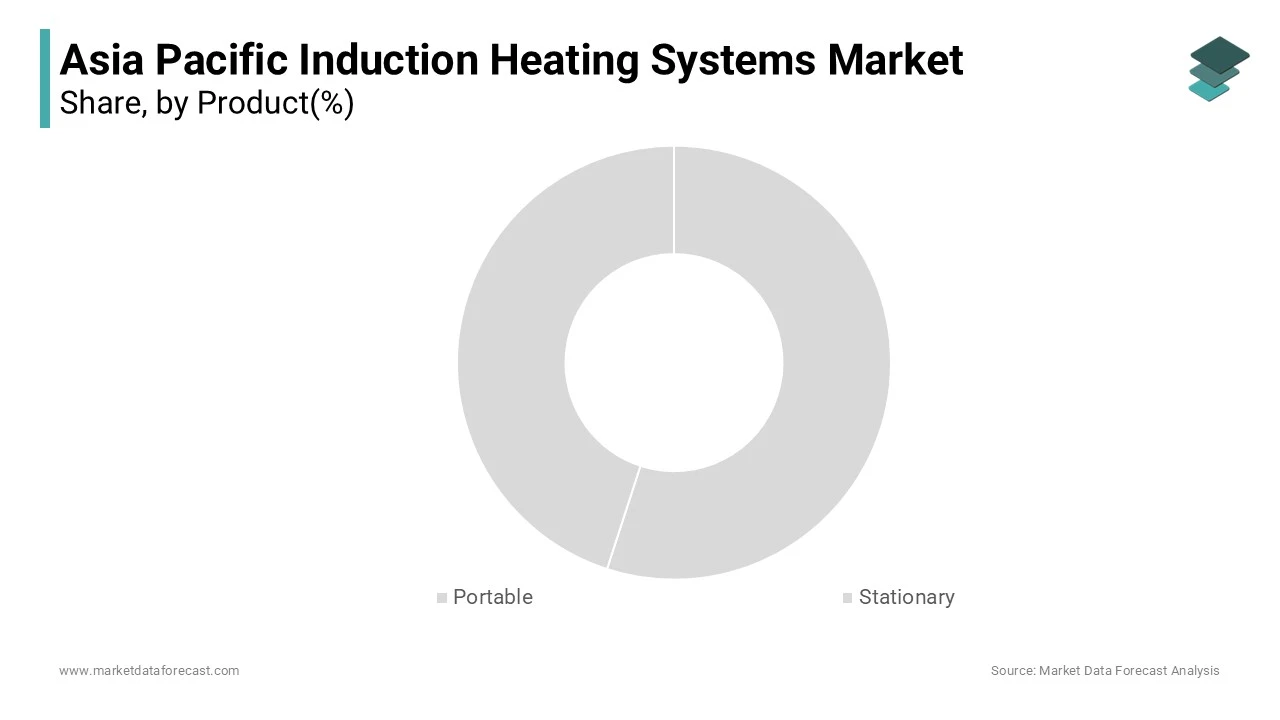
The portable and stationary segment held a dominant share of the Asia Pacific induction heating systems market in 2025. Integration into High-Volume Manufacturing and Assembly Lines Stationary induction systems are the backbone of mass production processes in industries such as automotive, heavy machinery, and power generation, where consistency, precision, and throughput are paramount. In China, over 80% of automotive component manufacturers utilize stationary induction heaters for hardening crankshafts, gears, and transmission shafts, enabling cycle times under 30 seconds per part, as documented by the China Machine Tool Association. The country produced 30 million vehicles in 2023, according to the China Association of Automobile Manufacturers, necessitating automated, high-capacity thermal systems.
The portable induction heating systems segment is expected to witness a CAGR of 10.8% from 2026 to 2034. Portable induction heating systems are gaining traction due to their ability to perform thermal operations in remote or inaccessible locations by eliminating the need to dismantle and transport heavy components. In shipbuilding, dry-dock repairs often require localized heating for stress relieving and bolt expansion, where portability is essential. As per the Society of Naval Architects and Marine Engineers, over 60% of shipyards in Southeast Asia now use portable induction systems for precision repairs.
Small and medium enterprises (SMEs) across the Asia Pacific are increasingly adopting portable induction systems due to their lower capital cost, ease of deployment, and minimal infrastructure requirements. These units typically cost between $15,000 and $40,000, significantly less than fixed installations, according to the Asian Productivity Organization. As per the Indonesia Institute of Foundry Technology, over 1,200 SMEs have transitioned from coal-fired crucibles to portable induction units since 2020. In Bangladesh and Cambodia, where factory space is limited and grid stability is poor, portable systems offer a practical alternative. Their versatility in applications from bearing fitting to brazing that further enhances their utility.
By End Use Insights
The automotive sector was the largest and held 39.2% of the Asia Pacific induction heating systems market share in 2025. The automotive industry relies heavily on induction heating for the mass production of durable, high-precision metal parts that require consistent metallurgical properties. Processes such as hardening of crankshafts, camshafts, and gears are almost exclusively performed using induction due to its ability to deliver localized, repeatable heat treatment without distortion.. In India, the Society of Indian Automobile Manufacturers notes that over 70% of new component manufacturing facilities use induction systems to meet Bharat Stage VI emission standards, which demand higher engine durability. As per the International Iron and Steel Institute, induction-treated components exhibit 30–50% greater fatigue resistance than conventionally treated parts. The shift toward electric vehicles has further increased demand, with induction brazing used in motor rotor assembly and battery interconnects.
The aerospace sector is anticipated to witness a CAGR of 12.3% from 2025 to 2033. National initiatives to develop indigenous aerospace and defense capabilities are fueling demand for high-precision induction heating in component manufacturing. The country’s defense budget reached $75 billion in 2023, with a focus on self-reliance, according to the International Institute for Strategic Studies. Japan’s Mitsubishi Heavy Industries employs induction brazing in the production of F-35 engine components, requiring micron-level joint accuracy and thermal stability. Australia’s AUKUS pact includes plans for nuclear-powered submarines, necessitating advanced heat treatment for marine-grade titanium and steel alloys, as projected by the Australian Strategic Policy Institute. In South Korea, Hanwha Aerospace operates a turbine blade facility where induction heating ensures uniform grain structure in single-crystal blades. As per the Royal Aeronautical Society, over 70% of aerospace metal components undergo induction processing due to its repeatability and minimal distortion.
REGIONAL ANALYSIS
China was the largest contributor of the Asia Pacific induction heating systems market by accounting for 36.3% of share in 2025. The country produced over 30 million vehicles in 2023, according to the China Association of Automobile Manufacturers, which is necessitating high-volume heat treatment systems. The Ministry of Industry and Information Technology reports that over 12,000 foundries have adopted medium-frequency induction furnaces to comply with green manufacturing standards, reducing coke usage by 40 million tons annually. The “Made in China 2025” initiative promotes smart manufacturing, with over 30,000 factories integrating induction systems with IoT and AI for predictive maintenance. In aerospace, COMAC’s C919 program relies on induction-based stress relieving for components.
Japan was ranked second by holding 22.3% of the Asia Pacific induction heating systems market share in 2025. Over 70% of industrial robots in Japan are integrated with induction systems, as reported by the Japan Robot Association by ensuring high repeatability in automotive and electronics manufacturing. Companies like IHI Corporation and Mitsubishi Heavy Industries use vacuum induction melting for jet engine superalloys, meeting stringent aerospace standards. Japan’s foundries have achieved 75% energy efficiency in melting operations, compared to the global average of 55%, as per the Japan Foundry Engineering Society.
India induction heating systems market is likely to grow with prominent growth opportunities in the next coming years. The country’s rapid industrialization and government-led manufacturing initiatives are driving induction heating adoption. The Defence Research and Development Organisation uses induction for armor plate treatment by achieving 98% material integrity, according to the Ministry of Defence. However, only 12% of SMEs have adopted the technology due to cost and skill barriers, as noted by the National Skill Development Corporation. Domestic manufacturers like ETP Industries are expanding production to meet demand.
South Korea induction heating systems market is esteemed to have a significant growth opportunities in the next coming years. The country’s advanced manufacturing ecosystem, particularly in automotive and aerospace, drives demand for high-precision induction systems. Hyundai and Kia use induction for over 90% of engine component heat treatment, ensuring compliance with global emission standards, as reported by the Korea Automobile Manufacturers Association. Hanwha Aerospace employs induction brazing in turbine blade production, achieving micron-level accuracy. The Ministry of Trade, Industry and Energy’s Smart Factory Initiative has supported the deployment of intelligent induction systems in 35,000 factories by 2023, improving energy efficiency by 18%, as per the Korea Institute of Industrial Technology.
Australia induction heating systems market growth is likely to have a significant growth opportunities during the forecast period. The country’s resource-intensive industries and defense modernization programs are key demand drivers. In mining and oil & gas, portable induction systems are widely used for pipeline pre-heating and on-site repairs, reducing downtime by 35%, as reported by the Australian Industry Group. The AUKUS submarine program is expected to generate demand for over 200 high-precision induction units for marine alloy treatment, according to the Department of Defence. The Clean Energy Finance Corporation has funded the replacement of fossil-fueled furnaces with electric induction units in steel plants, supporting decarbonization. In manufacturing, companies like Marand Precision Engineering use induction for aerospace component hardening. As per the Australian Manufacturing Council, 60% of new industrial heating installations in 2023 were induction-based.
COMPETITIVE LANDSCAPE
Competition in the Asia Pacific induction heating systems market is characterized by a dynamic interplay between global technology leaders, regional specialists, and emerging domestic manufacturers, each vying for dominance through innovation, service depth, and application expertise. Multinational firms such as EFD Induction and Mitsubishi Electric leverage advanced R&D, automation integration, and global quality standards to maintain its dominance in high-precision sectors like automotive and aerospace. European and Japanese players emphasize reliability and energy efficiency, aligning with stringent industrial regulations in countries like Japan and South Korea. Chinese manufacturers such as Hengli and Kexin are gaining ground in the mid-range segment by offering cost-competitive systems with localized support. The rise of smart manufacturing is shifting competition from hardware performance to digital ecosystem integration, with firms embedding AI, IoT, and data analytics into their controls. Portable systems are becoming a battleground for flexibility, particularly in oil & gas and maintenance applications. Regulatory diversity across countries necessitates localized certifications and technical adaptation, favoring companies with regional engineering teams. Price sensitivity in SME markets is driving demand for modular and scalable solutions.
KEY MARKET PLAYERS
Some of the companies that are playing a dominating role in the Asia Pacific Induction Heating Systems Market include
- Inductotherm Group
- EFD Induction
- Ambrell
- Electrotherm
- Ultraflex Power Technologies
- Microtech Inductions
- Solidheat Industries
- C-Tech Innovation
- TM Induction Heating
- Abhay Induction Tech
- Kitashiba Electric
- Neturen
- Schaeffler Singapore
- ACME
- Dai-ichi Kiden
- Fuji Electric
- Chengdu Jinkezhi Electronic
- ITW Welding Singapore
- KBG Induction
- Lu-Chiuan Heating Elements
- Rapid Heat Systems
- Uchino
Top Players in the Asia Pacific Induction Heating Systems Market
EFD Induction (a subsidiary of ITW)
EFD Induction has established a formidable presence in the Asia Pacific induction heating systems market through its focus on precision engineering and advanced thermal solutions for automotive, aerospace, and heavy industry. The company has deployed its proprietary DynaFlex and Transcoil technologies across high-volume manufacturing facilities in China, India, and South Korea, enabling efficient hardening, brazing, and annealing of components. In 2023, EFD launched the SuperHex coil technology in Japan and Australia, offering 25% higher energy efficiency and improved field uniformity for shaft hardening applications. The company has strengthened its regional service network by establishing application centers in Pune, Shanghai, and Seoul, providing localized testing and process optimization. EFD has also partnered with major automotive OEMs such as Toyota and Tata Motors to co-develop customized induction solutions that meet stringent quality standards. By integrating IoT-enabled monitoring and predictive maintenance features into its power supplies, EFD is advancing smart manufacturing integration.
Mitsubishi Electric Corporation
Mitsubishi Electric has emerged as a key contributor to the Asia Pacific induction heating systems market by leveraging its expertise in automation, power electronics, and factory integration. The company offers a comprehensive range of medium- and high-frequency induction heaters tailored for automotive, electronics, and machinery manufacturing sectors across Japan, Thailand, Vietnam, and India. In 2023, Mitsubishi Electric introduced its MELDAS IH Series with AI-driven temperature control, enhancing process consistency in heat treatment applications. The system is fully compatible with its MELSEC automation platform, enabling seamless integration into smart factories under Japan’s Society 5.0 initiative. The company has expanded its footprint by collaborating with local system integrators in Indonesia and Malaysia to deliver turnkey solutions for forging and brazing lines. Mitsubishi Electric also emphasizes energy efficiency, with its inverters achieving over 90% electrical efficiency, as verified by the Japan Electrical Manufacturers' Association. The company’s R&D centers in Amagasaki and Tokyo continue to innovate in coil design and power supply miniaturization.
ABP Induction Systems
ABP Induction Systems has become a pivotal player in the Asia Pacific market by specializing in heavy-duty induction solutions for foundry, steel, and shipbuilding industries. The German-headquartered company has a strong operational presence in China, India, and South Korea, where its coreless and channel induction furnaces are widely used in large-scale metal melting and casting operations. In 2023, ABP commissioned the largest induction melting system in Southeast Asia at a steel plant in Surabaya, Indonesia, with a capacity of 70 tons, supporting the country’s domestic smelting initiative. The company has localized its engineering and service teams in Shanghai and Mumbai to provide rapid technical support and commissioning. ABP’s furnaces are designed to meet China’s strict environmental regulations, reducing particulate emissions by up to 90% compared to cupola furnaces, as documented by the China Association of Metal Industries. The company has also introduced water-cooled busbar technology to improve energy efficiency by 15% in high-power applications.
Top Strategies Used by Key Market Participants
Key players in the Asia Pacific induction heating systems market are deploying technological innovation, regional localization, strategic partnerships, digital integration, and application-specific customization to strengthen their competitive positioning. Companies are investing in R&D to enhance energy efficiency, precision control, and compatibility with Industry 4.0 systems. Firms are establishing local manufacturing, service hubs, and training centers to ensure faster deployment and regulatory compliance. Collaborations with system integrators and OEMs enable tailored solutions for automotive, aerospace, and defense applications. Product portfolios are being expanded to include portable units and hybrid systems for SMEs and field operations. Digital features such as IoT connectivity, real-time monitoring, and predictive maintenance are being embedded to improve operational efficiency. Some manufacturers are offering lifecycle management services, including coil redesign and power supply upgrades, to extend system longevity. Sustainability branding and alignment with national green manufacturing policies are also being leveraged to gain government and industrial favor. These strategies collectively enable firms to differentiate offerings, reduce downtime, and capture growing demand in a technically complex and rapidly evolving industrial landscape.
RECENT MARKET DEVELOPMENTS
- In February 2023, EFD Induction launched its SuperHex coil technology in Japan and Australia, offering 25% higher energy efficiency and improved magnetic field uniformity for shaft hardening applications by enabling enhanced process consistency and reduced operational costs in high-volume automotive manufacturing environments.
- In May 2023, Mitsubishi Electric established a new application and training center in Bangkok, providing localized technical support, process validation, and operator training for induction heating systems, which is strengthening its service infrastructure and market penetration in Southeast Asia’s growing manufacturing sector.
- In September 2023, ABP Induction Systems commissioned a 70-ton coreless induction melting furnace at a steel plant in Surabaya, Indonesia, marking the largest installation of its kind in Southeast Asia and reinforcing its position in heavy industrial and foundry applications amid the country’s push for domestic metal processing.
- In November 2023, Nippon Steel & Sumitomo Metal Engineering partnered with Daido Steel to co-develop high-frequency induction hardening systems for rail tracks, enhancing wear resistance and service life, supporting Japan’s railway modernization and export-oriented infrastructure projects across the Asia Pacific.
- In March 2025, Hengli Industrial Furnace, a leading Chinese manufacturer, expanded its production capacity in Wuxi by 40% by enabling faster delivery of medium-frequency induction furnaces to domestic and export markets, which is strengthening its competitiveness in the cost-sensitive SME and foundry segments across Asia.
MARKET SEGMENTATION
This research report on the Asia Pacific Induction Heating Systems Market is segmented and sub-segmented into the following categories.
By Product
- Portable
- Stationary
By End Use
- Automotive
- Aerospace
- Power generation
- Shipbuilding
- Oil & Gas
- Others
By Country
- India
- China
- Japan
- South Korea
- Australia
- New Zealand
- Thailand
- Malaysia
- Vietnam
- Philippines
- Indonesia
- Singapore
- Rest of APAC