- Product Description Description
- Table of Contents TOC
- List of Table & Figure LOT
- Get Free Sample PDF Sample PDF
Market Size, 2025
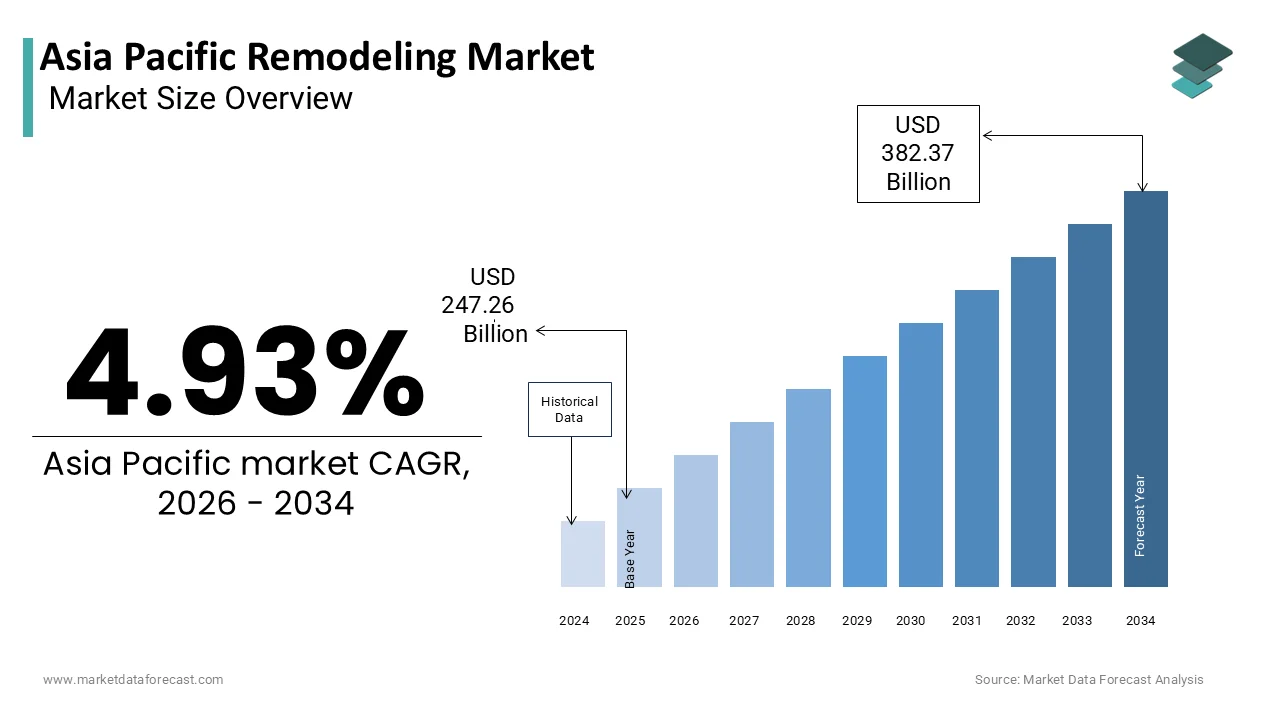
$247.26 BnMarket Estimate, 2026
$260.18 BnMarket Forecast, 2034
$382.37 BnCAGR, 2026–2034
4.93%Asia Pacific Remodeling Market Size
The Asia Pacific Remodeling Market size was calculated to be USD 247.26 billion in 2025 and is anticipated to be worth USD 382.37 billion by 2034, from USD 260.18 billion in 2026, growing at a CAGR of 4.93% during the forecast period.
Remodeling refers to the renovation, modernization, and functional enhancement of existing residential, commercial, and institutional buildings across the region. Unlike new construction, remodeling focuses on upgrading interiors, improving energy efficiency, adapting spaces for changing lifestyles, and extending the lifecycle of built environments. This sector has gained strategic importance due to rapid urbanization, aging infrastructure, and shifting societal preferences toward sustainable living. A defining characteristic of the region is the growing proportion of older housing stock requiring updates to meet contemporary safety, comfort, and technological standards.
In China, the Ministry of Housing and Urban-Rural Development launched a national urban renewal initiative in 2021 targeting 55,000 old residential communities for comprehensive retrofitting, including facade repairs, elevator installations, and utility modernization. These systemic efforts reflect a broader regional shift from expansion-driven construction to quality-centric renewal, positioning remodeling as a critical component of urban resilience and livability.
MARKET DRIVERS
Urbanization and the Rise of Aging Housing Stock Requiring Modernization
The convergence of rapid urbanization and the increasing obsolescence of existing residential infrastructure is one of the most significant drivers of the Asia Pacific remodeling market. As cities expand vertically and horizontally, many older neighborhoods face deterioration in structural integrity, outdated utility systems, and inadequate space planning.
According to the Asian Development Bank, many of Asia’s urban population resides in housing units built before the year 2000, many of which lack energy-efficient windows, proper insulation, or modern plumbing. In Australia, the Australian Bureau of Statistics reported that a significant portion of dwellings were constructed before 1980, with a growing number undergoing kitchen, bathroom, and roofing upgrades to improve functionality and resale value. The push for adaptive reuse is further amplified by land scarcity in cities like Hong Kong and Singapore, where demolition and new builds are economically and environmentally unsustainable. As a result, homeowners and developers are increasingly investing in seismic retrofitting, accessibility modifications, and aesthetic enhancements. Japan emphasizes that renovating existing homes generates less carbon emissions than constructing new ones, aligning remodeling with national climate goals. This structural shift from new builds to renewal is institutionalizing remodeling as a permanent fixture in the region’s urban development strategy.
Changing Lifestyles and Demand for Smart, Multifunctional Living Spaces
The transformation of household dynamics and living expectations across Asia Pacific is fueling a surge in remodeling activity, as homeowners seek to adapt their spaces to modern lifestyles. The rise of remote work, smaller family units, and wellness-centric living has redefined spatial needs, prompting renovations that prioritize flexibility, comfort, and technology integration.
As per the International Labour Organization, a large share of professional workers in urban India, Australia, and Malaysia continued hybrid or remote work arrangements post-pandemic, increasing demand for dedicated home offices and improved broadband-ready infrastructure. Similarly, in Japan, the trend of machiya (traditional townhouse) renovations has surged, with owners converting outdated wooden structures into energy-efficient, smart-enabled homes that preserve cultural heritage while meeting modern standards.
The integration of smart lighting, automated climate control, and security systems is now a key component of mid-to-high-end remodeling projects. This cultural reimagining of domestic space, where homes are no longer static shelters but dynamic environments, has elevated remodeling from a maintenance activity to a lifestyle investment, ensuring sustained demand across urban and suburban markets.
MARKET RESTRAINTS
Skilled Labor Shortages and Fragmented Contractor Ecosystem
The persistent shortage of skilled tradespeople and the highly fragmented nature of the construction services sector is a critical impediment to the growth of the Asia Pacific remodeling market. Unlike large-scale infrastructure projects that attract organized contractors, remodeling relies heavily on small, independent firms and freelance laborers, many of whom lack formal training or certification.
Like, Japan faces a significant deficit of construction workers, primarily due to an aging workforce and declining youth interest in manual trades. In India, the National Skill Development Corporation estimates that a very low percentage of millions of construction workers are formally trained in modern renovation techniques, limiting the quality and scalability of remodeling services.
Australia’s Housing Industry Association draws attention on a key share of homeowner complaints in renovation projects stem from poor workmanship or project delays, often linked to unregulated subcontractors. The absence of standardized licensing frameworks across countries like Indonesia and the Philippines further exacerbates inconsistencies in service delivery. In rural and peri-urban areas, access to qualified electricians, plumbers, and designers remains limited, forcing homeowners to compromise on design integrity or abandon projects altogether. Without systemic investments in vocational education, digital project management tools, and contractor accreditation, the labor bottleneck will continue to constrain the market’s potential, particularly for complex, high-value renovations.
Regulatory Complexity and Inconsistent Building Code Enforcement
The Asia Pacific remodeling market is hindered by a labyrinth of regulatory requirements, zoning restrictions, and uneven enforcement of building codes, which vary significantly across cities and countries. Homeowners and contractors often face prolonged approval timelines, ambiguous compliance standards, and sudden project halts due to non-conforming changes.
In India, obtaining permits for residential renovations in major cities can take up to 120 days, involving multiple agencies and overlapping jurisdictions. In China, while national guidelines exist, local municipalities impose additional restrictions on structural modifications, particularly in heritage zones, leading to delays and increased compliance costs. In Southeast Asia, informal settlements and undocumented property ownership further complicate legal renovation pathways. Even in developed markets like South Korea and Australia, heritage preservation laws restrict exterior modifications, limiting aesthetic and functional upgrades. The lack of a unified digital permitting system and real-time compliance verification tools amplifies inefficiencies. Until regulatory frameworks become more transparent, harmonized, and digitally integrated, the administrative burden will remain a significant drag on market expansion.
MARKET OPPORTUNITIES
Government-Led Urban Renewal and Sustainable Retrofitting Initiatives
The proliferation of government-backed urban renewal and green retrofitting programs aimed at improving livability and reducing environmental impact is a transformative opportunity within the Asia Pacific remodeling market. National and municipal authorities are increasingly prioritizing the rehabilitation of aging neighborhoods over new construction to address housing shortages, reduce carbon emissions, and enhance disaster resilience.
In China, the Ministry of Housing and Urban-Rural Development committed to renovating a large number of old urban residential communities, with a focus on energy-efficient windows, insulation, and renewable energy integration. As per the International Energy Agency, deep energy retrofits in Chinese cities could reduce building-related emissions, making remodeling a cornerstone of climate policy.
Japan’s Green Transformation (GX) Strategy includes subsidies for homeowners who install solar panels, heat pumps, and seismic reinforcements during renovations. These top-down initiatives not only stimulate private investment but also create standardized demand for certified contractors, energy auditors, and green materials. By aligning public funding with private sector innovation, governments are catalyzing a systemic shift toward high-performance, future-ready buildings, positioning remodeling as a key lever for sustainable urban development.
Integration of Prefabricated and Modular Solutions in Residential Renovations
The adoption of prefabricated and modular construction technologies is emerging as a game-changing opportunity for the Asia Pacific remodeling market, offering faster project completion, reduced waste, and higher quality control. Unlike traditional on-site renovations, which are prone to delays and material inefficiencies, modular systems allow for off-site manufacturing of kitchen pods, bathroom units, and structural extensions, which are then assembled on location with minimal disruption.
Additionally, modular solutions enable standardized compliance with building codes, reducing regulatory risks. With rising labor costs and urban density, the scalability and precision of factory-built components are making modular remodeling an attractive alternative for developers and homeowners alike, particularly in high-cost metropolitan areas.
MARKET CHALLENGES
Financing Barriers and Limited Access to Consumer Renovation Loans
The lack of accessible and affordable financing options for homeowners, particularly in emerging economies where formal credit systems are underdeveloped, is a persistent challenge in the Asia Pacific remodeling market. Unlike mortgage-backed construction loans, renovation financing remains a niche product, often characterized by high interest rates, stringent eligibility criteria, and low awareness.
In India, the Reserve Bank of India noted that less share of home improvement expenditures are funded through formal loans, with most households relying on personal savings or informal lending. This restricts the scale and scope of remodeling, especially for middle- and low-income families. Without tailored financial products, such as low-interest green renovation loans or government-guaranteed schemes, many homeowners delay or abandon projects. The absence of standardized valuation methods for renovation ROI further deters lenders. Until financial institutions develop inclusive, risk-assessed remodeling credit frameworks, a significant portion of latent demand will remain unmet, particularly in rapidly urbanizing regions where housing upgrades are most needed.
Supply Chain Volatility and Material Cost Instability
The Asia Pacific remodeling market faces significant headwinds from supply chain disruptions and fluctuating material costs, which undermine project planning and erode consumer confidence. The region’s reliance on imported construction inputs—such as steel, aluminum, insulation, and smart home components—makes it vulnerable to global price swings and logistical bottlenecks. The aftermath of the pandemic, geopolitical tensions, and extreme weather events have further destabilized supply routes, particularly for high-tech components like smart thermostats and energy-efficient glazing. Without localized manufacturing, strategic stockpiling, or long-term supplier contracts, remodelers struggle to guarantee pricing and timelines. This volatility discourages homeowners from initiating projects, stalling market momentum despite strong underlying demand.
REPORT COVERAGE
| REPORT METRIC | DETAILS |
| Market Size Available | 2025 to 2034 |
| Base Year | 2025 |
| Forecast Period | 2026 to 2034 |
| Segments Covered | By End Use And Country |
| Various Analyses Covered | Regional and Country Level Analysis; Segment-Level Analysis; DROC; PESTLE Analysis; Porter’s Five Forces Analysis; Competitive Landscape; Analyst Overview of Investment Opportunities |
| Regions Covered | India, China, Japan, South Korea, Australia, New Zealand, Thailand, Malaysia, Vietnam, Philippines, Indonesia, Singapore, And the Rest Of Asia-Pacific |
| Market Leaders Profiled | LIXIL Corporation, Nippon Paint Holdings Co. Ltd., Daiken Corporation, TOTO Ltd., Kajima Corporation, Sekisui House Ltd., Panasonic Corporation, Saint-Gobain, Hitachi Ltd., Mitsubishi Chemical Group Corporation, YKK AP Inc., AICA Kogyo Co. Ltd., Sumitomo Forestry Co. Ltd. |
SEGMENTAL ANALYSIS
By End Use Insights
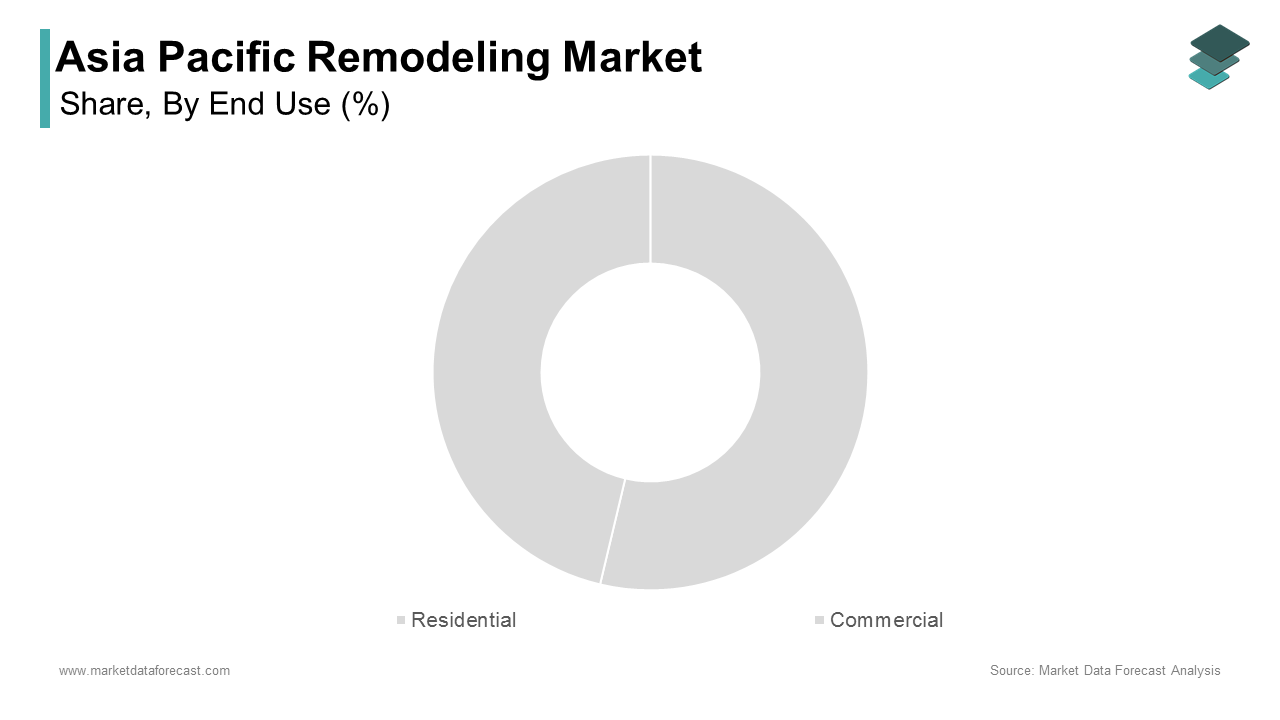
The residential segment dominated the Asia Pacific remodeling market by capturing an estimated 64.2% share in 2024. Across Asia Pacific, a significant portion of residential buildings were constructed decades ago and now require structural, electrical, and utility modernization. The aging structures were not designed for contemporary energy standards or smart technologies, compelling homeowners to invest in comprehensive remodeling. The trend is further amplified in high-density cities like Hong Kong and Singapore, where land scarcity limits new construction, making renovation the only viable path to improved living conditions. As governments promote urban renewal and disaster resilience, residential remodeling has evolved from discretionary spending to a necessity, ensuring sustained dominance in the market.
Shifting social patterns, such as the rise of remote work, smaller family units, and aging populations, are redefining residential space requirements, fueling demand for adaptive remodeling. According to the International Labour Organization, a notable share of professional workers in India, Malaysia, and Australia continue hybrid or remote work arrangements, increasing the need for dedicated home offices and upgraded internet-ready infrastructure. Additionally, aging populations are driving demand for accessibility modifications, primarily for bathroom safety and mobility access. This cultural shift, where homes are no longer static shelters but dynamic environments, has elevated remodeling from maintenance to a lifestyle investment, reinforcing the residential segment’s market leadership.
The commercial remodeling segment is expanding at the highest CAGR of 9.3% from 2025 to 2033. This accelerated growth is driven by corporate sustainability mandates, post-pandemic workplace transformations, and digital infrastructure modernization. Businesses across Asia Pacific are increasingly investing in energy-efficient retrofits to meet ESG (Environmental, Social, and Governance) targets and reduce operational costs. As climate regulations tighten and carbon pricing mechanisms expand, commercial remodeling is becoming a strategic imperative rather than a cosmetic upgrade.
The shift to hybrid and flexible work models has triggered a fundamental redesign of office spaces, prioritizing collaboration zones, health-centric design, and technology integration. Additionally, retail and hospitality sectors are remodeling to integrate digital kiosks, contactless payments, and experiential layouts to attract post-pandemic consumers. This transformation of commercial real estate into agile, health-conscious environments is fueling sustained demand for high-value remodeling, positioning the sector as the fastest-growing segment in the market.
REGIONAL ANALYSIS
China Remodeling Market Insights
China led the Asia Pacific remodeling market by accounting for 35.3% of total regional value in 2024. As the region’s most populous nation and a leader in urban development, China’s remodeling activity is driven by large-scale government-led urban renewal and rising middle-class homeownership. In cities like Beijing and Shanghai, these projects are critical for improving livability and disaster resilience. Additionally, the Smart Cities Mission has catalyzed commercial retrofits, integrating IoT systems and energy-efficient lighting in office complexes. Rising disposable incomes and aesthetic expectations among urban homeowners have also fueled demand for kitchen and bathroom renovations, supported by digital platforms like Tmall Home that offer end-to-end remodeling services. With strong policy backing and massive urban density, China remains the cornerstone of the region’s remodeling growth.
Japan Remodeling Market Insights
Japan stands out for its advanced regulatory framework and high rate of building maintenance. As a developed economy with one of the oldest housing stocks globally, Japan’s market is defined by mandatory seismic retrofits, aging-in-place adaptations, and energy efficiency upgrades. Additionally, Japan’s aging population is driving demand for barrier-free modifications. Commercial remodeling is also accelerating, particularly in Tokyo, where office buildings are being retrofitted for hybrid work and net-zero emissions. With high homeowner awareness and institutional support, Japan exemplifies a mature, quality-driven remodeling market.
India Remodeling Market Insights
India is emerging as a high-potential growth hub driven by rapid urbanization and rising disposable incomes. As India’s middle class expands, homeownership and renovation spending are increasing, particularly in Tier-1 and Tier-2 cities. The Smart Cities Mission has initiated redevelopment in several urban centers, including infrastructure upgrades and heritage building restorations, creating opportunities for both public and private remodeling projects. Additional, digital platforms like Livspace and HomeLane are standardizing design and execution, capturing growing consumer trust. Commercial remodeling is also gaining momentum, with co-working spaces and retail outlets undergoing aesthetic and technological upgrades. Despite challenges in financing and labor quality, India’s urban transformation and demographic dividend position it as a key future driver of regional remodeling demand.
Australia Remodeling Market Insights
Australia is characterized by a mature, consumer-driven renovation culture supported by strong regulatory standards and financial incentives. Additionally, state-level programs in New South Wales and Victoria offer rebates for solar panel and battery installations, accelerating green remodeling. Commercial remodeling is also robust, particularly in Sydney and Melbourne, where office buildings are being retrofitted for hybrid work and NABERS compliance. With high homeowner confidence, access to credit, and environmental awareness, Australia maintains a stable, high-value remodeling market.
South Korea Remodeling Market Insights
South Korea is distinguished by its technologically advanced, policy-driven renovation ecosystem. The country’s dense urban landscape, particularly in Seoul, features a large number of aging apartment complexes built in the 1980s and 1990s, many of which are now undergoing government-supported modernization. Additionally, South Korea’s leadership in smart technology has led to widespread integration of IoT systems in remodeling projects. The trend of officetel (mixed-use residential-commercial) renovations has also surged, catering to young professionals seeking compact, tech-enabled living. With strong public funding, digital infrastructure, and consumer demand for high-performance homes, South Korea is a model of integrated, future-ready remodeling in the region.
LEADING PLAYERS IN THE ASIA PACIFIC REMODELING MARKET
LIXIL Group
LIXIL Group, headquartered in Japan, stands as a transformative force in the Asia Pacific remodeling market, renowned for its innovation in water technology, kitchen systems, and accessible home solutions. The company integrates design, functionality, and sustainability into its product portfolio, offering end-to-end renovation solutions for both residential and commercial spaces. Through its flagship brands like INAX and American Standard, LIXIL delivers high-performance sanitaryware, smart faucets, and modular bathroom units that are widely adopted in retrofit projects across urban Asia. Its focus on aging-in-place design has led to the development of barrier-free fixtures and ergonomic layouts, particularly in Japan and Southeast Asia, where demographic shifts demand adaptable living environments. Globally, LIXIL contributes to advancing sustainable construction by pioneering water-saving technologies and low-carbon manufacturing processes. Its participation in international green building initiatives and partnerships with urban developers in emerging markets positions LIXIL as a leader in shaping the future of human-centric, environmentally responsible remodeling on a global scale.
Panasonic Corporation (Housing Solutions Division)
Panasonic’s Housing Solutions Division has established a distinctive presence in the Asia Pacific remodeling landscape by merging advanced technology with holistic living environments. The company specializes in integrated home renovation systems that combine energy-efficient insulation, smart home automation, and indoor air quality management, particularly in Japan’s aging residential sector. Known for its “Amenity Space” concept, Panasonic redefines remodeling by transforming outdated homes into intelligent, climate-responsive dwellings equipped with solar power, battery storage, and AI-driven climate control. Its modular retrofit kits allow for rapid installation with minimal disruption, setting new benchmarks for precision and scalability. Beyond Japan, Panasonic collaborates with developers in Southeast Asia to introduce sustainable housing upgrades tailored to tropical climates. On the global stage, the company influences smart renovation standards through its participation in international energy efficiency consortia and urban resilience programs. By embedding cutting-edge electronics into structural upgrades, Panasonic bridges the gap between construction and technology, redefining what remodeling can achieve in the modern era.
Daiwa House Industry Co., Ltd.
Daiwa House Industry, a Japanese housing and construction innovator, plays a pivotal role in advancing high-quality, system-based remodeling across the Asia Pacific region. The company is recognized for its prefabricated renovation solutions, including modular kitchens, bathrooms, and structural extensions, which are engineered for rapid deployment and superior durability. Its expertise in seismic retrofitting and energy-efficient retrofits has made it a preferred partner for government-led urban renewal projects in Japan, where aging housing stock demands safe, scalable upgrades. Daiwa House’s commitment to sustainability is evident in its zero-energy home renovation programs, which integrate solar panels, insulation, and smart energy management systems. The company also leads in elderly-friendly remodeling, designing homes with universal access and remote health monitoring capabilities. Internationally, Daiwa House contributes to global construction innovation by exporting its volumetric modular technology and collaborating on smart city developments in Southeast Asia. Its emphasis on factory-controlled quality, lifecycle efficiency, and disaster resilience positions it as a model for next-generation remodeling that balances technological sophistication with social responsibility.
TOP STRATEGIES USED BY KEY MARKET PARTICIPANTS
One key strategy employed by leading players is vertical integration of design, manufacturing, and installation services to deliver seamless, end-to-end remodeling experiences. By controlling the entire value chain—from product development to on-site execution—companies ensure consistency, reduce delays, and enhance customer trust in complex renovation projects.
Another major approach is the adoption of digital transformation through 3D visualization, AI-driven project planning, and e-commerce platforms that allow homeowners to customize and order remodeling solutions online. This not only improves transparency but also accelerates decision-making and expands market reach beyond traditional geographic boundaries.
A third critical strategy is strategic collaboration with governments and urban development agencies to participate in large-scale public renovation initiatives. By aligning with national sustainability, accessibility, and urban renewal goals, companies secure long-term contracts, gain policy support, and establish themselves as trusted partners in shaping the future of cities.
KEY MARKET PLAYERS AND COMPETITION OVERVIEW
Major Players of the Asia Pacific Remodeling Market include
LIXIL Corporation, Nippon Paint Holdings Co. Ltd., Daiken Corporation, TOTO Ltd., Kajima Corporation, Sekisui House Ltd., Panasonic Corporation, Saint-Gobain, Hitachi Ltd., Mitsubishi Chemical Group Corporation, YKK AP Inc., AICA Kogyo Co. Ltd., Sumitomo Forestry Co. Ltd.
The competitive dynamics of the Asia Pacific remodeling market are shaped by a contrast between large, technology-driven corporations and a vast network of local contractors serving fragmented, region-specific demands. At one end, multinational firms like LIXIL, Panasonic, and Daiwa House leverage innovation, brand equity, and integrated systems to target high-value residential and commercial projects, particularly in developed markets. These companies differentiate through precision engineering, sustainability credentials, and smart technology integration, positioning remodeling as a premium, future-ready investment. At the other end, thousands of small and medium-sized contractors dominate the informal sector, offering cost-effective but often inconsistent services, especially in emerging economies where standardized practices are still evolving. Competition is further complicated by the rise of digital platforms—such as HomeLane in India and Tmall Home in China—that aggregate designers, suppliers, and laborers, disrupting traditional contractor-client relationships. Regional disparities in regulatory frameworks, labor skills, and consumer awareness create uneven playing fields, requiring firms to adopt hyper-localized strategies. Success increasingly depends on trust, transparency, and the ability to deliver predictable outcomes in a sector historically plagued by delays and cost overruns. As urbanization and environmental imperatives intensify, the market is shifting from fragmented, transactional engagements to integrated, long-term partnerships between homeowners, developers, and solution providers.
RECENT HAPPENINGS IN THE MARKET
- In February 2023, LIXIL Group launched a new modular bathroom system in Thailand designed for rapid installation in aging urban apartments, combining water-saving fixtures with anti-slip surfaces to address safety and sustainability in high-density housing.
- In July 2023, Panasonic Corporation introduced an AI-powered home assessment tool in Japan that uses infrared scanning and energy modeling to recommend personalized remodeling plans, enhancing customer engagement and technical precision.
- In October 2023, Daiwa House Industry partnered with the Seoul Metropolitan Government to retrofit 500 public housing units with solar-integrated roofs and smart ventilation systems, establishing a benchmark for scalable urban renewal projects.
- In January 2024, Hitachi Homes launched a smart kitchen renovation package in Australia featuring voice-controlled appliances and energy-efficient induction cooking, tailored for modern hybrid living and premium urban homeowners.
- In March 2024, CERA Sanitaryware expanded its manufacturing footprint in Vietnam with a new smart ceramics plant focused on producing water-efficient toilets and basins for the Southeast Asian remodeling market, strengthening regional supply autonomy.
MARKET SEGMENTATION
This research report on the Asia Pacific remodeling market has been segmented and sub-segmented based on end use and region.
By End Use
- Residential
- Commercial
By Region
- India
- China
- Japan
- South Korea
- Australia
- New Zealand
- Thailand
- Malaysia
- Vietnam
- Philippines
- Indonesia
- Singapore
- Rest of Asia-Pacific