North America Remodeling Market Size, Share, Trends & Growth Forecast Report By Type (Interior remodeling, Exterior remodeling, Structural remodeling), End Use and Country (The United States, Canada and Rest of North America), Industry Analysis From 2024 to 2033
North America Remodeling Market Size
The North America remodeling market is anticipated to rise from USD 1.26 billion in 2024 to USD 1.69 billion in 2033, growing at a CAGR of 3.33%.
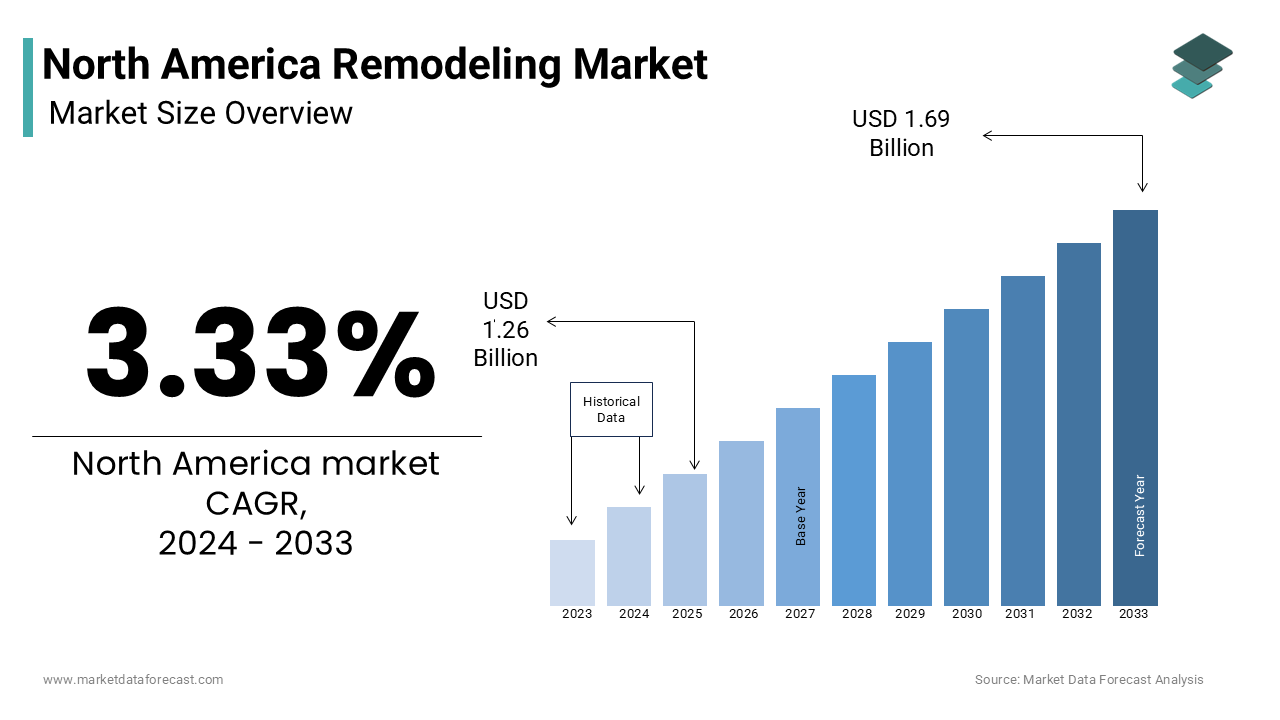
The remodeling is a residential and commercial infrastructure upgrade, modernization projects, and structural enhancements across the United States and Canada. This sector includes renovations driven by aging building stock, evolving consumer preferences, regulatory compliance, and sustainability goals. According to the U.S. Census Bureau, approximately 65% of American households resided in owner-occupied homes as of 2023, many of which were constructed prior to 1980, necessitating periodic updates. Furthermore, the Joint Center for Housing Studies at Harvard University indicated that over 38 million housing units in the U.S. require core repairs such as plumbing, electrical systems, or roofing improvements.
MARKET DRIVERS
Aging Residential Infrastructure
The inherent demand for renovation and modernization is driving the growth of the North American oncology market. As per the U.S. Department of Housing and Urban Development, nearly 43% of all housing units in the United States were built before 1980, which is indicating substantial wear and outdated systems. Many of these homes suffer from deteriorating foundations, obsolete electrical systems, and inefficient HVAC installations. According to the National Association of Home Builders, nearly 70% of homeowners will undertake at least one remodeling project during their tenure in a home due to functional obsolescence. These aging structures demand consistent attention, particularly in metropolitan areas where property values are high and energy efficiency standards are stringent.
Rising Homeownership and Lifestyle Expectations
The homeownership rates have stabilized following post-recession declines by contributing to increased investment in residential improvements, which is fuelling the growth of North America remodelling market. The U.S. Census Bureau reported that homeownership reached 65.5% in 2023, reflecting renewed confidence among buyers. Joint Center for Housing Studies at Harvard University data shows that home improvement spending averaged $400 billion annually between 2021 and 2023, with discretionary remodeling accounting for nearly 60% of total expenditures. Additionally, millennial homeowners, now representing the largest demographic cohort, are entering peak renovation years, which is prioritizing smart home technologies and sustainable materials.
MARKET RESTRAINTS
Labor Shortages and Skilled Trades Gap
The growing shortage of skilled labor is restricting the growth of the North American remodeling market. The Associated General Contractors of America stated in 2023 that nearly 70% of construction firms struggled to fill craft positions, including electricians, plumbers, and carpenters essential to renovation work. According to the Construction Industry Training Board, the average age of construction workers in Canada exceeds 45, with fewer than 15% under the age of 25. These trends directly impact project timelines and cost structures, as contractors often face delays and must pay premium wages to secure qualified personnel. This imbalance limits scalability for remodeling firms and reduces accessibility for homeowners seeking affordable upgrade options, thereby constraining overall market growth despite rising demand.
Regulatory Complexity and Permitting Delays
The complex regulatory frameworks and extended permitting processes is restraining the growth of the North American remodeling market. Municipal authorities across both the U.S. and Canada impose varying codes related to zoning, energy efficiency, and historical preservation, complicating renovation planning. A 2023 survey conducted by the National Association of Home Builders revealed that 62% of remodelers cited permitting delays as a major obstacle, with average approval times extending beyond 90 days in several urban jurisdictions. Furthermore, the International Code Council has introduced updated energy compliance standards that require extensive documentation and third-party inspections. These procedural bottlenecks elevate project costs and discourage smaller contractors from bidding on renovation contracts.
MARKET OPPORTUNITIES
Green Building and Energy Efficiency Incentives
The government-backed sustainability initiatives are gaining huge traction over the growth of the North American remodeling market grows. Federal and provincial agencies offer tax credits, rebates, and grants for energy-efficient retrofits, encouraging homeowners to upgrade insulation, windows, HVAC systems, and renewable energy installations. In the U.S., the Inflation Reduction Act of 2022 allocated $369 billion toward clean energy incentives, including $9 billion specifically for residential efficiency improvements. Similarly, Natural Resources Canada’s EnerGuide program supports eco-friendly renovations through subsidized energy audits and retrofit financing. The U.S. Environmental Protection Agency estimates that every dollar invested in energy-efficient remodeling yields $1.50 in utility savings over a decade. Moreover, green-certified homes command higher resale values, with studies from the University of California showing premiums of up to 8% for LEED-certified properties.
Smart Home Integration and Technological Adoption
The integration of smart home technologies into remodeling projects is a lucrative growth for the North America remodelling market. Consumer demand for connected devices, automated systems, and enhanced security features has surged, with Statista reporting that smart home device shipments in North America exceeded 230 million units in 2023. Homeowners increasingly incorporate voice-activated assistants, smart thermostats, lighting controls, and surveillance systems during renovation cycles. Installation of these systems typically occurs during kitchen and bathroom renovations, which together account for over 50% of all home improvement spending.
MARKET CHALLENGES
Economic Volatility and Interest Rate Pressures
The fluctuating macroeconomic conditions are a significant challenge for the growth of the North American remodeling market. Rising interest rates since 2022 have increased borrowing costs for both homeowners and contractors, reducing access to renovation financing. The Federal Reserve raised rates to over 5.25% by mid-2023, leading to higher mortgage payments and diminished disposable income among homeowners. As per the National Association of Realtors, existing home sales declined by 15% in 2023, which is correlated with reduced homeowner equity extraction used for major renovations.
Supply Chain Disruptions and Material Cost Inflation
The persistent supply chain disruptions and material price volatility are limiting the growth of the North America remodeling market. The pandemic-induced shortages of lumber, steel, and fixtures have evolved into chronic imbalances, exacerbated by geopolitical tensions and transportation bottlenecks. According to the Bureau of Labor Statistics, construction material costs rose by 18% between 2020 and 2023, with lumber prices experiencing swings exceeding 200% within 12-month periods. Remodeling contractors report lead times extending 6–12 weeks for common items such as cabinets, appliances, and flooring, forcing project delays and budget overruns. A 2023 survey by the National Kitchen & Bath Association indicated that 72% of remodelers experienced material shortages in the past year, with 45% citing increased client dissatisfaction due to delivery delays. Operators.
SEGMENTAL ANALYSIS
By Type Insights
The Interior segment held a prominent share of the North American remodeling market share in 2024 with the increasing focus on home aesthetics and functionality, particularly as more people spend time at home. According to the National Association of Home Builders (NAHB), kitchen renovations alone account for nearly 25% of all interior remodeling projects, generating over $95 billion annually. Additionally, aging housing stock across North America necessitates frequent interior upgrades. The U.S. Census Bureau reports that over 40% of homes in the U.S. were built before 1980, requiring modernization to meet current energy efficiency and design standards. Moreover, rising disposable income and home equity have empowered homeowners to invest in personal spaces. Based on Federal Reserve data, homeowner equity reached a record high of $12.3 trillion in 2023, providing financial flexibility for discretionary interior improvements.
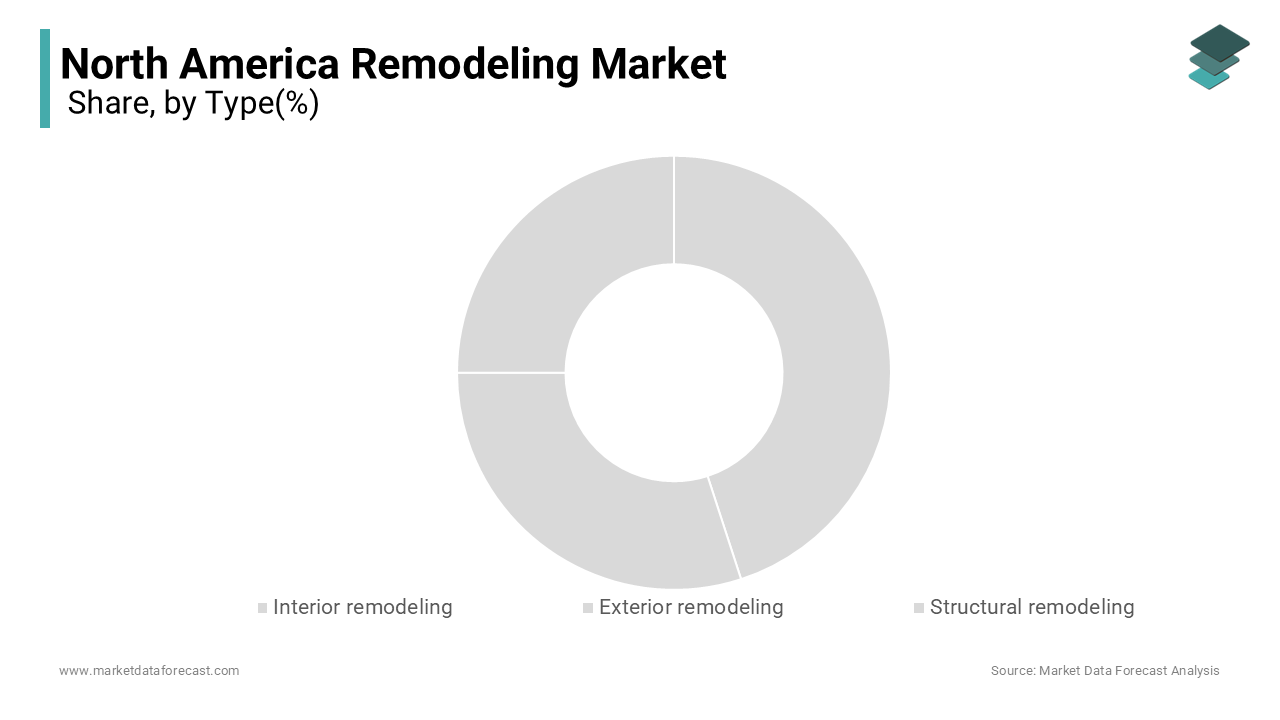
The structural segment is emerging with a CAGR of 4.8% from 2025 to 2033 with the growing emphasis on retrofitting older buildings to meet updated safety regulations. According to the International Code Council, over 70% of U.S. jurisdictions have adopted newer seismic and fire-resistance building codes with property owners to undertake structural modifications. These upgrades include foundation reinforcement, roof strengthening, and installation of fire-rated materials. The increase in extreme weather events, which is prompting structural resilience investments. According to the National Oceanic and Atmospheric Administration (NOAA), the U.S. experienced 28 weather and climate disasters exceeding $1 billion in damages in 2023. Furthermore, urban densification and infill development are spurring demand for structural remodeling to accommodate taller or mixed-use buildings on existing lots.
By End Use Insights
The residential segment dominated the North American remodeling market with a prominent share in 2024 owing to the aging millennial population entering peak homeownership years. As per the Joint Center for Housing Studies at Harvard University, millennials accounted for 43% of home purchases in 2023, many of whom are investing in first-time home renovations. These buyers often prioritize kitchen and bathroom upgrades, energy-efficient appliances, and open-concept layouts, contributing significantly to overall residential remodeling expenditure. Additionally, government incentives and rebates for energy-efficient improvements have spurred residential remodeling activities. Programs like the U.S. Department of Energy's Weatherization Assistance Program provided over $300 million in funding in 2023, supporting low-income households in making energy-saving renovations.
The commercial segment is expected to grow with an expected CAGR of 5.2% in the next coming years with the transformation of traditional office spaces into hybrid work environments. Companies are redesigning layouts to support collaboration zones, quiet areas, and technology integration. CBRE reports that over 60% of corporate tenants are renegotiating leases to include provisions for interior renovations, signaling a renewed focus on optimizing commercial real estate. Furthermore, infrastructure modernization in aging commercial properties is accelerating the need for structural and aesthetic upgrades.
REGIONAL ANALYSIS
United States Remodeling Market Insights
The United States was accounted in holding 85.4% of the North American remodeling market share in 2024 with the resurgence in home equity extraction following years of steady appreciation in real estate values. According to the Federal Housing Finance Agency, U.S. home prices rose by 6.7% in 2023 , increasing homeowner equity and enabling substantial investment in remodeling projects. Another key driver is the proliferation of online platforms and digital tools that simplify the remodeling process. Companies like Houzz and HomeAdvisor have streamlined contractor matching, project planning, and cost estimation, reducing barriers to entry for homeowners. In 2023, over 70 million users accessed these platforms, which is reflecting a digitally empowered consumer base that actively engages in home improvement decisions.
Canada Remodeling Market Insights
Canada was positioned second by holding 12.3% of the North American remodeling market share in 2024 due to the expansion of immigration and housing demand. Statistics Canada reported that over 485,000 new immigrants arrived in 2023. The increasing adoption of sustainable building practices among Canadian homeowners is amplifying the growth of the North American remodeling market. Natural Resources Canada states that over 35% of residential renovations in 2023 included eco-friendly elements, such as solar panels, high-efficiency windows, and water-saving fixtures. Provincial programs like Ontario’s GreenON initiative offer rebates for such upgrades, encouraging widespread participation. Moreover, government support through housing grants and renovation assistance plays a pivotal role. The Canada Mortgage and Housing Corporation (CMHC) allocated $4.5 billion in 2023 for housing repair and modernization initiatives, particularly targeting low-income and elderly homeowners.
KEY MARKET PLAYERS AND COMPETITIVE LANDSCAPE
Masco Corporation, The Home Depot, Lowe’s Companies Inc., Kohler Co., Ferguson Enterprises, Lutron Electronics Co., Inc., ABC Supply Co., Inc., Beacon Roofing Supply, Inc., Owens Corning, and JELD-WEN Holding, Inc. are the major players in the North America remodeling market.
The North American remodeling market presents a highly fragmented competitive landscape characterized by the coexistence of large national contractors, regional specialists, and numerous local service providers. Major players compete primarily on service quality, brand reputation, and project delivery capabilities rather than price alone. The market dynamics are influenced by factors such as skilled labor shortages, material supply chain disruptions, and evolving consumer preferences for sustainable and technologically advanced solutions. Competition intensifies in metropolitan areas where customer acquisition costs are high, and companies must differentiate themselves through superior craftsmanship, innovative design capabilities, and exceptional customer service. The industry also witnesses increasing consolidation as larger firms acquire smaller competitors to expand geographic reach and enhance service offerings. Market participants continuously adapt their business models to address changing regulatory requirements, environmental standards, and digital transformation demands while maintaining profitability in a challenging economic environment.
Top Players in the Middle East And Africa Tragacanth Market
Royal Barksdale Company
Royal Barksdale Company stands as a prominent player in the Middle East and Africa tragacanth market by leveraging decades of experience in natural gum trading. The company has established strong distribution networks across GCC countries and North African regions, serving pharmaceutical, food, and cosmetic industries. Their commitment to quality assurance and sustainable sourcing practices has enabled them to build long-term relationships with local manufacturers and international exporters. The company's strategic partnerships with Iranian suppliers ensure consistent supply chain management, while their investment in processing facilities enhances product purity and customization capabilities for diverse industrial applications.
Golnar Tragacanth Company
Golnar Tragacanth Company has emerged as a key supplier in the African tragacanth market through innovative processing techniques and extensive regional presence. The company specializes in producing pharmaceutical-grade tragacanth with enhanced solubility properties, which is catering to the growing demand from healthcare manufacturers. Their integrated approach from harvesting to final product development ensures quality control throughout the supply chain. Golnar's investment in research and development has led to the creation of specialized formulations for specific industrial applications, positioning them as a preferred supplier among cosmetic and food processing companies across Sub-Saharan Africa and Middle Eastern markets.
Persian Tragacanth Industries
Persian Tragacanth Industries represents a significant force in the regional market through their comprehensive product portfolio and strategic market expansion initiatives. The company has successfully penetrated both traditional and emerging markets by offering customized tragacanth solutions tailored to specific customer requirements. Their vertically integrated operations from raw material procurement to finished product manufacturing ensure competitive pricing while maintaining superior quality standards. The company's focus on sustainable harvesting practices and community engagement programs has strengthened its reputation among environmentally conscious buyers by enabling them to capture substantial market share across diverse geographical territories.
Top Strategies Used by Key Players in North America Remodeling Market
Strategic Partnerships and Alliances
Leading companies in the North American remodeling market are forming strategic partnerships with technology providers, material suppliers, and design firms to enhance their service offerings. These collaborations enable them to access cutting-edge tools, innovative materials, and specialized expertise that differentiate their services from competitors. Remodeling firms can offer integrated solutions that appeal to tech-savvy consumers by partnering with smart home technology companies. Additionally, alliances with sustainable material suppliers help companies meet growing demand for eco-friendly renovation options while maintaining competitive pricing structures.
Digital Transformation and Technology Integration
Market participants are investing heavily in digital platforms and advanced technologies to streamline operations and improve customer experience. This includes implementing project management software, virtual reality design tools, and mobile applications that facilitate real-time communication between clients and contractors. Companies are also utilizing artificial intelligence and machine learning algorithms to optimize resource allocation, predict project timelines, and enhance cost estimation accuracy.
Service Diversification and Specialization
Successful players are expanding their service portfolios beyond traditional remodeling to include specialized offerings such as accessibility modifications, energy-efficient upgrades, and smart home installations. This diversification strategy allows companies to tap into emerging market segments and reduce dependency on cyclical demand patterns. Many firms are developing expertise in specific niches like historic restoration, luxury custom renovations, or commercial tenant improvements, enabling them to command premium pricing and build strong reputations within their chosen specializations.
RECENT MARKET DEVELOPMENTS
- In March 2024, HomeAdvisor acquired Houzz's lead generation platform to strengthen its contractor matching capabilities and expand their digital marketplace presence in the residential remodeling sector.
- In June 2024, Lowe's Companies partnered with Procore Technologies to integrate project management software solutions, enabling their professional contractor customers to streamline workflow processes and improve job site efficiency.
- In September 2024, Masco Corporation launched a comprehensive sustainability initiative focusing on carbon-neutral product lines and energy-efficient manufacturing processes to meet growing environmental compliance requirements.
- In January 2024, 84 Lumber Company expanded their prefabricated component manufacturing facilities across multiple states to reduce project timelines and improve quality control for custom remodeling projects.
- In August 2024, Sherwin-Williams acquired Benjamin Moore's digital color visualization technology to enhance their virtual design consultation services and improve customer engagement in the architectural coatings market.
MARKET SEGMENTATION
This research report on the North America remodeling market is segmented and sub-segmented based on categories.
By Type
- Interior remodeling
- Kitchen remodeling
- Bathroom remodeling
- Living areas
- Basement finishing
- Exterior remodeling
- Roofing
- Siding
- Landscaping
- Structural remodeling
By End Use
- Residential
- Commercial
- Industrial
By Country
- U.S.
- Canada
- Rest of North America
Frequently Asked Questions
What are the key factors driving the growth of the remodeling market in North America?
The market growth is driven by factors such as increasing disposable incomes, aging infrastructure, a shift towards energy-efficient homes, and changing lifestyle preferences.
What is the current size of the North America remodeling market?
The North America remodeling market is currently valued in the hundreds of billions of dollars, with the U.S. being the largest contributor. The market is expected to grow steadily due to rising home improvement trends and aging housing stock.
What are the major challenges faced by the remodeling industry in North America?
Challenges include rising material costs, labor shortages, regulatory hurdles, and supply chain disruptions.
What trends are shaping the future of the remodeling market?
Key trends include the adoption of green building materials, smart home upgrades, do-it-yourself (DIY) projects, and aging-in-place renovations for senior citizens.
Related Reports
Access the study in MULTIPLE FORMATS
Purchase options starting from
$ 2000
Didn’t find what you’re looking for?
TALK TO OUR ANALYST TEAM
Need something within your budget?
NO WORRIES! WE GOT YOU COVERED!
Call us on: +1 888 702 9696 (U.S Toll Free)
Write to us: sales@marketdataforecast.com