- Product Description Description
- Table of Contents TOC
- List of Table & Figure LOT
- Get Free Sample PDF Sample PDF
Market Size, 2025
$6,909.65 MnMarket Estimate, 2026
$8,020 MnMarket Forecast, 2034
$26,420 MnCAGR, 2026–2034
16.07%Asia Pacific Intelligent Vending Machine Market Summary
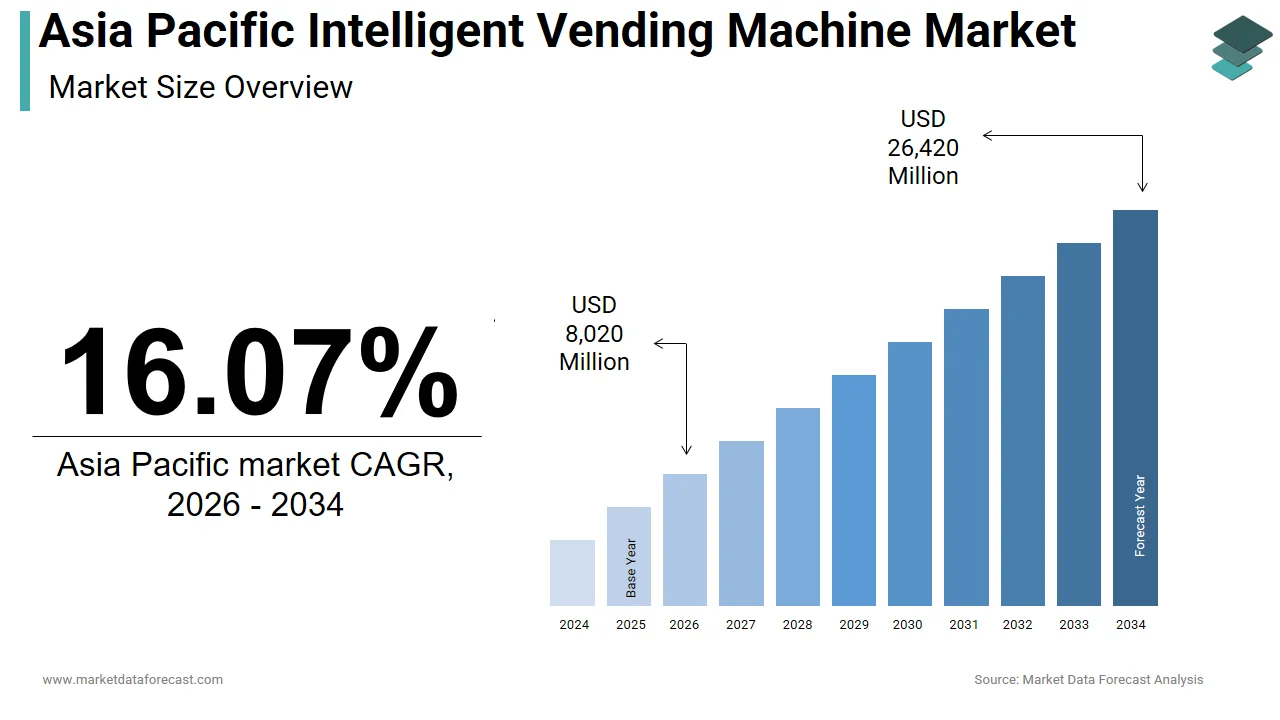
The Asia Pacific intelligent vending machine market was valued at USD 6,909.65 million in 2025, is estimated to reach USD 8,020 million in 2026, and is projected to reach USD 26,420 million by 2034, growing at a CAGR of 16.07% from 2026 to 2034. Intelligent vending machines integrate IoT connectivity, AI-driven inventory management, cashless payment systems, digital displays, and real-time remote monitoring, offering personalized experiences and operational efficiency across high-traffic urban environments.
Key Market Trends & Insights
- Japan held the largest share of the Asia Pacific intelligent vending machine market in 2025.
- China is expected to showcase significant growth during the forecast period.
- Based on product, the beverages segment was the leading category in 2025.
- Based on application, the commercial malls & retail stores held the dominant market share in 2025.
- Based on country, Japan remained the top market in 2025.
Market Size & Forecast
- 2025 Market Size: USD 6,909.65 Million
- 2026 Market Size: USD 8,020 Million
- 2034 Projected Market Size: USD 26,420 Million
- CAGR (2026 to 2034): 16.07%
- Japan: Largest market in 2025
- China: Strong growth region
Asia Pacific Intelligent Vending Machine Market Size
The size of the Asia Pacific intelligent vending machine market was worth USD 6,909.65 million in 2025. The market is anticipated to grow at a CAGR of 16.07% from 2026 to 2034 and be worth USD 26,420 million by 2034 from USD 8,020 million in 2025.
Intelligent vending machine refers to the network of advanced automated retail units equipped with technologies such as IoT connectivity, AI-driven inventory management, cashless payment integration, digital displays, and real-time remote monitoring. Unlike traditional vending systems, intelligent machines offer dynamic pricing, consumer behavior analytics, predictive restocking, and interactive user interfaces, enabling operators to deliver personalized experiences and optimize operational efficiency. These systems are increasingly deployed in high-traffic urban environments, including transit hubs, office complexes, universities, and healthcare facilities.
In Japan, where vending machine density is the highest globally, there is one machine for every 23 people, as reported by the Japan Vending Machine Manufacturers Association. The integration of these machines into smart city frameworks, such as Singapore’s Smart Nation initiative and Seoul’s Digital City Plan, further underscores their role in modern urban infrastructure. Additionally, rising concerns over labor costs and service consistency are prompting institutions to adopt automation for essential goods distribution.
MARKET DRIVERS
Surge in Cashless and Mobile Payment Adoption Enabling Frictionless Transactions
The rapid proliferation of digital payment platforms is a primary catalyst for the adoption of intelligent vending machines across Asia Pacific. Consumers are increasingly transacting via QR codes, NFC, and mobile wallets, eliminating the need for physical currency and aligning perfectly with the capabilities of smart vending systems. Intelligent vending machines leverage this shift by integrating directly with local payment ecosystems, GrabPay in Southeast Asia, Paytm in India, and Alipay in China, enabling instant, secure purchases. In Singapore, the majority of new vending units installed in 2023 support contactless payments, driven by public preference for hygiene and speed. Moreover, integration with loyalty programs and e-commerce apps allows vendors to offer targeted discounts and collect consumer data, enhancing repeat engagement. The decline in cash usage, particularly in urban centers like Tokyo and Shanghai, where cash accounts for less share of small transactions, is reducing the operational viability of traditional vending models. As digital payment infrastructure expands into secondary cities and rural areas, intelligent vending machines are becoming financially and logistically feasible across broader geographies.
Rising Urbanization and Labor Cost Pressures in High-Density Cities
The accelerating pace of urbanization across Asia Pacific is creating an urgent need for automated retail solutions that can operate efficiently in densely populated, fast-moving environments. In megacities like Jakarta, Mumbai, and Manila, congestion, high foot traffic, and limited retail space make intelligent vending machines an optimal solution for last-mile product delivery. Simultaneously, rising labor costs are compelling businesses to reduce dependency on human-operated kiosks and convenience stores. South Korea faces a similar challenge, with a shrinking workforce and a record low unemployment rate of 2.6% in 2023, according to Statistics Korea, limiting the availability of service staff. Intelligent vending machines address both spatial and labor constraints by operating 24/7 with minimal maintenance. In Tokyo, vending machines dispense not only beverages but also fresh meals, umbrellas, and electronics, serving as micro-retail hubs in subway stations and office towers. Hospitals in Australia have deployed smart vending units to distribute personal protective equipment and pharmaceuticals, reducing staff burden. As urban centers prioritize operational efficiency and space optimization, intelligent vending is evolving from a convenience tool to a strategic infrastructure component.
MARKET RESTRAINTS
High Initial Investment and Maintenance Costs in Emerging Economies
The capital intensity of intelligent vending machines remains a significant barrier to widespread adoption, particularly in lower-income countries across Southeast Asia and South Asia. A fully equipped smart vending unit with IoT sensors, refrigeration, touchscreens, and payment integration can cost more compared to that for a conventional machine. For small operators and independent vendors in nations like the Philippines, Bangladesh, and Cambodia, this upfront cost is prohibitive. Additionally, ongoing expenses, including connectivity subscriptions, cybersecurity updates, and technical repairs, further strain operational budgets. Power instability in rural and peri-urban regions also increases the risk of system failure, necessitating backup systems that add to the total cost. The lack of financing models tailored to small businesses exacerbates the issue; unlike in Japan or Australia, leasing and pay-per-use options remain underdeveloped in most markets. As a result, deployment remains concentrated in corporate-owned locations such as airports and private campuses, limiting scalability. Without accessible funding mechanisms and localized service ecosystems, the economic feasibility of intelligent vending remains constrained in price-sensitive environments.
Consumer Skepticism and Low Trust in Product Quality and Hygiene
Consumer hesitation persists regarding the freshness, safety, and authenticity of products dispensed by intelligent vending machines, particularly for perishable and high-value items. Moreover, incidents of counterfeit goods being loaded into machines, such as fake cosmetics or expired snacks, have eroded trust in unattended retail. The absence of real-time quality verification mechanisms, such as temperature logging or tamper-evident packaging, further fuels skepticism. Unlike in Japan, where decades of reliable operation have built public trust, newer markets lack institutional credibility. Additionally, limited return or refund options for defective products discourage trial. Without transparent monitoring systemssuch as live camera feeds, blockchain-based product tracking, or QR-code-linked expiry datesconsumers remain reluctant to shift from traditional retail, constraining the growth potential of intelligent vending in critical product categories.
MARKET OPPORTUNITIES
Integration with Smart City and Public Infrastructure Initiatives
Intelligent vending machines are increasingly being embedded into broader smart city frameworks, positioning them as essential nodes in urban digital ecosystems. Governments across Asia Pacific are leveraging automation to enhance public service delivery, reduce operational burdens, and improve citizen convenience. Similarly, in Seoul, the city government has installed AI-powered vending kiosks in subway stations that adjust inventory based on real-time passenger flow data from the Seoul Metropolitan Government’s transport analytics platform. These integrations are supported by municipal IoT networks, such as LoRaWAN and NB-IoT, which enable low-cost, city-wide connectivity. By aligning with public health, mobility, and sustainability goals, intelligent vending is transitioning from a commercial venture to a civic utility, unlocking new funding avenues through public-private partnerships and government tenders.
Expansion into Non-Traditional Product Categories and Niche Markets
The versatility of intelligent vending machines is enabling their deployment beyond beverages and snacks into high-growth, specialized segments such as pharmaceuticals, personal care, electronics, and even fresh produce. Hospitals in Thailand and Malaysia have adopted smart lockers to distribute insulin, prenatal vitamins, and surgical masks, ensuring 24/7 access while minimizing human contact. Similarly, in India, startups are deploying AI-driven units in corporate parks to sell personal hygiene products and emergency medical kits. These niche applications benefit from higher margins, reduced competition, and strong alignment with consumer wellness trends. As machine design becomes more modular and adaptable, operators can customize units for specific environmentsschools, gyms, airportsoffering tailored product mixes. This diversification reduces reliance on commoditized goods and opens scalable revenue streams in underserved markets.
MARKET CHALLENGES
Fragmented Regulatory and Safety Standards Across Countries
The lack of harmonized regulations governing intelligent vending operations across Asia Pacific creates operational complexity and compliance risks for multinational operators. Each country imposes distinct requirements on food safety, electrical standards, data privacy, and consumer protection, making cross-border deployment challenging. Data privacy laws vary significantlyJapan’s Act on the Protection of Personal Information (APPI) and Singapore’s PDPA impose strict consent requirements for customer data collected via facial recognition or purchase history, whereas enforcement in countries like Cambodia and Myanmar remains weak. This fragmentation increases the cost of compliance and delays market entry. Additionally, fire safety and electrical codes differ, requiring hardware modifications for each market. Without regional standardization, vendors face duplicated testing, certification, and software localization, undermining scalability and increasing time-to-market, particularly for small and medium enterprises seeking regional expansion.
Vulnerability to Cybersecurity Threats and Data Breaches
As intelligent vending machines become interconnected nodes in digital networks, they are increasingly exposed to cyber threats that can compromise financial data, disrupt operations, and damage brand reputation. These machines process sensitive informationincluding payment credentials, user IDs, and location datamaking them attractive targets for hackers. In India, the Computer Emergency Response Team (CERT-In) issued advisories against vulnerabilities in IoT-enabled vending platforms that could allow attackers to manipulate pricing or disable machines. The decentralized nature of vending networks, often managed through third-party cloud platforms, further complicates security oversight. Many operators lack dedicated cybersecurity teams, relying instead on vendor-provided updates that are inconsistently applied. As machines integrate with enterprise resource planning (ERP) and inventory systems, a single breach could cascade across supply chains. Without robust encryption, regular penetration testing, and compliance with frameworks like ISO/IEC 27001, the sector remains a soft target in an increasingly hostile digital landscape.
REPORT COVERAGE
| REPORT METRIC | DETAILS |
| Market Size Available | 2025 to 2034 |
| Base Year | 2025 |
| Forecast Period | 2026 to 2034 |
| Segments Covered | By Product, Application, and Region. |
| Various Analyses Covered | Global, Regional and Country-Level Analysis, Segment-Level Analysis, Drivers, Restraints, Opportunities, Challenges; PESTLE Analysis; Porter’s Five Forces Analysis, Competitive Landscape, Analyst Overview of Investment Opportunities |
| Countries Covered | India, China, Japan, South Korea, Australia, New Zealand, Thailand, Malaysia, Vietnam, Philippines, Indonesia, Singapore, Rest of APAC |
| Market Leaders Profiled | Crane Co., Advantech Co., Ltd., Azkoyen Group, FAS International S.p.A., Bianchi Vending Group S.p.A., Rhea Vendors Group, N&W Global Vending S.p.A., Westomatic Vending Services Ltd., Seaga, Jofemar, Sanden Corp., and Royal Vendors. |
SEGMENTAL ANALYSIS
By Product Insights
The beverages segment dominated the Asia Pacific intelligent vending machine market by capturing 54.7% of total revenue in 2024. This preeminence is rooted in deeply entrenched consumer habits, high purchase frequency, and the logistical simplicity of dispensing liquid products. The region’s tropical and subtropical climate further amplifies demand; in countries like Thailand, Indonesia, and the Philippines, average daily temperatures exceed 30°C for six months of the year, driving thirst-driven impulse purchases. Additionally, beverages require minimal inventory complexity and pose fewer spoilage risks compared to perishable food items, making them ideal for automated retail. The integration of premium beverage options, such as cold-pressed juices and functional drinks, into smart machines in Australia and South Korea has further elevated the segment’s value proposition, ensuring its continued dominance across urban landscapes.
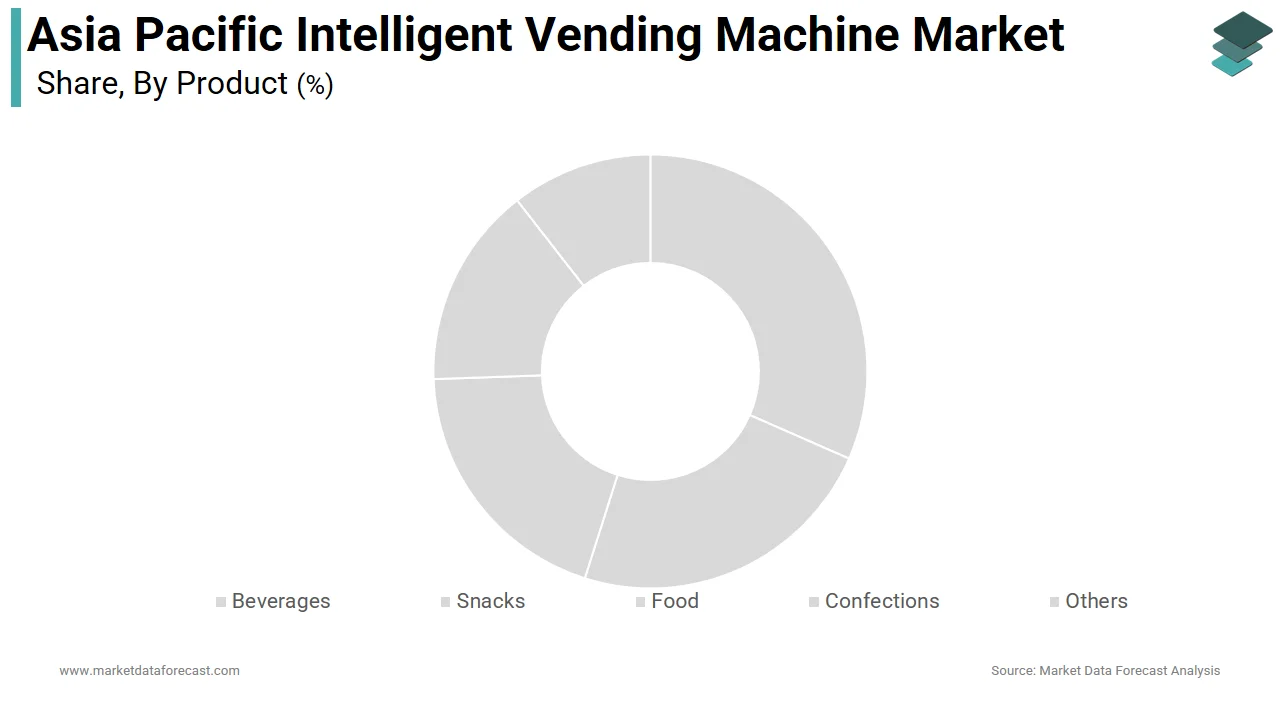
The food segment is emerging as the fastest-growing category in the Asia Pacific intelligent vending machine market and is projected to expand at a CAGR of 16.4% from 2026 to 2034. This surge is driven by rising demand for ready-to-eat meals, fresh produce, and nutrition-focused options in high-density urban environments where time scarcity and convenience are paramount. Companies like Meituan and Alibaba have deployed refrigerated vending machines in residential complexes that dispense pre-packaged bento boxes, dumplings, and steamed buns, with sales increasing year-on-year in 2023. These machines have achieved an average utilization rate of 8.7 transactions per day, significantly higher than snack-based units, as per the Korea Vending Association. Additionally, hospitals and universities are adopting food vending to provide 24/7 access to balanced meals, particularly for night-shift workers and students. As food safety standards improve and cold-chain logistics expand, intelligent vending is redefining urban food access, transforming from a novelty into a critical component of the regional food ecosystem.
By Application Insights
The commercial malls and retail stores segment led the market by accounted for 46.4% of the Asia Pacific intelligent vending machine market in 2024. This dominance is due to the high foot traffic, extended operating hours, and consumer dwell time characteristic of shopping centers across the region. In countries like China, India, and Thailand, mega-malls often span a large square footage and host a significant number of visitors on weekends, creating ideal conditions for impulse purchases. Intelligent vending units are strategically placed near entrances, rest zones, and cinema lobbies to capture spontaneous demand for beverages, snacks, and personal care items. These machines also serve as brand engagement toolsCoca-Cola’s “Freestyle” units in Australian shopping centers allow customers to customize drinks and share preferences via mobile apps, enhancing brand loyalty. Moreover, mall operators are integrating vending data into customer journey analytics to optimize tenant mix and layout planning. The ability of intelligent machines to operate beyond regular retail hours ensures revenue generation even after stores close. With malls increasingly positioning themselves as lifestyle destinations, automated retail complements the experiential economy, reinforcing its position as the largest application segment.
The office environment is the fastest-growing application for intelligent vending machines in Asia Pacific and is expanding at a CAGR of 15.8% from 2026 to 2034. This growth is fueled by shifting workplace dynamics, including hybrid work models, extended office hours, and rising employee expectations for on-site convenience. Intelligent vending units are being deployed in IT parks, financial hubs, and manufacturing facilities to provide 24/7 access to meals, beverages, and emergency supplies. Additionally, integration with corporate ID systems allows for seamless authentication, expense tracking, and subsidized pricing. In China, Tencent and Alibaba have incorporated AI-powered vending units into their campuses that recommend products based on user preferences and dietary goals. As employers prioritize operational efficiency and employee satisfaction, intelligent vending is evolving into a strategic workplace infrastructure element, driving rapid adoption across corporate Asia.
COUNTRY-LEVEL ANALYSIS
Japan Intelligent Vending Machine Market Insights
Japan held the largest share of the Asia Pacific intelligent vending machine market at 33.2%. The country’s position is underpinned by decades of technological maturity, cultural acceptance, and widespread integration of vending systems into daily life. With over 4.5 million units in operation for every 28 residentsJapan has the highest vending density globally. These machines dispense not only beverages but also umbrellas, hot meals, electronics, and even fresh produce, reflecting a deeply embedded automation culture. Government support for labor-saving technologies, particularly amid a shrinking workforce, has accelerated adoption. Moreover, Japan’s advanced cashless payment infrastructure facilitates seamless user experiences. Leading manufacturers like Suntory and Fuji Electric continuously innovate with AI-driven demand forecasting and energy-efficient refrigeration. As Japan advances its Society 5.0 initiative, intelligent vending is transitioning from a retail tool to a public utility, ensuring sustained dominance in the regional market.
China Intelligent Vending Machine Market Insights
China commanded a significant share of the Asia Pacific intelligent vending machine market. The country’s market is defined by rapid technological adoption, massive urban infrastructure, and strong backing from e-commerce giants. In Shanghai and Shenzhen, smart food lockers equipped with facial recognition and temperature control are now standard in residential complexes and office towers. The rise of “last-100-meter” delivery models has further accelerated deployment, with vending machines serving as micro-fulfillment hubs for groceries and pharmaceuticals. Government inclusion of automated retail in smart city blueprints, such as Beijing’s Digital Economy Action Plan, has unlocked public funding and regulatory support. As urbanization and digital consumption converge, China is reshaping the global vending landscape through scale, innovation, and ecosystem integration.
South Korea Intelligent Vending Machine Market Insights
South Korea holds a notable share of the Asia Pacific intelligent vending machine market. The country’s market is distinguished by high technological sophistication, strong consumer digital literacy, and government-led smart city integration. With over 320,000 intelligent units in operation, South Korea has one of the most advanced automated retail ecosystems in the region. The country’s emphasis on innovation is evident in its “Smart Store” initiative, which subsidizes the deployment of IoT-enabled vending units in underserved areas. CJ CheilJedang’s automated ramen dispensers. Additionally, universities like KAIST and Yonsei have integrated vending data into campus management systems for resource planning. With one of the world’s fastest internet networks and a culture of early tech adoption, South Korea is pioneering next-generation vending models that blend automation, AI, and hyper-convenience, positioning it as a regional innovation leader.
India Intelligent Vending Machine Market Insights
India is a lucrative player in the Asia Pacific intelligent vending machine market. The country’s market is in a high-growth phase, driven by urbanization, digital transformation, and corporate campus expansion. While traditional vending remains limited, intelligent units are gaining traction in IT parks, airports, and metro stations, with deployments increasing between 2021 and 2023. In Bengaluru and Hyderabad, tech companies like Infosys and Wipro have installed smart lockers for meals, hygiene kits, and electronics, reducing dependency on external vendors. The Unified Payments Interface (UPI) has been a critical enabler. Government initiatives like Smart Cities Mission have included automated retail in urban planning, with many cities piloting intelligent vending for public services. Startups are tailoring machines for local tastes, offering chai, samosas, and Ayurvedic products. As digital payments deepen and urban congestion grows, India’s intelligent vending market is poised for exponential expansion, transforming from niche to mainstream.
Australia Intelligent Vending Machine Market Insights
Australia holds a small share of the Asia Pacific intelligent vending machine market. The country’s market is characterized by early adoption, regulatory clarity, and integration with workplace and public infrastructure. In Melbourne and Sydney, vending machines dispense everything from insulin to emergency PPE, with integration into hospital inventory systems reducing staff workload. The rise of hybrid work models has driven deployment in corporate campuses. Additionally, universities like the University of Queensland have adopted smart lockers for textbook rentals and meal kits, improving student convenience. With strong internet connectivity, low vandalism rates, and a tech-savvy population, Australia is serving as a testing ground for advanced vending applications, particularly in non-traditional sectors, reinforcing its role as a mature, innovation-driven market.
COMPETITIVE LANDSCAPE
The competitive landscape of the Asia Pacific intelligent vending machine market is marked by a convergence of traditional manufacturers, beverage giants, and digital conglomerates, each leveraging distinct advantages to capture market share. Established hardware producers like Fuji Electric and Sanden Corporation dominate in Japan and South Korea, where technological precision and reliability are paramount. Meanwhile, beverage companies such as Suntory and Coca-Cola are redefining competition by owning the entire value chain from product formulation to point-of-sale automationensuring brand control and recurring revenue. In China and Southeast Asia, tech-driven players like Alibaba and Meituan are disrupting the space by integrating vending units into broader e-commerce and logistics networks, transforming them into smart fulfillment hubs. This ecosystem-based competition emphasizes data analytics, AI-driven personalization, and last-mile efficiency over standalone machine sales. Local startups are also emerging with niche offerings, such as Ayurvedic product dispensers in India or halal-compliant units in Indonesia, catering to regional preferences. The absence of dominant global players has fostered a fragmented yet dynamic environment where innovation cycles are rapid. Differentiation is increasingly based on software capabilities, energy efficiency, and integration with urban infrastructure. As intelligent vending evolves from a convenience tool to a strategic digital asset, competition is shifting toward platform dominance, data ownership, and seamless consumer experience across physical and digital touchpoints.
KEY MARKET PLAYERS
Some of the noteworthy companies in the Asia Pacific intelligent vending machine market profiled in this report are
- Crane Co.
- Advantech Co. Ltd.
- Azkoyen Group
- FAS International S.p.A.
- Bianchi Vending Group S.p.A.
- Rhea Vendors Group
- N&W Global Vending S.p.A.
- Westomatic Vending Services Ltd.
- Seaga
- Jofemar
- Sanden Corp.
- Royal Vendors
TOP LEADING PLAYERS IN THE MARKET
- Fuji Electric has been a cornerstone of innovation in the Asia Pacific intelligent vending machine market, leveraging its expertise in power electronics and IoT integration to deliver high-efficiency, networked retail solutions. The company’s intelligent units are widely deployed across Japan, South Korea, and Southeast Asia, featuring advanced refrigeration, real-time inventory tracking, and AI-driven demand forecasting. In 2023, Fuji Electric launched its next-generation VENDO Smart Series in Tokyo, equipped with facial recognition for personalized recommendations and dynamic pricing based on foot traffic data. It has strengthened its regional footprint by partnering with Suntory and Coca-Cola Japan to deploy energy-efficient beverage dispensers in high-heat urban zones. The company also introduced solar-powered vending units in Okinawa to support Japan’s carbon neutrality goals, reducing grid dependency. Fuji Electric has enhanced service reliability through cloud-based remote diagnostics, enabling predictive maintenance and minimizing downtime. By aligning with smart city initiatives and integrating with mobile payment platforms like PayPay, the company has positioned its machines as both commercial and civic infrastructure, reinforcing its leadership in technology-driven automated retail.
- Suntory Beverage & Food Limited has transformed from a beverage producer into a key infrastructure player in the intelligent vending ecosystem across Asia Pacific. The company operates over 300,000 connected vending machines in Japan and is expanding into Thailand, Vietnam, and Australia through strategic partnerships and localized product offerings. In 2022, Suntory launched its “Eco-Cool” intelligent machine, which uses AI to adjust cooling intensity based on weather and usage patterns, reducing energy consumption by up to 38%, as verified by Japan’s New Energy and Industrial Technology Development Organization. The machines integrate with Suntory’s loyalty app, allowing users to earn rewards and receive personalized drink suggestions. In Thailand, the company deployed solar-powered units in tourist-heavy areas to enhance sustainability and brand visibility. Suntory has also adopted blockchain technology to track machine performance and supply chain logistics, improving restocking accuracy. By owning both the product and the distribution channel, Suntory ensures brand consistency, data control, and direct consumer engagement. Its focus on sustainability, digital integration, and operational intelligence has redefined the role of beverage companies in the automated retail landscape.
- Alibaba Group, via its Cainiao Smart Logistics Network, has redefined intelligent vending by integrating automated retail with e-commerce, last-mile delivery, and urban logistics. The company has deployed thousands of smart lockers and multi-functional vending units across China, India, and Southeast Asia, serving as hybrid pickup points for online orders and standalone retail kiosks. In 2023, Cainiao launched its “RetailBox” in Hangzhou temperature-controlled intelligent unit that dispenses fresh food, beverages, and Alibaba-branded goods using facial recognition and QR-code payments. These units are linked to Taobao and Ele.me, enabling real-time inventory sync with online demand. In Malaysia, Cainiao partnered with local retailers to install vending kiosks in residential areas, expanding access to essential goods. The system uses AI to predict regional consumption trends and optimize product mix. By leveraging Alibaba’s vast data ecosystem, Cainiao has turned vending machines into intelligent nodes in a broader digital commerce network, blurring the lines between logistics and retail. This integration enhances scalability, consumer reach, and operational efficiency, positioning Alibaba as a transformative force in the region’s automated retail evolution.
TOP STRATEGIES USED BY THE KEY MARKET PARTICIPANTS
Key players in the Asia Pacific intelligent vending machine market are deploying sophisticated strategies to consolidate their presence and drive innovation. A dominant approach is vertical integration, where companies control both the hardware and the product ecosystemSuntory and Coca-Cola exemplify this by manufacturing machines that exclusively dispense their beverages, ensuring brand loyalty and supply chain efficiency. Another widespread tactic is digital ecosystem integration, with vendors linking machines to mobile wallets, loyalty programs, and e-commerce platforms to enhance consumer engagement. Companies like Alibaba and Meituan use AI to analyze purchase behavior and dynamically adjust pricing or promotions. Strategic partnerships with governments and transit authorities are enabling deployment in high-traffic public spaces, as seen in Japan and Singapore. Product differentiation is achieved through advanced features such as facial recognition, real-time inventory analytics, and energy-efficient cooling systems. Firms are also investing in sustainability, introducing solar-powered units and recyclable packaging to align with environmental regulations. Expansion into non-traditional categoriespharmaceuticals, fresh food, personal careis diversifying revenue streams and reducing reliance on commoditized goods. Additionally, remote monitoring and predictive maintenance are minimizing downtime and improving ROI. As competition intensifies, success is increasingly determined not by hardware alone but by data intelligence, service reliability, and seamless user experience across urban and corporate environments.
RECENT MARKET DEVELOPMENTS
- In January 2023, Fuji Electric launched its VENDO Smart Series in Tokyo, featuring AI-powered demand forecasting and facial recognition for personalized beverage recommendations, enhancing user engagement and optimizing inventory management across high-traffic urban locations in Japan and South Korea.
- In August 2022, Suntory Beverage & Food introduced its Eco-Cool intelligent vending machine in Thailand, utilizing AI-driven temperature modulation to reduce energy consumption by 38%, aligning with regional sustainability goals and strengthening its brand image as an environmentally responsible market leader.
- In November 2023, Cainiao Smart Logistics Network deployed its RetailBox units in Hangzhou, integrating temperature-controlled smart vending with Taobao and Ele.me platforms to enable real-time inventory synchronization and AI-based consumer behavior analysis, expanding Alibaba’s footprint in urban automated retail.
- In March 2024, Fuji Electric partnered with the Tokyo Metro to install 500 solar-powered intelligent vending machines across subway stations, reducing grid dependency and supporting the city’s carbon neutrality targets while increasing brand visibility in high-footfall public transit zones.
- In September 2023, Suntory expanded its intelligent vending network into Australia through a collaboration with convenience retailer 7-Eleven, deploying 200 connected beverage units in Sydney and Melbourne that support contactless payments and loyalty integration, marking its first major entry into the Southern Hemisphere market.
MARKET SEGMENTATION
This Asia Pacific intelligent vending machine market research report is segmented and sub-segmented into the following categories.
By Product
- Beverages
- Snacks
- Food
- Confections
- Others
By Application
- Manufacturing
- Commercial Malls & Retail Stores
- Offices
- Educational Institutes
- Others
By Country
- India
- China
- Japan
- South Korea
- Rest Of Asia Pacific