- Product Description Description
- Table of Contents TOC
- List of Table & Figure LOT
- Get Free Sample PDF Sample PDF
Market Size, 2025
$29.19 BnMarket Estimate, 2026
$33.05 BnMarket Forecast, 2034
$89.37 BnCAGR, 2026–2034
13.24%Global Smart Vending Machine Market Size, Growth, Trends & Forecast (2026–2034)
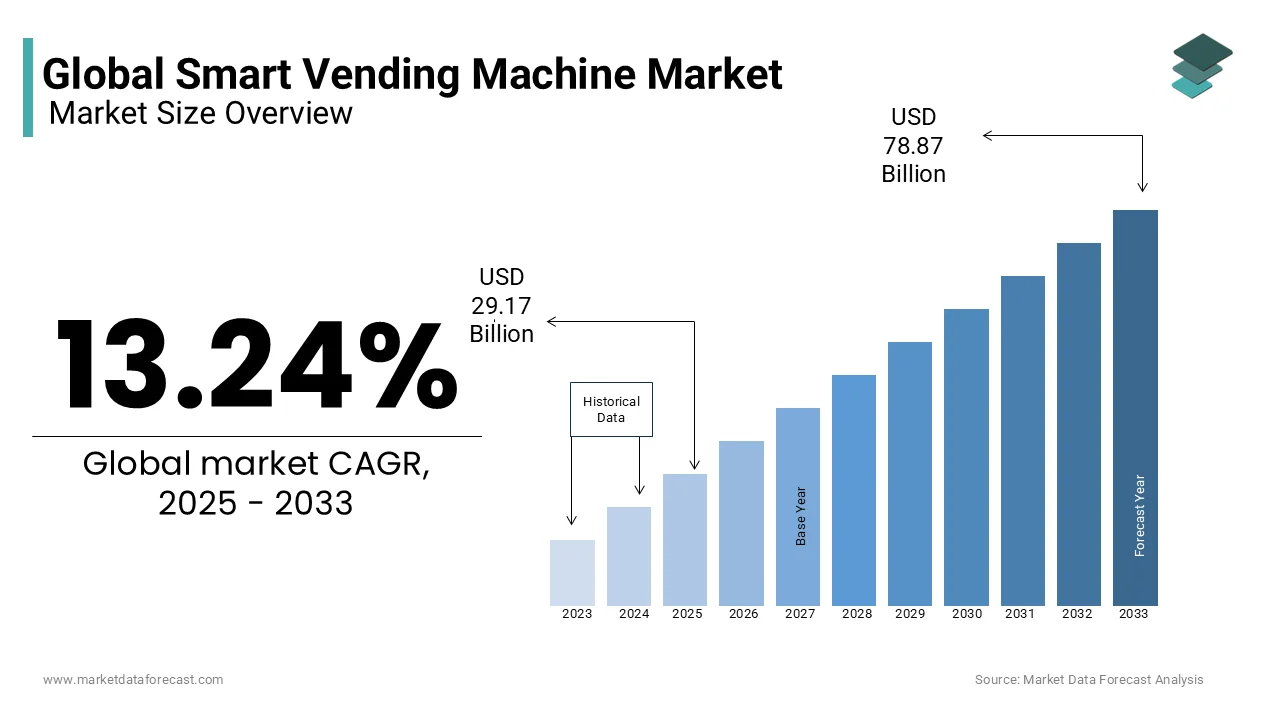
The global smart vending machine market was valued at USD 29.19 billion in 2025, is estimated to reach USD 33.05 billion in 2026, and is projected to scale up to USD 89.37 billion by 2034, registering a robust compound annual growth rate (CAGR) of 13.24% from 2026 to 2034. Driven by advanced touch screens, remote management tools, AI-powered interactions, and cashless payment integration, smart systems are completely reshaping the automated retail landscape.
Key Executive Metrics (At-a-Glance)
- 2025 Base Valuation: USD 29.19 Billion
- 2026 Current Valuation: USD 33.05 Billion
- 2034 Forecast Valuation: USD 89.37 Billion
- Compound Annual Growth Rate (CAGR): 13.24% (2026–2034)
- Dominant Type: Beverages & Snacks (traditional core offerings expanded with intelligent features)
- Dominant Application: Commercial & Public Spaces (shopping malls, transit hubs, and office coffee services)
- Dominant Region: North America (rapid adoption of automated POS and self-service tech)
- Fastest-Growing Region: Middle East & Africa / Asia-Pacific (infrastructure growth and smart retail modernization)
Core Market Drivers
- Interactive System Technologies: Deployment of large 6-14 inch touch screens, facial recognition, and voice modules enabling real-time consumer communication and tailored promotions.
- Office Coffee Service (OCS) & Workplace Trends: Growing corporate demand to optimize office environments, offering healthy snacks and automated order tracking for employees.
- Digital Payments & Telemetry: Shift toward cashless ecosystems, real-time transaction tracking, and data collection to maximize operational efficiency and revenue streams.
Primary Market Restraints & Challenges
- Regulatory Restrictions: Strict government controls and guidelines targeting the sale of junk food and tobacco products in public avenues and school zones.
- Early-Stage Implementation Costs: High initial setup and technology integration costs, limiting rapid penetration primarily to developed economic regions.
Global Smart Vending Machine Market Segmentation Breakdown
| Segment Category | Leading Sub-Segment (2025 Base) | Fastest-Growing Sub-Segment (2026–2034) |
|---|---|---|
| By Type | Beverages & Snacks (high frequency daily consumer purchases) | Commodities & Specialized Retail Items (expanding automated product ranges) |
| By Technology | Cashless & Telemetry Systems (essential baseline transaction architecture) | Voice Recognition & AI Interfaces (interactive engagement modules) |
| By Application | Shopping Malls, Offices, & Transit Hubs (high foot-traffic urban positioning) | Hospitals & Educational Institutions (24/7 convenient access requirements) |
| By Region | North America (mature automated retail and retail technology infrastructure) | Middle East, Africa & APAC (tourism expansion and infrastructure modernization projects) |
Major Industry Players Profiled
Key enterprises shaping the competitive global smart vending machine market include Royal Vendors, Westomatic Vending Services Ltd, Intel Corporation, Azkoyen Group, Crane Co, Ingenico S.A, Canteen, Glory Ltd, Fuji Electric Co., Ltd, and FAS International S.P.A.
Global Smart Vending Machine Market Size
The global smart vending machine market was valued at USD 29.19 billion in 2025, and the global market size is expected to reach USD 89.37 billion by 2034 from USD 33.05 billion in 2026. The market is growing at a CAGR of 13.24%.
The Smart Vending Machine industry is undergoing a massive change by using smart system technologies to install touch screens and remote management software to go far beyond simple food and beverage dispensing. It's the one with an LCD screen for interaction and a large tabletop vending machine that has enough area to possibly support 6-14 inch LCD screens. The integration of features such as facial recognition and voice that enable communication between the vending machine and the consumer drives the industry's growth forecasts. These features add intelligence to systems by detecting and responding to users and provide a visual experience with interactive promotions. Intelligent distribution systems help to better understand consumer behaviour and preferences. Interactive LCDs allow vendors to generate more revenue by displaying advertisements and loyalty programs. Office sales systems must increase motivation by allowing employees to have a quick snack between breaks without having to.
The business sector uses advanced and innovative strategies to optimize the office environment for employees. More commonly known as Office Coffee Service (OCS), these machines are primarily preferred by businesses to provide fresh, healthy, and light snacks during office hours. Incorporating smart technology into these machines will help offices track individual orders and the employees who consume the products. Globally, growing business demand is driving the market for smart vending machines. Applications of smart vending machines have increased dramatically in recent years in commercial and public places. Airports, train stations, bus stations, shopping malls, hospitals, universities, and offices are the most common places where these smart vending machines can be found. The increasing adoption of automated systems is acting as a propellant to the expansion of the global smart vending machine business. Manufacturers of smart vending machines are developing energy-efficient solutions to reduce the carbon footprint of these machines. Popular beverage brand Coca-Cola is developing smart, recycled and eco-friendly vending machines with sustainable technology that can balance environmental impact. Manufacturers are trying to incorporate a cashless payment solution into smart vending machines. They integrate connected solutions in vending machines to obtain transactional and consumer data in real-time. In anticipation of strong digitization, cashless payment technology in smart vending machines will undoubtedly increase revenue in the global smart vending machine market. However, regulations on the sale of junk food and tobacco products are holding back the growth of this market. This technology is implemented mainly in developed countries. The market for smart vending machines is currently in its early stages. However, technological advances and changes in consumer buying habits are supposed to usher in rapid growth in the future.
REPORT COVERAGE
| REPORT METRIC | DETAILS |
| Market Size Available | 2025 to 2034 |
| Base Year | 2025 |
| Forecast Period | 2026 to 2034 |
| CAGR | 13.24% |
| Segments Covered | By Type, Application, Technology, and Region |
| Various Analyses Covered | Global, Regional and Country Level Analysis; Segment-Level Analysis; DROC; PESTLE Analysis; Porter’s Five Forces Analysis; Competitive Landscape; Analyst Overview of Investment Opportunities |
| Regions Covered | North America, Europe, APAC, Latin America, Middle East & Africa |
| Market Leaders Profiled | Royal Vendors, Westomatic Vending Services Ltd, Intel Corporation, Azkoyen Group, Crane Co, Ingenico S.A, Canteen, Glory Ltd, Fuji Electric Co., Ltd, FAS International S.P.A. |
REGIONAL ANALYSIS
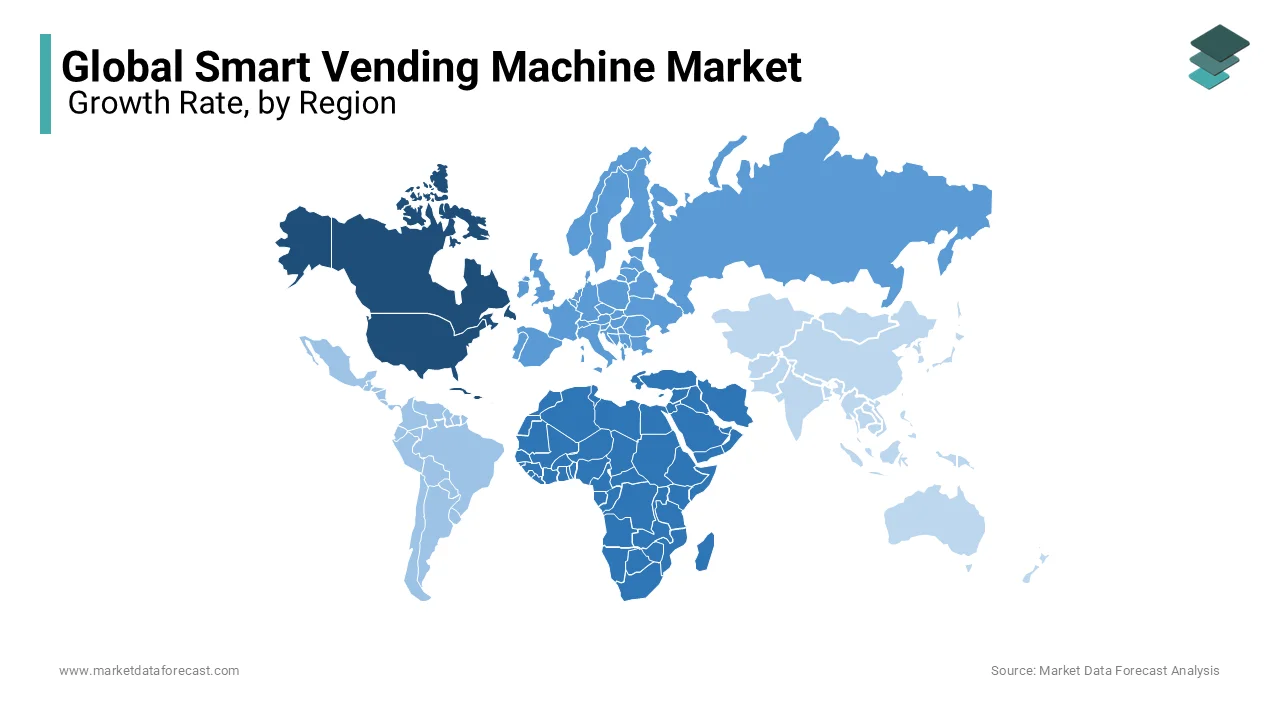
Revenues from the smart vending machine market in North America are growing strongly due to the growing demand for self-service technologies at the point of sale to automate the sales process. Points of sale in the United States and Canada have witnessed rapid adoption of these systems in various application areas, including supermarkets, retail stores, shopping malls, etc. Technological advancements and innovations in these systems help automate business processes in your application segments. Additionally, favorable initiatives and demand for a better customer experience will drive demand from the regional market. The growth of tourism in countries such as the United Arab Emirates, Saudi Arabia and South Africa has led to a large number of infrastructure development projects in the Middle East and Africa to adapt to the latest technology solutions and trends. These include developments in the design and modernization of stores with machines adapted to the needs of consumers.
KEY MARKET PLAYERS
Key Players in Smart Vending Machine Market are Royal Vendors, Westomatic Vending Services Ltd, Intel Corporation, Azkoyen Group, Crane Co, Ingenico S.A, Canteen, Glory Ltd, Fuji Electric Co., Ltd, FAS International S.P.A.
RECENT HAPPENINGS IN THE MARKET
-
In October 2015, Bianchi Vending SpA acquired Brasilia, a manufacturer of espresso coffee machines, to strengthen its activity in the hotel, restaurant and catering sector (HORECA), which ensures the supply of bars, restaurants, catering businesses and hotels.
-
Big Basket is in planning to produce a majority portion of Kwik24, a smart vending machine start-up in Bengaluru, India. The Bengaluru-based company is also in talks to acquire the RainCan milk distribution company and is ready to venture into drug distribution through a possible acquisition. The Alibaba-backed company, which has already started a pilot project with Kwik24 to implement smart vending machines in five apartment buildings in Bangalore as part of BigBasket's BB Instant service, is likely considering acquiring a stake in Kwik24 to increase its reach to customers offline clients.
MARKET SEGMENTATION
This research report on the global smart vending machine market has been segmented and sub-segmented based on type, application, technology & region.
By Type
- Beverages
- Snacks
- Commodities
By Application
- Fast-food restaurants
- Shopping malls
- Retail stores
- Public transportation
- Airports
- Hospitals
- Hotels
- Train stations
By Technology
- Cashless systems
- Telemetry systems
- Voice recognition
By Region
- North America
- Asia Pacific
- Europe
- Latin America
- Middle East and Africa