- Product Description Description
- Table of Contents TOC
- List of Table & Figure LOT
- Get Free Sample PDF Sample PDF
Market Size, 2025
$6.61 BnMarket Estimate, 2026
$7.05 BnMarket Forecast, 2034
$11.74 BnCAGR, 2026–2034
6.58%Executive Summary: Asia Pacific Medical Products Market
- Market Scope: Comprehensive market assessment of the Asia Pacific medical products ecosystem, covering specialized medical beds, walkers, and country-level profiles (forecast period: 2026–2034).
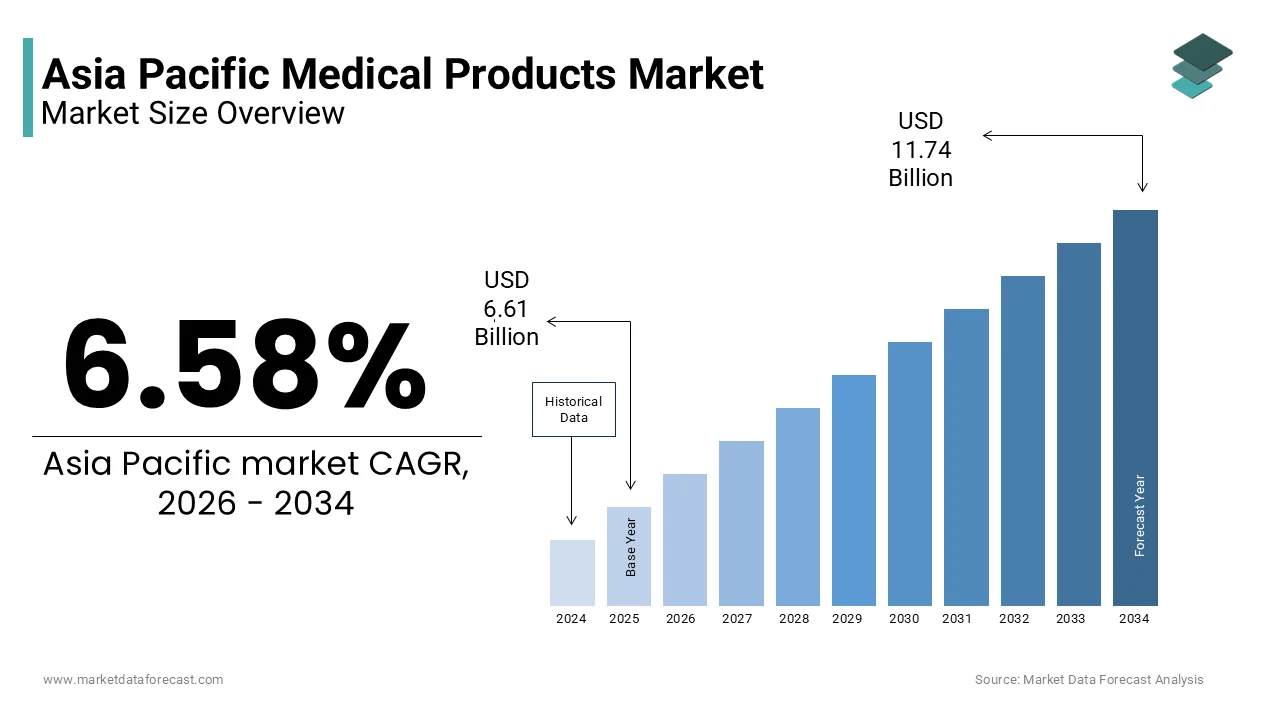
- Market Valuation: Valued at USD 6.61 billion in 2025, estimated at USD 7.05 billion in 2026, and projected to expand to USD 11.74 billion by 2034, growing at a steady CAGR of 6.58% from 2026 to 2034.
- Primary Growth Drivers: Proliferation of universal health coverage (UHC) programs, rising regional burden of chronic and lifestyle-related diseases, and rapidly expanding aging populations.
Key Market Segment Metrics
| Category | Leading Segment / Base Scope | Fastest-Growing / High-Growth Focus |
|---|---|---|
| By Medical Beds | Patient Beds (dominant hospital and clinical setup share, driven by critical care infrastructure expansions and ICU upgrades) | Specialized & Examination/Gurney Beds (fueled by rising emergency medical transports and outpatient surgical volumes) |
| By Walkers | Double-Handed Walkers (high adoption in elder care and rehabilitation facilities for maximum stability) | Single-Handed Walkers (expanding alongside home healthcare demand and targeted mobility assistance for stroke recovery) |
| By Country | China (holding 31.2% market share in 2025 under the Healthy China 2030 framework and extensive hospital modernization) | India (projected for highest CAGR growth backed by national insurance schemes like Ayushman Bharat and massive domestic manufacturing) |
Major Market Landscape & Competitive Structure
Market Structure: Highly competitive landscape featuring global medtech giants (Medtronic, GE HealthCare, Siemens Healthineers) converging with agile regional champions (Mindray, MicroPort, Samsung Medison) competing across high-end imaging, smart monitoring, and basic hospital equipment.
Key Market Leaders: Medtronic, Philips Healthcare, GE HealthCare, Siemens Healthineers, Abbott Laboratories, Johnson & Johnson, Shenzhen Mindray Biomedical, and Stryker.
 Download Free Sample Report
Asia Pacific Medical Products Market Size
The Asia Pacific medical products market size was valued at USD 6.61 billion in 2025, and is expected to reach USD 11.74 billion by 2034 from USD 7.05 billion in 2026. The market's promising CAGR for the predicted period is 6.58%.
The medical products is ecosystem of devices, equipment, diagnostics, implants, and consumables used across preventive, diagnostic, therapeutic, and rehabilitative healthcare settings. This domain extends beyond hospital-centric applications to include home healthcare, telemedicine-enabled diagnostics, and mobile clinics serving remote populations. According to the United Nations Population Division, the number of people aged 65 and over in the Asia Pacific is projected to reach 650 million by 2030, intensifying demand for chronic care devices such as glucose monitors, dialysis equipment, and cardiovascular implants. Simultaneously, infectious disease prevalence remains significant: the World Health Organization estimates that 4.2 million new tuberculosis cases emerge annually in the region, necessitating widespread use of diagnostic kits, respiratory support devices, and infection control tools.
MARKET DRIVERS
Proliferation of Universal Health Coverage (UHC) Programs
The proliferation of universal health coverage (UHC) programs is propelling the growth of the Asia Pacific medical products market. Countries like Thailand, South Korea, and Japan have long-standing UHC systems, but recent expansions in middle-income nations are transforming healthcare accessibility. India’s Ayushman Bharat Pradhan Mantri Jan Arogya Yojana (AB-PMJAY) provides health insurance to 500 million vulnerable citizens by enabling them to receive care at empaneled hospitals equipped with modern medical technologies. These policies not only increase patient volume but also standardize care delivery, necessitating uniform procurement of approved medical products. The institutionalization of UHC across the region ensures predictable, long-term demand for a broad spectrum of medical devices by transforming them from discretionary purchases into essential public health infrastructure.
Rising Burden of Chronic and Lifestyle-Related Diseases
The escalating prevalence of non-communicable diseases (NCDs) is also to fuel the growth of the Asia Pacific medical products market. Cardiovascular diseases, diabetes, chronic respiratory conditions, and cancer now account for 77% of all deaths in the region, according to the World Health Organization, surpassing infectious diseases as the leading health threat. In China, 300 million people suffer from hypertension, and 141 million have diabetes, as reported by the Chinese Center for Disease Control and Prevention, creating massive demand for blood pressure monitors, insulin delivery systems, and continuous glucose monitors. Urbanization and sedentary lifestyles are exacerbating NCD risks: in South Korea, 42% of adults are overweight, according to Statistics Korea, increasing demand for bariatric devices and metabolic monitoring tools.
 MARKET RESTRAINTS
Inconsistent Regulatory Harmonization Across Countries
The absence of standardized regulatory frameworks is limiting the growth of the Asia Pacific medical products market. Each country maintains distinct approval processes, classification systems, and post-market surveillance requirements, complicating market entry and delaying product availability. As per the ASEAN Secretariat, only four out of ten ASEAN member states have fully implemented the ASEAN Medical Device Directive (AMDD), which is resulting in fragmented compliance obligations for manufacturers. In Vietnam, medical device registration can take up to 18 months, compared to 6–9 months in Australia, according to the Asia Pacific Medical Technology Association, creating significant delays in patient access. India’s Central Drugs Standard Control Organization (CDSCO) has only recently introduced a dedicated medical device regulatory pathway, leaving many products in a legal gray area. The World Health Organization’s 2023 regulatory assessment found that 40% of low-income Asia Pacific countries lack functional systems for monitoring device safety, increasing risks of counterfeit or substandard products entering circulation. These disparities not only inflate compliance costs for global manufacturers but also hinder regional coordination during health emergencies, where rapid deployment of uniform medical products is essential.
Limited Healthcare Infrastructure in Rural and Remote Areas
The population remain underserved due to inadequate healthcare infrastructure in rural, mountainous, and island regions is hindering the growth of the Asia Pacific medical products market. This structural gap restricts the deployment and utilization of advanced medical products, which often require stable power, trained operators, and maintenance support. Telemedicine is expanding, but connectivity remains a challenge: the International Telecommunication Union notes that only 55% of rural households in Southeast Asia have reliable internet access, undermining digital diagnostics. In India, over 50% of sub-centers in tribal regions lack essential diagnostic tools, according to the National Health Systems Resource Centre. These limitations force reliance on low-tech, manual solutions, constraining market growth for sophisticated devices.
MARKET OPPORTUNITIES
Integration of Artificial Intelligence and Digital Diagnostics
The intehration of artificial intelligence (AI) and digital diagnostics is unlocking transformative opportunities in the Asia Pacific medical products market in imaging, point-of-care testing, and remote monitoring. AI-powered medical devices are enhancing diagnostic accuracy, reducing clinician workload, and enabling early disease detection in resource-constrained settings. In ophthalmology, AI algorithms developed by companies like Eyenuk and integrated into retinal cameras are being deployed across India and Thailand to screen for diabetic retinopathy, a leading cause of blindness. The Indian Council of Medical Research reports that AI-assisted screening has increased detection rates by 35% in rural clinics. Australia’s Commonwealth Scientific and Industrial Research Organisation has developed AI-driven ultrasound systems that guide non-specialists in emergency assessments, improving triage in remote areas. The Ministry of Health in Singapore has approved over 50 AI-based medical devices since 2020, including stroke detection algorithms and sepsis prediction tools.
Growth of Domestic Manufacturing and Medical Technology Localization
Governments actively promoting domestic manufacturing of medical products to reduce import dependency, enhance supply chain resilience, and stimulate economic growth, which is creating a strategic opportunity for local and multinational players. As per the Department of Pharmaceuticals, this initiative has already attracted over 120 manufacturers, including Transmed, Zykadia, and Trivitron, to set up advanced production facilities. Vietnam has established medical device industrial parks in Hanoi and Ho Chi Minh City by offering tax incentives to attract foreign investment. The Thai Board of Investment reports that medical device exports grew by 18% in 2023, driven by increased production of syringes, catheters, and surgical instruments. Indonesia’s Ministry of Health mandates that 40% of medical equipment in public hospitals be sourced locally by 2026, accelerating technology transfer.
MARKET CHALLENGES
Vulnerability to Supply Chain Disruptions from Geopolitical and Climate Risks
The Asia Pacific medical products market faces escalating risks from geopolitical tensions and climate-related disruptions, both of which threaten the stability of manufacturing and distribution networks. The 2022 lockdowns in Shanghai disrupted the production of over 200,000 medical devices, including ventilators and infusion pumps, destined for Southeast Asia and Oceania, as documented by the Asian Trade Centre. Rising tensions in the South China Sea have led to increased customs scrutiny and shipping delays, with the International Chamber of Commerce reporting that medical cargo transit times increased by 25% in 2023 for shipments passing through contested waters. Climate change is compounding these risks: typhoons in the Philippines and floods in Bangladesh regularly damage logistics infrastructure, delaying deliveries. The United Nations Office for Disaster Risk Reduction states that the Asia Pacific experienced 60% of global natural disasters in 2023, many of which disrupted medical supply routes. Additionally, port congestion in major hubs like Singapore and Busan creates bottlenecks.
Shortage of Skilled Healthcare Professionals for Advanced Device Operation
The acute shortage of trained personnel capable of operating and maintaining advanced medical devices in rural and underserved areas is limiting the growth of the Asia Pacific medical products market. According to the World Health Organization, the Western Pacific Region faces a deficit of 3.2 million health workers, with critical shortages in radiographers, biomedical engineers, and clinical technologists. Indonesia reports that 70% of newly installed CT scanners in provincial hospitals remain idle for weeks due to lack of trained radiologists, according to the Indonesian Medical Association. Even in advanced economies like Japan, the aging workforce is a concern: over 40% of biomedical engineers are aged 55 or older, per the Japan Association for Clinical Engineering.
REPORT COVERAGE
| REPORT METRIC | DETAILS |
| Market Size Available | 2025 to 2034 |
| Base Year | 2025 |
| Forecast Period | 2026 to 2034 |
| CAGR | 6.58% |
| Segments Covered | By Medical Beds, Walkers, and Region |
| Various Analyses Covered | Regional & Country Level Analysis, Segment-Level Analysis, DROC, PESTLE Analysis, Porter’s Five Forces Analysis, Competitive Landscape, Analyst Overview on Investment Opportunities |
| Regions Covered | India, China, Japan, South Korea, Australia, New Zealand, Thailand, Malaysia, Vietnam, Philippines, Indonesia, Singapore, and the Rest of Asia-Pacific |
| Market Leaders Profiled | Medtronic, Philips Healthcare, GE Healthcare, Siemens Healthineers, Abbott Laboratories, Johnson & Johnson, Boston Scientific, Stryker, Olympus Corporation, Terumo Corporation, Shimadzu Corporation, Nipro Corporation, Sysmex Corporation, Shenzhen Mindray Biomedical, Lepu Medical Technology, MicroPort Inc., Wellell, and others |
REGIONAL ANALYSIS
China
China was the top performer of the Asia Pacific medical products market with 31.2% of the share in 2025. As the region’s most populous nation and a global manufacturing hub, China’s influence spans both domestic consumption and international supply chains. The country’s medical device market has expanded rapidly under the "Healthy China 2030" strategy, which includes the construction of over 1,500 specialized hospitals and 500 regional medical centers by 2026, according to the National Health Commission. The government’s response to the pandemic catalyzed a massive upgrade in critical care infrastructure, including the installation of 200,000 ventilators and 5 million patient monitors in public hospitals. Domestic firms like Mindray, MicroPort, and Wondfo have scaled production of imaging systems, IVD kits, and surgical devices, reducing import reliance. China’s “Made in China 2026” initiative prioritizes high-end medical equipment, with over 60% of MRI and CT scanners now produced domestically, per the China Association of Medical Equipment.
Japan
Japan was positioned second with 18.2% of the Asia Pacific medical products market share in 2025. Japan performs over 500,000 cardiovascular procedures annually, including stent placements and pacemaker implants, as reported by the Japanese Circulation Society, creating sustained demand for interventional cardiology devices. The Fire and Disaster Management Agency notes that over 6 million emergency medical transports occur each year, requiring advanced monitoring and life-support systems.
India
India medical products market is esteemed to grow with a highest CAGR during the forecast period. The demand for glucose monitors, insulin delivery systems, and cardiovascular devices is immense with 1.4 billion people and 83 million diabetics, as reported by the Indian Council of Medical Research. The Ayushman Bharat program has enabled 30 million hospital admissions, each requiring surgical instruments, implants, and diagnostic tools, according to the National Health Authority. India now produces over 70% of its syringes and surgical gloves, per the Confederation of Indian Industry. The expansion of private hospital chains Apollo, Fortis, and Max has led to the installation of over 1,000 new CT and MRI units since 2020.
Australia
Australia medical products market is esteemed to grow in the coming years. Australia’s advanced healthcare system, high per capita spending, and focus on preventive care create strong demand for premium medical technologies. Cardiovascular disease affects 4.2 million Australians, and cancer impacts 150,000 new patients each year, per Cancer Australia, driving adoption of diagnostic and therapeutic devices. The Commonwealth Scientific and Industrial Research Organisation has developed AI-powered ultrasound and wound monitoring tools deployed in remote clinics.
South Korea
South Korea medical products market growth is having steady growth with advanced and rapidly evolving market. The country’s healthcare system is characterized by universal coverage, high digital integration, and rapid adoption of cutting-edge technologies. South Korea performs over 2 million surgical procedures annually, with over 70% classified as minimally invasive, according to the Korean Society of Endoscopic and Laparoscopic Surgery, driving demand for advanced laparoscopic and robotic devices. Domestic firms like Samsung Medison, LG Chem, and Seegene are global leaders in ultrasound, diagnostics, and biotech, exporting to over 100 countries. The Ministry of Health and Welfare has invested KRW 1.2 trillion ($900 million) in AI and medical device R&D from 2021 to 2026, fostering innovation. The U.S. FDA has approved over 50 South Korean medical devices since 2020, including AI-based stroke detection systems.
COMPETITIVE LANDSCAPE
The competitive landscape of the Asia Pacific medical products market is shaped by a convergence of global multinationals, regional innovators, and domestic manufacturers, each vying for dominance across diverse healthcare ecosystems. Multinational corporations such as Medtronic, GE HealthCare, and Siemens Healthineers lead in high-end segments like imaging, cardiovascular, and surgical devices, leveraging technological superiority, regulatory expertise, and established distribution networks in advanced markets like Japan, Australia, and South Korea. However, they face growing competition from regional powerhouses like Mindray, Samsung Medison, and Transasia, which offer clinically reliable, cost-effective alternatives tailored to the operational realities of emerging economies. National self-reliance policies in India and China are accelerating local production and procurement, challenging foreign market penetration. The rise of digital health, AI diagnostics, and telemedicine is redefining competitive advantage, with companies integrating software, data analytics, and remote monitoring into their offerings. Public tenders and government contracts play a decisive role in market access, making regulatory compliance and local partnerships essential. While innovation is concentrated in smart imaging and robotic surgery, price sensitivity in low-income nations ensures that basic consumables remain a battleground for cost leadership.
KEY MARKET PLAYERS
Medtronic, Philips Healthcare, GE Healthcare, Siemens Healthineers, Abbott Laboratories, Johnson & Johnson, Boston Scientific, Stryker, Olympus Corporation, Terumo Corporation, Shimadzu Corporation, Nipro Corporation, Sysmex Corporation, Shenzhen Mindray Biomedical, Lepu Medical Technology, MicroPort Inc., Wellell are the key players in the Asia Pacific medical products market.
TOP PLAYERS IN THE MARKET
- Medtronic plays a pivotal role in the Asia Pacific medical products market through its extensive portfolio of cardiovascular, neurological, and surgical devices. The company supplies life-saving technologies including pacemakers, stents, insulin pumps, and minimally invasive surgical systems to hospitals and clinics across China, India, Japan, and Southeast Asia. Medtronic has deepened its regional integration by establishing innovation centers in Singapore and Shanghai, focused on developing solutions tailored to local clinical needs. In 2023, it launched the Hugo RAS System, its robotic-assisted surgery platform, in Australia and South Korea, marking a strategic expansion into high-growth surgical automation. The company also partnered with India’s Apollo Hospitals to implement integrated care pathways for diabetes and cardiovascular disease, enhancing device utilization. Through clinical training programs with regional medical associations, Medtronic ensures proper adoption of its technologies. Its localized manufacturing in Malaysia and distribution alliances with government health systems strengthen supply chain resilience.
- GE HealthCare is a leading force in the Asia Pacific medical products market, renowned for its diagnostic imaging systems, patient monitoring solutions, and digital health platforms. The company’s Revolution CT, SIGNA MRI, and LOGIQ ultrasound systems are widely deployed in public hospitals, private chains, and rural clinics across India, China, and Australia. GE HealthCare has strengthened its regional presence through localized production in Wuxi, China, and service hubs in Mumbai and Jakarta, ensuring rapid deployment and maintenance. In 2023, it introduced Edison AI-powered imaging analytics in Japan and South Korea, enabling faster diagnosis of stroke and lung disease. The company partnered with Thailand’s Ministry of Public Health to equip 500 district hospitals with portable ultrasound and monitoring devices. Its Command Centers, operational in Singapore and Melbourne, use real-time data to optimize hospital workflows and device utilization. GE HealthCare also launched the “Pivot to Precision” initiative in 2025, focusing on AI-integrated oncology and cardiology solutions tailored for Asian patient profiles.
- Mindray is a dominant player in the Asia Pacific medical products market, leveraging its strong regional roots to deliver innovative, cost-effective solutions in monitoring, imaging, and in-vitro diagnostics. The company’s patient monitors, ultrasound systems, and AEDs are standard equipment in hospitals and emergency centers across China, India, Indonesia, and Vietnam. Mindray has expanded its influence through strategic R&D investments, including the establishment of a global R&D center in Shenzhen and a training academy in New Delhi to support clinicians in emerging markets. In 2023, it launched the M9 handheld ultrasound with AI-assisted lung imaging in Australia and the Philippines by enhancing point-of-care diagnostics in remote and disaster-prone areas. The company also introduced its CL-900i immunoassay analyzer in Southeast Asia, targeting high-volume infectious disease and chronic care testing. Mindray’s partnership with Indonesia’s BPJS Kesehatan ensures widespread distribution of critical care devices across public health facilities.
TOP STRATEGIES USED BY KEY MARKET PLAYERS
Key players in the Asia Pacific medical products market are deploying multifaceted strategies to consolidate their presence and capture emerging opportunities. Integration of digital health technologies is another critical strategy, with firms embedding AI, IoT, and cloud connectivity into devices to enhance diagnostic accuracy and workflow efficiency. GE HealthCare’s Edison AI platform and Siemens Healthineers’ teamplay ecosystem exemplify this trend. Strategic partnerships with governments, hospitals, and insurers are widespread, enabling participation in public procurement and national screening programs. Training and clinical education initiatives are being scaled to ensure proper device utilization, particularly in low-resource settings. Regulatory harmonization efforts through ASEAN and APAC networks are being leveraged to streamline approvals. Sustainability is emerging as a differentiator, with companies adopting eco-friendly packaging and energy-efficient devices.
RECENT HAPPENINGS IN THE MARKET
- In January 2023, Medtronic launched the Hugo RAS robotic-assisted surgery system in South Korea and Australia by expanding its presence in minimally invasive surgical technologies and integrating with local hospital networks.
- In May 2023, GE HealthCare partnered with Thailand’s Ministry of Public Health to deploy 500 portable ultrasound and monitoring devices across rural district hospitals by enhancing diagnostic access in underserved regions.
- In August 2023, Mindray inaugurated a clinical training academy in New Delhi, India, to educate healthcare providers on advanced patient monitoring, ultrasound, and critical care device utilization.
- In February 2025, Siemens Healthineers received PMDA approval in Japan for its AI-Rad Companion for stroke detection, which is strengthening its position in neuroimaging and digital diagnostics.
- In April 2025, Abbott expanded its manufacturing facility in Johor, Malaysia, to increase production of diabetes care devices and point-of-care diagnostics for the Southeast Asian market.
MARKET SEGMENTATION
This research report on the Asia Pacific medical products market has been segmented and sub-segmented based on the following categories.
By Medical Beds
- Patient Beds
- Examination Beds
- Massage Beds
- Gurney Beds
- Other Medical Beds
By Walkers
- Double-Handed Walkers
- Single-Handed Walkers
By Country
- India
- China
- Japan
- South Korea
- Australia
- New Zealand
- Thailand
- Malaysia
- Vietnam
- Philippines
- Indonesia
- Singapore
- Rest of Asia-Pacific