- Product Description Description
- Table of Contents TOC
- List of Table & Figure LOT
- Get Free Sample PDF Sample PDF
Market Size, 2025
$6.13 BnMarket Estimate, 2026
$6.61 BnMarket Forecast, 2034
$12.15 BnCAGR, 2026–2034
7.91%Asia Pacific Offshore Support Vessel Market Size
The Asia Pacific offshore support vessel market size was valued at USD 6.13 billion in 2025 and is anticipated to reach USD 6.61 billion in 2026 from USD 12.15 billion by 2034, growing at a CAGR of 7.91%. during the forecast period from 2026 to 2034.
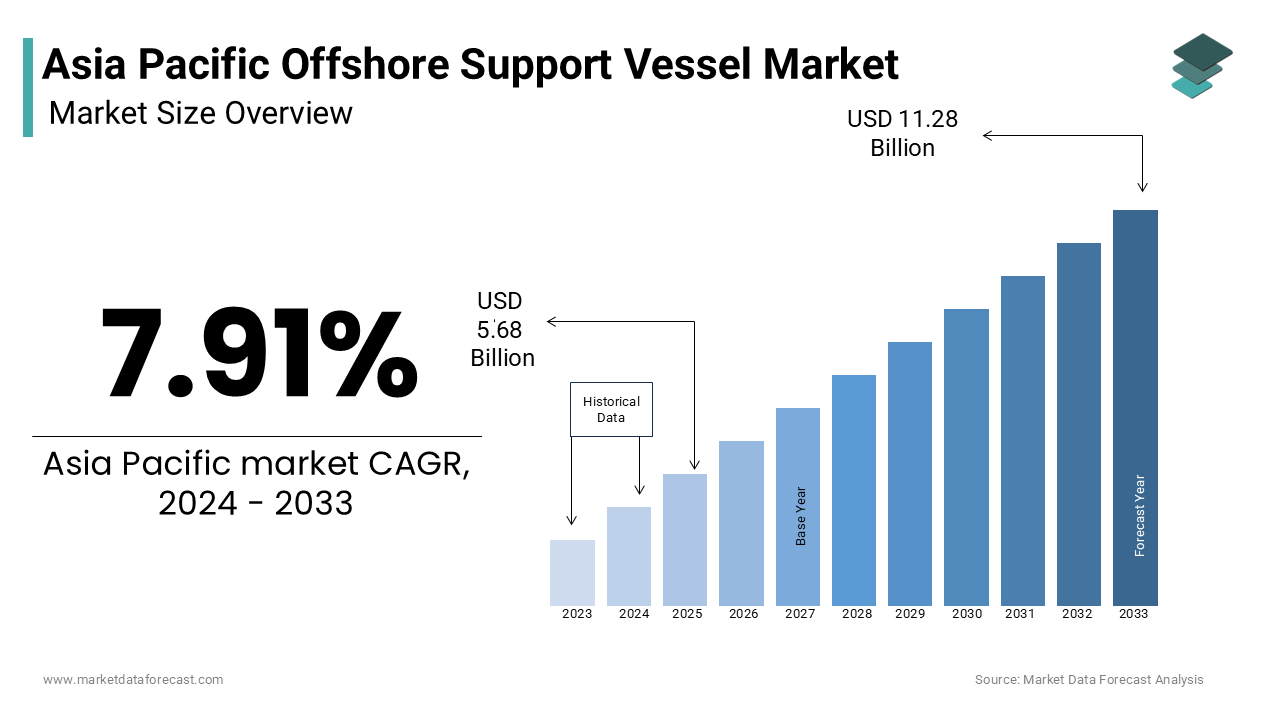
The offshore support vessel (OSV) is designed to assist offshore oil and gas operations, including transportation of personnel and cargo, anchor handling, towing, and supply support. These vessels play a crucial role in exploration, drilling, production, and maintenance activities across offshore fields. According to the International Energy Agency, offshore oil and gas production in the Asia Pacific region has increased significantly, particularly in countries like Australia, Malaysia, and Vietnam. As per the Australian Institute of Petroleum, offshore oil and gas platforms in the North West Shelf and Browse Basin require consistent vessel support, driving the need for a robust OSV fleet.
MARKET DRIVERS
Expansion of Offshore Oil and Gas Exploration Activities
The expansion of offshore oil and gas exploration and production activities is propelling the growth of the Asia Pacific offshore support vessel market. Countries such as Australia, Malaysia, Vietnam, and Indonesia are actively investing in offshore energy projects to meet growing energy demand and reduce dependence on imports. According to the U.S. Energy Information Administration, offshore crude oil production in the Asia Pacific region has increased by nearly 15% over the past five years, necessitating a larger fleet of offshore support vessels. As per the Australian Petroleum Production & Exploration Association, over 80% of Australia’s natural gas production now comes from offshore fields, requiring continuous vessel support. Similarly, in Malaysia, Petronas has launched several deepwater exploration projects that rely heavily on offshore support vessels for logistics and operational efficiency.
Growth of Offshore Wind Energy Projects
The rapid growth of offshore wind energy projects, which require specialized vessels for installation, maintenance, and logistics support will additionally to drive the growth of the Asia Pacific offshore support vessel market. Countries such as China, Japan, and South Korea are leading the shift toward offshore wind as part of their broader renewable energy strategies. According to the Global Wind Energy Council, Asia Pacific accounted for over 40% of global offshore wind installations in 2023, with China alone contributing more than 30%.
MARKET RESTRAINTS
Volatility in Oil and Gas Prices
The volatility in global oil and gas prices, which directly affects offshore exploration and production investments is limiting the growth of the Asia Pacific offshore support vessel market. According to the International Energy Agency, oil prices experienced a 30% decline in 2020 due to the global pandemic, which is leading to a sharp drop in offshore drilling activities across the Asia Pacific region. As per the Singapore Shipping Association, vessel utilization rates for offshore supply vessels fell below 50% in 2020, which is affecting the profitability of OSV operators. In Australia, the downturn in oil prices led to a slowdown in LNG expansion projects, reducing demand for anchor handling and logistics support.
Regulatory and Environmental Compliance Pressures
The regulatory and environmental compliance pressures are inhibiting the growth of the Asia Pacific offshore support vessel market. Governments and international bodies are imposing stricter emissions standards, safety regulations, and operational restrictions to mitigate the environmental impact of offshore activities. According to the International Maritime Organization, new sulfur oxide (SOx) and nitrogen oxide (NOx) emission limits have required vessel operators to invest in cleaner fuels, retrofit existing fleets, or adopt alternative propulsion technologies. In China, the Ministry of Transport has introduced stricter environmental regulations for offshore operations, mandating the use of low-sulfur fuel and imposing limits on ballast water discharge. As per the China Classification Society, compliance with these regulations has increased operational costs for OSV operators by up to 15%.
MARKET OPPORTUNITIES
Development of LNG-Powered Offshore Support Vessels
The growing development and adoption of liquefied natural gas (LNG)-powered vessels is setting up new opportunities in the next coming years. According to the Society for Gas Technology, LNG is increasingly being recognized as a viable fuel option due to its lower emissions of sulfur oxides, nitrogen oxides, and particulate matter. As per the China Classification Society, over 100 LNG-fueled offshore vessels were in operation or under construction in 2024. Additionally, in South Korea, shipbuilders such as Hyundai Heavy Industries are expanding their LNG vessel production capabilities to serve growing regional demand.
Expansion of Marine Logistics for Offshore Renewables
The expansion of marine logistics for offshore renewable energy projects such as wind and tidal energy is amplifying the growth of the Asia Pacific offshore support vessel market. In China, the State Grid Corporation has launched several offshore wind logistics hubs to support turbine installation and maintenance, requiring a fleet of service operation vessels (SOVs) and crew transfer vessels (CTVs). As per the China Wind Energy Association, the number of offshore wind support vessels in China has doubled since 2021. Additionally, in South Korea, the government has introduced tax incentives for companies investing in offshore wind support vessels, encouraging private sector participation.
MARKET CHALLENGES
Skilled Crew Shortage and Labor Constraints
The shortage of skilled maritime crew and labor constraints in the offshore sector are hampering the growth of the Asia Pacific offshore support vessel market. The operation of offshore support vessels requires highly trained personnel, including captains, engineers, and deckhands, who must be certified for offshore operations. According to the International Transport Workers’ Federation, the maritime industry in the Asia Pacific is experiencing a growing skills gap, with insufficient training programs and declining interest among younger generations in seafaring careers. As per the Singapore Shipping Association, recruitment and retention of skilled personnel have become increasingly difficult due to the demanding nature of offshore work and competition from other maritime sectors. Additionally, in Southeast Asia, countries like Indonesia and the Philippines face challenges in maintaining a steady supply of trained seafarers due to fluctuating training standards and employment conditions.
Rising Fuel and Operational Costs
The rising fuel and operational costs present a significant challenge for the offshore support vessel operators in the Asia Pacific region. The maritime industry is highly sensitive to fluctuations in fuel prices, and the transition to cleaner fuels such as LNG and low-sulfur diesel has further increased operational expenses. According to the International Energy Agency, marine fuel prices in the Asia Pacific have increased by approximately 25% over the past two years, driven by global supply chain disruptions and environmental regulations. Additionally, in Southeast Asia, rising insurance premiums and maintenance costs have further strained vessel operators, particularly for older fleets that require frequent servicing. These financial pressures are making it increasingly difficult for operators to maintain competitive pricing while ensuring compliance with evolving environmental and safety standards.
REPORT COVERAGE
| REPORT METRIC | DETAILS |
| Market Size Available | 2025 to 2034 |
| Base Year | 2025 |
| Forecast Period | 2026 to 2034 |
| CAGR | 7.91% |
| Segments Covered | By Vessels Type and Region |
| Various Analyses Covered | Regional & Country Level Analysis, Segment-Level Analysis, DROC, PESTLE Analysis, Porter’s Five Forces Analysis, Competitive Landscape, Analyst Overview on Investment Opportunities |
| Countries Covered | India, China, Japan, South Korea, Australia, New Zealand, Thailand, Malaysia, Vietnam, Philippines, Indonesia, Singapore, and the Rest of APAC |
| Market Leaders Profiled | DOF Group ASA, Tidewater Inc., Bourbon Offshore, Maersk Supply Service, Seacor Marine, Swire Pacific Offshore, Solstad Offshore ASA, Vroon Offshore Services, Havila Shipping ASA, and Edison Chouest Offshore. |
SEGMENTAL ANALYSIS
By Vessel Type Insights
The Platform Supply Vessels (PSVs) segment was the largest and held 45.3% of the Asia Pacific offshore support vessel market share in 2024 due to the extensive use of PSVs in transporting essential cargo, equipment, and supplies to offshore oil and gas platforms across the region. These vessels are crucial for maintaining continuous operations at offshore rigs, particularly in deepwater and ultra-deepwater fields. According to the Society of Naval Architects and Marine Engineers, PSVs account for over 60% of all offshore vessel movements in the Asia Pacific due to their versatility and high cargo capacity. The reliability, cargo-carrying capacity, and adaptability of PSVs in various sea conditions make them the most widely used offshore support vessel type in the Asia Pacific region.
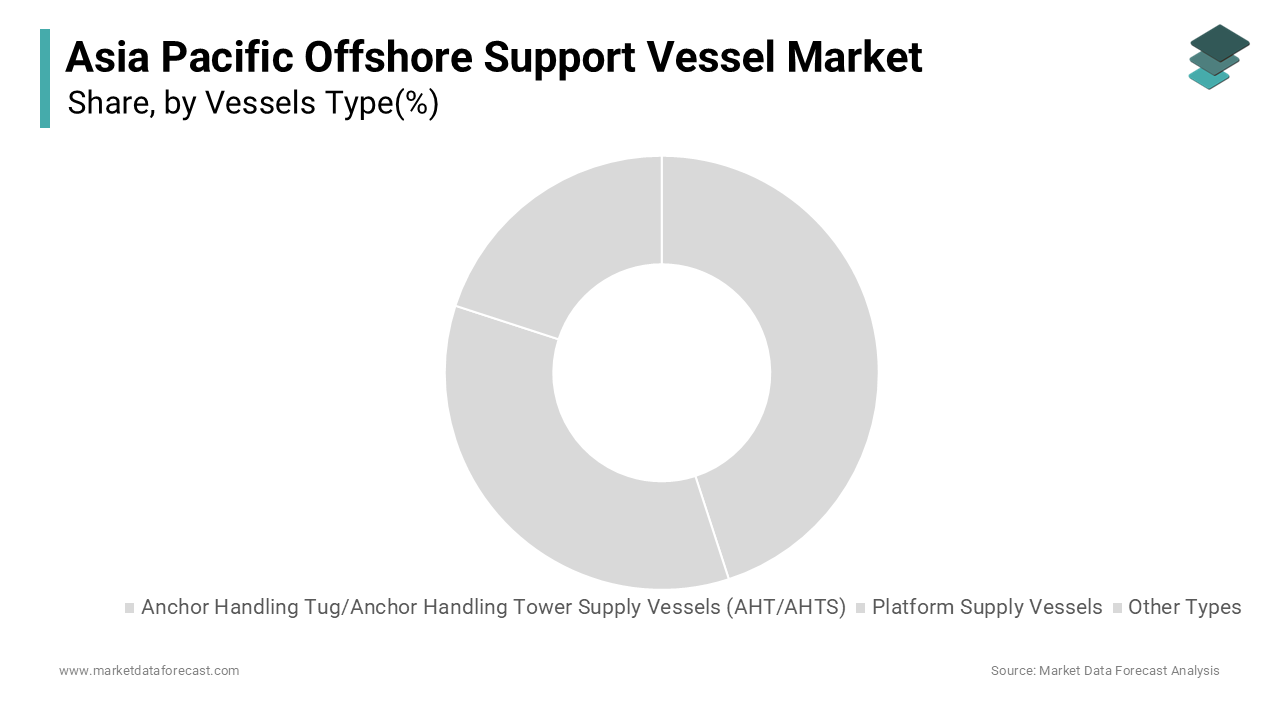
The Anchor Handling Tug / Anchor Handling Towing Supply (AHT/AHTS) vessels segment is projected to register a CAGR of 8.4% from 2025 to 2033. This growth is driven by the increasing demand for towing, mooring, and positioning services in offshore exploration and production activities. AHT/AHTS vessels play a critical role in supporting offshore drilling rigs, floating production systems, and subsea installations, particularly in deepwater environments. According to the International Association of Drilling Contractors, the number of floating drilling rigs operating in the Asia Pacific region has increased by 18% since 2020, directly boosting the demand for anchor handling support.
REGIONAL ANALYSIS
China Offshore Support Vessel Market Insights
China was the largest contributor to the Asia Pacific offshore support vessel market by contributing 32.3% of the share in 2024. China’s offshore energy sector is a major driver of demand for support vessels. The China National Offshore Oil Corporation (CNOOC) has significantly expanded its offshore exploration and production activities, particularly in the South China Sea, requiring a large fleet of platform supply and anchor handling vessels. Additionally, the country is rapidly expanding its offshore wind energy capacity, with the State Grid Corporation investing in specialized wind turbine installation vessels and service operation vessels. The government’s push for energy self-sufficiency and marine infrastructure development has further strengthened China’s position as the dominant market for offshore support vessels in the Asia Pacific region.
Australia Offshore Support Vessel Market Insights
Australia was positioned second by occupying 18.3% of the Asia Pacific offshore support vessel market share in 2024 with extensive offshore liquefied natural gas (LNG) projects and strong maritime infrastructure. The country’s North West Shelf, Browse Basin, and Carnarvon Basin host some of the largest offshore gas fields in the world, requiring continuous vessel support for logistics, drilling, and maintenance. According to the Australian Institute of Petroleum, over 90% of Australia’s natural gas production comes from offshore fields, necessitating a large fleet of platform supply and anchor handling vessels. The development of LNG export terminals such as Gorgon, Wheatstone, and Ichthys has significantly boosted demand for offshore support services. As per the Australian Maritime Safety Authority, the number of offshore vessel contracts in the region increased by 16% in 2023.
Malaysia Offshore Support Vessel Market Insights
Malaysia offshore support vessel market growth is driven by its well-established offshore oil and gas industry. Petronas, the national oil company, has been actively developing deepwater fields in the South China Sea and the Sabah and Sarawak basins, requiring extensive marine logistics and vessel support. According to the Malaysian Petroleum Association, offshore oil and gas production accounts for over 70% of the country’s total hydrocarbon output, reinforcing the need for a robust offshore vessel fleet. The government’s recent expansion of the Kasawari and Rotan gas fields has led to increased demand for platform supply and anchor handling vessels.
Indonesia Offshore Support Vessel Market Insights
Indonesia offshore support vessel market growth is driven by its expanding offshore oil and gas exploration and production activities. The country’s state-owned energy company, Pertamina, has intensified offshore drilling in the Natuna Sea, Java Sea, and eastern Indonesia, necessitating increased support vessel operations. According to the Indonesian Oil and Gas Association, offshore oil production in Indonesia has increased by 10% since 2020, with several new deepwater projects underway. In addition, the government has launched initiatives to modernize the national vessel fleet and improve marine logistics infrastructure. As per the Directorate General of Sea Transportation, the number of registered offshore support vessels in Indonesia has grown by 15% over the past three years.
South Korea Offshore Support Vessel Market Insights
South Korea offshore support vessel market growth is driven by its strong shipbuilding industry and growing offshore wind energy initiatives. The country’s leading shipbuilders, including Hyundai Heavy Industries and Daewoo Shipbuilding & Marine Engineering, are major suppliers of offshore support vessels to both domestic and international markets. According to the Korea Marine Equipment Industry Association, South Korea exported over 80 offshore support vessels in 2023, primarily to Southeast Asian and Middle Eastern markets. Additionally, the Korean government has launched several offshore wind energy projects, including the 1.4-gigawatt West Sea Wind Farm, which requires dedicated marine logistics and installation vessels. As per the Korea Electric Power Corporation (KEPCO), the country’s offshore wind capacity is expected to reach 12 gigawatts by 2030, significantly increasing the demand for specialized offshore support vessels.
COMPETITIVE LANDSCAPE
The Asia Pacific offshore support vessel market is highly competitive, with a mix of state-owned enterprises, regional players, and global operators vying for dominance in a dynamic and capital-intensive industry. The market is shaped by fluctuating oil prices, evolving energy policies, and increasing demand for marine logistics in both traditional hydrocarbon and emerging renewable energy sectors. In countries like China and Malaysia, national oil companies play a dominant role in shaping vessel demand, while in Australia and Singapore, private operators and international firms hold significant market shares. The competitive landscape is further influenced by the need for technological innovation, compliance with environmental regulations, and cost-effective operations. Companies are increasingly differentiating themselves through fleet modernization, digitalization of marine logistics, and expansion into offshore wind and subsea infrastructure projects.
KEY MARKET PLAYERS
Key players in the Asia Pacific Offshore Support Vessel Market include
- DOF Group ASA
- Tidewater Inc.
- Bourbon Offshore
- Maersk Supply Service
- Seacor Marine
- Swire Pacific Offshore
- Solstad Offshore ASA
- Vroon Offshore Services
- Havila Shipping ASA
- Edison Chouest Offshore
Top Players in the Asia Pacific Offshore Support Vessel Market
China Oilfield Services Limited (COSL) – China
China Oilfield Services Limited (COSL) is a leading player in the Asia Pacific offshore support vessel market and a major contributor to the global offshore energy logistics sector. The company operates a large fleet of platform supply vessels, anchor handling tug supply (AHTS) vessels, and specialized offshore support ships that serve both domestic and international markets. COSL plays a critical role in supporting China National Offshore Oil Corporation’s (CNOOC) deepwater exploration and production activities. Its technological advancements in vessel design and marine logistics have positioned it as a key player in the global offshore services industry.
Pacific Radiance Ltd – Singapore
Pacific Radiance is a well-established offshore support vessel operator with a strong presence across Asia and beyond. The company provides a wide range of marine support services, including platform supply, anchor handling, and towing operations, primarily serving the oil and gas sector. Pacific Radiance has contributed to the global offshore vessel market by expanding its fleet and adapting to evolving energy demands, including support for offshore wind projects. Its operational flexibility and strategic partnerships have enhanced its reputation and influence in the international offshore logistics landscape.
Nam Cheong Limited (now part of Ezra Holdings) – Malaysia
Nam Cheong, now part of Ezra Holdings, has been a significant player in the offshore vessel market, offering platform supply and anchor handling vessels tailored for deepwater operations. The company has played a key role in supplying marine logistics to major oil and gas projects in the Asia Pacific region. Its global fleet and expertise in offshore vessel operations have made it a competitive force in the international market, contributing to the development of marine logistics for both hydrocarbon and renewable energy sectors.
Top Strategies Used by Key Market Participants
Fleet Modernization and Technological Upgrades
Leading offshore support vessel operators are investing in modernizing their fleets with technologically advanced and fuel-efficient vessels to meet evolving regulatory standards and client demands. Companies are integrating digital navigation systems, dynamic positioning technologies, and hybrid propulsion systems to enhance operational efficiency and reduce environmental impact. These upgrades help firms remain competitive and compliant with international maritime regulations.
Strategic Mergers and Acquisitions
To strengthen their market position and expand their service offerings, key players are engaging in strategic mergers and acquisitions. These moves allow companies to access new markets, enhance fleet capabilities, and improve service diversification. Mergers also enable better risk management and resource optimization in a volatile industry environment.
Expansion into Offshore Renewable Energy Logistics
Recognizing the shift toward cleaner energy, leading offshore vessel operators are expanding into offshore wind and tidal energy logistics. Companies are adapting their fleets and crew training to support wind farm installation and maintenance, which is aligning with regional energy transition goals and securing long-term contracts in the growing renewable energy sector.
RECENT MARKET DEVELOPMENTS
- In January 2024, China Oilfield Services Limited (COSL) launched a new series of LNG-powered offshore support vessels designed for deepwater operations, which are aiming to reduce emissions and align with international environmental standards while supporting China’s offshore energy expansion.
- In March 2024, Pacific Radiance announced a strategic partnership with a European offshore wind logistics firm to provide vessel support services for upcoming offshore wind farms in Southeast Asia, marking its expansion into the renewable energy segment.
- In June 2024, Ezra Holdings, through its subsidiary, deployed a newly built anchor handling tug supply (AHTS) vessel to support deepwater drilling operations in the South China Sea, enhancing its operational capabilities in high-demand offshore zones.
- In September 2024, a major South Korean shipbuilder entered into a joint venture with an Indonesian energy logistics firm to construct and operate a fleet of platform supply vessels tailored for the Indonesian offshore oil and gas sector, which is strengthening regional supply chain integration.
- In November 2024, a Japanese marine logistics company signed a long-term charter agreement with an Australian energy firm to provide offshore support services for its LNG projects in the North West Shelf, which is reinforcing its presence in the Australian offshore market.
MARKET SEGMENTATION
This research report on the Asia Pacific offshore support vessel market is segmented and sub-segmented into the following categories.
By Vessels Type
- Anchor Handling Tug/Anchor Handling Tower Supply Vessels (AHT/AHTS)
- Platform Supply Vessels
- Other Types
By Country
- India
- China
- Japan
- South Korea
- Australia
- New Zealand
- Thailand
- Malaysia
- Vietnam
- Philippines
- Indonesia
- Singapore
- Rest of APAC