- Product Description Description
- Table of Contents TOC
- List of Table & Figure LOT
- Get Free Sample PDF Sample PDF
Market Size, 2025
$102.28 MnMarket Estimate, 2026
$133.13 MnMarket Forecast, 2034
$1,096.70 MnCAGR, 2026–2034
30.16%APAC Thyroid Cancer Market Size, Share, & Growth Analysis (2026–2034)
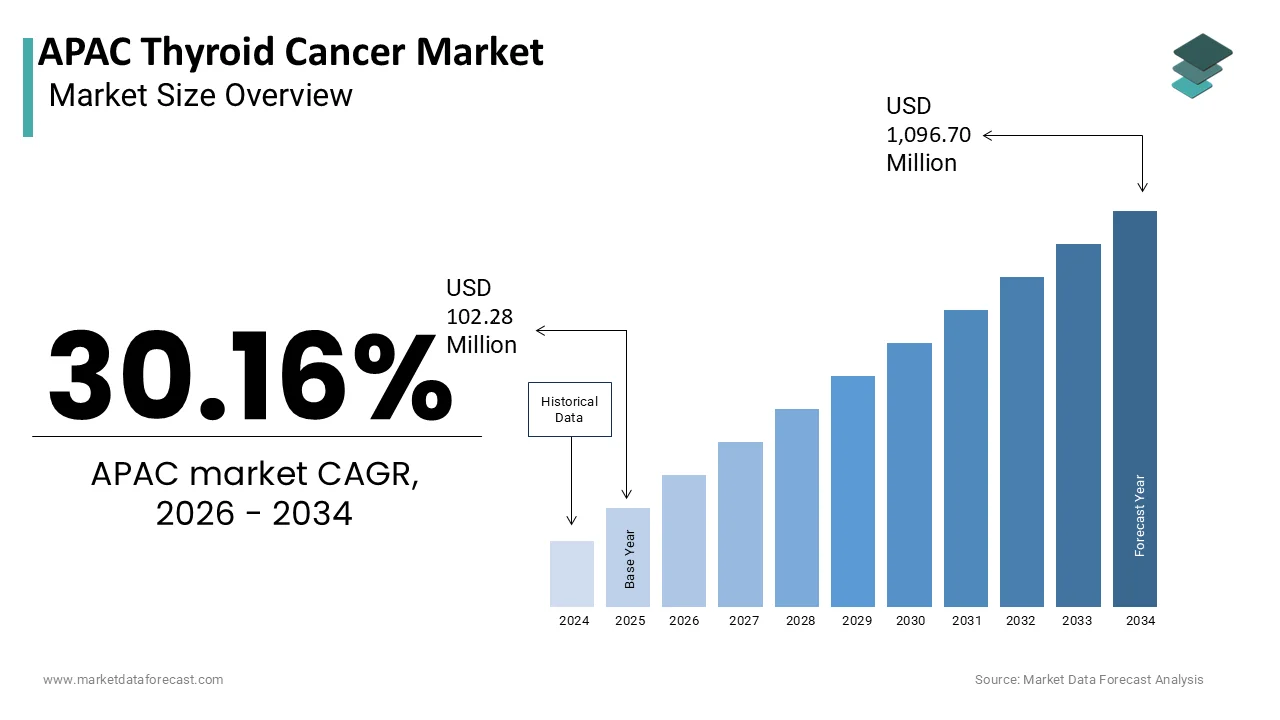
The APAC thyroid cancer market was valued at USD 102.28 million in 2025, estimated at USD 133.13 million in 2026, and is projected to reach USD 1,096.70 million by 2034, registering a remarkable CAGR of 30.16% from 2026 to 2034. This comprehensive report covers treatment types, drug categories, end users, and country-level frameworks across the Asia-Pacific region.
- Market Valuation: USD 133.13B (2026) to USD 1,096.70B by 2034 (30.16% CAGR).
- Primary Growth Drivers: High-resolution diagnostic imaging adoption, expansion of precision medicine and molecular diagnostics, and rising health screening programs.
- Key Market Restraints: Healthcare infrastructure access disparities and high out-of-pocket financial toxicity for advanced therapies.
APAC Thyroid Cancer Market Segment Metrics (2026–2034)
| Category | Leading Segment Focus | Segment Overview & Key Details | Alternative / Growth Focus |
|---|---|---|---|
| By Treatment | Surgery | Dominates market share as the primary curative approach, with over 92% of differentiated thyroid carcinoma patients undergoing total or hemithyroidectomy. | Targeted drug therapies projected to grow at a strong CAGR of 14.2% due to expanding TKIs indications. |
| By End User | Hospitals | Captures the majority share (88% of diagnoses and initial treatments) due to integrated multidisciplinary care infrastructure. | Retail pharmacies growing at a CAGR of 11.8% driven by chronic thyroxine replacement therapy dispensing. |
| By Country | China & India | China leads with a 32.3% share in 2025 backed by massive diagnostic scaling and domestic target therapy rollouts; India follows with 18.2% share. | Japan pioneers active surveillance protocols; South Korea focuses on value optimization and post-screening course corrections. |
Major Market Players & Market Structure
Market Structure: Stratified ecosystem featuring multinational pharmaceutical corporations dominating targeted therapies and regional generic manufacturers managing thyroxine and supportive care lines.
Key Companies: Eisai Co. Ltd., Exelixis Inc., Bayer AG, Baxter International Inc., Mylan Pharmaceuticals Inc., Alara Pharmaceutical Corporation, Bristol Myers Squibb Company, Abbott Laboratories, Teva Parenteral Medicines, Inc., APP Pharmaceuticals, LLC, and Jerome Stevens Pharmaceuticals, Inc.
APAC Thyroid Cancer Market Size
The APAC Thyroid Cancer Market is projected to grow from USD 102.28 million in 2025 to USD 133.13 million in 2026 and reach USD 1,096.70 million by 2034, registering a CAGR of 30.16% from 2026 to 2034.
The thyroid cancer clinical and commercial ecosystem is dedicated to the diagnosis, treatment, and long-term management of thyroid malignancies. According to the survey, approximately 285000 new thyroid cancer cases were diagnosed in Asia in 2022, representing nearly 45% of the global incidence burden. The World Health Organization Western Pacific Regional Office states that age-standardized incidence rates have tripled in countries like South Korea and China over the past two decades, largely attributed to widespread adoption of high-resolution ultrasonography in routine health screenings. Furthermore, papillary thyroid carcinoma accounts for over 90% of all diagnoses in the region, yet significant disparities persist in access to molecular testing between urban tertiary centers and rural facilities. This market is uniquely shaped by a confluence of advanced technological adoption in developed economies and emerging infrastructure expansion in developing nations, creating a heterogeneous landscape where clinical guidelines and therapeutic accessibility vary dramatically across national boundaries within the Asia Pacific geography.
MARKET DRIVERS
Proliferation of High-Resolution Diagnostic Imaging Technologies
The widespread integration of advanced ultrasonography into national health screening programs is a major factor propelling the growth of the Asia Pacific thyroid cancer market. According to the study, the implementation of nationwide ultrasound screening protocols contributed to a 15-fold increase in thyroid cancer incidence between 1999 and 2019, with over 95% of detected cases being early-stage papillary carcinomas amenable to curative treatment. China’s National Health Commission documented that tier-three hospitals performing over 5000 thyroid ultrasounds monthly grew by 28% annually since 2020, reflecting systematic capacity expansion driven by government mandates for cancer early detection. This technological diffusion transforms thyroid cancer from a rare clinical entity into a commonly managed condition, generating sustained demand for downstream surgical procedures, pathological analysis, and surveillance protocols. The driver operates independently of true disease prevalence increases, instead representing enhanced diagnostic sensitivity that converts latent asymptomatic disease into clinically actionable diagnoses requiring intervention and lifelong monitoring within healthcare systems across the region.
Rising Adoption of Precision Medicine and Molecular Diagnostics
The integration of genomic profiling into clinical decision-making fundamentally reshapes therapeutic selection and risk stratification for patients and is additionally elevating the growth of the Asia Pacific thyroid cancer market. The Chinese Clinical Oncology Society guidelines now mandate molecular testing for all radioiodine-refractory differentiated thyroid cancers before initiating tyrosine kinase inhibitor therapy, directly linking diagnostic expenditure to treatment eligibility. Australia’s Medical Benefits Schedule added reimbursement for next-generation sequencing panels in thyroid cancer in 2022, resulting in uptake among eligible patients within the first year. India’s Department of Biotechnology funded the establishment of 12 regional molecular pathology hubs specifically serving endocrine malignancies, reducing turnaround times from 6 weeks to 10 days for patients in underserved areas. This precision medicine paradigm shift creates demand not only for testing kits and bioinformatics services but also for targeted therapeutics matched to specific mutations.
MARKET RESTRAINTS
Significant Disparities in Healthcare Infrastructure Access
Unequal distribution of specialized endocrine surgery and nuclear medicine capabilities and realization is restricting the growth of the Asia Pacific thyroid cancer market. According to the study, physician density ranges from 24 per 10000 population in Japan to fewer than 7 per 10000 in Cambodia and Laos, creating fundamental bottlenecks in timely diagnosis and treatment initiation. According to the International Atomic Energy Agency, only 8 countries in Southeast Asia possess adequate radioactive iodine therapy facilities, forcing patients from neighboring nations to travel internationally or forego adjuvant treatment entirely. Rural India faces similar challenges, where the National Cancer Registry Programme indicates median time from symptom onset to definitive treatment exceeds 8 months in Bihar versus 3 weeks in Delhi. These infrastructural gaps mean that epidemiological need translates incompletely into market demand, as millions of potential patients remain undiagnosed or untreated despite available technologies existing elsewhere in the region.
Financial Toxicity and Limited Insurance Coverage for Advanced Therapies
Out-of-pocket expenditure burdens and fragmented reimbursement frameworks restrict patient access to newer targeted agents and comprehensive molecular diagnostics, which is also hindering the growth of the Asia Pacific thyroid cancer market. According to the study, direct medical costs for advanced thyroid cancer treatment exceed 300% of average annual household income in the Philippines and Vietnam, causing catastrophic health expenditure for 45% of affected families. Thailand’s Universal Coverage Scheme covers basic surgery and radioactive iodine but excludes second-line tyrosine kinase inhibitors costing 2500 to 4000 US dollars monthly, leaving patients to self-pay or discontinue therapy. As per Malaysia’s Ministry of Health, eligible patients receive lenvatinib or sorafenib despite clinical indication, primarily due to cost barriers even with partial subsidies. China’s National Reimbursement Drug List negotiations reduced prices for some targeted therapies in 2023, yet provincial implementation varies, creating geographic inequities within a single national system.
MARKET OPPORTUNITIES
Expansion of Active Surveillance Protocols for Low Risk Disease
The adoption of conservative management strategies for microcarcinomas creates sustainable long-term monitoring while reducing unnecessary surgical interventions, fostering new opportunities for the expansion of the Asia Pacific thyroid cancer market. According to the study, active surveillance enrollment for papillary thyroid microcarcinoma reached 12000 patients by 2023, with only 8% requiring conversion to surgery duringa median follow-up of 6 years. Kuma Hospital in Kobe published landmark data demonstrating that 97% of observed tumors remained stable or regressed over 20 years, providing an evidence base for protocol standardization across the region. South Korea’s National Evidence-Based Healthcare Collaborating Agency issued formal guidelines endorsing active surveillance in 2022, triggering insurance reimbursement for quarterly ultrasound monitoring previously denied as investigational. Australia’s Royal Australasian College of Surgeons incorporated surveillance pathways into clinical practice guidelines in 2023, estimating a potential reduction of 3000 unnecessary thyroidectomies annually. This paradigm shift transforms one-time surgical events into recurring diagnostic encounters spanning decades, creating predictable revenue streams for imaging centers and specialist consultations. As overtreatment concerns gain traction among clinicians and patients alike, active surveillance represents both ethical advancement and commercial opportunity aligned with value-based healthcare principles emphasizing appropriate care intensity matched to disease biology rather than reflexive intervention.
Development of Region-Specific Clinical Guidelines and Registries
Harmonization efforts and indigenous research initiatives create opportunities for locally validated diagnostic algorithms and therapeutic protocols tailored to Asian population characteristics. This factor is another factor to fuel the growth of the Asia Pacific thyroid cancer market. According to the study, collaborative registry data from 14 countries encompassing 85000 patients revealed distinct mutational spectra compared to Western cohorts, with RAS mutations occurring at 35% frequency versus 15% in European populations. India’s Indian Council of Medical Research launched the National Thyroid Cancer Registry in 2022 with target enrollment of 50000 patients across 40 centers, generating real-world evidence to inform contextually appropriate treatment standards. These initiatives reduce dependency on imported clinical paradigms while creating demand for regionally optimized diagnostic assays and therapeutic approaches. As evidence accumulates demonstrating unique epidemiological and molecular features of Asian thyroid cancer, commercial stakeholders can develop differentiated products addressing unmet needs specific to this population rather than competing solely on global platforms designed for different demographic contexts.
MARKET CHALLENGES
Overdiagnosis Controversy and Clinical Practice Variation
The persistent debate regarding appropriate detection thresholds creates uncertainty in clinical decision-making and inconsistent signals, which is a huge challenge for the growth of the Asia Pacific thyroid cancer market. China’s National Health Commission issued contradictory guidance in successive years, alternately encouraging and restricting screening ultrasound in asymptomatic populations, causing whiplash effects on diagnostic volumes and equipment procurement cycles. This guideline discordance prevents manufacturers from forecasting demand accurately and complicates regulatory approval strategies requiring consistent clinical endpoints. Until international harmonization achieves meaningful convergence or regional bodies establish authoritative standards accepted across borders, participants face persistent volatility driven by shifting professional opinions rather than stable epidemiological fundamentals or technological advancement trajectories.
Workforce Shortages in Specialized Endocrine Pathology and Surgery
The critical deficits in trained specialists capable of accurate cytological interpretation and complex neck surgery constrain service delivery capacity is another factor inhibiting the growth of the Asia Pacific thyroid cancer market. Some district hospitals lack any staff trained in ultrasound-guided fine needle aspiration, necessitating patient referrals that delay diagnosis by a median of 45 days. Training pipeline expansion requires decade-long investments in fellowship programs and mentorship networks that cannot be accelerated through financial incentives alone. These human capital constraints represent hard ceilings on market growth independent of technology availability or patient willingness to pay, as each additional diagnostic finding requires corresponding specialist capacity to translate into therapeutic action without compromising quality or safety standards.
REPORT COVERAGE
| REPORT METRIC | DETAILS |
| Market Size Available | 2025 to 2034 |
| Base Year | 2025 |
| Forecast Period | 2026 to 2034 |
| Segments Covered | By Treatment, Drug, End User, and Region. |
| Various Analyses Covered | Global, Regional, and Country-Level Analysis, Segment-Level Analysis, Drivers, Restraints, Opportunities, Challenges; PESTLE Analysis; Porter’s Five Forces Analysis, Competitive Landscape, Analyst Overview of Investment Opportunities |
| Countries Covered | India, China, Japan, South Korea, Australia, New Zealand, Thailand, Malaysia, Vietnam, Philippines, Indonesia, Singapore, Rest of APAC |
| Market Leaders Profiled |
|
SEGMENTAL ANALYSIS
By Treatment Insights
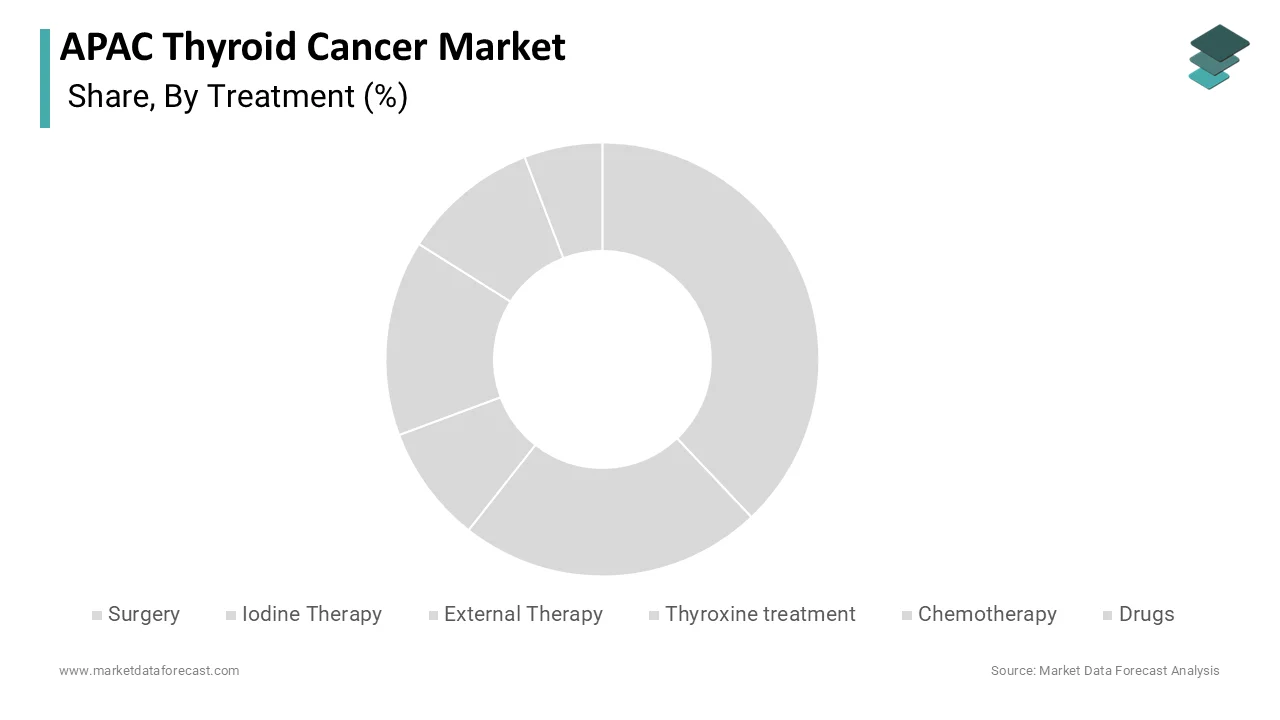
The surgery segment was the largest, accounting for a dominant share of the Asia Pacific thyroid cancer market in 2025 due to its role as the primary curative approach for differentiated thyroid carcinoma. According to the study, over 92% of newly diagnosed papillary and follicular thyroid cancer patients in the region undergo total or hemithyroidectomy as first-line management. The surgical volume increased by 18% between 2019 and 2023, driven by early detection through widespread ultrasound screening programs identifying resectable disease at localized stages, as per the study. China’s National Cancer Center documented that 85% of thyroid cancer surgeries are now performed using minimally invasive techniques, including endoscopic and robotic approaches, reflecting technological advancement within the surgical segment rather than displacement by non-surgical alternatives. This dominance persists because surgery provides definitive histopathological staging essential for guiding subsequent adjuvant therapy decisions, making it an indispensable gateway procedure regardless of downstream treatment pathway selection. No pharmacological intervention currently offers equivalent cure rates for localized disease,y ensuring surgical primacy across all APAC healthcare systems irrespective of economic development level.
The targeted drug therapies segment is likely to grow at an anticipated CAGR of 14.2% throughout the forecast period with the expanding indications for tyrosine kinase inhibitors in radioiodine refractory differentiated thyroid cancer and medullary thyroid carcinoma populations, previously lacking effective systemic options. China’s National Medical Products Administration approved lenvatinib and sorafenib for domestic use in 2021 and 2022, respectively, triggering immediate uptake among eligible patients who previously relied on compassionate access programs or international procurement. Unlike surgery, which faces saturation in early-stage disease, the drug segment benefits from accumulating evidence supporting earlier intervention in high-risk populations and combination strategies that extend progression-free survival. As genomic profiling becomes standard of care and new agents targeting RET, NTRK, K and BRAF mutations gain regulatory approval the addressable patient population expands beyond traditional refractory cohorts into broader molecularly defined subgroups.
By End User Insights
The hospitals segment accounted for a significant share of the Asia Pacific thyroid cancer market due to their exclusive capability to deliver integrated multidisciplinary care encompassing surgery, nuclear medicine, pathology, and long-term surveillance under a single institutional umbrella. According to the studies, 88% of thyroid cancer diagnoses and initial treatments occur in hospital settings across the region, reflecting the concentration of specialized equipment and trained personnel unavailable in ambulatory facilities. Japan’s Cancer Care Map designates 47 prefectural base hospitals as designated thyroid cancer centers, concentrating expertise and ensuring standardized treatment protocols nationwide. This institutional centrality persists because thyroid cancer management requires sequential coordination between surgical teams, nuclear medicine physicians administering radioiodine, endocrinologists managing thyroxine suppression, and pathologists providing risk stratification, all functions rarely coexisting outside hospital environments. Even as outpatient care expands for chronic disease management, acute diagnostic and therapeutic phases remain hospital-anchored due to technical complexity and regulatory requirements governing radiation safety and surgical accreditation.
The retail pharmacies segment is likely to grow at an anticipated CAGR of 11.8% during the forecast period, with the shifting burden of chronic thyroxine replacement therapy and supportive care medication dispensing away from hospital pharmacies towardcommunity-basedd outlets offering greater convenience and accessibility for long-term survivors. Australia’s Pharmacy Guild reports that community pharmacy dispensing of levothyroxine prescriptions increased between 2021 and 2023, following government policy encouraging repeat prescription transfers from hospital to retail settings to reduce outpatient clinic congestion. Thailand’s Universal Coverage Scheme authorized retail pharmacy dispensing for stable thyroid cancer follow-up medications in 2022, resulting in a reduction in hospital pharmacy workload and a corresponding increase in community pharmacy revenue streams. Japan’s Ministry of Health, Labour and Welfare promoted separation of prescribing and dispensing functions in 2021, accelerating transfer of maintenance medications from hospital to retail channels. As thyroid cancer survivorship extends decades beyond initial treatment, cumulative prevalence of patients requiring lifelong hormone replacement creates an expanding base for retail pharmacy engagement independent of new diagnosis volumes.
COUNTRY LEVEL ANALYSIS
China Thyroid Cancer Market Analysis
China thyroid cancer market was the top performer, holding a 32.3% share in 2025, driven by massive diagnostic capacity expansion and rapid adoption of precision medicine technologies. According to the study, new thyroid cancer cases reached 466000 in 2022, representinga 40% increase from 2018 levels attributable primarily to enhanced screening penetration rather than a true incidence rise. Domestic pharmaceutical companies including Hengrui Medicine and BeiGene launched locally developed BRAF and RET inhibitors in 2023, reducing reliance on imported agents and lowering treatment costs by 55% through competitive pricing. Tier three hospitals in eastern provinces now offer comprehensive genomic profiling within 7 days for 85% of advanced cases, matching Western turnaround benchmarks.
India Thyroid Cancer Market Analysis
India was positioned second by capturing 18.2% of the Asia Pacific thyroid cancer market share in 2025, with the extreme heterogeneity between world-class private sector capabilities and severe public sector resource constraints. According to the study, age-adjusted incidence rates vary tenfold between urban registries like Delhi at 4.8 per 100000 and rural registries like Barshi at 0.5 per 100000, reflecting differential diagnostic access rather than true epidemiological variation. Government Ayushman Bharat scheme covered 85000 thyroid cancer procedures in 2023, expanding access but straining already overburdened public infrastructure. India’s trajectory depends critically on balancing premium private sector innovation with scalable public sector capacity building, creating dual-track dynamics where advanced therapies coexist with fundamental access gaps affecting the majority population.
Japan Thyroid Cancer Market Analysis
Japan thyroid cancer market growth is expected to have steady growth opportunities throughout the forecast period, with the highest per capita diagnostic intensity and pioneering active surveillance protocols for low-risk disease. Kuma Hospital’s landmark active surveillance program enrolled over 12000 microcarcinoma patients by 2023, with only 8% requiring conversion to surgery duringa median 6-year follow-up, establishing a global evidence base for conservative management. Universal health insurance covers comprehensive molecular panels including next-generation sequencing since 2022, ensuring equitable access regardless of socioeconomic status. Japan manifests an emphasis on appropriateness rather than volume growth, with innovation focused on refining indication boundaries and minimizing treatment morbidity rather than expanding intervention thresholds.
South Korea Thyroid Cancer Market Analysis
South Korea thyroid cancer market growth is likely to grow with the distinctive experience navigating overdiagnosis crisis and subsequent course correction informing regional best practices. According to the study, thyroid cancer incidence declined 35% between 2014 and 2018 following a national campaign against excessive screening, yet stabilized at 45 per 100000 by 2022, as appropriate detection replaced indiscriminate testing. Seoul National University Hospital pioneered liquid biopsy assays detecting circulating tumor DNA in postoperative surveillance, offering a potential alternative to repeated neck ultrasonography for recurrence monitoring. Current focus emphasizes value optimization through refined risk stratification and survivorship care rather than volume expansion.
Australia Thyroid Cancer Market Analysis
Australia thyroid cancer market growth is driven by advanced molecular diagnostics integration and strong research infrastructure supporting clinical trial participation. According to the Australian Institute of Health and Welfare, thyroid cancer five-year survival reaches 97% nationally, reflecting excellent access to comprehensive multidisciplinary care through publicly funded cancer centers. The Medical Benefits Schedule added reimbursement for comprehensive genomic profiling in 2022, with uptake among eligible advanced cancer patients within the first year, enabling matched targeted therapy access. Royal Australasian College of Surgeons updated clinical practice guidelines in 2023, incorporating active surveillance recommendations aligned with international best practice, reducing unnecessary surgery estimates by 3000 cases annually. Geographic isolation creates challenges in accessing certain radiopharmaceuticals and specialized surgical expertise outside major metropolitan centers, prompting telehealth consultation expansion.
COMPETITIVE LANDSCAPE
Competition in the APAC thyroid cancer market exhibits pronounced stratification between multinational pharmaceutical companies dominating targeted therapy segments and regional generic manufacturers controlling thyroxine replacement and supportive care categories. Multinationals compete primarily through clinical differentiation and regulatory exclusivity periods protecting premium-priced innovations from immediate biosimilar erosion. Regional players leverage cost advantages and established distribution networks in public hospital tender systems, where price sensitivity outweighs brand loyalty for commoditized treatments. Domestic Chinese and Indian pharmaceutical companies increasingly challenge multinational dominance through locally developed targeted agents achieving non-inferiority at substantially lower price points, disrupting traditional pricing hierarchies. Competition intensifies as national health insurers implement reference pricing and therapeutic substitution policies, forcing originator brands to justify premiums through demonstrated superior outcomes rather than marketing alone. Diagnostic companies compete alongside therapeutic providers as molecular testing becomesa prerequisite for treatment eligibility, creating interdependent competitive dynamics where diagnostic accuracy directly determines therapeutic market size.
KEY MARKET PLAYERS
Some of the companies that are playing a dominating role in the Asia Pacific Thyroid Cancer Market include:
- Baxter International Inc.
- Mylan Pharmaceuticals Inc.
- Alara Pharmaceutical Corporation
- Bristol Myers Squibb Company
- Abbott Laboratories
- Teva Parenteral Medicines, Inc.
- APP Pharmaceuticals, LLC
- Jerome Stevens Pharmaceuticals, Inc.
TOP LEADING PLAYERS IN THE MARKET
- Eisai Co Ltd significantly influences the APAC thyroid cancer market through its targeted therapy Lenvatinib, which serves as standard of care for radioiodine-refractory differentiated thyroid cancer across the region. The company recently expanded clinical trial enrollment in Southeast Asia to generate population-specific efficacy data supporting regulatory submissions in emerging countries. Eisai partnered with regional diagnostic companies to improve molecular testing access, enabling appropriate patient selection for precision therapies. Their commitment to medical education programs has enhanced physician familiarity with tyrosine kinase inhibitor management protocols throughout Asia Pacific. These initiatives strengthen therapeutic adoption, while addressing infrastructure gaps limiting treatment accessibility in resource-constrained settings across diverse national healthcare systems.
- Exelixis Inc contributes to APAC thyroid cancer treatment through cabozantinib approval for progressive medullary and differentiated thyroid cancer following accelerated regulatory pathways in Japan, Australia, and South Korea. The company established regional distribution partnerships ensuring consistent drug supply across geographically dispersed areas, including Pacific Island nations previously lacking access. Exelixis fundedinvestigator-initiatedd studies at leading Asian academic centers, generatingreal-worldd evidence on dosing optimization for Asian populations, who experience distinct toxicity profiles compared to Western cohorts. Their patient support programs reduce financial barriers through copayment assistance and navigation services. These actions expand addressable patient populations, while building long-term clinical relationships with key opinion leaders shaping regional treatment guidelines and formulary inclusion decisions.
- Bayer AG maintains a substantial presence in the APAC thyroid cancer market through sorafenib, which remains a widely prescribed first-line option despite newer agents entering regional formularies. The company recently negotiated price reductions with national health insurers in Thailand, Malaysia, and the Philippines, improving affordability and expanding reimbursement eligibility criteria. Bayer collaborated with Asian pathology societies to standardize BRAF testing methodologies by ensuring reliable biomarker assessment guiding treatment sequencing decisions. Their digital health initiatives include mobile applications supporting adverse event monitoring and medication adherence for patients managing chronic targeted therapy regimens.
TOP STRATEGIES USED BY KEY MARKET PARTICIPANTS
Key players prioritize regulatory harmonization strategies leveraging ASEAN and ICH frameworks to accelerate multi-country approvals, reducing time to market for novel thyroid cancer therapeutics across fragmented Asia Pacific jurisdictions. Companies increasingly establish local manufacturing or packaging facilities to mitigate supply chain vulnerabilities exposed during pandemic disruptions, while qualifying for domestic preference policies in government procurement tenders. Strategic partnerships with regional diagnostic firms enable bundled offerings combining molecular testing with matched therapeutics ,creating integrated value propositions that address both identification and treatment barriers simultaneously. Clinical trial designs now routinely include Asian subgroup analyses and local comparator arms, generating regionally relevant evidence satisfying increasingly sophisticated health technology assessment requirements.
MARKET SEGMENTATION
This research report on the Asia Pacific thyroid cancer market has been segmented and sub-segmented into the following categories.
By Treatment
- Surgery
- Iodine Therapy
- External Therapy
- Thyroxine treatment
- Chemotherapy
- Drugs
By Drug
- Levothyroxine
- Radioiodine
By End User
- Hospitals
- Oncology Centres
- Hospital Pharmacies
- Retail Pharmacies
By Country
- India
- China
- Japan
- South Korea
- Australia
- New Zealand
- Thailand
- Malaysia
- Vietnam
- Philippines
- Indonesia
- Singapore
- Rest of APAC