Asia Pacific Ultrasonic Sensor Market Size, Share, Trends & Growth Forecast Report By Technology (Retro-Reflective Sensor, Through-Beam Sensor, Others), Type, Application And Country (India, China, Japan, South Korea, Australia, New Zealand, Thailand, Malaysia, Vietnam, Philippines, Indonesia, Singapore, Rest Of Asia-Pacific), Industry Analysis From 2025 To 2033
Asia Pacific Ultrasonic Sensor Market Size
The Asia Pacific Ultrasonic Sensor Market size was calculated to be USD 1.11 billion in 2024 and is anticipated to be worth USD 2.30 billion by 2033, from USD 1.20 billion in 2025, growing at a CAGR of 8.43% during the forecast period.
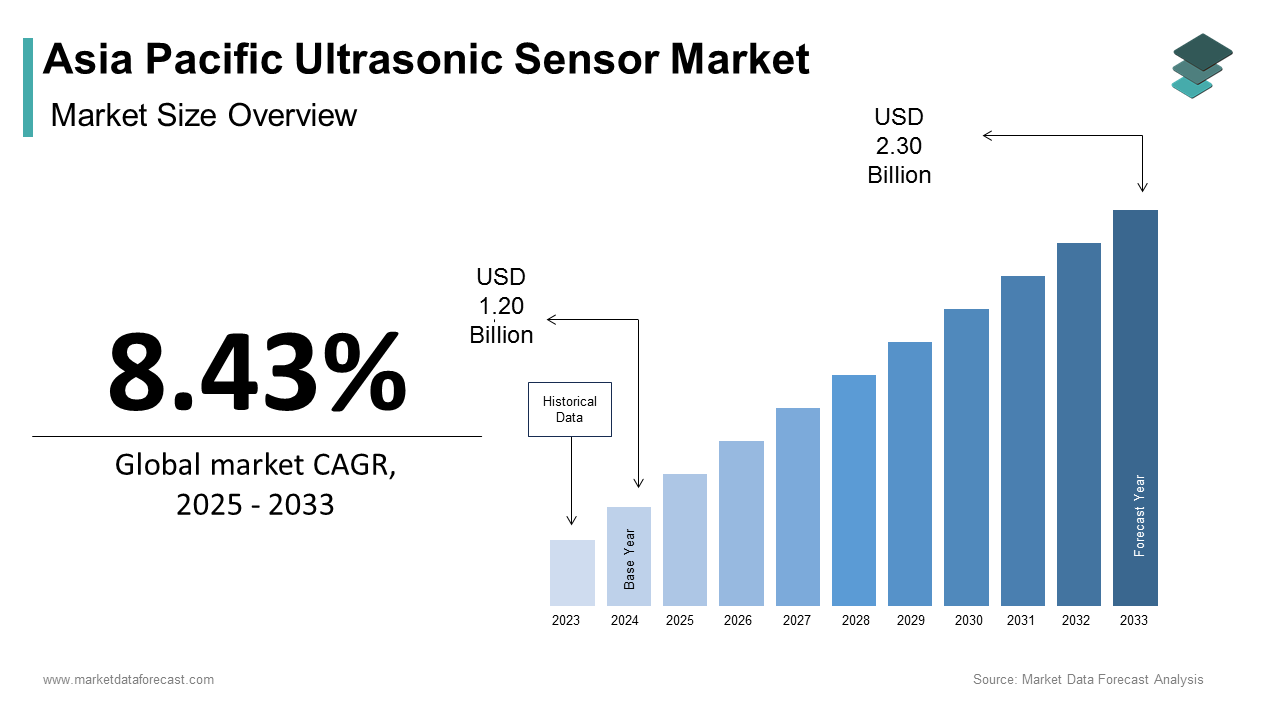
The ultrasonic sensor utilizes high-frequency sound waves to detect and measure physical parameters such as distance, presence, and flow. These sensors are widely used across industries like automotive, healthcare, industrial automation, and consumer electronics due to their non-contact measurement capabilities and reliability in harsh environments. The market has been witnessing robust growth, driven by rapid industrialization and technological advancements across key economies such as China, Japan, South Korea, and India. As per the Asian Development Bank, the region accounted for more than 60% of global economic growth in 2023, reinforcing the expansion of manufacturing and automation sectors that rely heavily on precision sensing technologies.
MARKET DRIVERS
Growth in Industrial Automation and Smart Manufacturing Initiatives
The rapid expansion of industrial automation and the adoption of smart manufacturing practices are escalating the growth of the Asia Pacific ultrasonic sensor market. Countries such as China, Japan, and South Korea are leading the transition toward Industry 4.0, integrating advanced technologies like IoT, AI, and robotics into production processes. According to the United Nations Industrial Development Organization (UNIDO), manufacturing value added (MVA) in the Asia Pacific increased by 5.6% in 2023, reflecting the region’s deepening industrial base. Ultrasonic sensors play a crucial role in these environments by enabling non-contact object detection, fluid level monitoring, and real-time process control. Furthermore, the Chinese Ministry of Industry and Information Technology indicated that over 15,000 smart factories were under development or operation across China by the end of 2023, significantly boosting demand for precision sensing devices. This trend is expected to continue as governments across the region push for digital transformation in manufacturing to enhance productivity and reduce operational costs.
Rising Demand in Automotive Applications
The automotive sector is another factor promoting the growth of the Asia Pacific ultrasonic sensor market. As per the International Organization of Motor Vehicle Manufacturers, Asia Pacific accounted for nearly 55% of global vehicle production in 2023, with China, India, and Thailand witnessing notable growth in automotive manufacturing. Ultrasonic sensors are extensively used in parking assistance systems, blind spot detection, and automated braking systems. For example, the China Association of Automobile Manufacturers noted that over 60% of new passenger vehicles sold in China in 2023 were equipped with at least Level 1 ADAS features, which often include ultrasonic sensors. This growing integration of ultrasonic sensors into automotive safety and navigation systems is anticipated to sustain strong demand across the region.
MARKET RESTRAINTS
High Cost of Advanced Ultrasonic Sensor Systems
The high costs associated with advanced sensor systems are restricting the growth of the Asia Pacific ultrasonic sensor market. While basic ultrasonic sensors remain relatively affordable, high-precision and multi-functional variants, particularly those integrated with AI or IoT capabilities, come with elevated price tags. According to the World Bank, while economies like China and Japan have strong industrial bases, many Southeast Asian countries still struggle with limited capital availability for high-end automation equipment. For instance, Indonesia’s manufacturing sector investment grew by only 3.2% in 2023, as reported by the Central Bureau of Statistics, indicating a cautious approach toward adopting expensive sensor technologies. This cost barrier limits the adoption rate of ultrasonic sensors in price-sensitive markets, particularly among smaller manufacturers. Moreover, the complexity involved in integrating these sensors into existing systems further increases implementation costs, discouraging widespread adoption across certain sectors and regions.
Technical Limitations and Environmental Sensitivity
The technical limitations and environmental sensitivity of these devices also hinder the growth of the Asia Pacific ultrasonic sensor market. Ultrasonic sensors can be impacted by external factors such as temperature fluctuations, humidity, and airborne particulates, which can interfere with the accuracy of readings. In tropical regions such as Southeast Asia, where humidity levels often exceed 80%, as noted by the World Meteorological Organization in 2023, sensor performance can be significantly affected.
MARKET OPPORTUNITIES
Expansion of Smart City Initiatives
The proliferation of smart city projects is greatly influencing the growth of the Asia Pacific ultrasonic sensor market. Governments in countries such as Singapore, India, and South Korea are heavily investing in smart infrastructure to enhance urban efficiency, improve public services, and reduce environmental impact. According to the Asian Development Bank, over 200 smart city projects were either underway or planned across the Asia Pacific in 2023, with a combined investment exceeding USD 50 billion. Ultrasonic sensors play a vital role in these initiatives by enabling real-time monitoring of parking spaces, waste levels in public bins, and water management systems. Additionally, in South Korea, Seoul’s Metropolitan Government integrated ultrasonic sensors into its public transportation network to optimize bus stop spacing and improve commuter flow.
Integration in Healthcare and Medical Devices
The increasing adoption of ultrasonic sensors in healthcare and medical diagnostics is another opportunity for market expansion. These sensors are being increasingly used in applications such as patient monitoring, non-invasive diagnostics, and surgical robotics due to their ability to provide accurate, real-time data without direct contact. According to the World Health Organization, healthcare expenditure in the Asia Pacific region increased by 6.4% in 2023, driven by rising demand for advanced medical equipment. Additionally, South Korea’s Korea Health Industry Development Institute indicated that the country’s medical device exports grew by 9.1% in 2023, with ultrasonic sensors playing a key role in portable and wearable health monitoring systems.
MARKET CHALLENGES
Intense Market Competition and Fragmentation
The intense competition and market fragmentation among both global and regional players are hampering the growth of the Asia Pacific ultrasonic sensor market. The presence of numerous manufacturers offering similar products leads to price wars and reduced profit margins. According to the Nikkei Asian Review, in 2023, over 300 companies in China alone were engaged in the production of ultrasonic sensors, ranging from small-scale manufacturers to large multinational corporations. This saturation makes it difficult for new entrants to establish a foothold and for existing players to differentiate their offerings.
Regulatory and Compliance Hurdles
The ultrasonic sensor is a significant regulatory and compliance challenge that can hinder product development and market expansion. Each country in the region has its own set of standards and certification requirements for electronic and sensing devices, particularly in sectors such as healthcare, automotive, and industrial safety. According to the International Electrotechnical Commission (IEC), as of 2023, there were over 20 different regulatory frameworks governing sensor technologies across Asia Pacific nations. Japan’s Ministry of Economy, Trade and Industry (METI) also requires adherence to the Radio Law and other technical regulations, especially for sensors used in automotive and robotics applications. These varying compliance landscapes create operational complexities for manufacturers, particularly those seeking to scale across multiple markets. Additionally, the need for frequent updates to meet evolving regulatory standards adds to the cost and effort required to maintain product compliance, which poses a significant challenge for sustained market growth.
REPORT COVERAGE
| REPORT METRIC | DETAILS |
| Market Size Available | 2024 to 2033 |
| Base Year | 2024 |
| Forecast Period | 2025 to 2033 |
| CAGR | 8.43% |
| Segments Covered | By Technology, Type, Application, And Country |
| Various Analyses Covered | Regional and Country Level Analysis; Segment-Level Analysis; DROC; PESTLE Analysis; Porter’s Five Forces Analysis; Competitive Landscape; Analyst Overview of Investment Opportunities |
| Regions Covered | India, China, Japan, South Korea, Australia, New Zealand, Thailand, Malaysia, Vietnam, Philippines, Indonesia, Singapore, And the Rest Of Asia-Pacific |
| Market Leaders Profiled | Honeywell, Siemens, Panasonic, STMicroelectronics, Baumer, Texas Instruments, OMRON, Murata Manufacturing, Ifm Electronic, and MaxBotix. |
SEGMENTAL ANALYSIS
By Technology Insights
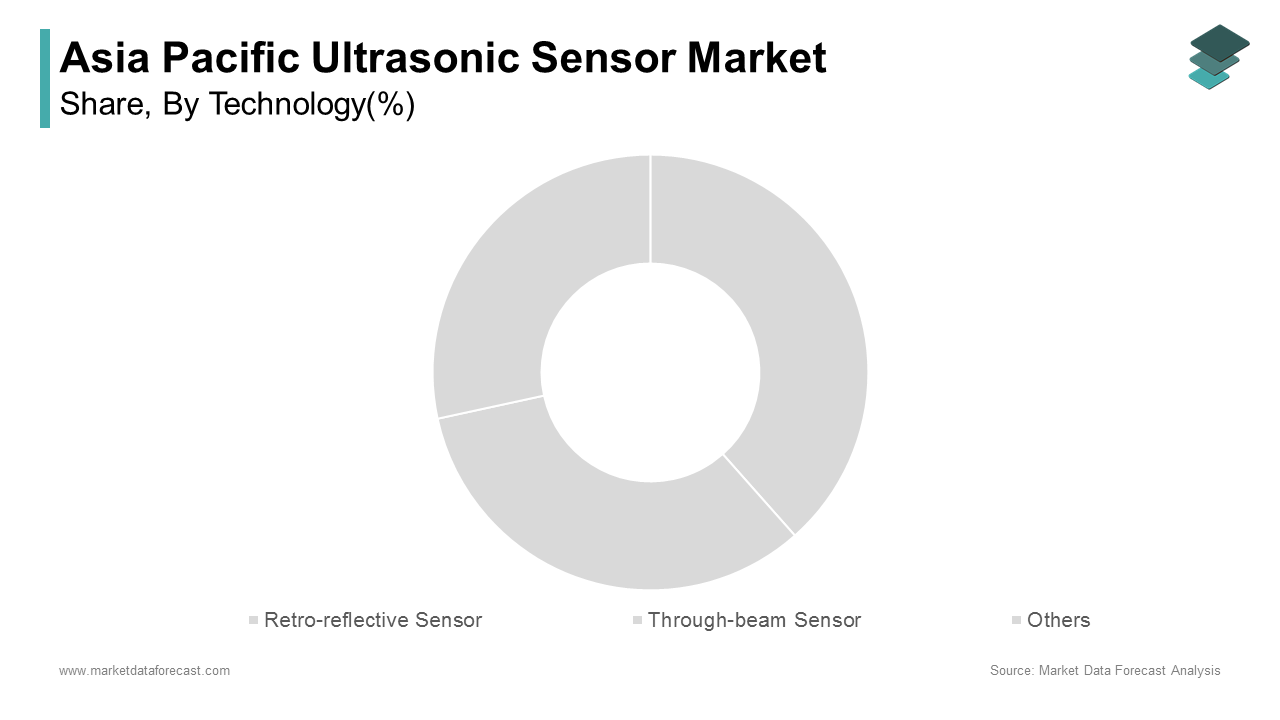
The through-beam sensor segment was the largest and held 38.4% of the Asia Pacific ultrasonic sensor market share in 2024, with its superior detection accuracy and reliability in challenging industrial environments. Unlike other types, through-beam sensors use separate transmitter and receiver units, allowing for precise and stable object detection even in dusty or high-vibration settings. As per the Japan Industrial Robot Association, over 70% of automated assembly lines in Japan incorporate through-beam ultrasonic sensors for real-time material handling and conveyor monitoring. Additionally, the rapid expansion of smart manufacturing in China has led to increased integration of these sensors. According to the China Electronics Components Institute, more than 12 million units of through-beam ultrasonic sensors were deployed in Chinese factories in 2023 alone, particularly in the automotive and electronics sectors.
The retro-reflective sensor segment is projected to grow with a CAGR of 9.2% during the forecast period due to its compact design and cost-effectiveness, making it ideal for space-constrained applications and mid-sized manufacturing units. Unlike through-beam sensors, retro-reflective sensors use a single unit that both emits and receives the ultrasonic wave after it reflects off a target, reducing installation complexity. According to the Indian Ministry of Electronics and Information Technology, retro-reflective ultrasonic sensors accounted for nearly 40% of all sensor installations in small and medium enterprises (SMEs) in India in 2023. In addition, the Thailand Board of Investment reported a 15% increase in automation investments in the food processing sector, where retro-reflective sensors are extensively used for packaging and conveyor belt monitoring.
By Type Insights
The distance measurement segment accounted in holding 36.4% of the Asia Pacific ultrasonic sensor market share in 2024, with the widespread use of ultrasonic sensors in applications requiring precise non-contact distance estimation, such as robotics, automotive navigation, and industrial automation. In China, the Ministry of Industry and Information Technology reported that over 85% of autonomous guided vehicles (AGVs) deployed in smart factories in 2023 used ultrasonic sensors for real-time distance measurement. Additionally, the Japanese Automotive Manufacturers Association noted that more than 70% of new passenger vehicles in Japan incorporated ultrasonic-based distance sensors for parking assistance and collision avoidance systems.
The obstacle detection segment is projected to grow with a CAGR of 9.7% during the forecast period, with the increasing integration of ultrasonic sensors in autonomous vehicles, drones, and robotic systems, where real-time obstacle identification is crucial. According to the International Transport Forum, the number of autonomous vehicle test fleets in Asia Pacific increased by 25% in 2023, with most equipped with ultrasonic-based obstacle detection systems. In South Korea, the Korea Institute of Robotics Technology reported that over 60% of industrial robots deployed in 2023 included ultrasonic sensors for obstacle avoidance.
By Application Insights
The industrial application segment was the largest by occupying 34.2% of the Asia Pacific ultrasonic sensor market share in 2024, with the widespread deployment of ultrasonic sensors in manufacturing, logistics, and process automation. Countries such as China, Japan, and South Korea are at the forefront of industrial modernization, incorporating ultrasonic sensors into robotics, conveyor systems, and quality control processes. According to the United Nations Industrial Development Organization (UNIDO), the Asia Pacific contributed over 60% of global manufacturing output in 2023, with ultrasonic sensors playing a key role in enhancing efficiency and precision. In China, the Ministry of Industry and Information Technology reported that over 10,000 smart factories were in operation by the end of 2023, many of which used ultrasonic sensors for proximity and level detection.
The healthcare application segment is anticipated to grow with a CAGR of 10.1% during the forecast period, with the increasing use of ultrasonic sensors in medical diagnostics, patient monitoring, and surgical robotics. According to the World Health Organization, healthcare expenditure in the Asia Pacific increased by 6.5% in 2023, supporting the adoption of advanced medical equipment.
REGIONAL ANALYSIS
China Ultrasonic Sensor Market Insights
China was the top performer in the Asia Pacific ultrasonic sensor market by capturing 32.3% of the share in 2024 with its vast industrial base, rapid automation, and government initiatives promoting smart manufacturing. According to the China Association of Automobile Manufacturers, the automotive industry alone accounted for over 40% of ultrasonic sensor consumption in 2023, primarily for ADAS and autonomous vehicle applications. Additionally, the Ministry of Industry and Information Technology reported that more than 10,000 smart factories were operational across the country, integrating ultrasonic sensors for proximity and level detection.
Japan Ultrasonic Sensor Market Insights
The Japanese ultrasonic sensor market held 14.3% of share in 2024. The country’s strong industrial and automotive sectors are key contributors to this position. According to the Japan Automobile Manufacturers Association, over 70% of new vehicles in Japan featured ultrasonic sensors for parking assistance and obstacle detection in 2023.
South Korea Ultrasonic Sensor Market Insights
South Korea's ultrasonic sensor market growth is likely to be driven by its advanced electronics and automotive industries. Additionally, the Ministry of Trade, Industry, and Energy noted that South Korea’s automotive electronics market grew by 8.5% in the same year, fueled by investments in electric and autonomous vehicles. The country’s semiconductor and electronics manufacturing sectors also contribute significantly, with companies like Samsung and LG integrating ultrasonic sensors into smart devices and home appliances.
India Ultrasonic Sensor Market Insights
India's ultrasonic sensor market growth is driven by the expanding industrial automation and smart city initiatives. According to the Indian Ministry of Electronics and Information Technology, the domestic sensor market grew by 12% in 2023, with ultrasonic sensors playing a key role in manufacturing and logistics. The Confederation of Indian Industry (CII) reported that over 15,000 SMEs adopted automation technologies in 2023, many of which integrated ultrasonic sensors for proximity and level detection. Additionally, the Ministry of Housing and Urban Affairs indicated that more than 100 cities had implemented ultrasonic-based smart parking and waste management systems.
Australia Ultrasonic Sensor Market Insights
Australia's ultrasonic sensor market growth is attributed to being driven by its growing industrial and healthcare sectors. The Department of Industry, Science, and Resources noted that ultrasonic sensors were increasingly deployed in autonomous mining equipment for obstacle detection and proximity sensing. Additionally, the automotive industry saw a 7% increase in ultrasonic sensor integration in new vehicles, according to the Federal Chamber of Automotive Industries. The country’s smart city initiatives, particularly in Sydney and Melbourne, also contributed to growth, with ultrasonic sensors being used in intelligent transport systems and smart parking solutions.
LEADING PLAYERS IN THE ASIA PACIFIC ULTRASONIC SENSOR MARKET
One of the leading players in the Asia Pacific ultrasonic sensor market is Murata Manufacturing Co., Ltd. With a Japanese multinational electronics company. Murata is known for its advanced sensor technologies and has a strong presence across automotive, consumer electronics, and industrial applications. The company plays a crucial role in supplying high-precision ultrasonic sensors that support proximity detection, obstacle sensing, and automation functions. Its continuous innovation in sensor miniaturization and integration has made it a preferred supplier for major automotive and electronics manufacturers in the region.
Honeywell International Inc. is another global leader in sensing and control technologies. Honeywell has a significant footprint in the Asia Pacific market through its extensive distribution network and localized R&D centers. The company offers a wide range of ultrasonic sensors tailored for industrial automation, aerospace, and healthcare applications. Its focus on developing high-performance, durable sensors has helped it maintain a strong position in the region, especially in sectors requiring high reliability and precision.
Omron Corporation is a Japanese automation leader that is also a key contributor to the Asia Pacific ultrasonic sensor market. Omron’s ultrasonic sensors are widely used in industrial and automotive applications across the region. The company emphasizes product innovation and application-specific design, enabling seamless integration into complex systems.
TOP STRATEGIES USED BY KEY MARKET PARTICIPANTS
One of the primary strategies adopted by key players in the Asia Pacific ultrasonic sensor market is product innovation and technological advancement. Companies are continuously investing in R&D to develop compact, high-precision, and multi-functional ultrasonic sensors that cater to evolving industry needs. The strategic partnerships and collaborations are another strategy followed by the top key players. Leading manufacturers are forming alliances with regional electronics firms, automotive companies, and industrial automation providers to enhance their market reach. These collaborations help in co-developing customized sensor solutions that align with specific application requirements across different sectors.
The expansion into emerging markets is a key approach used by market participants. Companies are strengthening their presence in high-growth economies such as India, Vietnam, and Indonesia by setting up local manufacturing units, distribution centers, and R&D hubs. This not only reduces operational costs but also improves responsiveness to regional demand dynamics and regulatory requirements.
KEY MARKET PLAYERS AND COMPETITION OVERVIEW
Major Players of the Asia Pacific Ultrasonic Sensor Market include Honeywell, Siemens, Panasonic, STMicroelectronics, Baumer, Texas Instruments, OMRON, Murata Manufacturing, Ifm Electronic, and MaxBotix.
The Asia Pacific ultrasonic sensor market is characterized by a highly competitive landscape, with both global and regional players striving to capture market share. The competition is driven by rapid technological advancements, increasing application diversification, and growing demand for precision sensing solutions across industries. Major companies are focusing on product differentiation through innovation, performance enhancement, and integration with emerging technologies such as artificial intelligence and the Internet of Things. Additionally, market participants are leveraging strategic collaborations, mergers, and acquisitions to strengthen their regional foothold and expand their customer base. The presence of numerous local manufacturers, particularly in China and India, adds to the intensity of competition by offering cost-effective alternatives.
RECENT HAPPENINGS IN THE MARKET
- In March 2024, Murata Manufacturing launched a new line of compact ultrasonic sensors designed specifically for integration into next-generation automotive and consumer electronics applications across Asia. The launch aimed to address the growing demand for miniaturized and high-performance sensing solutions.
- In February 2024, Honeywell International expanded its regional R&D facility in Shanghai, China, to accelerate the development of application-specific ultrasonic sensors tailored for industrial automation and healthcare systems in the Asia Pacific region.
- In January 2024, Omron Corporation partnered with a leading South Korean robotics firm to co-develop advanced ultrasonic sensor modules for use in industrial robots by enhancing obstacle detection and safety features in smart manufacturing environments.
- In May 2024, TDK Corporation entered into a strategic distribution agreement with an Indian automation equipment provider to expand its ultrasonic sensor offerings across SMEs and mid-sized manufacturing units in the country.
- In June 2024, Sick AG is a German sensor technology leader, established a regional service and support center in Singapore to improve after-sales service, technical assistance, and customization capabilities for ultrasonic sensors used in logistics and smart infrastructure applications across Southeast Asia.
MARKET SEGMENTATION
This research report on the Asia Pacific ultrasonic sensor market has been segmented and sub-segmented based on technology, type, application, and region.
By Technology
- Retro-reflective Sensor
- Through-beam Sensor
- Others
By Type
- Level Measurement
- Distance Measurement
- Obstacle Detection
- Others
By Application
- Consumer Electronics
- Automotive
- Aerospace & Defense
- Healthcare
- Industrial
- Others
By Region
- India
- China
- Japan
- South Korea
- Australia
- New Zealand
- Thailand
- Malaysia
- Vietnam
- Philippines
- Indonesia
- Singapore
- Rest of Asia-Pacific
Frequently Asked Questions
1. What are the key drivers of growth in this market?
Major drivers include increasing adoption of industrial automation, rising demand in automotive applications (e.g., parking assistance), and the growing robotics sector.
2. What are the main applications of ultrasonic sensors in the region?
Applications include automotive systems, industrial automation, robotics, consumer electronics, and healthcare.
3. What types of ultrasonic sensors are commonly used?
Proximity sensors, level sensors, and distance measurement sensors are widely used, often categorized as through-beam, retro-reflective, and diffuse sensors.
4. Which end-user industries dominate the market?
Automotive, industrial manufacturing, healthcare, and consumer electronics are the major end-users.
5. What are the main challenges faced by this market?
Challenges include the presence of alternative sensing technologies (e.g., LiDAR), performance limitations in harsh environments, and high initial installation costs.
6. How is the automotive sector influencing market growth?
Ultrasonic sensors are integral in ADAS (Advanced Driver-Assistance Systems), especially for parking sensors and collision avoidance, boosting demand in the automotive sector.
7. What technological advancements are shaping the market?
Developments include miniaturization of sensors, integration with IoT and AI, and enhanced sensor range and accuracy.
8. How is the industrial automation trend impacting the market?
The increasing automation of manufacturing processes is driving the demand for ultrasonic sensors for tasks like distance measurement, object detection, and material handling.
9. What is the market outlook for the next 5 years?
The Asia Pacific ultrasonic sensor market is projected to witness significant growth, driven by expanding applications in smart cities, Industry 4.0, and consumer electronics.
10. Who are the key players in the Asia Pacific ultrasonic sensor market?
Major players include Omron Corporation, Panasonic Corporation, Murata Manufacturing, Pepperl+Fuchs, and Keyence Corporation.
Related Reports
Access the study in MULTIPLE FORMATS
Purchase options starting from
$ 2000
Didn’t find what you’re looking for?
TALK TO OUR ANALYST TEAM
Need something within your budget?
NO WORRIES! WE GOT YOU COVERED!
Call us on: +1 888 702 9696 (U.S Toll Free)
Write to us: sales@marketdataforecast.com