Asia Pacific Wi-Fi Chipset Market Size, Share, Trends & Growth Forecast Report By Product (Smartphones, Tablets, PCs, Access Point Equipment, Connected Home Devices, Others), Band (Single Band, Dual Band, Tri Band), MIMO Configuration (SU-MIMO, MU-MIMO), and Country (India, China, Japan, South Korea, Rest Of Asia Pacific) – Industry Analysis, 2026 to 2034
Market Size, 2025
$7,082.92 MnMarket Estimate, 2026
$7281.24 MnMarket Forecast, 2034
$9,081 MnCAGR, 2026–2034
2.8%Asia Pacific Wi-Fi Chipset Market Size
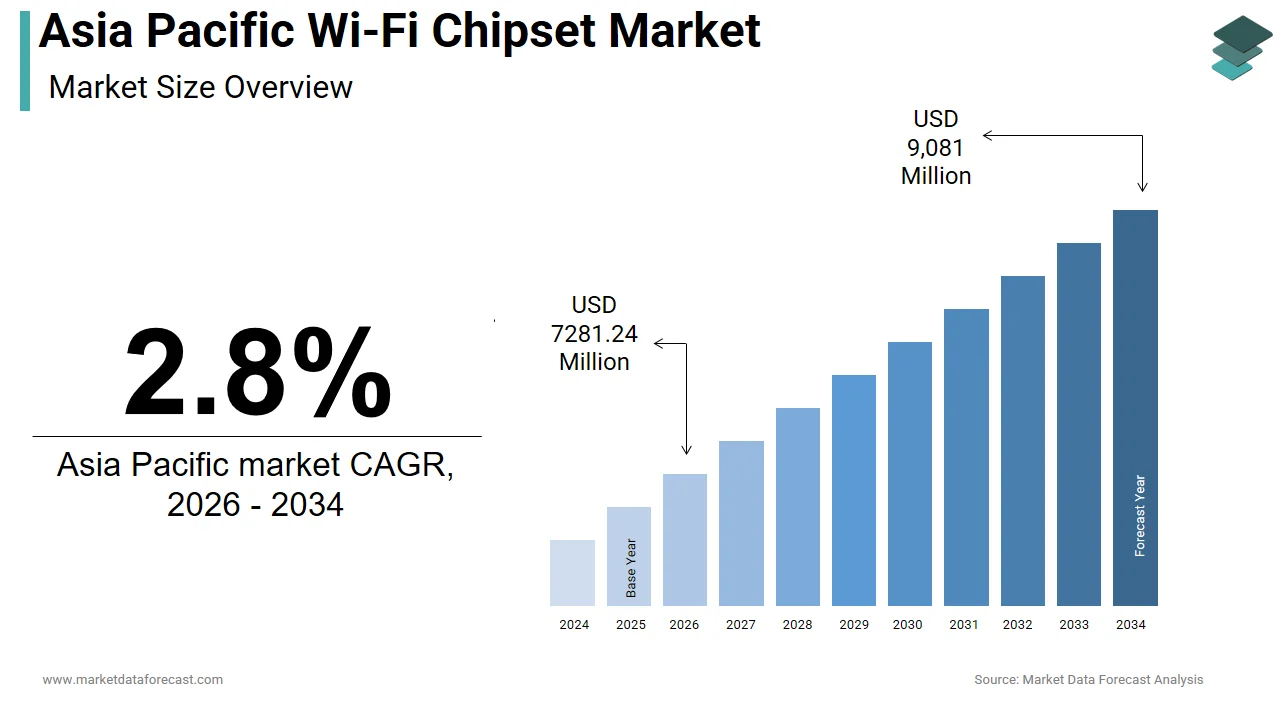
The Asia Pacific Wi-Fi chipset market was valued at USD 7,082.92 million in 2025, is estimated to reach USD 7281.24 million in 2026, and is projected to reach USD 9,081 million by 2034, growing at a CAGR of 2.8% from 2026 to 2034.
The Wi-Fi chipset is an integrated circuit enabling wireless local area network (WLAN) connectivity across consumer electronics, enterprise networking, industrial applications, and automotive systems. These chipsets support a range of Wi-Fi standards, including Wi-Fi 4 (802.11n), Wi-Fi 5 (802.11ac), Wi-Fi 6 (802.11ax), and the emerging Wi-Fi 7 (802.11be), catering to the growing demand for high-speed, low-latency connectivity in both urban and rural settings.
MARKET DRIVERS
Expansion of Smart Homes and IoT Ecosystems
The rapid growth of smart homes and the Internet of Things (IoT) is driving the growth of the Asia Pacific Wi-Fi chipset market. The increasing adoption of connected devices such as smart speakers, security cameras, thermostats, and home automation systems has significantly boosted the demand for embedded Wi-Fi chipsets. According to the Consumer Technology Association, smart home device shipments in the Asia Pacific region grew by over 20% in 2023, with China and India witnessing the highest growth rates. In China, the Ministry of Industry and Information Technology reported that over 300 million IoT devices were connected to Wi-Fi networks in 2023, largely driven by government-backed smart city initiatives. Additionally, in Japan, major electronics manufacturers such as Sony and Panasonic have integrated Wi-Fi 6 chipsets into their latest home appliances to support seamless cloud connectivity and voice-controlled automation.
Rising Demand for High-Speed Internet in Commercial and Industrial Applications
The growing demand for high-speed internet connectivity in commercial and industrial environments is additionally to further fuel the growth of the Asia Pacific Wi-Fi chipset market. Businesses across the region are increasingly adopting cloud-based services, video conferencing, and real-time data analytics, necessitating robust Wi-Fi infrastructure. According to the World Bank, as of 2023, over 60% of small and medium-sized enterprises (SMEs) in Southeast Asia had transitioned to digital operations, requiring reliable and high-capacity Wi-Fi networks. In South Korea, where digital transformation is a national priority, the Ministry of Science and ICT reported that enterprise Wi-Fi adoption increased by 18% in 2023, with many companies deploying Wi-Fi 6 access points to support hybrid work environments.
MARKET RESTRAINTS
Supply Chain Disruptions and Semiconductor Shortages
The ongoing impact of global supply chain disruptions and semiconductor shortages is restricting the growth of the Asia Pacific Wi-Fi chipset market. According to the Semiconductor Industry Association, global semiconductor lead times remained above 26 weeks in 2023, significantly affecting Wi-Fi chipset production. In China, the Ministry of Industry and Information Technology reported that over 40% of chipset manufacturers experienced delays in wafer supply from overseas foundries, leading to production cutbacks. In Malaysia, where a significant portion of global chip packaging takes place, labor shortages and pandemic-related restrictions disrupted operations in early 2023.
Regulatory and Spectrum Allocation Challenges
The variation in regulatory frameworks and spectrum allocation policies across different countries is likely to hinder the growth of the Asia Pacific Wi-Fi chipset market. According to the Asia-Pacific Economic Cooperation (APEC) Telecommunications and Information Working Group, as of 2023, only 12 out of 21 APEC economies had fully harmonized the 6 GHz band for Wi-Fi 6E and Wi-Fi 7 operations. In India, the Department of Telecommunications delayed the commercial rollout of 6 GHz band usage until late 2023, limiting early adoption of next-generation Wi-Fi chipsets. Similarly, in Indonesia and Vietnam, regulatory authorities imposed restrictions on the use of certain frequency bands, creating uncertainty for chipset manufacturers and device vendors.
MARKET OPPORTUNITIES
Growth of Automotive Connectivity and In-Vehicle Wi-Fi Systems
The growing adoption of automotive connectivity and in-vehicle Wi-Fi systems is driving the growth of the Asia Pacific Wi-Fi chipset market. According to the International Telecommunication Union, over 60% of new vehicles in Japan and South Korea in 2023 featured built-in Wi-Fi hotspots, supporting infotainment, over-the-air updates, and vehicle diagnostics. In Japan, major automakers such as Toyota and Honda have integrated Wi-Fi 6 chipsets into their latest models to enable seamless connectivity for passengers and onboard systems. Similarly, in South Korea, Hyundai and Kia have expanded their partnership with semiconductor manufacturers to integrate dual-band Wi-Fi chipsets into next-generation electric vehicles (EVs). Additionally, in China, the Ministry of Industry and Information Technology has mandated the inclusion of Wi-Fi connectivity in all new EVs sold in the country, further boosting demand.
Expansion of Wi-Fi 6 and Wi-Fi 7 Adoption in Smart Manufacturing
The increasing deployment of Wi-Fi 6 and Wi-Fi 7 in smart manufacturing and industrial automation is additionally to fuel the growth of the Asia Pacific Wi-Fi chipset market. According to the International Society of Automation, over 70% of new manufacturing facilities in China and South Korea in 2023 adopted Wi-Fi 6-based industrial networks for real-time monitoring and control systems. In China, the Ministry of Industry and Information Technology launched the "Smart Manufacturing Development Plan," which encourages the use of Wi-Fi 6 chipsets in factory automation, robotics, and predictive maintenance applications. Similarly, in Japan, the Ministry of Economy, Trade, and Industry (METI) has promoted the adoption of Wi-Fi 6 in smart factories through public-private partnerships. Additionally, in India, the Make in India initiative has led to an increase in the deployment of Wi-Fi-enabled automation systems in electronics and automotive manufacturing units.
MARKET CHALLENGES
Increasing Complexity in Chipset Design and Integration
The increasing complexity in chipset design and integration with the adoption of Wi-Fi 6E and Wi-Fi 7 standards is restricting the growth of the Asia Pacific Wi-Fi chipset market. These next-generation chipsets require advanced multi-band support, beamforming capabilities, and enhanced security protocols, making their design and manufacturing more complex and costly. According to the IEEE, the development cycle for Wi-Fi 7 chipsets is nearly 18 months longer than that of Wi-Fi 6, primarily due to the integration of 6 GHz band support and multi-link operation (MLO). In China, leading chipset manufacturers such as HiSilicon and MediaTek have reported delays in product launches due to challenges in RF front-end design and antenna optimization.
Growing Cybersecurity Concerns in Wi-Fi-Enabled Devices
The increasing concern over cybersecurity vulnerabilities in Wi-Fi-enabled devices is also limiting the growth of the Asia Pacific Wi-Fi chipset market. According to the Asia Pacific Computer Emergency Response Team (APCERT), cyberattacks targeting IoT and Wi-Fi-connected devices in the region increased by over 35% in 2023. In Japan, the National Institute of Information and Communications Technology (NICT) identified multiple vulnerabilities in consumer-grade Wi-Fi routers that could be exploited for remote access and data interception. Additionally, in South Korea, concerns over Wi-Fi-based surveillance and data exfiltration have prompted stricter cybersecurity regulations for connected devices.
REPORT COVERAGE
| REPORT METRIC | DETAILS |
| Market Size Available | 2025 to 2034 |
| Base Year | 2025 |
| Forecast Period | 2026 to 2034 |
| Segments Covered | By Product, Band, MIMO Configuration, and Region. |
| Various Analyses Covered | Global, Regional and Country-Level Analysis, Segment-Level Analysis, Drivers, Restraints, Opportunities, Challenges; PESTLE Analysis; Porter’s Five Forces Analysis, Competitive Landscape, Analyst Overview of Investment Opportunities |
| Countries Covered | India, China, Japan, South Korea, Australia, New Zealand, Thailand, Malaysia, Vietnam, Philippines, Indonesia, Singapore, Rest of APAC |
| Market Leaders Profiled | Qualcomm Technologies, Inc., Broadcom, Intel Corporation, MediaTek, Inc., Infineon Technologies, and others. |
SEGMENTAL ANALYSIS
By Product Insights
The smartphone segment accounted in holding 35.4% of the Asia Pacific Wi-Fi chipset market share in 2024, with the region’s massive smartphone user base and the continuous demand for next-generation devices featuring advanced Wi-Fi capabilities. According to the China Academy of Information and Communications Technology, over 320 million smartphones were sold in China in 2023, with more than 80% supporting Wi-Fi 6 or Wi-Fi 6E. Additionally, in South Korea, where smartphone penetration exceeds 95%, major manufacturers such as Samsung and LG have incorporated dual-band Wi-Fi 6 and Wi-Fi 7 chipsets into flagship models to support high-speed connectivity. The widespread adoption of mobile internet, coupled with the increasing integration of Wi-Fi 6/6E in budget smartphones, continues to drive the smartphone segment’s strong market position across the Asia Pacific region.
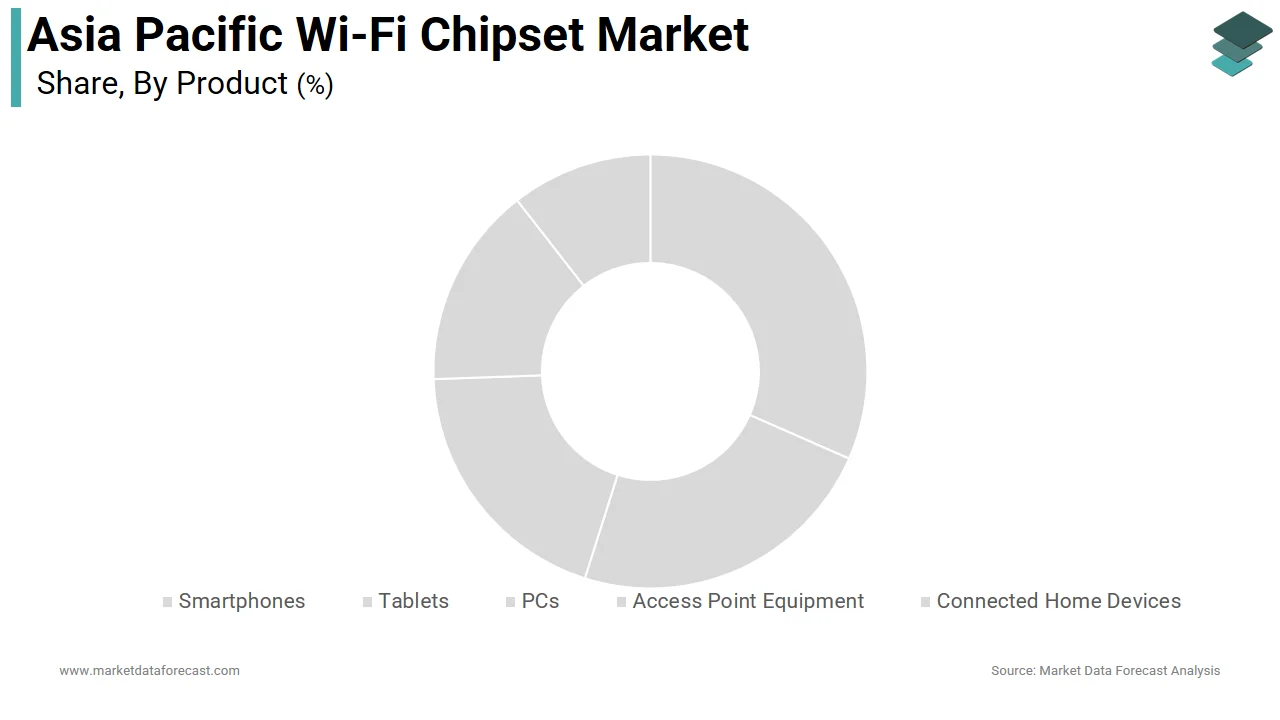
The connected home devices segment is projected to grow with a CAGR of 12.4% from 2026 to 2034. According to the Consumer Technology Association, smart home device shipments in the Asia Pacific region grew by over 25% in 2023, with China and India leading the expansion. In China, the Ministry of Housing and Urban-Rural Development reported that over 50 million new smart homes were built in 2023, all of which integrated Wi-Fi-enabled appliances and security systems. Similarly, in India, the Smart Cities Mission has led to the deployment of millions of Wi-Fi-connected surveillance and energy management systems.
By Band Insights
The dual-band segment was the largest and held 58.2% of the Asia Pacific Wi-Fi chipset market share in 2024, with the widespread deployment of dual-band routers and access points in both residential and commercial settings, offering a balance between performance and cost. According to the International Telecommunication Union, over 70% of newly deployed Wi-Fi routers in the Asia Pacific region in 2023 supported dual-band (2.4 GHz and 5 GHz) connectivity, catering to the growing demand for high-speed internet in households and small businesses. Similarly, in India, the Broadband India Forum noted that dual-band routers accounted for over 60% of broadband equipment sales, driven by increasing internet penetration and online streaming consumption.
The tri-band Wi-Fi chipset segment is projected to grow with a CAGR of 14.2% from 2026 to 2034. This rapid growth is driven by the increasing demand for high-performance Wi-Fi networks in multi-device environments, particularly in urban households and enterprise settings. According to the Wi-Fi Alliance, tri-band routers, which support two 5 GHz bands and one 2.4 GHz band, are becoming the preferred choice for users requiring seamless connectivity across multiple high-bandwidth applications such as 4K/8K streaming, online gaming, and video conferencing. In South Korea, where internet speeds are among the highest in the world, telecom operators such as SK Broadband and KT have launched tri-band Wi-Fi services to support gigabit-speed broadband. Similarly, in Australia, the National Broadband Network (NBN) has encouraged the adoption of tri-band routers to optimize network performance in densely populated areas.
By MIMO Configuration Insights
The MU-MIMO (Multi-User Multiple Input Multiple Output) configuration segment was the largest and held a dominant share of the Asia Pacific Wi-Fi chipset market in 2025 due to the growing deployment of Wi-Fi 5 and Wi-Fi 6 routers that support MU-MIMO technology, allowing multiple devices to communicate with a router simultaneously without degrading performance. According to the Wi-Fi Alliance, over 80% of Wi-Fi 6 routers shipped in the Asia Pacific region in 2023 featured MU-MIMO capabilities to enhance network efficiency and reduce latency. In China, the Ministry of Industry and Information Technology reported that over 100 million MU-MIMO-enabled Wi-Fi 6 routers were deployed in 2023, particularly in urban residential and enterprise environments.
The SU-MIMO (Single-User MIMO) configuration segment is expected to grow with a CAGR of 8.7% from 2026 to 2034, with the continued demand for cost-effective Wi-Fi chipsets in budget smartphones, entry-level tablets, and IoT devices in emerging economies. According to the International Telecommunication Union, as of 2023, nearly 40% of smartphone users in Southeast Asia still used budget models equipped with SU-MIMO chipsets due to affordability constraints. In India, the Cellular Operators Association of India reported that over 60 million SU-MIMO-equipped smartphones were sold in 2023, primarily in rural and semi-urban markets. Similarly, in Indonesia and the Philippines, low-cost smart home devices such as Wi-Fi-enabled LED bulbs and security cameras continue to rely on SU-MIMO chipsets for basic connectivity. Additionally, in Vietnam, local manufacturers have expanded production of SU-MIMO-based Wi-Fi modules for industrial sensors and monitoring systems.
COUNTRY-LEVEL ANALYSIS
China Wi-Fi Chipset Market Insights
China was the top performer in the Asia Pacific Wi-Fi chipset market with 32.3% of the share in 2024. According to the China Academy of Information and Communications Technology, over 320 million smartphones were sold in China in 2023, with more than 80% supporting Wi-Fi 6 or Wi-Fi 6E. The Ministry of Industry and Information Technology has also mandated the inclusion of Wi-Fi connectivity in all new electric vehicles, further boosting demand. Additionally, the Smart Cities Mission has led to the deployment of millions of Wi-Fi-connected surveillance and energy management systems across urban centers. Domestic semiconductor companies such as HiSilicon and Unisoc have ramped up production of Wi-Fi chipsets for integration into smartphones and routers.
India Wi-Fi Chipset Market Insights
India was positioned next in the Asia Pacific Wi-Fi chipset market with 18.3% of share in 2024 with the rapid digital transformation, expanding smartphone penetration, and government initiatives to promote smart infrastructure have driven significant demand for Wi-Fi chipsets. According to the Cellular Operators Association of India, smartphone shipments in India exceeded 150 million units in 2023. The Department of Telecommunications has also launched the BharatNet program, aiming to provide high-speed internet connectivity to rural areas, which has increased demand for Wi-Fi routers and access points. Additionally, the Smart Cities Mission has led to the deployment of millions of connected home and surveillance devices, further boosting Wi-Fi chipset adoption.
South Korea Wi-Fi Chipset Market Insights
South Korea Wi-Fi chipset market growth is likely to grow with the advanced telecommunications infrastructure and high smartphone penetration. According to the Korea Internet & Security Agency, over 95% of the population in South Korea uses smartphones, with nearly all new models supporting Wi-Fi 6 or Wi-Fi 6E. The Ministry of Science and ICT has been actively promoting the rollout of Wi-Fi 6E and Wi-Fi 7 networks to support next-generation applications such as augmented reality, virtual reality, and cloud gaming. Major telecom operators such as SK Broadband and KT have launched high-speed Wi-Fi services with tri-band routers and MU-MIMO technology. Additionally, South Korean automakers such as Hyundai and Kia have integrated Wi-Fi 6 chipsets into their latest electric vehicles for over-the-air updates and real-time connectivity.
Japan Wi-Fi Chipset Market Insights
Japan Wi-Fi chipset market is likely to grow with the digital ecosystem and strong presence in consumer electronics and automotive connectivity. According to the Ministry of Internal Affairs and Communications, over 85% of Japanese households have broadband internet access, with increasing adoption of Wi-Fi 6 routers. Major electronics manufacturers such as Sony, Panasonic, and Sharp have integrated Wi-Fi 6 chipsets into smart home appliances, enhancing connectivity and automation. In the automotive sector, companies like Toyota and Honda have adopted Wi-Fi 6 chipsets for vehicle infotainment, diagnostics, and remote updates. Additionally, the Japanese government has been promoting the use of Wi-Fi 6E in smart factories and industrial automation to support Industry 4.0 initiatives.
Australia Wi-Fi Chipset Market Insights
Australia Wi-Fi chipset market growth is driven by its expanding broadband infrastructure and growing adoption of smart home and enterprise connectivity solutions. According to the Australian Communications and Media Authority, broadband penetration in Australia reached 92% in 2023, with increasing deployment of Wi-Fi 6 and Wi-Fi 6E routers. The National Broadband Network (NBN) has facilitated the adoption of high-speed internet services, leading to higher demand for Wi-Fi-enabled devices in both residential and commercial settings. Additionally, major retailers and hospitality businesses have integrated Wi-Fi analytics and location-based services to enhance customer engagement. In the education sector, schools and universities have adopted Wi-Fi 6 networks to support remote learning and digital classrooms.
COMPETITIVE LANDSCAPE
The Asia Pacific Wi-Fi chipset market is highly competitive, characterized by the coexistence of global semiconductor giants and a growing number of regional players striving to capture market share. International companies such as Qualcomm, Broadcom, and MediaTek dominate due to their strong R&D capabilities, extensive product portfolios, and established partnerships with major device manufacturers. However, emerging domestic players are gaining traction by offering cost-effective and region-specific Wi-Fi solutions tailored to the needs of local markets. The competition is intensifying as companies race to integrate next-generation Wi-Fi standards such as Wi-Fi 6E and Wi-Fi 7 into a wide range of applications, from smartphones and smart homes to enterprise networks and automotive systems. In addition to product innovation, companies are focusing on expanding their regional presence through localized manufacturing, strategic collaborations, and customer-centric design approaches. The increasing demand for seamless connectivity across urban and rural areas is further driving companies to differentiate themselves through performance, efficiency, and ecosystem integration.
KEY MARKET PLAYERS
Noteworthy Companies dominating the Asia Pacific Wi-Fi chipset market profiled in the report are
- Qualcomm Technologies, Inc.
- Broadcom
- Intel Corporation
- MediaTek, Inc.
- Infineon Technologies
TOP LEADING PLAYERS IN THE MARKET
- Qualcomm is a global leader in wireless communication technologies and plays a pivotal role in shaping the Wi-Fi chipset landscape in the Asia Pacific region. The company offers a broad portfolio of Wi-Fi 6 and Wi-Fi 6E chipsets for smartphones, routers, automotive, and IoT applications. Qualcomm's Snapdragon and networking platforms are widely adopted by leading smartphone and networking equipment manufacturers across China, India, and Southeast Asia. Its innovations in multi-band connectivity, low-latency communication, and energy efficiency have made it a preferred partner for OEMs aiming to deliver high-performance wireless solutions.
- MediaTek is a dominant player in the Asia Pacific Wi-Fi chipset market, particularly in the smartphone and consumer electronics segments. The company is known for delivering cost-effective yet high-performance Wi-Fi solutions tailored for emerging markets. MediaTek’s Wi-Fi 6 chipsets are integrated into a wide range of devices, from smartphones and tablets to smart TVs and home gateways. Its deep integration with regional manufacturing ecosystems and strong relationships with local device makers have enabled rapid adoption across the region.
- Broadcom is a key contributor to the enterprise and infrastructure side of the Asia Pacific Wi-Fi chipset market. The company provides high-end Wi-Fi chipsets for access points, routers, and industrial applications. Broadcom’s solutions are widely used by telecom operators, data centers, and enterprise IT providers across Japan, South Korea, and Australia. Its focus on performance-driven Wi-Fi 6 and Wi-Fi 7 chipsets has positioned it as a go-to supplier for high-density connectivity environments in the region.
TOP STRATEGIES USED BY KEY MARKET PARTICIPANTS
Key players are heavily investing in R&D to stay ahead in the race for next-generation Wi-Fi standards, particularly Wi-Fi 6E and Wi-Fi 7. Companies are launching chipsets with multi-band support, ultra-low latency, and enhanced throughput to meet the growing demands of high-performance applications such as smart homes, industrial automation, and automotive connectivity. This focus on innovation ensures they remain relevant in a rapidly evolving technological landscape.
To strengthen their market position in the Asia Pacific region, leading companies are forming strategic partnerships with local original equipment manufacturers (OEMs), telecom operators, and service providers. These collaborations help them tailor their Wi-Fi solutions to regional needs, accelerate product integration, and expand their distribution networks across diverse consumer and enterprise segments.
Several global players are expanding their regional presence by setting up or expanding R&D centers, design hubs, and manufacturing partnerships in countries like China, India, and Malaysia. This localized approach supports faster product development cycles, reduces costs, and enhances responsiveness to market-specific regulatory and technical requirements, thereby strengthening their foothold in the Asia Pacific Wi-Fi chipset market.
RECENT MARKET DEVELOPMENTS
- In March 2023, Qualcomm launched a new series of Wi-Fi 6E chipsets tailored for mid-range smartphones and smart home devices, which is expanding its reach across emerging markets in Southeast Asia and India.
- In October 2023, MediaTek announced a strategic partnership with a leading Chinese smartphone manufacturer to integrate its latest Wi-Fi 6 chipsets into budget and premium models by enhancing its market penetration in the region.
- In January 2024, Broadcom expanded its regional R&D center in Japan to accelerate the development of Wi-Fi 7 solutions for enterprise and industrial applications, which is strengthening its presence in the high-performance connectivity segment.
- In June 2024, Realtek Semiconductor introduced a new line of cost-effective dual-band Wi-Fi chipsets for IoT and consumer electronics by targeting small and medium-sized manufacturers in India and Indonesia.
- In November 2024, Intel collaborated with a South Korean telecom operator to deploy Wi-Fi 6E-enabled infrastructure in smart cities, which is supporting next-generation applications such as edge computing and real-time analytics.
MARKET SEGMENTATION
This Asia Pacific Wi-Fi chipset market research report is segmented and sub-segmented into the following categories.
By Product
- Smartphones
- Tablets
- PCs
- Access Point Equipment
- Connected Home Devices
- Others
By Band
- Single Band
- Dual Band
- Tri Band
By MIMO Configuration
- SU-MIMO
- MU-MIMO
By Country
- India
- China
- Japan
- South Korea
- Rest Of Asia Pacific
Frequently Asked Questions
1. Which countries lead the Asia Pacific Wi-Fi Chipset Market?
Key markets are China (largest and fastest growing due to low-cost production and numerous local electronics brands), Japan, India, and South Korea
2. Who are the key players in the Asia Pacific Wi-Fi Chipset Market?
Leading companies include Intel, Qualcomm, ESPRESSIF SYSTEMS, Broadcom, Hitachi, Cisco, Microsoft, Apple, Celeno Communications, TSMC, and STMicroelectronics
3. What device segments dominate the Asia Pacific Wi-Fi Chipset Market?
Smartphones represent the largest demand, followed by connected home devices, access points, PCs, tablets, and automotive/transportation modules
4. What are the main technological trends in the Asia Pacific Wi-Fi Chipset Market?
Notable trends include rapid adoption of Wi-Fi 6/6E, increased investment in Wi-Fi 7 chipsets, multi-band (dual/tri-band) support, and use of advanced fabrication technologies like FinFET and SOI CMOS
5. How is rising IoT adoption impacting Wi-Fi chipsets in Asia Pacific?
Expanding IoT use in smart homes, wearables, and industrial applications is driving the demand for high-speed, low-power, and secure Wi-Fi chipsets
6. Which MIMO configurations are popular in the Asia Pacific Wi-Fi Chipset Market?
The market features a wide range—MU-MIMO, 4x4, 8x8, and various single-user and multi-user configurations—for applications from smartphones to enterprise routers
7. What verticals are major adopters of Wi-Fi chipsets in Asia Pacific?
Major sectors include consumer electronics, automotive, healthcare, education, BFSI, travel, hospitality, and smart infrastructure
8. How does public Wi-Fi expansion affect the Asia Pacific Wi-Fi Chipset Market?
Growth in public Wi-Fi hotspots, smart cities, and public digital infrastructure projects increases demand for scalable and robust Wi-Fi chipsets across the region
9. What are the top challenges for the Asia Pacific Wi-Fi Chipset Market?
Challenges include high chipset development costs, chip shortages, supply chain disruptions, and intense competition from local and global brands
10. What opportunities exist in the Asia Pacific Wi-Fi Chipset Market?
Opportunities arise from 5G-Wi-Fi convergence, edge computing, AR/VR, automotive connectivity, and rapid digital adoption in developing Asia
Related Reports
Access the study in MULTIPLE FORMATS
Purchase options starting from
$ 2000
Didn’t find what you’re looking for?
TALK TO OUR ANALYST TEAM
Need something within your budget?
NO WORRIES! WE GOT YOU COVERED!
Call us on: +1 888 702 9696 (U.S Toll Free)
Write to us: sales@marketdataforecast.com