- Product Description Description
- Table of Contents TOC
- List of Table & Figure LOT
- Get Free Sample PDF Sample PDF
Market Size, 2025
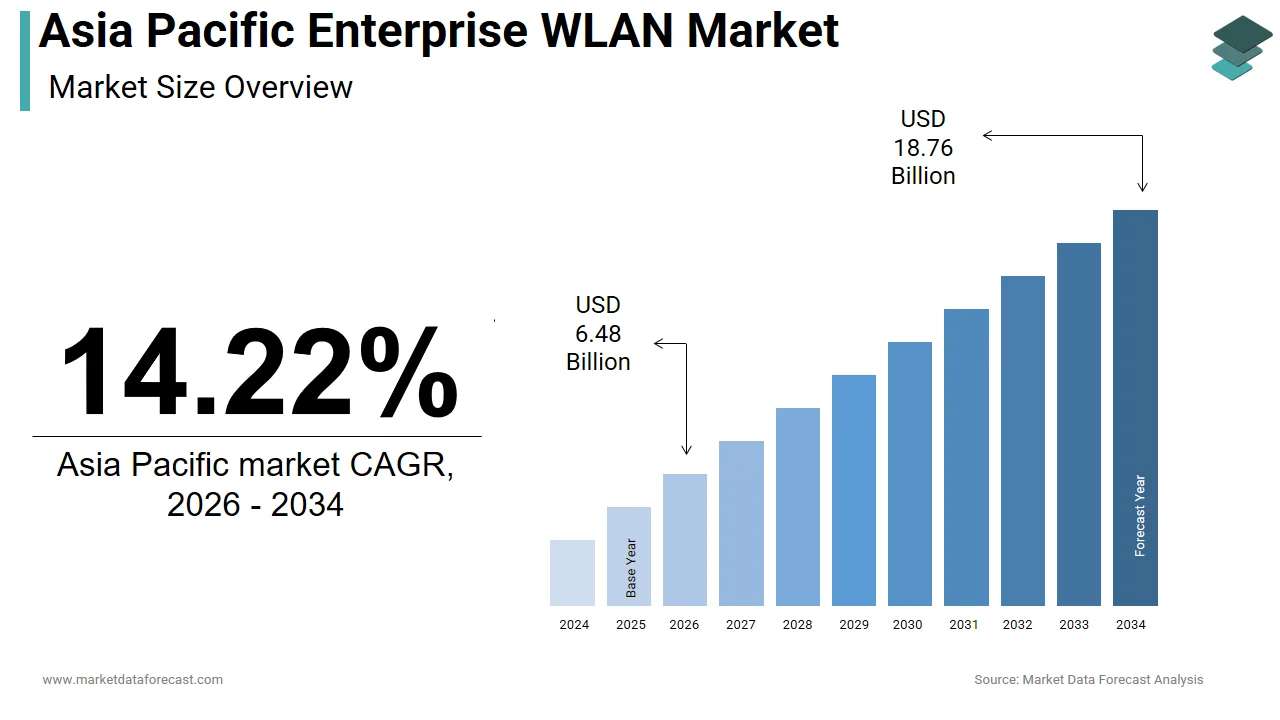
$5.67 BnMarket Estimate, 2026
$6.48 BnMarket Forecast, 2034
$18.76 BnCAGR, 2026–2034
14.22%Asia Pacific Enterprise WLAN Market Size
The Asia Pacific enterprise WLAN market was valued at USD 5.67 billion in 2025, is estimated to reach USD 6.48 billion in 2026, and is projected to reach USD 18.76 billion by 2034, growing at a CAGR of 14.22% from 2026 to 2034.
Enterprise WLAN (Wireless Local Area Network) is a wireless infrastructure solution deployed in corporate offices, educational institutions, healthcare facilities, retail outlets, and industrial environments. Enterprise WLAN enables seamless, secure, and high-speed connectivity for a wide range of devices, supporting mobility, collaboration, and digital transformation initiatives. As businesses across the region increasingly adopt cloud computing, IoT, and AI-driven applications, the demand for high-performance wireless networks has surged.
These macroeconomic and digital transformation trends show the Asia Pacific enterprise WLAN market as a key growth engine in the global networking landscape.
MARKET DRIVERS
Expansion of Digital Transformation and Cloud Adoption in Enterprises
The rapid digital transformation and widespread adoption of cloud-based services across organizations a key drivers of the Asia Pacific enterprise WLAN market. Enterprises are increasingly migrating to cloud platforms to improve operational efficiency, scalability, and remote access capabilities. This shift necessitates robust and secure WLAN systems to support seamless connectivity between cloud platforms and on-premises or hybrid work environments. Japanese and South Korean enterprises have also accelerated their cloud integration efforts, with many deploying AI-driven analytics and real-time data processing applications that depend on stable wireless connectivity. As digital transformation continues to gain momentum across the region, the demand for enterprise WLAN is expected to grow in tandem.
Surge in Remote Work and Hybrid Work Models
The proliferation of remote and hybrid work models has significantly boosted the demand for enterprise WLAN solutions across the Asia Pacific region. The global shift toward flexible work environments has led organizations to invest in secure, scalable, and high-capacity wireless networks to support employees working from home, co-working spaces, or satellite offices. As organizations continue to prioritize employee flexibility and digital collaboration, the demand for enterprise WLAN solutions is expected to remain strong across the Asia Pacific region.
MARKET RESTRAINTS
High Cost of Advanced WLAN Infrastructure Deployment
The high cost associated with deploying advanced WLAN infrastructure, particularly in small and medium enterprises (SMEs), is one of the primary restraints affecting the Asia Pacific enterprise WLAN market. While next-generation WLAN solutions such as Wi-Fi 6 and Wi-Fi 6E offer superior performance, security, and scalability, their implementation requires significant investment in access points, controllers, and network management systems.
Like, SMEs in countries like Indonesia and the Philippines accounted for over 60% of the business sector in 2023. These cost barriers hinder widespread adoption, particularly in price-sensitive markets, thereby limiting market growth in certain segments across the Asia Pacific region.
Cybersecurity Concerns and Data Privacy Regulations
The growing concern around cybersecurity and the increasing complexity of data privacy regulations are other significant restraints in the Asia Pacific enterprise WLAN market. As enterprises adopt wireless networks to support mobility and digital transformation, the risk of unauthorized access, data breaches, and network vulnerabilities has increased. Also, cyberattacks targeting enterprise networks in the Asia Pacific region rose in 2023, prompting governments to impose stricter data protection laws. Additionally, the Personal Data Protection Commission (PDPC) in Singapore mandated stricter compliance requirements for data handling, affecting how enterprises configure and manage their WLAN systems. These regulatory and security challenges add complexity and cost to WLAN deployment, discouraging some enterprises from adopting advanced wireless solutions.
MARKET OPPORTUNITIES
Rise of Smart Cities and Connected Infrastructure
The rapid development of smart cities and connected infrastructure across the Asia Pacific region presents a significant growth opportunity for the enterprise WLAN market. Governments in countries such as Singapore, India, and South Korea are investing heavily in intelligent transportation systems, automated building management, and public Wi-Fi initiatives, all of which rely on robust wireless networking solutions. Enterprise WLAN plays a crucial role in enabling seamless connectivity for smart surveillance, real-time data analytics, and IoT-based infrastructure management. In Singapore, smart building automation systems utilizing enterprise WLAN had improved energy efficiency in 2023. In India, over 100 cities have deployed enterprise-grade WLAN networks for smart governance and public services. Additionally, in South Korea, Seoul’s Metropolitan Government integrated enterprise WLAN into its public transportation system to support real-time passenger information and contactless payments.
Expansion of Retail and Hospitality Sectors with Digital Integration
The growing digital transformation of the retail and hospitality sectors across Asia Pacific is another major opportunity for the enterprise WLAN market. Businesses in these industries are increasingly adopting digital solutions such as contactless payments, mobile point-of-sale (POS) systems, and personalized customer engagement tools, all of which require reliable and secure wireless connectivity. Also, retail e-commerce sales in Asia Pacific grew notably in 2023, with physical stores enhancing their digital infrastructure to support omnichannel experiences. In Australia, enterprise WLAN adoption in retail outlets increased, driven by the need for cloud-based POS integration and customer analytics. As the retail and hospitality sectors continue to modernize, the demand for enterprise WLAN solutions is expected to expand further.
MARKET CHALLENGES
Rapid Technological Obsolescence and Upgrading Costs
The rapid pace of technological obsolescence, which necessitates frequent upgrades and replacements, is among the key challenges facing the Asia Pacific enterprise WLAN market. As wireless networking standards evolve, enterprises must continuously invest in newer infrastructure to maintain performance, security, and compatibility with emerging applications. Also, Wi-Fi 7 was introduced in 2023, promising higher speeds and lower latency, yet many enterprises were still in the process of adopting Wi-Fi 6. Additionally, in South Korea, many businesses delayed infrastructure upgrades due to concerns over network downtime and integration complexities. These challenges create financial and operational burdens for enterprises, particularly SMEs, and hinder the seamless adoption of next-generation WLAN technologies across the region.
Spectrum Congestion and Interference in Dense Urban Areas
A further significant challenge in the Asia Pacific enterprise WLAN market is spectrum congestion and interference, particularly in densely populated urban centers. As the number of wireless devices and IoT-enabled applications continues to grow, enterprises face increasing difficulties in maintaining stable and high-performance WLAN connectivity. In Singapore, enterprise WLAN performance in high-rise commercial buildings was often affected by signal interference from neighboring networks. These challenges necessitate advanced WLAN management tools, such as dynamic frequency selection and beamforming, which add complexity and cost to enterprise deployments. As urbanization continues to accelerate, managing spectrum efficiency remains a critical challenge for the enterprise WLAN market in the Asia Pacific region.
REPORT COVERAGE
| REPORT METRIC | DETAILS |
| Market Size Available | 2025 to 2034 |
| Base Year | 2025 |
| Forecast Period | 2026 to 2034 |
| Segments Covered | By Component, Organization Size, End-user Vertical, Deployment Mode, and Region. |
| Various Analyses Covered | Global, Regional and Country-Level Analysis, Segment-Level Analysis, Drivers, Restraints, Opportunities, Challenges; PESTLE Analysis; Porter’s Five Forces Analysis, Competitive Landscape, Analyst Overview of Investment Opportunities |
| Countries Covered | United States, Canada, Mexico, Rest of North America |
| Market Leaders Profiled | Cisco Systems Inc., Huawei Technologies Co. Ltd., Alcatel Lucent Enterprises, Dell Inc., Fortinet, and others. |
SEGMENT ANALYSIS
By Component Insights
The hardware segment dominated the Asia Pacific enterprise WLAN market by accounting for 54.5% of total revenue in 2024. This segment includes access points, controllers, and networking equipment that form the backbone of enterprise wireless infrastructure. The dominance of hardware is driven by the increasing deployment of Wi-Fi 6 and Wi-Fi 6E access points to support high-density environments, IoT integration, and hybrid work models. As organizations continue to invest in robust wireless infrastructure, the hardware segment is expected to maintain its leading position in the market.
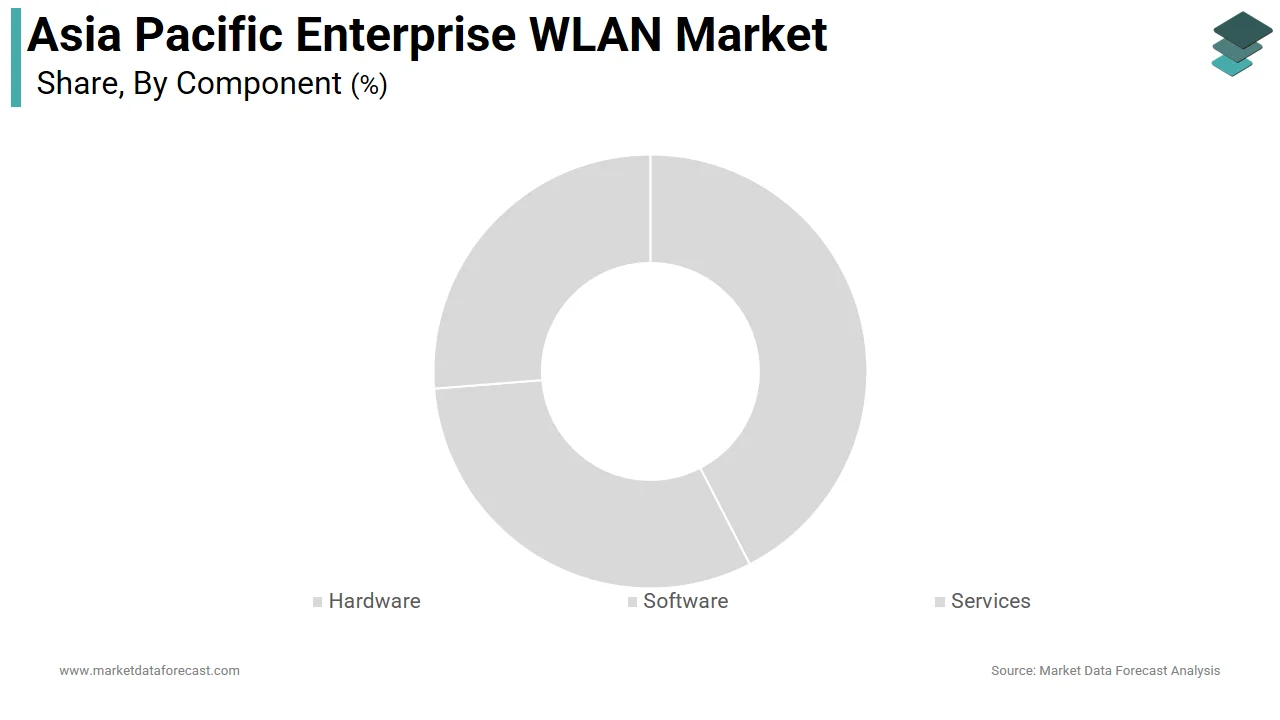
The services segment is projected to grow at the highest CAGR of 12.8% during the forecast period. The rapid expansion of this segment is attributed to the increasing demand for professional and managed WLAN services, including network design, optimization, security consulting, and cloud-based management. As enterprises seek to optimize network performance and security, the services segment is expected to witness significant growth.
By Organization Size Insights
The large enterprises segment led the Asia Pacific enterprise WLAN market in 2025. The dominance of this segment is primarily due to the high level of digital transformation investments by multinational corporations, financial institutions, and manufacturing conglomerates. These organizations require robust, scalable, and secure wireless networks to support distributed work environments, cloud integration, and IoT deployments. As digital transformation accelerates, large enterprises will continue to drive market growth.
The SME segment is projected to grow at the fastest CAGR of 13.4% during the forecast period. The growth of this segment is fueled by increasing adoption of cloud-based services, mobile workforce support, and government initiatives promoting digital infrastructure development. Additionally, in Thailand, there has been an increase in digital infrastructure investments by SMEs in the retail and hospitality sectors. As cloud-based WLAN solutions become more affordable and accessible, the SME segment is expected to experience rapid adoption across the region.
By End-User Vertical Insights
The BFSI sector prevailed in the Asia Pacific enterprise WLAN market by accounting for 28.5% of total revenue in 2024. The dominance of this segment is attributed to the sector’s increasing reliance on secure and high-speed wireless connectivity for mobile banking, digital transactions, and customer service applications. Financial institutions are deploying enterprise WLAN to support contactless payments, real-time fraud detection, and AI-driven analytics. According to the Asian Development Bank, digital banking adoption in Asia Pacific has grown notably in recent years, driven by increased smartphone penetration and mobile banking usage. Also, in India, there has been an increase in digital payment transactions in 2023, reinforcing the need for secure enterprise WLAN infrastructure. Additionally, in Japan, financial institutions were increasingly adopting AI-driven WLAN analytics to detect anomalies and prevent cyber threats. As digital banking expands, the BFSI segment is expected to remain the largest in the market.
The healthcare segment is projected to grow at the fastest CAGR of 14.2% during the forecast period. The rapid expansion of this segment is driven by the increasing adoption of IoT-enabled medical devices, telemedicine platforms, and hospital automation systems that rely on stable and secure wireless connectivity. Similarly, in Australia, there has been an increase in telehealth consultations in 2023, reinforcing the demand for high-performance wireless networks. Additionally, in Singapore, enterprise WLAN was being used to support robotic surgery, remote diagnostics, and AI-driven healthcare analytics. As digital health adoption accelerates, the healthcare segment is expected to witness the fastest growth in the enterprise WLAN market.
COUNTRY LEVEL ANALYSIS
China Enterprise WLAN Market Insights
China spearheaded the Asia Pacific enterprise WLAN market by contributing 31.3% in 2024. The country’s strong digital transformation initiatives and government-led smart city projects have driven widespread adoption of enterprise WLAN solutions. The BFSI and manufacturing sectors are key contributors, with major banks and industrial firms investing in secure, high-performance wireless networks. As China continues to expand its digital infrastructure and promote 5G-Wi-Fi integration, the enterprise WLAN market is expected to grow further.
Japan Enterprise WLAN Market Insights
Japan holds a strong position in the Asia Pacific enterprise WLAN industry. The country’s advanced digital economy and strong focus on automation and cybersecurity have driven demand for high-performance WLAN solutions. Additionally, the Japanese banking sector saw a surge in contactless payment adoption, reinforcing the need for secure wireless infrastructure. As Japan continues to advance in digital transformation and IoT integration, the enterprise WLAN market is expected to expand steadily.
India Enterprise WLAN Market Insights
India is a lucrative region in the Asia Pacific enterprise WLAN market in 2023, supported by rapid digitalization and government initiatives promoting smart infrastructure. As India continues to invest in digital transformation and smart infrastructure, the enterprise WLAN market is expected to grow steadily.
South Korea Enterprise WLAN Market Insights
South Korea contributes a notable share to the Asia Pacific enterprise WLAN market, driven by its leadership in digital innovation and 5G integration. Also, enterprise WLAN deployments in South Korea grew in recent years, with BFSI and healthcare institutions leading adoption. Additionally, enterprise WLAN was being used in hospitals for real-time patient monitoring and mobile diagnostics. The country’s focus on smart manufacturing and digital transformation further supports market growth. As South Korea continues to expand its digital infrastructure, the enterprise WLAN market is expected to grow rapidly.
Australia Enterprise WLAN Market Insights
Australia holds a notable share of the Asia Pacific enterprise WLAN market in 2023, supported by its strong digital economy and increasing adoption of cloud-based services. In addition, enterprise WLAN investments in Australia grew, driven by BFSI, healthcare, and retail sectors. There has been an increase in telehealth consultations, reinforcing the demand for high-performance wireless networks. The country’s focus on digital transformation and cybersecurity further supports market growth. As Australia continues to modernize its enterprise IT infrastructure, the demand for enterprise WLAN is expected to expand further.
COMPETITIVE LANDSCAPE
The Asia Pacific enterprise WLAN market is highly competitive, shaped by the convergence of global networking giants and agile regional players. The region’s rapid digital transformation, increasing reliance on mobile connectivity, and expansion of cloud-based infrastructure have intensified competition among vendors. Market leaders such as Cisco, Aruba, and Extreme Networks maintain a strong presence through advanced technologies, robust security features, and scalable cloud-managed solutions. At the same time, emerging players and local vendors are gaining traction by offering cost-effective, region-specific WLAN systems that cater to small and medium enterprises. The competitive landscape is further influenced by the growing demand for secure, high-density wireless networks in sectors such as BFSI, healthcare, and smart cities. Companies are differentiating themselves through AI-driven analytics, seamless integration with IoT ecosystems, and proactive customer support services. Additionally, the increasing adoption of hybrid work models and the rollout of next-generation Wi-Fi standards are prompting vendors to continuously innovate and enhance their product portfolios. This dynamic environment fosters continuous evolution, with companies striving to offer differentiated solutions that meet the diverse and evolving needs of enterprises across the Asia Pacific region.
KEY MARKET PLAYERS
Some of the noteworthy companies in the Asia Pacific enterprise WLAN market profiled in this report are
- Cisco Systems Inc.
- Huawei Technologies Co., Ltd.
- Alcatel Lucent Enterprises
- Dell Inc.
- Fortinet
TOP LEADING PLAYERS IN THE MARKET
- Cisco Systems is a global leader in enterprise networking and holds a dominant presence in the Asia Pacific enterprise WLAN market. The company provides a comprehensive portfolio of wireless infrastructure solutions, including access points, controllers, and cloud-managed services tailored for large enterprises and service providers. Cisco’s innovations in AI-driven network management, security integration, and automation have made its WLAN solutions a preferred choice across industries. Its global ecosystem, coupled with strong partnerships in the Asia Pacific region, enables it to deliver scalable and secure wireless networks that support digital transformation initiatives.
- Aruba, a Hewlett Packard Enterprise company, is a key player known for its adaptive and secure enterprise WLAN offerings. Aruba’s solutions are widely adopted across enterprises, educational institutions, and hospitality sectors in the Asia Pacific region. The company emphasizes secure mobility, cloud-native architecture, and IoT readiness in its WLAN systems. Aruba’s edge services platform integrates networking and security, making it a strategic choice for organizations looking to deploy intelligent and future-ready wireless infrastructure across the region.
- Extreme Networks has established a strong foothold in the Asia Pacific enterprise WLAN market by offering scalable, cloud-managed, and AI-enabled wireless solutions. The company is known for its customer-centric approach, providing tailored WLAN systems for both large enterprises and SMEs. Extreme Networks integrates networking with analytics and automation, enabling enterprises to optimize performance and security. Its growing presence in emerging markets and focus on hybrid cloud infrastructure have enhanced its competitiveness in the region.
TOP STRATEGIES USED BY KEY MARKET PARTICIPANTS
One of the most prominent strategies employed by key players in the Asia Pacific enterprise WLAN market is continuous innovation and product development. Companies are investing heavily in research and development to introduce next-generation WLAN solutions that support Wi-Fi 6E, cloud-managed services, and AI-driven analytics. These innovations help enterprises enhance network performance, security, and scalability to meet evolving business needs.
Another key strategy is expanding through strategic partnerships and channel ecosystems. Market leaders are collaborating with local distributors, system integrators, and managed service providers to strengthen their regional reach. These alliances help in a better understanding of regional requirements and faster deployment of customized WLAN solutions tailored to specific industries.
Lastly, enhancing cloud-based and managed service offerings has become a major focus. As enterprises increasingly shift to hybrid and remote work models, vendors are prioritizing cloud-managed WLAN platforms that offer centralized control, real-time monitoring, and automated troubleshooting. This approach allows enterprises to reduce operational complexity while ensuring secure and scalable wireless connectivity across the Asia Pacific region.
RECENT MARKET DEVELOPMENTS
- In March 2024, Cisco Systems launched a new line of AI-powered WLAN access points specifically designed for high-density enterprise environments across Asia Pacific. The launch aimed to enhance network intelligence, security, and performance for organizations undergoing digital transformation.
- In February 2024, Aruba, a Hewlett Packard Enterprise company, expanded its cloud-native WLAN management platform in China, enabling enterprises to centrally control and optimize wireless networks across multiple locations with improved security and automation capabilities.
- In January 2024, Extreme Networks partnered with a leading Indonesian managed services provider to deliver enterprise-grade WLAN solutions tailored for SMEs and educational institutions, strengthening its foothold in emerging markets across Southeast Asia.
- In May 2024, Juniper Networks entered into a strategic collaboration with a South Korean telecommunications company to deploy AI-driven enterprise WLAN infrastructure for smart city and industrial IoT applications, enhancing its regional market presence.
- In June 2024, Fortinet established a regional WLAN security innovation center in Singapore to develop integrated wireless and cybersecurity solutions for enterprises in the Asia Pacific region, addressing the growing need for secure and intelligent wireless networks.
MARKET SEGMENTATION
This Asia Pacific enterprise WLAN market research report is segmented and sub-segmented into the following categories.
By Component
- Hardware
- Access Points
- WLAN Controllers
- Wireless Hotspot Gateways
- Software
- WLAN Security
- WLAN Management
- WLAN Analytics
- Other Software
- Services
- Professional Services
- Managed Services
By Organization Size
- Large Enterprises
- Small and Medium-sized Enterprises (SME)
By End-user Vertical
- Banking, Financial Services and Insurance
- Healthcare
- Retail
- IT and Telecommunications
- Manufacturing
- Education
- Hospitality
- Other Verticals
By Deployment Mode
- On-premises
- Cloud-managed
By Country
- India
- China
- Japan
- South Korea
- Rest Of Asia Pacific