- Product Description Description
- Table of Contents TOC
- List of Table & Figure LOT
- Get Free Sample PDF Sample PDF
Market Size, 2025
$8.64 BnMarket Estimate, 2026
$9.69 BnMarket Forecast, 2034
$24.31 BnCAGR, 2026–2034
12.18%North America Enterprise WLAN Market Size
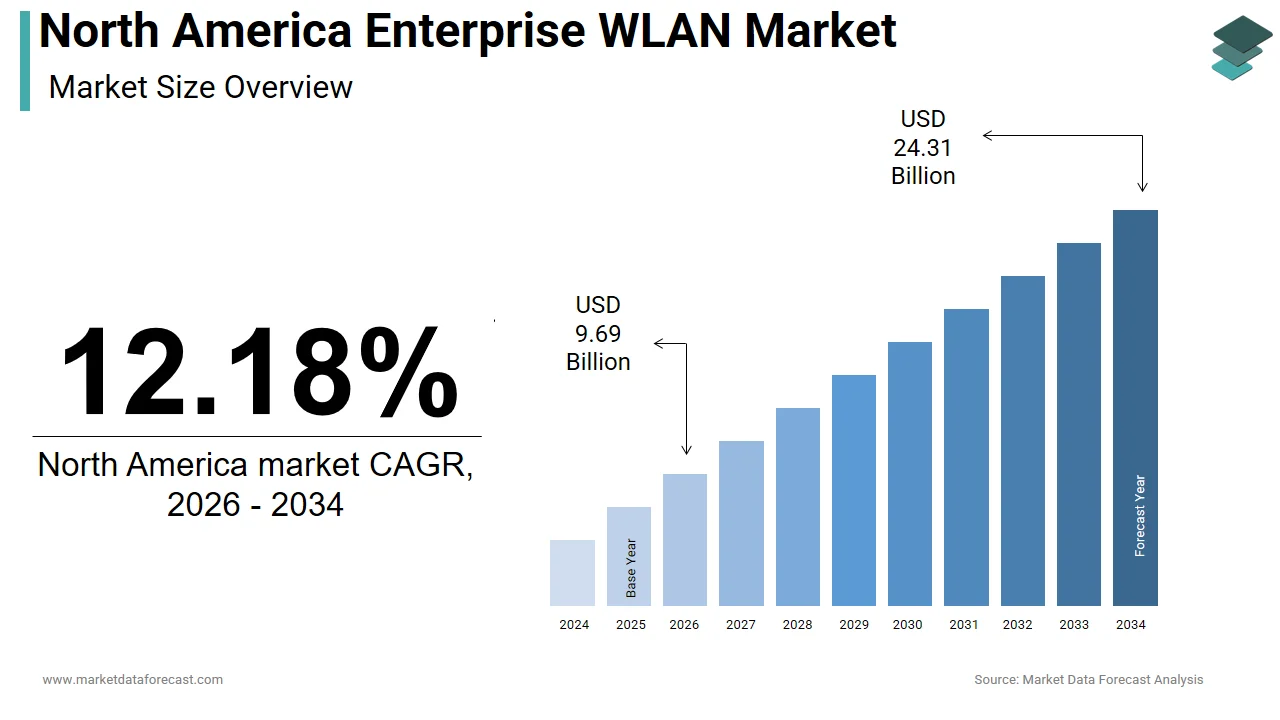
The size of the North America enterprise WLAN market stood at USD 8.64 billion in 2025. It is expected to grow from USD 9.69 billion in 2026 to USD 24.31 billion by 2034, registering a CAGR of 12.18% from 2026 to 2034.
Enterprise WLAN (Wireless Local Area Network) market refers to the deployment and management of wireless networking infrastructure within business environments to support seamless connectivity, mobility, and data communication. This market encompasses hardware such as access points, controllers, and antennas, as well as software and services for network management, security, and analytics. Enterprise WLAN solutions are widely adopted across sectors, including healthcare, education, finance, manufacturing, and retail, to enable efficient and scalable wireless connectivity.
The United States is the dominant player in this market, driven by the widespread adoption of digital transformation initiatives, increasing reliance on mobile devices, and the integration of IoT-enabled systems in enterprise environments. According to the U.S. Census Bureau, over 85% of American businesses had adopted some form of wireless networking infrastructure by 2023, with a significant portion upgrading to next-generation Wi-Fi 6 and Wi-Fi 6E standards.
Canada also plays a growing role in the regional market, particularly in the public sector and education institutions. The expansion of smart buildings and the demand for secure, high-density wireless networks in urban centers are further contributing to the region’s WLAN growth.
Additionally, the shift toward hybrid work models and the need for robust, secure, and high-performance wireless infrastructure have prompted enterprises to invest heavily in WLAN upgrades, making North America a key growth hub for vendors in this space.
MARKET DRIVERS
Rise of Hybrid Work and Remote Collaboration Tools
The rapid adoption of hybrid work models has significantly increased the demand for robust enterprise WLAN solutions across North America. As businesses adapt to flexible work arrangements, the reliance on cloud-based collaboration tools such as Microsoft Teams, Zoom, and Slack has surged.
Enterprise WLAN systems have become essential in enabling secure, high-speed access to cloud services, real-time communication platforms, and enterprise applications. As per the U.S. Chamber of Commerce, in 2023, over 70% of mid-to-large enterprises had invested in WLAN upgrades to support remote collaboration and ensure consistent network performance across office spaces, satellite offices, and co-working environments.
Moreover, the proliferation of mobile devices, including smartphones, tablets, and laptops, has further amplified the need for scalable and secure wireless networks. Enterprises are increasingly deploying Wi-Fi 6 and Wi-Fi 6E access points to manage higher device density and ensure low-latency connectivity. This trend is particularly evident in sectors such as finance, legal services, and consulting, where uninterrupted digital communication is critical to daily operations.
Integration of IoT and Smart Devices in Enterprise Environments
The increasing integration of Internet of Things (IoT) and smart devices in enterprise settings is a key driver of the North America enterprise WLAN market. Businesses across healthcare, manufacturing, retail, and logistics are deploying IoT-enabled sensors, wearables, and automation systems that rely on stable and secure wireless connectivity.
In healthcare, for instance, hospitals are utilizing WLAN-connected medical devices such as infusion pumps, patient monitors, and asset tracking systems to improve patient care and operational efficiency.
Similarly, in the manufacturing sector, industrial IoT (IIoT) devices are being used for real-time equipment monitoring and predictive maintenance. As per the National Association of Manufacturers (NAM) reported that in 2023, over 40% of manufacturers had adopted smart factory technologies, necessitating robust WLAN infrastructure to support seamless data transmission and device communication.
As enterprises continue to digitize operations and deploy smart technologies, the demand for scalable and secure WLAN solutions is expected to grow significantly.
MARKET RESTRAINTS
Cybersecurity Concerns and Network Vulnerabilities
The growing concern over cybersecurity threats and network vulnerabilities is a major restraint affecting the North America enterprise WLAN market. With the increasing reliance on wireless networks, enterprises are facing heightened risks of data breaches, unauthorized access, and malware attacks. According to the FBI’s Internet Crime Complaint Center (IC3), in 2023, there were over 800,000 reported cyber incidents in the U.S., many of which exploited vulnerabilities in wireless networks.
Enterprise WLANs, particularly those supporting a large number of mobile and IoT devices, can become entry points for cybercriminals if not properly secured.
Besides, the adoption of Bring Your Own Device (BYOD) policies has expanded the attack surface, making it more challenging for IT departments to maintain secure network access. The Ponemon Institute’s 2023 Cost of a Data Breach Report found that the average cost of a data breach involving a wireless network was $4.45 million, underscoring the financial and reputational risks associated with insecure WLAN deployments.
These concerns are prompting enterprises to delay or scale back WLAN investments until more secure and resilient solutions become available, thereby restraining market growth.
High Implementation and Maintenance Costs
The high cost of deploying and maintaining enterprise WLAN infrastructure is another significant restraint on market growth. While wireless networking offers flexibility and scalability, the initial investment required for access points, controllers, and security solutions can be substantial.
In addition to hardware expenses, enterprises must invest in professional services for network design, optimization, and security configuration. As per the Information Systems Security Association (ISSA) in 2023, nearly 45% of organizations faced budget constraints when implementing enterprise WLAN solutions, particularly in small and medium-sized businesses.
Moreover, the complexity of managing large-scale WLAN deployments often requires specialized IT staff or third-party managed service providers, further increasing operational expenses. As per the Uptime Institute’s 2023 Data Center Survey, 38% of enterprises cited cost as the primary barrier to adopting next-generation WLAN technologies such as AI-driven network analytics and cloud-managed solutions.
These financial challenges are leading some organizations to delay WLAN upgrades or opt for less comprehensive solutions, limiting the market’s expansion potential.
MARKET OPPORTUNITIES
Expansion of Smart Building and Digital Infrastructure Initiatives
The rapid expansion of smart building and digital infrastructure initiatives is a major opportunity for growth in the North America enterprise WLAN market. Governments and private enterprises are increasingly investing in intelligent building systems that integrate lighting, HVAC, security, and access control through a unified wireless network.
Smart buildings rely on a dense deployment of wireless access points to support real-time data exchange between connected devices, ensuring seamless operation of building management systems.
Also, the rise of digital transformation in urban planning, such as smart cities and connected campuses, is further boosting demand for scalable and secure wireless networks. Cities like New York, Toronto, and San Francisco have launched smart city initiatives that incorporate enterprise WLAN for public Wi-Fi, surveillance, and municipal service delivery.
As smart infrastructure continues to evolve, the enterprise WLAN market is well-positioned to benefit from the increasing need for reliable and high-capacity wireless connectivity.
Adoption of Cloud-Managed and AI-Driven WLAN Solutions
The growing adoption of cloud-managed and AI-driven WLAN solutions presents a significant opportunity for market expansion. Enterprises are increasingly shifting from on-premises WLAN infrastructure to cloud-based platforms that offer centralized management, scalability, and predictive analytics.
Cloud-managed WLAN solutions allow IT teams to monitor, configure, and optimize wireless networks remotely, reducing operational overhead and improving network performance. As per the Computing Technology Industry Association (CompTIA), in 2023, cloud-based WLAN deployments reduced network downtime by an average of 30% compared to traditional on-premises setups.
Also, AI-driven WLAN systems are gaining traction for their ability to self-optimize, detect anomalies, and enhance security. As per the IEEE 2023 Networking Conference, AI-enabled WLAN solutions could improve network efficiency by up to 40% through dynamic channel selection and load balancing.
As enterprises seek greater agility and operational efficiency, the demand for intelligent and cloud-native WLAN solutions is expected to grow, offering new growth avenues for market players.
MARKET CHALLENGES
Interoperability Issues with Legacy Systems
The interoperability issues arising from the coexistence of legacy systems and modern wireless infrastructure. Many enterprises still operate older networking equipment that does not support the latest Wi-Fi standards, leading to compatibility problems and performance bottlenecks. According to the IEEE 2023 Networking Report, over 40% of enterprises in North America were still using networking hardware that supported only Wi-Fi 5 or earlier standards.
This technological disparity results in network inefficiencies, slower data transmission speeds, and increased latency, particularly in high-density environments such as corporate offices and educational institutions.
Besides, maintaining backward compatibility with older devices while ensuring seamless connectivity for newer ones presents a challenge for IT departments. As per the SANS Institute in 2023, managing a hybrid network environment required additional configuration, security patching, and firmware updates, increasing operational complexity.
As businesses continue to modernize their wireless infrastructure, resolving interoperability issues remains a critical challenge that can impact deployment timelines and overall network performance.
Spectrum Congestion and Network Performance Degradation
Spectrum congestion is another significant challenge for the North America enterprise WLAN market, particularly in urban and high-density environments. As the number of connected devices continues to grow, the limited availability of radio frequency spectrum leads to interference, reduced throughput, and inconsistent connectivity.
This congestion is particularly problematic in office buildings, airports, and educational campuses where thousands of devices operate simultaneously. As per the Wi-Fi Alliance in 2023, in high-density deployments, network performance could degrade by up to 40% due to overlapping channels and inefficient spectrum utilization.
To mitigate this issue, enterprises are increasingly adopting Wi-Fi 6E, which utilizes the 6 GHz band to provide additional spectrum and reduce interference. However, the transition requires compatible hardware and regulatory approvals, which can delay implementation. The FCC’s 2023 spectrum allocation report indicated that while 6 GHz access had expanded, full adoption across enterprise environments would take several years.
As the demand for wireless connectivity continues to surge, managing spectrum congestion remains a critical challenge that affects network reliability and user experience.
REPORT COVERAGE
| REPORT METRIC | DETAILS |
| Market Size Available | 2025 to 2034 |
| Base Year | 2025 |
| Forecast Period | 2026 to 2034 |
| Segments Covered | By Component, Organization Size, End-user Vertical, Deployment Mode, and Region. |
| Various Analyses Covered | Global, Regional and Country-Level Analysis, Segment-Level Analysis, Drivers, Restraints, Opportunities, Challenges; PESTLE Analysis; Porter’s Five Forces Analysis, Competitive Landscape, Analyst Overview of Investment Opportunities |
| Countries Covered | United States, Canada, Mexico, Rest of North America |
| Market Leaders Profiled | Cisco Systems Inc., Huawei Technologies Co., Ltd., Aruba, Alcatel Lucent Enterprises, Dell Inc., Extreme Networks, Inc., Fortinet, and others. |
SEGMENTAL ANALYSIS
By Component Insights
The hardware segment led the North America enterprise WLAN market by capturing 55.5% of total revenue in 2024. The continuous expansion of enterprise IT infrastructure, particularly in large organizations that require high-density wireless coverage, is one of the key drivers of this segment’s dominance. This segment includes wireless access points (APs), controllers, antennas, and other physical infrastructure necessary for deploying and maintaining enterprise-grade wireless networks. These advanced hardware solutions offer higher throughput, lower latency, and improved spectral efficiency, making them essential for high-traffic environments such as corporate offices, educational institutions, and healthcare facilities. Additionally, the increasing deployment of IoT and mobile devices in enterprise settings has driven demand for additional access points to support seamless connectivity. As organizations continue to modernize their networking infrastructure, the hardware segment remains the cornerstone of enterprise WLAN adoption.
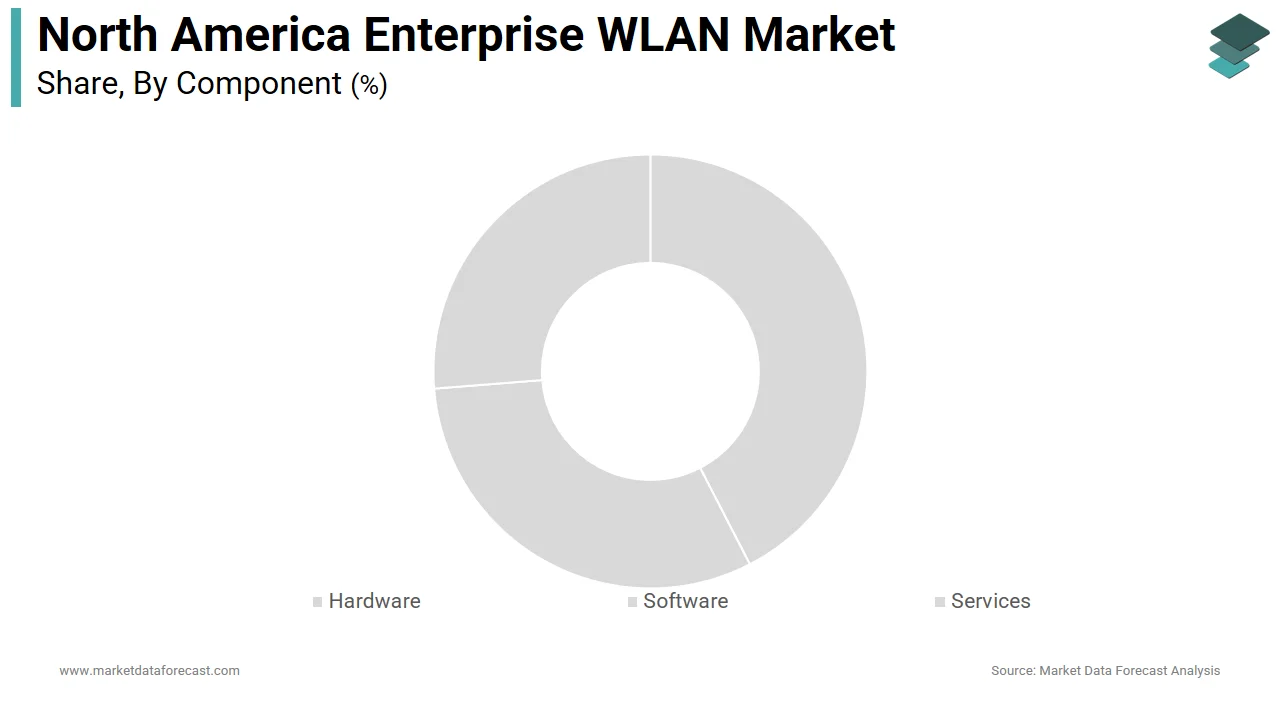
The services segment is projected to grow at the fastest CAGR of 12.3% between 2026 to 2034. The increasing complexity of enterprise WLAN deployments, particularly with the adoption of AI-driven analytics, cloud-managed systems, and secure access service edge (SASE) architectures, is a major driver of this segment’s rapid growth. This segment includes professional services such as network design, deployment, integration, and managed services, as well as ongoing support and maintenance offerings. Additionally, the growing reliance on managed services to reduce operational overhead and ensure continuous network availability is fueling demand. As per the Uptime Institute’s 2023 Data Center Survey, 45% of enterprises had shifted to managing WLAN services to reduce IT staffing costs and improve network reliability. As enterprises increasingly adopt hybrid work models and digital transformation initiatives, the need for expert support and ongoing optimization is expected to drive sustained growth in the services segment.
By Organization Size Insights
The large enterprise segment held the largest share of the North America enterprise WLAN market of 68.4% of total revenue in 2024. The widespread adoption of smart building technologies and IoT-enabled systems in large organizations is one of the key factors behind this segment. This dominance is also driven by the extensive digital infrastructure requirements of multinational corporations, government agencies, and healthcare institutions that demand high-capacity, secure, and scalable wireless networks. Large enterprises are also early adopters of Wi-Fi 6E and cloud-managed WLAN solutions, enabling seamless connectivity across distributed locations. Additionally, the rise of hybrid work models and the need for secure, high-performance wireless networks in corporate campuses and data centers have further fueled demand.
The SME segment is projected to grow at the fastest CAGR of 13.6% between 2026 to 2034. The adoption of digital transformation initiatives among SMEs, particularly in the retail, hospitality, and professional services sectors, is one of the key growth drivers. This rapid growth is attributed to the increasing affordability of enterprise-grade WLAN solutions and the shift toward cloud-managed networking, which allows smaller businesses to deploy advanced wireless infrastructure without significant upfront investment. Cloud-managed WLAN solutions, offered as subscription-based services, have made it easier for SMEs to scale their networks as needed. Additionally, the proliferation of mobile devices and the need for secure guest Wi-Fi in small businesses have contributed to increased WLAN adoption. As more SMEs embrace wireless networking to enhance productivity and customer experience, this segment is poised for strong growth.
By End-User Vertical Insights
The healthcare sector led the North America enterprise WLAN market by accounting for 24% of total revenue in 2024. This dominance is driven by the sector’s increasing reliance on wireless connectivity for patient monitoring, medical device integration, and real-time data access across hospitals and clinics. A further driver of this segment’s growth is the widespread deployment of IoT-enabled medical devices such as infusion pumps, cardiac monitors, and asset tracking systems. The ability to support mobility and real-time health data access is crucial for improving patient care and operational efficiency. Additionally, the healthcare sector has seen a surge in telemedicine and remote diagnostics, which require high-speed and secure wireless networks. As hospitals continue to digitize operations and adopt AI-driven diagnostics, the demand for robust wireless infrastructure is expected to remain strong.
The education sector is projected to grow at the fastest CAGR of 14.2% between 2026 to 2034. This growth is driven by the increasing adoption of digital learning tools, hybrid education models, and the need for secure, high-density wireless networks in schools and universities. A different key growth factor is the expansion of 1:1 device programs, where students are provided with laptops or tablets for digital learning. Universities have also increased their investment in smart classrooms and collaborative learning environments, further boosting demand. Additionally, the shift toward cloud-based educational platforms and video conferencing tools has increased reliance on wireless networks. As digital transformation in education continues to accelerate, the education vertical is expected to remain the fastest-growing segment in the enterprise WLAN market.
COUNTRY-LEVEL ANALYSIS
United States Enterprise WLAN Market Insights
The United States held the dominant position in the North America enterprise WLAN market by capturing 82.5% of total revenue in 2024. This lead position is driven by the country’s strong digital infrastructure, widespread adoption of smart technologies, and high investment in enterprise IT across multiple sectors. A further key factor contributing to the U.S. market’s dominance is the rapid expansion of cloud-managed networking solutions. The education, healthcare, and retail sectors have been particularly active in deploying next-generation Wi-Fi 6 and Wi-Fi 6E access points to support high-density device environments. Also, the presence of leading WLAN vendors and a strong ecosystem of managed service providers has facilitated widespread adoption. As per the Computing Technology Industry Association (CompTIA) in 2023, over 60% of enterprises outsourced WLAN deployment and maintenance to managed service providers, indicating a mature and well-developed market landscape.
Canada Enterprise WLAN Market Insights
Canada holds a significant share of the North America enterprise WLAN market. The market is primarily driven by strong investment in digital transformation across the public sector, education, and healthcare industries. One of the key contributors to Canada’s market position is the widespread adoption of enterprise WLAN in educational institutions. Additionally, the healthcare sector in Canada has seen a surge in the deployment of IoT-enabled medical devices that rely on wireless connectivity. As government agencies and private enterprises continue to invest in smart buildings and cloud-based networking solutions, Canada’s enterprise WLAN market is expected to maintain steady growth.
Rest of North America Enterprise WLAN Market Insights
The Rest of North America, primarily consisting of Mexico and select Caribbean territories, holds a smaller but steadily growing share of the regional enterprise WLAN market. The market is driven by increasing digital transformation initiatives in the education, healthcare, and retail sectors. Mexico is the primary contributor to this segment, with growing investment in enterprise WLAN infrastructure across urban centers such as Mexico City, Monterrey, and Guadalajara. Additionally, the education sector in Mexico has seen increased deployment of digital learning tools, supported by government-led initiatives to expand internet access in schools. As digital infrastructure continues to expand, the Rest of North America is expected to experience sustained growth in enterprise WLAN adoption.
COMPETITIVE LANDSCAPE
The competition in the North America enterprise WLAN market is intense and marked by the presence of established global players and emerging vendors striving to capture market share through innovation and differentiation. The market is evolving rapidly due to the growing demand for high-density connectivity, cloud-managed infrastructure, and AI-powered network optimization. While Cisco maintains a strong lead, companies like Aruba and Extreme Networks continue to challenge the status quo by offering agile, cloud-native solutions tailored for specific verticals.
Innovation is a key battleground, with vendors focusing on AI-driven analytics, secure access service edge (SASE) integration, and automated network management to improve performance and security. Additionally, the rise of hybrid work models and the increasing reliance on IoT and mobile devices are pushing companies to differentiate through advanced features and superior customer support.
Strategic acquisitions, partnerships, and ecosystem development are also shaping the competitive landscape, as vendors aim to expand their capabilities beyond hardware into comprehensive digital infrastructure solutions. As enterprises continue to prioritize digital transformation, the competition is expected to intensify, with a greater emphasis on cloud, security, and intelligent networking.
KEY MARKET PLAYERS
Noteworthy Companies dominating the North America enterprise WLAN market are
- Cisco Systems Inc.
- Huawei Technologies Co., Ltd.
- Aruba
- Alcatel Lucent Enterprises
- Dell Inc.
- Extreme Networks, Inc.
- Fortinet
TOP LEADING PLAYERS IN THE MARKET
- Cisco is a global leader in enterprise networking and holds a dominant position in the North America enterprise WLAN market. The company is known for its comprehensive portfolio of wireless access points, controllers, and cloud-managed networking solutions. Cisco’s innovations in AI-driven network analytics, secure access, and integration with its broader networking ecosystem have made its WLAN offerings a preferred choice among large enterprises and government institutions. Its commitment to security, scalability, and performance continues to reinforce its leadership in the market.
- Aruba is a key player in the enterprise WLAN space, offering a wide range of hardware, software, and cloud-based solutions tailored for diverse industries. The company is recognized for its adaptive cloud architecture and AI-powered network optimization tools that enhance user experience and operational efficiency. Aruba’s strong focus on hybrid work environments and smart building technologies has made it a preferred partner for organizations seeking intelligent and secure wireless infrastructure across North America.
- Extreme Networks is a growing force in the enterprise WLAN market, offering scalable and secure wireless solutions designed for enterprise and campus environments. Known for its cloud-driven management platforms and AI-enabled analytics, Extreme provides enterprises with intelligent networking capabilities that support digital transformation. The company’s strategic acquisitions and emphasis on customer-centric innovation have strengthened its position in the North American market, particularly in the education and healthcare sectors.
TOP STRATEGIES USED BY KEY MARKET PARTICIPANTS
Innovation through AI and Cloud-Managed Solutions Leading companies are investing heavily in AI-driven network analytics and cloud-managed WLAN platforms to enhance performance, security, and ease of management. These technologies allow enterprises to optimize wireless connectivity, predict and resolve network issues proactively, and streamline operations without the need for on-premises infrastructure.
Expansion of Managed and Professional Services Offerings To meet the growing demand for expert support, vendors are expanding their managed services portfolios, offering end-to-end WLAN deployment, monitoring, and maintenance. This shift allows enterprises to focus on core operations while ensuring continuous network performance and security without the burden of in-house management.
Strategic Partnerships and Ecosystem Integration Key players are forming strategic alliances with cloud providers, cybersecurity firms, and IoT platform vendors to create integrated networking ecosystems. These partnerships enable seamless interoperability, enhance security postures, and provide customers with unified digital transformation solutions tailored to their industry-specific needs.
RECENT MARKET DEVELOPMENTS
- In February 2023, Cisco introduced a new AI-driven wireless assurance platform designed to enhance network performance and automatically detect and resolve connectivity issues. This innovation was aimed at improving user experience and reducing IT workload for enterprise customers.
- In June 2023, Aruba launched a cloud-native WLAN solution tailored for mid-sized enterprises, offering simplified deployment, centralized management, and built-in security features. This move was intended to expand Aruba’s presence in the SME segment and accelerate cloud adoption.
- In October 2023, Extreme Networks announced a strategic partnership with a leading cybersecurity firm to integrate advanced threat detection capabilities into its WLAN infrastructure. The collaboration was designed to enhance network security and offer a more holistic approach to enterprise wireless protection.
- In January 2024, Cisco acquired a cloud-based network analytics startup to strengthen its cloud-managed WLAN offerings and enhance its ability to deliver real-time insights and automation for enterprise customers across North America.
- In May 2024, Aruba unveiled a new line of Wi-Fi 6E access points optimized for high-density environments such as stadiums, universities, and corporate campuses. This product launch was aimed at meeting the growing demand for faster, more reliable wireless connectivity in large-scale deployments.
MARKET SEGMENTATION
This North America enterprise WLAN market research report is segmented and sub-segmented into the following categories.
By Component
- Hardware
- Access Points
- WLAN Controllers
- Wireless Hotspot Gateways
- Software
- WLAN Security
- WLAN Management
- WLAN Analytics
- Other Software
- Services
- Professional Services
- Managed Services
By Organization Size
- Large Enterprises
- Small and Medium-sized Enterprises (SME)
By End-user Vertical
- Banking, Financial Services and Insurance
- Healthcare
- Retail
- IT and Telecommunications
- Manufacturing
- Education
- Hospitality
- Other Verticals
By Deployment Mode
- On-premises
- Cloud-managed
By Country
- United States
- Canada
- Mexico
- Rest of North America