North America Wi-Fi Chipset Market Size, Share, Trends & Growth Forecast Report By Band (Single, Dual, Tri Band), MIMO Configuration (SU-MIMO, MU-MIMO), Standards (IEEE 802.11ay, IEEE 802.11ad, IEEE 802.11ax [Wi-Fi 6 & 6E], IEEE 802.11ac, IEEE 802.11n [SB and DB], IEEE 802.11b/G), Application (Smartphones, Tablet, Desktop PC, Laptop, Connected Home Devices, Others), and Country (United States, Canada, Mexico, Rest of North America) – Industry Analysis, 2026 to 2034
Market Size, 2025
$8.61 BnMarket Estimate, 2026
$8.91 BnMarket Forecast, 2034
$11.77 BnCAGR, 2026–2034
3.53%North America Wi-Fi Chipset Market Size
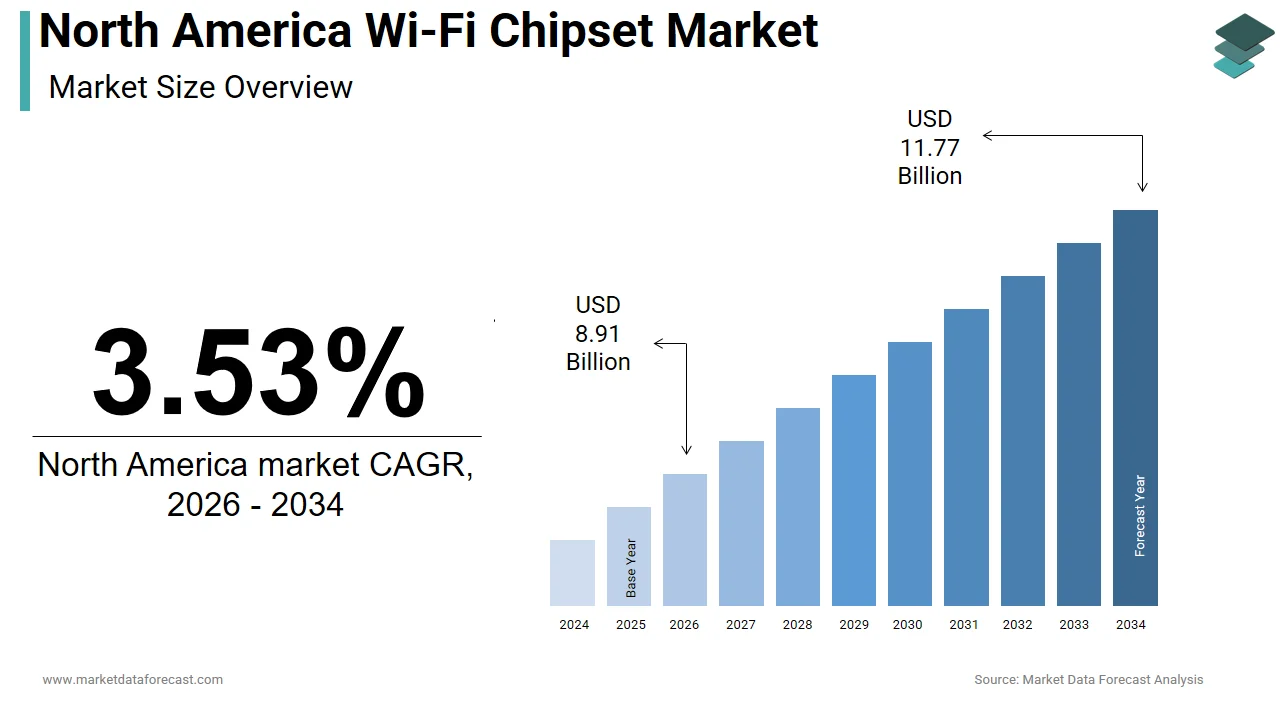
The size of the North America Wi-Fi chipset market was worth USD 8.61 billion in 2025. The regional market is anticipated to grow at a CAGR of 3.53% from 2026 to 2034 and be worth USD 11.77 billion by 2034 from USD 8.91 billion in 2026.
The Wi-Fi chipset is a semiconductor component designed to enable wireless connectivity across consumer, enterprise, and industrial applications. These chipsets are embedded in smartphones, routers, IoT devices, automotive systems, and smart home appliances, facilitating seamless internet access and data transmission. The integration of Wi-Fi 6 and Wi-Fi 6E standards is accelerating across enterprise networks, particularly in sectors like healthcare and finance, where latency and high throughput lare ow. The Federal Communications Commission (FCC) allocated the 6 GHz band for unlicensed use in 2020, which is further boosting innovation in next-generation Wi-Fi chipsets across the continent.
MARKET DRIVERS
Surge in Smart Home and IoT Device Adoption
The widespread adoption of smart home and Internet of Things (IoT) devices is amplifying the growth of the North America Wi-Fi chipset market. Consumers in the U.S. and Canada are increasingly investing in smart speakers, security cameras, thermostats, and lighting systems that rely on Wi-Fi connectivity for real-time data exchange and remote control. This growing ecosystem of interconnected devices necessitates efficient and reliable Wi-Fi chipsets capable of handling multiple simultaneous connections without compromising speed or stability. Chipset manufacturers have responded by integrating advanced technologies such as dual-band and tri-band support, beamforming, and improved power efficiency into their designs. Moreover, the convergence of artificial intelligence and edge computing within smart homes is pushing the need for more intelligent Wi-Fi solutions.
Expansion of Enterprise and Industrial Wireless Networks
The rapid expansion of enterprise and industrial wireless networks is fuelling the growth of the North America Wi-Fi chipset market. Businesses across sectors ranging from healthcare and education to logistics and manufacturing are increasingly relying on high-performance Wi-Fi infrastructure to support digital transformation initiatives. As per IDC, spending on enterprise networking equipment in North America reached $21 billion in 2024, with Wi-Fi access points accounting for nearly 40% of this expenditure. Wi-Fi 6 and Wi-Fi 6E have emerged as enablers of this transition, offering higher data rates, reduced latency, and improved network efficiency. In hospitals, for example, these standards are being used to support real-time patient monitoring systems, telemedicine platforms, and AI-driven diagnostic tools. In industrial settings such as smart factories and warehouses, Wi-Fi chipsets are integral to enabling automation through connected sensors, robotics, and asset tracking systems. The Industrial Internet Consortium reported that over 65% of North American manufacturers were piloting or deploying Wi-Fi-based IIoT solutions by the end of 2023.
MARKET RESTRAINTS
Spectrum Congestion and Regulatory Constraints
The growing issue of spectrum congestion and evolving regulatory constraints is restricting the growth of the North America Wi-Fi chipset market. This overcrowding leads to signal interference, degraded performance, and inconsistent connectivity in densely populated urban areas and enterprise environments. According to the National Telecommunications and Information Administration (NTIA), the 2.4 GHz and 5 GHz bands, which have traditionally been the backbone of Wi-Fi communications, are nearing capacity limits in many metropolitan regions. This challenge is exacerbated by the overlapping channels and lack of dynamic frequency management in legacy Wi-Fi architectures. Furthermore, regulatory bodies are continuously updating compliance requirements around emissions, power levels, and coexistence protocols. These changes often necessitate costly redesigns of existing chipsets to meet new standards, delaying product launches and increasing time-to-market. For instance, the FCC’s recent review of unlicensed device operations in the 6 GHz band may impose additional restrictions on outdoor use, potentially limiting the deployment of high-range Wi-Fi 6E and Wi-Fi 7 solutions. As a result, chipset manufacturers must invest heavily in research and development to overcome spectral limitations through innovations such as cognitive radio, advanced channel bonding, and improved antenna design.
Supply Chain Disruptions and Component Shortages
The persistent supply chain disruptions and semiconductor component shortages is also limiting the growth of the North America Wi-Fi chipset market. The global semiconductor industry has faced unprecedented bottlenecks since 2020, primarily due to pandemic-related factory shutdowns, geopolitical tensions, and surging demand across multiple sectors. North America, despite being home to several leading chipmakers, remains vulnerable to delays in raw material procurement, wafer fabrication, and packaging capacities concentrated in Asia-Pacific. According to the Semiconductor Industry Association (SIA), lead times for RF components and substrates used in Wi-Fi chipsets remained above 30 weeks in early 2024, significantly longer than the pre-pandemic average of 8 to 12 weeks. Additionally, rising costs of silicon wafers, gallium arsenide, and copper substrates have increased production expenses.
MARKET OPPORTUNITIES
Integration of Wi-Fi 7 in Next-Generation Devices
The adoption of Wi-Fi 7 technology in next-generation consumer and enterprise devices is greatly influencing the growth of the North America Wi-Fi chipset market. Wi-Fi 7, also known as IEEE 802.11be, introduces groundbreaking features such as multi-link operation (MLO), 320 MHz channel width, and 4K-QAM modulation, enabling theoretical speeds exceeding 40 Gbps. This represents a substantial leap from Wi-Fi 6’s peak throughput of 9.6 Gbps, positioning Wi-Fi 7 as a cornerstone for future digital experiences. Leading technology firms such as Qualcomm, MediaTek, and Broadcom have already launched Wi-Fi 7-capable chipsets aimed at premium smartphones, gaming consoles, and ultra-low-latency applications like extended reality (XR) and cloud gaming. Moreover, enterprise adoption of Wi-Fi 7 is gaining momentum in sectors requiring ultra-reliable and high-density connectivity. For instance, financial institutions and tech campuses are beginning to pilot Wi-Fi 7 access points to support AI-driven analytics, 8K video conferencing, and hybrid work environments.
Growth of Automotive Wi-Fi Connectivity
The automotive sector is expanding with the increasing integration of connected vehicle technologies is promoting new opportunities for the growth of the North America Wi-Fi chipset market. Modern vehicles are evolving into mobile data hubs, equipped with infotainment systems, telematics units, V2X (vehicle-to-everything) communication modules, and OTA (over-the-air) update capabilities all of which depend on robust wireless connectivity. Automakers such as Tesla, Ford, and General Motors are embedding multi-gigabit Wi-Fi chipsets to support high-definition mapping, streaming services, and passenger hotspot access. These systems not only enhance in-car entertainment but also facilitate secure communication between the vehicle and cloud-based services for diagnostics, software updates, and predictive maintenance. Qualcomm’s Snapdragon Auto Connectivity Platform, for instance, supports Wi-Fi 6 and Bluetooth 5.3, enabling seamless device pairing and ultra-low-latency connectivity.
MARKET CHALLENGES
Rising Cybersecurity Threats in Wi-Fi Networks
The escalating threat landscape surrounding wireless network security is hampering the growth of the North America Wi-Fi chipset market. As more personal, enterprise, and industrial devices connect via Wi-Fi, they become potential targets for cyberattacks, including man-in-the-middle attacks, ransomware propagation, and unauthorized network access. According to the Cybersecurity and Infrastructure Security Agency (CISA), there was a 40% increase in reported Wi-Fi-related cyber incidents in the U.S. during 2023 alone. Wi-Fi chipsets, which serve as the first line of defense in securing wireless communications, must incorporate advanced encryption mechanisms, intrusion detection systems, and secure boot processes to mitigate these risks. However, retrofitting legacy devices with updated security protocols poses a significant challenge, especially in industrial and healthcare settings where equipment lifecycles can span a decade or more. Moreover, the proliferation of open and public Wi-Fi hotspots exacerbates the problem. As per OpenSignal, over 60 million public Wi-Fi access points exist in North America, many of which operate without adequate encryption or authentication measures.
Interoperability and Standardization Issues Across Wi-Fi Generations
Interoperability and standardization issues are restricting the growth of the North America Wi-Fi chipset market as newer generations of Wi-Fi protocols emerge alongside older ones. The coexistence of Wi-Fi 4, Wi-Fi 5, Wi-Fi 6, and Wi-Fi 7 standards within the same network environment often leads to compatibility conflicts, inconsistent performance, and suboptimal utilization of available bandwidth. According to the Wi-Fi Alliance, nearly 40% of enterprise IT administrators reported encountering interoperability problems when integrating mixed-standard Wi-Fi devices in 2024. These challenges are particularly acute in heterogeneous environments such as smart homes, where consumers own devices spanning multiple Wi-Fi generations from legacy printers using 802.11n to modern smartphones supporting Wi-Fi 6E. Ensuring backward compatibility while maintaining optimal throughput and latency requires sophisticated chipset design, including adaptive modulation schemes and intelligent traffic prioritization.
REPORT COVERAGE
| REPORT METRIC | DETAILS |
| Market Size Available | 2025 to 2034 |
| Base Year | 2025 |
| Forecast Period | 2026 to 2034 |
| Segments Covered | By Band, MIMO Configuration, Standards, Application, and Region. |
| Various Analyses Covered | Global, Regional and Country-Level Analysis, Segment-Level Analysis, Drivers, Restraints, Opportunities, Challenges; PESTLE Analysis; Porter’s Five Forces Analysis, Competitive Landscape, Analyst Overview of Investment Opportunities |
| Countries Covered | United States, Canada, Mexico, Rest of North America |
| Market Leaders Profiled | Qualcomm Technologies, Inc., Broadcom, Intel Corporation, MediaTek, Inc., Infineon Technologies, and others. |
SEGMENTAL ANALYSIS
By Band Insights
The dual-band Wi-Fi chipsets segment was the largest and held 58.3% of the North America Wi-Fi chipset market share in 2025, with its ability to balance performance and cost-effectiveness. Unlike single-band solutions, which operate solely on the congested 2.4 GHz frequency, dual-band chipsets offer simultaneous access to both 2.4 GHz and 5 GHz bands. Additionally, enterprises are increasingly deploying dual-band access points to support high-density environments such as office campuses and retail locations. According to IDC, enterprise Wi-Fi infrastructure spending in North America exceeded $19 billion in 2024, with dual-band APs accounting for nearly half of all installations. The proliferation of video conferencing tools and cloud-based collaboration platforms has further reinforced demand for stable and high-throughput connectivity, which is making dual-band Wi-Fi chipsets indispensable in modern network design.
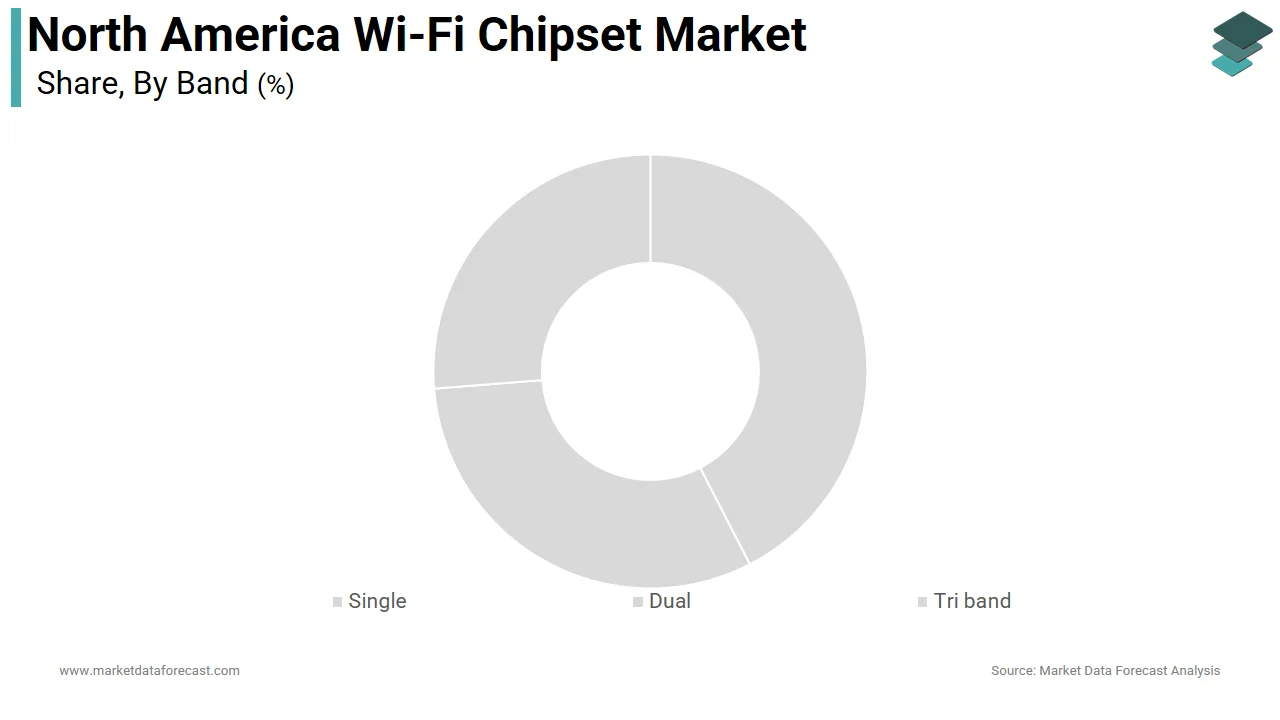
The tri-band Wi-Fi chipsets segment is lucratively growing with a CAGR of 19.6% from 2026 to 2034, with the rise of mesh networking systems, particularly among households with multiple connected devices. As per Parks Associates, approximately 45% of broadband-connected U.S. homes now use mesh Wi-Fi systems, many of which incorporate tri-band technology to dedicate one band exclusively for backhaul communication between nodes. Moreover, the gaming and streaming industries are accelerating tri-band chipset integration. The enterprise adoption of tri-band infrastructure is gaining momentum, especially in sectors like finance and healthcare, where real-time data transmission is required.
By MIMO Configuration Insights
The SU-MIMO segment was accounted for in holding 52.3% of the North America Wi-Fi chipset market share in 2024, with the SU-MIMO’s continued relevance is its compatibility with older Wi-Fi standards such as IEEE 802.11n and early iterations of 802.11ac. According to the Wi-Fi Alliance, over 40% of active Wi-Fi devices in North America still rely on SU-MIMO-based architectures in industrial IoT deployments, small businesses, and rural broadband access points where budget constraints limit upgrades to newer technologies. Additionally, SU-MIMO remains widely used in mobile devices such as smartphones, tablets, and wearables, where hardware limitations restrict support for more complex antenna arrays.
The MU-MIMO segment is expected to grow with an expected CAGR of 21.4% in the coming years, with the surge in enterprise-grade Wi-Fi infrastructure, particularly in large organizations, educational institutions, and public venues. As per Dell'Oro Group, enterprise Wi-Fi 6 access point shipments in North America grew by 34% in 202,4 with nearly all new models supporting MU-MIMO to optimize spectrum utilization in dense user environments. In addition, residential demand for MU-MIMO-enabled routers is increasing alongside the proliferation of smart home devices. Parks Associates reported that the average U.S. broadband household now owns over 13 connected devices, necessitating advanced concurrency management features that only MU-MIMO can provide. Leading router manufacturers such as Netgear, ASUS, and TP-Link have responded by incorporating 4x4 and 8x8 MU-MIMO antennas into flagship models. Moreover, advancements in Wi-Fi 6E and Wi-Fi 7 standards have further propelled MU-MIMO integration by enabling multi-gigabit speeds and ultra-low latency for applications like cloud gaming, VR/AR, and telemedicine.
By Standards Insights
The IEEE 802.11ac segment held 38.2% of the North America Wi-Fi chipset market share in 2024 with the widespread deployment across consumer electronics, enterprise networking gear, and service provider routers during the mid-2010s, creating a vast installed base that remains operational today. According to ABI Research, over 150 million Wi-Fi 5 chipsets were deployed in North America in 2024, primarily in budget smartphones, set-top boxes, and industrial control units where full Wi-Fi 6 capabilities are not yet essential. Furthermore, the prevalence of 802.11ac in enterprise access points, especially in schools, hospitals, and small-to-medium businesses, continues to drive demand. As per IDC, nearly 45% of enterprise Wi-Fi access points deployed in North America in 2024 supported Wi-Fi 5, often as part of hybrid network setups that include newer Wi-Fi 6 nodes.
The Wi-Fi 6 and Wi-Fi 6E segment is lucratively growing with an expected CAGR of 26.3% from 2026 to 2034 due to its integration into the latest generation of smartphones, laptops, and tablets. Qualcomm’s FastConnect 6900 and MediaTek’s Filogic 380 chips are examples of industry-leading solutions accelerating this transition. Additionally, enterprise adoption of Wi-Fi 6 infrastructure is surging. Wi-Fi 6E’s extension into the 6 GHz band, enabled by FCC regulations, has also spurred innovation in areas such as AR/VR, cloud computing, and automated manufacturing.
COUNTRY-LEVEL ANALYSIS
United States Wi-Fi Chipset Market Insights
The United States held 78.3% of the North America Wi-Fi chipset market share in 2024. With a global hub for technological innovation and digital infrastructure development, the U.S. leads in the deployment of next-generation Wi-Fi solutions across consumer, enterprise, and industrial domains.
The country’s robust ecosystem of semiconductor firms, including Qualcomm, Broadcom, Intel, and Marvell, which continue to pioneer advancements in Wi-Fi 6, Wi-Fi 6E, and Wi-Fi 7 chipsets, is expected to fuel the growth of the market in this country. According to the Semiconductor Industry Association (SIA), U.S.-based companies accounted for over 45% of global Wi-Fi SoC revenues in 2024. Additionally, the widespread adoption of smart home technologies, enterprise mobility, and cloud-based services has fueled demand for high-performance Wi-Fi chipsets. As per Statista, over 93 million U.S. households owned at least one smart speaker in 2024, each requiring stable Wi-Fi connectivity.
Canada Wi-Fi Chipset Market Insights
Canada was ranked second by holding 14.3% of the North America Wi-Fi chipset market share in 2024, with strong urbanization rates, increasing smart city projects, and expanding digital infrastructure investments. The country’s well-developed telecommunications sector and high broadband penetration make it a key market for next-generation Wi-Fi technologies. In addition, the Canadian enterprise sector is embracing Wi-Fi 6 and Wi-Fi 6E for office automation, contactless payments, and telehealth services. As per IDC Canada, enterprise IT spending on wireless networking equipment rose by 19% in 2024, with a notable shift toward high-density Wi-Fi deployments in banking, education, and healthcare sectors. Consumer adoption is also on the rise, with over 85% of Canadian households owning at least two Wi-Fi-enabled devices, as reported by the Canadian Radio-television and Telecommunications Commission (CRTC).
COMPETITIVE LANDSCAPE
The competition in the North America Wi-Fi chipset market is characterized by intense technological rivalry and strategic maneuvering among established semiconductor giants. The market sees active participation from both vertically integrated firms and specialized chipset providers, each vying for dominance across consumer, enterprise, and industrial applications. Innovation cycles have shortened, pushing vendors to deliver cutting-edge solutions at an accelerated pace. Additionally, differentiation through proprietary enhancements in antenna design, power management, and security protocols plays a crucial role in maintaining competitive advantage.
KEY MARKET PLAYERS
Noteworthy Companies dominating the North America Wi-Fi chipset market profiled in the report are
- Qualcomm Technologies, Inc.
- Broadcom
- Intel Corporation
- MediaTek, Inc.
- Infineon Technologies
TOP LEADING PLAYERS IN THE MARKET
- One of the leading players in the North America Wi-Fi chipset market is Qualcomm Technologies, Inc. The company has a strong presence across mobile and enterprise segments, offering advanced Wi-Fi solutions integrated into smartphones, routers, and automotive platforms. Qualcomm’s continuous innovation in Wi-Fi 6, Wi-Fi 6E, and upcoming Wi-Fi 7 technologies positions it as a key enabler of high-speed wireless connectivity. Its strategic partnerships with device manufacturers and infrastructure providers further enhance its influence in shaping next-generation Wi-Fi ecosystems.
- Another major player is Broadcom Inc., known for its extensive portfolio of networking and wireless communication solutions. Broadcom supplies Wi-Fi chipsets to a wide range of industries, including enterprise, automotive, and consumer electronics. The company’s focus on integrating Wi-Fi with broader connectivity solutions, such as Bluetooth and Ethernet, strengthens its competitive edge. Broadcom's acquisition-driven growth strategy and deep integration into OEM supply chains contribute significantly to its sustained dominance in the global and regional markets.
- Intel Corporation also holds a prominent position in the North America Wi-Fi chipset market, particularly in the PC and enterprise networking sectors. Intel’s Wi-Fi solutions are widely embedded in laptops and desktops, ensuring seamless connectivity for both personal and professional users. The company continues to advance its Thunderbolt and Wi-Fi 6/6E offerings, enhancing performance and compatibility across computing platforms. Intel’s emphasis on co-developing hardware-software ecosystems supports its long-standing relevance in the evolving wireless landscape.
TOP STRATEGIES USED BY KEY MARKET PARTICIPANTS
One major strategy employed by key players in the North America Wi-Fi chipset market is continuous innovation through R&D investment. Companies are heavily investing in developing next-generation Wi-Fi standards such as Wi-Fi 7, focusing on features like multi-link operation, higher throughput, and lower latency. These advancements enable them to maintain technological dominance and meet growing demand from high-performance applications in enterprise and consumer domains.
The strategic partnerships and ecosystem collaborations is another strategy for the players in the North America Wi-Fi chipset market. Leading vendors collaborate with device manufacturers, network operators, and software developers to ensure seamless integration of their Wi-Fi chipsets into end-user products. These alliances help accelerate product adoption and enhance interoperability across diverse platforms, strengthening market positioning.
Companies are adopting acquisition-based expansion to consolidate their capabilities and broaden their product portfolios. By acquiring smaller firms specializing in niche areas such as IoT connectivity or network security, key players can rapidly scale their offerings and enter new verticals, with their dominance in the competitive landscape.
RECENT MARKET DEVELOPMENTS
- In January 2024, Qualcomm introduced its next-generation FastConnect 7800 system, which is designed to support Wi-Fi 7 and ultra-low latency applications. This launch reinforces Qualcomm’s prominence in mobile connectivity and enhances its footprint across smartphones, laptops, and extended reality (XR) devices.
- In March 2024, Broadcom announced a collaboration with a leading cloud service provider to integrate its Wi-Fi 6E solutions into enterprise data centers. This partnership aims to improve wireless performance for high-density environments and strengthen Broadcom’s presence in business networking infrastructure.
- In June 2024, Intel launched a new line of Thunderbolt 5 controllers featuring integrated Wi-Fi 6E capabilities. The move is intended to streamline connectivity in PCs and workstations, offering faster data transfer rates and improved wireless performance for professional users.
- In November 2024, MediaTek partnered with a major North American telecom operator to develop customized Wi-Fi 6E gateways for residential broadband services. This collaboration is expected to enhance MediaTek’s visibility in the U.S. home networking market and drive broader adoption of its Wi-Fi solutions.
MARKET SEGMENTATION
This North America Wi-Fi chipset market research report is segmented and sub-segmented into the following categories.
By Band
- Single
- Dual
- Tri band
By MIMO Configuration
- SU-MIMO
- MU-MIMO
- 1x1 MU-MIMO
- 2x2 MU-MIMO
- 3x3 MU-MIMO
- 4x4 MU-MIMO
- 8x8 MU-MIMO
By Standards
- IEEE 802.11ay
- IEEE 802.11ad
- IEEE 802.11ax (Wi-Fi 6 & Wi-Fi 6E)
- IEEE 802.11ac
- IEEE 802.11n (SB and DB)
- EEE 802.11b/G
By Application
- Smartphones
- Tablet
- Desktop PC
- Laptop
- Connected home devices
- Others
By Country
- United States
- Canada
- Mexico
- Rest of North America
Frequently Asked Questions
1. What are the major growth drivers of the North America Wi-Fi Chipset Market?
Key drivers include surging demand for high-speed and reliable wireless connectivity, rapid adoption of Wi-Fi 6/6E and Wi-Fi 7 standards, IoT expansion, and integration with smart home, industrial, and automotive applications
2. Who are the major players in the North America Wi-Fi Chipset Market?
Leading companies include Qualcomm Technologies, Broadcom, Intel Corporation, MediaTek, Texas Instruments, Marvell Technology, NXP Semiconductors, and Infineon (formerly Cypress Semiconductor)
3. How is the market segmented by Wi-Fi standard in the North America Wi-Fi Chipset Market?
The market is segmented by standards such as Wi-Fi 4, Wi-Fi 5, Wi-Fi 6, Wi-Fi 6E, and Wi-Fi 7, with rapid growth seen in Wi-Fi 6/6E and emerging adoption of Wi-Fi 7 chipsets
4. What applications are driving demand in the North America Wi-Fi Chipset Market?
Major applications include consumer electronics (smartphones, tablets, PCs, TVs), enterprise/commercial networking, automotive infotainment, healthcare devices, and industrial IoT solutions
5. How does Wi-Fi 7 impact the North America Wi-Fi Chipset Market?
Wi-Fi 7 chipsets provide higher throughput, lower latency, and improved multi-device capacity, supporting bandwidth-intensive applications such as gaming, AR/VR, and 8K streaming
6. What trends are shaping the North America Wi-Fi Chipset Market?
Key trends include integration of Wi-Fi with 5G networks, AI-enhanced power management, development of multi-band and tri-band chipsets, and a focus on security and energy efficiency
7. Which segment leads in market share: single-band, dual-band, or tri-band chipsets?
Dual-band chipsets are most widely adopted, but tri-band chipsets—favoring advanced enterprise and home mesh systems—are the fastest-growing segment
8. How does the competitive landscape look in the North America Wi-Fi Chipset Market?
Competition is intense, with companies investing in R&D, partnerships, and acquisitions to develop next-gen chipsets, increase efficiency, and secure strategic supply agreements
9. How do regulatory and spectrum issues affect the North America Wi-Fi Chipset Market?
Spectrum allocation (such as for Wi-Fi 6E in the 6 GHz band) and regulatory compliance significantly influence product development and market deployment schedules
10. What are the main challenges for the North America Wi-Fi Chipset Market?
Major challenges include high integration and development costs, evolving cybersecurity threats, supply chain disruptions, and the pace of technology transition
Related Reports
Access the study in MULTIPLE FORMATS
Purchase options starting from
$ 2000
Didn’t find what you’re looking for?
TALK TO OUR ANALYST TEAM
Need something within your budget?
NO WORRIES! WE GOT YOU COVERED!
Call us on: +1 888 702 9696 (U.S Toll Free)
Write to us: sales@marketdataforecast.com