- Product Description Description
- Table of Contents TOC
- List of Table & Figure LOT
- Get Free Sample PDF Sample PDF
Market Size, 2025
$7.76 BnMarket Estimate, 2026
$8.32 BnMarket Forecast, 2034
$14.51 BnCAGR, 2026–2034
7.20%Executive Summary: Global Automated Truck Loading System Market
- Market Scope: Comprehensive market evaluation of the global automated truck loading system (ATLS) industry, covering loading dock types, conveyor/system variants, end-use industrial sectors, and regional geographic frameworks.
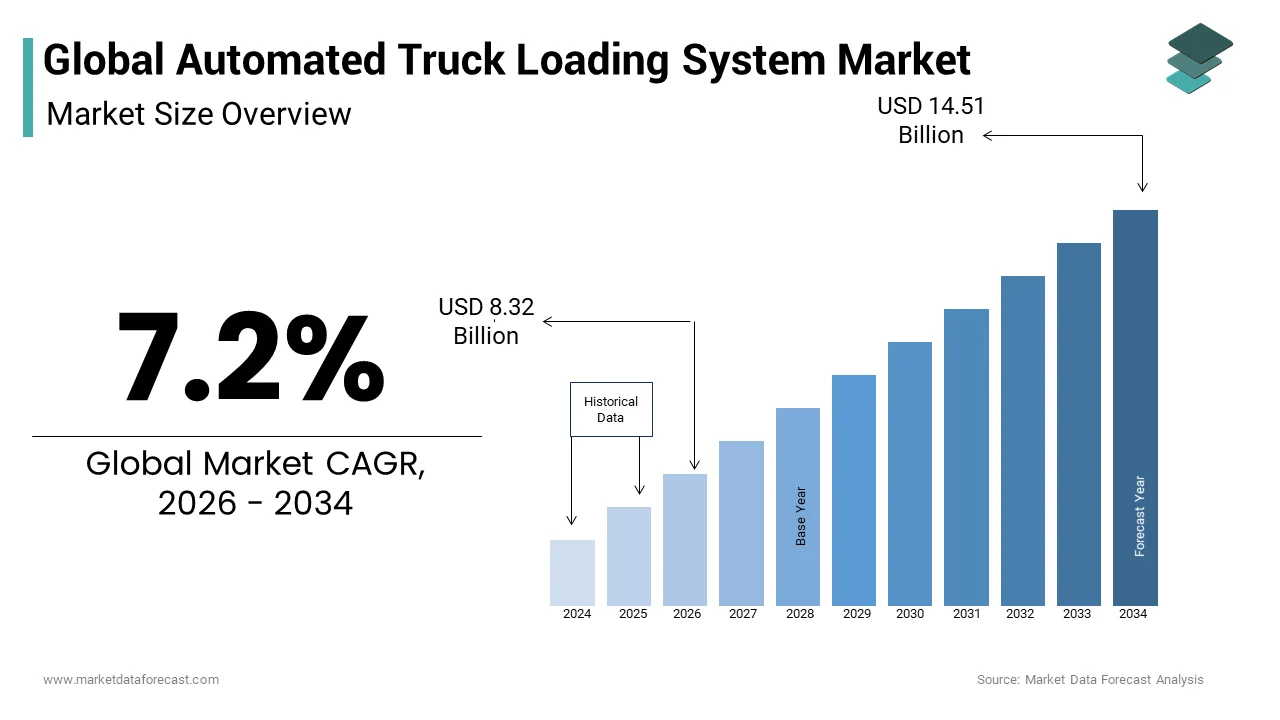
- Market Valuation: Valued at USD 7.76 billion (2025), estimated at USD 8.32 billion in 2026, and projected to reach USD 14.51 billion by 2034, registering a CAGR of 7.2% (2026–2034).
- Primary Growth Drivers: Significant reduction of manual labor and turnaround times, enhanced workplace safety and minimized accident risks, precision loading capabilities, and the rising demand for accelerated, streamlined supply chain operations globally.
Key Market Segment Metrics (2026–2034)
| Category | Leading Segment / Position | Fastest-Growing / Key Segment |
|---|---|---|
| By Loading Dock | Flush Dock (holds the largest share due to its simplicity, versatility, space-saving attributes, and compatibility with diverse truck types) | Sawtooth Dock (substantial share favored for high-volume, simultaneous processing and large-scale distribution) |
| By System Type | Belt Conveyor Systems (leading market demand thanks to high efficiency, simplicity, telescopic automation accuracy, and ease of maintenance) | Roller Track Conveyor Systems (registering a healthy CAGR for moderate-weight item transport and smooth track movement) |
| By Industry | FMCG (stands at the forefront accounting for the major market share driven by quick, accurate distribution of food, beverages, and household goods) | Automotive & Post & Parcel (holding substantial shares backed by high-volume production and e-commerce logistics demands) |
| By Region | Europe (dominant player owing to advanced manufacturing, robust logistics infrastructure, and strong emphasis on labor cost reduction) | Asia-Pacific (rapidly growing second-largest market driven by rapid manufacturing and e-commerce expansion in China, India, and surrounding economies) |
Major Market Participants & Market Structure
Market Structure: Competitive global marketplace characterized by specialized industrial automation providers and material handling technology leaders focusing on predictive maintenance, automated guided vehicle (AGV) integrations, and cross-continental partnerships.
Key Companies: Haver & Boecker, Joloda International, Secon Components, The Heico Companies (Ancra Systems), Actiw, BEUMER Group, Cargo Floor, Euroimpianti, and FLSmidth Ventomatic.
Global Automated Truck Loading System Market Size
The global automated truck loading system market size was valued at USD 7.76 billion in 2025 and is anticipated to reach a valuation of USD 8.32 billion in 2026 and USD 14.51 billion by 2034, growing at a CAGR of 7.2% from 2026 to 2034.
Automated truck loading system includes telescopic belt conveyors, automated guided vehicles, and robotic palletizers that integrate with warehouse management systems to optimize logistics throughput. According to the Occupational Safety and Health Administration, manual material handling injuries account for approximately 35% of all workplace injuries in the logistics sector, highlighting the critical need for automation to enhance worker safety. According to the International Labour Organization, musculoskeletal disorders resulting from repetitive lifting cost global economies an estimated 20 billion dollars annually in healthcare and lost productivity. As per the Council of Supply Chain Management Professionals, average dwell times for trucks at distribution centers have increased by 15% due to labor shortages, necessitating faster turnaround solutions. Regulatory frameworks, such as the European Union Directive on Manual Handling of Loads, mandate strict limits on weight and frequency of manual lifting, which is driving adoption of mechanical aids. The market definition extends beyond simple conveyor belts to include intelligent systems capable of real-time load optimization and integration with autonomous yard management protocols. This technological evolution reflects a paradigm shift toward fully automated supply chain nodes where speed, accuracy, and safety are paramount for maintaining competitive advantage in high-volume distribution networks.
MARKET DRIVERS
Critical Labor Shortages in Logistics and Warehousing
The persistent and deepening shortage of warehouse and logistics personnel propels the expansion of the global automated truck loading system market. According to the American Trucking Associations, the logistics industry faces a deficit of over 80,000 drivers and warehouse workers, creating bottlenecks that delay shipments and increase operational costs. According to the Bureau of Labor Statistics, turnover rates in warehousing and storage exceed 40% annually, which is forcing companies to constantly recruit and train new staff, which is both time-consuming and expensive. Automated truck loading systems mitigate this dependency by enabling continuous operation regardless of staffing levels, ensuring that goods are loaded efficiently even during peak demand periods or shift changes. These systems reduce the physical strain on remaining workers, allowing them to focus on higher-value tasks such as quality control and inventory management rather than repetitive heavy lifting. The ability to operate with minimal human intervention makes automated loading an attractive solution for distribution centers struggling to fill entry-level positions. Consequently, the urgency to stabilize workforce capacity drives significant investment in automation technologies that promise reliability and consistency in labor-constrained environments.
Urgent Need for Enhanced Workplace Safety and Injury Reduction
Stringent occupational health regulations and the high cost of workplace injuries drive the global automated truck loading system market forward. As per the National Safety Council, work-related injuries in the transportation and warehousing sector result in over 1.2 million lost workdays annually, costing employers billions in compensation and insurance premiums. According to the European Agency for Safety and Health at Work, back injuries and musculoskeletal disorders account for 60% of all reported accidents in manual loading operations, prompting stricter enforcement of safety standards. Automated truck loading systems remove workers from dangerous environments, such as inside trailers where risks of falls, crushing, and exposure to extreme temperatures are prevalent. By mechanizing the loading process, companies significantly reduce the incidence of acute and chronic injuries, leading to lower insurance premiums and improved employee retention. Compliance with international safety standards, such as ISO 45001, becomes easier to achieve with automated systems that provide consistent and predictable operational parameters. The financial and ethical imperative to protect worker well-being compels logistics providers to replace manual processes with safer, automated alternatives. This regulatory and moral pressure ensures sustained growth for systems that prioritize human safety alongside operational efficiency.
MARKET RESTRAINTS
High Initial Capital Investment and Integration Costs
The substantial upfront financial burden associated with purchasing, installing, and integrating automated truck loading systems is impeding the automated truck loading system market growth, particularly for small and medium-sized logistics providers. According to the Material Handling Industry, the average cost of implementing a fully automated truck loading solution ranges from 100,000 to 500,000 dollars depending on complexity and customization requirements, excluding ongoing maintenance expenses. According to the Small Business Administration, 45% of logistics companies cite budget constraints as the primary barrier to adopting advanced automation technologies, limiting market penetration among smaller players. The integration of these systems with existing warehouse management software and facility infrastructure often requires extensive retrofitting and engineering services, further escalating total project costs. For many organizations, the return on investment period extends beyond three years, making it difficult to justify the expenditure in low-margin operating environments. Financial institutions may perceive high-tech automation as risky collateral, limiting access to necessary capital for expansion. This economic barrier restricts widespread adoption to large enterprises with deep pockets, leaving a significant portion of the market underserved. Consequently, the high entry cost slows down the overall growth rate of the automated truck loading system market despite clear long-term benefits.
Complexity of Retrofitting Legacy Infrastructure
The technical difficulty of integrating modern automated truck loading systems into older warehouse facilities with non-standardized dock designs is further hampering the global market expansion. As per the Warehouse Education and Research Council, over 60% of existing distribution centers in North America were built before 2000, featuring dock layouts that are incompatible with contemporary automated loading equipment. According to the International Association of Logistics Professionals, retrofitting legacy docks to accommodate automated systems can increase project timelines by 30 to 50% due to structural modifications and electrical upgrades required. Variations in trailer heights, dock leveler conditions, and building column placements necessitate custom engineering solutions for each installation, increasing complexity and cost. Many older facilities lack the digital infrastructure necessary to support smart loading systems, requiring parallel upgrades to network connectivity and software platforms. The disruption caused during installation can halt operations, leading to revenue losses that deter facility managers from pursuing upgrades. The lack of universal standards for dock interfaces further complicates interoperability between different vendors' equipment. These technical hurdles create friction in the adoption process, causing delays and discouraging potential buyers who fear operational downtime and unforeseen complications during implementation.
MARKET OPPORTUNITIES
Expansion of E-Commerce and Last-Mile Delivery Networks
The explosive growth of e-commerce and the consequent demand for rapid last-mile delivery offer substantial opportunities for the global automated truck loading system market. According to the United Nations Conference on Trade and Development, global e-commerce sales reached 29.2 trillion dollars in 2023, driving an unprecedented volume of parcels through logistics networks that require faster processing speeds. According to the National Retail Federation, same-day and next-day delivery expectations have increased order fulfillment pressure by 40%, necessitating highly efficient loading operations to meet tight dispatch windows. Automated truck loading systems enable continuous and rapid transfer of goods, reducing truck dwell times and allowing for more frequent departures, which is critical for meeting consumer delivery promises. The ability to handle diverse package sizes and weights automatically supports the mixed-SKU nature of e-commerce orders without slowing down operations. As retailers expand their distribution networks to closer proximity to urban centers, the need for compact and efficient loading solutions grows. This trend toward speed and flexibility positions automated loading systems as essential infrastructure for modern e-commerce logistics providers seeking to maintain competitive service levels.
Integration with Internet of Things and Smart Warehouse Technologies
The convergence of automated truck loading systems with Internet of Things sensors and artificial intelligence offers significant opportunities for the global market. As per the International Data Corporation, spending on Internet of Things solutions in the logistics sector is projected to reach 15 billion dollars by 2025, enabling real-time visibility and control over loading processes. According to the MIT Center for Transportation and Logistics, smart loading systems equipped with sensors can improve load stability and space utilization by 20% by analyzing package dimensions and weight distribution in real time. These intelligent systems communicate with warehouse management platforms to coordinate inbound and outbound flows, minimizing congestion at dock doors. Predictive maintenance capabilities enabled by IoT connectivity reduce unplanned downtime by identifying potential equipment failures before they occur. The data generated by these systems provides valuable insights into operational bottlenecks, allowing managers to optimize staffing and scheduling. This technological integration transforms loading docks from passive transfer points into active nodes of information, enhancing overall supply chain efficiency. Companies that leverage these smart capabilities gain a competitive edge through improved accuracy and reduced operational costs.
MARKET CHALLENGES
Lack of Standardization in Trailer and Pallet Dimensions
The absence of universal standards for trailer sizes, pallet dimensions, and packaging formats is a significant challenge of the global automated truck loading system market. According to the International Organization for Standardization, while pallet standards exist, variations in regional practices mean that over 30% of loads in global supply chains do not conform to uniform dimensions, complicating automated handling. According to the European Pallet Association, differences between Euro pallets and standard US pallets require adaptable gripping mechanisms and software adjustments, increasing system complexity and cost. Automated systems struggle to handle irregularly shaped items or non-standard packaging, which are common in certain industries such as retail and automotive parts. The variability in trailer floor conditions and door widths further exacerbates alignment issues, requiring sophisticated sensor arrays and adaptive control algorithms to ensure safe operation. Manufacturers must design flexible systems capable of accommodating a wide range of variables, which increases development time and price. This lack of standardization limits the scalability of automated solutions and requires extensive customization for each client. Until global harmonization of logistics standards occurs, this heterogeneity remains a persistent technical hurdle for widespread adoption.
Resistance to Change and Workforce Displacement Concerns
Cultural resistance to automation and concerns regarding job displacement among warehouse workers are further challenging the global market expansion. As per the International Trade Union Confederation, surveys indicate that 55% of logistics workers fear that automation will lead to job losses, creating morale issues and potential labor disputes during transition periods. According to the Society for Human Resource Management, companies implementing automation without adequate change management strategies experience a 25% drop in productivity during the initial rollout phase due to employee skepticism and lack of engagement. Unions may oppose the introduction of automated systems, citing threats to collective bargaining agreements and job security, leading to prolonged negotiations and delays. The perception that machines replace human effort rather than augment it creates a hostile environment for innovation. Companies must invest heavily in retraining programs and communication campaigns to alleviate fears and demonstrate the value of upskilling. Failure to address these human factors can result in sabotage, low adoption rates, and negative public relations. Managing the social impact of automation is as critical as the technical implementation for successful deployment.
REPORT COVERAGE
| REPORT METRIC | DETAILS |
| Market Size Available | 2025 to 2034 |
| Base Year | 2025 |
| Forecast Period | 2026 to 2034 |
| CAGR | 7.2% |
| Segments Covered | By Loading Dock, System, Industry and Region |
| Various Analyses Covered | Global, Regional & Country Level Analysis, Segment-Level Analysis, DROC, PESTLE Analysis, Porter’s Five Forces Analysis, Competitive Landscape, Analyst Overview on Investment Opportunities |
| Regions Covered | North America, Europe, APAC, Latin America, Middle East & Africa |
| Market Leaders Profiled | Haver & Boecker, Joloda International, Secon Components, The Heico Companies, Actiw, BEUMER Group, Cargo Floor, Euroimpianti, FLSmidth Ventomatic and Others. |
SEGMENTAL ANALYSIS
By Loading Dock Insights
The flush docks segment led the market with the largest share of the global market in 2025. The growth of the flush docks segment in the global market is attributed to their widespread adoption in modern distribution centers and manufacturing facilities where seamless integration with warehouse flooring is prioritized for efficiency and safety. The dominance of flush docks is further driven by their ability to maximize usable warehouse space and facilitate smooth material flow without the obstructions associated with elevated or sawtooth configurations. According to the Warehousing Education and Research Council, flush dock designs allow for 15% more efficient use of floor space compared to traditional raised platforms because they eliminate the need for extensive ramp structures and approach areas. According to the Material Handling Industry, facilities utilizing flush docks experience a 20% reduction in vehicle maneuvering time as trucks can back directly into the loading bay with minimal alignment adjustments. This streamlined access is critical for automated truck loading systems, which require precise positioning to engage telescopic conveyors or robotic arms effectively. The level transition between the dock and the trailer floor reduces the risk of product damage during transfer and minimizes wear on automated equipment. Furthermore, flush docks support higher throughput volumes by enabling simultaneous loading and unloading operations across multiple bays without traffic congestion. As logistics providers seek to optimize real estate costs and increase turnover rates, the spatial advantages of flush docks make them the preferred choice for new construction and major renovations in high-volume distribution networks.
On the other hand, the enclosed docks segment is estimated to record a promising CAGR of 9.4% over the forecast period in the global market owing to the rising need for climate-controlled environments and security in sensitive supply chains. The rapid growth of enclosed docks is fueled by the expanding pharmaceutical and food industries, which require strict temperature control during the loading and unloading process to maintain product integrity. According to the International Air Transport Association, over 40% of perishable goods suffer quality degradation due to temperature excursions during transit and handling, highlighting the critical need for sealed loading environments. According to the Food and Drug Administration, compliance with cold chain regulations has become stricter, with penalties for violations increasing by 20% annually, driving investment in enclosed docking solutions. Enclosed docks create an airtight seal around the truck trailer, preventing exposure to external weather conditions such as heat, rain, or snow, which can compromise refrigerated loads. Automated truck loading systems integrated within these enclosures ensure rapid transfer times, minimizing the duration doors are open and further preserving internal temperatures. This capability is essential for distributing vaccines, fresh produce, and frozen foods, where even brief exposure can result in significant financial loss. As global trade in perishable goods expands, the demand for enclosed docks that guarantee thermal continuity continues to rise sharply.
By System Insights
The belt conveyor systems segment held the dominant share in the global automated truck loading system market in 2025 due to their versatility, reliability, and ability to handle a wide variety of package types including irregularly shaped items and soft goods. The leadership of belt conveyor systems is further attributed to their ability to transport virtually any type of packaged good without the risk of damage or jamming that affects other conveyor technologies. According to the Material Handling Institute, belt conveyors account for over 60% of all automated loading installations in general merchandise and e-commerce distribution centers because they provide a continuous smooth surface for stable transport. According to the Council of Supply Chain Management Professionals, belt systems can handle packages ranging from small envelopes to large boxes weighing up to 50 kilograms with consistent speed and accuracy. This flexibility is essential for modern distribution centers that process mixed-SKU orders with varying dimensions and weights. The friction provided by the belt ensures that items remain stationary during incline or decline movements, preventing slippage and misalignment. Unlike roller or skate systems, belt conveyors do not require specific bottom surface characteristics, allowing them to handle bags, cartons, and polywrapped items equally well. This universal compatibility reduces the need for multiple specialized loading lines, simplifying facility design and operation. As e-commerce continues to diversify product offerings, the adaptability of belt conveyor systems ensures their continued dominance in the market.
However, the roller track conveyor systems segment is estimated to witness a CAGR of 10.1% over the forecast period in the global market owing to their ability to move heavy uniform loads such as pallets and standardized cases at high speeds with minimal energy consumption. According to the Modern Materials Handling magazine, roller tracks can achieve throughput rates of up to 100 pallets per hour, which is 40% faster than traditional belt systems for unitized loads. According to the Grocery Manufacturers Association, the food and beverage industry, which relies heavily on palletized distribution, is increasingly adopting roller track systems to meet tight delivery windows and reduce truck dwell times. The low-friction design of roller tracks allows heavy items to glide effortlessly, requiring less motor power and reducing energy costs. This efficiency is particularly valuable in high-volume distribution centers where speed is a key competitive advantage. Roller tracks are also ideal for integration with automated guided vehicles and robotic palletizers, which require precise and rapid transfer points. As supply chains prioritize speed and efficiency for bulk goods, the adoption of roller track systems is accelerating rapidly.
By Industry Insights
The FMCG segment dominated the market by holding the leading share of the global market in 2025 due to the extremely high volume of goods processed and the critical need for speed and efficiency in distribution networks. The dominance of the FMCG sector is driven by the sheer volume of products such as packaged foods, beverages, and household items that must be moved quickly from manufacturing plants to retail outlets. According to the Consumer Goods Forum, the global FMCG market generates over 10 trillion dollars in annual revenue, with supply chains operating on thin margins that demand maximum operational efficiency. According to the Retail Industry Leaders Association, FMCG distributors handle millions of cases daily, requiring automated loading systems to keep pace with production outputs and prevent bottlenecks. Manual loading cannot match the speed required to load trucks within the short dwell times typical of FMCG logistics, often less than 30 minutes per truck. Automated systems ensure continuous flow, reducing labor costs and increasing the number of trips per day. The consistency of packaging in FMCG also makes it ideal for automation, allowing for standardized handling processes. As consumer demand for immediate availability grows, the pressure on FMCG supply chains intensifies, reinforcing the need for advanced loading automation.
However, the post & parcel segment represents the fastest growing segment in the automated truck loading system market and is anticipated to grow at a CAGR of 11.5% over the forecast period owing to the unprecedented surge in online shopping, which has generated billions of individual parcels requiring efficient sorting and loading. According to the Universal Postal Union, global parcel volumes reached 159 billion in 2023, representing a 10% annual increase that strains traditional manual loading capabilities. According to the National Postal Forum, peak season volumes can double regular throughput, necessitating scalable automated solutions that can handle fluctuating demand without proportional increases in labor. Automated truck loading systems enable postal operators to process small irregular packages quickly and accurately, reducing the time trucks spend at hubs. The ability to integrate with high-speed sortation systems allows for seamless transfer from sorting lines directly into delivery vehicles. This end-to-end automation is critical for meeting next-day and same-day delivery promises that define modern postal services. As e-commerce penetration continues to grow globally, the post and parcel sector will continue to drive demand for advanced loading automation.
REGIONAL ANALYSIS
North America Market Analysis
North America had the dominating share of the global market in 2025 and is likely to maintain robust growth and strong market dominance for the next few years due to advanced logistics infrastructure, high labor costs, and strong adoption of automation technologies. According to the MHI Annual Report, the United States accounts for over 40% of global material handling equipment sales, reflecting the region’s commitment to modernizing supply chains. According to the American Trucking Associations, driver and warehouse labor shortages have reached critical levels, prompting widespread investment in automated loading solutions to maintain productivity. The presence of major e-commerce giants and third-party logistics providers accelerates the deployment of advanced systems in distribution centers. Regulatory focus on workplace safety further encourages adoption by reducing manual handling risks. High energy efficiency standards also drive demand for modern automated systems that consume less power than older manual methods. The mature market sees continuous upgrades and replacements, ensuring steady growth. Strong vendor presence and technical support networks facilitate easy implementation and maintenance. These factors sustain North America’s leadership in the global automated truck loading market.
Europe Market Analysis
Europe is poised for steady, regulation-driven expansion over the coming years. Europe represents a significant and mature market characterized by stringent labor regulations and a strong emphasis on sustainability and worker safety. As per the European Agency for Safety and Health at Work, strict directives on manual handling have compelled logistics companies to adopt automated solutions to comply with legal requirements. According to Eurostat, labor costs in Western Europe are among the highest globally, making automation an economic necessity for maintaining competitiveness. The region leads in the adoption of green logistics practices, driving demand for energy-efficient automated loading systems. Government incentives for digital transformation and Industry 4.0 initiatives support investment in smart loading technologies. The well-developed rail and road infrastructure facilitates efficient distribution networks that benefit from automated loading speeds. High awareness of ergonomic benefits drives acceptance among workforce and unions. Established manufacturers and integrators provide robust local support. These regulatory and economic drivers ensure steady and sustainable market growth in Europe.
Asia Pacific Market Analysis
Asia Pacific is anticipated to exhibit the most aggressive expansion trajectory in the near future. Asia Pacific is the fastest-growing regional market for Automated Truck Loading Systems, fueled by rapid industrialization, expansion of e-commerce, and rising labor costs in key economies. According to the Asian Development Bank, the region’s e-commerce market is projected to reach 2 trillion dollars by 2025, driving massive investments in logistics infrastructure. According to the China Federation of Logistics and Purchasing, automation adoption in Chinese distribution centers has increased by 25% annually as companies seek to improve efficiency and reduce reliance on manual labor. Rising wages in countries like China and India are eroding the cost advantage of manual loading, prompting a shift toward automation. Government initiatives such as Made in China 2025 prioritize smart manufacturing and logistics, encouraging technology uptake. The presence of major global manufacturers and local tech firms fosters innovation and competitive pricing. Rapid urbanization increases demand for fast delivery services, requiring efficient loading operations. These dynamic factors position Asia Pacific as the primary engine of future growth for the automated truck loading market.
Latin America Market Analysis
Latin America is expected to experience gradual acceleration and increasing adoption in the upcoming years. Latin America presents an emerging market with growing potential, driven by modernization of retail sectors and increasing foreign investment in logistics infrastructure. As per the Inter-American Development Bank, investments in supply chain technology in the region have grown by 12% annually as companies seek to improve service levels and reduce costs. According to the Brazilian Logistics Association, high turnover rates and labor instability are prompting major retailers and manufacturers to explore automated loading solutions. The expansion of organized retail and e-commerce platforms creates demand for faster and more reliable distribution networks. Economic volatility remains a challenge, but long-term trends favor automation. Government efforts to improve trade facilitation and infrastructure support market development. Local partnerships with global technology providers enhance access to advanced solutions. While currently smaller than other regions, the market is poised for significant growth as economic conditions stabilize and awareness of automation benefits increases.
Middle East and Africa Market Analysis
The Middle East and Africa region is projected to witness emerging development and localized adoption phases over the next few years. The Middle East and Africa region displays nascent but developing interest in Automated Truck Loading Systems, supported by major infrastructure projects and economic diversification strategies. According to the Gulf Cooperation Council Standardization Organization, member states are investing heavily in world-class logistics hubs to position themselves as global trade gateways. According to the African Union, improvements in port and inland terminal infrastructure are creating opportunities for modern loading technologies to enhance throughput and efficiency. High temperatures and harsh working conditions in the region make automated solutions attractive for improving worker safety and comfort. Government visions such as Saudi Vision 2030 prioritize logistics sector development, encouraging adoption of advanced technologies. Limited local expertise requires reliance on international vendors for implementation and support. While market size is currently small, strategic investments in key hubs like Dubai and Johannesburg signal future growth potential. As trade volumes increase and labor markets evolve, the region is expected to see gradual but steady adoption of automated truck loading systems.
COMPETITIVE LANDSCAPE
The competitive landscape of the Automated Truck Loading System Market is characterized by intense rivalry among specialized automation vendors and diversified material handling giants striving for technological leadership. Major participants continuously invest in research and development to introduce smarter and more adaptable loading systems capable of handling diverse cargo types and integrating seamlessly with existing infrastructure. This drive for innovation results in frequent product launches featuring enhanced sensor technologies and modular designs that reduce installation complexity. Companies also compete through strategic partnerships with trailer manufacturers and logistics software providers aiming to create integrated ecosystem solutions. Digital transformation plays a crucial role as firms leverage Internet of Things connectivity to offer predictive maintenance and real time performance analytics adding value beyond physical equipment. Regulatory compliance regarding safety and ergonomics remains a significant differentiator with companies navigating strict standards to maintain market access. Price competition is moderate due to the emphasis on total cost of ownership and long term reliability over initial purchase price. Brand reputation and after sales support significantly influence purchasing decisions creating loyalty among large distribution operators. The market sees continuous consolidation as larger entities acquire niche technology firms to enhance their portfolio breadth ensuring comprehensive coverage of evolving automation needs globally.
KEY MARKET PLAYERS
Companies playing a major role in the global automated truck loading system market include
- Haver & Boecker
- Joloda International
- Ancra Systems
- Secon Components
- The Heico Companies (Ancra Systems)
- Actiw
- BEUMER Group
- Cargo Floor
- Euroimpianti
- FLSmidth Ventomatic.
Top Players In The Market
- Joloda Hydraroll stands as a global leader in automated truck loading solutions specializing in skate conveyor systems that transform standard trailers into automated loading units. The company actively innovates to reduce manual handling risks and accelerate dock turnaround times for logistics operators worldwide. Recent initiatives include launching next generation lightweight skate tracks compatible with diverse trailer types to broaden application scope. They have expanded their service network across North America and Europe to provide faster installation and maintenance support. Strategic partnerships with major trailer manufacturers enable factory integrated automation options reducing retrofit complexity. Their commitment to safety and operational efficiency solidifies their reputation as a trusted partner for high volume distribution centers seeking reliable loading automation. This focus on specialized skate technology ensures continued relevance in evolving supply chains.
- BEUMER Group demonstrates strong market presence through its comprehensive portfolio of belt and roller conveyor systems designed for seamless truck loading integration. The company emphasizes energy efficiency and modularity allowing clients to scale operations flexibly according to demand fluctuations. Recent actions involve enhancing software integration capabilities to connect loading systems with warehouse management platforms for real time data visibility. They have strengthened their position in Asia Pacific by establishing local engineering teams to customize solutions for regional infrastructure standards. Investment in sustainable materials reduces environmental impact aligning with green logistics trends. Their holistic approach combines hardware and digital services to optimize total cost of ownership. This strategic focus on adaptability and sustainability reinforces their leadership in modernizing distribution facilities globally.
- Ancra Systems contributes significantly to the market by delivering innovative slip chain and roller track solutions that automate palletized cargo handling without modifying trailers. The company leverages proprietary technology to enable rapid loading and unloading cycles improving asset utilization for transport companies. Recent developments include introducing smart sensor arrays that monitor load stability and system performance proactively preventing downtime. They have expanded distribution channels in Latin America to capture emerging market opportunities driven by retail modernization. Collaborations with logistics software providers enhance interoperability and data analytics capabilities. Their dedication to non invasive automation solutions addresses key retrofitting challenges faced by fleet operators. This focus on compatibility and innovation strengthens their role as a key enabler of efficient freight movement across diverse industries.
Top Strategies Used By Key Market Participants
Key players in the Automated Truck Loading System Market primarily employ technological differentiation and strategic geographic expansion to maintain competitive advantage. Companies invest heavily in developing proprietary conveyor mechanisms and intelligent software interfaces to offer unique value propositions beyond generic hardware. This focus on innovation allows them to address specific industry pain points such as irregular cargo handling or legacy facility constraints. Simultaneously firms establish local manufacturing and service hubs in high growth regions like Asia Pacific to reduce lead times and improve customer responsiveness. These investments facilitate deeper market penetration and stronger client relationships. Additionally manufacturers prioritize sustainability by designing energy efficient systems and using recyclable materials to meet evolving regulatory and corporate social responsibility standards. Such multifaceted strategies enable companies to navigate complex market dynamics effectively while strengthening brand loyalty among logistics providers across diverse global regions.
MARKET SEGMENTATION
This research report on the global automated truck loading system market has been segmented and sub-segmented based on loading dock, system, industry and region.
By Loading Dock
- Flush Dock
- Enclosed Dock
- Sawtooth Dock
- Others
By System Type
- Chain Conveyor Systems
- Slat Conveyor Systems
- Roller Track Conveyor Systems
- Belt Conveyor Systems
- Skate Conveyor Systems
By Industry
- Aviation
- Food & Beverages
- Cement
- Automotive
- Paper
- FMCG
- Post & Parcel
By Region
- North America
- Europe
- Asia-Pacific
- Latin America
- Middle East and Africa