- Product Description Description
- Table of Contents TOC
- List of Table & Figure LOT
- Get Free Sample PDF Sample PDF
Market Size, 2025
$24.84 BnMarket Estimate, 2026
$26.77 BnMarket Forecast, 2034
$48.63 BnCAGR, 2026–2034
7.75%Executive Summary: Global Automotive Closure Market
- Market Scope: Comprehensive global automotive closure market analysis covering applications, components, types, regional leadership frameworks, and market drivers.
- Market Valuation: Valued at USD 24.84 billion (2025), estimated at USD 26.77 billion (2026), and projected to reach USD 48.63 billion by 2034, registering a CAGR of 7.75% (2026–2034).
- Primary Growth Drivers: Increasing consumer demand for comfort and luxury in vehicles, growing complexity of mechanical operations, lightweight design requirements for automotive locks, and rising demand for quiet, smooth operations. Restraints include high development and research costs associated with advanced automated and electronic system components.
Key Market Segment Metrics (2026–2034)
| Category | Leading Segment (2025 Position) | Fastest-Growing Segment |
|---|---|---|
| By Application | Side doors and tailgates (standard components integral to vehicle design and aerodynamics) | Sunroof and convertible roof applications (driven by luxury vehicle trends) |
| By Component | Latches, switches, and motors/actuators (widely integrated into modern automotive door systems) | Electronic Control Units (ECUs) and powered actuators |
| By Type | Manual variety (more widely used in developing markets and low-cost economy automobiles) | Powered variety (preferred in mid-to-high-range cars for enhanced comfort and luxury) |
| By Region | North America (dominated due to high per capita income and high personal vehicle ownership preference) | Asia-Pacific (expanding rapidly alongside growing automotive manufacturing hubs) |
Major Market Players & Market Structure
Market Structure: Highly competitive automotive closure ecosystem featuring tier-1 manufacturers, component suppliers, and global automotive brands competing intensely on lightweight designs, electronic integration, comfort features, and advanced mechanical reliability.
Key Companies: Continental AG, Magna International Inc., Robert Bosch GmbH, Aisin Seiki Co. Ltd., Volkswagen AG, General Motors, Toyota Motor Corporation, Maruti Suzuki, Hyundai, and Nissan.
 Download Free Sample Report
Global Automotive Closure Market Size
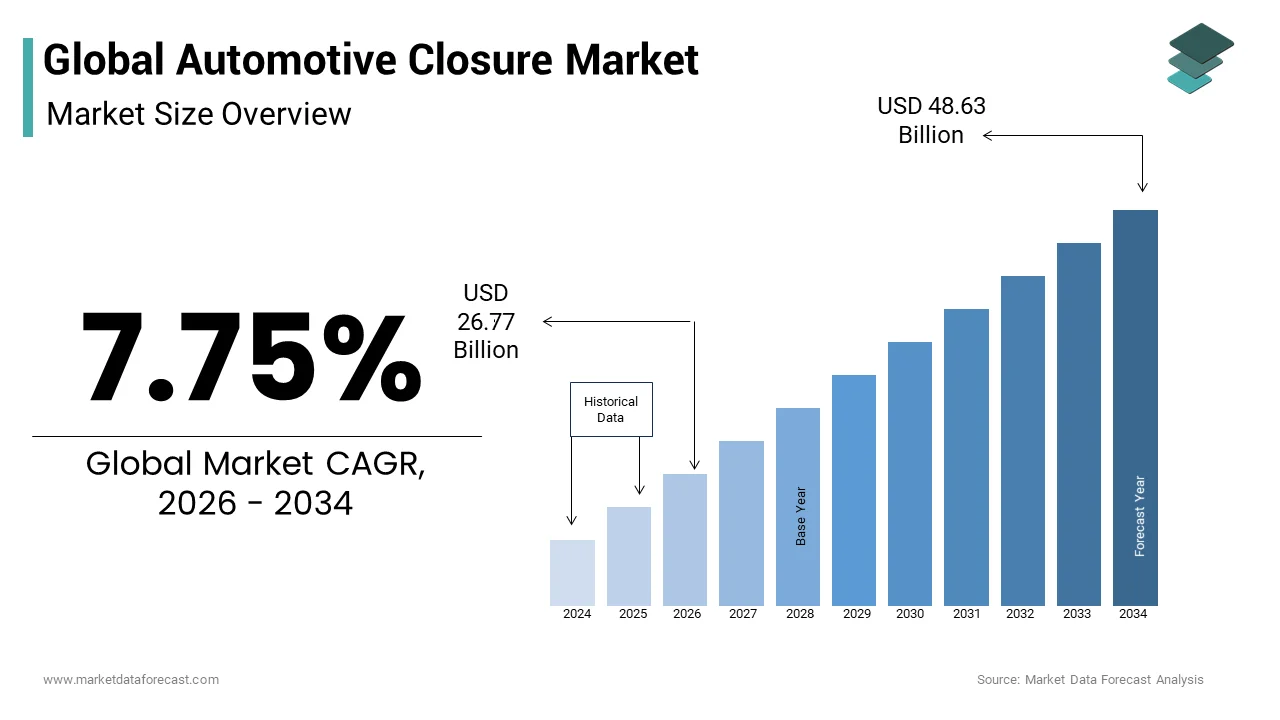
The global automotive closure market size was valued at USD 24.84 billion in 2025 and is anticipated to reach a valuation of USD 26.77 billion in 2026, and USD 48.63 billion by 2034, growing at a CAGR of 7.75% from 2026 to 2034.
As per the International Organization of Motor Vehicle Manufacturers, global light vehicle production reached 89 million units in 2023, establishing a substantial baseline demand for closure components across all major manufacturing hubs. According to the European Automobile Manufacturers Association, modern vehicles now incorporate an average of 14 distinct closure mechanisms per unit, reflecting increased complexity due to features like power lift gates and soft close doors. Regulatory bodies such as the National Highway Traffic Safety Administration mandate rigorous crashworthiness standards requiring closures to withstand specific impact forces without unintended opening during collisions. This regulatory pressure drives continuous innovation in material science and mechanical design ensuring that closure systems contribute effectively to overall vehicle safety ratings. Furthermore, the rise of electric vehicles necessitates lightweight closure solutions to offset battery weight, thereby influencing material selection toward advanced composites and high strength aluminum alloys that maintain durability while reducing mass.
MARKET DRIVERS
Rising Consumer Demand for Enhanced Convenience Features and Power Operated Systems
Consumer expectations for effortless vehicle interaction fuel the expansion of the global automotive closure market. According to J.D. Power, initial quality studies indicate that 65% of new vehicle buyers consider convenience features such as power liftgates and soft close doors as critical decision factors, particularly in the premium and mid-size segments where competition is fierce. According to the Society of Motor Manufacturers and Traders, vehicles equipped with power closure systems demonstrate 18% higher customer satisfaction scores related to ease of use compared to those relying solely on manual mechanisms. This preference is driven by the practical benefits of hands free operation which allows users to open trunks while carrying groceries or luggage enhancing daily usability. According to Cox Automotive, power liftgate adoption has increased by 22% annually over the past five years, with penetration rates exceeding 70% in luxury vehicles and reaching 45% in mainstream models. The integration of sensor based kick sensors and voice activated controls further elevates the user experience aligning with broader trends toward smart connectivity and intuitive human machine interfaces. Automakers recognize that these features serve as tangible differentiators in a crowded market encouraging widespread specification even in entry level trims to maintain perceived value and competitive appeal.
Stringent Safety Regulations Mandating Improved Crashworthiness and Pedestrian Protection
Global regulatory frameworks increasingly impose stringent requirements on vehicle closure systems to ensure they maintain structural integrity during collisions and minimize injury risks to pedestrians and occupants alike, which is further boosts the automotive closure market growth. The European New Car Assessment Programme mandates that all new vehicles achieve five star safety ratings which necessitates robust door latch mechanisms capable of withstand lateral impact forces exceeding 15 kilonewtons without failure. According to the National Highway Traffic Safety Administration, vehicles complying with Federal Motor Vehicle Safety Standard number 206 regarding door locks and retention components have seen a 30% reduction in occupant ejection incidents during side impact crashes since the regulation was strengthened in 2020. The United Nations Economic Commission for Europe regulation number 127 specifically addresses pedestrian safety requiring hood designs that absorb impact energy through specialized hinge and latch configurations that allow controlled deformation upon contact. According to the Insurance Institute for Highway Safety, cars with advanced closure systems featuring dual stage latches and reinforced striker plates experience 25% lower repair costs after minor collisions because the systems prevent misalignment that often leads to expensive bodywork corrections. These regulatory pressures compel manufacturers to invest heavily in advanced engineering simulations and physical testing to develop closure components that meet both passive safety criteria and active protection standards driving continuous technological advancement in the sector.
MARKET RESTRAINTS
High Material and Manufacturing Costs Impede Adoption in Budget Segment Vehicles
The escalating costs of raw materials such as high strength steel aluminum and engineered plastics combined with complex assembly processes create significant financial barriers for implementing advanced closure systems in affordable vehicle segments. According to Deloitte, automotive industry analysis shows that the cost of a fully integrated power closure system including motors sensors and control modules ranges from 150 to 250 dollars per unit, representing a substantial portion of the total bill of materials for entry level vehicles. According to the Center for Automotive Research, fluctuations in aluminum prices which increased by 18% in 2023 directly impact the profitability of closure manufacturers who rely on lightweight materials to meet fuel efficiency targets without compromising strength. Small and medium sized automakers face disproportionate challenges as they lack the purchasing power to negotiate favorable long term contracts with suppliers leading to higher per unit costs compared to global giants. According to PwC, automotive practice data shows that 55% of budget vehicle programs opt for basic manual closure systems to keep retail prices competitive, limiting the addressable market for sophisticated electronic solutions. Additionally, the labor intensive nature of installing precise sealing strips and aligning multi point latches increases assembly time by 15 minutes per vehicle, according to Toyota production data, further inflating manufacturing expenses. Consequently many manufacturers restrict advanced closure features to higher trim levels slowing widespread market penetration in price sensitive regions where cost remains the primary purchase driver.
Complexity in Supply Chain for Specialized Electronic Components Creates Production Vulnerabilities
The increasing reliance on specialized electronic components such as microcontrollers sensors and actuators for power closure systems exposes manufacturers to supply chain disruptions that can halt production lines and delay vehicle deliveries, which further impedes the global market expansion. According to AlixPartners, the automotive sector experienced a 20% decline in closure system production during 2022 due to semiconductor shortages which affected the availability of control modules essential for power latch and liftgate operations. According to the Semiconductor Industry Association, lead times for automotive grade microcontrollers extended to 40 weeks in 2023 compared to the historical average of 12 weeks, creating bottlenecks for tier one suppliers who could not secure sufficient inventory to meet original equipment manufacturer demands. Bosch and Continental reported that 15% of their closure system orders were delayed in 2023 specifically due to missing electronic subcomponents and this indicates the fragility of just in time manufacturing models when faced with global chip scarcity. According to Resilinc, 70% of closure system suppliers source electronic parts from single region providers primarily in East Asia, creating concentration risks that amplify disruption impacts during geopolitical tensions or natural disasters. These vulnerability forces manufacturers to hold larger safety stocks increasing working capital requirements and reducing operational efficiency while complicating efforts to scale production rapidly in response to surging demand for vehicles equipped with advanced closure technologies.
MARKET OPPORTUNITIES
Integration of Smart Connectivity and Internet of Things Technologies Opens New Revenue Streams
The convergence of automotive closure systems with internet of things platforms and smartphone connectivity creates lucrative opportunities for manufacturers in the global automotive closure market. According to McKinsey Company, the connected car services market is projected to reach 215 billion dollars by 2030, with remote closure control representing a growing segment as consumers seek seamless integration between their mobile devices and vehicle functions. According to the GSM Association, 80% of new vehicles sold in 2024 included embedded telematics modules enabling bidirectional communication that allows owners to lock unlock and monitor closure status via mobile applications, enhancing security and convenience. BMW and Mercedes Benz have already launched digital key services that permit users to grant temporary access to family members or service providers through encrypted smartphone signals generating subscription revenue streams beyond initial hardware sales. According to Accenture, vehicles offering remote closure management features see 20% higher engagement with manufacturer apps, fostering brand loyalty and providing valuable usage data for future product development. This shift transforms closures from passive mechanical components into interactive digital interfaces that enhance the overall ownership experience while opening pathways for software defined vehicle monetization strategies that extend customer lifetime value.
Expansion of Electric Vehicle Platforms Requires Lightweight and Aerodynamic Closure Solutions
The rapid proliferation of electric vehicles presents significant opportunities for closure system manufacturers to develop lightweight and aerodynamically optimized components that help offset heavy battery packs and extend driving range. According to the International Energy Agency, global electric vehicle sales surpassed 14 million units in 2023, accounting for 18% of total light duty vehicle registrations and establishing a fast growing addressable market for specialized closure technologies. According to the European Alternative Fuels Observatory, reducing vehicle weight by 100 kilograms can increase electric vehicle range by approximately 6 kilometers, making lightweight closure materials such as carbon fiber reinforced polymers and aluminum alloys highly desirable for original equipment manufacturers. Tesla and Rivian have pioneered the use of large single piece castings for rear closures which reduce part count and weight while improving structural rigidity demonstrating industry wide recognition of the need for innovative design approaches. According to Bloomberg New Energy Finance, electric vehicles will constitute 35% of global new car sales by 2030, implying that demand for optimized closure systems will grow proportionally as manufacturers prioritize efficiency and range maximization. The smooth flush mounted surfaces required for aerodynamic efficiency in electric vehicles also drive adoption of hidden hinge mechanisms and electronic latches that eliminate external protrusions reducing drag coefficients and contributing to overall energy savings.
MARKET CHALLENGES
Volatility in Raw Material Prices Impacts Profit Margins and Pricing Stability
Fluctuating prices of key raw materials including steel aluminum rubber and engineering plastics creates significant uncertainty for closure system manufacturers affecting their ability to maintain stable pricing structures and predictable profit margins. According to the World Bank, prices for aluminum which is extensively used in lightweight closure frames increased by 25% in 2022 before stabilizing but remaining at historically high levels compared to pre pandemic averages. According to the International Monetary Fund, geopolitical tensions and trade restrictions have disrupted supply chains for rare earth elements and specialty polymers leading to sporadic price spikes that squeeze manufacturer margins especially when long term fixed price contracts with automakers are in place. According to S&P Global Platts, synthetic rubber prices which are critical for weather seals fluctuated by 30% over the past two years, forcing suppliers to frequently renegotiate terms or absorb costs to remain competitive. ThyssenKrupp and Magna International reported that raw material volatility accounted for 12% of their operating cost variance in 2023 highlighting the financial strain imposed by unpredictable input costs. This instability complicates long term strategic planning and investment decisions as manufacturers struggle to balance cost recovery with customer expectations for affordable components in an increasingly price sensitive automotive landscape.
Strict Environmental Regulations on Material Recycling and Disposal Increase Compliance Burdens
Increasingly stringent environmental regulations governing the recyclability and disposal of automotive components impose additional compliance burdens on closure system manufacturers requiring them to redesign products for easier material separation and recovery. According to the European Union End of Life Vehicles Directive, 95% of a vehicle's weight must be reusable or recyclable by 2025, mandating that closure systems utilize mono materials or easily separable composites rather than complex multi material assemblies that are difficult to process. The Environmental Protection Agency in the United States has introduced stricter guidelines on hazardous substances in automotive parts requiring manufacturers to eliminate certain flame retardants and heavy metals from plastic components used in door panels and trim. According to the Ellen MacArthur Foundation, only 40% of automotive plastics are currently recycled effectively due to contamination and mixed material composition, prompting regulators to push for design for recycling principles that closure manufacturers must adopt. Volkswagen and Ford have announced targets to use 30% recycled content in new vehicle components by 2030, forcing closure suppliers to validate new material sources and adjust production processes to meet these sustainability goals. These regulatory requirements necessitate significant investment in research and development for eco-friendly materials and recycling technologies increasing operational costs while challenging traditional manufacturing methods that prioritized performance and cost over end of life considerations.
REPORT COVERAGE
| REPORT METRIC | DETAILS |
| Market Size Available | 2025 to 2034 |
| Base Year | 2025 |
| Forecast Period | 2026 to 2034 |
| CAGR | 7.75% |
| Segments Covered | By Application, Component, Type, and Region. |
|
Various Analyses Covered | Global, Regional and Country Level Analysis; Segment-Level Analysis, DROC, PESTLE Analysis, Porter’s Five Forces Analysis, Competitive Landscape, Analyst Overview of Investment Opportunities |
| Regions Covered | North America, Europe, APAC, Latin America, Middle East & Africa |
| Market Leaders Profiled | Continental AG (Germany), Magna International Inc. (Canada), Robert Bosch GmbH (Germany), and Aisin Seiki. Co., Ltd. (Japan). These systems and technologies are supplied to automotive suppliers such as Volkswagen AG (Germany), General Motors (USA), Toyota Motor Corporation (Japan), Maruti Suzuki (Japan), Hyundai, Nissan, and Others. |
SEGMENTAL ANALYSIS
By Application Insights
The side door segment dominated the market by commanding for the highest share of the global market in 2025 because every passenger vehicle requires at least two to four side doors for occupant access making it the most ubiquitous closure application with consistent demand across all vehicle categories from compact cars to large sport utility vehicles. Side doors are fundamental structural components of virtually all automotive platforms necessitating their inclusion in every vehicle produced globally which creates a massive and stable addressable market for closure system manufacturers regardless of technological shifts or consumer preference changes. According to the International Organization of Motor Vehicle Manufacturers, global light vehicle production reached 89 million units in 2023 with each unit requiring an average of 3.5 side doors, resulting in over 311 million side door assemblies manufactured annually establishing a baseline demand that dwarfs other closure applications. According to the Society of Motor Manufacturers and Traders, side door systems account for approximately 45% of total automotive closure revenue due to their complexity and integration with safety features such as side impact beams and airbag sensors. According to J.D. Power, side door functionality including ease of opening closing and sealing quality ranks among the top three factors influencing initial vehicle quality scores prompting manufacturers to invest heavily in precision engineering and durable materials. The universal requirement for side doors ensures that this segment remains resilient to market fluctuations affecting niche applications like convertible roofs or sliding doors which are limited to specific vehicle types. Furthermore regulatory mandates for side impact protection require robust door structures that incorporate advanced latching mechanisms reinforcing the technical complexity and value contribution of this segment within the overall closure market ecosystem.
On the other end, the tailgate segment is projected to register the highest CAGR of 10.2% over the forecast period in the global market owing to the surging popularity of sport utility vehicles and pickup trucks which feature large rear openings that increasingly incorporate power operated liftgates and hands free access technologies. The global shift in consumer preference toward larger vehicles with enhanced cargo capacity has led to a significant increase in sport utility vehicle and pickup truck sales which inherently require robust and often automated tailgate systems for practical utility and convenience. According to IHS Markit, sport utility vehicles and light trucks accounted for 52% of global light vehicle sales in 2023 up from 40% five years ago, creating a rapidly expanding base for tailgate closure systems. According to the European Automobile Manufacturers Association, 78% of new sport utility vehicles sold in Europe now feature power liftgates as standard or optional equipment, reflecting strong consumer demand for automated rear access solutions. According to Ford Motor Company, F Series pickup trucks which consistently rank as best sellers in North America have seen a 25% increase in configurations with power tailgates over the past three years, highlighting the mainstream adoption of this technology. The functional necessity of tailgates for loading heavy items combined with the ergonomic benefits of power operation makes them a high priority feature for buyers in these segments. As automakers continue to expand their sport utility vehicle and truck portfolios to meet market demand the corresponding need for advanced tailgate mechanisms including soft close and height adjustable systems drives substantial growth in this segment outpacing traditional sedan oriented closures.
By Component Insights
The latch segment held the largest share of the global market in 2025 because it serves as the critical mechanical and electronic interface that secures closures against accidental opening during normal operation and collisions making it indispensable for meeting stringent safety regulations and ensuring occupant protection. Global safety standards mandate that all vehicle closures remain securely locked during dynamic driving conditions and crash events necessitating the use of high strength latches that can withstand significant forces without failure. According to the United Nations Economic Commission for Europe regulation number 11, door latches and hinges must withstand longitudinal loads of 11 kilonewtons and transverse loads of 9 kilonewtons without releasing. According to the National Highway Traffic Safety Administration, compliance with Federal Motor Vehicle Safety Standard number 206 has reduced door opening incidents during side impacts by 28% since stricter enforcement began in 2019, driving widespread adoption of dual stage latches. According to ZF Friedrichshafen, modern vehicle latches incorporate redundant locking mechanisms and crash sensors that trigger immediate unlocking for emergency rescue while maintaining integrity during impact. The complexity of these safety features increases the value and specification intensity of latches compared to other components. Additionally the transition to electric vehicles has not diminished the need for robust latching but rather intensified it due to heavier vehicle weights and higher center of gravity which place greater stress on closure systems during rollover scenarios. Consequently latch manufacturers continue to innovate with stronger materials and smarter electronics to meet evolving safety benchmarks ensuring this segment remains central to the automotive closure ecosystem.
However, the motor and actuator segment is experiencing the fastest growth and is expected to exhibit a CAGR of 12.4% over the forecast period owing to the rapid proliferation of power operated closures including windows sunroofs liftgates and sliding doors which rely on precise electromechanical movement for automated functionality. The increasing consumer preference for convenience features such as power windows power sunroofs and automatic liftgates has led to a surge in the installation of motors and actuators in vehicles across all segments from entry level to luxury. According to J.D. Power, 85% of new vehicles sold in North America in 2023 featured power windows as standard equipment while power liftgate penetration reached 45% in mid size sport utility vehicles. According to the European Automobile Manufacturers Association, the average number of motors per vehicle has increased from 4 in 2015 to 7 in 2023 due to the addition of power folding mirrors power tailgates and active aerodynamic flaps. According to BorgWarner, the demand for compact high torque actuators has grown by 18% annually as manufacturers seek to reduce weight and space requirements while maintaining performance. Electric vehicles further accelerate this trend as they often feature flush mounted doors and hidden handles that require specialized actuators for seamless operation. The transition from manual to power operation in emerging markets also contributes to growth as rising disposable incomes enable consumers to afford vehicles with enhanced comfort features. This widespread adoption of automated closure systems ensures that the motor and actuator segment continues to expand at a rate significantly higher than static mechanical components.
REGIONAL ANALYSIS
North America Market Analysis
North America dominated the market by capturing the highest share of the global market in 2025 and is expected to maintain steady demand driven by large vehicle preferences and robust manufacturing investments over the next few years. North America represents a mature and high value market for automotive closures characterized by strong consumer preference for large vehicles such as sport utility vehicles and pickup trucks which require robust and often automated closure systems. The region accounts for approximately 28% of global demand driven by high vehicle production volumes and advanced technological adoption. According to the Alliance for Automotive Innovation, light truck and sport utility vehicle sales accounted for 78% of total new vehicle registrations in the United States in 2023, creating substantial demand for tailgates and power door systems. The National Highway Traffic Safety Administration stringent safety regulations mandate rigorous testing for door latches and hinges ensuring high quality standards that drive innovation in closure components. General Motors and Ford Motor Company have invested heavily in local manufacturing facilities for closure systems to support their high volume truck production lines. According to J.D. Power, North American consumers rank ease of entry and exit as a top five factor in vehicle satisfaction prompting manufacturers to prioritize smooth operating doors and liftgates. The presence of major suppliers such as Magna International and Nexteer Automotive ensures a robust supply chain capable of delivering advanced closure solutions. Additionally the growing adoption of electric vehicles in the region is driving demand for lightweight and aerodynamically optimized closure systems that help extend driving range.
Europe Market Analysis
Europe is anticipated to sustain robust growth led by stringent environmental regulations and high electric vehicle adoption rates in the coming years. Europe maintains a strong position in the automotive closure market driven by stringent environmental regulations premium vehicle concentration and leading adoption of electric vehicles that require specialized lightweight closure solutions. The region contributes approximately 32% of global demand with Germany France and the United Kingdom serving as primary manufacturing hubs. According to the European Automobile Manufacturers Association, vehicle production in Europe reached 18 million units in 2023, with a significant portion featuring advanced closure technologies such as soft close doors and power liftgates. The European Union End of Life Vehicles Directive mandates high recyclability rates for automotive components forcing manufacturers to develop closure systems using mono materials and easily separable composites. BMW Group and Volkswagen AG have pioneered the use of aluminum and composite materials in door structures to reduce weight and improve fuel efficiency. According to JATO Dynamics, European consumers prioritize build quality and acoustic comfort leading to high specification of multi layer seals and precision engineered latches. The region also leads in the adoption of hands free tailgate technology with over 60% of premium sport utility vehicles featuring this capability. Regulatory pressure for pedestrian safety further drives innovation in hood latch and hinge designs that allow for controlled deformation upon impact.
Asia Pacific Market Analysis
Asia Pacific is projected to achieve the fastest regional expansion driven by surging vehicle production and EV manufacturing over the next few years. Asia Pacific emerges as the fastest growing regional market for automotive closures fueled by expanding middle class rising vehicle ownership rates and aggressive electric vehicle policies in China and other key economies. The region accounts for approximately 35% of global demand with China Japan South Korea and India serving as key growth engines. According to the China Association of Automobile Manufacturers, new energy vehicle sales in China exceeded 9 million units in 2023, with many featuring innovative closure systems such as frameless doors and electronic latches. Japanese manufacturers including Toyota and Honda are increasingly adopting power closure systems in domestic models to enhance comfort and competitiveness. According to Frost and Sullivan, the Asia Pacific automotive closure market will grow at a 10.5% compound annual growth rate through 2030, outpacing other regions due to volume growth and technology upgrade cycles. The presence of low cost manufacturing bases in China and India allows for competitive pricing of closure components supporting high volume production. Government incentives for electric vehicles in countries like South Korea and India are accelerating the adoption of lightweight closure materials. Additionally rising consumer expectations for convenience features in emerging markets are driving penetration of power windows and sunroofs in entry level segments.
Latin America Market Analysis
Latin America is expected to see gradual market stabilization and increased technology adoption in localized manufacturing hubs over the coming years. Latin America represents an emerging market for automotive closures characterized by gradual technology adoption concentrated in premium vehicle segments and steady growth in local manufacturing capacity. The region contributes approximately 3% of global demand with Brazil Mexico and Argentina serving as primary markets. According to the Brazilian Automotive Industry Association ANFAVEA, vehicle production in Brazil reached 2.5 million units in 2023, with increasing inclusion of power windows and central locking systems as standard features. Mexican automotive manufacturing hub produces vehicles for both domestic consumption and North American export with many export bound models featuring advanced closure technologies that influence local market expectations. According to the Inter American Development Bank, infrastructure improvements and rising disposable incomes are supporting steady growth in vehicle sales particularly in the sport utility vehicle segment. Ford Motor Company and General Motors have expanded their production facilities in the region to meet growing demand for trucks and sport utility vehicles which require robust closure systems. The gradual improvement in road infrastructure and expansion of authorized service networks capable of maintaining electronic closure systems is reducing adoption barriers. Consumer preference for durable and reliable vehicles drives demand for high quality latches and seals that can withstand harsh environmental conditions.
Middle East and Africa Market Analysis
The Middle East and Africa region is forecasted to experience steady niche growth supported by luxury consumption trends and infrastructure investments over the next few years. Middle East and Africa constitute a niche but growing market for automotive closures driven primarily by luxury vehicle preference in Gulf Cooperation Council countries and gradual infrastructure development in South Africa. The region accounts for approximately 2% of global demand with United Arab Emirates Saudi Arabia and South Africa representing primary consumption centers. According to the Gulf Organization for Industrial Consulting, luxury vehicles constitute 35% of new car sales in United Arab Emirates compared to a global average of 12%, creating disproportionate demand for premium closure features such as soft close doors and power liftgates. Mercedes Benz and BMW report that S Class and X5 models with advanced closure systems account for the majority of sales in the region, reflecting consumer preference for status and comfort. According to Alpen Capital, the Middle East luxury vehicle market will grow 8% annually through 2028, sustaining demand for high end closure technologies. The harsh desert climate favors sealed and dust proof closure systems that protect interior components from sand intrusion. South African automotive industry benefits from local manufacturing agreements requiring certain technology content levels with manufacturers producing vehicles with electronic closures for domestic and export markets. Gradual expansion of urban infrastructure and rising middle class in African nations are expected to drive future growth in this segment.
COMPETITIVE LANDSCAPE
The competitive landscape of the Automotive Closure Market features intense rivalry among established global suppliers and regional specialists striving to capture growing demand for advanced closure systems. Major participants compete primarily on technological innovation product reliability and ability to provide comprehensive system integration services that simplify manufacturer adoption processes. Price pressure remains significant particularly in high volume segments forcing companies to optimize production efficiency and achieve economies of scale through standardized platform approaches. Differentiation increasingly depends on software capabilities including smart access features predictive analytics and cybersecurity protection rather than hardware specifications alone. New entrants from electronics sector bring fresh perspectives on human machine interaction design challenging traditional automotive suppliers to accelerate innovation cycles. Collaborative ecosystems involving semiconductor firms software developers and original equipment manufacturers are becoming essential for delivering holistic solutions. Geographic expansion into Asia Pacific regions offers growth opportunities but requires adaptation to local regulatory frameworks. Intellectual property protection through patents remains critical defensive strategy as technology complexity increases. Customer retention relies heavily on after sales support quality and ability to provide timely updates.
KEY MARKET PLAYERS
The ecosystem of the automotive closure market includes manufacturers and service providers such as
- Continental AG (Germany)
- Magna International Inc. (Canada)
- Robert Bosch GmbH (Germany)
- Brose Fahrzeugteile
- Mitsui Kinzoku
- Aisin Seiki. Co. Ltd. (Japan)
- Volkswagen AG (Germany)
- General Motors (USA)
- Toyota Motor Corporation (Japan)
- Maruti Suzuki (Japan)
- Hyundai
- Nissan
Top Players In The Market
- Magna International stands as a global leader in automotive closure systems providing comprehensive solutions including door modules liftgates and sliding door mechanisms for major original equipment manufacturers. The company leverages its extensive engineering expertise to develop lightweight and aerodynamically optimized closures that enhance vehicle efficiency and performance. Magna recently expanded its production capabilities in Asia to support the growing electric vehicle market with specialized closure technologies. Their focus on modular design allows for rapid integration into diverse vehicle platforms reducing development time for automakers. By investing in advanced manufacturing techniques such as aluminum extrusion and composite molding Magna ensures high quality and durability. Strategic partnerships with technology firms enable the integration of smart sensors and automated features into closure systems enhancing user convenience and safety.
- Brose Fahrzeugteile specializes in mechatronic systems for vehicle access and closure offering innovative products such as power door drives electronic latches and window regulators. The company is renowned for its quiet and efficient motor technologies that improve passenger comfort and perceived quality. Brose has intensified its research and development efforts to create compact and energy efficient actuators suitable for electric vehicles. Recent collaborations with premium automakers have led to the deployment of hands free tailgate systems and soft close doors in high end models. The company emphasizes sustainability by utilizing recyclable materials and optimizing production processes to reduce environmental impact. Brose continues to strengthen its global footprint through strategic investments in local manufacturing facilities ensuring timely delivery and cost competitiveness.
- Mitsui Kinzoku is a prominent supplier of automotive latches hinges and lock systems known for their reliability and precision engineering. The company plays a critical role in ensuring vehicle safety through robust closure mechanisms that meet stringent global regulatory standards. Mitsui Kinzoku has recently focused on developing next generation electronic latches that integrate seamlessly with advanced driver assistance systems. Their innovations include crash sensing latches that automatically unlock during emergencies facilitating faster rescue operations. The company actively participates in joint ventures with international partners to expand its technological capabilities and market reach. By prioritizing quality control and continuous improvement Mitsui Kinzoku maintains strong relationships with leading automakers worldwide. Their commitment to innovation ensures they remain at the forefront of closure system technology.
Top Strategies Used By Key Market Participants
Key players in the Automotive Closure Market prioritize strategic partnerships with automotive original equipment manufacturers to co develop customized solutions that meet specific brand requirements and accelerate time to market. Companies invest substantially in research and development to enhance material strength reduce weight and improve functional safety compliance with international standards. Expansion of manufacturing footprint in emerging economies helps reduce production costs and mitigate supply chain risks associated with geopolitical tensions. Integration of smart connectivity features enables remote monitoring and predictive maintenance enhancing long term customer satisfaction. Focus on sustainable materials and recycling processes supports environmental goals while meeting regulatory requirements. Continuous innovation in automation and robotics improves production efficiency and product consistency.
MARKET SEGMENTATION
This market research report on the global automotive closure market is segmented and sub-segmented into the following categories.
By Application
- Power-Window
- Sunroof
- Tailgate
- Convertible Roof
- Sliding Door
- Side Door
By Component
- Switch
- ECU
- Latch
- Motor/Actuator
- Relay
By Type
- Manual
- Powered
By Region
- North America
- Latin America
- Europe
- Asia Pacific
- Middle East & Africa