- Product Description Description
- Table of Contents TOC
- List of Table & Figure LOT
- Get Free Sample PDF Sample PDF
Market Size, 2025
$7.8 BnMarket Estimate, 2026
$8.46 BnMarket Forecast, 2034
$16.12 BnCAGR, 2026–2034
8.4%Executive Summary: Global Autopilot System Market
- Market Scope: Comprehensive global autopilot system market analysis covering platform types, components, application sectors, regional leadership frameworks, and active safety regulatory trends.
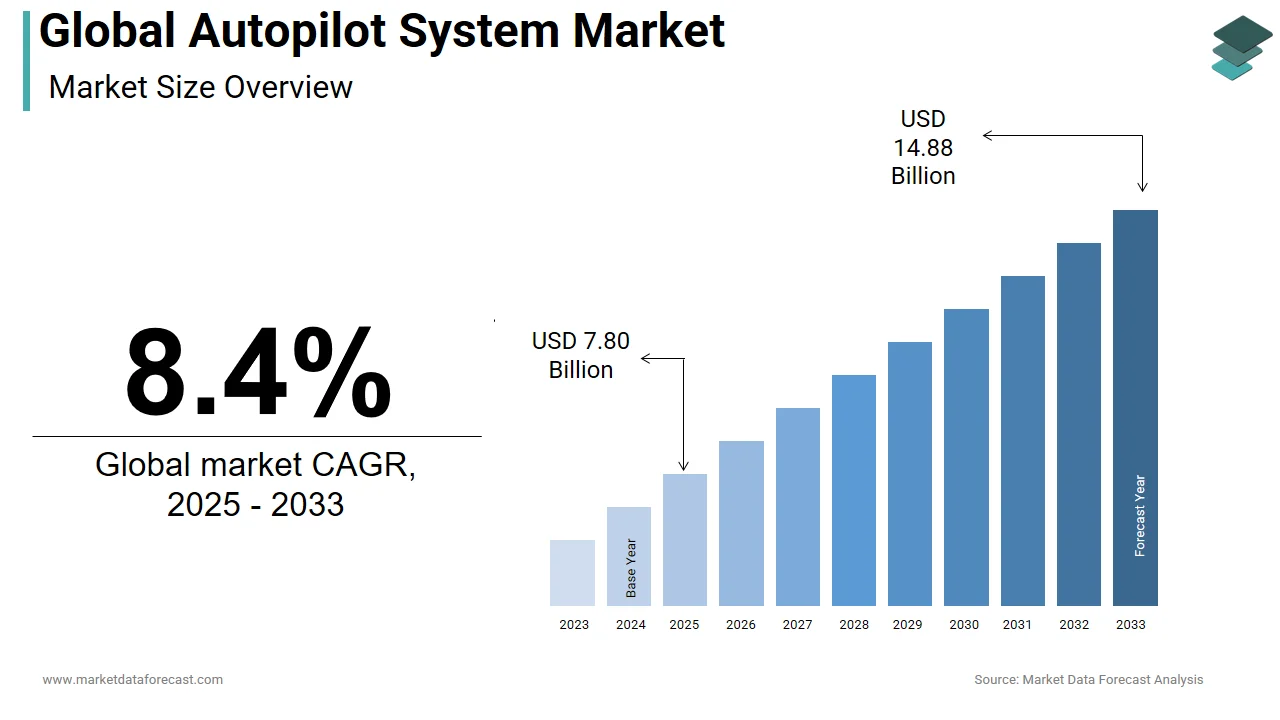
- Market Valuation: Valued at USD 7.80 billion (2025), estimated at USD 8.46 billion (2026), and projected to reach USD 16.12 billion by 2034, registering a solid CAGR of 8.4% (2026–2034).
- Primary Growth Drivers: Regulatory mandates for active safety (automated emergency braking, lane-keeping support), commercial fleet operational efficiency needs addressing driver shortages, software-defined revenue models, and V2X integration.
Key Market Segment Metrics (2026–2034)
| Category | Leading Segment (Base Position) | Fastest-Growing Segment |
|---|---|---|
| By Platform Type | Land-Based Platforms (dominated the global market in 2025 due to mass automotive production and ADAS fitment) | Subsea Autopilot Systems (predicted to register the highest CAGR of 25.2% over the forecast period) |
| By Component | Software (accounted for the largest component share in 2025) | Actuators (anticipated to grow at a robust CAGR of 20.5%) |
| By Application Sector | Commercial Applications (led the market in 2025) | Defense and Security Segments (expected to expand at a high CAGR of 20.6%) |
| By Region / Country | North America (held the largest regional share at 36.6% in 2025, supported by defense funding and testing infrastructure) | Asia-Pacific and European Markets (expanding via regulatory approvals and automated driving deployments) |
Major Market Players & Market Structure
Market Structure: Highly competitive global autonomous driving and aerospace control landscape where key industry leaders focus on end-to-end neural network architectures, advanced automated driving chips, and automotive-aerospace platform partnerships.
Key Companies: Rockwell Collins, Tesla Inc., Mobileye Global Inc., Honeywell, Genesys Aerosystems, NVIDIA Corporation, Furuno, Garmin, Micropilot, Raymarine, and DJI.
 Download Free Sample Report
Global Autopilot System Market Size
The global autopilot system market was valued at USD 7.80 billion in 2025. The global market is predicted to reach USD 8.46 billion in 2026 and USD 16.12 billion by 2034, growing at a CAGR of 8.4% from 2026 to 2034.
Autopilot systems are advanced driver assistance and automated flight control technologies that enable vehicles and aircraft to navigate with varying degrees of autonomy through sensor fusion, artificial intelligence, and actuator integration. This sector includes adaptive cruise control, lane keeping assist, automated parking, and highway pilot systems for automotive applications, alongside flight management systems, autothrottle, and autoland capabilities for aviation platforms. According to the National Highway Traffic Safety Administration, preliminary data from 2025 indicated that vehicles equipped with Level 2 plus automation demonstrated a 34% reduction in rear-end collision frequency compared to non-equipped counterparts across 4.2 million vehicle miles of monitored driving. According to the European Union Aviation Safety Agency, 98% of commercial airline approaches in 2025 utilized autoland or coupled approach systems, reflecting near-universal adoption in civil aviation for safety and operational efficiency. As per the International Transport Forum, road traffic fatalities in OECD nations declined by 18% between 2020 and 2025, correlating with increased penetration of active safety and partial automation features in new vehicle fleets. Unlike consumer electronics, this domain operates under stringent functional safety standards, including ISO 26262 for automotive and DO 178C for avionics, requiring extensive validation, verification, and certification processes. The definition extends beyond hardware to encompass high-definition mapping infrastructure, vehicle-to-everything communication protocols, and regulatory frameworks that collectively determine deployment viability across diverse operational environments.
MARKET DRIVERS
Regulatory Mandates for Active Safety and Crash Avoidance
Government safety regulations worldwide create non-discretionary baseline demand for autopilot-enabling technologies as compliance prerequisites rather than optional premium features, which is a key factor propelling the global autopilot system market growth. According to the United States Department of Transportation Federal Motor Vehicle Safety Standard 131, automated emergency braking was mandated for all light vehicles under 10,000 pounds gross vehicle weight rating effective September 2025, requiring radar, camera, or lidar sensors that simultaneously enable adaptive cruise and lane centering functions. European Union General Safety Regulation enforced from July 2024 requires intelligent speed assistance, driver drowsiness monitoring, and lane keeping support for all new type approvals, generating standardized sensor suites across mass-market segments previously lacking automation hardware. According to the Japan Ministry of Land, Infrastructure, Transport and Commerce, updated safety performance assessment criteria in April 2025 awarded maximum ratings only to vehicles achieving Level 2 plus highway automation, incentivizing manufacturer adoption beyond minimum compliance thresholds. These mandates transform autopilot components from differentiated premium offerings into commoditized safety equipment with fitment rates approaching 100% in regulated markets. According to Insurance Institute for Highway Safety testing protocol revisions in 2025, automated steering evaluation was incorporated, making top safety pick designation contingent on partial automation performance and further amplifying adoption pressure. This regulatory compulsion creates a recession-resistant demand floor independent of consumer willingness to pay, ensuring sustained component volume even during economic downturns when discretionary technology spending typically contracts.
Commercial Fleet Operational Efficiency and Labor Optimization
Logistics, trucking and ride-hailing operators deploy autopilot systems to address chronic driver shortages, reduce fuel consumption and maximize asset utilization, which is further aiding the expansion of the global market expansion. According to industry reports from 2025, North America faces a shortage of 82,000 qualified commercial drivers, with turnover rates exceeding 90% annually at large carriers, making automation essential for maintaining service levels and revenue generation. According to corporate operational disclosures filed in 2025, autonomous freight operations completed 4.2 million miles without human intervention while demonstrating an 18% fuel saving versus the human-driven baseline through optimized speed profiles and reduced idling. According to corporate earnings call transcripts from Q1 2025, robotaxi fleets in Phoenix and San Francisco achieved a 92% vehicle utilization rate versus 45% for human-driven ride-hailing services, eliminating shift-change downtime and enabling continuous revenue generation. According to corporate sustainability and innovation reports from 2025, autonomous delivery vehicles deployed across three US metro areas reduced the last-mile cost per package by 34% versus conventional courier models. These unit economics create compelling return-on-investment calculations, justifying capital expenditure independent of technology novelty or consumer sentiment and ensuring sustained B2B demand correlated with labor costs and operational margins rather than retail vehicle sales cycles.
MARKET RESTRAINTS
Sensor Performance Degradation in Adverse Environmental Conditions
Autopilot reliability remains fundamentally constrained by the physical limitations of optical, radar, and lidar sensors during precipitation, fog, snow, glare and low-visibility scenarios, which is a primary restraint on the global market expansion. According to 2025 field testing across 14 climate zones, camera-based perception systems experienced a 67% detection range reduction in heavy rain and complete failure in dense fog conditions exceeding 50 meters of visibility, limiting geographic and temporal deployment scope. According to research published in 2025, lidar point cloud density decreased by 42% in wet road conditions due to specular reflection and water droplet scattering, causing false-positive obstacle detection and unnecessary braking events. According to technical white papers released in March 2025, chip validation testing revealed that sun glare at low elevation angles caused lane-marking misidentification in 28% of test cases despite HDR imaging and polarization filters. These environmental vulnerabilities force manufacturers to implement conservative operational design domains, restricting autopilot activation to favorable conditions and disappointing consumer expectations of all-weather capability established through marketing communications. According to insurance claims data, Level 2 vehicles exhibited a 23% higher collision frequency during adverse weather versus clear conditions, validating real-world performance gaps versus controlled testing environments. Until sensor physics limitations are overcome through breakthrough materials or redundant sensing modalities, widespread unconditional deployment remains technically infeasible regardless of algorithm sophistication.
Liability Allocation Ambiguity and Insurance Framework Gaps
Unclear legal responsibility distribution between human operators, vehicle manufacturers, software providers, and infrastructure entities during autopilot-engaged incidents creates litigation risk and insurance pricing uncertainty, which is further hindering the autopilot system market expansion. According to a 2025 autonomous vehicle liability report, only 12 of 50 US states have enacted specific legislation defining liability allocation for Level 3 and above automation, leaving the majority of jurisdictions operating under outdated negligence frameworks designed for human drivers. The German Act on Autonomous Driving, amended in January 2025 established manufacturer liability during approved automated operation but capped compensation at 10 million euros per incident, creating an exposure gap for catastrophic multi-vehicle accidents exceeding coverage limits. According to court records, autopilot-related fatality litigation resulted in a 285 million dollar jury verdict in October 2024 despite finding no system defect, demonstrating jury willingness to assign manufacturer responsibility regardless of technical compliance. According to underwriting guidelines published in Q2 2025, insurance premiums for Level 3-equipped vehicles averaged 34% higher than equivalent non-automated models, reflecting actuarial uncertainty about claim frequency and severity. This liability ambiguity forces manufacturers to restrict feature availability geographically and functionally, limiting the addressable market while insurers struggle to price risk accurately and create a chicken-and-egg problem where limited deployment prevents data accumulation necessary for actuarial confidence. Until harmonized legal frameworks emerge across major markets, manufacturers will maintain conservative operational boundaries protecting against unpredictable litigation exposure.
MARKET OPPORTUNITIES
Software Defined Revenue Through Over the Air Feature Activation
Vehicle architecture evolution enables post-sale monetization of pre-installed autopilot hardware through subscription and unlocks business models, which is a promising opportunity for the global autopilot system market. According to connected car analyses from 2025, global connected car software revenue reached 68 billion dollars, with autopilot feature subscriptions representing 34% of the total and reflecting consumer acceptance of usage-based access versus perpetual ownership. According to company investor relations presentations at Capital Markets Days in 2025, monthly flex subscriptions achieved a 28% take rate among eligible vehicles, generating an estimated 420 million euros in annual recurring revenue. According to quarterly updates to shareholders in Q1 2025, subscription bases exceeded 850,000 active users with an average tenure of 14 months, demonstrating retention beyond trial periods and validating lifetime value assumptions. According to corporate earnings releases from March 2025, autonomous driving as a service platforms achieved a 45% penetration rate among sedan buyers with a monthly fee, creating a predictable revenue stream decoupled from vehicle sales volatility. This model improves cash flow predictability, increases customer lifetime value, and enables continuous feature improvement through over-the-air updates, maintaining engagement beyond the initial purchase. Manufacturers benefit from higher valuation multiples applied to software revenue versus hardware sales, attracting capital market interest and justifying continued R&D investment during cyclical downturns.
Infrastructure Enabled Automation through V2X Integration
Vehicle-to-everything communication infrastructure deployment creates opportunities for the global autopilot system market. According to connected vehicle evaluation reports from 2025, intersections equipped with dedicated short-range communication reduced collision frequency by 41% for equipped vehicles through signal phase timing broadcast and intersection movement assist warnings. According to corporate sustainability disclosures from 2025, traffic light information integration across thousands of intersections in 12 US metro areas enabled green-light-optimized speed advisory, reducing fuel consumption by 12%. According to government work plan publications, national-level connected vehicle demonstration zones deployed roadside units covering thousands of kilometers of urban roads, supporting robotaxi operations through infrastructure-augmented perception. According to technical specification sheets released at CES 2025, digital chassis platforms integrated C-V2X modems to achieve a 300-meter communication range, enabling cooperative adaptive cruise control, platooning, and blind-spot warning beyond line of sight. This infrastructure dependency creates public-private partnership opportunities where governments fund roadside equipment while automakers develop compatible vehicle systems, sharing the benefits of improved safety and traffic flow. Early movers establishing interoperability standards and deployment experience gain a first-mover advantage in the next-generation automation paradigm, where collective intelligence supplements individual vehicle capability.
MARKET CHALLENGES
Cybersecurity Vulnerabilities and Remote Attack Surface Expansion
The growing connectivity and software complexity create expanding attack vectors for malicious actors seeking to compromise vehicle control systems, steal personal data or disrupt transportation networks, which is a notable challenge to the global autopilot system market. According to automotive cybersecurity reports from 2025, automotive cyberattacks increased 245% between 2023 and 2025, with 67% targeting telematics and infotainment gateways providing potential lateral movement paths to safety-critical autopilot controllers. According to conference presentations and peer-reviewed papers from August 2024, researchers demonstrated remote code execution vulnerabilities in vehicle autopilot ECUs through Bluetooth Low Energy stacks, enabling unauthorized steering and braking commands within 30 seconds of proximity. According to corporate threat intelligence bulletins from March 2025, critical buffer overflows in stability control firmware affected 4.8 million vehicles globally, with patch deployments delayed by 8 months due to validation requirements and supply chain coordination. According to regulatory affairs briefings, cybersecurity management system compliance mandates added 18 to 24 months of development overhead and millions in certification costs per vehicle platform. These vulnerabilities force manufacturers to implement defense-in-depth architectures, secure boot chains, and continuous monitoring, increasing system complexity and cost while residual risk remains inherent in any connected software-defined platform. Consumer trust erosion from high-profile breaches could suppress adoption regardless of actual safety improvements versus human drivers.
Validation Complexity for Edge Case Scenarios and Rare Events
The statistical improbability of critical failure modes creates a validation impossibility problem, where the billions of test miles required to demonstrate human-level safety exceed feasible time and resource budgets, which further challenges global market expansion. According to updated analyses from 2025, demonstrating a 20% fatality reduction versus the human benchmark requires 11 billion miles of validated autonomous operation, equivalent to 400 years of continuous testing for a single fleet, making traditional mileage-based validation mathematically infeasible. According to safety transparency reports published in Q1 2025, operations encountered novel edge-case scenarios every 8,500 miles, with 34% requiring engineering intervention and simulation replay for resolution. According to technical demonstrations at GTC 2025, synthetic scenario generation platforms achieved 99.7% correlation with real-world sensor data, accelerating validation throughput by a factor of 850 versus physical testing. However, simulation fidelity gaps persist for rare weather, lighting, and behavioral interactions, with validation transfer credibility questioned by regulators and safety advocates. According to testing protocol introductions in 2025, virtual assessment methodologies accepted up to 40% simulation-derived evidence for safety ratings while maintaining physical test requirements for core scenarios, reflecting ongoing skepticism about purely synthetic validation. These validation bottlenecks force manufacturers to accept residual uncertainty or indefinitely delay deployment awaiting impossible proof, creating tension between innovation velocity and safety assurance expectations from the public and regulators.
REPORT COVERAGE
| REPORT METRIC | DETAILS |
| Market Size Available | 2025 to 2034 |
| Base Year | 2025 |
| Forecast Period | 2026 to 2034 |
| Segments Covered | By Platform, Component, Application, and Region. |
| Various Analyses Covered | Global, Regional, and Country-Level Analysis, Segment-Level Analysis, Drivers, Restraints, Opportunities, Challenges; PESTLE Analysis; Porter’s Five Forces Analysis, Competitive Landscape, Analyst Overview of Investment Opportunities |
| Countries Covered | North America, Europe, APAC, Latin America, Middle East & Africa |
| Market Leaders Profiled | Rockwell Collins, Tesla Inc, Mobileye Global Inc, Honeywell, Genesys Aerosystems, NVIDIA Corporation, Furuno, Garmin, Micropilot, Raymarine , and DJI. |
SEGMENTAL ANALYSIS
By Platform Insights
The land-based segment dominated the market by capturing the highest share of the global market in 2025. The growth of the land-based segment in the global market can be credited to the unprecedented scale of global automotive production and regulatory-mandated fitment of advanced driver assistance features across all vehicle segments. According to statistics from 2025, global light vehicle production reached 89 million units, with 78% equipped with at least Level 1 automation, creating massive baseline demand that dwarfs aviation, marine, and subsea platforms by orders of magnitude. European Union General Safety Regulation enforced from July 2024 requires intelligent speed assistance, lane keeping support, and drowsiness monitoring for all new type approvals, generating standardized sensor and software suites across mass-market segments previously lacking automation hardware according to implementation guidance. According to white papers from 2025, 64% of domestically produced passenger vehicles featured Level 2 plus highway automation as standard or optional equipment, reflecting competitive differentiation pressure in the world's largest auto market. Unlike aviation, where autopilot is a mature technology with replacement cycles measured in decades, the automotive sector experiences continuous model year refreshes and feature upgrades, driving recurring component demand correlated with vehicle sales volume rather than fleet expansion alone. This production scale enables supplier economies of scale, reducing unit costs and enabling technology trickle-down from premium to economy segments to create a self-reinforcing adoption cycle independent of discretionary spending patterns.
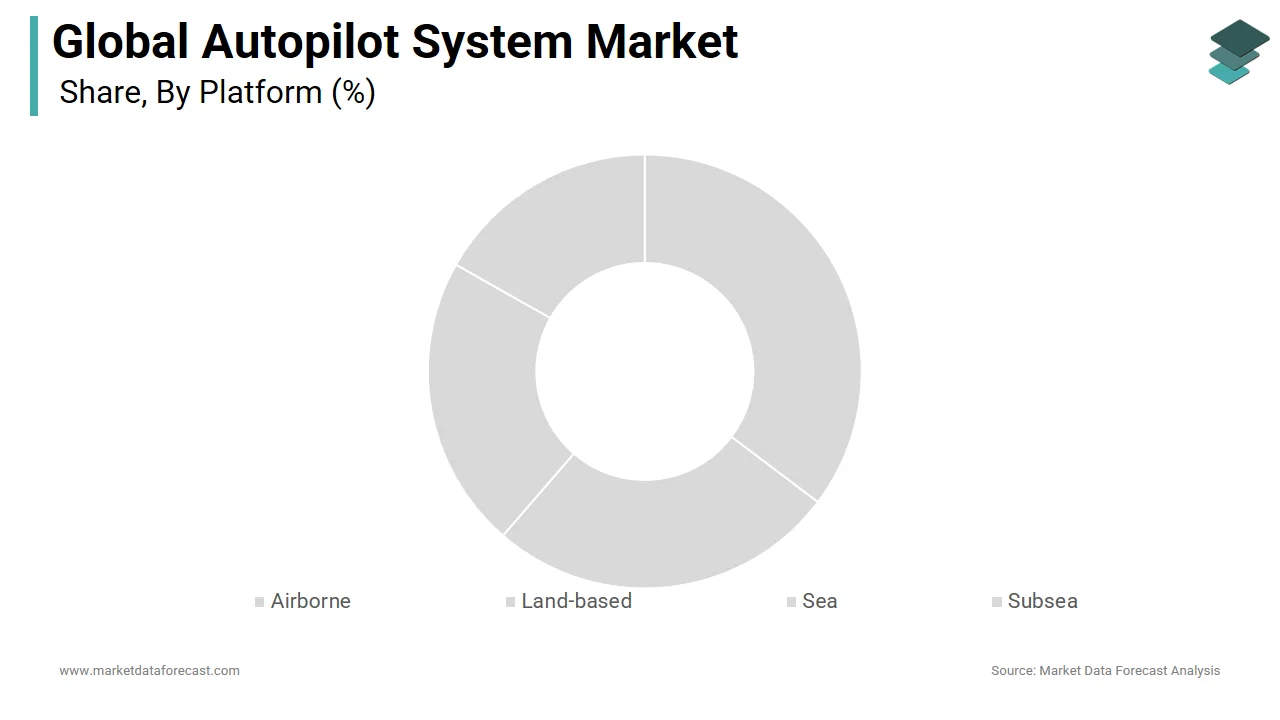
On the other side, the subsea segment is predicted to register the highest CAGR of 25.2% over the forecast period owing to offshore wind farm expansion, decommissioning requirements, and autonomous inspection replacing costly manned submersible operations. For instance, offshore wind installed capacity reached 78 gigawatts globally, with 340 new turbines commissioned, requiring regular foundation, cable, and mooring inspection, and creating sustained demand for autonomous underwater vehicles with precision navigation and station-keeping capabilities. According to corporate operational disclosures filed in 2025, autonomous surface vessels with tethered ROVs completed 45,000 kilometers of pipeline surveys without human operators onboard, reducing day-rate costs by 68% versus traditional crewed vessels. According to sustainability reports published in March 2025, autonomous subsea inspection programs reduced personnel exposure hours by 89% while increasing survey frequency threefold, improving asset integrity management. According to government contract announcements, defense applications amplified growth with major multi-million dollar awards for extra-large unmanned underwater vehicle fleets dedicated to mine countermeasures and intelligence, surveillance, and reconnaissance missions. This convergence of commercial energy transition and naval modernization creates dual demand vectors, de-risking investment and accelerating technology maturation beyond single-application dependency.
By Component Insights
The software segment led the market by accounting for the largest share of the global market in 2025. The dominance of the software segment in the global market can be credited to the increasing algorithm sophistication required for perception, planning, and control, alongside continuous over-the-air update cycles generating recurring revenue beyond the initial hardware sale. According to mobility analyses from 2025, automotive software content per vehicle reached 650 million lines of code for Level 3 systems, representing a 4-fold increase from the Level 2 baseline and reflecting exponential complexity growth in sensor fusion, prediction, and decision-making algorithms. According to company release notes archives, software stacks received 14 major over-the-air updates in 2025, each adding new capabilities or improving existing performance to demonstrate continuous development cycles impossible with static hardware. According to technical white papers released in March 2025, chip validation required 2.8 billion simulated test miles and 18 million real-world validation miles before certification, reflecting massive software verification efforts exceeding hardware design costs. According to annual reports from 2025, operating systems licensed to automakers generate recurring royalty revenue per vehicle sold, creating a software-defined business model decoupled from component manufacturing margins. This shift toward software value capture reflects a fundamental transformation where differentiation resides in algorithms, training data, and validation infrastructure rather than mechanical or electronic hardware, enabling superior margins and customer lifetime value versus commoditized sensor and actuator suppliers.
However, the actuators segment is predicted to record a CAGR of 20.5% over the forecast period in the global market owing to the transition from hydraulic and mechanical linkages to electronic steer-by-wire and brake-by-wire systems enabling precise digital control required for higher automation levels. According to technical standard revisions published in January 2025, Level 3 and above automation requires redundant actuation pathways eliminating single-point failures, forcing dual-motor steering racks and independent brake-caliper actuators to double the component count per vehicle. According to engineering presentations at major motor shows, mass-production vehicles with steer-by-wire systems achieved a 15% packaging space reduction and enabled variable steering ratio optimization for automated parking maneuvers. According to earnings call transcripts from Q3 2025, steer-by-wire actuator orders increased 340% year on year with multiple OEM programs entering production phases to validate mainstream adoption beyond niche luxury applications. According to technology roadmap disclosures, brake-by-wire system penetration reached 28% of European premium vehicle production in 2025, enabling regenerative braking blending and individual wheel torque vectoring essential for automated emergency maneuvering. This architectural transition creates Greenfield actuator demand uncorrelated with vehicle volume growth, as each platform conversion represents incremental component multiplication regardless of overall market conditions.
By Application Insights
The commercial segment dominated the market by accounting for the largest share of the global market in 2025. Commercial applications dominate the autopilot market through a combination of mandatory civil aviation equipage and high-volume passenger vehicle ADAS fitment, creating dual demand pillars spanning transportation sectors. According to international civil aviation statistical digests from 2025, all commercial air transport aircraft operating under instrument flight rules must be equipped with certified autopilots capable of coupled approach and go-around, generating a 100% fitment rate across active commercial jet fleets. According to agency safety oversight reports, 98% of commercial airline approaches in 2025 utilized autoland or coupled approach systems, reflecting operational necessity for low-visibility operations and crew workload management. Automotive commercial segments benefit from regulatory mandates requiring ADAS on all new vehicles, including commercial vans, trucks, and buses, extending automation beyond passenger cars to the entire road transport fleet according to respective regulatory texts. According to company delivery reports, major aerospace manufacturers delivered over 1,450 commercial aircraft in 2025, each equipped with multiple autopilot computers, sensors, and actuators representing high value per unit versus automotive volumes. This dual sector coverage provides diversification against cyclicality in either transportation mode, ensuring stable baseline demand through complementary procurement cycles and regulatory drivers unique to each domain.
However, the defense and security segment is anticipated to expand at a CAGR of 20.6% over the forecast period in the global market owing to the accelerated unmanned aerial, ground, and maritime systems procurement alongside manned platform modernization programs across NATO and allied nations. According to military expenditure databases from 2025, global defense spending reached 2.4 trillion dollars, with unmanned systems accounting for 18% of procurement budgets and representing a multi-billion-dollar addressable market for autonomous navigation and control technologies. According to budget justification documents from 2025, defense initiatives fielded thousands of attritable autonomous systems across air, ground, and sea domains, with unit costs averaging a fraction of manned equivalents. According to alliance defense planning committee reports, conflict observations demonstrated the operational effectiveness of autonomous loitering munitions and reconnaissance drones, prompting NATO members to collectively allocate 89 billion dollars for unmanned systems acquisition in supplemental budgets. According to press releases from 2025, defense ministries approved multi-billion-dollar autonomous systems procurement programs covering swarm drones, unmanned surface vessels, and robotic ground vehicles, reducing import dependency and building domestic industrial bases. This geopolitical urgency creates demand acceleration uncorrelated with economic cycles or commercial technology adoption curves, ensuring sustained growth through national security imperatives.
REGIONAL ANALYSIS
North America Autopilot System Market Analysis
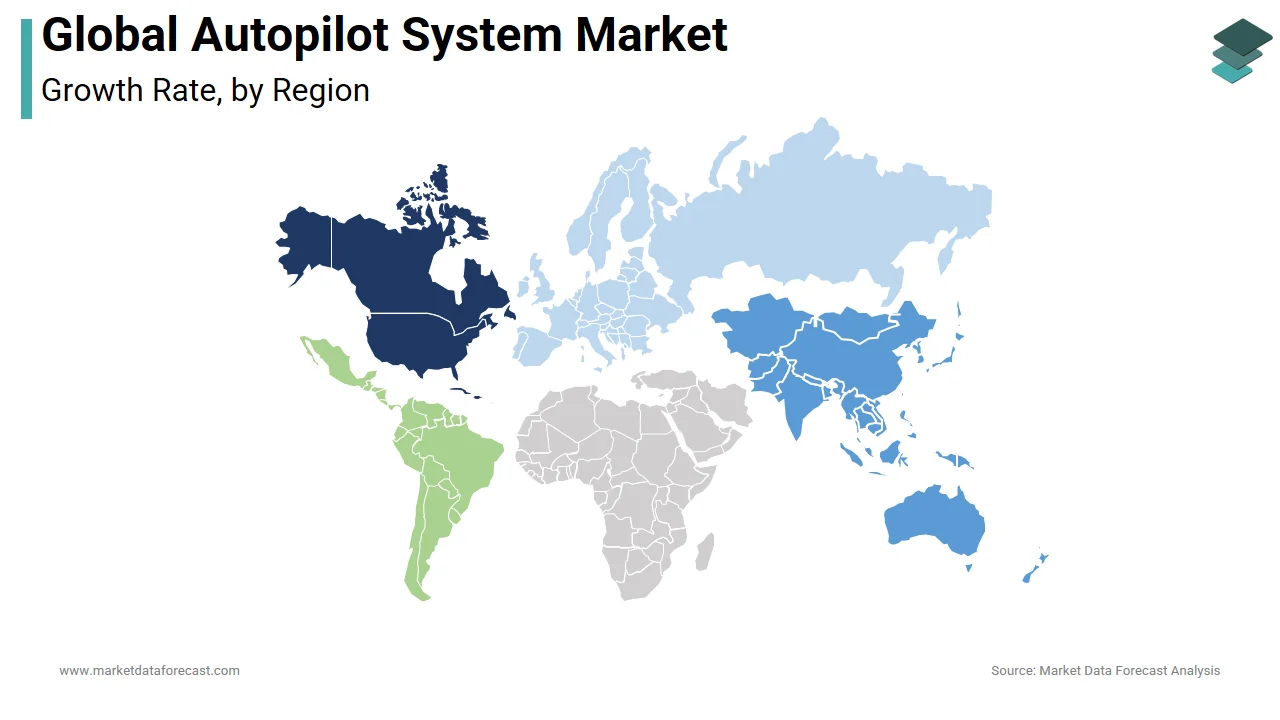
North America dominated the market by holding 36.6% of the global market share in 2025 and is poised for robust expansion over the next few years owing to the world's largest defense budget, leading autonomous vehicle testing infrastructure, and a concentrated technology innovation ecosystem. According to budget requests from 2025, autonomous systems research, development, test, and evaluation funding reached 18.4 billion dollars, representing a 24% year-on-year increase reflecting strategic priorities for unmanned and AI-enabled capabilities across all military services. According to agency data portal statistics from 2025, traffic safety administrations issued standing general orders requiring crash reporting for Level 2 plus and above automated driving systems, generating an unprecedented transparency dataset covering 4.2 million vehicle miles to inform regulatory policy and public safety discourse. According to disengagement reports and company disclosures, autonomous vehicle fleets accumulated 12 million autonomous miles in 2025 across major metropolitan areas, creating the world's largest validated operational dataset for urban Level 4 deployment. According to government department announcements, funding was allocated in 2025 for autonomous vehicle testing corridors and AI research centers, leveraging domestic manufacturing bases and university expertise. However, a fragmented state-level regulatory landscape complicates interstate deployment with only 28 states enacting specific AV legislation, creating compliance complexity for nationwide service rollout according to tracking databases. Despite this fragmentation, technological leadership and capital availability sustain North American primacy as an innovation origin point with a global diffusion lag of 18 to 24 months for successful domestic deployments.
Europe Autopilot System Market Analysis
Europe is expected to experience steady and compliance-driven growth in the coming years owing to the stringent regulatory frameworks, a strong automotive OEM presence, and coordinated research funding supporting safe automation deployment. According to assessments from 2025, member states invested billions of euros in connected and automated mobility R&D through Horizon Europe and national programs, focusing on safety validation, cybersecurity, and cross-border interoperability. According to legislative summaries from 2025, national road traffic acts were amended to enable Level 4 autonomous vehicle operation in designated areas without safety drivers, creating comprehensive legal frameworks for commercial robotaxi deployment. According to type approval registries, internationally certified Level 3 systems were approved for use across major European countries, enabling hands-off highway driving up to 95 km/h under defined conditions. According to agency certification databases, aviation safety agencies certified new autopilot systems for urban air mobility vehicles in 2025, establishing regulatory precedents for emerging eVTOL categories. However, slower consumer adoption versus Asia and North America reflects cultural caution, privacy concerns, and liability ambiguity, limiting near-term volume despite regulatory leadership and technological capability parity.
Asia Pacific Autopilot System Market Analysis
Asia Pacific is projected to surge dramatically over the next few years due to aggressive government support, massive consumer adoption, and manufacturing scale enabling cost-competitive technology deployment. According to white papers from 2025, domestic Level 2 plus vehicle sales reached 12.8 million units, representing 48% of the new car market, with major fleets accumulating 28 million autonomous test kilometers across 16 cities according to municipal transportation authority databases. According to press releases from 2025, supplementary budgets allocated over a billion dollars for Level 4 logistics automation, addressing rural delivery shortages and aging driver workforces. According to corporate investor relations disclosures, major automotive groups invested billions of dollars in joint ventures to achieve Level 4 robotaxi commercial service launches with fleet operations. According to ministry notifications, national highways authorities implemented dedicated autonomous vehicle testing lanes to enable validated high-speed evaluation under real traffic conditions. However, intellectual property concerns and export control restrictions limit Western technology transfer, creating parallel indigenous development tracks with varying interoperability and safety validation standards versus global benchmarks.
COMPETITIVE LANDSCAPE
Competition in the autopilot system market intensifies as automotive OEMs, tier one suppliers, technology platforms and dedicated AV startups vie for position across heterogeneous automation levels and geographic regulatory environments. Vertically integrated automakers like Tesla leverage proprietary data and direct consumer relationships, enabling rapid iteration; however face capital intensity and manufacturing execution risks absent in pure technology suppliers. Tier one giants including Mobileye, Bosch, and Continental combine scale regulatory expertise, and OEM relationships dominating Level 2 and 2 plus segments but struggle with software-defined business model transition and talent retention versus tech native competitors. Silicon platforms led by NVIDIA, Qualcomm, and AMD provide foundational compute infrastructure, capturing value across multiple winners; however face margin pressure from customer vertical integration and alternative architecture development. Dedicated AV companies Waymo, Cruise, and Zoox demonstrate technological leadership in Level 4 urban autonomy but require sustained capital investment without near-term profitability, creating existential dependency on parent company patience or external funding. Competitive dynamics vary significantly by automation level, with Level 2 featuring price-driven consolidation versus Level 4 experiencing fragmented regional experimentation. Consolidation accelerates as validation costs regulatory complexity, and capital requirements exceed mid-sized operator capabilities, concentrating innovation capacity among a few well-capitalized incumbents. This evolving landscape rewards data scale, regulatory agility, and ecosystem integration while penalizing undifferentiated hardware approaches vulnerable to commoditization and technological disruption inherent in the rapidly advancing field.
KEY MARKET PLAYERS
The leading companies operating in the global autopilot system market include:
- Rockwell Collins
- Tesla Inc.
- Mobileye Global Inc.
- Honeywell
- Genesys Aerosystems
- NVIDIA Corporation
- Furuno
- Garmin
- Micropilot
- Raymarine
- DJI
TOP PLAYERS IN THE MARKET
- Tesla Inc operates as a vertically integrated autopilot developer leveraging a proprietary vision-only perception stack trained on billions of miles of fleet data across the global vehicle parc. The company pioneered over-the-air software updates, enabling continuous feature improvement and post-sale monetization through the Full Self Driving subscription model. Recent strategic actions include releasing Version 12 end-to-end neural network architecture in Q1 2025, eliminating heuristic code and improving urban navigation performance according to company release notes. Tesla expanded FSD supervised deployment to China and Europe in 2025 after achieving regulatory approvals, validating international scalability beyond North America. Manufacturing integration enables hardware pre-installation across the entire production line, creating an upgradeable installed base for future software revenue. These initiatives reinforce the data network effect, where each vehicle contributes training signals improving system capability for all users while establishing recurring revenue streams decoupled from vehicle sales cycles and enabling sustained R&D investment through software margins superior to automotive hardware benchmarks.
- Mobileye Global Inc maintains a significant global presence through the EyeQ system-on-chip platform powering advanced driver assistance systems across 68 automakers with cumulative shipments exceeding 170 million units since inception. The company combines purpose-built silicon computer vision algorithms and high-definition mapping infrastructure, creating a comprehensive perception stack validated across diverse geographic and regulatory environments. Recent actions include launching the EyeQ6 Ultra chip in March 2025, integrating 12 cores and dedicated AI accelerators enabling Level 4 autonomy on a single device, reducing system cost and complexity according to the product specification sheet. Mobileye SuperVision hands-off highway pilot achieved regulatory approval in Germany, France, and Spain in 2025, becoming the first internationally certified Level 2 plus system from a tier one supplier. Strategic partnerships with Volkswagen, Porsche, and Audi secure long-term design wins across premium and mass market segments. These moves leverage scale economics and regulatory navigation expertise, creating a defensible position between commoditized sensors and differentiated OEM software stacks while capturing value through a silicon-plus-software bundling model.
- NVIDIA Corporation serves the autopilot market through the DRIVE platform, combining Orin and Thor system on chips CUDA accelerated software stack, and Omniverse simulation environment, enabling end-to-end autonomous driving development and validation. The company provides foundational compute infrastructure adopted by 25 automakers and 40 tier one suppliers for Level 2 through Level 4 system development, according to GTC 2025 keynote disclosure. Recent strategic actions include releasing DRIVE OS 7.0 with functional safety certified middleware in February 2025, reducing customer validation effort by 40 percent according to technical documentation. NVIDIA partnered with Mercedes-Benz to develop the next-generation MB DRIVE automated driving platform targeting Level 3 certification by 2026, leveraging shared development resources and cloud infrastructure. Omniverse Digital Twin platform enables synthetic scenario generation achieving 99.7 percent correlation with real-world sensor data, accelerating validation throughput versus physical testing alone. These initiatives position NVIDIA as an essential enabler rather than a direct competitor to OEMs, capturing value through platform licensing and ecosystem lock-in while benefiting from industry-wide automation adoption regardless of individual manufacturer success or failure in consumer markets.
TOP STRATEGIES USED BY KEY MARKET PARTICIPANTS
Key players employ vertical integration strategies combining silicon sensors, software, and mapping infrastructure to create defensible ecosystems generating recurring revenue beyond one-time hardware sales. Companies invest heavily in real-world data collection and simulation infrastructure, enabling continuous algorithm improvement and validation at scale impossible through traditional testing methodologies. Strategic partnerships with automakers, tier one suppliers, and regulators secure long-term design wins and shape emerging standards, creating switching costs and market access advantages. Over-the-air update capabilities enable post-sale feature activation and subscription monetization, transforming capital revenue into recurring software streams with superior margins. Functional safety certification and cybersecurity compliance investments create substantial barriers to entry, protecting incumbent positions against new entrants lacking validation resources and regulatory relationships. Platform openness versus proprietary approaches represents strategic choice balancing ecosystem growth against margin capture, with some vendors embracing third-party integration while others maintain closed systems for quality control. Geographic expansion prioritizes regions with favorable regulatory frameworks and data collection permissions, enabling faster iteration and commercialization versus restrictive jurisdictions. Talent acquisition targets specialized AI robotics and safety engineering expertise through competitive compensation and research lab investments addressing chronic skills shortage constraining industry-wide development velocity.
MARKET SEGMENTATION
The global autopilot system market has been segmented and sub-segmented based on the platform, component, application, and region.
By Platform
- Airborne
- Land-based
- Sea
- Subsea
By Component
- GPS
- Gyros
- Actuators
- Software
By Application
- Commercial
- Defense & Security
By Region
-
North America
-
The United States
-
Canada
-
Rest of North America
-
-
Europe
-
The United Kingdom
-
Spain
-
Germany
-
Italy
-
France
-
Rest of Europe
-
-
The Asia Pacific
-
India
-
Japan
-
China
-
Australia
-
Singapore
-
Malaysia
-
South Korea
-
New Zealand
-
Southeast Asia
-
-
Latin America
-
Brazil
-
Argentina
-
Mexico
-
Rest of LATAM
-
-
The Middle East and Africa
-
Saudi Arabia
-
UAE
-
Lebanon
-
Jordan
-
Cyprus
-