- Product Description Description
- Table of Contents TOC
- List of Table & Figure LOT
- Get Free Sample PDF Sample PDF
Market Size, 2025
$154.25 MnMarket Estimate, 2026
$164 MnMarket Forecast, 2034
$263 MnCAGR, 2026–2034
6.10%Executive Summary: Global Bio Decontamination Market
- Market Scope: Comprehensive global analysis of the bio-decontamination sector, detailing neutralization techniques, agent types, equipment systems, end-user facilities, and regional market landscapes.
- Market Valuation: Valued at USD 154.25 million in 2025, reaching USD 164 million in 2026, and projected to expand to USD 263 million by 2034, growing at a robust CAGR of 6.10% from 2026 to 2034.
- Primary Growth Drivers: Rising prevalence of viral and bacterial infections, increasing hospital-acquired infections (HAIs), expansion of pharmaceutical and biotechnology sectors, and growing outsourcing of bio-decontamination facilities to enhance operational efficiency.
Key Market Segment Metrics
| Category | Leading Segment (Base Position) | Fastest-Growing / High-Growth Segment |
|---|---|---|
| By Type | Chamber Bio-Decontamination (dominated the market share, driven by low power consumption, small footprint, and high adaptability) | Room Bio-Decontamination (high-growth segment driven by rising demand for broad-space sterilization in healthcare facilities) |
| By Agent Type | Hydrogen Peroxide (led the market due to its high material compatibility, safety profile, and broad-spectrum antimicrobial efficacy) | Chlorine Dioxide (anticipated to register a high CAGR fueled by advanced gaseous fumigation applications) |
| By Product Type | Equipment (recorded the largest share supported by robust capital investments in sterilization hardware) | Services (fastest-growing segment driven by lower cost requirements and reduced capital expenditures compared to equipment purchase) |
| By End User | Pharmaceutical & Medical Device Manufacturing Companies (captured major share due to strict sterility and regulatory compliance rules) | Life Sciences & Biotechnology Research Organizations (high-growth segment propelled by increasing R&D activities and clinical trials) |
| By Region | North America (market leader backed by strict medical safety regulations, advanced healthcare infrastructure, and key players) | Asia-Pacific (fastest-growing regional market driven by government initiatives to improve medical infrastructure and booming pharmaceutical exports) |
Major Market Players & Industry Landscape
Market Structure: Highly competitive environment characterized by technological innovations in fumigation systems, regulatory compliance demands, and strategic footprint expansions by key sterilization providers.
Key Companies: STERIS, Ecolab Inc., TOMI Environmental Solutions Inc., JCE Biotechnology, Fedegari Autoclavi SpA, Zhejiang Tailin Bioengineering Co., Ltd., Noxilizer, Inc., and Howorth Air Technology Limited.
 Download Free Sample Report
Global Bio Decontamination Market Size
The global bio-decontamination market was valued at USD 154.25 million in 2025, is estimated to reach USD 164 million in 2026, and is projected to reach USD 263 million by 2034, growing at a CAGR of 6.10% from 2026 to 2034.
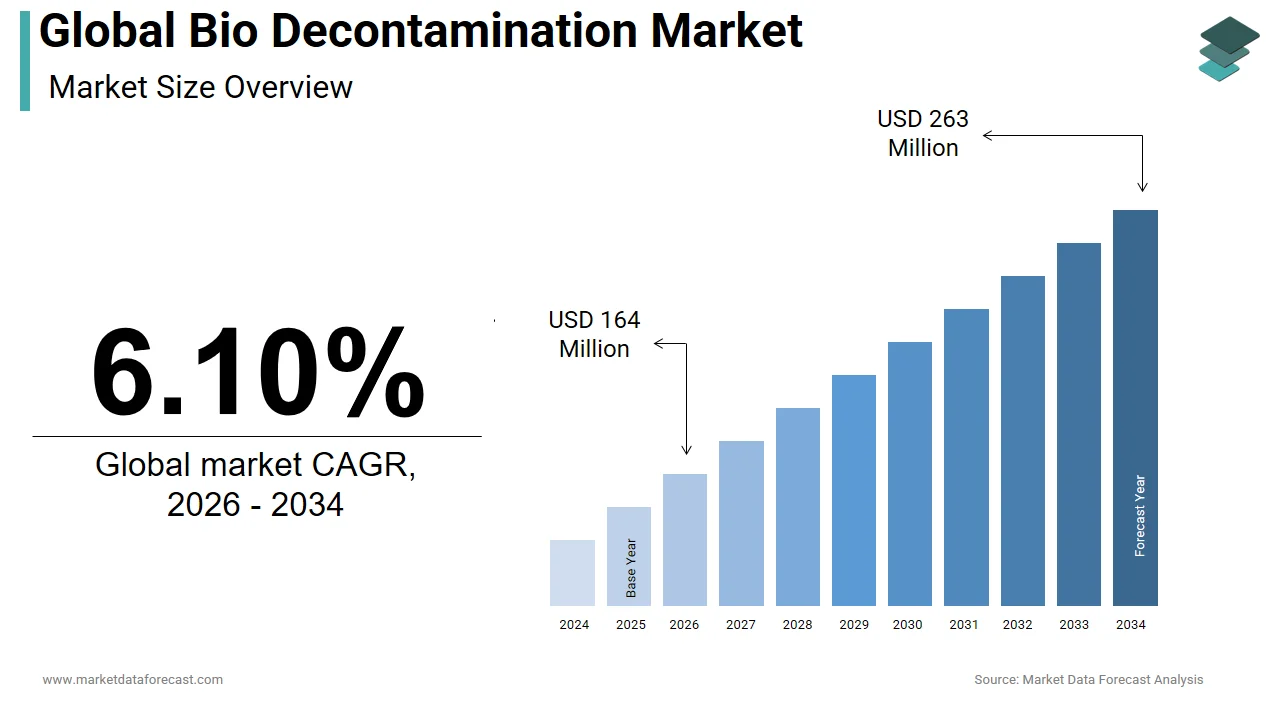
The bio-decontamination involves neutralizing and eliminating infectious microbes, chemical agents, and radioactive elements. The three standard techniques used to perform the bio-decontamination function are biological, chemical, and physical. Thermal and high-pressure methods are involved while serving the bio-decontamination process physically. At the same time, the neutralization of oxidizing agents and utilization of enzyme systems and artificial bacteria are involved in chemical and biological bio-decomposition, respectively.
MARKET DRIVERS
The growing prevalence of virus and bacterial infections boosts the bio-decontamination market growth.
In many developing and developed countries, the outsourcing of the bio-decontamination market is also famous for increasing the efficiency of the process. In addition, the ability to reduce the adverse effect of microorganisms is another benefit associated with the bio-decomposition market.
The cost-effective nature and ability to perform viral decontaminating products with bacteria or fungi involved in the biological decontamination process make it preferable to other conventional methods. Growing developments and research activities in the bio-decontamination sector also diverge into industry developments, which leads to the entry of more potential players in the market. The rise in the number of surgeries and treatment of toxic by-products released by microorganisms is expected to drive the market's growth. In addition, the rising demand for equipment due to the increasing need for minimal manual use is expected to drive the development of the bio-decontamination market further.
On the other hand, the stringent rules and regulations imposed by the government and other regulatory bodies on using traditional methods made up of plastics and increasing public awareness of their adverse effects are driving market growth. In addition, the increasing influx of advanced fumigation systems presents other potential opportunities for the growth of the bio-decontamination market in the coming years. Furthermore, increasing rates of hospital-acquired infections, the development of the pharmaceutical and biotechnology sectors, and increased outsourcing of bio-decontamination facilities are driving the market's overall growth.
MARKET RESTRAINTS
The budgetary constraints in the bio-decomposition market and the advent of manual bio-decontamination methods impede the market's growth. The installation of decomposition devices and machines requires significant capital, which is impossible for small and medium companies, restraining market growth. The long-life cycle of bio-decontamination equipment can also limit the market growth as they got obsolete with the changing time and technology. Another major challenge in the bio-decomposition market is the lack of infrastructure for effective composting. Before starting the process, the interior must be completely sealed to prevent formaldehyde vapor from escaping to other areas.
REPORT COVERAGE
| REPORT METRIC | DETAILS |
| Market Size Available | 2025 to 2034 |
| Base Year | 2025 |
| Forecast Period | 2026 to 2034 |
| Segments Covered | By Type, Agent Type, Product, End-Users, and Region. |
| Various Analyses Covered | Global, Regional and Country-Level Analysis, Segment-Level Analysis, Drivers, Restraints, Opportunities, Challenges; PESTLE Analysis; Porter’s Five Forces Analysis, Competitive Landscape, Analyst Overview of Investment Opportunities |
| Regions Covered | North America, Europe, Asia Pacific, Latin America, Middle East & Africa |
| Market Leaders Profiled | STERIS (US), Ecolab, Inc. (the US), TOMI Environmental Solutions, Inc. (the US), JCE Biotechnology (France), Fedegari Autoclavi SpA (Italy), Zhejiang Tailin Bioengineering Co., Ltd. (China), Noxilizer, Inc. (the US) and Howorth Air Technology Limited (UK). |
SEGMENTAL ANALYSIS
By Type Insights
Based on the product type, the chamber bio-decontamination segment accounted for the largest market share in 2025 and is expected to show the highest growth during the forecast period. This is due to its low power consumption, small footprint, high adaptability, and economical decontamination of the chamber. In addition, the low cost involved in the process also boosts the demand for the chamber bio-decontamination product. This is mainly due to the small equipment and small floor space.

By Agent Type Insights
Over the forecast period, the hydrogen peroxide segment had the largest share of the bio-decontamination market in 2025 and is expected to grow at the highest CAGR from 2026 to 2034. The compatibility and safety of the material are the main factors contributing to its advantage in the bio-decontamination market.
By Product Type Insights
The equipment segment recorded a rapid share over the forecast period. However, services are the fastest-growing segment due to the lower cost of services and the lower capital expenditures required than purchasing equipment and consumables.
By End User Insights
Pharmaceutical and medical device manufacturers' market penetration of bio-decontamination will increase significantly. Strict regulations are being enforced due to the increasing incorporation of bio-decontamination products and services into these facilities. Bio pharmacy companies also have a growing need for a hygienic and sterile environment. The influx of technologically advanced products and easy access to the fleet of decontamination equipment promotes market dynamics.
REGIONAL ANALYSIS
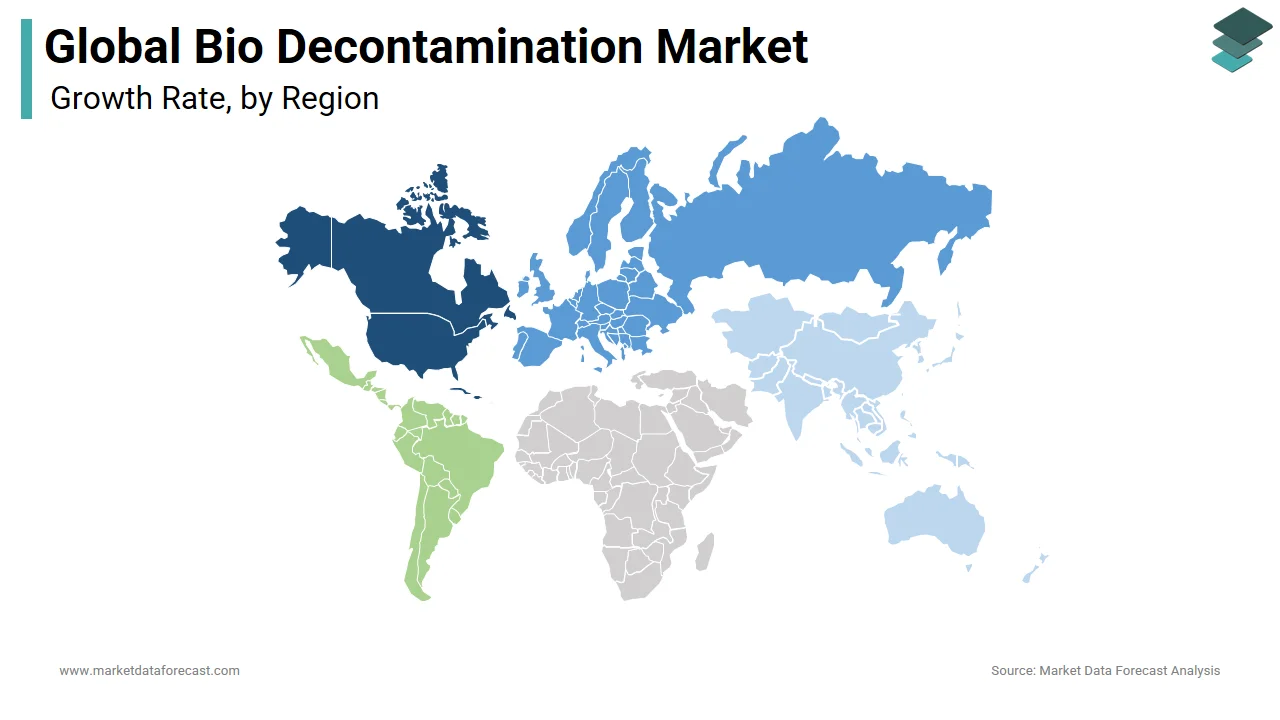
Due to strict medical safety laws, advanced healthcare infrastructure, and favorable reimbursement policies, North America dominates the bio-decontamination market. In addition, the increased implementation of awareness campaigns related to the benefits and needs of bio-decontamination will further drive the growth of the regional bio-decontamination market over the forecast period. The United States accounted for the majority share of the market during the forecast period. Healthcare spending, technological advancements in the healthcare sectors, and the presence of key market players.
Europe is likely to be the second-largest market for the Bio decontamination market. The evolving healthcare sector and the regional market players such as Germany, the UK, France, Spain, and Italy significantly contribute to the European regional market growth. However, the UK is projected to witness significant growth in the market in the coming period. The European Commission's ban on plastics is expected to boost the development of the packaging sector during the investigation and use of biodegradable products in the medical industry. Drug encapsulation and medical surgery are becoming more common in the given region.
The Asia Pacific region has also shown significant growth in the bio-decontamination market due to increased government support for healthcare infrastructure. In addition, the rise in the number of hospitals and clinics is expected to further drive the growth of the regional bio-decontamination market in the coming years. In the Asia Pacific region, government initiatives to increase the number of hospitals and clinics, increase population and improve medical infrastructure are other factors boosting the growth. In addition, APAC is also the world's largest exporter of pharmaceuticals, emphasizing the need to ensure the high quality of drugs for export and provide market participants with the opportunity to enter these markets.
KEY MARKET PLAYERS
Some of the companies that are playing a dominating role in the global bio-decontamination market include
- STERIS
- Ecolab, Inc.
- TOMI Environmental Solutions, Inc.
- JCE Biotechnology
- Fedegari Autoclavi SpA
- Zhejiang Tailin Bioengineering Co., Ltd.
- Noxilizer, Inc.
- Howorth Air Technology Limited
MARKET SEGMENTATION
This research report on the global bio-decontamination market has been segmented and sub-segmented based on type, agent type, product, end-users, and region.
By Type
- Room bio-decontamination
- Chamber bio-decontamination
By Agent Type
- Hydrogen Peroxide
- Nitrogen Dioxide
- Chlorine Dioxide
By Product Type
- Equipment
- Consumables
- Services
By End User
- Pharmaceutical & medical device manufacturing companies
- Hospitals & healthcare facilities
- Life sciences & biotechnology research organizations.
By Region
- North America
- Europe
- Asia-Pacific
- Latin America
- Middle East and Africa