- Product Description Description
- Table of Contents TOC
- List of Table & Figure LOT
- Get Free Sample PDF Sample PDF
Market Size, 2025
$45.49 BnMarket Estimate, 2026
$49.95 BnMarket Forecast, 2034
$105.6 BnCAGR, 2026–2034
9.81%Global Biodiesel Market Size, Growth, Trends & Forecast (2026–2034)
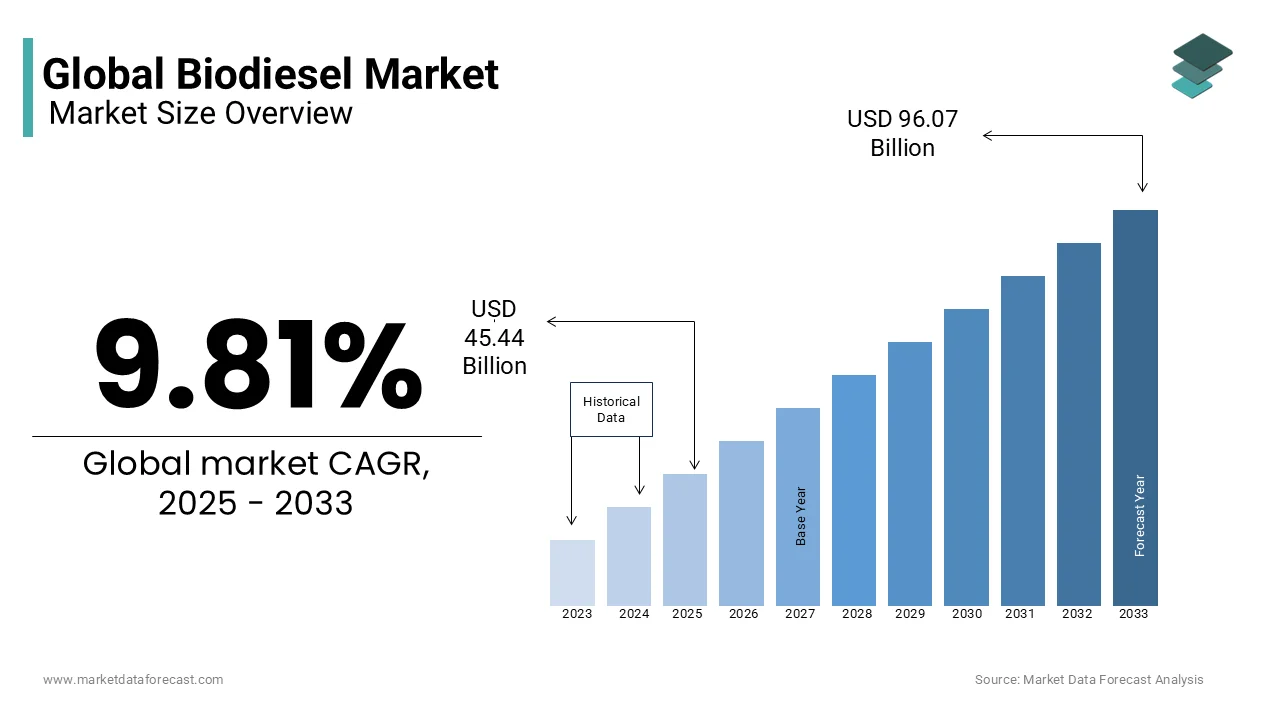
The global biodiesel market size was valued at USD 45.49 billion in 2025, reached USD 49.95 billion in 2026, and is projected to scale up to USD 105.60 billion by 2034, registering a compound annual growth rate (CAGR) of 9.81% during the forecast period from 2026 to 2034. Driven by stringent government policies targeting carbon emissions in transportation, expanding utilization of waste-derived feedstocks, and rising integration into maritime and aviation decarbonization pathways, the market continues to expand significantly across the globe.
Key Executive Metrics (At-a-Glance)
- 2025 Base Valuation: USD 45.49 Billion
- 2026 Current Valuation: USD 49.95 Billion
- 2034 Forecast Valuation: USD 105.60 Billion
- Compound Annual Growth Rate (CAGR): 9.81% (2026–2034)
- Leading Regional Market: Europe (38.3% share, 2025)
- Fastest-Growing Blend Segment: B20 Blend (6.8% CAGR)
- Fastest-Growing Feedstock Segment: Used Cooking Oil (UCO) (7.3% CAGR)
- Fastest-Growing Application Segment: Power Generation (7.1% CAGR)
Core Market Drivers
- Regulatory Mandates: Government policies like the EU’s RED III and the U.S. RFS program mandating renewable energy share in transport fuels.
- Waste-Derived Feedstocks: Transition toward used cooking oil (UCO) and animal tallow to lower indirect land-use change (ILUC) risks and improve carbon scores.
Primary Market Restraints & Challenges
- Feedstock Limitations: Limited availability and high price volatility of high-quality oils amidst competing demands from food and industrial sectors.
- Technical Constraints: Inferior cold-flow properties, oxidative instability, and material incompatibility in older engine models.
Global Biodiesel Market Segmentation Highlights
| Segment Category | Largest Segment | Fastest-Growing Segment |
|---|---|---|
| By Blend | B5 Blend (Dominant share, 2025) | B20 Blend (6.8% CAGR) |
| By Feedstock | Vegetable Oils (52.3% share, 2025) | Used Cooking Oil - UCO (7.3% CAGR) |
| By Application | Fuel (Dominant share, 2025) | Power Generation (7.1% CAGR) |
Major Industry Players Profiled
Key energy corporations and market leaders shaping the global biodiesel sector include Neste, POET, Wilmar International, Archer-Daniels-Midland Company, Ag Processing Inc., Avril Group, Cargill Inc., Renewable Energy Group, VERBIO Vereinigte BioEnergie AG, and World Energy LLC.
Global Biodiesel Market Size
The global biodiesel market size was valued at USD 45.49 billion in 2025, and the global market size is expected to be worth USD 49.95 billion in 2026 and USD 105.60 billion by 2034, growing at a CAGR of 9.81% during the forecast period.
The Biodiesel is fuel derived primarily from vegetable oils, animal fats, and recycled cooking grease through a chemical process known as transesterification. Unlike conventional diesel, biodiesel emits significantly lower levels of sulfur oxides, particulate matter, and carbon monoxide, making it a pivotal alternative in decarbonizing the transport sector. As per the International Energy Agency, global biofuel production reached 1.7 million barrels per day in 2023, with biodiesel accounting for nearly 40% of this volume. Additionally, the United States Environmental Protection Agency notes that biodiesel reduces lifecycle greenhouse gas emissions by up to 86% compared to petroleum diesel.
MARKET DRIVERS
Stringent Government Policies Targeting Carbon Emissions in Transportation
Government mandates to reduce transportation-related emissions is driving the growth of the Biodiesel Market. According to the European Union’s Renewable Energy Directive III (RED III), 14% of transport energy must come from renewable sources by 2030, with specific sub-targets favoring advanced biofuels like biodiesel. In the United States, the Renewable Fuel Standard (RFS) program, overseen by the Environmental Protection Agency, required 2.76 billion gallons of biomass-based diesel to be blended into the national fuel supply in 2023. These regulatory frameworks create a stable demand pull, ensuring consistent procurement by fuel distributors and encouraging long-term investment in feedstock cultivation and refining infrastructure across both developed and emerging economies.
Expanding Utilization of Waste-Derived Feedstocks to Meet Sustainability Criteria
The shift toward waste and residue-based feedstocks, such as used cooking oil (UCO) and animal tallow, is transforming the biodiesel industry’s sustainability profile. As per the European Environment Agency, the use of UCO in biodiesel production in the EU increased by 38% between 2018 and 2022, reducing competition with food crops and lowering indirect land-use change (ILUC) risks. In 2023, waste-based feedstocks constituted over 40% of total biodiesel feedstock input in Europe, according to data from the European Biodiesel Board. This transition aligns with stricter sustainability certification requirements under RED III, which assign higher carbon savings to waste-derived fuels.
MARKET RESTRAINTS
Limited Availability and Price Volatility of High-Quality Feedstocks
Feedstock availability in production of biodiesel for high-quality oils such as rapeseed, palm, and soybean is restricting the growth of the market. According to the Food and Agriculture Organization (FAO), global vegetable oil production in 2023 reached approximately 207 million metric tons, yet less than 16% is allocated to biodiesel due to competing demands from food, cosmetics, and industrial sectors. Palm oil, which accounts for nearly 30% of global vegetable oil supply, faces export restrictions from key producers like Indonesia and Malaysia, driven by domestic consumption mandates.
Degradation of Engine Performance and Material Incompatibility in Cold Climates
The biodiesel exhibits inferior cold-flow properties compared to petroleum diesel in colder regions is additionally to hinder the growth of the biodiesel market. A 2022 study by the Swedish Transport Administration revealed that B20 blends (20% biodiesel) experienced a 15% increase in fuel filter replacements during winter months compared to conventional diesel. Furthermore, biodiesel’s higher oxidative instability can degrade elastomers and seals in older engine models, as noted by the German Automotive Industry Association (VDA), which reported a 22% rise in injector fouling incidents in non-upgraded commercial vehicles operating on high-blend biodiesel.
MARKET OPPORTUNITIES
Integration of Biodiesel into Maritime and Aviation Decarbonization Pathways
The maritime and aviation sectors, historically reliant on high-carbon fuels, are increasingly exploring biodiesel and its derivatives as viable decarbonization tools, which is gearing up top showcase new opportunities for the growth of the biodiesel market. As per the International Maritime Organization (IMO), shipping accounts for nearly 2.8% of global CO₂ emissions, prompting regulatory pressure to reduce emissions by at least 40% by 2030 compared to 2008 levels.
Advancement of Co-Processing Technologies in Existing Refineries
The co-processing of renewable feedstocks in conventional petroleum refineries pathway to increase biodiesel output without requiring dedicated infrastructure. This attribute is more likely to elevate the growth of the biodiesel market. As per the International Council on Clean Transportation (ICCT), co-processing can reduce capital expenditure by up to 50% compared to building standalone biorefineries. The U.S. Energy Information Administration notes that over 120 U.S. refineries possess hydroprocessing units compatible with co-processing, representing a latent capacity to integrate up to 500,000 barrels per day of renewable feedstocks.
MARKET CHALLENGES
Risk of Indirect Land-Use Change and Associated Environmental Trade-offs
The biodiesel expansion can trigger indirect land-use change (ILUC), where cultivation of energy crops displaces food agriculture into forests or grasslands, which is resulting in net carbon emissions is hampering the growth of the biodiesel market. As per a 2023 study published by the Intergovernmental Panel on Climate Change (IPCC), large-scale soybean and palm oil cultivation for biodiesel contributed to the conversion of 1.3 million hectares of tropical forests between 2010 and 2020, primarily in Southeast Asia and the Amazon Basin. The Union of Concerned Scientists estimates that when ILUC effects are factored in, palm-based biodiesel may emit up to 3.5 times more greenhouse gases over a 30-year period than conventional diesel.
Inconsistent Global Regulatory Frameworks and Trade Barriers
The absence of harmonized international standards for biodiesel certification, sustainability, and carbon accounting is also to decline the growth of the biodiesel market. As per the World Trade Organization, 18 out of 27 EU member states applied differential tax rates on biodiesel based on feedstock origin in 2023, disadvantaging imports from countries like Argentina and Indonesia. Indonesia, the world’s largest palm oil producer, faced a 27% anti-dumping duty on biodiesel exports to the EU in 2022, as determined by the European Commission, citing unfair pricing and environmental concerns. Meanwhile, the U.S. imposes strict Renewable Identification Number (RIN) compliance requirements that foreign producers often struggle to meet. According to the International Chamber of Commerce, these regulatory misalignments increase compliance costs by an average of 18% for cross-border biodiesel traders, inhibiting global market integration and discouraging investment in export-oriented production facilities.
REPORT COVERAGE
| REPORT METRIC | DETAILS |
| Market Size Available | 2025 to 2034 |
| Base Year | 2025 |
| Forecast Period | 2026 to 2034 |
| CAGR | 9.81% |
| Segments Covered | By Blend, Feedstock, Application, and Region. |
| Various Analyses Covered | Global, Regional & Country Level Analysis, Segment-Level Analysis, DROC, PESTLE Analysis, Porter’s Five Forces Analysis, Competitive Landscape, Analyst Overview of Investment Opportunities |
| Regions Covered | North America, Europe, APAC, Latin America, Middle East & Africa |
| Market Leaders Profiled | Archer-Daniels-Midland Company, Ag Processing Inc., Avril Group, Biodiesel Bilbao S.L., Cargill Inc., Emami Agrotech Ltd, FutureFuel Chemical Company, G-Energetic Biofuels Private Limited, Louis Dreyfus Company, Münzer Bioindustrie GmbH, Renewable Energy Group, VERBIO Vereinigte BioEnergie AG, Wilmar International Limited and World Energy LLC., and Others. |
SEGMENTAL ANALYSIS
By Blend Insights
The B5 blend segment was the largest and held a dominant share of the biodiesel market with its widespread regulatory acceptance and compatibility with existing diesel engines without requiring modifications. In the United States, the Environmental Protection Agency mandates B5 as the baseline for biodiesel integration under the Renewable Fuel Standard, with over 70% of diesel fuel sold in 2023 containing at least 5% biodiesel. Similarly, India’s National Policy on Biofuels mandates a 5% biodiesel blend in transportation diesel across 20 states, covering 90% of national diesel consumption. As per the European Environment Agency, B5 is the default blend in 18 EU member states due to its minimal impact on fuel infrastructure and cold-flow performance by enabling seamless adoption in legacy fleets.
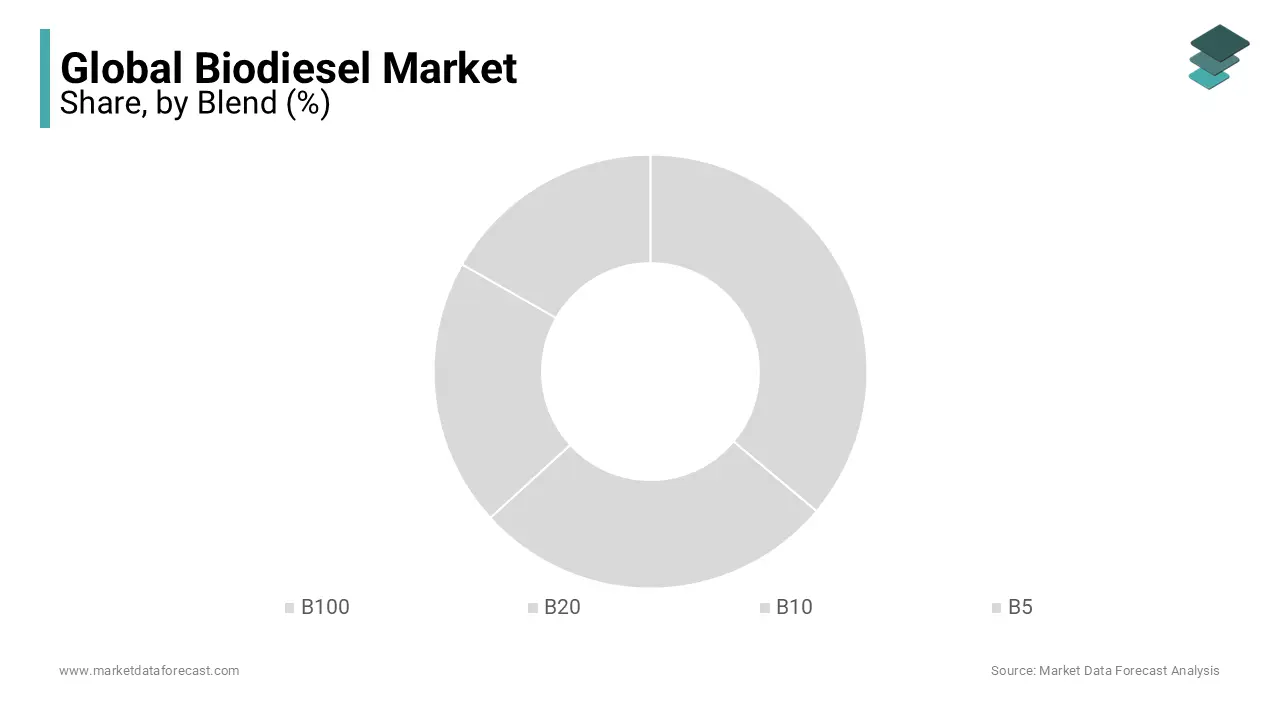
The B20 blend (20% biodiesel) is deemed to grow with an expected CAGR of 6.8% during the forecast period with the commercial fleet operators seeking to meet corporate sustainability targets while maintaining engine efficiency. In Brazil, state-owned transport companies are required to use B15 blends, with plans to transition to B20 by 2026 under the RenovaBio program, as confirmed by the Ministry of Mines and Energy. Additionally, California’s Low Carbon Fuel Standard incentivizes B20 use by assigning higher carbon credit values to fuels with greater renewable content.
By Feedstock Insights
The vegetable oils segment was accounted in holding 52.3% of the biodiesel market share in 2025 with the high oil yield and established agricultural infrastructure for crops such as soybean, rapeseed, and palm. Indonesia, the world’s largest palm oil producer, contributed 56% of global palm oil output in 2023, with nearly 30% diverted to biodiesel production under its B35 national mandate, according to the Indonesian Ministry of Energy and Mineral Resources.
The Used Cooking Oil (UCO) segment is likely to grow with an expected CAGR of 7.3% during the forecast period with its superior sustainability profile and regulatory preference under the EU’s Renewable Energy Directive III, which assigns UCO-based biodiesel a 91% reduction in greenhouse gas emissions compared to fossil diesel. In 2023, the European Union sourced 42% of its biodiesel feedstock from UCO, a 50% increase from 2018 levels, according to Eurostat. China has also intensified UCO collection, with urban recycling rates rising to 68% in Tier-1 cities, as reported by the Ministry of Housing and Urban-Rural Development. Furthermore, the U.S. Environmental Protection Agency awards 1.7 Renewable Identification Numbers (RINs) per gallon for biodiesel from UCO, compared to 1.0 for soy-based biodiesel, which is creating a strong economic incentive for refiners to prioritize waste-derived inputs.
By Application Insights
The fuel application segment was the largest by capturing a dominant share of the biodiesel market in 2025 with the urgent need to decarbonize the transportation sector. Biodiesel is increasingly integrated into heavy-duty transport, where electrification remains challenging. In India, the state-run oil marketing companies supplied over 1.2 million metric tons of biodiesel for freight transport in 2023, as reported by the Ministry of Petroleum and Natural Gas. The compatibility of biodiesel with existing compression-ignition engines ensures continued reliance on it as a transitional fuel in both urban and intercity logistics.
The power generation segment is swiftly growing with an expected CAGR of 7.1% in the next coming years with the increasing deployment of biodiesel in off-grid and backup power systems, particularly in regions with unreliable grid infrastructure. Nigeria’s Rural Electrification Agency installed over 1,200 biodiesel-run mini-grids in 2023, which utilizes locally produced jatropha oil. Additionally, data centers in Europe are adopting biodiesel for emergency generators to meet corporate net-zero goals.
REGIONAL ANALYSIS
Europe Biodiesel Market Analysis
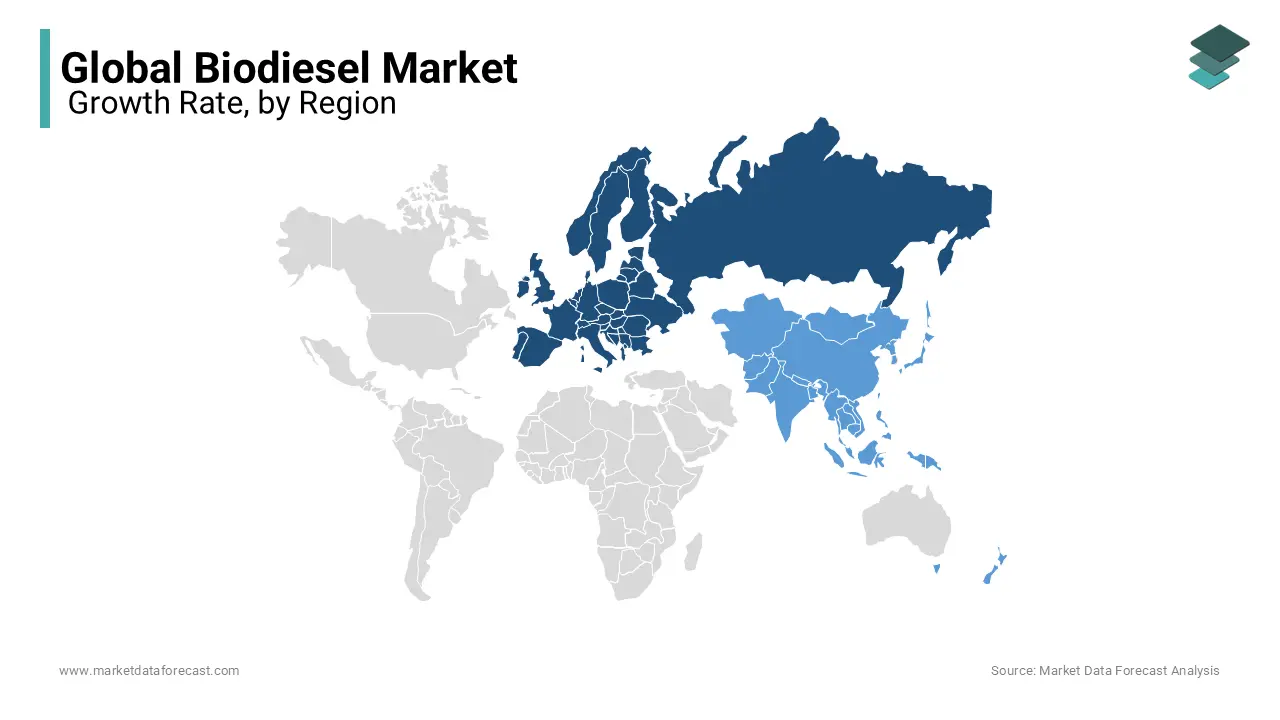
Europe was the top performer in the biodiesel market by holding 38.3% of the share in 2025. The Renewable Energy Directive III (RED III), which mandates a 57% reduction in transport emissions by 2030 and prioritizes advanced biofuels. Germany is the largest contributor for the growth of the biodiesel market. Germany generated 2.8 million metric tons of biodiesel in 2023, primarily from rapeseed oil, according to the German Biofuels Association. France mandates a 13% renewable content in diesel, with biodiesel contributing 8.5 percentage points.
North America Biodiesel Market Analysis
North America was positioned next by capturing 27.3% of the biodiesel market share in 2025. The United States accounts for 89% of regional production, with biodiesel output reaching 1.6 billion gallons in 2023, according to the National Biodiesel Board. Additionally, California’s Low Carbon Fuel Standard generated $1.2 billion in credit revenue for biodiesel producers in 2023, as reported by the California Air Resources Board, reinforcing economic viability.
Asia Pacific Biodiesel Market Analysis
Asia Pacific (APAC) biodiesel market growth is likely to have significant opportunities in the coming years with production increasingly centralized in Southeast Asia due to favorable climatic conditions and government mandates, as per the International Energy Agency. This policy has reduced the country’s diesel imports by 30%, saving $2.1 billion in foreign exchange. Malaysia follows with a B20 mandate, achieving 95% compliance across federal transportation fleets in 2023, as reported by the Malaysian Palm Oil Board.
Latin America Biodiesel Market Analysis
Latin America biodiesel market growth is likely to be driven with Brazil serving as the regional epicenter due to its integrated agro-industrial base and biofuel policy continuity. Brazil’s biodiesel output reached 4.2 million cubic meters in 2023, with the national blend rising to B14, as confirmed by the Brazilian National Petroleum Agency (ANP). Soybean oil contributes 72% of feedstock, supported by a surplus production of 102 million metric tons in 2023, according to CONAB, the national agricultural agency. Colombia mandates a B10 blend and has expanded jatropha cultivation on degraded lands to avoid food crop competition.
Middle East and Africa Biodiesel Market Analysis
Middle East and Africa (MEA) biodiesel market growth is likely to grow with the renewable fuels to diversify energy portfolios and reduce diesel import dependency. South Africa implemented a mandatory B2 blend in 2023, with plans to increase to B5 by 2026, according to the Department of Mineral Resources and Energy. In the Gulf, the UAE’s Masdar City project integrated biodiesel into municipal fleets, achieving a 25% emissions reduction in pilot zones.
COMPETITIVE LANDSCAPE
The biodiesel market exhibits a highly dynamic and fragmented competitive landscape, characterized by the coexistence of large integrated agribusinesses, specialized biofuel producers, and national oil companies. Competition is intensifying as firms strive to secure sustainable feedstock supplies and comply with evolving environmental regulations across major markets. Differentiation is increasingly based on carbon intensity scores, feedstock traceability, and technological innovation rather than price alone. Companies are investing heavily in certification systems and blockchain-enabled supply chain tracking to meet EU and North American import standards. Regional policy divergence creates both challenges and opportunities, prompting firms to adopt localized strategies.
KEY MARKET PLAYERS
Some of the leading companies in the global biodiesel market are
-
Archer-Daniels-Midland Company
-
Ag Processing Inc.
-
Avril Group
-
Biodiesel Bilbao S.L.
-
Cargill Inc.
-
Emami Agrotech Ltd
-
FutureFuel Chemical Company
-
G-Energetic Biofuels Private Limited
-
Louis Dreyfus Company
-
Münzer Bioindustrie GmbH
-
Renewable Energy Group
-
VERBIO Vereinigte BioEnergie AG
-
Wilmar International Limited
-
World Energy LLC
TOP PLAYERS IN THE MARKET
- Neste has established itself as a pioneer in renewable diesel and biodiesel innovation, with significant influence across the Asia-Pacific region. The company operates advanced refining facilities capable of processing waste and residue feedstocks into high-quality biodiesel. In Singapore, Neste’s refinery is one of the largest renewable diesel plants outside Finland, serving markets across Asia, including Japan, Australia, and India. In 2023, the company expanded its collaboration with Indian Oil Corporation to develop scalable biodiesel supply chains using non-edible oils.
- POET, one of the largest biofuel producers in the United States, has extended its influence into the Asia-Pacific biodiesel landscape through strategic export initiatives and technology licensing. While primarily focused on ethanol, POET’s subsidiary POET Biodiesel operates large-scale production facilities that supply biodiesel to international markets, including Australia and Southeast Asia. In 2023, the company launched a joint feasibility study with Australian agribusinesses to assess the potential for establishing biodiesel plants using tallow and canola oil. POET also enhanced its supply chain resilience by securing long-term contracts with Indonesian used cooking oil collectors. The company’s emphasis on low-carbon intensity fuels aligns with clean fuel policies in California and British Columbia by enabling indirect market penetration into Pacific Rim countries through compliant fuel exports.
- Wilmar International is a Singapore-based agribusiness giant, plays a pivotal role in the Asia-Pacific biodiesel market by integrating palm oil cultivation, refining, and biofuel production across Indonesia and Malaysia. As one of the largest palm oil producers, Wilmar supplies feedstock to its own biodiesel plants while also serving third-party refiners. In 2023, the company expanded its biodiesel production capacity in Riau, Indonesia, to meet the national B35 mandate, ensuring uninterrupted supply to state energy company Pertamina. Wilmar has also invested in sustainable palm oil certification across its plantations, responding to EU regulatory scrutiny. Additionally, it launched a digital traceability platform to verify the origin of feedstocks by enhancing compliance with international carbon accounting standards and improving export eligibility to environmentally sensitive markets.
TOP STRATEGIES USED BY THE KEY MARKET PLAYERS
Key players in the biodiesel market are deploying vertical integration, feedstock diversification, and strategic partnerships to consolidate their positions. Vertical integration enables companies to control operations from feedstock sourcing to fuel distribution, reducing cost volatility and ensuring supply chain resilience. Many are expanding into waste-based feedstocks such as used cooking oil and animal fats to meet stringent sustainability criteria in export markets. Strategic collaborations with government agencies and oil marketing companies ensure regulatory compliance and stable off-take agreements. Geographical expansion in emerging economies with blending mandates, is another prevalent tactic. Additionally, firms are investing in research to improve cold-flow properties and engine compatibility, enhancing product performance. Carbon credit monetization through compliance programs like LCFS is being leveraged to boost profitability and justify premium pricing.
RECENT HAPPENINGS IN THE MARKET
- In January 2023, Neste expanded its renewable diesel production capacity at its Singapore refinery by 25%, enabling increased supply to Japan and Australia amid tightening transport emission norms.
- In June 2023, Wilmar International launched a blockchain-based traceability system for palm oil feedstock across its Indonesian plantations to meet EU deforestation regulations and maintain biodiesel export eligibility.
- In September 2023, POET LLC initiated a joint venture with Australian Renewable Fuels to assess the development of a tallow-based biodiesel plant in Queensland, which is targeting domestic and export markets.
- In November 2023, Pertamina, in collaboration with Wilmar, commenced operations at a new 200 kiloliters-per-day biodiesel plant in Sumatra to support Indonesia’s B35 national blending mandate.
- In April 2025, Neste partnered with Japan’s Idemitsu Kosan to supply renewable diesel for commercial fleets in Tokyo, which is strengthening its B2B presence in the Asia-Pacific transportation sector.
MARKET SEGMENTATION
This research report on the global biodiesel market has been segmented and sub-segmented based on the product, technology, application, and region.
By Blend
- B100
- B20
- B10
- B5
By Feedstock
- Vegetable Oils
- Animal Fats
- Used Cooking Oil (UCO)
- Other Feedstock
By Application
- Fuel
- Power Generation
- Other Applications
By Region
- North America
- Europe
- Asia-Pacific
- Latin America
- Middle East and Africa