- Product Description Description
- Table of Contents TOC
- List of Table & Figure LOT
- Get Free Sample PDF Sample PDF
Global Bioreactors Market Size
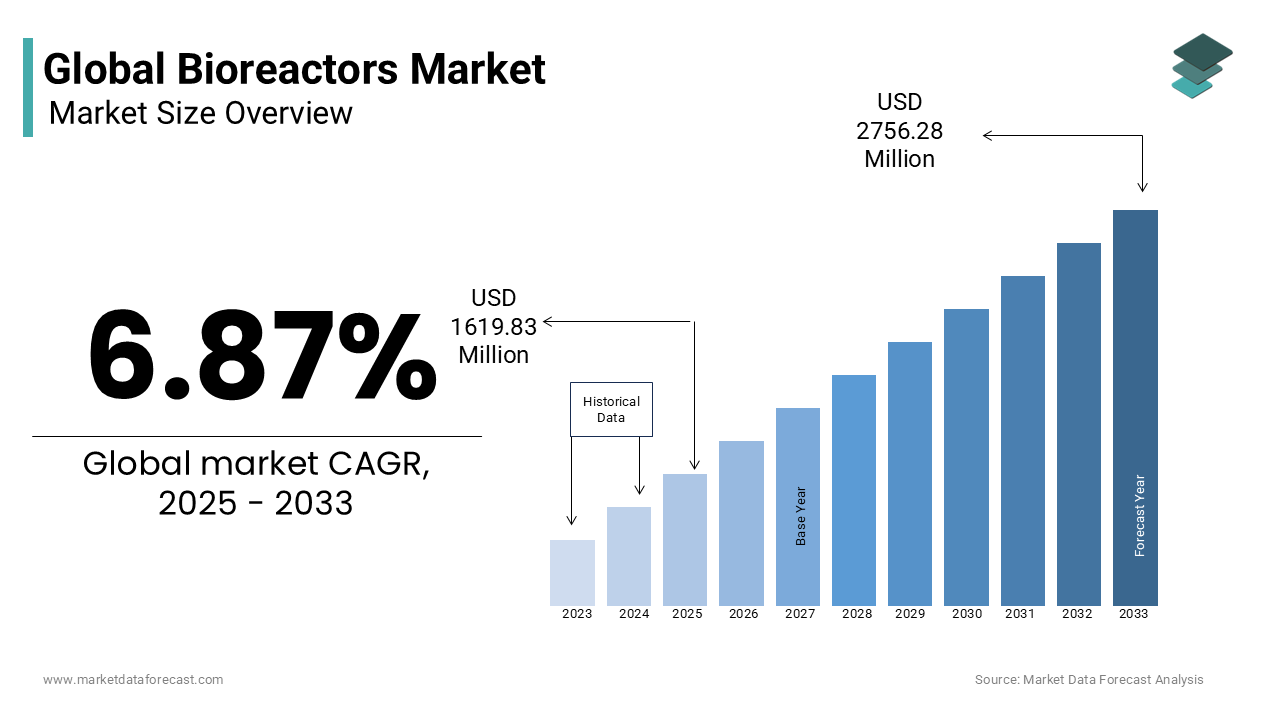
The global bioreactors market size was valued at USD 1515.73 million in 2024. The size of the bioreactors market is expected to be worth USD 2756.28 million by 2033, from USD 1619.83 million in 2025. This market is estimated to be growing at a CAGR of 6.87% during the forecast period.
Bioreactors are used to manufacture biochemically active substances through a chemical process in a vessel. The device's design is an engineering task involving monitoring the optimum conditions that enable the performance level. Bioreactors help to grow cells or tissues, and also these are also specially designed with the help of biochemical engineering. This technique follows three stages to form the finished product from the raw materials. Selecting raw materials for the appropriate application is also an important task. These devices also keep the cell's inhomogeneous state to obtain the desired output.
MARKET DRIVERS
The growing adoption of single-use technologies and hybrid technologies is expected to drive the global bioreactors market growth.
Bioreactors are in high demand due to single-use and stainless steel, increasing popularity among biopharmaceutical businesses as single-use bioreactors and biologics. The expansion of bioreactors in the pharmaceutical industry is a significant driver driving the market growth. In addition, high operational costs and a lack of traditional servicing and control are further reasons driving global market expansion. Innovative approaches and analytical tools should improve process resilience, speed up scale-up to industrial production, and increase resource efficiency. In addition, ineffective waste management due to the extensive usage of hybrid bioreactor engineering will also allow the bioreactor market to grow.
The growing adoption of single-use bioreactors (SUBs) and hybrid bioreactors and the increasing usage of bioreactors in pharmaceuticals further fuel the bioreactors market growth. Biopharmaceuticals are used in various ways, from biopharmaceutical synthesis to tissue engineering applications like cell growth and 3D tissue construct generation. Therefore, bioreactors are used to provide a controlled environment for any cells or cellular constructs introduced into them in terms of pH, temperature, food delivery, and shear stress. In addition, bioreactors have been used to develop in vitro models of 2D cultures and suspensions to 3D structures, simulating the natural physiological state in situ. As a result, they effectively treat autoimmune illnesses, cancer, asthma, and organ rejection. As a result, the pharmaceutical industry's expansion of bioreactors is a primary driver of market growth.
Furthermore, advances in bioreactor technology have enhanced the flexibility, quality, and scalability of operations with minimal capital and energy costs. The novel approaches and analytical tools are expected to improve process resilience, speed up scale-up to industrial production, and promote resource efficiency. In addition, the widespread application of hybrid bioreactor technology in effective waste management has aided the market's growth.
MARKET RESTRAINTS
Regulatory concerns relating to single-use bioreactors and leachable and extractable issues relating to single-use bags impede the growth of this industry. Besides, the processing of plastic derivatives on a large scale is an environmental concern that restricts the global bioreactors market growth.
REPORT COVERAGE
| REPORT METRIC | DETAILS |
| Market Size Available | 2024 to 2033 |
| Base Year | 2024 |
| Forecast Period | 2025 to 2033 |
| Segments Covered | By Material, Production, Supplies, Scale, Control Type, End-User, and Region |
| Various Analyses Covered | Global, Regional & Country Level Analysis, Segment-Level Analysis, Drivers, Restraints. Opportunities, Challenges, PESTLE Analysis, Porter’s Five Forces Analysis, Competitive Landscape, Analyst Overview on Investment Opportunities |
| Regions Covered | North America, Europe, Asia Pacific, Latin America, Middle East, and Africa |
| Market Leaders Profiled | Sartorius AG, Thermo Fisher Scientific, Merck KGaA, GE Healthcare, Danaher Corporation, and Eppendorf AG. |
SEGMENTAL ANALYSIS
By Material Insights
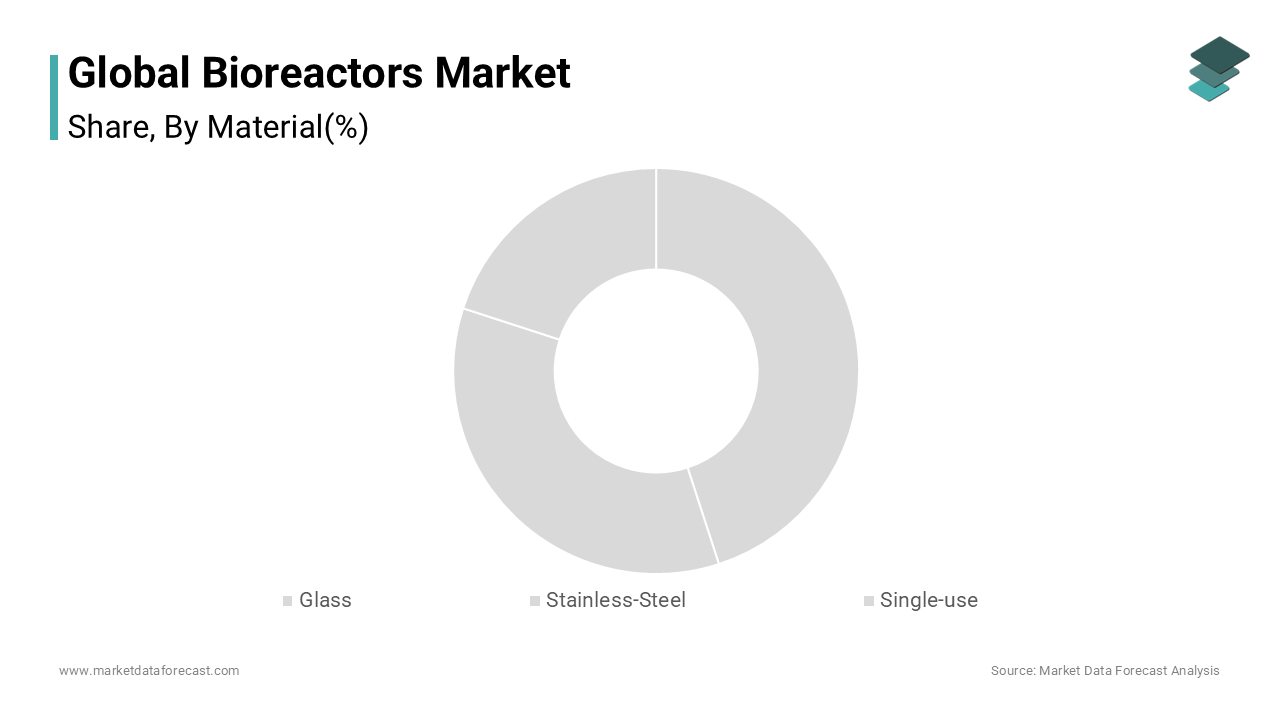
Based on the material, The single-use bioreactors segment is anticipated to show the highest growth by volume. Rapid growth in this segment is attributed to the benefits of SUBs, such as the decreased need for cleaning and sterilization, reduced risk of cross-contamination, and increased control of aseptic conditions. In addition, SUBs increase end-product quality by reducing the complexity of automation.
By Scale Insights
Based on the scale, the 20L-200L scale type dominates the market with the highest share. The rise in capital income in both developed and developing countries greatly influences the market's demand.
By Control Type Insights
Based on control Type, the automatic control form segment has accounted for the largest market share for bioreactors in terms of volume. However, the preference for mass flow controllers (MFCs) is increasing in the current scenario, resulting in the use of an automated type of control. It is because they are adding additional security protection and increasing bioreactors' operating costs. In addition, it doesn't take skilled labor to operate bioreactors on MFCs. As a result, an increasing number of firms opt for MFCs.
By End-users Insights
Due to the increased use of bioreactors in process development, the R&D segment is expected to report the highest growth rate during the forecast period. On the other hand, it is anticipated that contract manufacturing organizations (CMOs) will gain traction in the coming years due to increased outsourcing needs for biologics manufacturers due to increased demand for biologics.
By Suppliers Insights
Since OEMs not only supply the machines, the piping and installation, instrumentation, programming, and control are also set up. As a result, OEMs are expected to account for a more significant market share than EPCs.
REGIONAL ANALYSIS
Geographically, the North American bioreactors market occupies the largest share of the global bioreactors market, and this dominance is projected to last for a few more years. Because of increased cooperation between industry and academic institutions, this area is likely to grow its market share. Because pharmaceuticals and high-tech product manufacturers have announced multimillion-dollar expenditures to enhance production capacities, the United States owns the majority of the market in the North American region.
Furthermore, the United States and Canada, two of the region's major countries, invest heavily in research and development. For example, the United States spent roughly USD 7,767 million on biotechnology research in 2020, according to the National Centre for Health Statistics (NCHS) of the Centres for Disease Control and Prevention (CDC). They also predicted that by 2022, this figure would have risen to USD 7,912 million. The large sums spent are projected to drive market growth since they increase demand for new pharmaceuticals and pharmaceutical ingredients produced in bioreactors.
Domestic enterprises are using a variety of measures to increase their market position, including R&D, mergers and acquisitions, and product launches. In September 2019, for example, ABEC Inc., a biopharmaceutical business, announced the debut of a single-use bioreactor system with a working volume of 6,000 L. According to the business, this amount was more than three times the industry's normal top limit at the time. In addition, Thermo Fisher Scientific launched the HyPerforma DynaDrive 3,000 L and HyPerforma DynaDrive 5,000 L single-use bioreactors in March 2021 in response to increased demand for large-scale single-use systems. These product introductions are projected to boost market growth over the forecasted period.
Furthermore, the market is likely to benefit from increased demand for biopharmaceutical goods in the region and a focus on expanding localized production over the forecast period.
During the projected period, the European bioreactors market was the second largest region, accounting for the highest part of the global market. Government policies, research and & development initiatives, and private financing are projected to offer new opportunities for the bioreactors market in this area. Bioreactors have been created in Europe by biotechnology and pharmaceutical companies. The pharmaceutical industry in Europe is seeing an increase in demand for single-use bioreactors to synthesize new medicinal drugs.
Because of the use of new technology to develop innovative goods, the United Kingdom Bioreactors Market holds the most significant proportion of the market. In addition, companies that make bioreactors in Spain have a robust and well-connected network with other industries. Therefore, they provide customers with well-integrated modern bioreactors according to their needs. One aspect that contributes to the market's growth is consistent economic growth. Following in the footsteps of the UK, the German Bioreactors market is driving toward market dominance. The bioreactor market is being evaluated due to the increased prevalence of chronic diseases and the rising demand for high-quality treatment. In addition, increased investment in pharmaceutical businesses is growing the demand for this industry.
KEY MARKET PLAYERS
Notable market participants leading the global bioreactors market profiled in this report are
- Sartorius AG
- Thermo Fisher Scientific
- Merck KGaA
- GE Healthcare
- Danaher Corporation
- Eppendorf AG
- Amec Foster Wheeler plc
- Fluor Corporation
- Jacobs Engineering Group Inc.
- M+W Group
- PM Group
- Technip S.A.
RECENT MARKET DEVELOPMENTS
-
Sartorius purchased the U.S.-based “kSep systems” in early 2016, a company involved in developing automated centrifugation systems used to manufacture cell-based therapies, vaccines, and monoclonal antibodies. This purchase extended the scope of Sartorius ' technologies for bioprocessing.
MARKET SEGMENTATION
This research report on the global bioreactors market has been segmented and sub-segmented based on the material, production, supplies, scale, control type, end-user, and region.
By Material
- Glass
- Stainless-Steel
- Single-use
By Scale
- 5L-20L
- 20L-200L
- 200L-1500L
- Over 1500L
By Production
- Lab-Scale Production
- Pilot-Scale Production
- Full-Scale Production
By Control Type
- Manual
- Automated (MFCs)
By End-users
- R&D Departments
- R&D Institutes
- CRO’s
- Biopharmaceutical Companies
- Biopharmaceutical Manufacturers
- CMO’s
By Region
- North America
- Europe
- Asia Pacific
- Latin America
- Middle East and Africa