Global Blockchain in Healthcare Market Size, Share, Trends & Growth Forecast Report By Application, End User and Region (North America, Europe, Asia-Pacific, Latin America, Middle East and Africa), Industry Analysis From 2026 to 2034.
Market Size, 2025
$13 BnMarket Estimate, 2026
$17.38 BnMarket Forecast, 2034
$177.23 BnCAGR, 2026–2034
33.68%Global Blockchain in Healthcare Market Size
The size of the global blockchain in healthcare market was worth USD 13 billion in 2025. The global market is anticipated to grow at a CAGR of 33.68% from 2026 to 2034 and be worth USD 177.23 billion by 2034, up from USD 17.38 billion in 2026.
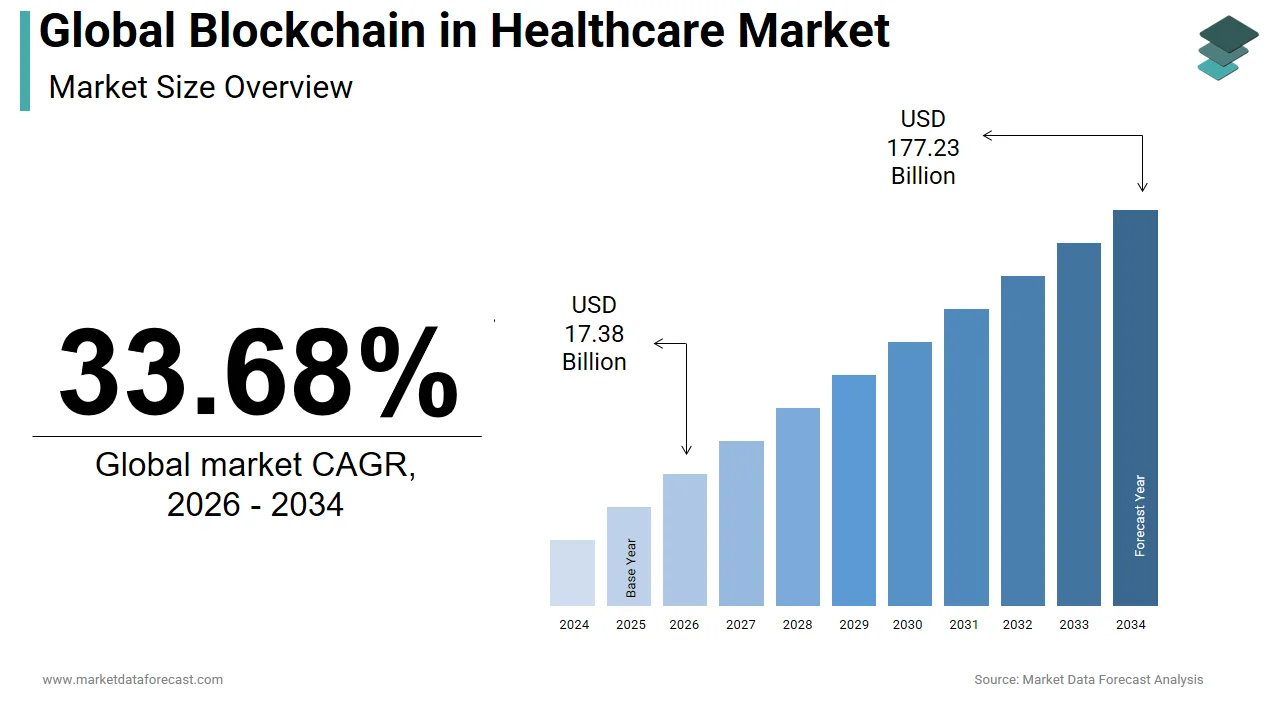
MARKET DRIVERS
The growing need for data security in the healthcare industry and rising awareness among governmental organizations and healthcare facilities regarding the importance of data security majorly drive the blockchain in healthcare market. The volume of patient data has been growing significantly worldwide and this data is shared across various healthcare systems for treatment and analysis purposes. Ensuring the security and privacy of the data of patients has become one of the top priorities for healthcare organizations. Traditional healthcare databases are more likely to experience cyber-attacks and data breaches and can expose the sensitive data of the patients. To avoid such risks, healthcare organizations have used blockchain technology to protect patient data. The technology of blockchain offers a highly secure and decentralized way to manage and share data and uses cryptographic algorithms to encrypt and protect data at every step.
The interoperability capabilities of blockchain technology are another key attribute boosting the market growth. Interoperability is one of the major challenges to the healthcare industry as different providers and systems use different formats to share patient data across healthcare providers. Blockchain technology can ease this problem in the healthcare industry by providing a decentralized and secure platform for healthcare data exchange. Blockchain technology uses a common and standardized data format and a shared ledger that is accessible to all authorized users and enables seamless data exchange between different healthcare systems and devices, which aids in improved efficiency and accuracy of patient care.
Cost savings associated with blockchain technology is further accelerating the usage of blockchain in healthcare industry and contributing to market growth. Healthcare organizations can save costs can be significantly saved by reducing administrative costs and eliminating the need for intermediaries, such as insurance companies using blockchain. Blockchain technology also assists in delivering improved patient outcomes by facilitating the collection and sharing of patient data, which further leads to more accurate diagnoses and personalized treatment plans. Regulatory compliance that blockchain technology provides healthcare organizations to achieve regulatory requirements such as HIPPA is driving the adoption of blockchain technology in the healthcare industry and propelling market growth. The benefits that blockchain technology offers such as greater transparency to the health data of the patients, improved efficiency and transparency of clinical trials and tracking the medical supplies and equipment to ensure that they are authentic and not counterfeit further resulted in the increased adoption of this technology in the healthcare industry and this trend is anticipated to continue in the coming years and boost the market growth.
MARKET RESTRAINTS
No industry-wide standard for blockchain implementation in healthcare is one of the key factors hampering market growth. The regulatory uncertainty for blockchain in healthcare further hinders market growth. Poor awareness and understanding of blockchain applications in the healthcare industry among healthcare organizations and healthcare professionals and the high initial investment required to implement a blockchain solution in healthcare impede market growth. The scarcity of skilled professional that have the required technical expertise to handle the operations of blockchain technology in some countries, resistance to adopting new technologies and approaches by healthcare organizations and issues of scalability inhibits the market’s growth rate.
SEGMENTAL ANALYSIS
By Application Insights
Based on the application, the supply chain management segment accounted for the leading share of the worldwide market in 2024 and is expected to grow at a healthy CAGR during the forecast period. Factors such as increasing focus on transparency and traceability in the pharmaceutical and medical device supply chains, a growing number of cases of counterfeit drugs and medical devices and the rising need for secure and efficient management of supply chain data primarily drive the segmental growth.

The clinical data exchange and interoperability segment had the second-largest share of the global market in 2024 and is expected to grow at a promising CAGR during the forecast period. The growing need for secure and efficient sharing of patient health data across different healthcare providers and systems majorly drives segmental growth. The growing focus on patient-centric healthcare and value-based care models and the increasing need for interoperability between different healthcare IT systems further boost the growth rate of the segment.
The claims adjudication and billing segment is expected to grow steadily during the forecast period. Factors such as the rising need for reducing administrative costs and improving the efficiency of claims processing, the rising adoption of value-based care models and alternative payment models and the growing prevalence of healthcare fraud and billing errors drive the segmental growth.
By End User Insights
Based on the end-user, the pharmaceutical companies segment accounted for the major share of the worldwide market in 2024 and is estimated to grow at a promising CAGR during the forecast period. The rising for improved supply chain management and data security in drug development and distribution, the growing prevalence of counterfeit drugs and supply chain fraud and the increasing adoption of blockchain-based solutions by pharmaceutical companies majorly propel the segmental growth.
The healthcare payer segment is expected to register the fastest CAGR during the forecast period. Factors such as the growing for reducing administrative costs and improving the efficiency of claims processing and payment management, increasing adoption of value-based care models and alternative payment models and rising prevalence of healthcare fraud and billing errors boost the growth rate of the segment.
The healthcare providers segment captured a considerable share of the worldwide market in 2024 and is anticipated to grow at a healthy CAGR during the forecast period. The rising adoption of blockchain technology by hospitals, clinics, and other healthcare providers for secure and efficient data management and sharing drives segmental growth.
REGIONAL ANALYSIS
Europe Blockchain in Healthcare Market Analysis
Geographically, Europe held the largest share of the global market in 2024. The European market is anticipated to grow at a promising CAGR during the forecast period due to the presence of well-established healthcare infrastructure in Europe, rising emphasis on interoperability and data sharing among different healthcare providers and systems and growing adoption of blockchain technology by pharmaceutical companies and supply chain management companies. In addition, favorable government initiatives and funding for healthcare IT and blockchain-based solutions, the rising prevalence of healthcare data breaches and cyber-attacks and increasing demand for improved healthcare data security and privacy drive the European market growth. The United Kingdom, Germany, France, and Switzerland are predicted to account for the major share of the European market during the forecast period.

North America Blockchain in Healthcare Market Analysis
The North American market had the second biggest share of the global market in 2024. The domination of the North American market is estimated to continue during the forecast period owing to factors such as the rising adoption of healthcare IT systems and EHRs, the presence of several healthcare IT companies and start-ups and rising demand for secure and efficient healthcare data management and sharing. The rising focus on patient-centric healthcare and value-based care models, favorable government initiatives and funding for healthcare IT and blockchain-based solutions and growing awareness and acceptance of blockchain technology in the healthcare industry further boost the propel the regional market growth. The U.S. captured the largest share of the North American market in 2024, followed by Canada and this pattern is expected to continue throughout the forecast period.
Asia Pacific Blockchain in Healthcare Market Analysis
Asia Pacific captured a substantial share of the global market in 2024. The growth of the Asia Pacific market is primarily driven by the increasing adoption of healthcare IT systems and EHRs across the Asia-Pacific region, growing demand for secure and efficient healthcare data management and sharing and rising emphasis on international market participants to capture the potential of the Asia Pacific market. The increasing number of initiatives from the governments of China, Japan and South Korea to promote the adoption of blockchain technology in healthcare industry is one of the key factors propelling the regional market growth. The growing demand for secure and transparent data exchange platforms and rising emphasis on patient-centric healthcare contribute to segmental growth. Rapid shift towards digitalization of healthcare, increasing demand for efficient and secure healthcare solutions, growing population of chronic diseases and increasing investments by private organizations for the development of healthcare technologies drive the regional market growth. China, India, Japan and Australia are expected to occupy the largest share of the Asia Pacific market during the forecast period.
Latin America Blockchain in Healthcare Market Analysis
Latin America occupied a considerable share of the global market in 2024. The Latin American market is estimated to witness a healthy CAGR during the forecast period. The rapid adoption of digital technologies including blockchain in the healthcare sector of Latin America, the increasing need for improving healthcare outcomes and reducing healthcare costs, rising concern for data privacy and security in the healthcare sector, an increasing number of initiatives by the Latin American governments to improve healthcare infrastructure and promote the adoption of advanced technologies such as blockchain in the healthcare sector drive the Latin American market growth. Brazil, Mexico and Argentina are estimated to control the major share of the Latin American market during the forecast period.
Middle East and Africa Blockchain in Healthcare Market Analysis
The Middle East and Africa had a moderate share of the global market in 2024 and is expected to grow at a sluggish CAGR during the forecast period. Saudi Arabia, the United Arab Emirates, and South Africa are predicted to occupy the major share of the Middle East and Africa market during the forecast period.
KEY MARKET PLAYERS
The leading companies operating in the global blockchain in healthcare market include:
- Guardtime
- PokitDok
- IBM
- Microsoft
- Gem
- Chronicled
- iSolve
- Hashed Health
- Patientory
- Proof.Work
- SimplyVital Health
- FarmaTrust
- Blockpharma
- Medicalchain
- Factom
MARKET SEGMENTATION
This global blockchain in healthcare market research report is segmented and sub-segmented into the following categories.
By Application
- Supply Chain Management
- Clinical Data Exchange & Interoperability
- Claims Adjudication and Billing
By End User
- Pharmaceutical Companies
- Healthcare Payers
- Providers
By Region
- North America
- Europe
- Asia-Pacific
- Middle East Africa
- Latin America
Frequently Asked Questions
1. What is the global blockchain in healthcare market?
The global blockchain in healthcare market focuses on secure, decentralized data exchange for medical records, billing transactions, supply chains and regulated health information flow.
2. What was the value of the global blockchain in healthcare market in 2025?
The global blockchain in healthcare market was valued at USD 85 million in 2025 due to emerging adoption of secure and digital record management platforms.
3. What is the projected value of the global blockchain in healthcare market by 2034?
The global blockchain in healthcare market is expected to reach USD 548 million by 2034 due to mandatory digital transformation efforts.
4. What growth rate is projected for the global blockchain in healthcare market?
The global blockchain in healthcare market is estimated to grow at a 23% CAGR from 2025-2033, supported by interoperability innovations and regulatory alignment.
5. Which applications drive the global blockchain in healthcare market?
Electronic record protection, claims verification, medical supply chain traceability and care coordination drive the global blockchain in healthcare market.
6. Who benefits most from the global blockchain in healthcare market?
Hospitals, pharmacies, insurance networks, medical device firms and lab networks benefit from the global blockchain in healthcare market due to secure data workflows.
7. What challenge does the global blockchain in healthcare market solve?
The global blockchain in healthcare market helps reduce data tampering, fraud, duplication, identity misuse and record-access delays in digital healthcare channels.
8. How does data security influence the global blockchain in healthcare market?
Data protection is central to adoption, enabling encrypted access, transaction logs and tamper-proof audit trails across the global blockchain in healthcare market.
9. Which regions lead the global blockchain in healthcare market?
North America leads the global blockchain in healthcare market, while Europe scales adoption under compliance frameworks and Asia-Pacific experiences emerging deployments.
10. What challenges affect the global blockchain in healthcare market?
Integration cost, data privacy regulations, technology migration barriers and skill gaps affect adoption in the global blockchain in healthcare market.
Related Reports
Access the study in MULTIPLE FORMATS
Purchase options starting from
$ 2500
Didn’t find what you’re looking for?
TALK TO OUR ANALYST TEAM
Need something within your budget?
NO WORRIES! WE GOT YOU COVERED!
Call us on: +1 888 702 9696 (U.S Toll Free)
Write to us: sales@marketdataforecast.com